Home Blog Page 186

Pi Network’s v25 rally unravels – Are 776mln token unlocks to blame?

0
Pi Network’s v25 rally unravels – Are 776mln token unlocks to blame?


Pi Network’s native cryptocurrency, Pi [PI], fell more than 10% over the past 24 hours. The decline came days after PI gained 11% following the v25 protocol upgrade.

Trading Volume rose about 35%, showing increased activity as PI declined.

By contrast, Bitcoin’s [BTC] Trading Volume fell, suggesting traders were less active across the broader market. This divergence indicated that PI faced stronger coin-specific selling pressure.

On top of a bearish market structure, profit-taking and upcoming token unlocks contributed to PI’s sell-off.

Can PI avoid its all-time low?

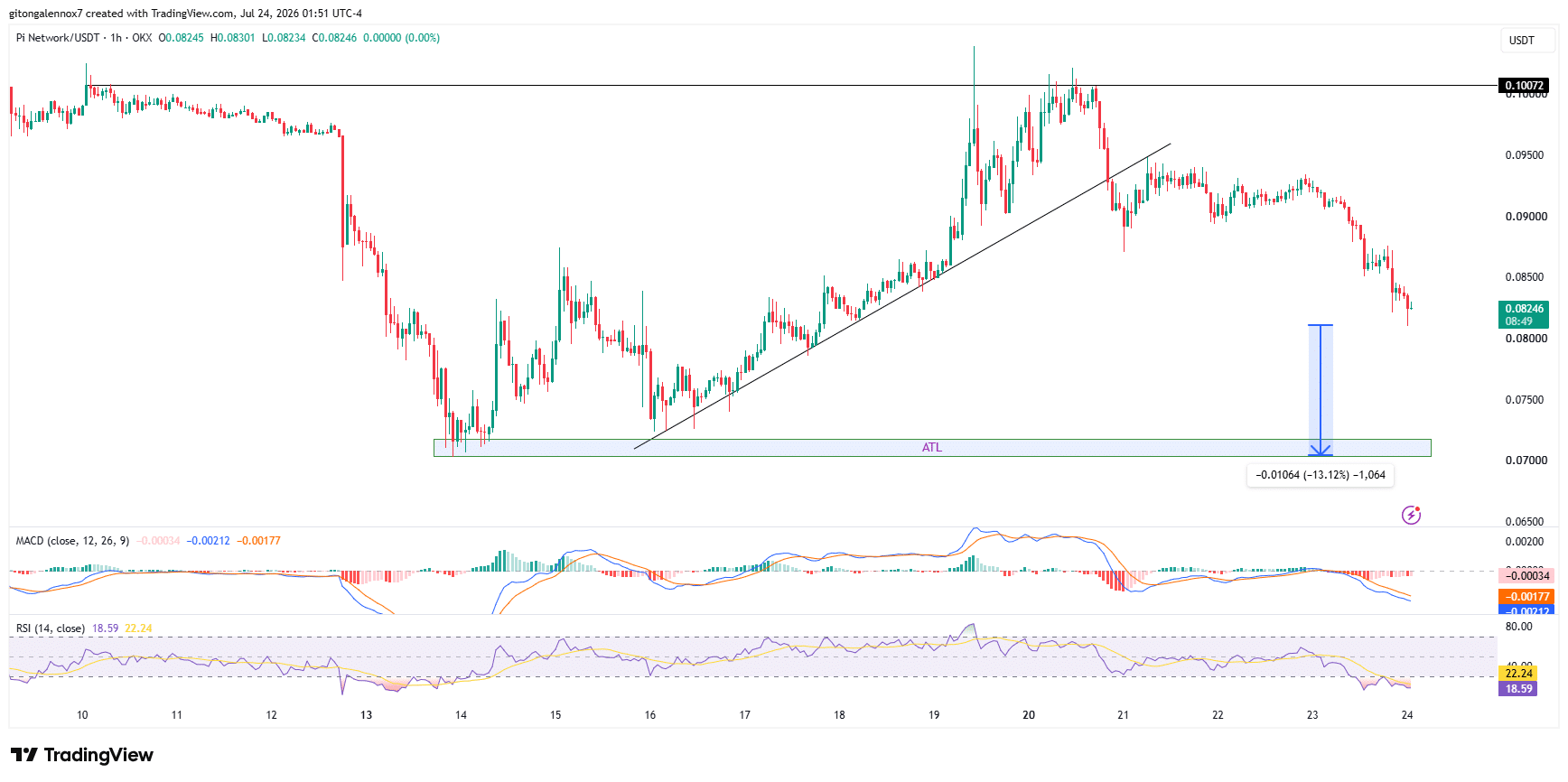
PI’s daily market structure remained bearish, while its hourly structure also turned negative. This reversal came days after PI gained short-term momentum following the v25 protocol upgrade.

Bears regained control after PI broke below the ascending trendline formed from its all-time low.

PI reached its all-time low of $0.07036 before recovering towards $0.10072. However, the latest breakdown left the token around 13% above that record low.

The Moving Average Convergence Divergence [MACD] showed strengthening bearish momentum.
PI
Source: PI/USDT on TradingView

Meanwhile, the Relative Strength Index [RSI] fell to 18, placing PI deep inside oversold territory. A break below $0.0800 could expose the $0.07036 all-time low [ATL].

However, the oversold RSI may signal seller exhaustion and create room for a short-term reversal.

Buyers could also return around demand levels above the record low, especially after another positive catalyst. Even so, PI would need to reclaim its broken trendline before suggesting that bulls had regained control.

Why the selloff may be just the beginning

There is selling pressure from bulls taking profits from the surge that resulted from the frenzy of the v25 protocol upgrade. In total, PI made a move of over 43%, up from an ATL of $0.07036 to $0.10072.

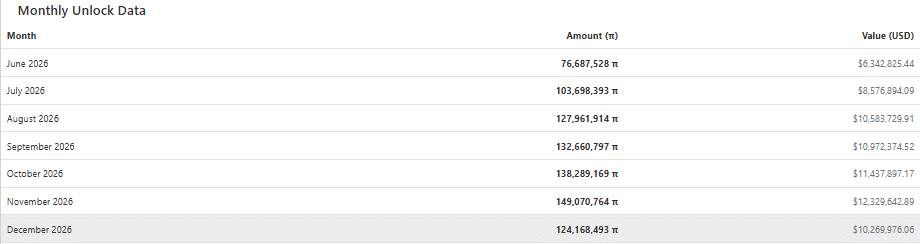
Additionally, the selling pressure is coming from the heavy unlocks that span up to December 2026. Pi Network is set to unlock 775.8 million PI tokens in the months leading up to the end of the year. This will definitely continue increasing liquid supply in the market.
Pi NetworkPIPi NetworkPI
Source: PiScan

On the other hand, additional supply could improve market liquidity and support greater trading activity.

Better liquidity may reduce sharp price swings, but it cannot absorb persistent selling by itself.

Therefore, the PI’s outlook depends on whether new demand can match profit-taking and unlock-related supply.

Without stronger demand, the latest decline could develop into a deeper retest of $0.07036.


Final Summary

  • Pi Network fell more than 10% in the past 24 hours after breaking below a key market structure. 
  • PI price appears to be headed for further decline amid profit-taking and heavy unlocks, but meeting the liquidity deficit could cushion the sell-off. 



Source link

Strategy overhauls bitcoin metrics to account for senior claims

0
Strategy (MSTR) news: Michael Saylor gets into public back-and-forth with critics

The first metric is the new “Net Reserve”, which currently sits at $36.6 billion. That figure takes Strategy’s $55.6 billion BTC reserve (843,775 BTC), adds $3.2 billion in USD reserves, then subtracts $6.8 billion in out-of-the-money convertible debt and $15.5 billion in notional preferred, the $22.3 billion in senior claims that rank ahead of common shareholders in any liquidation scenario.

The company has also updated its multiple to net asset value (mNAV) formula. Under the old accounting method, the accretion threshold would usually keep the company’s mNAV above 1.0x, making it increasingly difficult to know whether new share issuance was actually beneficial for existing holders. The new formula anchors that threshold permanently at 1.0x — if MSTR trades above it, issuing new shares adds BTC per share for all investors.

According to the company, the formula is: MSTR Price, divided by Net Bitcoin Per Share, representing whether MSTR trades above or below Net Bitcoin Per Share after debt and preferred claims.

The BTC Floor ARR is the minimum sustained BTC growth rate over the credit structure’s duration before restructuring becomes a consideration for the company. Currently, the BTC Breakeven ARR sits at 3.22%, meaning bitcoin only needs to appreciate faster than that rate annually for Strategy to fund all interest and dividend obligations through BTC gains alone, in perpetuity.

Strategy has also introduced new bitcoin market metrics, such as the premium to the 200-week moving average and the Fear and Greed Index.


Source link

How Trump Accounts could impact your child’s student aid

0
How Trump Accounts could impact your child's student aid


Touted as an “IRA for children,” Trump Accounts promise to give your child a “head start on the American Dream.” 

These tax-advantaged investment accounts come with a one-time $1,000 contribution from the federal government. When your child turns 18, the money can be used for their education, a home purchase, or other qualified expenses.

However, questions remain about how these accounts factor into financial aid formulas. Here’s what we know. 

Trump Accounts, created under President Trump’s One Big Beautiful Bill Act, are tax-deferred investment accounts for Americans under age 18. 

The goal: Bolster the next generation by giving children a head start on their wealth-building journey, so that they later can afford to buy a home, retire early, fund their education, and more.  “Trump Accounts are now live, giving every child a stake in the American Dream from day one, thanks to President Trump,” said U.S. Treasury Secretary Scott Bessent in a statement. 

As the child grows, additional contributions of up to $5,000, including $2,500 from employers, can be made by parents, family members, employers, and other organizations along the way. Those born between Jan. 1, 2025, and Dec. 31, 2028, get the added incentive of a one-time contribution of $1,000 from the government. 

These accounts are technically owned by the child but managed by a parent or custodian until that child turns 18 — right around the time most people head to college. Withdrawals are generally subject to ordinary income tax.

According to the White House Council of Economic Advisers, account balances can reach a minimum of $5,800 with no additional contributions or a maximum of $303,800 by age 18 if maximum contributions are made, assuming average returns on the US stock market. 

For many parents, this may seem like a no-brainer; however, the Department of Education hasn’t released any official information as to how Trump Accounts will factor into need-based aid.  

Read more: The overlooked group Melania Trump helped add to Trump Accounts

The Free Application for Federal Student Aid (FAFSA) assesses your eligibility for student aid, including federal grants, student loans, and work-study programs. To determine your eligibility, it considers the cost of attendance (COA) for a particular school and the Student Aid Index (SAI). 

The Student Aid Index considers a family’s financial resources, including parent and student assets, income, and living expenses, to determine how much they can contribute toward college costs. 

Experts argue that Trump Accounts could create a hurdle for students in the future by potentially reducing the amount of aid they qualify for if these accounts are treated as student assets, which are assessed at a higher rate than parent assets. 

“Financial aid measures two things — income and assets. My understanding is that the Trump Account will be an asset of the student, which can reduce aid by as much as 20 cents on every dollar in the account,” said Jack Wang, wealth advisor at Innovative Advisory Group and host of the “Smart College Buyer” podcast.

Wang notes that withdrawals could have additional implications on financial aid eligibility. “Once money is withdrawn from the account, that can count as income to the student, which can reduce aid by as much as 50 cents on the dollar.”

This differs from parent-owned 529 plans, which are treated as parent assets and assessed at a more favorable maximum rate of 5.64%.

The $1,000 injection into Trump Accounts for those who qualify is a big bonus, and can certainly make a difference for many families — but there are other account options available that could prove to be more beneficial long-term if your goal is to fund higher education.

For example, 529 plans may not offer the $1,000 seed money, but they offer tax-free withdrawals for qualified education expenses and higher annual contribution limits.  

When choosing a savings vehicle for higher education, it’s important to consider how the account you choose will grow with your child, contribution caps, tax implications, and financial aid implications to determine if it’s the right fit for your financial plan.  

“The general advice is that if a family has a newborn and can get the $1,000 starter deposit, that is worth doing,” said Wang. “Whether the family should continue to save in that account is a different question entirely. If a family anticipates need-based federal aid, and they aren’t going to get the initial deposit bonus, then there may be better options than a Trump Account.” 

Read more: Trump accounts vs. IRAs and 529s: How do they stack up?


Source link

The 4-Part Framework Every Leader Needs Before Delivering Bad News

0
The 4-Part Framework Every Leader Needs Before Delivering Bad News


Opinions expressed by Entrepreneur contributors are their own.

Key Takeaways

  • Bad news doesn’t erode trust — surprise and confusion do; teams stay engaged when leaders explain the decision and the reasoning behind it, not just the outcome.
  • Every hard conversation should hit four beats: state the facts directly, explain the business context, acknowledge the human impact and lay out a clear path forward.

In 2008, the financial world was coming apart at the seams. I was at Morgan Stanley, and no one knew what was coming next. But when leadership came in to talk to us, they did it in a way that let us exhale. They didn’t paint a rosy picture. They were direct, and they brought us into the process of solving the problem. At a time when giants like Lehman Brothers and Bear Stearns were crumbling, they gave us a lifeline of confidence. They reinforced the idea that we were partners in finding a way forward, and they rallied the team at a moment when morale was at rock bottom.

Every leader will eventually have to deliver disappointing news — a missed target, a restructuring, a canceled initiative, a budget reduction, a layoff. These conversations are hard for everyone involved. Behind every business decision are people whose work, plans and expectations may be affected.

Over the course of my career, I’ve learned that trust isn’t damaged by the news itself. Trust is damaged when people feel surprised, confused or excluded from understanding why decisions were made. Trust gets built one transparent conversation at a time.

When leaders communicate difficult news with clarity and honesty, people are far more likely to stay engaged — even when they disagree with the outcome. I rely on a simple four-part framework whenever I have to deliver a hard message. It helps people understand what is happening, why it is happening and how we move forward together.

Start with the facts

When people sense bad news is coming, they want clarity. Leaders often spend too much time building up to the message. They provide excessive background, soften the language or avoid the core issue altogether. As a result, people become distracted trying to figure out what is actually being said.

State the decision clearly and early. We are reducing the size of the organization. We will not hit the target we committed to this quarter. We’ve decided to stop this initiative.

Direct communication is a form of respect. It gives people a clear understanding of the situation and lets them focus on the information that follows.

Explain the business context

Once people understand the decision, they need to understand the reasoning behind it. Context matters because it connects the decision to the broader realities the organization is facing. Without it, assumptions and skepticism fill the gaps.

Whenever feasible, share the factors that led to the decision — the business conditions, strategic priorities, market changes or operational realities that shaped the outcome. The goal isn’t to justify the decision or win consensus. It’s to help people understand it. When people understand the circumstances leaders are navigating, they are better able to accept difficult outcomes and maintain confidence in the team steering the ship.

Acknowledge the impact

Business decisions affect people differently. Some will feel disappointed. Others may feel uncertain, frustrated or worried about what comes next. Leaders should acknowledge that reality directly.

If you hired well, these are sharp, capable people — they need information, and they need to know you’re mindful of them. Leaders who cling to platitudes miss the chance to create alignment and squander the trust of their team in the process.

People want to know that leadership understands the consequences of the decision. They want to know that leaders have considered the human side of the equation. Acknowledging impact doesn’t require lengthy emotional discussions. It requires awareness, sincerity and respect.

Provide a path forward

After difficult news is delivered, attention quickly shifts to the future. People want to understand what comes next, what priorities remain unchanged and where to focus their efforts.

This is where leaders need to create direction. Be forthcoming about next steps. Clarify expectations. Explain where the organization is headed and how the team will move forward. Even when circumstances are challenging, clarity creates stability. People can navigate uncertainty when they understand the mission and their role within it.

The moment that matters most

It’s easy to be a good leader when the news is good. The moments that actually shape trust are the difficult ones. People remember whether leaders communicated openly. They remember whether they got honest, authentic explanations. They remember whether they were treated with respect.

In my experience, difficult conversations become far more effective when leaders focus on four things: communicating the facts, providing context, acknowledging impact and creating clarity about what comes next.

The news may still be hard. The relationship doesn’t have to be.

Key Takeaways

  • Bad news doesn’t erode trust — surprise and confusion do; teams stay engaged when leaders explain the decision and the reasoning behind it, not just the outcome.
  • Every hard conversation should hit four beats: state the facts directly, explain the business context, acknowledge the human impact and lay out a clear path forward.

In 2008, the financial world was coming apart at the seams. I was at Morgan Stanley, and no one knew what was coming next. But when leadership came in to talk to us, they did it in a way that let us exhale. They didn’t paint a rosy picture. They were direct, and they brought us into the process of solving the problem. At a time when giants like Lehman Brothers and Bear Stearns were crumbling, they gave us a lifeline of confidence. They reinforced the idea that we were partners in finding a way forward, and they rallied the team at a moment when morale was at rock bottom.

Every leader will eventually have to deliver disappointing news — a missed target, a restructuring, a canceled initiative, a budget reduction, a layoff. These conversations are hard for everyone involved. Behind every business decision are people whose work, plans and expectations may be affected.

Over the course of my career, I’ve learned that trust isn’t damaged by the news itself. Trust is damaged when people feel surprised, confused or excluded from understanding why decisions were made. Trust gets built one transparent conversation at a time.


Source link

Bitcoin holds near $65,000 as the Iran conflict sends oil to a two-month high: Crypto Markets Today

0
Bitcoin holds near $65,000 as the Iran conflict sends oil to a two-month high: Crypto Markets Today

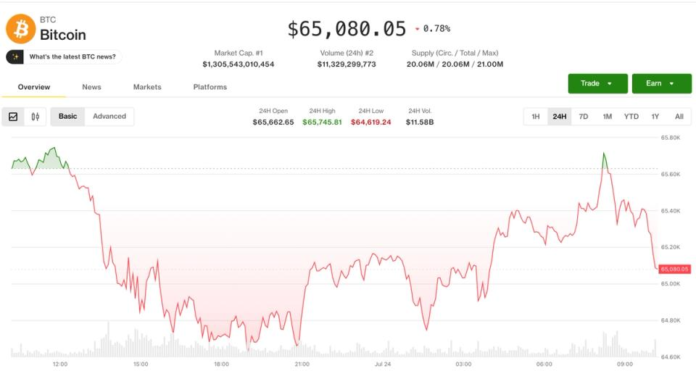
The crypto market is closing out the week on a constructive note, with bitcoin adding as much as 1.1% since midnight UTC to $65,760 as the broader market held its ground despite a macro backdrop that should be applying far more pressure.

Brent crude futures are trading at $97.66 per barrel, the highest since mid-May, as the Iran conflict shows no sign of de-escalating. While previous oil spikes have rattled risk assets including crypto, digital assets are broadly green this morning.

Ether (ETH) mirrored bitcoin’s gain, rising as much as 1.6%, while the likes of HYPE and FET rose more than 2%.

Traditional markets are muted, with S&P 500 and Nasdaq 100 index futures both marginally positive and gold holding above $4,000. The Dollar Index has edged slightly lower.

Derivatives positioning

  • Market churn dominates activity: Volume increased by 11% to $165 billion in 24 hours while open interest (OI) held steady at around $116 billion. This shows a market that’s seen churn rather than positional interest.
  • Bearish buildup in dogecoin: DOGE futures OI continues to rise and is nearing 16 billion tokens, the most since October. The continued gains come as DOGE’s spot price remains under pressure after falling to the lowest since November 2023 on Thursday. The combination of rising open interest alongside a drop in price is said to confirm the downtrend and signal trader interest in shorting the falling market.
  • Mixed signals from ether: OI in ether futures is rising as well, currently at 14.53 million ETH, the highest since June 7. Other indicators paint a mixed picture with positive funding rates still pointing to bullish sentiment while the negative 24-hour CVD indicates that bears are leading the price aciton by shorting at market orders rather than placing limit orders.
  • Broad-based bear leadership: With the exception of TRX and CRO, most tokens, including BTC, have negative 24-hour CVD.
  • Volatility declines: There is good news for the bulls from the BVIV index, which measures BTC’s 30-day implied volatility. The measure has declined by 3% since midnight to 39%, halting a five-day streak of advances. Ether’s EVIV is under pressure too.
  • Options cluster: In the Deribit-listed bitcoin options market, a massive $5 billion open interest cluster has formed at $70,000-$72,000 options, mainly driven by bullish bets, or call options. Volume rankings also show a bias for upside with calls at strikes $77,000 and $80,000 featuring in the list alongside other calls.

Token talk

  • Hyperliquid (HYPE) led the altcoin market for the second consecutive session, rising 2.4% to $58.93 as it rebuilds with a series of higher lows since its July pullback from record highs.
  • AI tokens FET and NEAR posted gains of 2.23% and 1.38%, respectively, offering tentative signs of stabilization after weeks of underperformance, while added 1.89% to extend one of the more consistent runs in the DeFi sector this month.
  • gave back 2.13% of Thursday’s 12% surge, a familiar pattern for the Trump family-linked token, which remains highly susceptible to sharp reversals due to thin liquidity.
  • Lighter (LIT) fell a further 1.32%, extending a slide that has now unwound close to 20% from its July peak as profit-taking continues following its 200%-plus rally between May and early July.
  • The broader 24-hour picture tells a more cautious story, with WLFI, AVAX, HBAR and SUI all down between 4% and 10% over the past day, a reminder that the intraday recovery masks lingering weakness across a portion of the altcoin market.


Source link

Banks oppose stablecoin yield deal – Can CLARITY Act find 60 votes?

0
Banks oppose stablecoin yield deal – Can CLARITY Act find 60 votes?


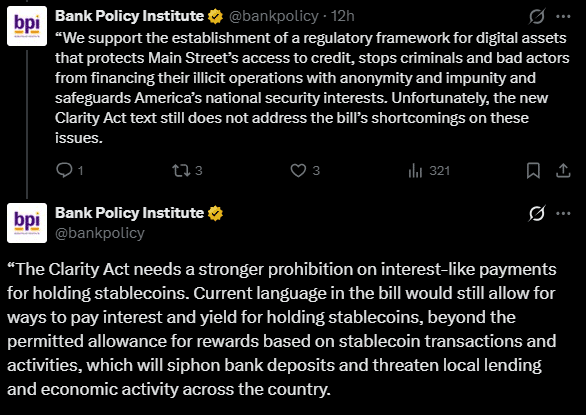
U.S banking trade group, the Bank Policy Institute (BPI), has opposed the newly released CLARITY Act draft, flagging gaps on key issues. 

In a statement on Thursday, the 23rd of July, the BPI said the bill still has “shortcomings” on stablecoin yield and illicit finance provisions that should be “strengthened.”

CLARITY Act
Source: X

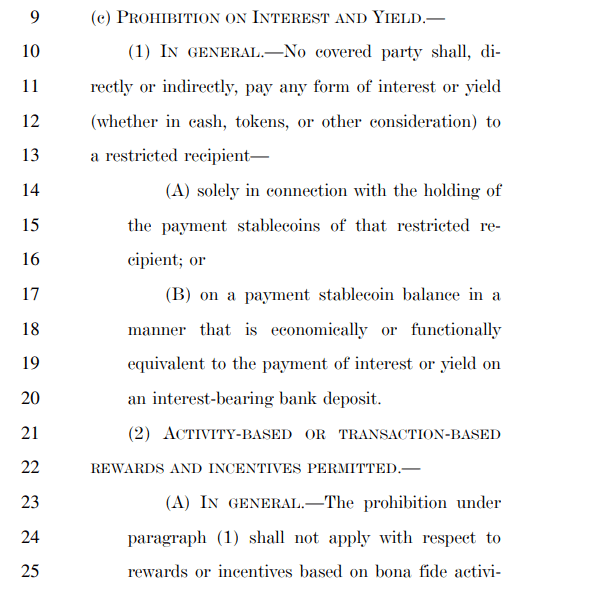
The banking industry has been opposed to the earlier stablecoin yield compromise that only allowed incentives based on account activity, not idle balances. 

This passive yield ban sought to address banks’ capital flight concerns. The compromise is captured in the new draft (Section 404).

CLARITY ActCLARITY Act
Source: U.S Senate


Unfortunately, the banking industry sought a total ban on any form of stablecoin yield or incentive. 

Unsurprisingly, the banking sector has lobbied some lawmakers, including Sen. John Curtis (R-Utah) and Sen. John Cornyn (R-Texas), who now share the banks’ concerns over the crypto bill.

Will the CLARITY Act win the needed 60 votes?

This is bad news for Republicans and the crypto industry. 

Before the death of Sen. Lindsey Graham this month, the Republicans had 53 members. Besides, another member, Kentucky’s Senator Mitch McConnell, has been sick for over a month, bringing their headcount to 51. 

If Sen. Curtis and Cornyn withhold support for the bill, the Republican support will drop to 49.

In other words, they’ll need 11 Senate Democrats to support the bill to hit the 60-vote threshold. Unfortunately, some pro-crypto Democrats like Sen. Angela Alsobrooks and Ruben Gallego have opposed the bill due to inadequate provisions on ethics and illicit finance, among other issues. 

This complicates the 60-vote target if a deal isn’t reached to win over all the key holdouts. On top of this, the timing and Majority Leader’s outlook don’t help the bill’s progress.

Only two weeks remain before the Senate breaks for the August recess. Most analysts had warned that if the bill is not passed by August, it will be as good as dead.

For his part, the U.S. Senate Majority Leader John Thune warned that the bill may fail to pass before the August recess. 

I don’t think we’ll be able to get them done. I would like to get at least Clarity started. We’ll see where the votes are.

In response, White House Chief Crypto Advisor Patrick Witt urged Thune to schedule the vote and stop waiting for Democrats.

You’d be waiting forever (for Democrats). Nobody thought that we could actually produce an ethics provision that had real teeth, and that included the President.

For Witt, the new ethics provision addresses Democrats’ concerns. 

CLARITY ActCLARITY Act
Source: Polymarket

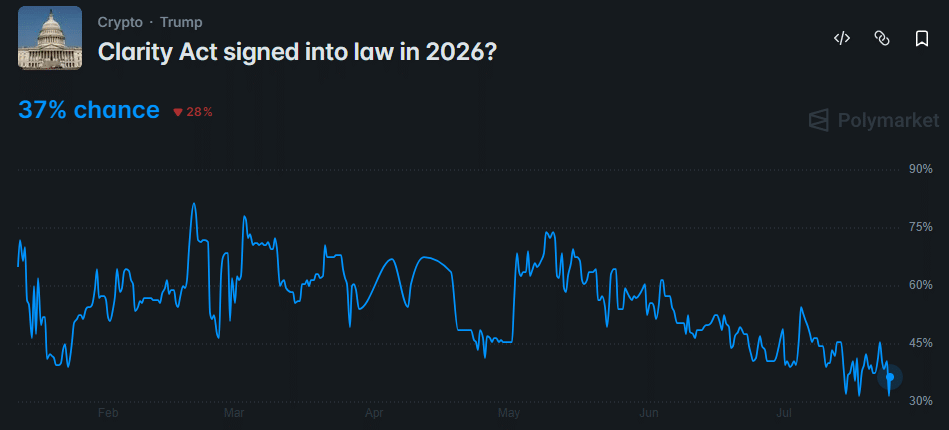
Market expectations for the bill’s passage in 2026 briefly dropped to 32% on Friday. Whether the passage odds will improve in the next two weeks remains uncertain.


Final Summary

  • Tentative Senate backing for the crypto bill has dropped below 50. 
  • Majority Leader John Thune doubted the CLARITY Act’s chance of passage before the August recess


Source link

Mortgage and refinance interest rates today, Friday, July 24, 2026: Dropping below 6.5%

0
Mortgage and refinance interest rates today, Friday, July 3: Rates mostly higher again today


According to the Zillow lender marketplace, the average 30-year fixed rate today, Friday, July 24, 2026, is 6.455%, down 5.9 basis points since yesterday. The 15-year fixed loan is currently at 6.301%, 11.4 basis points higher than yesterday. The 5/1 ARM is 6.223%, 11.3 basis points lower than on Thursday.

Read more: Weekly survey of mortgage lenders with the lowest rates: Rates bubble higher

Here are the current purchase rates, according to the latest Zillow data, for Friday, July 24, 2026:

  • 30-year fixed: 6.455%

  • 20-year fixed: 6.301%

  • 15-year fixed: 5.94%

  • 5/1 ARM: 6.223%

  • 7/1 ARM: 6.213%

  • 30-year VA: 6.046%

  • 15-year VA: 5818.%

  • 5/1 VA: 5.925%

Remember, these are national averages and have been rounded to the nearest hundredth. 

These are the latest refinance rates, according to the latest Zillow data, for Friday, July 24, 2026:

  • 30-year fixed: 6.621%

  • 20-year fixed: 6.51%

  • 15-year fixed: 5.914%

  • 5/1 ARM: 6.491%

  • 7/1 ARM: 6.425%

  • 30-year VA: 5.946%

  • 15-year VA: 5.682%

  • 5/1 VA: 5.688%

Again, the numbers provided are national averages rounded to the nearest hundredth. Mortgage refinance rates are often higher than rates when you buy a house, although that’s not always the case.

Learn more: Dig deeper into the 7 home refinance options

Your mortgage rate plays a large role in how much your monthly payment will be. Use this mortgage calculator to see how your mortgage amount, rate, and term length will impact your monthly payments:

Mortgage payment calculator

Mortgage payment breakdown

81% Principal & interest

$2,149


You can bookmark the Yahoo Finance mortgage payment calculator and keep it handy for future use, as you shop for homes and lenders.

A mortgage interest rate is a fee for borrowing money from your lender, expressed as a percentage. You can choose from two types of rates: fixed or adjustable.

A fixed-rate mortgage locks in your rate for the entire life of your loan. For example, if you obtain a 30-year mortgage with a 6% interest rate, your rate will remain at 6% for the entire 30-year term unless you refinance or sell.

An adjustable-rate mortgage locks in your rate for a predetermined period and then adjusts it periodically. Let’s say you get a 7/1 ARM with an introductory rate of 6%. Your rate would be 6% for the first seven years, then the rate would increase or decrease once per year for the last 23 years of your term. Whether your rate goes up or down depends on several factors, such as the economy and housing market.

At the beginning of your mortgage term, most of your monthly payment goes toward interest. Your monthly payment toward mortgage principal and interest stays the same throughout the years. However, less and less of your payment goes toward interest, and more goes toward the mortgage principal or the amount you originally borrowed.

Read more: Determine whether an adjustable-rate vs. fixed-rate mortgage is better for you

A 30-year fixed-rate mortgage is a good choice if you want a lower mortgage payment and the predictability that comes with having a fixed rate. Just know that your rate will be higher than if you choose a shorter term, and you will pay significantly more in interest over the years.

You may want to consider a 15-year fixed-rate mortgage if you aim to pay off your home loan quickly and save money on interest. These shorter terms come with lower interest rates, and since you’re cutting your repayment time in half, you’ll save a lot in interest in the long run. But you’ll need to be sure you can comfortably afford the higher monthly payments that come with 15-year terms.

Read more: Learn how to decide between a 15-year and 30-year fixed-rate mortgage

Typically, an adjustable-rate mortgage might be suitable if you plan to sell before the introductory rate period ends. Adjustable rates usually start lower than fixed rates, and then your rate will change after a predetermined amount of time. However, 5/1 and 7/1 ARM rates have been similar to (or even higher than) 30-year fixed rates recently. Before getting an ARM just for a lower rate, compare your rate options from term to term and lender to lender.

Some rates are decreasing, but not all. According to the Zillow lender marketplace, the average 30-year fixed-rate mortgage rose by 5.9 basis points to 6.455% today, Friday, July 24, 2026. The average 15-year fixed rate rose by 11.4 basis points to 5.94%. The average 5/1 ARM fell/rose by 11.3 basis points to 6.223%.

According to Freddie Mac, the average 30-year mortgage rate was 6.58% through Wednesday, up from 6.55% a week earlier. A year ago, the average 30-year mortgage rate was 6.72%.

According to the latest forecasts, the MBA expects the 30-year mortgage rate to be between 6.4% and 6.5% through 2026. Fannie Mae predicts a 30-year rate of 6.4% through the end of the year.

Mortgage rates are likely to remain little changed in 2027. The MBA forecasts 30-year fixed rates of 6.5% for all of 2027. However, Fannie Mae is more optimistic, predicting average rates will be between 6.3% and 6.4% throughout 2027. 


Source link