Home Blog Page 190

Trump Hits 60 Countries With New Tariffs: Here’s Why

0
Trump Hits 60 Countries With New Tariffs: Here’s Why


Topline

The Trump administration will impose new tariffs on 60 countries over alleged forced-labor violations, U.S. trade officials announced Thursday, as President Donald Trump’s temporary global tariffs are set to expire.

Key Facts

Levies between 10% and 12.5% will be imposed on 60 U.S. trade partners and will take effect shortly after midnight Friday, the Office of the U.S. Trade Representative announced.

The trade partners face new tariffs for their alleged “failure to impose and effectively enforce” a ban on forced-labor practices in trade with the U.S., the office said.

This is a developing story.


Source link

Clarity Act expected to miss its window before Congress’ summer break, leadership says

0
Clarity Act expected to miss its window before Congress' summer break, leadership says

White House crypto adviser Patrick Witt responded to Thune’s remarks in an interview with CoinDesk on Thursday, arguing that the first week in August should still be open for potential Senate action. Witt said he was “perplexed” by Thune’s sentiment and that he’s “slightly more optimistic,” though he agreed that the bill is unlikely to get a final vote in July.

“There’s that first week of August that the Senate is in session,” Witt said in the interview with CoinDesk TV. “So I wouldn’t count it out.”

The midterm congressional elections are in November, and lawmakers are expected to use their summer break to campaign. The House of Representatives and Senate return for about three weeks in September, and if the Senate manages to pass Clarity, the House will still have to follow suit.

Clarity — even more than last year’s Guiding and Establishing National Innovation for U.S. Stablecoins (GENIUS) Act — is the crypto industry first priority in crypto policy, with the hope it finally secures a permanent legal foundation for U.S. crypto activity.

The Senate’s floor process is a multi-stage affair that can take a few days or even longer to advance legislation past the 60-vote threshold needed in that chamber. At this stage, the crypto bill is hardly guaranteed to muster even a majority, as some Republican senators have also raised concerns with its treatment of stablecoin yield and the language of the government-ethics provision.


Source link

The oil spike everyone feared never showed up

0
The oil spike everyone feared never showed up


Forecasting is mostly a way of buying peace of mind. You want a number for the worst case so you can decide how frightened to be, and once you have that number, you quietly stop thinking and start bracing for it.

That instinct is not irrational. It is how you decide whether to refinance, whether to take the job across town, whether the August road trip is still on.

Then late February arrived, and the worst case got a number.

When the United States and Israel struck Iran on Feb. 28, Tehran shut the Strait of Hormuz, the narrow channel that carries roughly a fifth of the world’s oil and refined products. The forecasts that followed were not subtle. Trading desks talked about crude at $150 a barrel. Some of them talked about $200.

You ran that math in your head. Most drivers did. One tank, times 52 weeks, times two cars in the driveway.

Five months later, that number still has not shown up. Brent crude futures peaked around $126 a barrel, comfortably below the 2008 record of $147, and averaged roughly $101 between the start of the war and June 11, before briefly retreating to prewar levels near $70 in early July, according to Reuters.

The distance between that forecast and your actual receipt is one of the most underrated personal finance stories of the year. It is also worth real money to you.

What 5 months of war actually did to oil prices

Start with what a closed Hormuz is supposed to mean. About 20% of the world’s oil and refined products move through it, and before the war, 100 to 130 ships passed through the waterway daily, according to AAA. Traffic has been a fraction of that for most of the year.

That is the textbook definition of a supply shock. The textbook says prices go vertical and stay there.

Related: JPMorgan sends blunt verdict on oil, economy

They did not. West Texas Intermediate, the U.S. benchmark, has swung between roughly $68 and nearly $113 since the fighting began, AAA reported. It sat near $85 on Tuesday, July 21.

At the pump, the damage was real but bounded. Here is the shape of it.

  • Feb. 28: This is the day the strikes began: the national average for regular gas was $2.98 a gallon, according to AAA.

  • May 21: The national average peaked at $4.56, its high for 2026, AAA reported.

  • Early July: Brent briefly retreated to prewar levels near $70 a barrel, Reuters reported.

  • July 20: The national average climbed back above $4 for the first time since June 17, AAA said.

  • July 21:WTI traded near $85, roughly $18 higher than a year earlier, according to AAA.

5 reasons the oil price spike never showed up

The mechanics are not mysterious, and none of the five reasons involve luck, according toReuters. They involve a market that had far more slack in it than the models assumed.

China was the surprise. The world’s largest oil importer cut crude purchases to their lowest in nearly a decade by June, curbed fuel exports and shifted drivers toward electric taxis, the wire service reported.

More Oil & Gas:

The United States pumped harder. Domestic crude production hit a record 13.93 million barrels a day by April, and Washington drained the Strategic Petroleum Reserve as part of a record 400 million-barrel release coordinated by the International Energy Agency in March.

Saudi Arabia rerouted. The kingdom pushed far more crude out of its Red Sea port at Yanbu, partly replacing barrels stranded behind Hormuz.

Traders stopped chasing headlines. Liquidity thinned, funds refused to build big bullish positions, and the market went numb to each new announcement out of Washington and Tehran. “Everybody is bullish now, but nobody is long,” said Ilia Bouchouev of the Oxford Institute for Energy Studies.

And there was simply more physical crude sitting around than the doomsday models assumed, which is why the European grades that help set the Brent benchmark flipped from a record premium in April to a discount.

What $150 oil would have cost you at the pump

Here is where I ran the numbers, because this is the part that lands in your budget rather than on a trading screen.

AAA’s own rule of thumb is that every $1 move in crude translates to 2.4 to 2.5 cents a gallon at the pump. Crude accounts for roughly 57% of what you pay for a gallon of regular, according to the Energy Information Administration.

Run the $150 forecast through that. With WTI near $85 now, an extra $65 a barrel works out to about $1.59 a gallon, which would put the national average somewhere around $5.60.

The all-time record national average is $5.02, set on June 14, 2022. The consensus disaster scenario would have blown past the worst pump prices in American history by roughly 60 cents.

The $200 version gets uglier. That is about $2.82 a gallon on top of today’s price, or a national average near $6.80.

Now put it in household terms. A two-car family burning 1,000 gallons a year would have paid about $1,600 more under $150 oil, and roughly $2,800 more under $200 oil.

That is a car payment. It is also, for a lot of households, the entire difference between funding a Roth IRA this year and telling yourself you will start next year.

What struck me running this against the actual pump data is how little comfort that offers, because you are already paying.

The national average crossed $4 on July 20 for the first time since June 17, AAA said. At $4.02 against $2.98 on the day the war started, that same 1,000-gallon household is out about $1,040 a year already. Diesel, which sets the cost of nearly everything trucked to your grocery store, hit $5.14, AAA reported.

Five months of war, a closed Hormuz, and gas at $4.02 instead of $5.60.Abraham Gonzalez Fernandez / Getty Images

Why your gas budget is still exposed to Hormuz

The reason this matters going forward is that most of the shock absorbers listed above were one-time moves.

The Strategic Petroleum Reserve fell to 311.4 million barrels last week, its lowest level since March 1983, and has given up more than 104 million barrels since the war began, AAA reported. That cushion does not refill quickly.

China can only cut imports so far. Saudi Arabia’s Red Sea workaround carries its own risk, with roughly 2.5 million barrels a day exposed to Houthi threats, and if a ceasefire does not materialize, “the risk of a significant rebound in oil prices would be substantial,” Rystad Energy geopolitical analysis head Jorge Leon said, according to Seeking Alpha.

Pump prices nationally had been falling steadily since late May, and drivers “can also expect higher prices in the short term,” said AAA Oregon/Idaho public affairs director Marie Dodds.

So stop watching the headlines out of Tehran. They have stopped moving the price, which is exactly what the traders worked out months ago.

Watch the reserve level and the Yanbu shipments instead. Those are the two numbers standing between your current fuel budget and the forecast that never came true, and one of them is running low.

Related: Chevron makes critical move to sidestep Iran oil risk

This story was originally published by TheStreet on Jul 22, 2026, where it first appeared in the Economy section. Add TheStreet as a Preferred Source by clicking here.


Source link

Bitcoin’s longest ETF inflow streak in nine months points to improving market sentiment

0
Bitcoin's longest ETF inflow streak in nine months points to improving market sentiment


 Bitcoin [BTC] has witnessed accumulation. Spot demand was still weak but recovering. Recently, CryptoQuant data of exchange netflows demonstrated that 9,030 BTC left Binance.

Yet the Coinbase Premium Gap was negative, indicating that U.S. institutional investors were net sellers. AMBCrypto reported that there was reason to think seller exhaustion was at hand.

This exhaustion and a slow recovery in demand could set up the conditions for a recovery, and the bear cycle could be behind us.

In the short-term, leverage and realized volatility were also falling. In these conditions, a recovery is possible. Patience is needed to confirm a market turnaround.

Bitcoin ETF netflows reach positive streak not seen in nine months

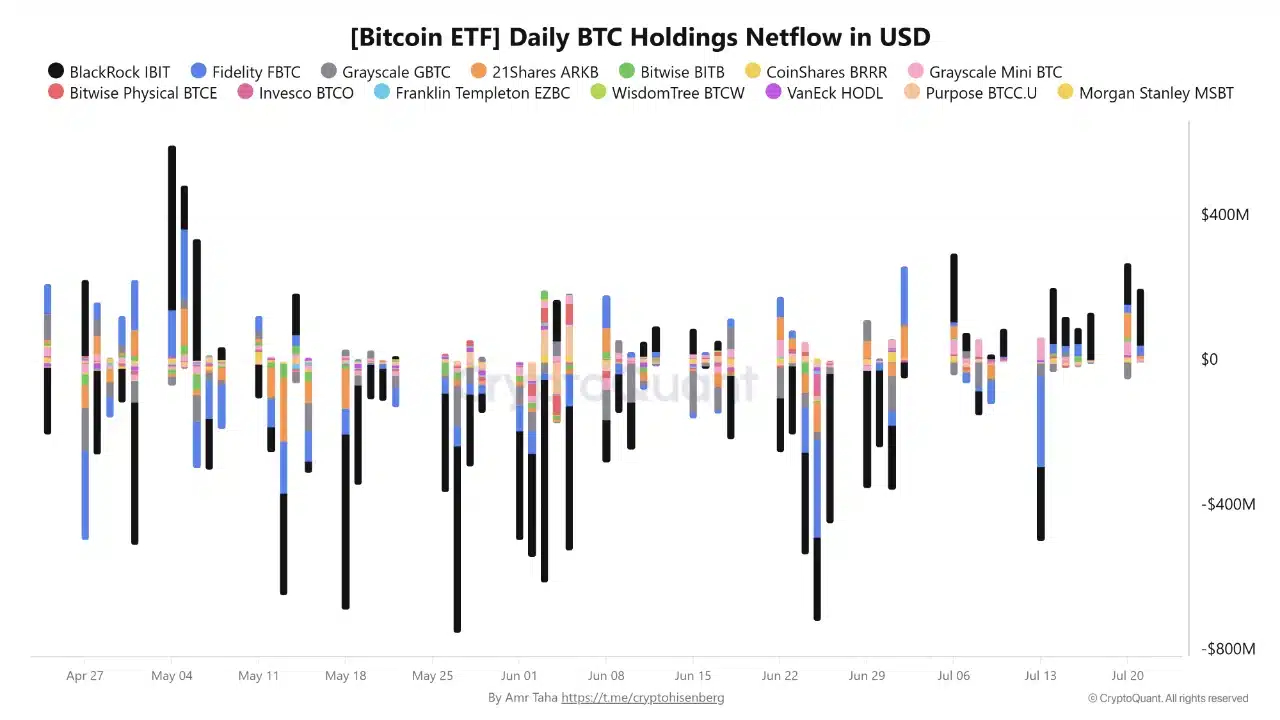
Bitcoin Daily Holdings Netflow
Source: CryptoQuant

Analyst Amr Taha pointed out that Bitcoin ETF inflows were not limited to a single entity. BlackRock’s IBIT recorded approximately $557 million in positive net flows between four sessions from July 14 and 21.

On July 21, 21Shares ARKB added approximately $70 million. Sustained positive readings show investor confidence in the market.

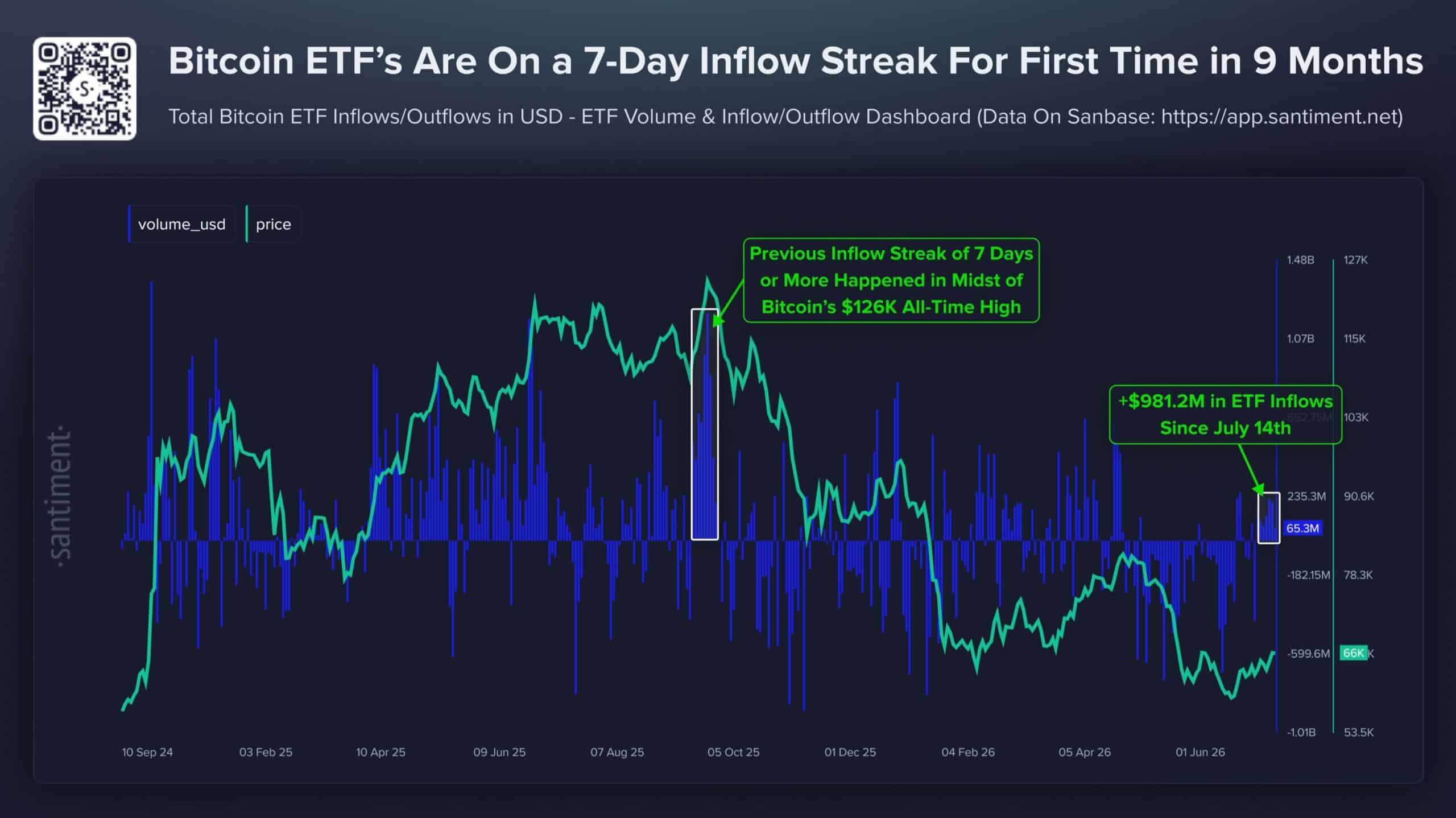
Bitcoin ETF Inflow StreakBitcoin ETF Inflow Streak
Source: Santiment

Santiment observed in a post on X that $981 million in Bitcoin spot ETF inflows were seen since July 14. This 7-day streak of inflows was a first in nine months, last occurring in October 2025, when Bitcoin was pushing toward the $126k highs.

Inflow momentum can lead the crypto markets higher, the intelligence platform wrote. On the flip side, a day of huge inflows could be a sign of FOMO. Heated short-term bullish conviction could lead to a local top forming.

The Bitcoin ETF flows led to a price bounce to a local high of $66,956. So far, it was unable to clear the $67,292 level and invalidate the bearish near-term price structure.

In other news, earlier in July, it was reported that a crypto bill was passed in Japan that could open the doors to spot Bitcoin ETFs listed on the Tokyo Stock Exchange. It would also cut the crypto tax rate from around 55% now to 20%.

The crypto bill has only cleared a committee in Japan’s Upper Parliament, but was not yet law. It could potentially become law by 2027.


Final Summary

  • Bitcoin ETF net flows reached a 7-day positive streak, a length of time of consistent inflows last seen in October 2025, before the market topped.
  • The market sentiment was recovering but it was still too early to call for a definitive market bottom.


Source link

Robinhood CEO Vlad Tenev’s X account hacked to promote token amid memecoin frenzy

0
Ethereum news: Robinhood chain hits $568M in trading frenzy, benefitting Arbitrum


Robinhood (HOOD) CEO Vlad Tenev’s X account was compromised on Thursday and used to promote a fake memecoin as traders have piled into tokens on the brokerage’s recently-launched blockchain network.

The now-deleted post introduced a token called Vladhood ($VLAD) as the “official Robinhood chain mascot” and falsely claimed it would be listed in the Robinhood app. It included a blockchain wallet address and described the token as part of the company’s focus on Robinhood Chain.

“Does Robinhood love memes? The answer is yes,” the post read.

Robinhood later confirmed the account had been hacked.

“Heads up: Our CEO Vlad Tenev’s X account was compromised and posted a fake promotion for a meme coin,” the company said through its communications account on X. “We’re working with X to restore access and the post has been removed.”

The incident came as Robinhood’s newly launched blockchain has become a hotbed of speculative trading.


Source link

How to trade options: 7 steps from account approval to your first contract

0
How to trade options: 7 steps from account approval to your first contract


Placing an options trade looks a lot like buying a stock. You pick a ticker, type in a quantity, and tap a button. The options ticket just adds a few extra choices first, and each one changes what you’re agreeing to.

These choices decide whether you expect the stock’s price to rise or fall, by how much, and when. Let’s walk through your first options trade, from account approval to expiration day, one decision at a time.

An option is a contract that lets you lock in a price to buy or sell a stock for a limited time. A call locks in a buying price. A put locks in a selling price.

Traders label the locked-in price the strike price, and the up-front fee you pay for the contract is the premium. Every contract also carries an expiration date, the deadline after which it stops existing, meaning you can’t exercise it to buy or sell at the strike price.

Explore options contracts with AlphaSpace

Standard options on stocks and exchange-traded funds (ETFs) cover 100 shares per contract. The premium you pay is per share, so a $2 quote costs $200 for one contract. If prices move far enough in your favor before expiration, the contract can pay off. If they don’t, you can let it expire and only lose the premium.

Buying and selling contracts split this market into two roles. A buyer pays the premium and gets a choice to exercise the contract at the strike price or let it expire. A seller collects that premium and takes on the opposite obligation, buying shares from the buyer or selling them shares at the price the contract locked in, if they decide to exercise it.

Learn more: What are options, and how do they work?

Almost every broker walks you through the same basic sequence once you decide to trade options. The screens might look different depending on where you have your account, but the order behind them barely changes. Here’s how it typically breaks down.

A regular brokerage account doesn’t include options, so you’ll need to apply for access to the options market. The application typically opens with a few questions about your trading experience, income, and net worth, and what you plan to use options for.

Based on your answers, the broker decides whether options fit your account. Approval times vary by broker. Schwab, for example, emails applicants a decision within three business days, while Robinhood approved my account almost instantly.

If your broker approves you, it’ll assign you an approval level that decides which trades your account can place. Brokers commonly offer around five tiers from lowest to highest risk, though the count varies by firm. Lower levels typically include buying calls and puts, while higher levels can add more complex and potentially riskier strategies like selling contracts on stock you don’t own.

Read more: What is options trading?

Every option tracks an underlying asset, such as a stock or an ETF. You don’t need to own the asset itself to buy calls or puts on it. ETFs work the same way. The contract just tracks the fund’s price instead of one company’s stock.

Owning shares only asks you to believe a company or fund improves over time. Options ask for a sharper stance, one that covers both price and timing, since the contract only pays off if you’re right about both. A vague hunch that a stock will eventually rise may not fit inside an option contract deadline.

Heavily traded stocks and ETFs tend to have busier options markets, and that keeps prices fairer. It also makes it easier to sell your contract to someone else before it expires.

As an example, I picked Dolby (DLB), a well-known audio equipment company. Its stock was trading near $50 when I checked after a year-long downtrend. With options approval now on my account, a “Trade DLB options” button appeared right under the stock’s price window. 

You’ll see an options chain table showing all the available options contracts for a particular stock, organized in one view. On most platforms, expiration dates sit across the top, and strike prices run down the middle, split into calls on one side and puts on the other. 

Using the simplified view, I priced up a call on Dolby when the stock traded at $49.74 on July 21, 2026. The $60 call expiring in 31 days had a premium of $2.40 a share, for an estimated cost of $240.04 after regulatory and exchange fees. Buying it means paying for the right to buy 100 shares of Dolby at $60 each, no matter how high the stock climbs before the contract expires.

If Dolby trades at $70, I can buy its shares for $60 and stand to make a profit from the difference. If I hold the contract through expiration and Dolby never clears $60, it expires worthless, and I lose the premium. 

This is where your opinion turns into a contract. A call gives its buyer the right to buy 100 shares at a set strike price. Calls can pay off when the stock climbs above that price. 

A put works the other way. It gives its buyer the right to sell 100 shares at the strike price, so it can pay off when the stock falls. Puts can also protect shares you already own, working like insurance that locks in a floor price for a fee.

Two choices you control help shape a contract’s price: how far the strike sits from the stock’s price, and how much time is left until expiration.

Dolby’s options chain shows this in action. Under the 31-day expiration, the closer a strike is to the stock’s price, the more the contract costs since it takes a smaller move to pay off.

If the strike is below the stock’s price, like Dolby’s $45 call, the premium goes higher still. That contract already carries value even if the stock never moves another cent.

Expiration works on the same logic. A longer window typically costs more, since the stock has more room to reach the strike. That same stretch of time works against you once the clock starts running. All else equal, a contract’s value falls as time passes, and the drag often speeds up as expiration nears. Traders refer to this as time decay.

To calculate the cost of each option, multiply the ask or bid price by the 100 shares each contract covers. Brokers may also add their own per-contract fee. For example, Schwab and Fidelity charge $0.65 per contract, while Robinhood doesn’t charge a fee, but it passes through a $0.04 regulatory fee for each contract.

Dolby’s $60 call asked for $2.40 per share. Multiply that by the 100 shares each contract covers, add any regulatory and exchange fees,to get your total cost. Two contracts would run around $480.08 and so on. 

That $240.04 premium raises the bar for profit. The $60 strike marks where the contract begins carrying potential value, but the $2.40 you paid per share needs to come back first. Add the two together, and Dolby needs to clear $62.40 before the trade actually turns a profit, a move of about 25% from its $49.74 price. 

Say Dolby only climbs to $61. The stock now trades above the $60 strike price, and the contract carries potential value. Traders refer to these contracts as in the money. However, you’d still be down $140.04 after subtracting that $100 of value from the $240.04 paid to open the trade. 

Before submitting, you can choose the order’s time in force. A good-for-day order cancels automatically if it doesn’t fill before the market closes.

The review screen is your last chance to catch a mistake. Check the action, the strike, and the expiration one more time before you tap “submit.” A wrong tap earlier in the process, like picking a put instead of a call, carries through unless you catch it here.

Once submitted, the order shows as pending until it matches with a seller. After it fills, the contract appears in your portfolio, and its value starts changing with the underlying price, time to expiration, and other pricing factors.

Once you own a contract, its value moves with the stock and, all else equal, its time value fades as expiration approaches. This leaves you with three main options.

Selling is the exit most buyers take, more common than exercising or riding a contract to expiration. The order mirrors the one that opened the trade, except the action now reads “sell to close.” You can place it on any market day before the contract expires. The sale ends your side of the contract for good.

Take the Dolby $60 call, bought for $240.04. If Dolby climbs to $56, the bid might rise to $4.50. Selling at that price returns $450, a gain of about $210 before fees. If Dolby slips to $45 instead, the bid might sink to $0.80. Selling then returns $80 of the $240.04 paid, an early exit that limits the loss instead of losing it all.

Exercising means using the right you paid for. For the Dolby $60 call, it means buying 100 shares at $60 apiece, $6,000 in cash on top of the $240.04 premium already spent. A put works in reverse. Exercising it sells 100 shares at the strike price, which requires having shares on hand to deliver.

This means that exercising trades your option contract for stock or cash. To do it, simply tap “exercise” on the contract in your broker’s app, and the trade settles the next business day. A call turns into shares landing in your account. A put turns into shares leaving your account, with cash landing in its place.

Do nothing, and the expiration date settles the trade for you. A call that finishes below its strike price is out of the money. It expires worthless, and you lose the premium you paid. Puts expire worthless when the stock finishes at or above the strike.

A call that finishes above the strike, even by a penny, carries value and doesn’t just disappear. A put works in reverse, carrying value once the stock finishes even a penny below the strike. The Options Clearing Corporation (OCC) stands behind every listed options trade as its clearinghouse, and it automatically exercises any contract that closes a penny or more in the money.

For the Dolby $60 call, a close at $60.01 on expiration day can mean buying 100 shares for $6,000. To avoid exercise, you need to tell your broker not to exercise, and brokers set their own deadlines for that instruction.

Want to learn more about options? Subscribe to AlphaSpace.

You now know how a trade opens, prices, and closes. What trips up first-time traders usually isn’t the mechanics. It’s a handful of repeat mistakes: 

  • Sending an order into a thin contract: Dolby’s options chain showed a $0 bid against the $2.40 ask on that $60 call. Nobody was bidding on it at that moment, so you may not be able to easily sell your contract.

  • Treating a cheap, far-off strike as a bargain: Far-out strikes can look cheap, but a low premium isn’t proof of a bargain. The contract still needs a larger move to finish in the money.

  • Watching only the stock price, not the calendar: A contract’s value responds to several things at once, including the stock’s price and the time left on the contract. A trader tracking only the price may be surprised to see the contract lose value, even after a move in the right direction.

  • Risking money saved for something else: Buyers can lose their entire premium. Trade only what you can watch disappear without impacting your finances.

  • Entering a trade without deciding how it ends: A contract closes by selling, exercising, or expiring. Decide which one fits your plan before you submit the order, so expiration day doesn’t make that decision for you.

None of this means you should avoid options. Buying a stock simply asks you to get one thing right: up or down. Buying an option asks you to get three things right at once: direction, amount, and timing.

Not always, at least not right away. Selling a contract means taking on an obligation to deliver or buy shares, not just a choice, so riskier selling strategies often sit at higher approval levels. Covered calls and cash-secured puts are exceptions at some firms because shares or cash back up the obligation. Uncovered selling, where the trader doesn’t have shares or cash to cover the calls and puts they sell, sits behind a tier most beginners don’t start with.

No. Options trade on their own market, separate from the shares they track. If you buy calls or puts, you never need to hold a single share. Owning the stock only matters for certain selling strategies like covered calls. In those trades, the shares back up the seller’s promise to deliver shares to the buyer.

No, options don’t pay dividends. That payout belongs to the stock, not the contract sitting on top of it. If you’re holding a call and want in on the dividend payouts, you’d have to exercise and actually own the shares before the dividend date. 

Editorial disclaimer: Information on this page is for educational purposes and not investment advice or a recommendation to buy any specific asset or adopt any particular investment strategy. Independently research products and strategies before making any investment decision.


Source link

Coinbase’s corporate customers can now accept payments from AI agents

0
Coinbase introduces AI advisor, stock options and pre-IPO markets in finance push

“We are delivering that experience for the new online agentic economy,” Coelho-Prabhu said in an interview. “Agents, on one side of the transaction, will go and read the Coinbase developer docs, create a wallet for themselves, and are ready to shop. Then we empower businesses so that everything in their inventory is now available on the internet through this agent-friendly checkout flow.”

For users of the exchange, they can get an easier command of crypto markets with a live order list that streams an agent’s open and active orders in real time, showing status, price, and size so the user can supervise every move, Coinbase said in a press release.

This will put agentic trading at the user’s fingertips, with the agent getting real-time market data and the ability to act on conditions autonomously. “Tell it what you want in plain English – ‘buy ETH if it dips 5%,’ ‘sell when my order fills’ – and it watches the market and executes for you. The same WebSocket data that powers institutional desks is now accessible through natural language,” Coinbase said.

In addition, for developers there’s a new x402 SDK from Coinbase Developer Platform, builders can now add x402 payment acceptance to any API, MCP server, or web service in 3 lines of code.


Source link