Home Blog Page 191

How to trade options: 7 steps from account approval to your first contract

0
How to trade options: 7 steps from account approval to your first contract


Placing an options trade looks a lot like buying a stock. You pick a ticker, type in a quantity, and tap a button. The options ticket just adds a few extra choices first, and each one changes what you’re agreeing to.

These choices decide whether you expect the stock’s price to rise or fall, by how much, and when. Let’s walk through your first options trade, from account approval to expiration day, one decision at a time.

An option is a contract that lets you lock in a price to buy or sell a stock for a limited time. A call locks in a buying price. A put locks in a selling price.

Traders label the locked-in price the strike price, and the up-front fee you pay for the contract is the premium. Every contract also carries an expiration date, the deadline after which it stops existing, meaning you can’t exercise it to buy or sell at the strike price.

Explore options contracts with AlphaSpace

Standard options on stocks and exchange-traded funds (ETFs) cover 100 shares per contract. The premium you pay is per share, so a $2 quote costs $200 for one contract. If prices move far enough in your favor before expiration, the contract can pay off. If they don’t, you can let it expire and only lose the premium.

Buying and selling contracts split this market into two roles. A buyer pays the premium and gets a choice to exercise the contract at the strike price or let it expire. A seller collects that premium and takes on the opposite obligation, buying shares from the buyer or selling them shares at the price the contract locked in, if they decide to exercise it.

Learn more: What are options, and how do they work?

Almost every broker walks you through the same basic sequence once you decide to trade options. The screens might look different depending on where you have your account, but the order behind them barely changes. Here’s how it typically breaks down.

A regular brokerage account doesn’t include options, so you’ll need to apply for access to the options market. The application typically opens with a few questions about your trading experience, income, and net worth, and what you plan to use options for.

Based on your answers, the broker decides whether options fit your account. Approval times vary by broker. Schwab, for example, emails applicants a decision within three business days, while Robinhood approved my account almost instantly.

If your broker approves you, it’ll assign you an approval level that decides which trades your account can place. Brokers commonly offer around five tiers from lowest to highest risk, though the count varies by firm. Lower levels typically include buying calls and puts, while higher levels can add more complex and potentially riskier strategies like selling contracts on stock you don’t own.

Read more: What is options trading?

Every option tracks an underlying asset, such as a stock or an ETF. You don’t need to own the asset itself to buy calls or puts on it. ETFs work the same way. The contract just tracks the fund’s price instead of one company’s stock.

Owning shares only asks you to believe a company or fund improves over time. Options ask for a sharper stance, one that covers both price and timing, since the contract only pays off if you’re right about both. A vague hunch that a stock will eventually rise may not fit inside an option contract deadline.

Heavily traded stocks and ETFs tend to have busier options markets, and that keeps prices fairer. It also makes it easier to sell your contract to someone else before it expires.

As an example, I picked Dolby (DLB), a well-known audio equipment company. Its stock was trading near $50 when I checked after a year-long downtrend. With options approval now on my account, a “Trade DLB options” button appeared right under the stock’s price window. 

You’ll see an options chain table showing all the available options contracts for a particular stock, organized in one view. On most platforms, expiration dates sit across the top, and strike prices run down the middle, split into calls on one side and puts on the other. 

Using the simplified view, I priced up a call on Dolby when the stock traded at $49.74 on July 21, 2026. The $60 call expiring in 31 days had a premium of $2.40 a share, for an estimated cost of $240.04 after regulatory and exchange fees. Buying it means paying for the right to buy 100 shares of Dolby at $60 each, no matter how high the stock climbs before the contract expires.

If Dolby trades at $70, I can buy its shares for $60 and stand to make a profit from the difference. If I hold the contract through expiration and Dolby never clears $60, it expires worthless, and I lose the premium. 

This is where your opinion turns into a contract. A call gives its buyer the right to buy 100 shares at a set strike price. Calls can pay off when the stock climbs above that price. 

A put works the other way. It gives its buyer the right to sell 100 shares at the strike price, so it can pay off when the stock falls. Puts can also protect shares you already own, working like insurance that locks in a floor price for a fee.

Two choices you control help shape a contract’s price: how far the strike sits from the stock’s price, and how much time is left until expiration.

Dolby’s options chain shows this in action. Under the 31-day expiration, the closer a strike is to the stock’s price, the more the contract costs since it takes a smaller move to pay off.

If the strike is below the stock’s price, like Dolby’s $45 call, the premium goes higher still. That contract already carries value even if the stock never moves another cent.

Expiration works on the same logic. A longer window typically costs more, since the stock has more room to reach the strike. That same stretch of time works against you once the clock starts running. All else equal, a contract’s value falls as time passes, and the drag often speeds up as expiration nears. Traders refer to this as time decay.

To calculate the cost of each option, multiply the ask or bid price by the 100 shares each contract covers. Brokers may also add their own per-contract fee. For example, Schwab and Fidelity charge $0.65 per contract, while Robinhood doesn’t charge a fee, but it passes through a $0.04 regulatory fee for each contract.

Dolby’s $60 call asked for $2.40 per share. Multiply that by the 100 shares each contract covers, add any regulatory and exchange fees,to get your total cost. Two contracts would run around $480.08 and so on. 

That $240.04 premium raises the bar for profit. The $60 strike marks where the contract begins carrying potential value, but the $2.40 you paid per share needs to come back first. Add the two together, and Dolby needs to clear $62.40 before the trade actually turns a profit, a move of about 25% from its $49.74 price. 

Say Dolby only climbs to $61. The stock now trades above the $60 strike price, and the contract carries potential value. Traders refer to these contracts as in the money. However, you’d still be down $140.04 after subtracting that $100 of value from the $240.04 paid to open the trade. 

Before submitting, you can choose the order’s time in force. A good-for-day order cancels automatically if it doesn’t fill before the market closes.

The review screen is your last chance to catch a mistake. Check the action, the strike, and the expiration one more time before you tap “submit.” A wrong tap earlier in the process, like picking a put instead of a call, carries through unless you catch it here.

Once submitted, the order shows as pending until it matches with a seller. After it fills, the contract appears in your portfolio, and its value starts changing with the underlying price, time to expiration, and other pricing factors.

Once you own a contract, its value moves with the stock and, all else equal, its time value fades as expiration approaches. This leaves you with three main options.

Selling is the exit most buyers take, more common than exercising or riding a contract to expiration. The order mirrors the one that opened the trade, except the action now reads “sell to close.” You can place it on any market day before the contract expires. The sale ends your side of the contract for good.

Take the Dolby $60 call, bought for $240.04. If Dolby climbs to $56, the bid might rise to $4.50. Selling at that price returns $450, a gain of about $210 before fees. If Dolby slips to $45 instead, the bid might sink to $0.80. Selling then returns $80 of the $240.04 paid, an early exit that limits the loss instead of losing it all.

Exercising means using the right you paid for. For the Dolby $60 call, it means buying 100 shares at $60 apiece, $6,000 in cash on top of the $240.04 premium already spent. A put works in reverse. Exercising it sells 100 shares at the strike price, which requires having shares on hand to deliver.

This means that exercising trades your option contract for stock or cash. To do it, simply tap “exercise” on the contract in your broker’s app, and the trade settles the next business day. A call turns into shares landing in your account. A put turns into shares leaving your account, with cash landing in its place.

Do nothing, and the expiration date settles the trade for you. A call that finishes below its strike price is out of the money. It expires worthless, and you lose the premium you paid. Puts expire worthless when the stock finishes at or above the strike.

A call that finishes above the strike, even by a penny, carries value and doesn’t just disappear. A put works in reverse, carrying value once the stock finishes even a penny below the strike. The Options Clearing Corporation (OCC) stands behind every listed options trade as its clearinghouse, and it automatically exercises any contract that closes a penny or more in the money.

For the Dolby $60 call, a close at $60.01 on expiration day can mean buying 100 shares for $6,000. To avoid exercise, you need to tell your broker not to exercise, and brokers set their own deadlines for that instruction.

Want to learn more about options? Subscribe to AlphaSpace.

You now know how a trade opens, prices, and closes. What trips up first-time traders usually isn’t the mechanics. It’s a handful of repeat mistakes: 

  • Sending an order into a thin contract: Dolby’s options chain showed a $0 bid against the $2.40 ask on that $60 call. Nobody was bidding on it at that moment, so you may not be able to easily sell your contract.

  • Treating a cheap, far-off strike as a bargain: Far-out strikes can look cheap, but a low premium isn’t proof of a bargain. The contract still needs a larger move to finish in the money.

  • Watching only the stock price, not the calendar: A contract’s value responds to several things at once, including the stock’s price and the time left on the contract. A trader tracking only the price may be surprised to see the contract lose value, even after a move in the right direction.

  • Risking money saved for something else: Buyers can lose their entire premium. Trade only what you can watch disappear without impacting your finances.

  • Entering a trade without deciding how it ends: A contract closes by selling, exercising, or expiring. Decide which one fits your plan before you submit the order, so expiration day doesn’t make that decision for you.

None of this means you should avoid options. Buying a stock simply asks you to get one thing right: up or down. Buying an option asks you to get three things right at once: direction, amount, and timing.

Not always, at least not right away. Selling a contract means taking on an obligation to deliver or buy shares, not just a choice, so riskier selling strategies often sit at higher approval levels. Covered calls and cash-secured puts are exceptions at some firms because shares or cash back up the obligation. Uncovered selling, where the trader doesn’t have shares or cash to cover the calls and puts they sell, sits behind a tier most beginners don’t start with.

No. Options trade on their own market, separate from the shares they track. If you buy calls or puts, you never need to hold a single share. Owning the stock only matters for certain selling strategies like covered calls. In those trades, the shares back up the seller’s promise to deliver shares to the buyer.

No, options don’t pay dividends. That payout belongs to the stock, not the contract sitting on top of it. If you’re holding a call and want in on the dividend payouts, you’d have to exercise and actually own the shares before the dividend date. 

Editorial disclaimer: Information on this page is for educational purposes and not investment advice or a recommendation to buy any specific asset or adopt any particular investment strategy. Independently research products and strategies before making any investment decision.
Source link

Coinbase’s corporate customers can now accept payments from AI agents

0
Coinbase introduces AI advisor, stock options and pre-IPO markets in finance push

“We are delivering that experience for the new online agentic economy,” Coelho-Prabhu said in an interview. “Agents, on one side of the transaction, will go and read the Coinbase developer docs, create a wallet for themselves, and are ready to shop. Then we empower businesses so that everything in their inventory is now available on the internet through this agent-friendly checkout flow.”

For users of the exchange, they can get an easier command of crypto markets with a live order list that streams an agent’s open and active orders in real time, showing status, price, and size so the user can supervise every move, Coinbase said in a press release.

This will put agentic trading at the user’s fingertips, with the agent getting real-time market data and the ability to act on conditions autonomously. “Tell it what you want in plain English – ‘buy ETH if it dips 5%,’ ‘sell when my order fills’ – and it watches the market and executes for you. The same WebSocket data that powers institutional desks is now accessible through natural language,” Coinbase said.

In addition, for developers there’s a new x402 SDK from Coinbase Developer Platform, builders can now add x402 payment acceptance to any API, MCP server, or web service in 3 lines of code.


Source link

Solana price prediction: THREE reasons why SOL could hit $120

0
Solana price prediction: THREE reasons why SOL could hit $120


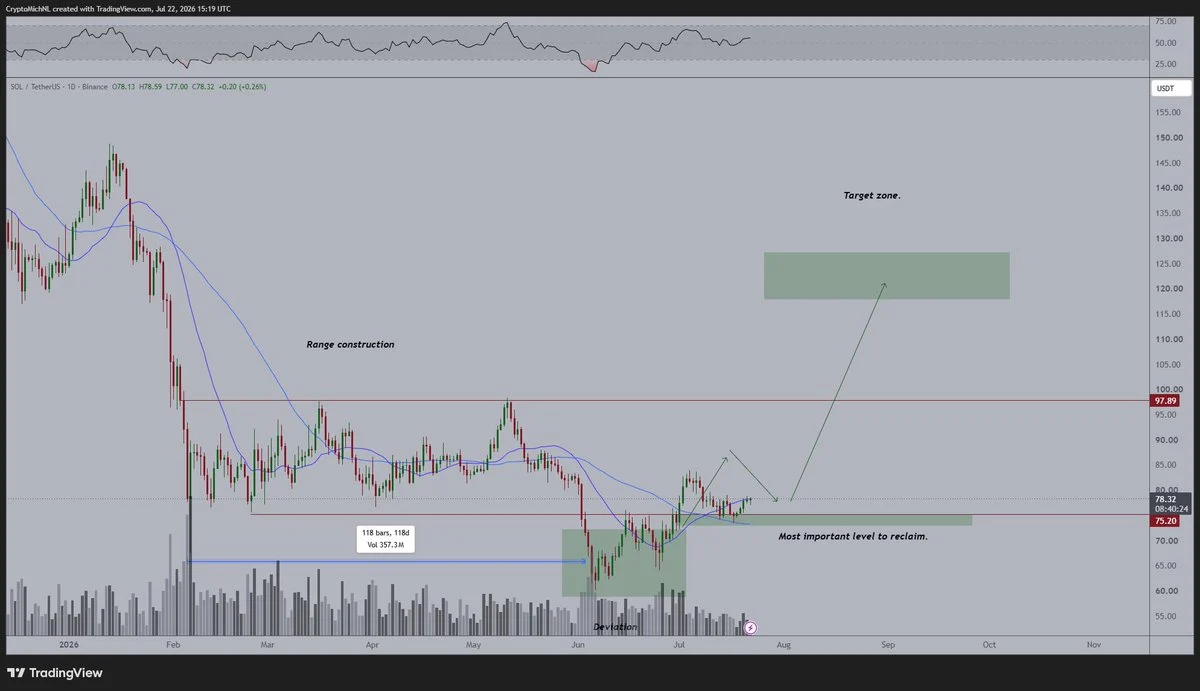
Solana [SOL] is slowly forming a bullish structure but remains below the most recent lower high at $97. At press time, the altcoin was trading at around $77, but SOL’s daily volume had surged to $1.61 billion.

Notably, a crypto analyst predicted that capital inflows and on-chain activity were starting to support SOL’s potential rise toward $120.

Solana ETFs turn positive as dormant wallets return

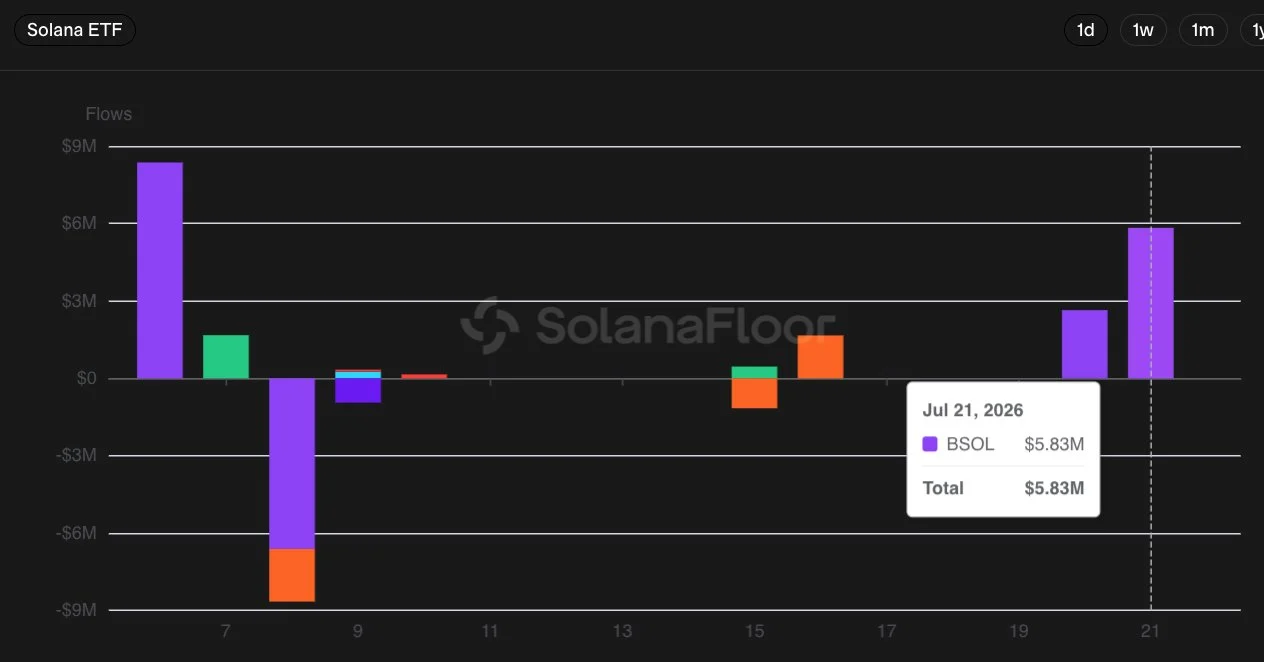
Capital inflows came from Solana ETFs, which recorded the highest daily inflows in two weeks. The Bitwise Solana Staking ETF [BSOL] led the inflows with about 75,714 SOL worth $5.83 million, and it was the only ETF that recorded any activity on the 21st of July.

However, the positive net inflow did not last. The following day, Solana ETFs recorded outflows of 16.4K SOL worth $1.27 million, less than a quarter of the more than 75K BSOL purchased earlier.

SolanaSOL
Source: Solana Floor

The daily volume of Solana ETFs traded was $54.47 million, with all assets under management nearing $1 billion. In fact, Solana and Hyperliquid ETFs account for nearly 80% of non-BTC/ETH ETF volume.

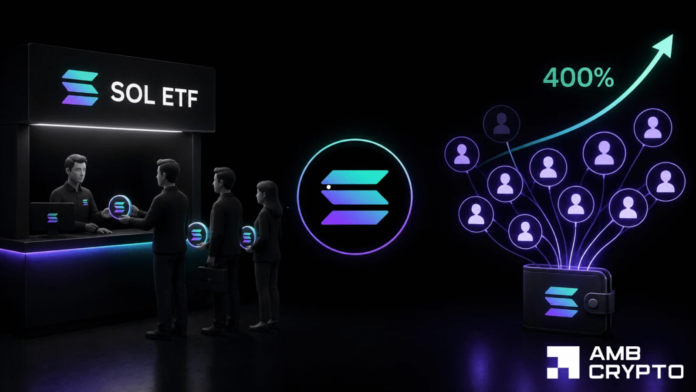
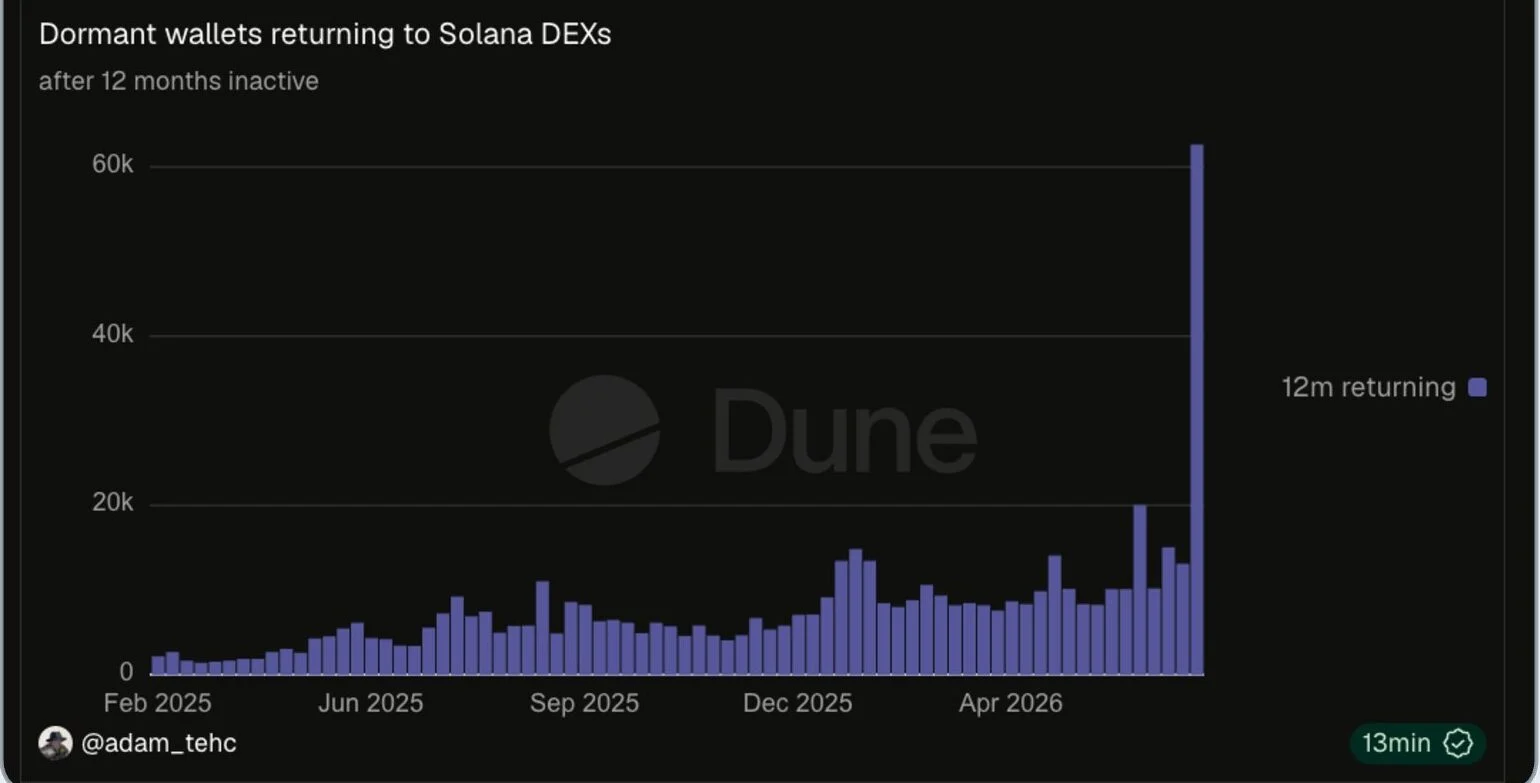
Additionally, dormant wallets returning to Solana DEXs surged to 62K last week, up from below 20K. This was equivalent to a 400% increase from the previous week. This was the highest number of returning users in a period of more than a year.

SolanaSOLSolanaSOL
Source: Dune

As Solana ETFs hit a two-week high and dormant wallets return, it hints at shifting market sentiment.

Can SOL break out and surge into the $120-$130 zone?

The price charts showed Solana was forming a base at $75 after sweeping liquidity below this level. The altcoin has returned to the consolidation between $75 and $97, but the upper resistance remains a key challenge.

However, the signs of a potential breakout toward $120-$130 are emerging as a Moving Average (MA) cross occurred with the fast‑moving MA rising above the slower MA. Moreover, these targets depend on a bullish breakout in the coming weeks.

SolanaSOLSolanaSOL
Source: SOL/USDT from Michael van de Poppe

Therefore, Solana is expected to turn bullish structurally if it can close above $97.89. At press time, the RSI was supportive of the prediction as it traded above the neutral level, indicating buying pressure.

Otherwise, SOL is still bearish even though it reclaimed the most important level at $75.


Final Summary

  • Solana ETFs’ inflows turned positive after $5.83 million was bought, and returning dormant wallets surged 400% in a week.
  • Traders are eyeing SOL to reach the $120-$130 zone but only if it breaks out of the range and stays above $97. 


Source link

Morgan Stanley doubles down on Schwab after earnings

0
Morgan Stanley doubles down on Schwab after earnings


Charles Schwab just delivered one of its strongest quarters on record, and the stock still dropped. That disconnect caught Morgan Stanley’s attention, prompting the firm to double down on its bullish stance.

Schwab reported second-quarter adjusted earnings of $1.62 per share on record revenue of $7.07 billion, beating Wall Street estimates on both fronts.

The company also raised its full-year revenue growth outlook to between 17.5% and 18.5%, up from the 14% to 15% range projected at its May investor day.

Despite those results, shares slipped roughly 2.5%, and Morgan Stanley’s report stated that the selloff was a positioning issue, not a fundamental one.

Schwab’s earnings beat came from trading and lending, not interest rates

Morgan Stanley emphasized that the guidance increase was not driven by more favorable net interest margin assumptions, which remained unchanged from May at 3.00% to 3.10% for the full year. 

Instead, the revenue uplift came from stronger-than-expected client engagement and transaction activity, according to the Morgan Stanley July 22 note.

Rick Wurster, CEO of Charles Schwab, attributed rising trading activity to generational and technological shifts.

During the second quarter, strong client engagement helped drive year-over-year revenue growth…Young investors, AI, all of that is leading towards a more sustained period of high levels of trading from our perspective

That distinction matters because Schwab’s stock has long traded as a bet on interest rates and the direction of cash sorting on its balance sheet.

Through the report, the second-quarter results provide evidence that the earnings algorithm is broadening and becoming less dependent on any single macro variable. 

Daily average trades hit a record 11.9 million during the quarter, a 57% jump from the same period a year earlier, according to the company’s earnings release

Trading revenue climbed 28% year over year to about $1.2 billion, while bank loan balances reached $67 billion, up 33% from a year ago.

Schwab’s lending push is reshaping its balance sheet economics

One of the sharpest observations in the Morgan Stanley note centers on how Schwab is deploying its balance sheet. 

Rather than funneling all available capacity into securities, the company is directing cash flow toward pledged asset lines and other client loans, which carry spreads more than 100 basis points above what the firm would earn from buying bonds, according to Schwab’s Q2 2026 earnings release.

Pledged asset line balances surged to $33.4 billion, representing a 59% increase from a year ago, while originations were up about 60%, Schwab’s Q2 2026 earnings release reported


Source link

Sephora Is Rolling Out ‘Quiet Hours’ Worldwide

0
Sephora Is Rolling Out 'Quiet Hours' Worldwide


For some shoppers, bright lights, blaring music and crowded aisles make a simple trip to the store feel like Times Square. “Sephora is always so challenging for me to tolerate,” Love on the Spectrum cast member Kaelynn Partlow wrote on social media.

Sephora is trying to fix that. The beauty retailer is expanding its “Quiet Hours” initiative worldwide after a pilot at 32 stores across eight markets got positive feedback from shoppers and employees, People reports. During designated hours, stores lower music, dim digital screens and cut sensory distractions.

Sephora developed the program with input from neurodiversity advocacy groups Open Inclusion and Purposeful Futures. It joins a growing list of retailers also turning down the volume. Walmart made its sensory-friendly hours permanent across US and Puerto Rico stores back in 2023. AMC Theatres runs Sensory Friendly Film screenings with the Autism Society. Target and Chuck E. Cheese have rolled out their own versions too. For retailers, accessibility is quietly becoming a real point of differentiation, not just a goodwill gesture.

For some shoppers, bright lights, blaring music and crowded aisles make a simple trip to the store feel like Times Square. “Sephora is always so challenging for me to tolerate,” Love on the Spectrum cast member Kaelynn Partlow wrote on social media.

Sephora is trying to fix that. The beauty retailer is expanding its “Quiet Hours” initiative worldwide after a pilot at 32 stores across eight markets got positive feedback from shoppers and employees, People reports. During designated hours, stores lower music, dim digital screens and cut sensory distractions.

Sephora developed the program with input from neurodiversity advocacy groups Open Inclusion and Purposeful Futures. It joins a growing list of retailers also turning down the volume. Walmart made its sensory-friendly hours permanent across US and Puerto Rico stores back in 2023. AMC Theatres runs Sensory Friendly Film screenings with the Autism Society. Target and Chuck E. Cheese have rolled out their own versions too. For retailers, accessibility is quietly becoming a real point of differentiation, not just a goodwill gesture.


Source link

Crypto for Advisors: It’s time for tokenization to get to work

0
Crypto for Advisors: It’s time for tokenization to get to work

Q. Not all tokenized equity products are the same. What is the most important distinction to understand?

The central question is what the token actually represents. In the strongest model, the token is the share itself, meaning ownership, voting rights and dividends travel with it. In a synthetic wrapper, the investor owns a contractual claim against another entity, not the underlying share, introducing counterparty risk, tracking risk and the possibility that corporate actions do not pass through correctly.

Two tokens with the same ticker can represent very different instruments. The SEC’s January 2026 staff statement drew this distinction explicitly. For advisors evaluating these products, the structure is not a technical detail. It determines what rights the holder actually has.

Q. How developed is the regulatory framework at this point?

More developed than most people realize, but with gaps remaining. In the past eight months, the SEC issued a no-action letter for DTC tokenization services, published a staff statement establishing ownership taxonomy and approved Nasdaq’s proposal to trade tokenized securities alongside conventional shares. DTCC completed its first live production transactions this month.

Despite the progress, uncertainty still exists. Tokenized equities remain largely restricted to non-U.S. or accredited investors, the CLARITY Act has not been enacted, and third-party synthetic models carry more legal uncertainty than issuer-sponsored structures. The framework is building in a clear direction, but there is still much to accomplish to drive confidence and adoption.


Source link

Brookfield to acquire Aypa Power from Blackstone for $7bn

0
Brookfield to acquire Aypa Power from Blackstone for $7bn


Brookfield has agreed to purchase Aypa Power from funds managed by Blackstone Energy Transition Partners, assigning an enterprise value of around $7bn and an equity value of $3bn to the transaction.

According to Brookfield, the deal will mark its entry into the North American battery energy storage market.

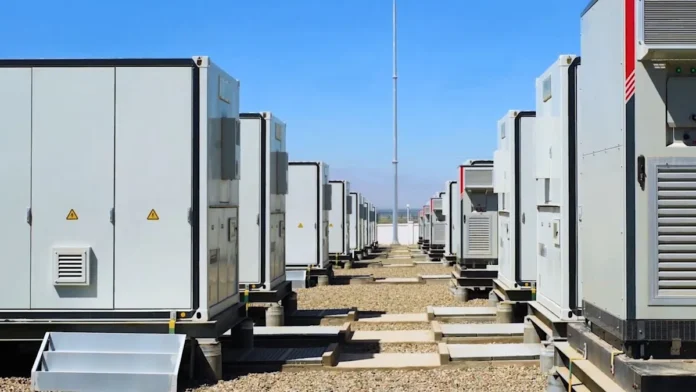
Aypa Power operates a portfolio comprising roughly 6.5GW of operating, under-construction and contracted battery storage capacity across the US and Canada.

The company is described as the largest stand-alone battery storage developer in North America, with a development pipeline that exceeds 20GW.

Its assets are located in regions where transmission and capacity constraints are present.

As part of the agreement, Brookfield will acquire Aypa’s project portfolio as well as its development operations and a team of approximately 200.

Brookfield energy group chief investment officer Jehangir Vevaina said: “We are excited to partner with Aypa to deliver on the company’s scale growth pipeline.

“Battery storage is increasingly critical to the reliability and resilience of today’s energy systems, and bringing together this leading platform with Brookfield’s broad capabilities across technologies and geographies further strengthens our ability to deliver integrated energy solutions to the world’s largest buyers of power.”

The acquisition will help advance Aypa’s next phase of growth and expand Brookfield’s ability to provide integrated energy solutions.

According to Brookfield, 95% of Aypa’s operating and under-construction assets are secured under long-term contracts with investment-grade clients, with these agreements having an average of 17 years remaining.

Aypa Power founder and CEO Moe Hajabed said: “This is an extraordinary achievement for the team that built Aypa. Over the past six years, with Blackstone’s partnership, we grew Aypa into the largest and most valuable storage-focused independent power producer in North America.

“Together, we helped establish battery storage as critical infrastructure, essential to a more reliable and resilient grid. I look forward to seeing Aypa flourish further under Brookfield’s ownership.”

Completion of the transaction is subject to customary regulatory approvals.

Aypa and Blackstone were advised by Cantor Fitzgerald & Co. as lead financial adviser, with additional financial advice from BofA.

Legal counsel was provided to both parties by Kirkland & Ellis, while Brookfield received legal advice from White & Case.

“Brookfield to acquire Aypa Power from Blackstone for $7bn” was originally created and published by Power Technology, a GlobalData owned brand.


Source link