Economic resilience is probably something most Americans would welcome.
We’re seeing that consumer spending is still growing, wage gains haven’t gone away, and corporate dealmaking is showing fresh momentum. Those trends point to a country that is successfully blowing past the recent inflation shock.
However, in an exclusive interview with CBS News’ “Face the Nation,” Bank of America CEO Brian Moynihan sees something more troubling beneath the surface.
The economy is arguably holding its own, but the relief households expected hasn’t followed. Food, housing, and fuel costs remain painful, while the strongest spending growth continues to come from consumers with the greatest financial cushions.
For investors and households, the next phase could look very different from the soft landing many had anticipated.
Economic growth isn’t disappearing, but interestingly, that relentless pace of expansion might compel an economic response few people are prepared for.
Moynihan warns inflation could outlast the recovery
Moynihan’s big concern is that inflation will likely remain sticky enough to prevent the relief everyone is expecting.
“It’s drifting down, and it’s drifting down slower than people would like it,” he said, pointing to continued pressure from housing, food, fuel, and other essential costs.
The problem extends beyond prices at the pump.
More Fed:
Moynihan said businesses are worried about “the cost of goods that’s coming through the pipeline,” as higher energy costs feed into plastics, materials, manufacturing, and transportation.
In effect, that has complicated the economic outlook.
The delayed pass-through helps to explain why Bank of America’s economists see “inflation staying higher all the way into 2027 and 2028.”
Moreover, that forecast led to a steep reversal in the bank’s interest-rate outlook.
Moynihan said that six months ago, the team expected the Federal Reserve to cut rates. Now, the team says, “our belief is we’ll raise rates” to contain consistent inflation.
He indicated that the tightening cycle would likely begin “more towards the end of the year,” with additional increases potentially extending into next year.
For perspective, as of its June 2026 outlook, I reported that BofA expects three quarter-point Fed rate hikes, in September, October, and December 2026, totaling 0.75 points.
Taken collectively, that forms a remarkably uncomfortable setup, where inflation will take “a long time to squeeze out of the system,” while renewed rate hikes add more pressure to already-strained household budgets.
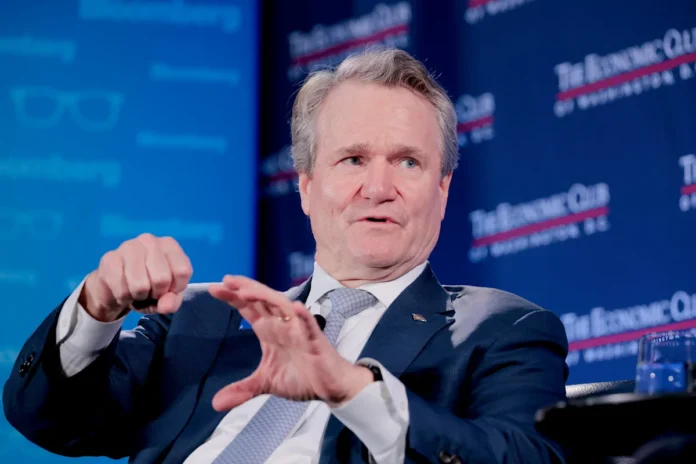
Bank of America CEO Brian Moynihan discusses inflation, interest rates, and the U.S. economy during a “Face the Nation” interview.Chip Somodevilla/Getty Images
Why inflation could outlast the oil shock
Moynihan’s warning of a greater risk is that the shock spreads beyond underlying prices, keeping monetary policy restrictive even as gasoline prices retreat.
According to the Fed’s summary of economic projections, the bank expects 2026 headline PCE inflation of 3.6% and core PCE of 3.3% (median). Moreover, according to the Bureau of Economic Analysis, headline PCE was already running at 4.1% in May, while core PCE stood at 3.4%.
According to its June projections, officials forecasted headline PCE to drop to 2.3% in 2027 and 2% in 2028, with core inflation easing to 2.5% and 2.1%, respectively.
At the same time, the Energy Information Administration expects average gasoline prices to decline from $3.64 per gallon in 2026 to $3.09 in 2027, according to Energies Media.
So the higher-for-longer inflation thesis only sticks if there are second-round effects.
That would include fuel and freight costs being passed through to goods, businesses defending margins through price bumps, workers seeking compensation for lost purchasing power, and consumers beginning to expect faster inflation.
BofA’s thesis weakens if gasoline follows the EIA’s path, while core services, wages, and inflation expectations simultaneously cool.
Moynihan sees an economy pulling apart
Another major arc from the interview was Moynihan’s comments, which reinforce the idea that America is running on two economic tracks.
“Affordability is a challenge,” he said, pointing to pressure from gas, food, and inflation. Yet Bank of America’s 70 million customers are still spending roughly 6% more in June than a year earlier, indicating that headline consumption still remains resilient.
However, there’s a clear split, which the bank’s been talking about for weeks.
Moynihan said spending among the “middle third” and “top third” of households is growing more quickly, while wage growth across income groups has only recently “coalesced together around 3% to 4%.”
“In some ways, the game is rigged,” Vance said. “We ran the experiment of offshoring all of our industrial jobs, becoming a services-and-finance economy, and allowing Wall Street to come in and buy every asset of modern life and turn it into an investable, line-goes-up asset.”
On top of that, recent investing trends underscore incredible frustration among younger retail investors, who are willing to take on much more risk to achieve outsized gains.
The crypto mania gave way to meme stocks during the pandemic, while prediction markets are the latest in this ongoing episode.
For perspective, prediction platform Kalshi said that millions accessed its platform on a weekly basis, with volumes surging past $1 billion per week in late 2025, while combined monthly trading on Kalshi and Polymarket surged from under $5 billion in September 2025 to roughly $24 billion by April 2026.
Moreover, the appetite for quick gains comes as more young adults remain at home.
Federal Reserve data shows 49% of Americans under 30 lived with a parent in 2025, up 6 percentage points from 2022 and 12 points from 2019.
What would three more rate hikes mean?
I feel Moynihan’s warning becomes a lot more consequential once BofA’s forecast is converted into an actual policy rate.
It’s important to note that the Fed is targeting a 3.5% to 3.75% range, according to CNBC.
Three conventional quarter-point increases would lift that range to 4.25% to 4.5%, with a midpoint of 4.375%.
Interestingly, that implied rate is roughly 0.63% above the Fed’s June median year-end projection of 3.75%.
It is also higher than current market expectations. According to the Fed’s July Monetary Policy Report, futures imply an effective rate near 4% by year-end, or 0.3% above its current level.
For consumers, a 0.75-point increase adds nearly $75 in annual interest for every $10,000 of fully repricing variable-rate debt. The consequences likely extend into housing affordability, small-cap refinancing, and long-duration stock valuations.
For investors, renewed rate hikes raise discount rates, which in turn make future earnings a lot less valuable and pressuring richly valued growth stocks that have dominated markets. Small-cap companies might face higher refinancing expenses, while homebuilders and REITs would contend with sluggish affordability and demand.
Banks will initially earn more on loans, though higher deposit expenses and eventual credit deterioration erode that benefit.
BofA might revisit that call if multiple core PCE readings decisively softened, wage growth fell behind inflation, and unemployment began rising.
An April 2025 CoinDesk investigation found that Movement was examining whether it had been misled into signing a market-making agreement that handed a single counterparty unusual influence over MOVE’s circulating supply. Internal documents reviewed by CoinDesk at the time showed the arrangement allowed 66 million MOVE tokens to be sold into the market one day after the token debuted, contributing to a sharp decline in price.
The controversy centered on Rentech, a little-known intermediary that appeared in contracts connected to Chinese market maker Web3Port. According to documents obtained by CoinDesk, Movement executives later questioned whether the foundation believed Rentech was affiliated with Web3Port when it was not. Rentech has denied any wrongdoing or misrepresentation.
The fallout extended beyond Movement. Binance banned the market-making account involved in the token launch for what it described as misconduct, while Movement launched a token buyback program and hired outside firm Groom Lake to review the events surrounding the deal.
Movement Labs and co-founder Rushi Manche separated in May 2025.
More recently, the company attempted to chart a new course.
In June, Move Industries, a separate legal entity from MVMT Labs, the company that filed for bankruptcy, announced it would pivot away from competing with other Ethereum scaling networks and instead focus on cross-border payments, remittances and stablecoin settlement. The company said it had secured access to licensed payment infrastructure in the U.S., Canada and the European Union as it sought to build services aimed at emerging markets.
Deposit account rates are on the decline — but the good news is you can lock in a competitive return on a certificate of deposit (CD) today and preserve your earning power. In fact, the best CDs still pay rates of 4% or higher. Read on for a snapshot of CD rates today and where to find the best offers.
Where are the best CD rates today?
CDs today typically offer rates significantly higher than traditional savings accounts. Currently, the best short-term CDs (six to 12 months) generally offer rates around 4% APY.
Today, the highest CD rate is 4.20% APY. This rate is offered by United Fidelity Bank and Sallie Mae on their 2-year CDs.
The following is a look at some of the best CD rates available today, Tuesday, July 21, 2026, from our verified partners.
Historical CD rates
The 2000s were marked by the dot-com bubble and later, the global financial crisis of 2008. Though the early 2000s saw relatively higher CD rates, they began to fall as the economy slowed and the Federal Reserve cut its target rate to stimulate growth. By 2009, in the aftermath of the financial crisis, the average one-year CD paid around 1% APY, with five-year CDs at less than 2% APY.
The trend of falling CD rates continued into the 2010s, especially after the Great Recession of 2007-2009. The Fed’s policies to stimulate the economy (in particular, its decision to keep its benchmark interest rate near zero) led banks to offer very low rates on CDs. By 2013, average rates on 6-month CDs fell to about 0.1% APY, while 5-year CDs returned an average of 0.8% APY.
However, things changed between 2015 and 2018, when the Fed started gradually increasing rates again. At this point, there was a slight improvement in CD rates as the economy expanded, marking the end of nearly a decade of ultra-low rates. However, the onset of the COVID-19 pandemic in early 2020 led to emergency rate cuts by the Fed, causing CD rates to fall to new record lows.
The situation reversed following the pandemic as inflation began to spiral out of control. This prompted the Fed to hike rates 11 times between March 2022 and July 2023. In turn, this led to higher rates on loans and higher APYs on savings products, including CDs.
Fast forward to September 2024 — the Fed finally decided to start cutting the federal funds rate after it determined that inflation was essentially under control. The Fed cut rates three times in 2025, and we saw CD rates steadily come down from their peak. Even with the Fed leaving interest rates unchanged so far in 2026, CD rates remain high by historical standards.
Take a look at how CD rates have changed since 2009:
Understanding today’s CD rates
Traditionally, longer-term CDs have offered higher interest rates compared to shorter-term CDs. This is because locking in money for a longer period typically carries more risk (namely, missing out on higher rates in the future), which banks compensate for with higher rates.
However, this pattern doesn’t necessarily hold today; the highest average CD rate is for a 12-month term. This indicates a flattening or inversion of the yield curve, which can happen in uncertain economic times or when investors expect future interest rates to decline.
When opening a CD, choosing one with a high APY is just one piece of the puzzle. There are other factors that can impact whether a particular CD is best for your needs and your overall return. Consider the following when choosing a CD:
Your goals: Decide how long you’re willing to lock away your funds. CDs come with fixed terms, and withdrawing your money before the term ends can result in penalties. Common terms range from a few months up to several years. The right term for you depends on when you anticipate needing access to your money.
Type of financial institution: Rates can vary significantly among financial institutions. Don’t just check with your current bank; research CD rates from online banks, local banks, and credit unions. Online banks, in particular, often offer higher interest rates than traditional brick-and-mortar banks because they have lower overhead costs. However, make sure any online bank you consider is FDIC-insured (or NCUA-insured for credit unions).
Account terms: Beyond the interest rate, understand the terms of the CD, including the maturity date and withdrawal penalties. Also, check if there’s a minimum deposit requirement, and if so, that it fits your budget.
Inflation: While CDs can offer safe, fixed returns, they might not always keep pace with inflation, especially for longer terms. Consider this when deciding on the term and amount to invest.
The market narrative is finally shifting from a local bottom to a macro bottom.
From a technical standpoint, Bitcoin’s breakout above $66,000 has sparked a wave of bullish sentiment.
Many analysts are arguing that the cycle low may already be in. While BTC was stuck consolidating between $60k- $65k, the discussion largely revolved around whether it was simply a local bottom.
Now, however, the focus is gradually shifting toward a move into the $70,000 region.
Looking at the charts, that shift isn’t entirely without merit.
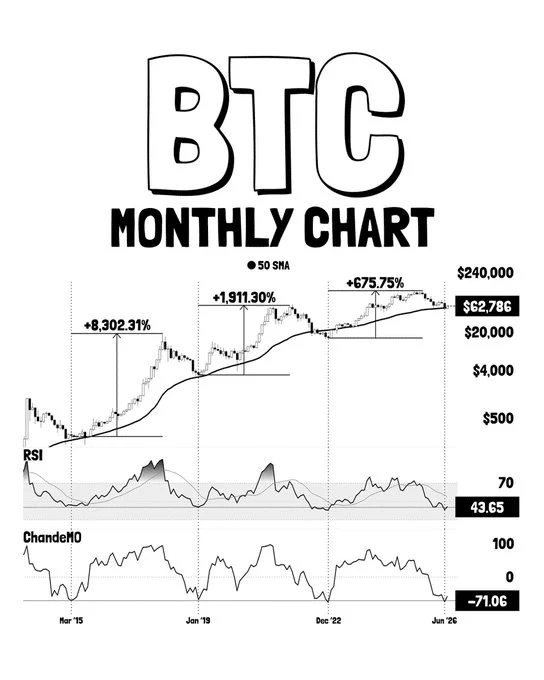
According to crypto analyst Ali Martinez, Bitcoin has once again flashed the same three technical signals that have historically coincided with macro cycle bottoms.
Those signals include the monthly RSI dropping to around 43.65, the Chande Momentum Oscillator (CMO) falling to roughly -71, and Bitcoin trading near its 50-month moving average.
Source: X
Notably, the pattern has repeated across previous cycles.
In 2015, the setup appeared around $235 before Bitcoin [BTC] went on to rally more than 8,300%.
In early 2019, it flashed near $3,333, preceding a gain of 1,900%. The same technical cluster returned in late 2022, around $16k, shortly after Bitcoin bottomed near $15k, before the market rallied 675%.
Interestingly, Bitcoin’s correction to $58k last month triggered this same setup once again.
So, if history is any guide, this alignment has consistently marked one of Bitcoin’s strongest long-term accumulation zones, adding weight to the idea that the market may already be transitioning from a local bottom to a macro one.
Liquidity remains Bitcoin’s biggest test
Bullish continuation ultimately depends on liquidity, and that’s where Bitcoin’s rally could still face a key test.
From a technical standpoint, stablecoin dominance has climbed to around 13%, narrowing the gap with Ethereum’s 10%+ market dominance.
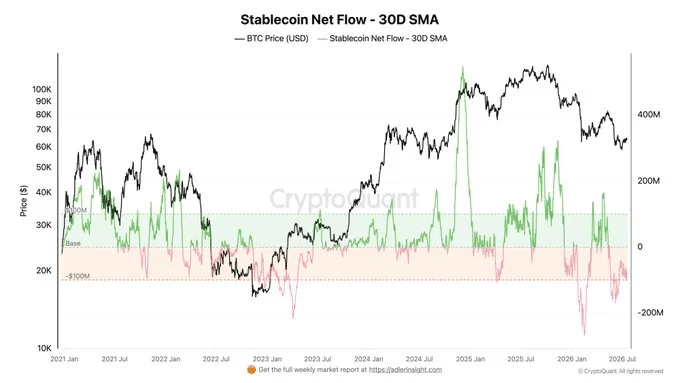
At the same time, the total stablecoin market cap has fallen by more than $10 billion over the past month, suggesting capital is still flowing out rather than back into the crypto.
Notably, on-chain data supports this trend.
As the chart below shows, Bitcoin is holding above $65,000, but the liquidity needed to sustain the rally appears to be fading. Stablecoins have been leaving exchanges for 35 consecutive days, while Bitcoin has yet to see a meaningful pickup in spot accumulation.
Source: CryptoQuant
In other words, price is breaking out, but liquidity isn’t following.
Against this backdrop, the shift from a local bottom to a macro bottom may still need stronger confirmation.
While Bitcoin’s breakout above $66,000 is technically bullish. However, the lack of fresh liquidity suggests the move could struggle to sustain enough momentum for a decisive breakout into the $70k zone.
August 7 — the fast-approaching final day before the Senate’s summer recess — is seen as a major deadline for finishing the Clarity Act this year. Crypto insiders are expecting the bill to get to the floor as soon as the beginning of next week, which would fit with what Senate Majority Leader John Thune had previously indicated. The legislation could require several days to get to a final vote.
Earlier on Tuesday, CoinDesk had reported that a White House official said Trump agreed to “the most comprehensive and wide-ranging ethics provision in history,” though the actual language he’s accepted hadn’t yet been shared with Democrats. As of press time, it was still unclear if Democrats had seen the exact language. Still, the administration argued that it had “bent over backward” to satisfy Democrats, suggesting it would be their fault if the legislation doesn’t advance.
Trump’s agreement to a crypto constraint of his own business ties raises significant questions about how his involvement would be made sufficiently remote to comply with the limit. The president and his family are deeply connected to several crypto business initiatives, including their ownership stake in World Liberty Financial. While Trump has insisted he’s not conflicted as his administration imposes crypto policies that affect his own businesses, Democratic lawmakers have openly accused him of corruption.
The Freedom Fuel Network, a private company that launched more than two dozen gas stations across New Jersey and Pennsylvania, is reportedly no longer selling fuel at the sharply discounted price of $3.47 per gallon, which was done in an apparent nod to President Donald Trump.
Analysts had said discounts offered by the Trump-promoted stations were unrealistic.
Copyright 2026 The Associated Press. All rights reserved.
Key Facts
Several Freedom Fuel stations, including some locations in and around Philadelphia and southern New Jersey, sold gas at around $3.92 as of Monday while nearby competitors charged between $3.89 and $4.09, The Philadelphia Inquirer reported.
The average price for a gallon of gas in Philadelphia was $4.19 as of Tuesday, up from $3.95 last week, matching the statewide average, which is the costliest on the East Coast, according to AAA.
A White House spokesperson told the Inquirer that Freedom Fuel did not receive government subsidies and did not acquire gas at a lower price, noting the company’s lower prices would continue “for as long as the company chooses.”
surprising fact
Randy Brown, a senior special teams coach for the Baltimore Ravens, and former commodities trader Yoni Gontownik formed Freedom Fuel on June 23, a week before Trump promoted the stations, according to Politico. Fourteen of Freedom Fuel’s 25 locations are controlled by companies linked to Shamikh and Syed Kazmi, eight of which are leased from the investment firm Blue Owl Capital, the Associated Press reported. Both Shamikh and Syed Kazmi have reportedly faced claims of unethical business practices in recent years: In 2021, a federal judge in New Jersey ordered the Kazmis to pay more than $600,000 to a fuel supplier that alleged they stole gas.
key background
Trump, who has repeatedly promised lower gas prices, announced the Freedom Fuel Network in a Truth Social post earlier this month. Trump said the gas stations were “taking the lead” at offering lower gas prices, even as costs began to rise again as a peace deal between the U.S. and Iran unraveled. It was previously unclear what company was behind the gas stations, and some analysts warned their lower costs were unrealistic without some form of government subsidy. Patrick De Haan, GasBuddy’s head of petroleum analysis, reportedly said of Freedom Fuel’s price point: “Generally, when losses happen, somebody’s got to pay for it.”
I have watched Seagate’s comeback story, and it has been one of the most impressive in the entire S&P 500. In fact, after the comeback, Seagate now ranks fourth in the top year-to-date S&P 500 performers according to Slickcharts.
That performance is after Sandisk, Dell, and Micron. But on Friday, July 17, Jim Cramer posted on X (formerly Twitter) something you should pay attention to, and it was not a buy call.
Comeback in Seagate is impressive, even as I think it might be an excellent opportunity to trim if you don’t have much cash on hand.
Seagate Technology (STX) closed the week at $787.66, up 5.66% on the session, according to Yahoo Finance. The stock is up 186.72% year-to-date and 441.28% over the past year. You may think those are typos, but they’re not. The three-year return stands at 1,285.43%.
Cramer is not calling this a sell. No. He is calling it a trim, and the distinction matters.
Knowing when to lock in your profits and exactly when to trim a winner is an elite skill. So Cramer is acknowledging the comeback while flagging that investors who are light on cash might use the strength to rebalance rather than hold a position that has compounded this dramatically heading into July 28 earnings.
The Seagate story in 2026 is a direct function of what Artificial Intelligence (AI) infrastructure spending requires, at scale. Training and serving large language models generate enormous quantities of data.
That data needs somewhere to live, and hard disk drives remain the most cost-efficient mass-capacity storage medium available at hyperscale.
More Jim Cramer:
Seagate’s HAMR technology, which uses heat-assisted magnetic recording to pack vastly more data onto each drive, is the product innovation that elevated the company from a commoditized hardware maker into a differentiated AI infrastructure supplier.
The Mozaic 3 platform reached full qualification across all planned cloud service providers earlier in 2026, and Mozaic 4 has two customers already qualified, according to the company’s March 3 disclosures.
The financial results themselves validated the structural shift.
Q3 fiscal 2026 revenue came in at $3.11 billion
Non-GAAP gross margin of 47%
Non-GAAP diluted EPS of $4.10
Free cash flow of $953 million
$641 million in debt was retired in a single quarter Source: April 29 Q3F26 Earnings Results.
CEO Dave Mosley described the quarter as “record margin performance” and said Seagate is “entering a new era of structural growth.”
What Seagate’s July 28 earnings needs to deliver
Management guided fiscal Q4 2026 revenue of $3.45 billion, plus or minus $100 million, with non-GAAP diluted EPS of $5.00, according to the company’s guidance.
Seagate holds a Zacks Rank #1 (Strong Buy) with an Earnings Surprise Prediction (ESP) of +1.75%, indicating a strong probability for an earnings beat.
For the July 28 earnings, Zacks also expects Seagate to report earnings of $5.10 per share, reflecting a 97% year-over-year increase.
The sequential revenue step from $3.11 billion in Q3 to $3.45 billion in Q4 is meaningful, and the EPS trajectory from $4.10 to $5.00 in a single quarter reflects continued margin expansion as higher-capacity drives generate more revenue per unit at lower incremental cost.
This is what Wall Street will focus on beyond the headline print.
Forward guidance language on hyperscaler demand trajectory into fiscal year 2027
Commentary on Mozaic 4 ramp timing
Any update on new long-term supply agreements
Those three items collectively will determine whether the July 28 print extends the rally or creates a “sell the news” event after an extraordinary run.
The Mozaic 3 platform reached full qualification across all planned cloud service providers earlier in 2026, and Mozaic 4 has two customers already qualified.Chris Jung/NurPhoto via Getty Images
Why Cramer’s trim call makes tactical sense at this level
My read of Cramer’s comment is that he is applying basic position management logic to a stock that has earned its gains but now carries elevated expectations heading into earnings.
That makes a lot of sense. I am also of the same idea because, at the end of the day, you need to pay yourself after a massive rally. Lock in some profits. If we get a retracement to a key level and positive forward guidance after the earnings, then you can also add to your winners for a potential extension of the rally.
STX at $787 is pricing in continued execution. The Q4 guidance is already known. For the stock to meaningfully re-rate higher after July 28, Seagate either needs to beat the $5.00 EPS guidance by a material margin or provide fiscal 2027 guidance that exceeds analyst estimates. Either outcome is possible given the demand environment. Neither is guaranteed.
The risk Cramer is pointing to is this. Investors who accumulated STX below $400, or even below $300, sitting on 3-digit percentage gains and more, have earned the right to take some profits before an event that could go either way. That is not a bearish call on the business. It is sound portfolio management.
For investors who bought more recently and have a smaller gain, the calculus is different. The structural AI storage thesis has not changed. Seagate’s balance sheet is healthier than it has been in years.
The demand environment remains intact as well. My argument is that sitting through earnings with full conviction is a defensible position, too.
The question Cramer is posing is essentially this. How much of your portfolio is Seagate right now? If the answer is a lot, trimming before July 28 is prudent. If it is a modest position, the risk of cutting early may outweigh the benefit of the insurance.