Home Blog Page 211

WWE SummerSlam Updated Card After Raw Detroit: What’s New?

0
WWE SummerSlam Updated Card After Raw Detroit: What's New?


WWE didn’t give us new matches for SummerSlam, but they definitely stirred the pot a bit with the ones that were already in place. Chad Gable and Penta team before clashing for the IC title. Oba Femi took out his frustrations on someone and Solo Sikoa is trying to maneuver his way into the Roman Reigns vs. Seth Rollins main event. Let’s talk wrestling.

Key Facts at a Glance

  • Event: WWE SummerSlam, August 1 and 2, U.S. Bank Stadium, Minneapolis
  • Broadcast: ESPN Unlimited in the US, Netflix internationally, 6 p.m. ET both nights
  • Raw: July 20, Little Caesars Arena, Detroit
  • New matches added: none
  • Confirmed for SummerSlam: Roman Reigns vs. Seth Rollins, World Heavyweight Championship · CM Punk vs. Cody Rhodes, Undisputed WWE Championship · Brock Lesnar vs. Oba Femi, Hell in a Cell · Liv Morgan vs. Iyo Sky, Women’s World Championship · Gunther vs. Nick Aldis · Penta vs. Chad Gable, Intercontinental Championship · six-man tag with LA Knight, Solo Sikoa and Royce Keys against Jacob Fatu and the Usos
  • Also announced: Darius Rucker performs the national anthem on August 2

What’s New On The WWE SummerSlam Card?

Nothing, in the literal sense. No match was added in Detroit, which is unusual for a Raw twelve days out from a two-night stadium show.

What WWE did instead was spend the night servicing matches it had already booked. Every significant segment moved an existing SummerSlam program rather than starting a new one, which suggests creative considers the card close to set.

The Aldis announcement at Fanatics Fest was the last real addition, and that came Sunday.

Why Did Chad Gable And Penta Team Up Before SummerSlam?

Gable seemingly has to win at SummerSlam. I’m rooting for him as much as anyone. He’s paid his dues in a major way and he’s still one of the best overall performers in the company. The IC title should be first and a world-title run should follow in the next three years.

The tag match against Ethan Page and Rusev was built to make both men look capable without either taking a loss. Gable fought out of the Accolade and made Rusev tap to a grapevined ankle lock while Penta hit Ethan Page with a Mexican Destroyer.

Booking opponents as partners the week before a title match is an old device, and it works because it lets both get over without a result complicating the finish. It also lands in Minneapolis, which is Gable’s hometown.

Is Solo Sikoa Working His Way Into Reigns Vs. Rollins?

Sikoa came through the crowd, called Rollins out, and offered to watch his back against the Bloodline at SummerSlam. Rollins said he wanted to think about it.

Jacob Fatu came down before he could answer. Sikoa left, Fatu turned his back, and Rollins superkicked him and walked off laughing.

That is WWE hedging. The main event is a singles championship match, and creative has now given itself a reason for four other people to be at ringside without committing to any of them. Backstage, Jey Uso took out Sikoa, and Fatu and Jimmy Uso mauled LA Knight and Sikoa later in the night.

What Else Happened On Raw In Detroit?

Is it me or is anyone else growing weary of Joe Hendry’s seemingly disconnected appearances. WWE doesn’t seem to have anything solid for him, so he just shows up here and there so fans can hear his song. I like Hendry, but more depth is needed and soon.

Hendry beat Dominik Mysterio in a non-title match with help from Danhausen and Iyo Sky, after early interference from Liv Morgan. Oba Femi beat JD McDonagh and told the camera the real money is at Hell in a Cell.

The Vision opened the show with a non-title win over Je’Von Evans and Dragon Lee. Full results are here.


Source link

Bitcoin: Rising oil prices keep BTC in check – Long-term holders in limbo

0
Bitcoin: Rising oil prices keep BTC in check - Long-term holders in limbo


Bitcoin [BTC] has absorbed a run of blows, and although sentiment looks steadier with the asset testing $64,500 again, the market has yet to earn a bullish label.

Traditional investors appear to be circling back, adding $75.76 million in inflows between the 13th and the 17th of July, yet several forces keep the market in a cautious state. Long-term holders remain at the center of that caution.

Bitcoin long-term holders still need watching

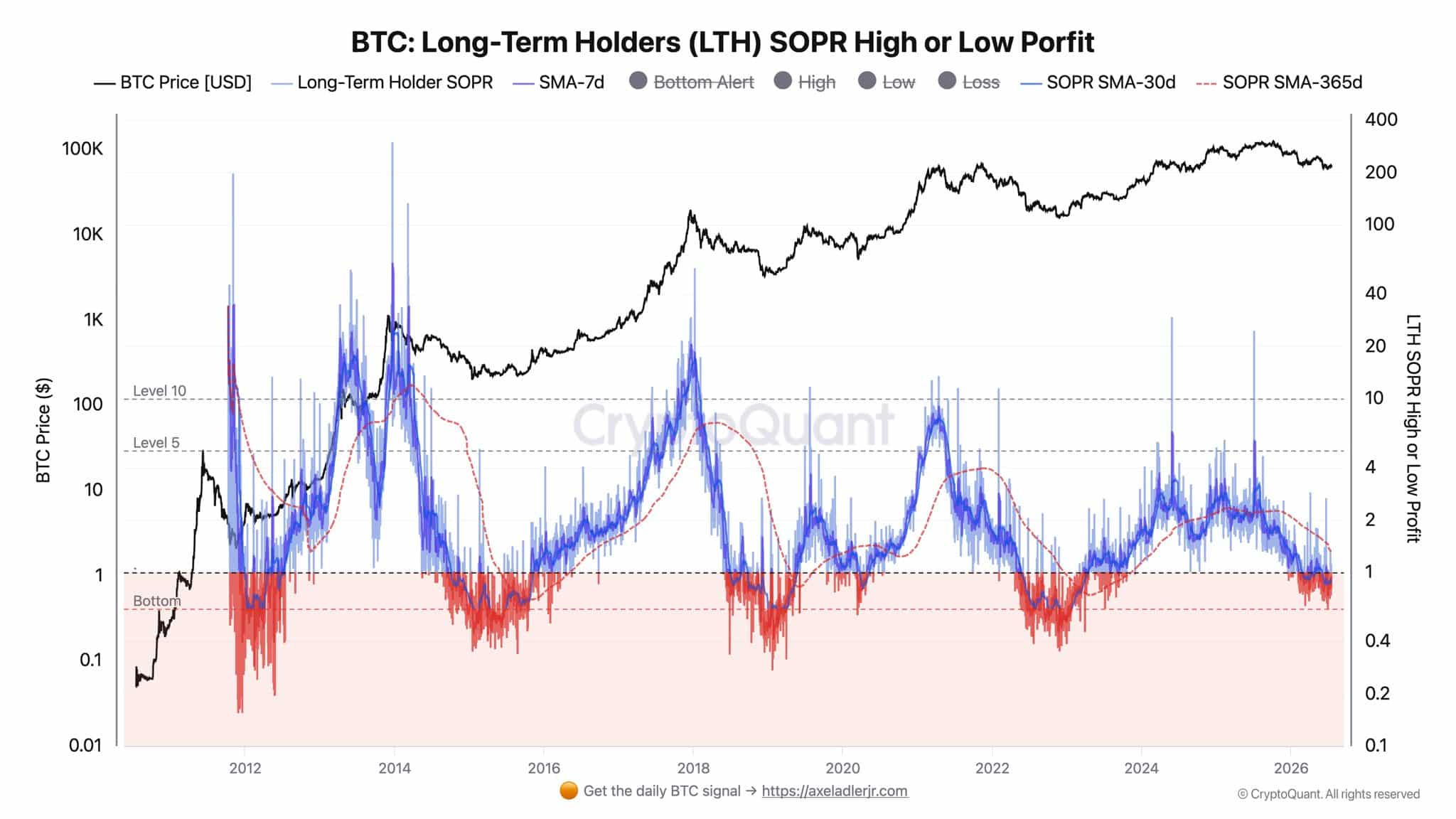
Long-term holders are investors who have held their coins for no less than 155 days without moving them, and on-chain data shows this group selling at a loss rather than a profit.

The 7-day moving average of the long-term holder SOPR – the Spent Output Profit Ratio (SOPR), which measures whether coins move at a profit or a loss – sits at 0.94 at press time, below the breakeven mark of 1.

That reading tells us long-term holders have parted with their Bitcoin at roughly a 6% loss so far.

Bitcoin longterm holders SOPR.
Source: CryptoQuant

The figure marks a sharp improvement from earlier in the cycle, when the group sold at a 27% loss and the LTH SOPR fell to 0.73.

Less selling does not translate to full conviction, and the improvement does not mean the market has locked in a rebound, so long-term holders remain exposed to further price swings.

The monthly picture reinforces that caution, with the LTH SOPR showing these investors selling at a 12% loss since June.

History still offers a counterweight, as prolonged stretches of loss-taking have often preceded Bitcoin rallies, including the 2020 and 2023 runs to fresh all-time highs after the market exited similar phases.

Exchange CDD points to short-term holder dominance

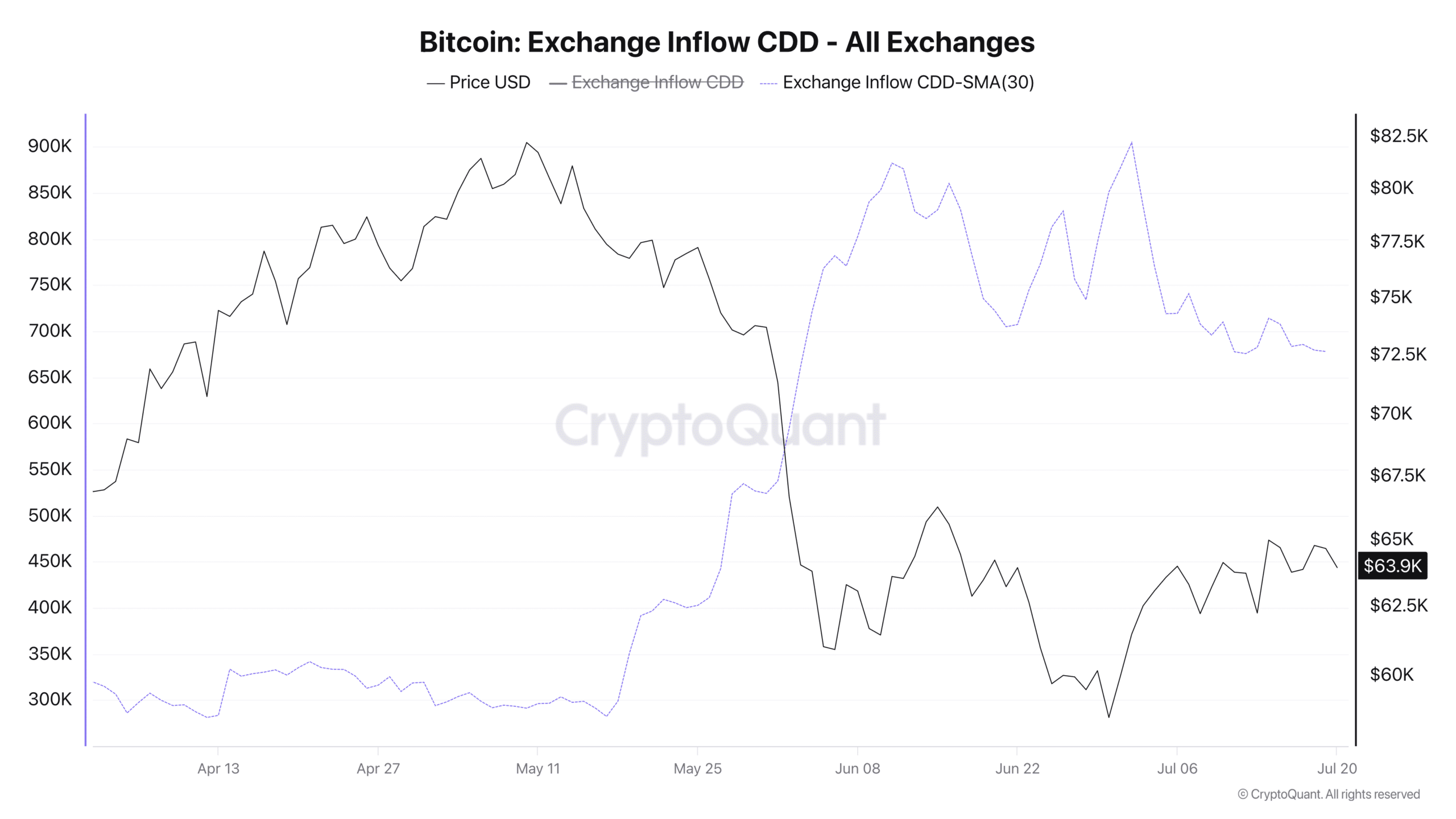
Exchange Coin Days Destroyed (CDD) weights each moving coin by how long it stayed dormant, which lets analysts see whether long-term or short-term holders drive the coins landing on exchanges, and the metric currently marks short-term, active participants as the dominant force.

An elevated Exchange CDD normally signals that sellers control the market as selling pressure builds, a classic bearish read, yet the opposite is playing out here and points to a more relaxed phase.

Bitcoin Exchange CDD Bitcoin Exchange CDD
Source: CryptoQuant

Fewer long-term holders are moving coins, and with that group nursing losses of only about 6%, the setup leans constructive and raises the odds of a faster recovery from current levels.

The exchange reserve reflects that shift, and although long-term holders do not dominate the reserve, they contribute to a decline that has carried it from a high of 2.718 million BTC to 2.704 million BTC.

That drop returns the reserve to its late-June footing, around the 24th of June.

Will US investors keep funding?

Economic pressures and the threat of resurgent inflation still weigh on the market.

Inflation cooled over the past week on official readings, yet concern has climbed as the conflict involving the US, Iran, and Israel has escalated. Oil has answered the tension, with WTI crude climbing to $85.59 at Monday’s open, its highest level since the 12th of June.

The inflation worry runs largely through oil, since rising crude lifts production costs across the economy and increases the risk-off mood—and Bitcoin depends on risk-on appetite. Should oil continue to climb, US investors may reduce their exposure through spot US Bitcoin ETFs.


Final Summary

  • Long-term holders have eased their selling, now offloading at a 6% loss versus 27% earlier.
  • Bitcoin still needs a risk-on appetite, so rising oil and fresh inflation fears could push US investors to trim exposure.


Source link

Domino’s value deals reveal shift in pizza lovers behavior

0
Domino's value deals reveal shift in pizza lovers behavior


Domino’s Pizza (DPZ) delivered enough good news to send its shares sharply higher Monday morning.

The details were substantially less festive.

Domino’s said second-quarter revenue was $1.19 billion, up 4.3% from a year ago and just over Wall Street‘s projection of $1.18 billion. Earnings rose 6.8% to $4.07 a share but fell short of the consensus forecast of $4.17.

Shares rose about 7% in premarket trading following the release. The stock fell roughly 23% in 2026 before the report, setting a low bar for signs of business stabilization.

Demand for pizza is not back, and the rally does not mean it will return immediately.

U.S. same-store sales barely climbed 0.1%, well below 3.4% a year ago. Currency-neutral international same-store sales were down 0.1%.

Instead, the findings reveal the genuine defensive edge that Domino has.

The corporation can drive revenues from shop openings, royalties, and supply-chain sales, too, even if current restaurants don’t grow much.

“I believe order growth is the most important driver of long-term success in our business,” retiring CEO Russell Weiner said.

Domino’s business grew faster than its restaurants

Domino’s said the number of orders was up in delivery and carryout, adding millions of new customers to its system.

That’s stronger than same-store sales, because transactions and revenue aren’t the same thing. Promotions can help you win new orders, while lower average expenditure can limit growth in sales.

Another concern is the difference between company-owned and franchised establishments.

Same-store sales at company-owned U.S. restaurants grew 2.1%. The far bigger group of franchised restaurants had no growth. About 99% of Domino’s stores throughout the world were operated by independent franchisees at the end of the quarter.

Domino’s corporate results were more robust.

Related: Domino’s CEO issues blunt message on growing problem

Supply-chain revenue increased 6.5% to $731.7 million, supported by higher store-order volumes and a 2.2% increase in food-basket pricing. Supply-chain gross margin improved to 12% from 11.8%.

That business offers food and supplies to restaurants, providing Domino’s another avenue to earn when its franchisees take more orders.

Domino’s value push may be stronger than its profitsCheng Xin / Getty Images

Domino’s stock rally is a bet on resilience

The premarket rise suggested that investors were glad that weak consumers had not led to a greater earnings breakdown.

Operating income increased 3.1% to $232 million, while net income rose 3.6% to $135.8 million. Earnings per share grew faster than profit, aided by a lower share count as Domino’s repurchased $156.2 million of stock during the quarter.

Management also reiterated its outlook for positive low-single-digit U.S. and international same-store-sales growth in 2026.

But thus far the company has not shown a widespread revival in demand.

More Restaurants:

Domino’s offers value deals to attract customers and has a supply chain that converts those orders into revenue. The danger is that promotions are more economically favorable for the parent firm than for franchisees who are bearing the cost of food, labor, and delivery.

Another reason not to interpret the quarter as a plain-vanilla win is that free cash flow declined 5.5% to $313.6 million in the first half.

What Domino’s investors should watch next

The first test is whether order increase finally leads to greater comp sales.

Investors also want to see proof that franchisees can hold restaurant-level earnings at acceptable levels with marketing and food costs still high.

Incoming CEO Joe Jordan will have that problem when he takes over for Weiner on Oct. 1. He inherits a system that has the ability to raise corporate revenue in a soft consumer environment but is still looking for real sales momentum.

Key takeaways for Domino’s investors

  • Revenue beat expectations, while earnings per share missed.

  • Shares rose about 7% in premarket trading.

  • U.S. same-store sales increased only 0.1%.

  • Supply-chain revenue and store openings drove much of the growth.

  • Franchise restaurant sales were flat.

  • Order counts and franchisee economics remain the critical indicators.

Domino’s second-quarter report doesn’t show people spending freely again.

It showed that the company can withstand their caution.

Sales at current restaurants were basically flat, and its franchise, supply chain, and store development businesses fueled the expansion. That resiliency initially offset the profit deficit in the eyes of investors.

Resilience is not the same thing as recovery.

Domino’s needs to convert more orders into better restaurant sales to sustain the rally without making value promotions harder and more difficult for franchisees to maintain.

Related: Domino’s Pizza CEO flags why consumer demand is suddenly slipping

This story was originally published by TheStreet on Jul 20, 2026, where it first appeared in the Restaurants section. Add TheStreet as a Preferred Source by clicking here.


Source link

Bank of Korea prepares for live CBDC transactions with 9 banks in September

0
Bank of Korea prepares for live CBDC transactions with 9 banks in September

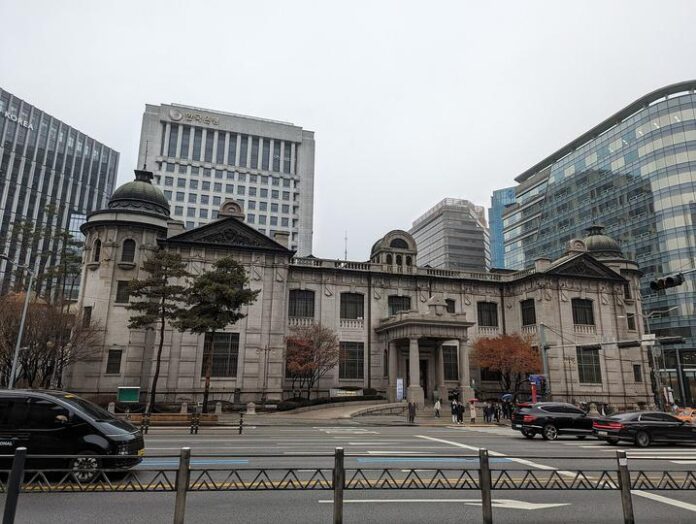
The Bank of Korea’s central bank digital currency (CBDC) plans are moving forward with nine participating banks.

The second phase of BOK’s CBDC program is scheduled for September with real-transaction testing, Yonhap News Agency reported on Monday.

“The Bank of Korea will provide the infrastructure for the institutional CBDC, and each bank will conduct its own business using deposit tokens,” a BOK official told YNA. “From the second phase, we will lay the groundwork for commercialization.”

The BOK’s second phase will expand to include a total of nine participating banks, including Gyeongnam Bank and iM Bank. The country’s top three banks, KB Kookmin, Shinhan, Hana, and Woori Financial Group, are also participating in the CBDC project.

“The goal is to create an environment where the won can be traded freely regardless of time or place,” Yonhap quoted the government as saying.

CBDCs are a digital form of blockchain-based fiat currency that are managed by the issuing central bank and considered legal tender. Only a handful of countries have officially introduced a CBDC. Bahamas unveiled one in October 2020, Nigeria in 2021, and Jamaica in 2022, according to the Atlantic Council’s CBDC tracker.


Source link

Silver prices today, Monday, July 20, 2026: Silver ticks up after violent weekend in Middle East

0
Silver prices today, Monday, June 15, 2026: Silver prices moving up following U.S., Iran ceasefire deal


Silver (SI=F) September futures opened at $55.96 per ounce on Monday, July 20, 2026, down 0.6% from Friday’s closing price. The silver price moved higher this morning, reaching $57.05 as of 8:45 a.m. ET.

Silver opened lower this morning as the U.S.-Iran conflict continued, with deadly results. The death of at least three U.S. service members over the weekend brings the American death toll to more than 15. Two of the three were killed in an Iranian strike on a U.S. air base in Jordan. The attack prompted U.S. Central Command to threaten a swift punishment on Friday. U.S. strikes continued through Sunday night.

The interest rate implications of continued fighting in the Middle East is a headwind for the price of silver. An extended war raises the likelihood of higher interest rates later this year. Rate increases raise the opportunity cost of holding silver, since it does not pay a cash yield.

The opening price of silver futures on Monday, July 20, 2026, was 0.6% lower compared to Friday’s closing price. Here’s how today’s opening silver price has changed versus last week, month, and year:

  • One week ago: -5%

  • One month ago: -15.5%

  • One year ago: +45.3%

For context, silver’s year-over-year growth was 173.3% on May 14.

24/7 silver price tracking: Don’t forget you can monitor the current price of silver on Yahoo Finance 24 hours a day, seven days a week.

Want to learn more about the current top-performing companies in the silver industry? Explore a list of the top-performing companies in the silver industry using the Yahoo Finance Screener. You can create your own screeners with over 150 different screening criteria.

There are several ways to invest in silver, from buying the metal itself to choosing financial products tied to its price. Here’s how each option works.

The most direct way to invest in silver is to buy it in physical form, either as bullion bars or government-minted coins. This gives you direct ownership of the metal, with no counterparty risk from an exchange or financial institution.

The trade-off is logistics. You’ll need to think about storage, security, and potentially insurance. Dealers also charge a markup above the spot price, which means prices need to rise enough to cover that premium before you’re in profit. Still, for investors who want tangible ownership of their assets, physical silver is a straightforward option.

Silver exchange-traded funds (ETFs) trade on stock exchanges the same way individual stocks do. Some ETFs hold physical silver directly, giving shareholders fractional ownership of real metal. Others invest in silver mining companies rather than the commodity itself.

ETFs are generally the most accessible and liquid way to get silver exposure. You can buy and sell them through any standard brokerage account, and there’s no storage or insurance to worry about.

Keep in mind, though, that some silver funds are taxed as collectibles rather than investments, which can mean a higher tax rate. It’s worth confirming the tax treatment with a professional before investing. You’ll also have to keep an eye on expense ratios.

Read more: 5 ways to invest in silver for beginners

Whether you’re tracking the price of silver since last month or last year, the price-of-silver chart below shows the precious metal’s value journey so far this year.

More silver coverage from the Yahoo Finance team: 


Source link

VIRTUAL traders bet on sustained gains, but can demand break $0.65?

0
VIRTUAL traders bet on sustained gains, but can demand break $0.65?


Virtuals Protocol [VIRTUAL] rallied nearly 5% in the past 24 hours, with an Open Interest increase of nearly 17%. The rally, rising open interest, and stronger trading volume suggest improving short-term sentiment, although the broader trend remains under pressure.

This statement was reinforced by the high daily trading volume. According to CoinMarketCap data, the volume in the past 24 hours at press time was $71.1 million, more than double the previous day’s volume.

Weekends tend to see low volume, and it could be that Monday kicked off VIRTUAL’s rally. Bitcoin [BTC] was also challenging the $65.2k local supply zone.

AMBCrypto reported that Virtuals Protocol had introduced customizable tokenized indexes to the Robinhood Chain. Any user can publish such a composite asset and would earn fees when others mint the associated token.

So far, the news has not been enough to nudge the altcoin prices back above key overhead supply zones. Let’s examine where these were and how strong demand really has been.

VIRTUAL still labors within a downtrend

VIRTUAL 1-day Chart
Source: VIRTUAL/USDT on TradingView

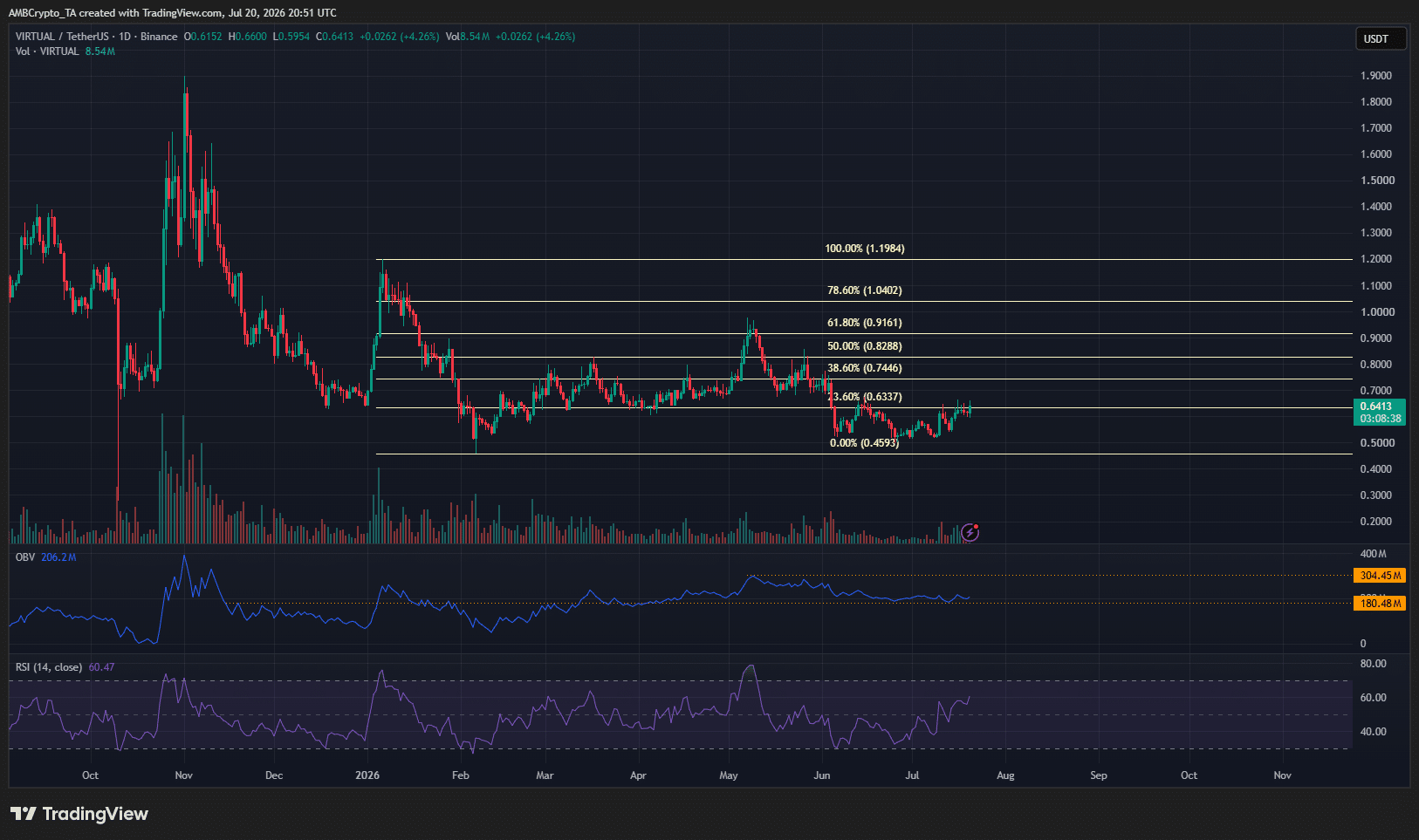
The swing structure on the 1-day timeframe was bearish. As things stand, a move below the $0.459 swing low would indicate a bearish trend continuation. Meanwhile, a rally past $1.19 is needed to flip the swing structure bullishly.

The VIRTUAL price gain of 17% in the past week was set against this bearish backdrop. The rally has reached the $0.63-$0.65 local supply zone. The same area had rejected the bulls back in mid-June.

The OBV has been trending lower since May. The 100% spike in daily trading volume could be a misleading sign. Though the RSI was above 50 to signal upward momentum, a lack of sustained buying volume over the past two months was a telltale sign of a weak bounce.

Traders’ call to action- Sell, but be ready to flip biases

In the short-term, a rejection from the $0.65 local supply zone is expected. However, if VIRTUAL prices breach this area, a bullish move as high as $1.04 and even $1.19 becomes possible.

Therefore, traders can maintain a bearish bias until $0.65 is conquered. Once it is flipped to support, swing traders can try to profit from the rally toward $1, although they should remember that the higher timeframe structure remained bearish.


Final Summary

  • The Virtuals Protocol price and volume spike on Monday could be a sign of a bullish short-term price move.
  • The long-term trend was bearish, but if $0.65 is flipped to support, a rally toward $1.0-$1.2 could follow.


Source link

A BTC price volatility surge may be brewing, key indicator suggests: Crypto Daily

0
A BTC price volatility surge may be brewing, key indicator suggests: Crypto Daily

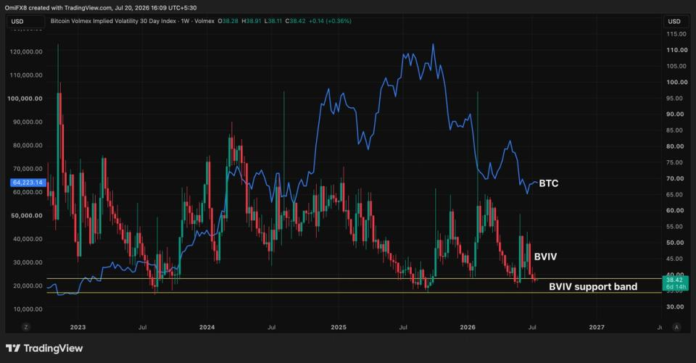
While past patterns are never a guarantee of future performance, volatility metrics are widely known to be mean-reverting. This cyclical nature suggests that periods of below-average volatility are often followed by higher turbulence, while above-average volatility paves the way for market stability.

Currently, the index is trading below both its 30-day and 200-day simple moving averages. In essence, volatility is relatively “cheap” and sitting at a historically reliable support zone, suggesting the measure could be set to rise, which means another round of turbulence.

For now, bitcoin continues to trade just above $64,000, maintaining the range-bound price action that has persisted since last Wednesday. While some analysts have noted two consecutive weeks of spot ETF inflows, the capital movement is tiny compared with the billions yanked from the market during the preceding eight-week outflow streak.

Global volatility gauges in traditional markets are currently offering mixed signals. South Korea’s KOSPI VIX is currently above 70%, its highest level since the 1990s. Meanwhile, Wall Street’s VIX jumped over 12% to reach 18% on Friday, where it continues to hover. However, these levels have been in the play for months, which means that stocks are anything but panicked.

Additionally, the MOVE index, the 30-day volatility gauge for U.S. Treasury notes that underpins global finance, remains steady around 70%, as it has since April, offering a constructive cue for risk assets. Stay alert!


Source link