Home Blog Page 213

Ethereum news: Bitmine (BMNR) slows ETH purchase pace to shift cash to $86 million stock buyback

0
Ethereum news: Bitmine (BMNR) buys 42k ETH while Strategy sells bitcoin (BTC)

Bitmine (BMNR), the largest Ethereum treasury firm, bought just 7,430 ether (ETH) last week, dialing back its buying spree as it redirected capital to a stock buyback.

The latest purchase, worth about $14 million at ether’s current price of $1,879, lifted BitMine’s holdings to 5,78 million ETH, or roughly 4.8% of Ethereum’s circulating supply, according to a Monday company update.

BMNR was 2.4% higher in pre-market trading.

The purchase marks one of firm’s smallest weekly additions since launching its Ethereum treasury strategy in June 2025. By comparison, the firm bought more than 111,000 ETH during one week in May and had regularly acquired tens of thousands of tokens throughout the first half of the year. The firm is nearing its goal to corner 5% of ETH supply.

Chairman Thomas “Tom” Lee attributed the slowdown to the company’s decision to repurchase approximately 5.5 million shares at an average price of $15.62 under its previously authorized $4 billion buyback program.

“The reduced pace of buys reflects that Bitmine repurchased 5.5 million common shares,” Lee said. He added that the company has purchased ETH every week since adopting its treasury strategy just over a year ago.


Source link

Gold prices today, Monday, July 20, 2026: Gold holds above $4,000 despite continued violence in the Middle East

0
Gold prices today, Monday, June 29: Holding at last week's levels ahead of June jobs report


Gold (GC=F) August futures opened at $4,005.60 per troy ounce on Monday, July 20, 2026, down 0.3% from Friday’s closing price. As of 8:15 a.m. ET, the price of gold was up to $4,016.10.

Gold rebounded slightly from a sub-$4,000 opening price on Friday, despite a weekend of violence in the Middle East. Three U.S. service members were killed, two in an Iranian attack in Jordan and another in northern Iran during a controlled detonation of a drone. Sunday marked the ninth consecutive night of U.S. strikes targeting a range of Iranian military targets. 

Secretary of State Marco Rubio said Sunday the U.S. is “always open to diplomacy,” but reiterated that Iran must reopen the Strait of Hormuz. The Strait’s closure has been a critical driver of higher gas prices in the U.S. and globally.

Continued high gas prices increase the broader inflation risk — which could force the Fed to raise interest rates. Higher interest rates encourage lower gold prices, since precious metals do not pay interest.

The opening price of gold futures on Monday, July 20, 2026, was down 0.3% from Friday’s closing price. Here’s a look at how the opening gold price has changed versus last week, month, and year:  

  • One week ago: -1.8%

  • One month ago: -6.4%

  • One year ago: +20%

For context, the one-year gain for gold was 95.6% on Jan. 29.

24/7 gold price tracking: Don’t forget you can monitor the current price of gold on Yahoo Finance 24 hours a day, seven days a week. 

Want to learn more about the current top-performing companies in the gold industry? Explore a list of the top-performing companies in the gold industry using the Yahoo Finance Screener. You can create your own screeners with over 150 different screening criteria.

The price of gold can be quoted in multiple forms because the precious metal is traded in different ways. The two main gold prices investors should know about are spot prices and gold futures prices.

Learn more: How to invest in gold in 4 steps

The spot price of gold is the current market price per ounce for physical gold as a raw material, sometimes called spot gold. Gold ETFs that are backed by physical gold assets generally track the gold spot price. 

The spot price is lower than what you’d pay to buy gold coins, bullion, or jewelry, since your total price will include a markup called the gold premium that covers refining, marketing, dealer overhead, and profits. The spot price is more like a wholesale price, and the spot price plus the gold premium is the retail price.   

Learn more: Thinking of buying gold? Here’s what investors should watch for.

Gold futures are contracts that mandate a gold transaction at a specific price on a future date. These contracts are exchange-traded and more liquid than physical gold. They settle on the contract expiration date or earlier, either financially or via delivery. A financial cash settlement involves paying the contract’s profit or loss in cash. Delivery means the seller sends physical gold to the buyer for the contracted price.

Supply and demand determine gold spot prices and gold futures prices. Factors that influence gold supply and demand include:

  1. Geopolitical events

  2. Central bank buying trends

  3. Inflation 

  4. Interest rates

  5. Mining production

Learn more: Who decides what gold is worth? How prices are determined.

Whether you’re tracking the price since last month or last year, the price of gold chart below shows the precious metal’s change in value. 


Source link

Bitcoin spot demand weakens as new capital hesitates despite ETF inflows

0
Bitcoin spot demand weakens as new capital hesitates despite ETF inflows


1alt HD: ETF Turnaround Proves Insufficient to Trigger True Macro Bullish Turnaround for Bitcoin Traders

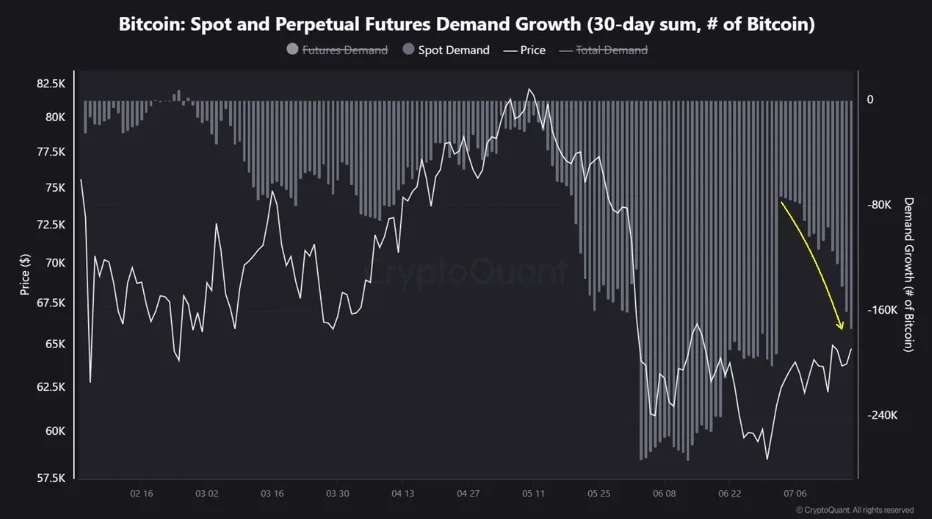
Bitcoin [BTC] was struggling to scale the $65k local supply zone. Since July 14, the spot Bitcoin ETF inflows have been positive. The injection of capital has not been enough to substantially elevate prices yet.

Bitcoin Demand Growth
Source: CryptoQuant

Crypto analyst ScenarioX noted a steady drop-off in the 30-day Bitcoin spot demand. The metric recovered to -80k BTC in early July, but has since deteriorated to -170k BTC, the analyst explained in a post on CryptoQuant Insights.

Despite decreased demand, prices have stayed relatively stable around $65k because of short-covering in the derivatives market. Easing short-term holder sell pressure was also a contributing factor.

AMBCrypto reported that the turnaround in ETF flows was not enough to confirm a bullish reversal. A reading of the short-term price structure highlighted the importance of the $67.3k local swing high.

Lack of new investors growth signals stabilization, not reversal

Bitcoin New InvestorsBitcoin New Investors
Source: Axel Adler Jr.

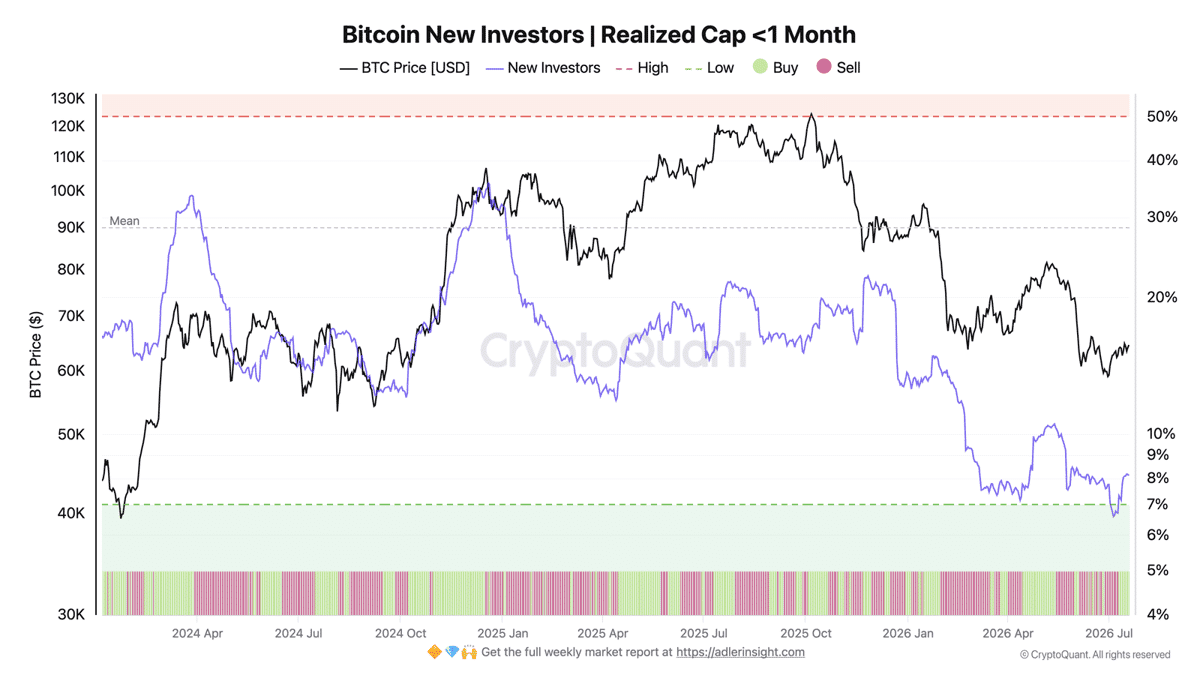
The Bitcoin New Investors metric remained near its yearly lows. It measures the share of capitalization concentrated among coins younger than 1 month [not moved in a month or less].

Crypto analyst Axel Adler Jr. used this metric to gauge new capital activity and short-term demand. The analyst observed a reading of 8.1, with the lower boundary at 7 and the upper at 50.

This meant an increase in new capital, but not in enough strength to point toward a BTC trend reversal.

Bitcoin STH SOPRBitcoin STH SOPR
Source: Axel Adler Jr.

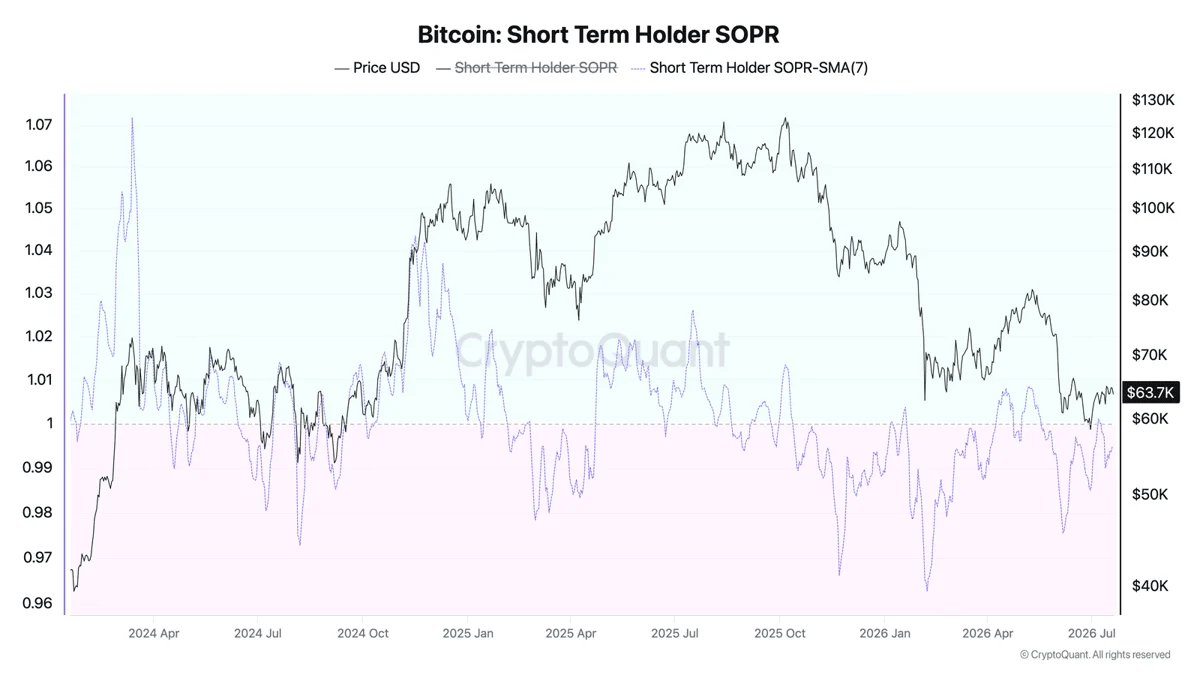
Further evidence of a local stabilization instead of a reversal came from the short-term holder spent output profit ratio [STH SOPR]. The metric measures the average profitability of short-term Bitcoin holders.

Its 7-day moving average was at 0.99, below the 1.0 mark that separates profitability from realized losses.

A sustained recovery in the metric above 1.0 would signal market sentiment has shifted. As things stand, the lack of significant participation from new capital and short-term holders realizing losses meant that bears were still in control.


Final Summary

  • Bitcoin has not yet found the momentum to take prices above the $65k-$67k local supply zone.
  • The bounce toward $65k was only a brief respite from selling, and not the beginning of a bullish recovery, the metrics showed.


Source link

Hut 8, IREN land billions in new contracts, lifting AI compute stocks MARA, RIOT, WULF

0
Hut 8, IREN land billions in new contracts, lifting AI compute stocks MARA, RIOT, WULF

Shares of bitcoin miners turned AI infrastructure providers surged Monday after Hut 8 (HUT) and IREN (IREN) announced billions of dollars in new contracts, easing concerns that demand for AI computing capacity may be slowing.

Hut 8 rose as much as 17% after signing a 15-year, $9.8 billion lease for the second phase of its Beacon Point AI data center campus in Texas. The agreement, with the same investment-grade customer that leased the first phase, doubles the tenant’s footprint to 704 megawatts (MW) and fully commercializes the site’s 1 gigawatt of power capacity.

IREN gained as much as 19% after announcing $2.8 billion in new multiyear cloud services contracts with AI developers. The company raised its year-end AI Cloud annualized run-rate revenue target to more than $4 billion, saying about 85% of that revenue is now under contract.

The news spilled over to peers across the high-performance compute sector. Mining (CIFR) gained 11% and TeraWulf (WULF) added 6.4%. Bitcoin miners Riot Platforms (RIOT) and MARA Holdings (MARA) advanced 5% and 9%, respectively. The CoinShares Bitcoin Miners ETF (WGMI) rose 8.5%.


Source link

Mark Cuban: Solution to income inequality is giving every worker, from CEO to janitor, company stock

0
Mark Cuban: Solution to income inequality is giving every worker, from CEO to janitor, company stock

Following SpaceX’s blockbuster $1.77 trillion initial public offering, Juan Hernandez, a former welder for the aerospace and satellite company, saw his wealth balloon overnight as a result of his stake in the firm. Hernandez, who joined SpaceXin 2015 earning $28 per hour, now holds an estimated $880,000 in shares following the company’s IPO, the Wall Street Journal reported. According to billionaire investor Mark Cuban, this model of employees owning shares of the companies they work for should be the norm, not the exception.

Company stock options don’t just offer the possibility of a hefty payday for a business’ perhaps unsung workers, Cuban said; it’s a way to address the pervasive problem of growing income inequality. In a recent episode of the “What It Takes” podcast by Unmoderated News, Cuban outlined his own philosophy around how to close wealth disparities.

“I would like to see it so that every single CEO, founder, entrepreneur does what I did, which was to give equity to every single employee,” he said. “The way you’re going to reduce income inequality for anybody who works with somebody is making sure they get shares of stock and then they benefit.”

Cuban gave 330 employees at his media company Broadcast.com stock ahead of Yahoo acquiring it for $5.7 billion 1999, making 300 of them millionaires, he said. He similarly gave equity and cash bonuses to employees of his first IT consulting company MicroSolutions

This isn’t the first time Cuban has made remarks regarding a more equitable distribution of wealth. Cuban has previously advocated for a $20 federal minimum wage, recalling instances in which a company he invested in, but didn’t run or name, had employees in need of government assistance.

“I made sure they all got raises,” Cuban wrote in an X post. “It was embarrassing to me that we didn’t pay enough. I’ve made, or helped make, at least a thousand millionaires. And I’ll keep working to increase that number.”

The K-shaped economy of the rich getting rich and the poor poorer is reflected in the growing wage gap among U.S. employees: In 2024, S&P 500 CEOS made 285 times more than the median pay of their workers, up from 268 times in 2023, according to a report by the AFL-CIO. The chief executives saw an average compensation of $18.9 million with an average increase of $1.4 million, a 7% year-over-year increase.

Other tech leaders like the world’s richest man Elon Musk, who saw his wealth increase by $215 billion in 2025, have similarly advocated for employee ownership, arguing the strategy aligns company incentives. A little more than a month later, SpaceX’s IPO has already minted at least 4,400 millionaires.

“I’ve always had the philosophy that everyone at the company should receive stock in the company, so that they can participate in the upside of the company,” Musk told Texas Gov. Greg Abbott earlier this month.

How would Cuban’s vision for more company stock ownership play out?

Amid a rise of democratic socialist politicians like New York City Mayor Zohran Mamdani championing affordability platforms, Cuban—a believer in “compassionate capitalism”—has argued a free-market economy can generate similar solutions to those generated by government-owned social services. One such example is his launching of the  pharmaceutical company Cost Plus Drugs in 2022, which is able to slash the cost of prescription medications by selling mostly generic products without the typical middlemen of Pharmacy Benefit Managers. 

He’s taking the same mechanism to the income side as well, believing he found a viable way to encourage more companies to adopt his employee-ownership philosophy. For example, Cuban explained, governments can incentivize CEOs to give every employee the same percentage of stock warrants, options, or other equities by dangling the carrot of a lower corporate tax rate than the set 21%. In other words, if a CEO receives a stock valued at 10% of their cash compensation, workers should likewise receive 10% in stock of their own earnings.

“So if the CEO gets $100,000 worth of stock because they make $1 million in cash, and the janitor makes $50,000, then they deserve the same percentage in stock, and that will change the game,” Cuban said.

How viable is Cuban’s philosophy?

Research suggests employee-ownership can be an effective means of closing the wealth gap. A 2021 Harvard Business School study citing government data found that if all private firms in the U.S. became 30% employee-owned, household wealth in the country would effectively double. In contrast, the wealth of the richest Americans would decrease as a result of this model, with the top 1% of wealth holders seeing an average 14% decrease in their net wealth.

Allowing employees to hold company equity is also associated with increased productivity and less turnover, and a 2004 Rutgers University study found companies offering employee ownership stakes of at least 5% have a higher likelihood of survival than those without the benefit, which researchers attributed to greater employment security.

“When you align everyone’s incentives with a common goal, everyone will work harder to achieve that goal,” Ethan Rouen, a Harvard Business School professor of business administration, said in an interview for the college about Harvard’s research. “When you have an equity stake, all of a sudden you have a claim on the upside, and so that incentivizes you to work harder to increase that upside. It is something that has the potential to grow the pie and create wealth for everyone involved.”


Source link

How to file a renters insurance claim — and what to do if a claim is denied

0
How to file a renters insurance claim — and what to do if a claim is denied


If you’re wondering how to file a renters insurance claim, there’s a good chance something stressful has already happened. Whether your belongings were stolen, damaged by a fire, or ruined by a burst pipe, knowing what to do next can help the claims process go smoothly.

In general, it may make sense to file a claim with renters insurance when two things happen: 

  1. The damage or loss is caused by a covered event.

  2. The cost to replace or repair your belongings exceeds your deductible.

Here’s an example: 

If a fire destroys $8,000 worth of furniture and electronics and your deductible is $500, filing a claim could save you $7,500. If a covered water leak ruins a $300 coffee table and your deductible is $500, filing a claim likely won’t result in a payout.

Some of the most common reasons renters file claims include theft, fire damage, vandalism, certain types of water damage, and liability incidents involving guests.

Learn more: 7 best renters insurance companies of 2026

Before you throw anything away, start repairs, or replace damaged items, take time to document exactly what happened. The more evidence you have, the easier it will be for your provider to verify your renters insurance claim.

Start by photographing all damaged property from multiple angles.

If there’s water damage, photograph the source of the leak if it’s visible. If there’s a break-in, photograph damaged doors, broken windows, or other signs of forced entry. A quick video walkthrough can also help capture the full extent of the damage and make sure you don’t overlook something.

Next, make a detailed inventory of everything affected.

For each item, try to include:

  • A description of the item

  • Brand and model number

  • Approximate purchase date

  • Original purchase price

  • Estimated replacement cost

It’s OK if you can’t remember every detail perfectly. Just focus on providing as much information as you reasonably can.

Read more: How much is renters insurance?

Ideally, you should keep physical or digital receipts for your belongings. But you can also show proof of ownership through: 

Learn more: What does renters insurance cover?

You may need to file a police report if your belongings were stolen or vandalized. Your insurance company may want a copy of this report before processing your claim.

Insurance companies generally expect you to take reasonable steps to prevent additional losses after an incident occurs.

For example, if a pipe bursts after a record-breaking snowstorm, you may need to shut off your water valve and move any of your undamaged belongings to a dry area. If your bedroom window was shattered during a thunderstorm, you may need to temporarily board it up.

Pro tip: If you incur any expenses while preventing further damage, keep the receipts. Your policy may reimburse some of those costs.

Once you’ve documented the damage, you’re ready to start a claim. Most renters insurance claims follow a similar process, no matter which company you use.

For most renters insurance companies, you can file a claim online through the website, via your phone through the mobile app, or by calling an insurance agent. 

When you start the claim, you’ll typically be asked for:

Next, you’ll provide all the documentation you gathered earlier to support your renters insurance claim.

This may include:

  • Photos and videos of the damage

  • A list of damaged or stolen items

  • Receipts or proof of ownership

  • Police reports

  • Repair estimates

  • Receipts for temporary expenses related to the loss

After you submit your claim, your insurance company may assign a claims adjuster to review it.

Depending on the situation, the adjuster may:

  • Ask follow-up questions

  • Request additional documentation

  • Conduct a virtual inspection

  • Visit the property in person

Once your insurance company finishes reviewing your claim, it will determine how much it will pay.

The amount may depend on:

For example, if your policy has a $1,000 deductible and the covered loss is valued at $6,000, your payout could be approximately $5,000.

After your claim is approved, you’ll receive payment. Depending on the size of the claim, you could receive payment all at once or in chunks over time as you complete repairs or as replacement costs are verified. In many cases, you could receive your payment electronically directly into your bank account or via a mailed check.

Even after you receive your renters insurance claim payout, hang on to any documents you received during the process. If questions come up later, it will be good to have any emails, receipts, settlement letters, claim numbers, and other communication you had along the way. 

A simple claim may be processed in a matter of a few business days, especially if you use a company that lets you file your claim online. But major losses that require more verification will take longer. 

In these cases, the insurance company may need to:

Once your claim is underway, try to respond promptly to any requests from your insurance company. If your adjuster has to repeatedly request receipts, photos, or additional details about damaged items, the claim can stall and take longer than necessary.

If you’re hit with a denied renters insurance claim, it could be for one of several reasons: 

A common reason claims are denied is that the loss wasn’t caused by a covered event. For example, standard renters insurance policies typically cover theft and fire, but they usually don’t cover floods, earthquakes, and some types of mold damage. If damage falls into an excluded category, your claim will probably be denied.

Insurance companies usually require a “proof of loss” inventory to help prove that an actual loss occurred. If you can’t provide photos, receipts, police reports, or other supporting documentation, your provider may deny all or part of the claim.

If your coverage accidentally lapsed because of a missed payment or because you forgot to renew your policy, for example, your claim could be denied. 

Sometimes a claim is partially denied because certain items exceed the limits in the policy.

For example, many renters insurance policies place special limits on jewelry, collectibles, firearms, cash, and electronics. Even if the overall claim is approved, you may not get reimbursed for the full value of every item.

Requesting a written explanation is the first thing you should do when a renters insurance claim is denied. You can then review this explanation to figure out their reasoning. If you disagree with the denial, there are several steps you could potentially take: 

  • Go through your insurer’s formal appeal process, if there is one.

  • Hire a public adjuster to review your claim or represent you.

  • File a complaint with your state department if you suspect your insurance company denied you without good reason.

Establishing these habits can make any renters insurance claim less stressful.

  • Create a home inventory before you need it. A home inventory is one of the most valuable tools you can have during a claim. Take photos of your belongings, record serial numbers for electronics, and keep a basic list of major purchases.

  • Save receipts for expensive purchases. You don’t need to keep every receipt forever, but try to save them for larger purchases. Many retailers make this easy through online accounts, emailed receipts, or purchase histories you can access later.

  • Take a moment to review your coverage. Understand your coverage before disaster strikes. Note of your deductible, coverage limits, and exclusions now can help prevent surprises later. For example, knowing if your policy pays actual cash value or replacement cost can help you know what to expect from a settlement.

  • Report losses as soon as possible. The sooner you notify your insurance company, the easier it may be to investigate the loss, gather evidence, and process your claim.

  • Keep a folder of everything related to your claim. Save claim numbers, emails, receipts, photos, repair estimates, and notes from conversations with your adjuster. Having everything organized can make the process much smoother if questions arise later.

Another way to save: Bundle auto and renters insurance

You should hear from your insurance company within 10 business days. That doesn’t mean you’ll receive your payout that soon, but you should at least know that it’s being looked into at that point. In some states, your insurance company has 30 days to decide if your claim is approved or not. 

It truly depends on what your deductible is and whether you’re at risk of having your premiums increase if you file a claim. If the damage is small enough that you could comfortably cover the repair or replacement — or if the damage is around the same amount as your deductible — it may not be worth it. 

You may need a police or fire department report to turn in your claim if the incident is a result of theft, vandalism, or a fire. If you haven’t filed a report and are wondering if you need one, call your insurance company and ask. 

It’s very normal for your insurance rates to go up after filing any type of claim, including a renters insurance claim. How much your rates are affected (if at all) will likely depend on the company you choose, the type of claim, and the size of the loss. 

You may need to involve your landlord in a renters insurance claim if the building itself is also damaged. For example, if your upstairs neighbor’s kitchen caught fire and it damaged part of your unit, your landlord will likely need to file their own insurance claim too. But if your bike was stolen off the front porch and nothing else was damaged, they likely don’t need to know about it.


Source link