Crypto wallet firm Exodus Movement (EXOD) will cut about 25% of its global workforce as it reshapes its business around stablecoin payments and card infrastructure.
The Omaha, Nebraska-based company said in a filing the layoffs are part of a broader effort to lower costs while supporting its strategy of building a full-stack payments platform.
The restructuring comes as Exodus continues to integrate Monavate, an electronic money institution, and crypto payments firm Baanx, two acquisitions that have expanded its payments capabilities and international footprint.
Exodus said it expects to record pre-tax restructuring charges of between $2.5 million and $3.5 million, mostly tied to severance and employee-related costs. Affected workers will receive severance, continued benefits and transition support.
The company said the restructuring should generate annual cash operating expense savings of $10 million to $13 million, with the full benefit expected in 2027.
EXOD is higher by 2.2% in early trading Monday, but remains down nearly 85% year-over-year.
Pi Network [PI] extended its bullish streak, briefly reclaiming $0.1 before slightly retracing. At press time, PI was trading at around $0.098 after rising 11% on the daily charts.
This price hike was backed by a 200% jump in trading volume while the market cap reclaimed $1 billion, reflecting steady capital flow.
Protocol v25 upgrade improves PI’s stability
The crypto market has been highly anticipated for the Pi Network’s upcoming upgrade. On the 22nd of July, the network will undergo an upgrade to Protocol v25. The upgrade seeks to improve the network’s reliability and stability and to add capabilities for more efficient, privacy-preserving smart contracts.
Protocol v25 will bring BN254 cryptography and Poseidon hashing, enabling developers to build modern zero-knowledge applications. Additionally, the network updated its app profile page in the mining app, thus restoring pioneers’ confidence in the ecosystem.
Demand for the altcoin holds steady
The anticipation of the upgrade has sparked market-wide optimism, with investors rushing to reposition.
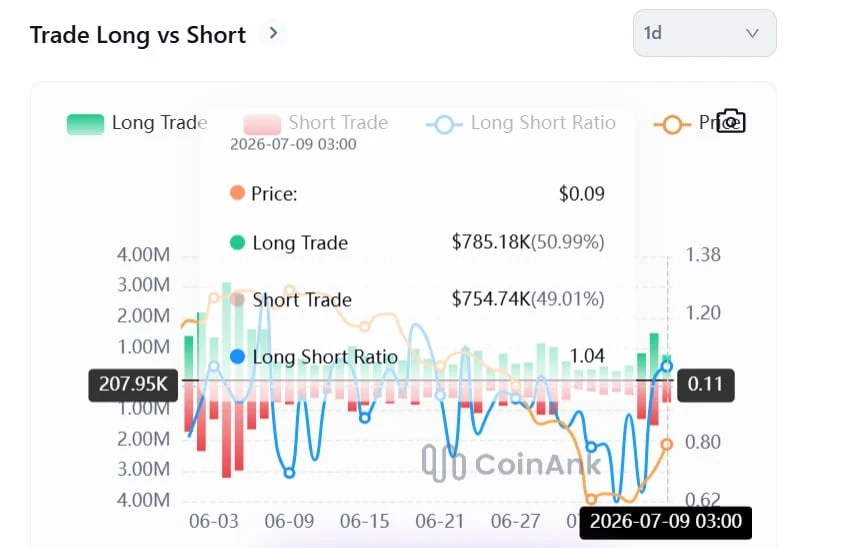
In fact, the speculative demand rebounded significantly. According to Coinank, PI’s Long/Short Ratio has remained above 1 for two consecutive days.
Source: Coinank
At press time, the metric was 1.04, with 50.9% accounting for long positions. When traders mostly open longs, it suggests they were bullish and anticipated further gains.
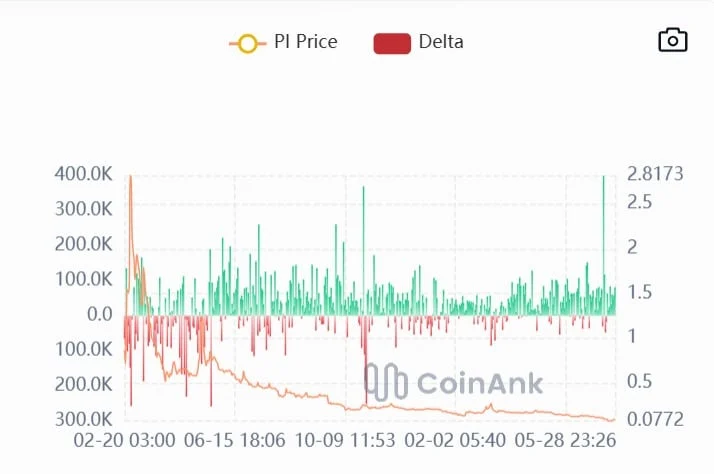
Moreover, investors on the spot side have been aggressively accumulating PI. Notably, the market Delta has remained positive for nine consecutive days.
Source: Coinank
A positive delta suggests that market demand is currently strong, with buyers actively pushing prices higher. This is often a strong bullish confirmation.
Typically, when both speculators and spot buyers are active, it strengthens the market, setting the stage for further gains on price charts.
Can the momentum hold?
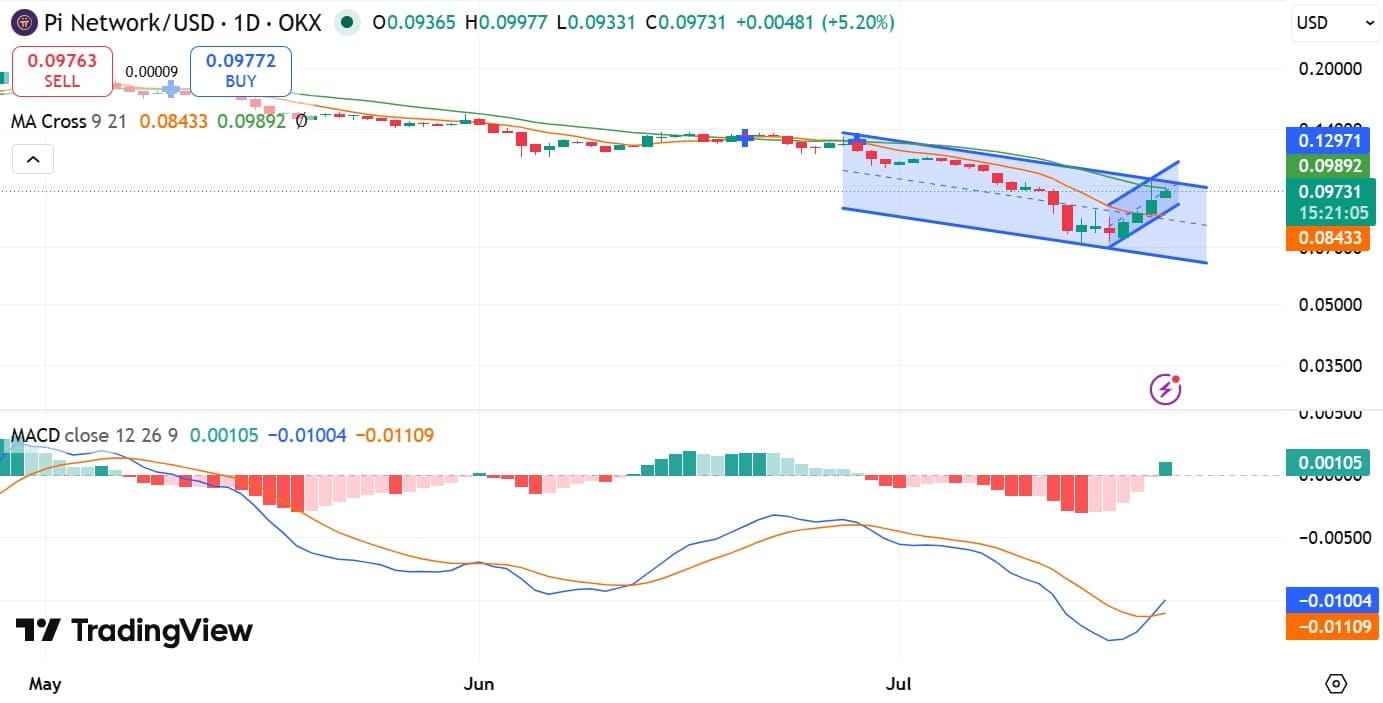
PI has experienced strong upside momentum, closing at higher highs for four consecutive days. As a result, the altcoin flipped both the 21 and 9-day Moving Averages, signaling strong upside momentum.
Source: TradingView
At the same time, the altcoin’s MACD formed a bullish crossover, rising to -0.009, further confirming the strengthening trend. However, the MACD remained negative, indicating that buyers have not yet fully retaken and dominated the market.
For now, if the upcoming upgrade incentivizes more market players to retake, the altcoin will make further gains. In doing so, PI will hold above $0.10 and target the $0.12 resistance.
Final Summary
Pi Network extended its bullish streak, rising by 11% to $0.1 before slightly retracing to $0.098 at press time.
PI has experienced renewed demand as traders reposition ahead of the upcoming protocol v25 upgrade.
Michael Saylor-led Strategy (Nasdaq: MSTR), formerly MicroStrategy, repeated its playbook from last week as it again sold the company’s common shares to boost its cash reserve while adding no Bitcoin (BTC) to its balance sheet.
The company disclosed in its filing with the Securities and Exchange Commission (SEC) on July 20 that it sold 2,732,318 MSTR shares worth $263.5 million and grew its U.S. dollar reserve to $3.225 billion.
The cash reserve is intended to support the payment of dividends on the company’s preferred stock and interest on its outstanding indebtedness.
Similar to last week, Strategy did not buy or sell any Bitcoin as the company’s holdings stood at 843,775 coins as of July 19.
The company even sold Bitcoin twice this year for the first time after 2022.
The company has purchased these coins for $63.69 billion at an average price of $75,476 per coin.
As reported earlier, JPMorgan Chase analysts said that Strategy’s cash boost, coupled with positive flows into Bitcoin futures, are “encouraging signs” for Bitcoin’s outlook.
As per the analysts, retail investors have been buying the Strategy-linked ETFs. This buying trend has supported the MSTR stock, they said.
It adds new capabilities to Plutus, the platform developers use to write Cardano’s smart contracts, unifying the built-in functions available across the platform’s three versions so older applications gain newer features.
The upgrade also tightens several of the ledger’s validation rules, including one guaranteeing that no two stake pools can reuse the same cryptographic identity key.
“As well as Plutus improvements and Plutus Cost Model enhancements, this upgrade lays the foundation for the next upgrade, the Dijkstra era hard fork, which will introduce Ouroboros Leios to Cardano,” Input Output wrote in a development report on Friday.
Ouroboros Leios is a scaling proposal for the proof-of-stake consensus model that Cardano runs. It is expected later in 2026 and aimed at sharply increasing transactions per second without weakening the protocol’s security guarantees.
Van Rossem is the procedural groundwork for Ouroboros, both in the ledger changes it ships and in the precedent it sets: that Cardano can now upgrade itself by vote.
The hard fork is named for Max van Rossem, a Cardano governance contributor who helped shape the network’s constitution and died in October 2025.
What the hard fork means for a Cardano user
There are no visible changes for someone casually holding or spending ADA. Transactions work the same way, wallets do not need updating and the fee to send ADA is unchanged. The upgrade does not alter how the network looks or feels to use.
Aon has increased capacity in its Data Center Lifecycle Insurance Programme (DCLP) to $5bn (£3.72bn), extending risk solutions for digital infrastructure assets from development to long-term operations.
According to Aon, the expansion comes amid increasing investment in AI, cloud computing and hyperscale data centres, which is driving demand for insurance solutions for larger, more complex and more capital-intensive projects through their life cycle.
Aon risk capital CEO Joe Peiser said: “As clients build larger and more complex data centre portfolios, they need access to greater insurance capacity alongside solutions that strengthen resilience throughout the asset life cycle.
“Expanding DCLP to $5bn demonstrates our ability to help clients access capital, manage risk and scale with confidence.”
The company said the enlarged programme reflects its “Reliable by Design” approach to digital infrastructure and takes DCLP beyond conventional insurance placement.
Aon said the model combines insurance capacity, engineering expertise and risk intelligence earlier in the development process.
It said this is intended to help clients reduce transition risk, improve resilience and create digital infrastructure assets that are bankable and insurable at scale.
Under the expanded programme, the DCLP now offers up to $5bn in construction all risks, delay in start-up, and property damage and business interruption cover.
It also provides broader liability, cyber and project cargo protection, including up to $200m in third-party liability outside the US, $100m within the US, $400m in cyber and technology errors and omissions cover, and $500m in project cargo cover.
The programme includes up to $1bn of terrorism capacity through existing Aon facilities.
Aon said the DCLP also now includes broader life cycle risk, resilience and advisory services through Aon Global Risk Consulting.
These include climate risk advisory, environmental risk solutions, operational resilience expertise, owners protective professional indemnity, risk engineering and security risk consulting, covering clients across the asset life cycle.
That change also broadened the programme so it covers existing data centres after their first year of operation.
“Aon expands Data Center Lifecycle Insurance Programme to $5bn” was originally created and published by Life Insurance International, a GlobalData owned brand.
From seafood staples and regional sandwiches to hearty stews and decadent desserts, every state has a dish that reflects its history, culture, and local ingredients.
We identified each state’s most iconic food based on its regional or national recognition, historical or cultural ties to the state, and its enduring place in the state’s culinary identity.
Several have become nationally famous, including Illinois’ deep-dish pizza and Tennessee’s Nashville hot chicken, served by restaurants such as Hattie B’s.
Others are beloved regional specialties, including Maine’s famous cold lobster rolls with mayonnaise and Colorado’s over-the-top Fool’s Gold sandwich.
Some are also tied to major industries that support jobs, tourism, and local economies within their states, such as Alaska’s salmon, Wisconsin’s cheese, and Virginia’s oysters.
Here’s the most iconic local dish from every state.
ALABAMA: Chicken with white barbecue sauce
Chicken with white barbecue sauce. Jacek Chabraszewski/Shutterstock
Alabama’s famous white barbecue sauce, which is made with mayonnaise, vinegar, salt, and ground black pepper, is described as both creamy and tangy.
The sauce, which is said to have been invented in the 1920s by Bob Gibson of Big Bob Gibson Bar-B-Q in Decatur, Alabama, often comes served on a sandwich or with grilled or fried chicken.
ALASKA: Smoked salmon
Smoked salmon. Frank Perry/AFP via Getty Images
Alaska is famous for its salmon, though locals may disagree on the best way to prepare it — whether that’s smoked, grilled, or pan-seared.
For a classic Alaskan meal, serve the fish with seasonal vegetables, or enjoy smoked salmon on a bagel with cream cheese.
ARIZONA: Chimichangas
Chimichangas. Ezume Images/Shutterstock
You might not know that chimichangas were invented in Arizona.
As Tucson Foodie reported, two restaurants in Tucson claim to have originated the dish, a large meat burrito filled with vegetables and spices, deep-fried, and topped with cheese and sauce.
ARKANSAS: Fried pickles
Fried pickles. Kay Ecker/Shutterstock
Fans of fried pickles have Arkansas to thank for the iconic snack. The first fried dill pickles ever sold anywhere first appeared on the menu of the Duchess Drive-In in Atkins, Arkansas, in the summer of 1963, Encyclopedia of Arkansas reported.
CALIFORNIA: Avocado toast
Avocado toast. Alexander Spatari/Getty Images
California is famous for its avocados, so it should come as no surprise that avocado toast is one of the most popular and famous local dishes in the Golden State. The San Francisco Chronicle reported that California residents have been making avocado toast for more than 130 years.
An issue of The Daily Alta California from 1885 lists a recipe that suggests spreading avocado “on slices of bread, and season with salt and pepper.”
COLORADO: The “Fool’s Gold” sandwich
“Fool’s Gold” sandwiches. Karl Gehring/The Denver Post/Getty Images
The now-closed Colorado Mine Company restaurant in Denver invented the original Fool’s Gold sandwich: a hollowed-out loaf of sourdough stuffed with peanut butter, blueberry jam, and a pound of bacon.
The over-the-top sandwich became legendary after Elvis Presley reportedly loved it so much that he flew his private jet to Denver and back in a single night just to eat one.
CONNECTICUT: Warm lobster rolls
Lobster roll. Rebecca Fondren Photo/Shutterstock
Culture Trip reported that the first documented lobster roll was served at a Milford, Connecticut, restaurant named Perry’s in 1929.
Although you may be more familiar with Maine-style lobster rolls served cold with mayonnaise, Connecticut has its own signature take.
A traditional Connecticut-style lobster roll features warm lobster meat lightly dressed with melted butter and served on a split-top bun.
DELAWARE: Peach pie
Peach pie. zoryanchik/Shutterstock
Delaware’s official state dessert is peach pie, and peaches are an integral part of the state’s agricultural industry.
According to the Delaware government, peaches have been an important part of the state’s agricultural heritage since their introduction during Colonial times, when they became a major industry in the 19th century.
At the industry’s peak in 1875, Delaware shipped about 6 million baskets of peaches to market.
FLORIDA: Cuban sandwiches
Cuban sandwiches. Old Republic Kitchen and Bar/Yelp
While these sandwiches can, of course, be traced back to Cuba, what we know now as a “Cuban sandwich” is largely thanks to Cuban immigrants in Tampa, Florida.
Thrillist reported that the sandwiches made in Cuba and the United States had a few key differences when it came to ingredients.
The Florida version, which sometimes used imported Italian salami, became known as a “Cuban sandwich.”
Both Brunswick County, Virginia, and Brunswick, Georgia, claim to be the birthplace of Brunswick stew.
In Brunswick, Georgia, a town monument features a 25-gallon iron pot with an inscription stating that the first batch of Brunswick stew was cooked in it in 1898.
HAWAII: Kālua pork
Kālua pork nachos. Maricay/Shutterstock
Kālua pork is one of Hawaii’s most iconic dishes. The smoked, shredded pork — sometimes mixed with cabbage — is traditionally cooked in an underground oven, which is reflected in its name: “kālua” means “to cook in an underground oven” in Hawaiian.
IDAHO: Finger steaks
Finger steaks. Paul_Brighton/Shutterstock
Many have traced the origin of finger steaks — fried pieces of beef — back to Milo’s Torch Lounge in Boise.
Idaho Beef says chef Milo Bybee invented the dish in 1957 to use the restaurant’s leftover tenderloin.
ILLINOIS: Deep-dish pizza
Deep-dish pizza. Irene Jiang/Business Insider
While you might assume that all pizza originates in Italy, deep-dish pizza is actually American.
The BBC reported that restaurant owners Ike Sewell and Ric Riccardo introduced their creation, an Italian-American pizza they called deep-dish, at Pizzeria Uno in Chicago’s Near North Side neighborhood in 1943.
INDIANA: Pork tenderloin sandwiches
A Hoosier sandwich. Jeff R Clow/Getty Images
Pork tenderloin sandwiches, also called “Hoosier sandwiches,” can be traced back to Nick Freienstein, a Huntington, Indiana, native-born to German parents. Eater reported the dish was originally inspired by Wiener schnitzel, a Viennese-style veal dish that is breaded and pan-fried.
In 1904, Freienstein began selling sandwiches and burgers out of a food cart. While veal was hard to come by in his hometown, pork was readily available. After he added pickles and onions to his fried pork tenderloin sandwich, Freienstein’s cart took off. He is credited with creating the first “Hoosier sandwich.”
IOWA: Fried catfish
Fried catfish and fries. HMR2017/Shutterstock
While fried catfish is a popular dish throughout the South, Iowans are fond of it as well.
KANSAS: Loose meat sandwiches
Loose meat sandwiches. P Lansing/Shutterstock
A cross between a sloppy Joe and a cheeseburger, loose meat sandwiches are a favorite among Kansas locals.
The Nu-Way Cafe, a Wichita-based chain of restaurants, is famous for its loose meat sandwiches. In other parts of the country, they are known as tavern sandwiches or Maid-Rites, named after the Iowa chain.
KENTUCKY: Beer cheese
Beer cheese dip. Africa Studio/Shutterstock
According to local lore, beer cheese was invented by Chef Joe Allman for his cousin Johnnie, the owner of the Driftwood Inn near Winchester, Kentucky.
The Downtown Winchester Beer Cheese Festival reported that the dish was originally created by Allman to entice customers to order more beer with their meals.
LOUISIANA: Gumbo
Chicken and sausage gumbo. Ken Durden/Shutterstock
Gumbo, a traditional stew consisting primarily of a strong-flavored stock, meat or shellfish, a thickener, and vegetables, is the official state cuisine of Louisiana.
Its origins date back to the late 1800s, and many food historians believe the dish evolved from kingombo, an okra-based stew introduced to colonial Louisiana by enslaved Africans.
MAINE: Lobster rolls
A lobster roll with coleslaw and french fries on a waterfront harbor in Maine. jenlo8/Shutterstock
Maine is famous for its lobster rolls, largely because lobster is one of Maine’s most profitable exports.
However, while the first lobster roll can be traced back to Connecticut, Maine-style lobster rolls often feature cold lobster meat rather than warm, dressed with mayonnaise and served in a toasted bun.
MARYLAND: Crab cakes
Crab cakes. Causeway/Shutterstock
Crab cakes likely trace back to Native American cooking in the Chesapeake Bay region of the United States.
However, the first official recipe for crab cakes appeared in a cookbook written by Crosby Gaige in the 1930s, under the name “Maryland Crab Cakes,” Baltimore Magazine reported.
MASSACHUSETTS: New England-style clam chowder
Clam chowder in a bread bowl from Quincy Market in Boston, Massachusetts. J Rook/Shutterstock
Clam chowder has roots all over the Northeast, but New England-style clam chowder is said to have been first served in Boston at Ye Olde Union Oyster House in 1836, Eater reported.
MICHIGAN: Wet burritos
A wet burrito. David Tonelson/Shutterstock
Wet burritos, which come covered in red chile sauce and tons of cheese, are said to have been created at the Beltline Bar in Grand Rapids, Michigan, according to the restaurant’s website, which has reportedly sold 6 million burritos and counting.
MINNESOTA: Corn dogs
Corn dogs. Igor Dutina/Shutterstock
While some say corn dogs, then called “corny dogs,” were introduced at the State Fair of Texas between 1938 and 1942, Pronto Pup vendors at the Minnesota State Fair claim to have invented the first breaded-and-fried hot dog in 1942, Eater reported.
Eater reported that Mississippi mud pie, a dessert made with pudding, cake, biscuits, ice cream, whipped cream, marshmallows, and some kind of liqueur like Kahlua or amaretto, originated somewhere in the Vicksburg or Natchez area.
MISSOURI: Barbecue
Barbecue. Chiquita L./Yelp
Henry Perry is known as the “father of Kansas City barbecue” — he began selling slow-smoked meats wrapped in newspaper for 25 cents in the Garment District of Kansas City, across the Missouri border, in the early 1900s.
He later opened Kansas City’s first official barbecue restaurant in an old trolley barn. Perry loved barbecue so much that, on his death certificate, his occupation was listed as “barbecue man.”
MONTANA: Meat pie
Meat pie. Slawomir Fajer/Shutterstock
Although meat pies have roots in Europe, they’re especially popular in Montana, where they’re better known as pasties.
The handheld pies became a staple in Butte thanks to the area’s large population of Irish and Cornish miners, who could easily carry them to work underground.
The classic Reuben sandwich, made with corned beef, sauerkraut, Swiss cheese, and Thousand Island dressing, and served on rye bread, was supposedly invented by an Omaha, Nebraska, grocer in 1925, the Nebraska State Historical Society reported.
NEVADA: Shrimp cocktail
Shrimp cocktail. Smith Collection/Gado/Getty Images
Although the shrimp cocktail may not have been invented in Nevada or even the United States, Las Vegas residents have certainly claimed it as their own.
The Golden Gate Hotel & Casino says that in 1959, it introduced Las Vegas to its famous, world-recognized 50-cent shrimp cocktail. Ever since, visitors have enjoyed partaking in the city’s signature dish.
NEW HAMPSHIRE: Pancakes with maple syrup
Pancakes with maple syrup. Shawn Patrick Ouellette/Portland Press Herald/Getty Images
Disco fries, which are french fries smothered in gravy, mozzarella, and other toppings, originate from the Garden State.
Local legend has it that the late-night dish got its name from the hordes of people pouring into New Jersey diners after a long night of dancing, in search of the perfect snack.
NEW MEXICO: Green chile cheeseburgers
Green chile cheeseburger. Chris Curtis/Shutterstock
Green chiles are the state’s signature vegetable, so it comes as no surprise that New Mexico natives would want to add the ingredient to their burgers.
NEW YORK: Pizza
New York pizza. ChameleonsEye/Shutterstock
New York is undeniably famous for its pizza, from cheap and cheerful $1 slices to more gourmet versions. New York City is also home to the nation’s first pizzeria, Lombardi’s, which opened in Little Italy in 1905.
NORTH CAROLINA: Krispy Kreme donuts
Krispy Kreme donuts. Rachel Askinasi/Insider
Krispy Kreme began operating in Winston-Salem, North Carolina, on July 13, 1937. At the time, the owner Vernon Rudolph was only selling his donuts to local grocery stores.
However, after people passing by the bakery asked about the heavenly scent, he cut a hole in an outside wall and began selling glazed donuts to people on the sidewalk.
NORTH DAKOTA: Walleye
Fried walleye. Cathy Scola/Getty Images
North Dakota is famous for its walleye, and the state is known not only for selling the fried fish on its own but also in sandwiches.
What’s Cooking America reported that Cincinnati prides itself on being the chili capital of the United States with more than 180 chili parlors. Thinner in consistency and commonly served over pasta, the dish is slightly different from traditional chili.
Cincinnati-style chili is also often topped with chopped onions, shredded cheese, beans, and crushed oyster crackers.
OKLAHOMA: Chicken-fried steak
Chicken-fried steak. bhofack2/Getty Images
Chicken-fried steak often comes served with mashed potatoes and gravy and is popular all over the South.
However, one state loves the dish so much that it decided to make it official. In 1988, Oklahomans named chicken-fried steak one of their state meals, the Oklahoma Historical Society reported.
OREGON: Clams
Clams. Shutterstock
Clamming is a popular activity in Oregon, where shellfish is abundant. So, it makes perfect sense that one of the most famous dishes from Oregon would involve clams.
PENNSYLVANIA: Philly cheesesteak
Philly cheesesteak. Shutterstock
The state’s most famous food by far is the classic Philly cheesesteak, which is believed to have been invented by a hot dog vendor in 1930, Visit Philadelphia reported.
The sandwich contains thinly cut steak handsomely topped with cheese on a roll, plus sautéed onions, peppers, mushrooms, mayonnaise, hot sauce, salt, pepper, or ketchup.
RHODE ISLAND: Stuffed clams
Stuffed clams. ProArtWork/Getty Images
Known locally as “stuffies” or stuffed quahogs, stuffed clams are considered Rhode Island’s unofficial state dish.
The classic recipe combines chopped clam meat with breadcrumbs, herbs, onion, bell pepper, and celery, then packs the mixture back into a clamshell and bakes it until golden.
SOUTH CAROLINA: Shrimp and grits
Shrimp and grits. Brent Hofacker/Shutterstock
Although the exact origins of shrimp and grits are debated, many historians believe the dish originated in Charleston or elsewhere along the Carolina coast.
Today, it’s considered one of South Carolina’s signature dishes and is a staple on menus across the state.
SOUTH DAKOTA: Navajo tacos
Navajo tacos. val lawless/Shutterstock
Instead of traditional taco shells, those in South Dakota use frybread, which is flattened dough cooked in hot oil until puffy and crispy, to make Navajo tacos.
However, while the dish is delicious, it also has a controversial history. Native Americans living in South Dakota invented the dish, but it was less about making a tasty meal and more about survival.
Lisa Ironcloud, who works with food sovereignty programs, told Argus Leader that frybread was invented because Native Americans could make it using rationed ingredients like yeast and because it “filled their stomachs.”
TENNESSEE: Nashville hot chicken
Nashville hot chicken. bhofack2/Shutterstock
Nashville hot chicken, which is famous for being extremely spicy, also has quite a spicy history. Nashville hot chicken was invented when Thornton Prince, the owner of Prince’s Hot Chicken, where legend says it was first created, came home to find his lover upset.
To get revenge, she served him chicken covered in extra-hot spices. However, Prince liked the dish so much that he decided to open a restaurant and serve a version of it to local people in Nashville.
TEXAS: Barbecue
A person cooking barbecue. lazyllama/Shutterstock
Texas is practically synonymous with barbecue. While every barbecue region has its own traditions, Texas-style barbecue stands apart for its emphasis on slow-smoked beef, particularly brisket, rather than pork.
Seasoned simply with salt and pepper or a house rub and cooked low and slow over wood, Texas barbecue has become one of the state’s defining culinary traditions and a draw for barbecue lovers from around the world.
UTAH: Pastrami burgers
Pastrami burgers. Tatty B./Yelp
The New York Times reported that pastrami burgers were popularized by Crown Burgers in Salt Lake City, and are still one of the city’s most famous foods. The burgers come topped with a Thousand Island-style sauce as well as tomatoes, shaved lettuce, and onions, but can also come served with cheese or other toppings.
VERMONT: Vermont corn chowder
Vermont corn chowder. zepp1969/Getty Images
Vermont corn chowder is a state-favorite dish made with a milk-based broth, corn, and other vegetables like onions, potatoes, and cabbage, thickened with flour or Vermont cheddar cheese. Bacon is also commonly added to the dish.
VIRGINIA: Oysters
A man shucking an oyster. ButtermilkgirlVirginia/Shutterstock
Virginia’s government website claims that “Virginia is for Oyster Lovers,” and there’s a reason. Not only is Virginia home to multiple oyster festivals but Virginia oysters can be harvested in eight different regions of the state.
WASHINGTON: Fish and chips
Fish and chips. Igor Sh/Shutterstock
While fish and chips are often thought of as a quintessentially British dish, the state of Washington is equally famous for its flaky, fried fish and chips.
WEST VIRGINIA: Biscuits and gravy
Biscuits and gravy. Bonnie Jo Mount/The Washington Post/Getty Images
The roots of biscuits and gravy can be traced back to the Southern Appalachian region of the United States in the late 1800s. The Washington Post reported that the earliest version of this Southern food used sausage gravy, which was also called “sawmill gravy” at the time.
Historians believe that the food was hearty enough to power sawmill workers through their long days lifting heavy logs, and also thick and flavorful enough to make biscuits of that era “more palatable.”
WISCONSIN: Fried cheese curds
Fried cheese curds. Paul Drinkwater/NBCU Photo Bank/NBCUniversal/Getty Images
Fried cheese curds are a favorite dish in Wisconsin, the state famous for its cheese and dairy products. What’s Cooking America reported that cheese factories in the state have to make cheese curds daily to meet the high demand for the product.
WYOMING: Bison burgers
The bison burger at Senator’s Steakhouse & Brass Buffalo Saloon in Cheyenne, Wyoming. Autumn Parry/For The Washington Post via Getty Images
Bison has long been associated with Wyoming, from the wild herds that have historically roamed the region to the private ranches that raise the animals across the state today.
As such, the meat reflects Wyoming’s Western and ranching identity. The state’s tourism office says, when it comes to popular dishes, Wyoming is best known for bison, as well as elk, venison, and locally caught trout.
Bison appears on menus across the state, including at Senator’s Steakhouse & Brass Buffalo Saloon in Cheyenne (pictured).
Avalanche [AVAX] is among the top chains by activity, but its price action continues to struggle just like other cryptos.
Notably, the number of transactions on Avalanche’s C-Chain has increased significantly since last year. Furthermore, while the stablecoin market cap is rising, indicating that liquidity is growing on the chain, AVAX’s price continues to lag.
Daily transactions on Avalanche surges
As per on-chain data, the number of average daily transactions on Avalanche has exploded in the past year. To be specific, they have been moving consistently up since Q2 of 2025.
In April and May of 2025, daily transactions on AVAX stood at around 300K per day. The spike on the 13th of July took Avalanche’s transactions to 6.2 million, which equates to an increase of nearly 20x in a year.
Source: DefILlama
However, this metric has not been steady, with traffic down 9% in the past 24 hours, clocking 2.620 million as of writing.
However, despite the decline in transactions, the burn rate increased by almost 4%. About 135.65 AVAX were burned permanently, an increase from 130.51 AVAX the previous day.
Total supply on Avalanche up by double-digits
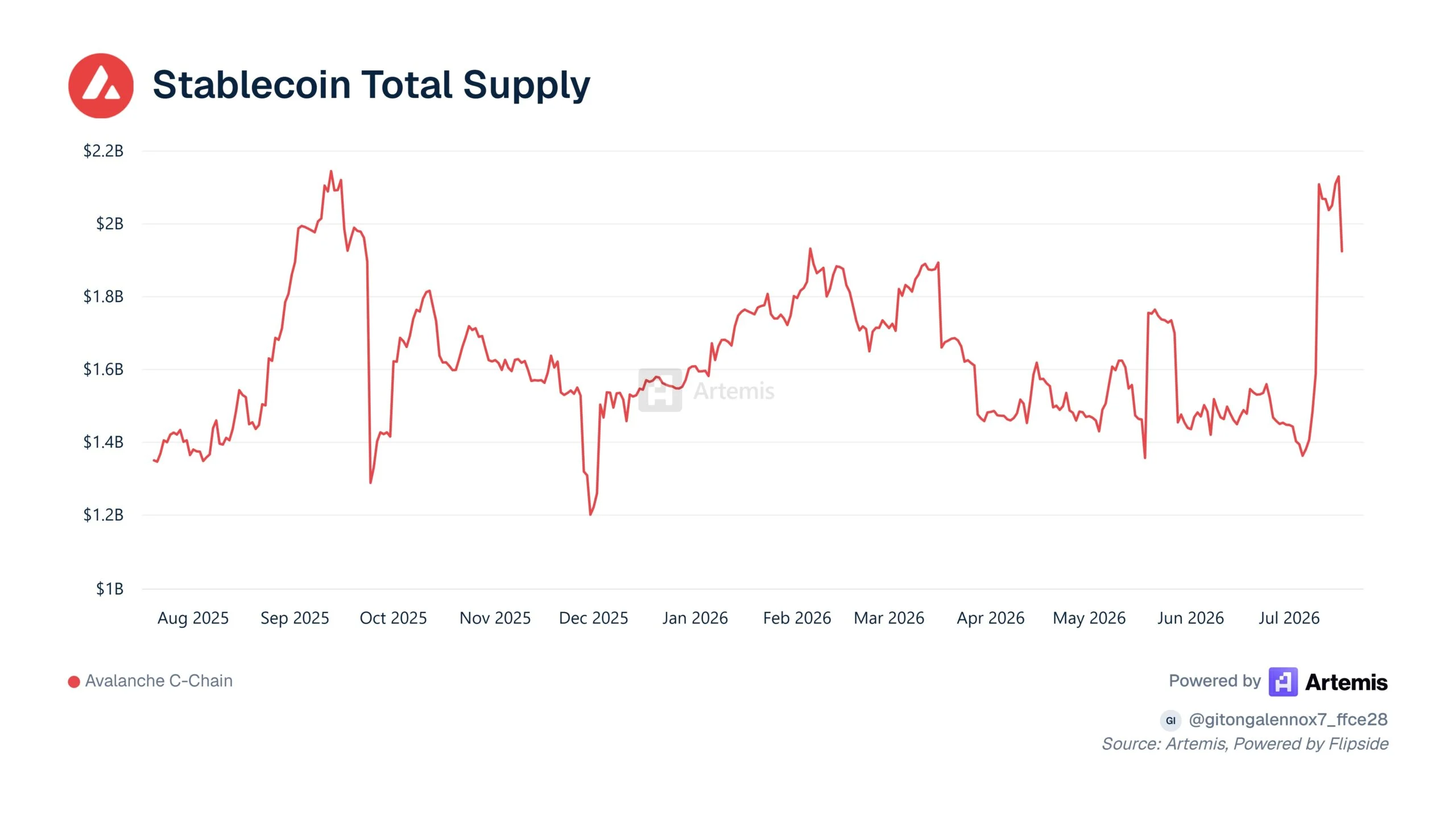
Moreover, Avalanche broke into the top-10 stablecoin networks. This is after AVAX’s stablecoin supply inreased by more than 43% in just a week, reaching a total of over $2 billion. However, at press time, it has dropped to $1.90 billion.
Source: Artemis
However, according to DefiLlama, the AVAX stablecoin market cap has declined by 11% this week to around $1.59 billion . All in all, the data shows chain activity on Avalanche is thriving organically, but it’s leaving the price of the native token behind.
Here’s why AVAX price is lagging
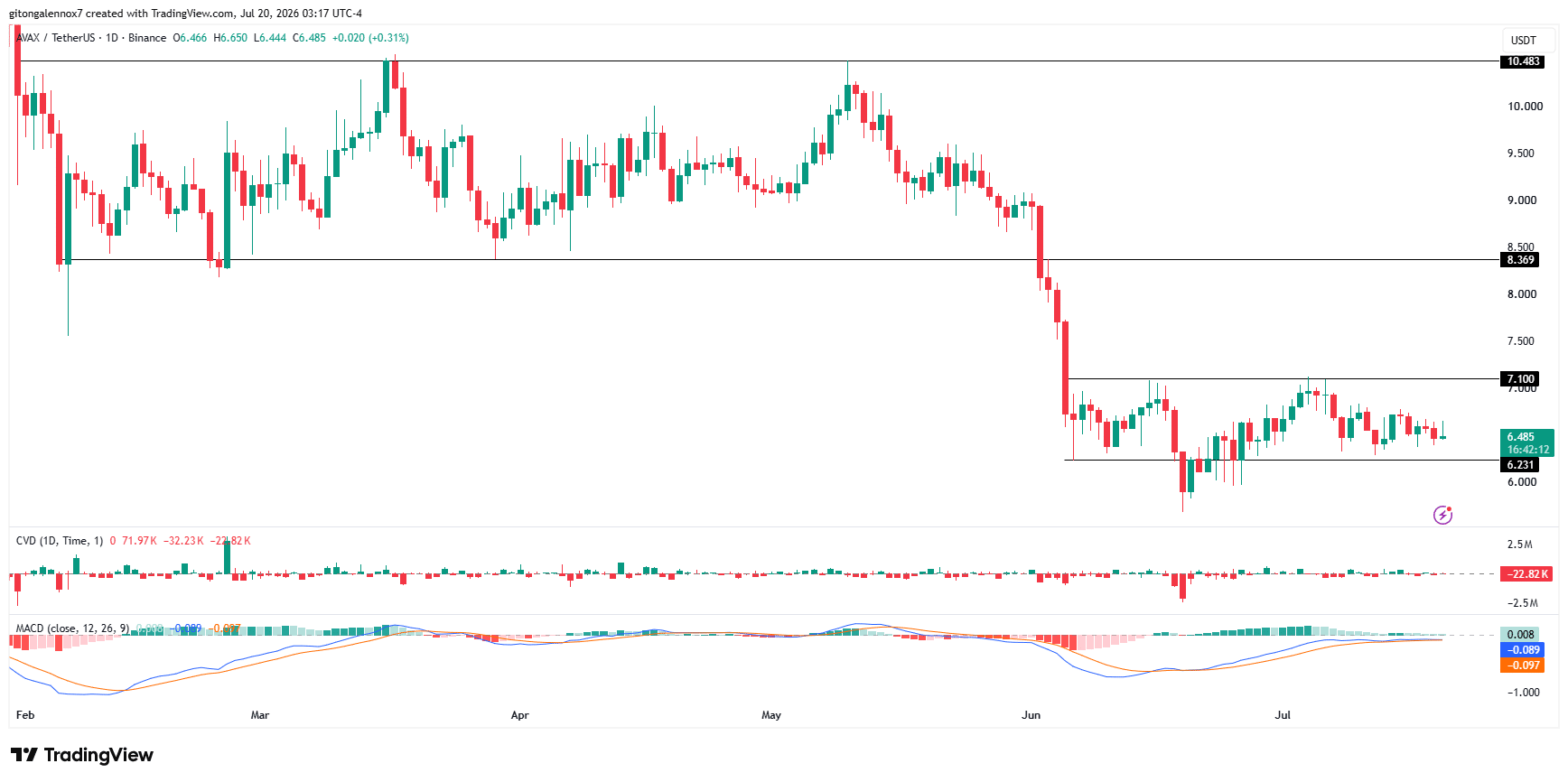
The daily price-action chart is making new lower levels. For instance, it consolidated between $8.369 and $10.483 from February to June before breaking below the $8 support. Again, it has entered another stall as it trades between $6.231 and $7.100 since the beginning of June.
The overall downtrend is evident from the CVD. In fact, 22.82K AVAX were sold in 24 hours despite momentum being on the buyers’ side.
Source: AVAX/USDT on TradingView
The market structure is bearish, which explains why the token is falling despite its thriving network activity. Again, the broader crypto market is weak, and AVAX is not an exception to this trend.
Final Summary
Avalanche’s daily transactions spike by nearly 20x in a year alongside its stablecoin market cap.
AVAX price is making new lower lows, with the price now stalling between $6.231 and $7.100 since June.