Brazil’s securities regulator, the Comissão de Valores Mobiliários (CVM) said it created a working group to draft an experimental framework for tokenized securities.
The regulator said the framework will cover the registration, custody, trading and settlement of securities using distributed ledger technology.
The group must send its first proposal to the CVM’s board within 60 days of being formally installed, while a broader review will run for 120 days, with a possible 30-day extension.
The group brings together 14 CVM departments and may consult government agencies, market associations, self-regulatory bodies and outside specialists. It will also review cybersecurity risks, international regulatory models and results from earlier sandbox programs, the regulator said.
Brazil already applies securities law according to a token’s economic characteristics. The CVM’s 2022 guidance clarified that using blockchain does not change whether an asset qualifies as a security.
The new review will focus on what happens around the asset.
Blockchains can combine functions that are normally split between exchanges, custodians, registrars, depositories and settlement systems. That raises questions over who controls the official ownership record, how private keys are held, when transactions can be reversed and who is liable when systems fail.
Big Tech companies Alphabet (GOOG, GOOGL) and Tesla (TSLA) highlight this week’s earnings calendar as investors remain torn about huge capex commitments for the AI build-out.
US chipmaker Intel (INTC) will also offer crucial updates on artificial intelligence demand, while IBM (IBM) will provide a fuller picture of its Q2 results after its stock plunged on pre-announced earnings. Rounding out the docket this week are reports from General Motors (GM), AMC Entertainment Holdings (AMC), GE Vernova (GEV), AT&T (T), Lockheed Martin (LMT), and American Express (AXP).
The second quarter reporting season kicked off last week with a wave of bank earnings from JPMorgan (JPM), Morgan Stanley (MS), Citigroup (C), and their Wall Street peers. While the banks reported robust profits, Netflix’s (NFLX) earnings disappointed as its forecast fell short of estimates.
Overall, it’s shaping up to be a strong earnings season for the S&P 500 (^GSPC). According to FactSet data, analysts estimate the year-over-year S&P 500 earnings growth rate for the second quarter will be 24.7% — above the five-year average of 16.4% and the 10-year average of 10.3%.
If that holds, it will mark the second consecutive quarter of earnings growth above 20% for the index and the seventh straight quarter of double-digit growth.
Hyperliquid said its HIP-4 upgrade, which introduced “outcome trading” to the decentralized exchange, will support permissionless deployment of the contracts in a future enhancement.
Once live, anyone will be able to offer a prediction market on the platform, subject to templates approved by validators, Hyperliquid said on Telegram on Sunday. In the meantime, they remain under the authority of validators.
Prediction markets, a sector dominated by Polymarket and Kalshi, allow participants to bet on event outcomes and have evolved into a multibillion-dollar sector of the blockchain industry. Users take positions on events from central bank interest-rate decisions to who performs at the Super Bowl halftime show.
The growing popularity of the platforms — the FIFA World Cup, which wrapped up Sunday with Spain winning its third title, drew more than $50 billion in bets — has attracted centralized trading platforms like Coinbase and Robinhood into the sector to offer customers a one-stop shop for predictions markets alongside more conventional financial trading.
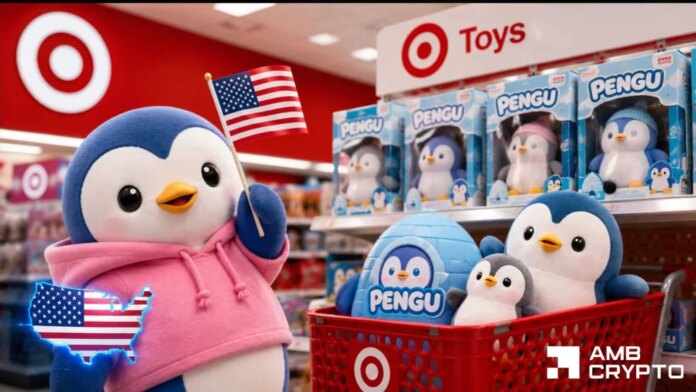
Pudgy Penguins [PENGU] made a major step towards fulfilling its goal to expand its reach beyond the internet.
Following its successful TCG drop in June, Pudgy Penguins has now launched PENGU plushies for retail purchase. The new plushie line marks the NFT project’s biggest push yet into retail. Even more importantly, with this move, Pudgy Penguins extends its reach to millions more users.
In fact, Pudgy Penguins noted this milestone, adding that,
Pengu has been introduced to millions of new people in retail
An expanded user base is good news for the network and the native token, PENGU, as it increases use cases for the token. Furthermore, more traders will discover the token via QR codes on plushies, thus potentially driving demand for PENGU.
How did Pudgy Penguins’ market react?
With the news, the PENGU price made a slight move higher, hiking to $0.0062 before slightly pulling back to $0.0061 at press time. These slight gains were mostly driven by spot buyers who rushed to accumulate.
According to CoinGlass data, the exchange outflows outpaced inflows significantly over the past day. As a result, the Spot Netflow remained negative.
Source: CoinGlass
At press time, the Spot Netflow was -$139k, indicating that more PENGU flowed out of exchanges. Often, reduced supply on exchanges has preceded better price performances.
Bears still dominate perps, risking another pullback
While buyers rushed into the spot on the good news, traders on the derivatives aggressively cashed out on these gains.
Source: Coinalyze
For starters, on the perpetual side, the Perps Sell Volume rose to 984.2 million, compared to 874.9 million in Buy Volume.
As a result, the perps recorded a negative delta of -109.3 million, a clear sign of aggressive selling. The same market behavior was observed on the futures side.
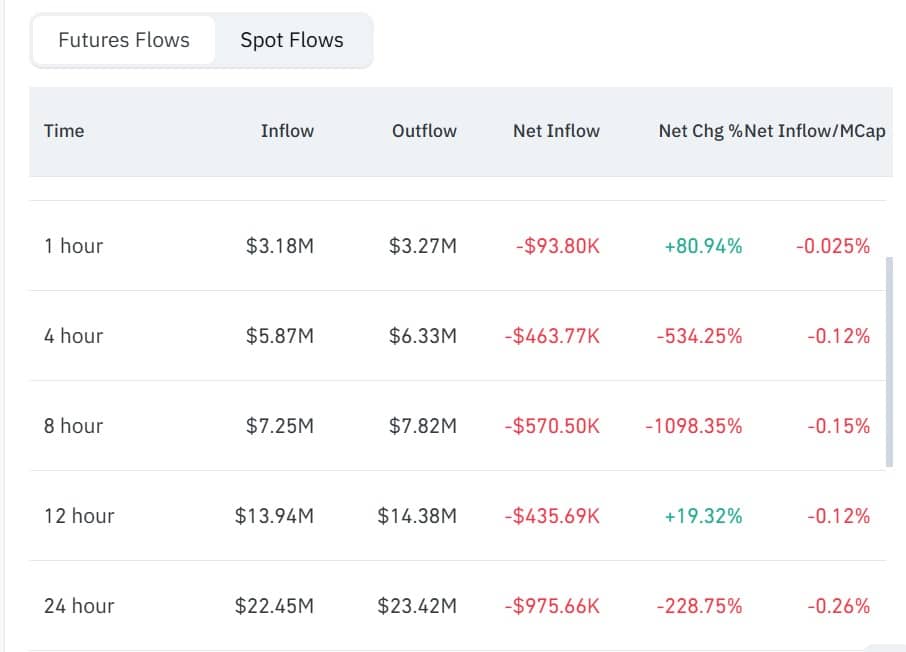
According to CoinGlass data, Futures Outflow rose to $23.4 million while Inflow fell to $22.4 million. For that reason, Futures Netflow dropped 228% to -$975k.
Source: CoinGlass
A negative Futures Netflow suggests that more traders closed their positions, reflecting increased bearishness.
What’s next for the memecoin?
Despite PENGU’s extended reach, the market structure remains strongly bearish. At press time, the Relative Strength Index remained within the bearish zone at 45.
Source: TradingView
This implies sellers are still controlling the market. The Stochastic Momentum Index also confirmed this view, as it remains negative.
Although SMI has been on an upward trajectory, the indicator holds deeply within the bearish zone. Combined, these two indicate that the momentum leans to the downside and is likely to remain so.
Thus, if the slight demand driven by the news fades, exacerbated by derivatives pressure, PENGU will drop to $0.0058. If the plushies help boost demand, however, with the extended base, PENGU could hold $0.006 and target $0.0068.
Final Summary
Pudgy Penguins announced the launch of PENGU plushies on all Target shelves across the United States.
PENGU market remains structurally bearish, driven by intense selling pressure on thderivativeses market.
If you’re looking to supercharge your savings, a high-yield savings account can provide a competitive interest rate to help your balance grow faster.
However, not all banks offer high savings account rates, which is why it’s important to shop around and find the most competitive savings interest rates available.
Read on to learn more about where to find the best savings interest rates today.
Where to find the best savings interest rates today
Today, Monday, July 20, 2026, the highest savings account rate available from our partners is 4.10% APY. This rate is offered by Bask Bank and CIT Bank.
Here is a look at some of the best savings rates available today:
How much interest can I earn with a high-yield savings account?
The amount of interest you can earn from a savings account depends on the annual percentage rate (APY). This is a measure of your total earnings after one year when considering the base interest rate and how often interest compounds (savings account interest typically compounds daily).
Say you put $1,000 in a savings account at the average interest rate of 0.38% with daily compounding. At the end of one year, your balance would grow to $1,003.81 — your initial $1,000 deposit, plus just $3.81 in interest.
Now, let’s say you choose a high-yield savings account that offers 4% APY instead. In this case, your balance would grow to $1,040.81 over the same period, which includes $40.81 in interest.
The more you deposit in an HYSA, the more you stand to earn. If we took our same example of a high-yield savings account at 4% APY, but deposited $10,000, your total balance after one year would be $10,408.08, meaning you’d earn $408.08 in interest.
Deposit account rates — including savings rates — are tied to the federal funds rate. This is the target interest rate set by the Federal Reserve; when it increases its target rate, deposit account rates usually increase. Conversely, when the Fed lowers its rate, deposit rates fall.
Savings account interest rates have fluctuated quite a bit over the past couple of decades. From 2010 to about 2015, rates were rock-bottom, hovering between 0.06% and 0.10%. This was largely due to the 2008 financial crisis and the Federal Reserve‘s decision to lower its target rate to near zero in order to spur economic growth.
From 2015 to 2018, interest rates gradually increased. However, they remained low by historical standards. Then, the onset of the COVID-19 pandemic in 2020 led to another sharp decrease in rates as the Fed cut rates again to stimulate the economy. This brought average savings interest rates down to new lows, around 0.05% to 0.06%, by mid-2021.
Since then, savings account rates have recovered considerably, largely driven by the Fed’s interest rate hikes in response to skyrocketing inflation. However, the Fed finally lowered the federal funds rate toward the end of 2024 and continued to do so throughout 2025. As a result, deposit rates have steadily declined. So far in 2026, the Fed has kept rates unchanged
Is now a good time to put your money in a high-yield savings account?
Choosing where to put your money is an important decision, and there are a few factors you should consider when evaluating your options. A high-yield savings account could make sense if you’re looking for a secure place to hold shorter-term savings while earning a solid return.
Here are a few key considerations:
Interest rates: One of the most important features of a savings account is the interest rate. It’s important to shop around and compare the best offers to ensure your money will grow over time. Considering that savings rates will likely drop in the near future, opening a high-yield savings account now will allow you to take advantage of historically high rates.
Goals: Today’s high-yield savings accounts offer rates we haven’t seen in more than a decade. That said, savings rates still don’t match average returns for the stock market. If you’re saving for a long-term goal like retirement, a savings account probably isn’t the best place to put your money, since your balance won’t grow at a pace that will allow you to reach your target. However, if you’re saving for a financial emergency, a down payment on a home or car, holiday gifts, or another short-term goal, a savings account is a great place to hold those funds.
Accessibility: Certain types of accounts and investments may provide higher returns than a savings account, but may make it difficult to access your funds in a pinch. For example, if you put your savings in a certificate of deposit (CD) and need to access the money before the maturity date, you could be subject to an early withdrawal penalty. So, if you want to be able to dip into your savings as needed, a high-yield savings account is likely the better choice.
Security: In most cases, savings accounts are insured by the FDIC up to the federal limit. They also can’t lose money due to fluctuations in the market, making them a low-risk option.
Do online banks have the best savings account rates?
Online banks operate exclusively via the web. This significantly reduces their overhead costs, so they’re able to pass those savings onto customers in the form of high deposit rates and low fees. In fact, many of the best high-yield savings accounts also come with zero monthly fees or minimum opening deposit requirements. If you’re searching for the best savings interest rates, online banks are a great place to start.
That said, online banks aren’t the only place you can find savings accounts with rates that range between 3% and 4% APY. Credit unions are not-for-profit financial cooperatives known for offering competitive rates and fewer fees. Many credit unions have requirements that must be met to become a member, though some allow just about anyone to join.
How to open a high-yield savings account
The requirements involved in opening a savings account vary by financial institution. However, if you’re ready to open an account, you can follow these general steps:
Research savings account rates: Of course, when choosing a savings account, one of the most important factors to evaluate is the interest rate. Be sure that you select a savings account with a competitive rate to help your money grow.
Figure out your must-haves: Although savings account interest rates should be top of mind, that’s not the only factor to consider. You’ll also want to think about what else you need from your account, whether it’s no minimum-balance requirement, low fees, or other perks. Finding a savings account with a solid rate that also helps you achieve your goals is key.
Prepare documentation: Opening a bank account requires you to provide a few important personal details and documents. Before you start your application, be sure you have your Social Security number, driver’s license or passport number, and proof of address.
Fill out the application: In many cases, you can apply for a savings account online. However, some financial institutions may require you to visit the branch in person to apply. Either way, the application for a new savings account should only take a few minutes to complete. In many cases, you’ll get your approval decision instantly.
Fund your account: Once your savings account application is approved, you’ll need to add funds to the account. Be sure you’re aware of any minimum opening deposit requirements and the timeline for funding.
A high-yield savings account is a good fit if you want to earn a competitive return on money you’ll need in the near future while keeping it safe and accessible. It’s important to not only consider whether the interest rate is attractive, but whether the account matches the purpose of your savings.
An HYSA may be right for you if…
You want to maximize your emergency fund.
You’re saving for a goal within the next one to five years.
You have extra cash sitting in a low-interest checking or traditional savings account.
You prioritize safety over higher potential investment returns.
You don’t need to write checks or use the money for everyday spending.
An HYSA may not be the best choice if…
You’re investing for retirement or another goal that’s 10+ years away. Investing in a diversified portfolio has historically produced higher long-term returns, though with greater risk.
You won’t need the money for a fixed period. If you can leave your savings untouched for several months or years, a certificate of deposit (CD) may offer a higher guaranteed yield.
You need frequent access to your money. A checking account is more convenient for paying bills and making everyday purchases.
A Japanese logistics company that counts Amazon Japan as a client plans to settle payments in the regulated yen stablecoin JPYC with business partners, including independent truck drivers, according to a report by Nikkei Asia.
Tokyo-listed AZ-COM Maruwa Holdings (9090), which reported 230.5 billion yen ($1.4 billion) in revenue for the fiscal year ended March, plans to use JPYC for fees and other payments to its network of around 2,300 partners, including subcontractors and truck drivers. The company has been working with Amazon Japan since 2017, providing delivery services for its online shopping operations.
The move marks the first large-scale corporate use of a stablecoin in day-to-day operations in Japan, signaling that mainstream adoption of tokenized assets continues to expand even as broader cryptocurrency valuations remain subdued in a lingering bear market.
JPYC is Japan’s first fully regulated yen-pegged stablecoin, and is issued by Tokyo-based fintech firm JPYC Inc. The stablecoin debuted in October last year under the Payment Services Act and maintains a strict 1:1 peg to the yen. It is 100% backed by bank deposits and Japanese government bonds. As of last week, its onchain circulation had surpassed 2 billion yen.
Congress might consider a “federal floor, state ceiling” approach to adopting a comprehensive federal set of AI laws.
getty
In today’s column, I examine a frequently identified means of having Congress recalibrate the morass of AI laws throughout the U.S. into a more comprehensible structure by focusing on a so-called “federal floor, state ceiling” approach. This approach is somewhat patterned on other national issues that have spawned a plethora of state-level laws. The gist is that Congress specifies the minimum set of nationwide protections, referred to as a federal floor, while the states then enact stricter requirements, doing so up to some maximum known as a state-level ceiling.
You might have heard or seen this kind of approach in statutes involving consumer protection, labor, and environmental considerations. The aim is to allow states to have a great deal of flexibility while also ensuring a national minimum. That being said, regulating AI in this manner is a challenging proposition since figuring out an acceptable federal floor is a lot harder than it might seem. Weighty debates about what constitutes the minimum could readily waylay the AI legislative endeavor. Furthermore, the worry is that states might go too far above the floor, breaking beyond any semblance of a perceived reasonable ceiling. The bottom line is that there is no free lunch when it comes to resolving the direction of state-level AI laws and the potential for a large-scale, comprehensive federal AI law.
Let’s talk about it. This analysis of AI breakthroughs is part of my ongoing Forbes column coverage on the latest in AI, including identifying and explaining various impactful AI complexities (see the link here).
AI And The Law
As a quick background, I’ve been extensively covering and analyzing a myriad of facets regarding the intersection of AI and the law for many years. You can find my writings not only in my Forbes column but also as posted in Bloomberg Law, ABA Law Journal, The National Jurist, The Global Legal Post, Lawyer Monthly, The Legal Technologist, MIT Computational Law Journal, and so on.
There are two major perspectives on the mixture of AI and law:
(1) Law & AI. The application of laws to the governance and regulation of AI.
(2) AI & Law. The application of AI to perform legal reasoning.
Thus, you can apply the law to AI, and conversely, you can apply AI to the law. For my big picture overview of both of these exciting and rapidly evolving realms, see my discussion at the link here and the link here.
When it comes to applying the law to AI, the aim is to establish suitable regulations and provide appropriate governance on how AI should be devised and implemented. There are longstanding concerns that AI makers aren’t giving due attention to the ethical ramifications of their wares. Ethical issues are construed as “soft laws” and aren’t as formidable as legally enacted laws, known as “hard laws”. To level the playing field and keep AI makers on the up-and-up, some believe that we need more AI laws.
On the other side of the coin is the application of AI to the law. This consists of using AI to aid legal activities. Lawyers tap into the latest AI to devise legal strategies, brainstorm to find creative legal arguments, draft court filings, and prepare for cases by having the AI pretend to be an able adversary. For my extensive coverage on AI for legal reasoning (AILR), see the link here.
The Current Situation Legally
In terms of the AI laws in the United States, they have not yet stood the test of time, meaning that we won’t really know how well they stand up until there are court cases that test these new laws. It is too early to know whether the laws will survive legal battles waged by AI makers and other contenders. Just because AI laws are enacted does not mean they are proper. All sorts of improper provisions and constitutionally contentious stipulations are undoubtedly buried within these shiny new AI laws.
Congress has repeatedly waded into establishing an overarching federal law that would encompass AI. So far, no dice. The efforts have ultimately faded from view. Thus, at this time, there isn’t an overarching federal law devoted to these controversial AI matters. The big question will be to what degree a sweeping federal law would impact the numerous state-level AI laws. The odds are that many state-level laws would run afoul of a federal mandate, and a tsunami of legal cases would arise as a tussle between federal and state law is undertaken. It surely will be a legal mess.
The crux is that there is intense and pervasive interest in using the law to govern AI. It is an abundantly burgeoning realm. AI companies would be wise to keep a close eye on what is happening in the hallways and byways of regulators and legislative bodies. I have repeatedly noted that a profitable specialty for budding lawyers is to consider concentrating on the exciting and dynamic field of AI and the law; see my predictions and suggestions at the link here.
Difficulties Aplenty
You can likely envision the challenges of the legal landscape governing AI.
Each state does its own thing. The AI laws in some states are poorly specified and legally ambiguous. States are also amending their AI laws that they previously thought were perfect. Other states that haven’t been enacting AI laws are opting to jump into the waters with both feet. They might borrow wording from other states, change it up, and put it into their legal books. Estimates suggest that there are well over 1,000 AI-related bills and laws that are in some form of consideration at the state level, ranging from pending status to actual enactment.
I’ve been extensively analyzing and explaining the disparate and at times conflicting state-level AI laws; see the link here. There are plenty of downsides to this situation. Plus, the matter is worsening. Public interest in AI laws is heightening. State-level lawmakers are becoming more familiar with AI and are joining the bandwagon on laws about AI. All told, a grand convergence is taking place toward a veritable tsunami of new AI laws across all 50 states.
Federal Floor, State Ceiling
Congress is faced with a rapidly growing myriad of state-level AI laws that will be nearly impossible to fit into a yet-to-be-devised comprehensive federal AI law. Conflicts are going to arise. Some areas of AI will be covered by some states, while other states are silent on those matters. Some states are already highly restrictive on some AI aspects, while other states are highly permissive on the same AI aspects. It is a scattergun jigsaw puzzle where the pieces do not fit together.
One belief is that perhaps Congress could focus on a classic regulatory model of a federal floor that is coupled with a state-level ceiling. A comprehensive federal AI law would establish a minimum regulatory base across all AI topics. States that happen to already have AI laws below that base would be expected to abide by the stipulated floor. Those states that are already above the floor are presumably good to continue. States with no AI laws in some of those base areas would now have a floor to rely upon.
This is a strategy that acknowledges the existing Byzantine arrangement of state-level AI laws. If Congress were to instead opt to preempt all those state-level AI laws, doing so would almost certainly generate tremendous hostility from the states, spurring lengthy court action. In theory, a well-shaped federal floor of AI laws would hopefully end up accommodating most of the states, by and large, plus provide the added flexibility that states could exceed the floor.
That doesn’t mean that the states will necessarily welcome or embrace such an approach. Some states will undoubtedly have grievances about whatever federal floor on AI laws is ultimately enacted. On the federal side, there are indubitably going to be concerns that some states’ AI laws go too far above the floor and exceed any reasonable semblance of a ceiling.
The crux is that either this approach will be a means of reaching across-the-board agreement or it will be rejected as a compromise that isn’t workable.
Grandfathering When Needed
An additional twist would be that the federal floor might be constructed to allow for a grandfathering of existing state-level AI laws that are below the stipulated floor. Thus, any state that had an existing AI law that was written such that it dropped below the federal floor, and the state was objecting to having to allow a federal floor that would essentially override their state-level AI laws, grandfathering might be permitted.
This would be an outright acknowledgment of such conflicts. The resolving angle would be that the state-level AI law prevails. A downside is that if the federal floor were construed as a safer or crucial level-setting aspect about AI, allowing those states with AI laws below the floor to continue unabated would be seen as flawed. Why allow a less-than option to continue when presumably it is insufficient, namely, it doesn’t even reach the minimum?
Preserving AI Elements As Preemptive
A contention underlying the AI floor and AI ceiling approach is that there are some elements of AI that some believe should be entirely regulated at the federal level. There should not be any state-based discretion. No floor, no ceiling. The AI element is exclusively in the hands of a comprehensive federal AI law.
For example, the regulation of frontier AI models is a realm that some believe should only be overseen by federal AI law. The argument is that frontier AI models are of such an existential risk that nothing other than stringent federal AI law would suffice. A floor would not be enough. States would have no specific say in the regulation of frontier AI models.
To learn more about why frontier AI models are thought to be a class of AI that deserves preemption, see my discussion at the link here.
National Goals Rather Than Federal AI Stipulations
Rather than a stipulated floor, another approach would be for a comprehensive federal AI law to lay out broad national goals regarding AI. The expectation would be that the states would seek to meet those national goals via the shaping of their state-level AI laws. This might include having to amend some of their existing AI laws.
A downside is that states could presumably decide not to fit within the national AI goals. Or a state might claim they are doing so, even though the federal level doesn’t see things that way. As such, some envision that a more rigorous avenue would be for states to provide their AI law drafts to the federal level and garner acceptance that the state-level AI law conforms to the national goals. Some liken this to the cooperative framework associated with the Clean Air Act.
Harmonization Of AI Laws
The messiness of having disparate state-level AI laws, even within the floor and ceiling approach, causes some to suggest that a harmonization of state-level AI laws should be undertaken. Whether this is plausible remains open to doubt, but it is something that is on the table for discussion.
In a harmonization approach, Congress would develop state-level AI law models or templates that the states could readily opt to adopt. Each area of AI would have a particular template. States would seemingly examine the templates and ascertain how close or far their existing AI laws extend from those junctures.
Over time, the states would be expected to match their existing AI laws to the templates. When a state devises new AI laws, it will begin with a suitable template. AI laws already on the books would be amended to more closely fit the respective template. The theory is that eventually, the states would look relatively similar in terms of the AI laws that they have all enacted.
AI Makers And State-Level AI Laws
An important reason to at least take into account a harmonization is that a conventional floor and ceiling approach is still going to include states having a great deal of variability associated with their AI laws. Since the AI legal aspects above the floor could be at any position, the states would likely vary significantly.
This confronts AI makers with a problem that they are already coping with, namely that they need to thread a needle and ensure that their AI conforms to the fifty states on a state-by-state basis. The federal floor and state-level ceiling don’t especially clean that up. The targets for the AI makers would still be wildly disparate.
National Safe Harbors For AI Makers
Of all the controversy involved in this, perhaps the most controversial proposition is that Congress could consider creating national safe harbors for AI makers. This would be part of the comprehensive federal AI law.
The national safe harbor would allow that if AI makers met the federal floor, the AI makers doing so would receive protection from certain forms of state AI law liabilities. The states would still be regulating AI. But the AI makers would not necessarily have to adjust their AI to meet the state-level above-floor differences. As long as the AI maker complied with the minimum, they would generally be considered legally protected.
States would likely find this blatantly out of line. Simply ensuring that the AI makers met the federal floor would be less than satisfying. Being handed an escape clause of having to accommodate state-specific above-floor AI laws would be viewed as untenable.
Layered National And State-Level AI Governance
There are many ways that this conundrum can be potentially tackled. It won’t be easy. It will be extremely challenging.
An overarching approach might consist of several layers, for example:
Layer 1: Uniform national baseline on AI governance that is applicable throughout the U.S.
Layer 2: Some federal AI regulations are reserved for uniquely national concerns, such as frontier AI models.
Layer 3: State authority over sector-specific and localized AI uses, provided state AI laws do not fall below federal minimum protection (the floor) and do not exceed some identifiable ceiling.
Layer 4: Ongoing harmonization of AI laws through shared technical standards, reciprocal recognition where appropriate, and a permanent federal-state AI governance coordination mechanism.
That last point suggests that a federal-state AI governance council might be arranged. This could be established by Congress as a permanent intergovernmental AI council. Members would consist of federal lawmakers, state lawmakers, AI scientists and policy experts, and the like.
A final thought for now. The inventor of the famous Rubik’s Cube, Erno Rubik, made this pointed remark: “If you are curious, you’ll find the puzzles around you. If you are determined, you will solve them.” Now that you’ve been introduced to the puzzle of AI laws in the U.S., it is vital that we all become determined to solve the puzzle. The Rubik’s Cube has 43 quintillion possible configurations. Solving the AI laws puzzle doesn’t have quite that many moving parts, though perhaps it surely seems like it.