Home Blog Page 216

Congress Could Recalibrate America’s Morass Of AI Laws Into ‘Federal Floor, State Ceiling’

0
Congress Could Recalibrate America’s Morass Of AI Laws Into ‘Federal Floor, State Ceiling’


In today’s column, I examine a frequently identified means of having Congress recalibrate the morass of AI laws throughout the U.S. into a more comprehensible structure by focusing on a so-called “federal floor, state ceiling” approach. This approach is somewhat patterned on other national issues that have spawned a plethora of state-level laws. The gist is that Congress specifies the minimum set of nationwide protections, referred to as a federal floor, while the states then enact stricter requirements, doing so up to some maximum known as a state-level ceiling.

You might have heard or seen this kind of approach in statutes involving consumer protection, labor, and environmental considerations. The aim is to allow states to have a great deal of flexibility while also ensuring a national minimum. That being said, regulating AI in this manner is a challenging proposition since figuring out an acceptable federal floor is a lot harder than it might seem. Weighty debates about what constitutes the minimum could readily waylay the AI legislative endeavor. Furthermore, the worry is that states might go too far above the floor, breaking beyond any semblance of a perceived reasonable ceiling. The bottom line is that there is no free lunch when it comes to resolving the direction of state-level AI laws and the potential for a large-scale, comprehensive federal AI law.

Let’s talk about it. This analysis of AI breakthroughs is part of my ongoing Forbes column coverage on the latest in AI, including identifying and explaining various impactful AI complexities (see the link here).

AI And The Law

As a quick background, I’ve been extensively covering and analyzing a myriad of facets regarding the intersection of AI and the law for many years. You can find my writings not only in my Forbes column but also as posted in Bloomberg Law, ABA Law Journal, The National Jurist, The Global Legal Post, Lawyer Monthly, The Legal Technologist, MIT Computational Law Journal, and so on.

There are two major perspectives on the mixture of AI and law:

  • (1) Law & AI. The application of laws to the governance and regulation of AI.
  • (2) AI & Law. The application of AI to perform legal reasoning.

Thus, you can apply the law to AI, and conversely, you can apply AI to the law. For my big picture overview of both of these exciting and rapidly evolving realms, see my discussion at the link here and the link here.

When it comes to applying the law to AI, the aim is to establish suitable regulations and provide appropriate governance on how AI should be devised and implemented. There are longstanding concerns that AI makers aren’t giving due attention to the ethical ramifications of their wares. Ethical issues are construed as “soft laws” and aren’t as formidable as legally enacted laws, known as “hard laws”. To level the playing field and keep AI makers on the up-and-up, some believe that we need more AI laws.

On the other side of the coin is the application of AI to the law. This consists of using AI to aid legal activities. Lawyers tap into the latest AI to devise legal strategies, brainstorm to find creative legal arguments, draft court filings, and prepare for cases by having the AI pretend to be an able adversary. For my extensive coverage on AI for legal reasoning (AILR), see the link here.

The Current Situation Legally

In terms of the AI laws in the United States, they have not yet stood the test of time, meaning that we won’t really know how well they stand up until there are court cases that test these new laws. It is too early to know whether the laws will survive legal battles waged by AI makers and other contenders. Just because AI laws are enacted does not mean they are proper. All sorts of improper provisions and constitutionally contentious stipulations are undoubtedly buried within these shiny new AI laws.

Congress has repeatedly waded into establishing an overarching federal law that would encompass AI. So far, no dice. The efforts have ultimately faded from view. Thus, at this time, there isn’t an overarching federal law devoted to these controversial AI matters. The big question will be to what degree a sweeping federal law would impact the numerous state-level AI laws. The odds are that many state-level laws would run afoul of a federal mandate, and a tsunami of legal cases would arise as a tussle between federal and state law is undertaken. It surely will be a legal mess.

The crux is that there is intense and pervasive interest in using the law to govern AI. It is an abundantly burgeoning realm. AI companies would be wise to keep a close eye on what is happening in the hallways and byways of regulators and legislative bodies. I have repeatedly noted that a profitable specialty for budding lawyers is to consider concentrating on the exciting and dynamic field of AI and the law; see my predictions and suggestions at the link here.

Difficulties Aplenty

You can likely envision the challenges of the legal landscape governing AI.

Each state does its own thing. The AI laws in some states are poorly specified and legally ambiguous. States are also amending their AI laws that they previously thought were perfect. Other states that haven’t been enacting AI laws are opting to jump into the waters with both feet. They might borrow wording from other states, change it up, and put it into their legal books. Estimates suggest that there are well over 1,000 AI-related bills and laws that are in some form of consideration at the state level, ranging from pending status to actual enactment.

I’ve been extensively analyzing and explaining the disparate and at times conflicting state-level AI laws; see the link here. There are plenty of downsides to this situation. Plus, the matter is worsening. Public interest in AI laws is heightening. State-level lawmakers are becoming more familiar with AI and are joining the bandwagon on laws about AI. All told, a grand convergence is taking place toward a veritable tsunami of new AI laws across all 50 states.

Federal Floor, State Ceiling

Congress is faced with a rapidly growing myriad of state-level AI laws that will be nearly impossible to fit into a yet-to-be-devised comprehensive federal AI law. Conflicts are going to arise. Some areas of AI will be covered by some states, while other states are silent on those matters. Some states are already highly restrictive on some AI aspects, while other states are highly permissive on the same AI aspects. It is a scattergun jigsaw puzzle where the pieces do not fit together.

One belief is that perhaps Congress could focus on a classic regulatory model of a federal floor that is coupled with a state-level ceiling. A comprehensive federal AI law would establish a minimum regulatory base across all AI topics. States that happen to already have AI laws below that base would be expected to abide by the stipulated floor. Those states that are already above the floor are presumably good to continue. States with no AI laws in some of those base areas would now have a floor to rely upon.

This is a strategy that acknowledges the existing Byzantine arrangement of state-level AI laws. If Congress were to instead opt to preempt all those state-level AI laws, doing so would almost certainly generate tremendous hostility from the states, spurring lengthy court action. In theory, a well-shaped federal floor of AI laws would hopefully end up accommodating most of the states, by and large, plus provide the added flexibility that states could exceed the floor.

That doesn’t mean that the states will necessarily welcome or embrace such an approach. Some states will undoubtedly have grievances about whatever federal floor on AI laws is ultimately enacted. On the federal side, there are indubitably going to be concerns that some states’ AI laws go too far above the floor and exceed any reasonable semblance of a ceiling.

The crux is that either this approach will be a means of reaching across-the-board agreement or it will be rejected as a compromise that isn’t workable.

Grandfathering When Needed

An additional twist would be that the federal floor might be constructed to allow for a grandfathering of existing state-level AI laws that are below the stipulated floor. Thus, any state that had an existing AI law that was written such that it dropped below the federal floor, and the state was objecting to having to allow a federal floor that would essentially override their state-level AI laws, grandfathering might be permitted.

This would be an outright acknowledgment of such conflicts. The resolving angle would be that the state-level AI law prevails. A downside is that if the federal floor were construed as a safer or crucial level-setting aspect about AI, allowing those states with AI laws below the floor to continue unabated would be seen as flawed. Why allow a less-than option to continue when presumably it is insufficient, namely, it doesn’t even reach the minimum?

Preserving AI Elements As Preemptive

A contention underlying the AI floor and AI ceiling approach is that there are some elements of AI that some believe should be entirely regulated at the federal level. There should not be any state-based discretion. No floor, no ceiling. The AI element is exclusively in the hands of a comprehensive federal AI law.

For example, the regulation of frontier AI models is a realm that some believe should only be overseen by federal AI law. The argument is that frontier AI models are of such an existential risk that nothing other than stringent federal AI law would suffice. A floor would not be enough. States would have no specific say in the regulation of frontier AI models.

To learn more about why frontier AI models are thought to be a class of AI that deserves preemption, see my discussion at the link here.

National Goals Rather Than Federal AI Stipulations

Rather than a stipulated floor, another approach would be for a comprehensive federal AI law to lay out broad national goals regarding AI. The expectation would be that the states would seek to meet those national goals via the shaping of their state-level AI laws. This might include having to amend some of their existing AI laws.

A downside is that states could presumably decide not to fit within the national AI goals. Or a state might claim they are doing so, even though the federal level doesn’t see things that way. As such, some envision that a more rigorous avenue would be for states to provide their AI law drafts to the federal level and garner acceptance that the state-level AI law conforms to the national goals. Some liken this to the cooperative framework associated with the Clean Air Act.

Harmonization Of AI Laws

The messiness of having disparate state-level AI laws, even within the floor and ceiling approach, causes some to suggest that a harmonization of state-level AI laws should be undertaken. Whether this is plausible remains open to doubt, but it is something that is on the table for discussion.

In a harmonization approach, Congress would develop state-level AI law models or templates that the states could readily opt to adopt. Each area of AI would have a particular template. States would seemingly examine the templates and ascertain how close or far their existing AI laws extend from those junctures.

Over time, the states would be expected to match their existing AI laws to the templates. When a state devises new AI laws, it will begin with a suitable template. AI laws already on the books would be amended to more closely fit the respective template. The theory is that eventually, the states would look relatively similar in terms of the AI laws that they have all enacted.

AI Makers And State-Level AI Laws

An important reason to at least take into account a harmonization is that a conventional floor and ceiling approach is still going to include states having a great deal of variability associated with their AI laws. Since the AI legal aspects above the floor could be at any position, the states would likely vary significantly.

This confronts AI makers with a problem that they are already coping with, namely that they need to thread a needle and ensure that their AI conforms to the fifty states on a state-by-state basis. The federal floor and state-level ceiling don’t especially clean that up. The targets for the AI makers would still be wildly disparate.

National Safe Harbors For AI Makers

Of all the controversy involved in this, perhaps the most controversial proposition is that Congress could consider creating national safe harbors for AI makers. This would be part of the comprehensive federal AI law.

The national safe harbor would allow that if AI makers met the federal floor, the AI makers doing so would receive protection from certain forms of state AI law liabilities. The states would still be regulating AI. But the AI makers would not necessarily have to adjust their AI to meet the state-level above-floor differences. As long as the AI maker complied with the minimum, they would generally be considered legally protected.

States would likely find this blatantly out of line. Simply ensuring that the AI makers met the federal floor would be less than satisfying. Being handed an escape clause of having to accommodate state-specific above-floor AI laws would be viewed as untenable.

Layered National And State-Level AI Governance

There are many ways that this conundrum can be potentially tackled. It won’t be easy. It will be extremely challenging.

An overarching approach might consist of several layers, for example:

  • Layer 1: Uniform national baseline on AI governance that is applicable throughout the U.S.
  • Layer 2: Some federal AI regulations are reserved for uniquely national concerns, such as frontier AI models.
  • Layer 3: State authority over sector-specific and localized AI uses, provided state AI laws do not fall below federal minimum protection (the floor) and do not exceed some identifiable ceiling.
  • Layer 4: Ongoing harmonization of AI laws through shared technical standards, reciprocal recognition where appropriate, and a permanent federal-state AI governance coordination mechanism.

That last point suggests that a federal-state AI governance council might be arranged. This could be established by Congress as a permanent intergovernmental AI council. Members would consist of federal lawmakers, state lawmakers, AI scientists and policy experts, and the like.

A final thought for now. The inventor of the famous Rubik’s Cube, Erno Rubik, made this pointed remark: “If you are curious, you’ll find the puzzles around you. If you are determined, you will solve them.” Now that you’ve been introduced to the puzzle of AI laws in the U.S., it is vital that we all become determined to solve the puzzle. The Rubik’s Cube has 43 quintillion possible configurations. Solving the AI laws puzzle doesn’t have quite that many moving parts, though perhaps it surely seems like it.


Source link

Florida doesn’t even crack the top 5 in new list of most ‘retirement-friendly’ states — where the living is truly easy

0
Florida doesn’t even crack the top 5 in new list of most ‘retirement-friendly’ states — where the living is truly easy


D. Steve Smith/Getty Images

If you’re dreaming of retirement you may be thinking about warm weather, beaches and a slower pace of life. But the reality of retirement often comes down to one thing: how far can your money actually stretch?

For many Americans, that question is becoming harder to answer. The average retired household spends more than $61,000 a year (1), according to the U.S. Bureau of Labor Statistics, with housing, healthcare and transportation coming in as their biggest expenses (2).

Must Read

That’s why the state you choose to retire in can make a major difference, and a new study (3) from home care agency Polaris Home Care has ranked all 50 states, with some surprising winners.

The best states to retire in 2026 may not be where you expect

Forget the usual retirement hotspots. The places where retirees may be able to stretch their savings the furthest aren’t always the states with the warmest winters or the biggest retirement communities.

The research from Polaris Home Care analyzed all 50 states to determine which offer the most retirement-friendly environments, using factors including healthcare costs, housing expenses, property taxes, utilities, food costs, crime rates and average earnings.

The results show that even popular retirement destinations can fall short when everyday costs are factored in.

Idaho claimed the top spot with a perfect Retirement Index Score of 100, thanks to its combination of affordability, safety and relatively low healthcare costs. The state reported annual medical expenses of $8,148 per person, above-average earnings of $63,894 and a crime rate about 41% lower than the national average.

Arizona ranked second with a score of 90.67, helped by its warm climate, lower property taxes and above-average earnings of $63,692. The state’s property tax rate of just 0.41% was among the lowest in the country, while average monthly utility costs came in at about $524.

North Dakota rounded out the top three with a score of 90.48. The state benefited from strong average earnings of $65,127 and lower food and beverage costs, which come in around $3,810 per person annually — more than $500 below the national average.

The remaining states that make up the study’s top 10 are Virginia, Alabama, Wyoming, Florida, Mississippi, Minnesota and Michigan.

One of America’s most famous retirement destinations, Florida, didn’t even crack the top five, coming in seventh with a score of 83.77. The warm weather and lack of state income tax keep it attractive for retirees but the study suggests taxes alone don’t determine retirement affordability.

So who rounded out the bottom of the list?

Alaska was named the least retirement-friendly state, scoring just 41.44. Although Alaska residents earn some of the highest average wages in the country at about $70,196 annually, those earnings are offset by high living costs.

The state recorded some of the highest expenses for utilities, healthcare and food, including average monthly utility costs of $658 and annual medical spending of more than $13,600 per person. Alaska also had the highest violent crime rate among states analyzed.

Read More: Are you paying too much for car insurance? Here are 3 clever ways to slash your monthly bill

Missouri, Texas, Nebraska and Louisiana also landed in the bottom five.

Texas, which has no state income tax, ranked third-worst in the study. The reason? Higher property taxes, above-average crime rates and high utility costs dragged down its overall score.

The rankings show that the best place to retire may not be the most famous destination, but it may be the place where income, expenses and quality of life are most balanced.

6 things to consider before relocating for retirement

For many retirees, choosing where to live after you retire is based on whether their income can keep pace with everyday expenses.

The average retired worker receives about $2,000 per month in Social Security benefits, or roughly $24,000 annually, according to the Social Security Administration. (4) Many retirees rely on additional income from pensions, investments and personal savings to maintain their lifestyle.

Healthcare is one of the biggest expenses to consider. Fidelity estimates that a 65-year-old retiring in 2025 may need approximately $172,000 to cover healthcare costs throughout retirement, excluding long-term care expenses. (5)

Housing is another major expense to keep in mind. A state with lower taxes may still be expensive if home prices, insurance costs, property taxes or utilities are costly.

Before making a move, here are six things to consider:

1. Total cost of living

A state with no income tax may still have higher housing, insurance or healthcare costs that can drain your retirement savings faster.

2. Healthcare access and affordability

Affordable medical care is only useful if quality providers and hospitals are accessible when you need them.

3. Housing costs and insurance

Property taxes, homeowners insurance and climate-related costs such as flood or hurricane coverage can make a difference to your retirement budget.

4. Safety and community amenities

Crime rates, access to recreation, transportation and having a sense of community and social activities can all play a role in your quality of life during retirement.

5. Being close to family and support networks

A lower-cost state may not be the best choice if relocating means you lose access to your network of family, friends or caregiving support.

6. Long-term affordability

Remember to consider whether a location will remain affordable as expenses rise over time.

Retirement planning isn’t necessarily about just finding the cheapest place to live. It’s about careful planning so that you can find a place where your money, health needs and lifestyle goals can work together.

You May Also Like

Join 250,000+ readers and get Moneywise’s best stories and exclusive interviews first — clear insights curated and delivered weekly. Subscribe now.

Article Sources

We rely only on vetted sources and credible third-party reporting. For details, see our ethics and guidelines.

FRED (Federal Reserve Economic Data) (1); Bureau of Labor Statistics (2); Gila Valley Central (3); Social Security Administration (4); Fidelity Newsroom (5)

This article originally appeared on Moneywise.com under the title: Florida doesn’t even crack the top 5 in new list of most ‘retirement-friendly’ states — where the living is truly easy

This article provides information only and should not be construed as advice. It is provided without warranty of any kind.


Source link

zcashd shuts down, Zcash enters Ironwood era: Is quantum-resistant privacy the future?

0
zcashd shuts down, Zcash enters Ironwood era: Is quantum-resistant privacy the future?


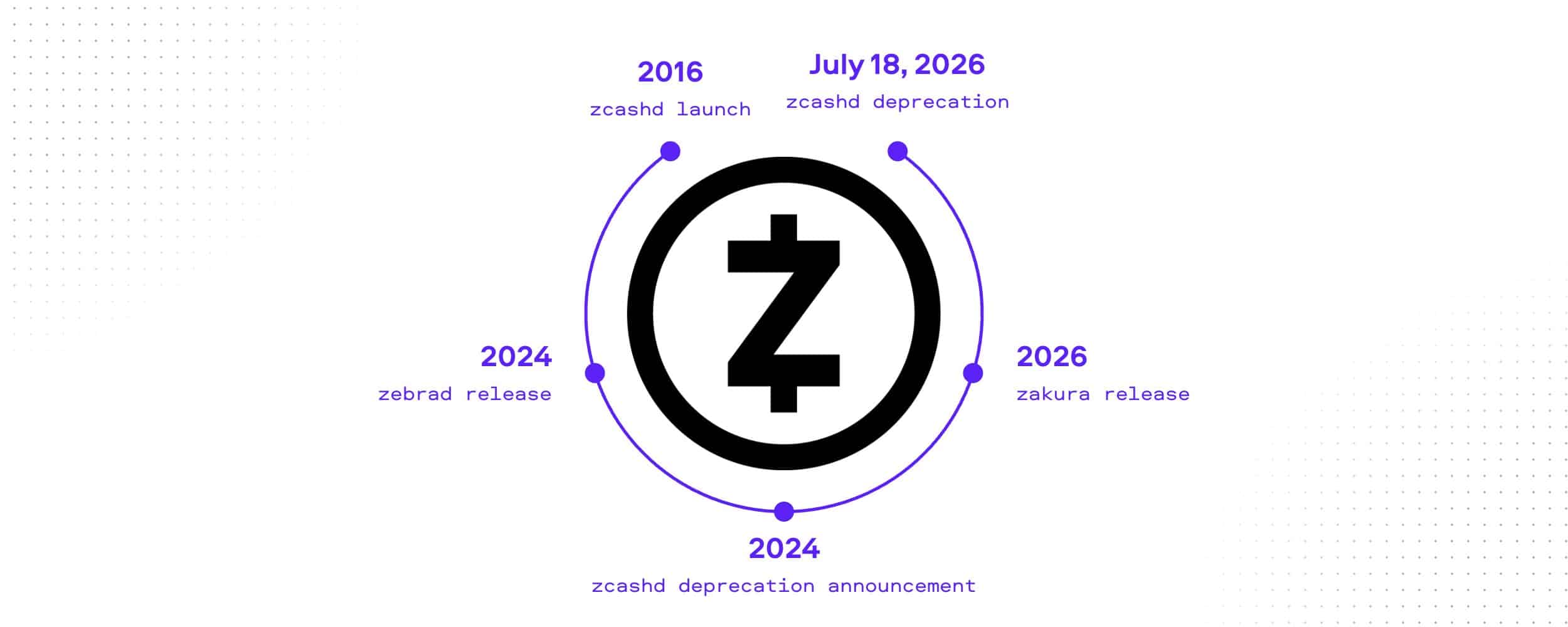
Zcash’s infrastructure has entered a new phase as the network completes its transition away from its original software implementation. That evolution took nearly a decade, beginning with zcashd’s 2016 launch before Zebra’s 2024 release introduced a Rust-based alternative.

After the 2024 deprecation notice, node operators had enough time to switch over before the planned retirement. On the 18th of July, zcashd reached end of support at block height 3417100.

Source: X

Meanwhile, Zakura completed the new node ecosystem. Rather than simply replacing legacy software, the transition strengthens maintainability, prepares the network for Ironwood, and reduces long-term operational risk.

Zcash’s adoption remains intact

Completing Zcash’s infrastructure transition did not remove the market’s biggest question. Instead, it shifted attention to whether users still trusted the network after the Orchard vulnerability. Early activity suggests that confidence largely held.

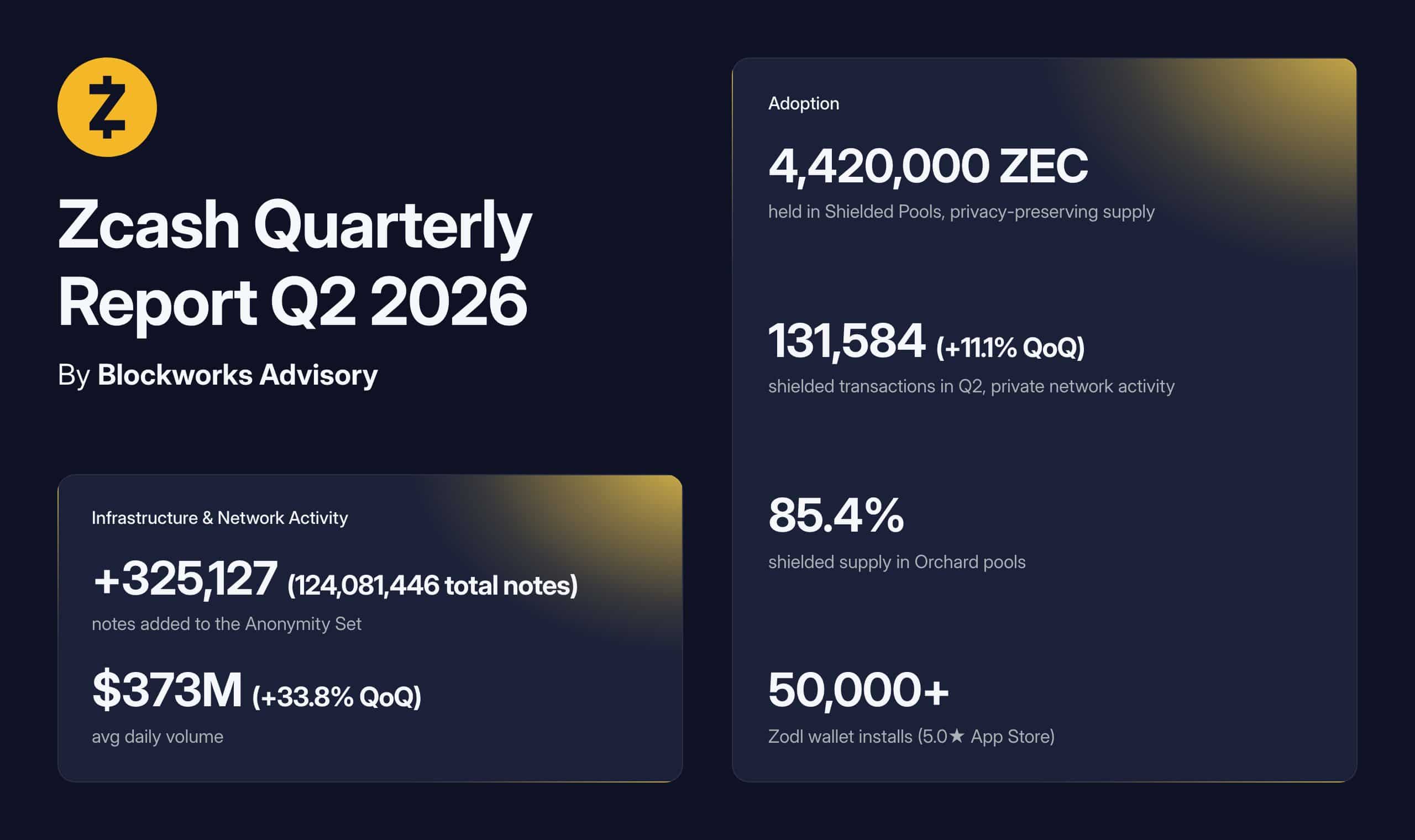
Although shielded balances declined 14% to 4.42 million ZEC, users continued relying on private transactions, which rose 11.1% QoQ to 131,584.

Source: Zcash on X

This trend became even more significant as the anonymity set for ZCash expanded by 325,127 units to 124.08 million.

This indicated an increase in participants using ZCash for privacy purposes. In addition, average daily trading volume increased by 33.8% QoQ to $373 million. This further reinforces that overall use of the network has been increasing.

Rather than reflecting weakening adoption, these trends point to cautious capital repositioning while confidence in Zcash’s privacy infrastructure remained intact.

Formal verification reinforces protocol integrity

Even resilient blockchain networks are ultimately judged by how they respond to critical security threats. Zcash faced such a test when researchers found a flaw in Orchard shielded pools that secured roughly 85% of shielded value.

But the flaw stayed contained because disclosure was coordinated, and developers were able to release an emergency fix within days. More importantly, this flaw allowed forgery inside Orchard rather than inflating the total supply of ZEC.

The turnstile mechanism prevented forged funds from leaving the pool other than legitimate deposits. Looking ahead, Ironwood strengthens this protection through formal verification and quantum recovery too.

Together these upgrades move Zcash from reactive fixes towards stronger assurances of long-term security and confidence within the ecosystem.


Final Summary

  • Zcash [ZEC] completed its migration to Zebra and Zakura, strengthening infrastructure while maintaining resilient network activity.
  • Zcash enters the Ironwood era with formal verification and quantum recovery, reinforcing long-term protocol security.


Source link

BTC ETFs attract $273 million in two weeks. That’s peanuts compared to recent exodus

0
BTC ETFs attract $273 million in two weeks. That's peanuts compared to recent exodus

That interpretation is intuitive given that ETFs, which let investors gain exposure to the cryptocurrency without owning it directly, are widely seen as a cleaner crypto market gateway for institutions. As a result, positive ETF inflows are taken to mean BTC is receiving institutional support, while outflows suggest the opposite.

Bitcoin’s price too has stabilized between $64,000 and $65,000 lately, offering hope that a bottom may be in. Prices peaked above $126,000 in October last year.

On the surface, it looks like the tide has turned. However, there is a massive caveat that makes these ETF inflows look like statistical noise rather than a structural shift.

The peanuts reality check

The hype surrounding this $273 million inflow quickly evaporates when compared to the carnage of the preceding eight weeks. During that two-month outflow streak, the market watched billions of dollars walk out the door.

To put the current “recovery” in perspective: the total amount of money that has entered the market over the last 14 days ($273 million) is barely more than the smallest single-week outflow recorded during that eight-week slump, which was $226.84 million in the week ended June 18.

In other words, it took two full weeks of “renewed optimism” just to offset the quietest week of the recent sell-off.


Source link

Is Automatic Data Processing (ADP) A Better Stock Than PAYX and WDAY

0
Is Automatic Data Processing (ADP) A Better Stock Than PAYX and WDAY


Is ADP a good stock to buy? We came across a bullish thesis on Automatic Data Processing, Inc. on Contrarian Indicator’s Substack by Cameron Fen. In this article, we will summarize the bulls’ thesis on ADP. Automatic Data Processing, Inc.’s share was trading at $253.31 as of July 16th. ADP’s trailing and forward P/E were 23.93 and 21.10 respectively according to Yahoo Finance.

5 Best Underperforming Tech Stocks to Buy for a Turnaround

Copyright: welcomia / 123RF Stock Photo

Automatic Data Processing, Inc. provides cloud-based human capital management (HCM) solutions worldwide. ADP’s latest quarter delivered a 14% increase in client-funds interest and 80 basis points of adjusted margin expansion, but with the shares already above the original $250 bull target, investors must decide whether they are buying a durable improvement in the payroll franchise or capitalizing a temporary lift from interest rates and a labor market that has not yet cracked.

Read More: 15 AI Stocks That Are Quietly Making Investors Rich

Read More: Undervalued AI Stock Poised For Massive Gains: 10000% Upside Potential

Automatic Data Processing reported fiscal third-quarter revenue of $5.94 billion, up 7% year over year, while adjusted diluted EPS increased 10% to $3.37 and adjusted EBIT margin reached 30.2%, leading management to raise its fiscal 2026 outlook to 6% to 7% revenue growth and 10% to 11% adjusted EPS growth. The operating case remains credible because payroll processing is a compliance-critical service with high switching costs, recurring revenue and limited capital intensity, while ADP’s scale across more than one million clients gives it a proprietary data advantage that could make artificial intelligence useful in service automation, implementation, sales conversion and retention rather than merely a branding exercise.

Client-funds interest added $403.9 million during the quarter, compared with $355.2 million a year earlier, as average balances increased 8.5% to $48.3 billion and the portfolio yield edged up to 3.3%, while Employer Services margin expanded 130 basis points to 41.1%. The valuation, however, leaves little room for an ordinary outcome. ADP closed at $254.29 on July 17 and trades at roughly 23.7 times trailing earnings; applying management’s 10% to 11% growth guidance to fiscal 2025 adjusted EPS of $10.01 implies fiscal 2026 earnings of approximately $11.01 to $11.11, meaning the market is already paying about 23 times the guided result and has effectively absorbed the original $250 thesis.

A renewed advance toward $276 would require approximately $12 of fiscal 2027 EPS at an unchanged 23 times multiple, equivalent to another 8% to 9% year of earnings growth, whereas a deceleration that prompts investors to apply a 20 to 21 times multiple would place the shares closer to $221 to $233. The bear case is therefore not that ADP’s franchise is impaired, but that the current price embeds continued execution while several underlying indicators are already less robust than the headline numbers suggest. U.S. pays per control increased only 1%, PEO worksite employees grew 2%, Employer Services organic constant-currency revenue rose 5%, and PEO margin contracted 120 basis points as selling, state unemployment insurance and other operating costs increased.


Source link

Is Strategy’s $54.5B Bitcoin bet no longer just about BTC’s price?

0
Is Strategy's $54.5B Bitcoin bet no longer just about BTC's price?


For years, Michael Saylor’s Bitcoin [BTC] strategy looked nearly impossible to challenge. Every capital raise financed another Bitcoin purchase. Every rally reinforced the model. Shareholder dilution also seemed justified because the corporate treasury kept expanding.

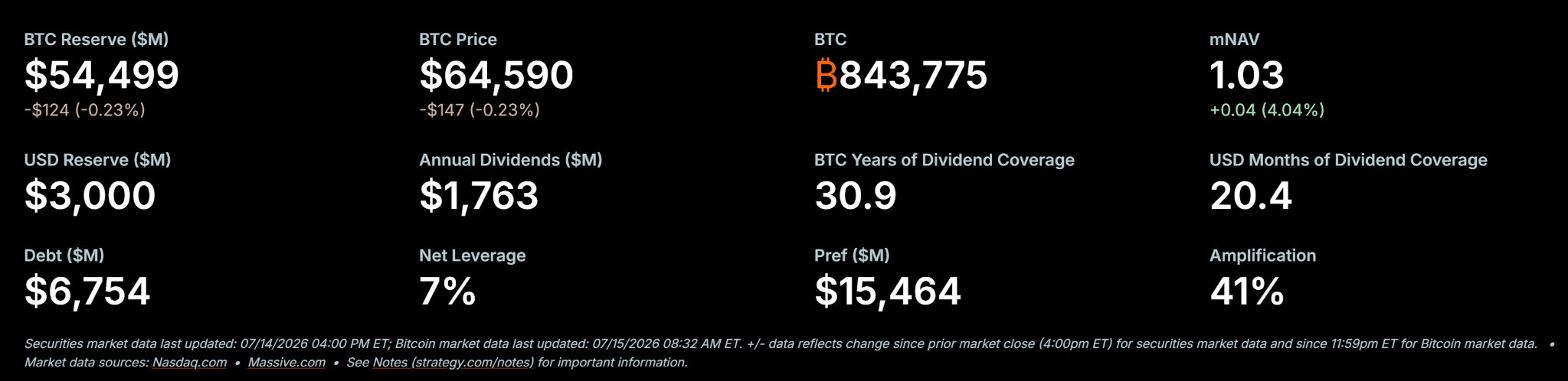
Yet, success gradually introduced a different challenge. The financial engine behind the relentless accumulation is now demanding more from the treasury it was built to grow. At press time, Strategy held 843,775 BTC, worth about $54.5 billion. This milestone comes after adding 171,278 BTC this year.

Source: Bitcoin Treasuries

However, those holdings carry a $63.69 billion cost basis, with an average purchase price of $75,482. That gap has shifted attention from accumulation toward the sustainability of the model. Reflecting that transition, the recent sale of 3,588 BTC was used to support STRC dividends and strengthen $3 billion in cash reserves.

That said, the real question remains. Can Bitcoin‘s future appreciation continue offsetting dilution, financing costs, and an increasingly self-dependent capital structure?

The engine behind Strategy

Dependence on the rising price of Bitcoin is no accident; it has been the foundation of Strategy’s accumulation engine since day one.

Meanwhile, the Market to Net Asset Value (mNAV) has slipped to just 1.03x. The metric gauges how the market values a Digital Asset Treasury (DAT). Previously, it spiked as high as 2.51x, but the sharp decline has eroded the premium that once made equity issuances highly accretive.

Rather than relying on operating cash flow, the company depended on maintaining an enterprise mNAV above 1, allowing it to issue shares at a premium and recycle fresh capital into Bitcoin purchases.

For years, that formula worked remarkably well in favor of the DAT. As mNAV climbed to 3.89x, Strategy raised $25.3 billion during 2025 and accelerated its treasury expansion without materially weakening shareholder exposure. However, currently,  the math has changed.

Source: Strategy

Therefore, Strategy will likely have to shift its focus away from adding to its Bitcoin holdings and toward creating flexibility within its balance sheet. Still, not everyone views the recent pressure as evidence that the model is failing.

 Lead Information Compliance Assurance Manager at SpaceX, Vincent Peters, observed,

People often confuse volatility with failure. Bitcoin has experienced extraordinary appreciation punctuated by significant corrections.

He added that while those corrections create headlines, they “don’t necessarily invalidate a long-term strategy.” Unless Bitcoin regains sustained upward momentum, rebuilding the premium may prove more important than acquiring the next Bitcoin.

The per-share challenge

That changing reality is also reshaping how Strategy measures success. The company was never trying to own more Bitcoin for the sake of it. Instead, the objective was to ensure every shareholder owned more Bitcoin over time. Such a distinction made BTC Yield and Bitcoin per share the clearest measures of whether the model was truly creating value. For several years, the model delivered on that promise.

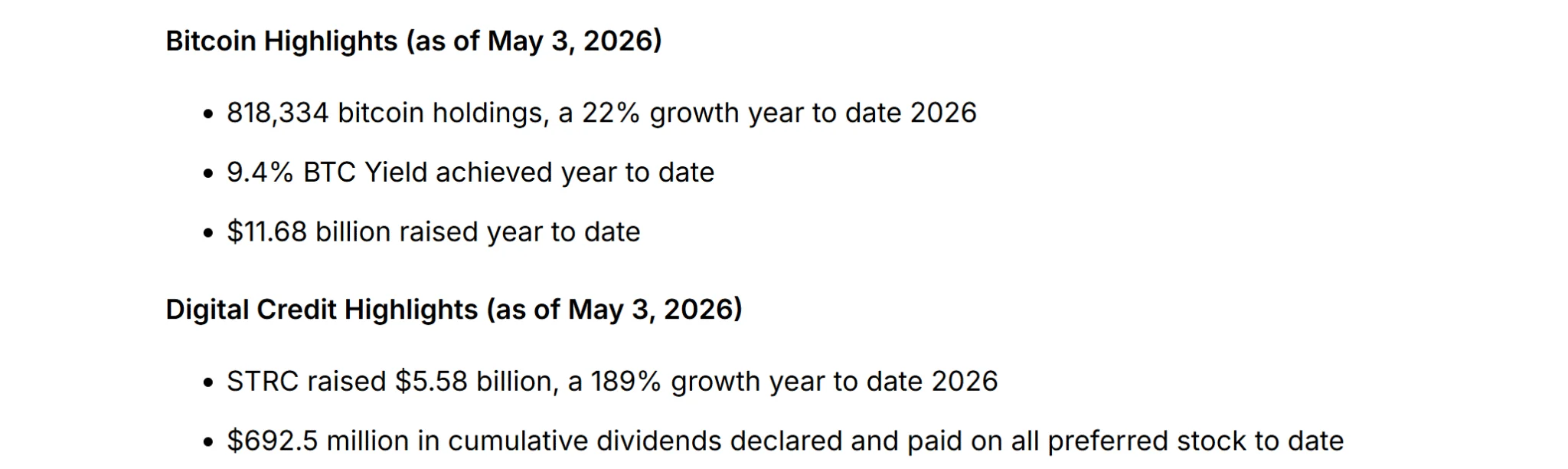
BTC yield reached 9.4% in early 2026, while Bitcoin per share climbed to 207,776 satoshi (sats), supported by 171,278 BTC in net accumulation. Yet, the BTC yield has fallen off slightly, hovering around 6.6% as of press time. Although the flywheel has slowed down considerably, that same slowdown has started to impact how well Strategy is performing, according to those same metrics.

As enterprise mNAV compressed toward 1.03x, each new share issued generated less incremental Bitcoin ownership than before.

Source: Strategy

More importantly, investors are no longer watching Strategy solely for the size of its Bitcoin treasury. They are watching whether it can continue funding future purchases. That debate has also attracted criticism from longtime Bitcoin skeptic Peter Schiff, who questioned Strategy’s capital allocation. He argued,

The model needlessly destroyed shareholder value by selling discounted MSTR shares instead of Bitcoin.

That shift matters. Rather than being simply the largest owner of Bitcoin, Strategy has become a proxy indicator for institutional demand for Bitcoin.

Therefore, the debate is moving beyond treasury growth alone, with the focus now on whether Strategy can maintain investor confidence in its ability to generate shareholder wealth over the long term by continuing to fund future purchases.

The cost of conviction

Building the world’s largest corporate Bitcoin treasury has given Strategy its greatest financial burden. That trade-off is becoming harder to ignore as Strategy’s capital structure grows more complex.

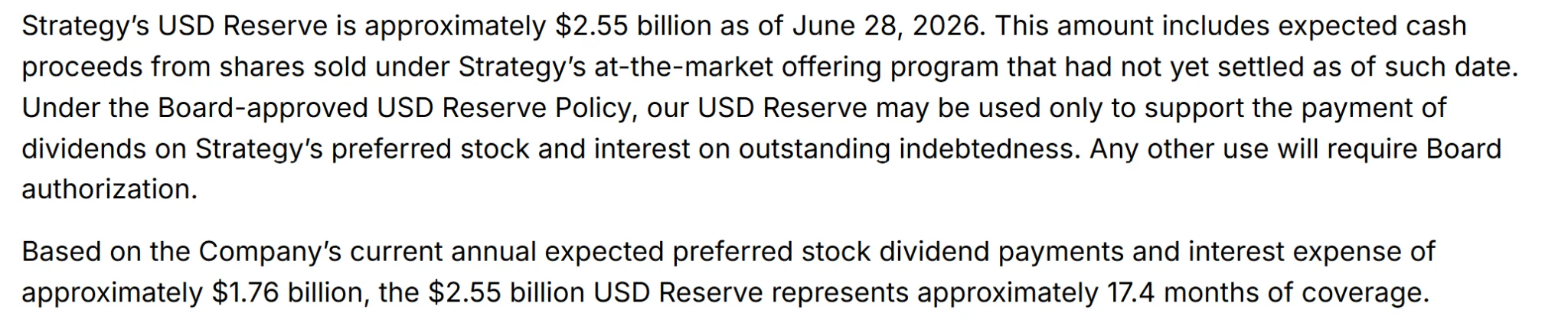
The DAT has approximately $1.76 billion annually in Stretch (STRC) dividend obligations. In addition to those, it also has convertible notes and continuing equity financing. Meanwhile, its software business generates only about $500 million in annual revenue.

Source: Strategy

Therefore, there exists a large funding gap. This funding gap explains why, currently, capital markets are equally important to the price of Strategy’s Bitcoin.

As Andrew Bahlmann, founder of Deal Leaders International, noted,

Having conviction with respect to an asset does not equate to having confidence in the ability to finance it.

He added that lenders ultimately favor collateral that remains stable across market cycles rather than assets whose value fluctuates sharply.

Strategy has approximately $2.5 to $3 billion in cash reserves. Therefore, it retains some financial flexibility. Still, prolonged mNAV compression may limit access to accretive capital. This would increase reliance upon reserves or selective sales of the Strategy’s Bitcoin to meet obligations. As such, this challenge is evident when compared to peers.

Metaplanet continues to expand through lower-cost yen-denominated financing. This is by accepting currency risk in exchange for cheaper capital despite mNAV near 0.92x. In contrast, Semler Scientific has adopted a more conservative approach, relying on lower issuance and minimal preferred obligations.

Source: Bitcoin Treasuries

Strategy still commands unmatched scale with 843,775 BTC, yet its funding model is also the most demanding. The comparison highlights a growing trade-off across Bitcoin treasury companies.

All in all, aggressive accumulation can accelerate growth, but resilient capital structures ultimately determine how well that growth survives prolonged market stress.


Final Summary

  • Bitcoin accumulation alone no longer guarantees Strategy’s long-term success.
  • BTC treasury growth now hinges on sustainable capital, not just larger holdings.


Source link

China’s Rare Earth Curbs Could Trigger $6.5 Trillion Supply Shock for Industries From EVs to Weapons Systems, IEA Warns

0
China’s Rare Earth Curbs Could Trigger $6.5 Trillion Supply Shock for Industries From EVs to Weapons Systems, IEA Warns


Benzinga and Yahoo Finance LLC may earn commission or revenue on some items through the links below.

China’s rare earth export controls could expose $6.5 trillion of production outside the country to supply shocks, the International Energy Agency warned on Thursday, highlighting how small volumes of strategic minerals can threaten large parts of the global economy.

China Controls Key Mineral Supply Chains

China, the world’s dominant rare earth processor, expanded export controls in October to cover more materials and to impose stricter licensing requirements, but later delayed full implementation for a year. Rare earths comprise 17 metals used in cars, aircraft, electronics, weapons systems, wind turbines and data centers. Reuters reported that the U.S. and Europe would face nearly half of the potential economic impact.

Don’t Miss:

“Our latest analysis shows that vast amounts of economic value depend on relatively small volumes of critical minerals, whose supply chains remain highly concentrated and are therefore vulnerable,” IEA Executive Director Fatih Birol said.

The IEA said automotive production faces the largest direct exposure, at more than $3 trillion outside China, followed by electronics and transport. It said full graphite controls could put another $300 billion at risk because China produces more than 90% of processed graphite.

ETF Investors Face Two-Sided Risk

The warning builds on earlier concerns over China’s tightening grip on rare earths and Washington’s push to counter Beijing’s dominance.

For investors, the risk cuts both ways. The VanEck Rare Earth and Strategic Metals ETF tracks companies involved in producing, refining and recycling rare earth and strategic metals, but its holdings include Chinese suppliers. VanEck says the industry has “volatile” supply-demand and geopolitical dynamics.

Trending: Avoid the #1 Investing Mistake: How Your ‘Safe’ Holdings Could Be Costing You Big Time

The Global X Rare Earth & Critical Materials ETF offers broader exposure to materials used in EVs, energy storage, robotics, and radar systems, while the Sprott Critical Materials ETF tracks a broader basket of critical materials and suggests upstream companies may benefit from rising investment.

That creates upside if prices rise or Western supply chains gain policy support, but it also leaves investors exposed to sharp reversals if Beijing delays curbs, grants licenses or trade talks ease, as earlier rare earth pullbacks showed.


Source link