Home Blog Page 217

China’s Rare Earth Curbs Could Trigger $6.5 Trillion Supply Shock for Industries From EVs to Weapons Systems, IEA Warns

0
China’s Rare Earth Curbs Could Trigger $6.5 Trillion Supply Shock for Industries From EVs to Weapons Systems, IEA Warns


Benzinga and Yahoo Finance LLC may earn commission or revenue on some items through the links below.

China’s rare earth export controls could expose $6.5 trillion of production outside the country to supply shocks, the International Energy Agency warned on Thursday, highlighting how small volumes of strategic minerals can threaten large parts of the global economy.

China Controls Key Mineral Supply Chains

China, the world’s dominant rare earth processor, expanded export controls in October to cover more materials and to impose stricter licensing requirements, but later delayed full implementation for a year. Rare earths comprise 17 metals used in cars, aircraft, electronics, weapons systems, wind turbines and data centers. Reuters reported that the U.S. and Europe would face nearly half of the potential economic impact.

Don’t Miss:

“Our latest analysis shows that vast amounts of economic value depend on relatively small volumes of critical minerals, whose supply chains remain highly concentrated and are therefore vulnerable,” IEA Executive Director Fatih Birol said.

The IEA said automotive production faces the largest direct exposure, at more than $3 trillion outside China, followed by electronics and transport. It said full graphite controls could put another $300 billion at risk because China produces more than 90% of processed graphite.

ETF Investors Face Two-Sided Risk

The warning builds on earlier concerns over China’s tightening grip on rare earths and Washington’s push to counter Beijing’s dominance.

For investors, the risk cuts both ways. The VanEck Rare Earth and Strategic Metals ETF tracks companies involved in producing, refining and recycling rare earth and strategic metals, but its holdings include Chinese suppliers. VanEck says the industry has “volatile” supply-demand and geopolitical dynamics.

Trending: Avoid the #1 Investing Mistake: How Your ‘Safe’ Holdings Could Be Costing You Big Time

The Global X Rare Earth & Critical Materials ETF offers broader exposure to materials used in EVs, energy storage, robotics, and radar systems, while the Sprott Critical Materials ETF tracks a broader basket of critical materials and suggests upstream companies may benefit from rising investment.

That creates upside if prices rise or Western supply chains gain policy support, but it also leaves investors exposed to sharp reversals if Beijing delays curbs, grants licenses or trade talks ease, as earlier rare earth pullbacks showed.


Source link

How AI Search Is Changing How Your Business Is Found Online

0
How AI Search Is Changing How Your Business Is Found Online


Opinions expressed by Entrepreneur contributors are their own.

Key Takeaways

  • Google Search isn’t all people are using these days. Artificial intelligence tools such as ChatGPT, Perplexity, Claude, Gemini and others have become popular search engines — and the ways we optimize our online presence for AI are different from Google.While AI search continues to evolve,
  • AI search continues to evolve, and if you don’t want to get left behind, there are four signals your business needs to get right to stay at the top of the search results page.

Recently, a client came to me with a problem that turned out to be anything but small.

On paper, their business was thriving. Their clientele was loyal. The offer was polished, and the team was exceptional at what they did. Yet when people searched online for their business, particularly inside the newer AI tools, they were nowhere to be found.

This client did not need another generic marketing checklist. They needed a real strategy to be seen. They needed to appear where people actually search today, not where they searched a decade ago.

Today, people are not only typing business names into Google. They are asking ChatGPT. They are turning to Gemini. They are consulting Perplexity. They rely on AI to decide who to trust, where to go and which expert deserves their business.

So if your company is built only for old-school search, you are playing yesterday’s game.

I watch this every single day across all of my businesses. AI search keeps evolving and I have no intention of being left behind. More importantly, I refuse to let my clients be left behind either.

Search isn’t just ranking anymore — it’s your reputation

For a long time, search felt fairly predictable.

You chose smart keywords. You placed them across your site. You pursued a few backlinks. But that version of search is no longer the full picture.

The bigger question now is not simply, “Where do I rank?” A better question is, “Do new ways people search the internet trust my business enough to recommend me?”

That is an entirely different game. Now your business has to be more than findable. It has to be worth recommending.

I think of it this way: Old search was about landing on the list. Modern AI search is about earning the introduction.

Different search engines want different things

One of the most common missteps I see owners make is assuming every search platform behaves the same way. They do not. Google, ChatGPT, Gemini, Perplexity, Claude and the rest each have their own way of finding, reading and sharing information. They overlap, but they are far from identical.

Some lean heavily on indexed web content. Some look for trusted sources and citations. Some study reviews and reputation closely. Some want clear, structured details so they understand exactly what you offer.

Picture each platform as a different customer. One wants credentials. One wants social proof. One wants receipts. One wants to hear what your clients think. One simply wants everything explained plainly. Your task is to make certain they all leave satisfied.

I build genuine proof across the web: clear messaging, strong content, accurate business details, press signals, reviews and a consistent story. When that foundation is right, your visibility begins to travel.

The 4 signals I build for every business

Your customers look for four signals: trust, authority, relevance and reputation. Get those four things right, and you give every engine more reasons to notice you and recommend you. If they are weak, even a beautiful website can struggle.

1. Trust

Trust is the starting line. Before anything recommends you, it needs to feel certain you are real and consistent. Your name, address, phone, website and profiles should match everywhere. You would be amazed how many businesses have mismatched versions of themselves drifting around. To clients, that looks careless. To search tools, it looks risky.

2. Authority

Authority is when credible sources vouch for you. Press, interviews, podcasts, articles, partnerships and recognition all help. You can praise yourself all day, but when a respected source says it, that carries real weight. I would rather earn one strong mention in the right place than 50 weak ones nobody trusts.

3. Relevance

Relevance is clarity. Engines need to understand what you do, who you serve and where you operate. Vague phrases like “solutions for modern businesses” sound impressive but say nothing. Be clear in your messaging.

4. Reputation

Reputation is what people say when you are not in the room. Reviews, testimonials and social proof shape how you are perceived. You cannot fake it for long. You earn it by doing exceptional work, inviting delighted clients to share positive reviews about your business.

Why this is so important

Here is the part people do not love to hear: AI search is not a fix-it-once-and-forget-it affair. There is no finish line. Platforms change. Results change. Competitors improve. Reviews arrive. Signals shift.

So I treat visibility as an ongoing part of every business I touch. AI search evolves daily and I refuse to wake up six months from now to discover a competitor became the answer to their question while I ignored the question. I check. I test. I ask AI tools what they recommend. I watch who appears and why. It is like glancing at your dashboard. You do not stare at it all day, but you want to know the moment the warning light flips on.

What this means for you

If you own a business, the truth is simple: Your clients already use AI search, ready or not. They ask for recommendations and weigh their options. If the tools they trust never mention you, you may never get the chance to compete.

Start by seeing what is actually happening. Ask Google, ChatGPT, Gemini and Perplexity about your industry and local market. Notice who appears. Then strengthen your foundation. Refine your information. Build real reviews. Create clear content. Earn credible mentions.

The winners in this new era will not be the loudest. They will be the clearest, the most trusted and the easiest to recommend. I am not chasing rankings like it is 2012. I am building trust across the entire web.

Key Takeaways

  • Google Search isn’t all people are using these days. Artificial intelligence tools such as ChatGPT, Perplexity, Claude, Gemini and others have become popular search engines — and the ways we optimize our online presence for AI are different from Google.While AI search continues to evolve,
  • AI search continues to evolve, and if you don’t want to get left behind, there are four signals your business needs to get right to stay at the top of the search results page.

Recently, a client came to me with a problem that turned out to be anything but small.

On paper, their business was thriving. Their clientele was loyal. The offer was polished, and the team was exceptional at what they did. Yet when people searched online for their business, particularly inside the newer AI tools, they were nowhere to be found.

This client did not need another generic marketing checklist. They needed a real strategy to be seen. They needed to appear where people actually search today, not where they searched a decade ago.


Source link

Major car dealer cuts 40% of its locations, issues serious warning

0
Major car dealer cuts 40% of its locations, issues serious warning


I haven’t met many people who were actually able to afford a new car.

Sure, plenty buy them, but suffocating monthly loan payments mean the “affording” part isn’t exactly met.

For decades, we shrugged off the warning that a new car loses 10% of its value the second it leaves the lot. The counter-argument was simple: You paid for peace of mind and the guarantee you wouldn’t end up stranded on the road. 

But today, even buying a used car is a crushing mathematical problem.

According to Edmunds, the average monthly new-car payment has hit a record $777, and 20.3% of buyers pay $1,000 or more monthly. To cope, many stretch loans over six or seven years. Edmunds’ Ivan Drury calls this a “mathematical trap,” warning that pairing a 7.0% APR with an 84-month loan means handing over nearly $10,000 in interest alone, leaving buyers “highly vulnerable to falling underwater.”

Used-car buyers are squeezed just as hard, financing an average of $30,414 at 10.5% interest. For subprime buyers, Experian data show interest rates averaging a staggering 19.4% to 21.7%.

That pressure isn’t just hurting buyers. It is also hitting the dealerships that specialize in financing customers with weaker credit. Now, one of the largest chains in the country has dramatically reduced its footprint.

America’s Car-Mart closes 40% of its retail footprint 

A major automotive retailer that operates a chain of used-car dealerships, America’s Car-Mart reported on July 14, 2026, its fourth-quarter and full-year results for the period ended April 30, 2026.

The car dealer, which specializes in the “buy here, pay here” (integrated auto sales and financing) market, reported total revenue of $1.281 billion, down by 7.9% from fiscal 2025. 

America’s Car-Mart full fiscal 2026 earnings vs. fiscal 2025: 

  • Gross profit per unit improved 1.0% to $7,442.

  • Gross margin percentage of 35.4% versus 36.7%.

  • Net loss amounted to $139.11 million, versus net income of $17.93 million.

  • Net loss per share was $16.79, compared to earnings per share of $2.38.
    Source: America’s Car-Mart official press release 

In the report, America’s Car-Mart confirmed it has consolidated 60 dealership locations in the period of 12 months (from April 30, 2025, to April 30, 2026). The company’s active dealership count decreased from 154 to 94, resulting in a 40% footprint reduction.

America’s Car-Mart closes 40% of its fiscal footprint. Cheng Xin / Getty Images

Why has America’s Car-Mart been closing so many locations?

America’s Car-Mart began showing the first signs of trouble more than a year ago. After digging through its official reports, I found that in December 2024, the company’s official Q2 FY25 Management Script said it had closed a $300 million term loan that removed the capital-related limits to optimize its store footprint and organization structure. 

“Now with more flexibility, we’re moving decisively on a multi-phase plan to optimize our footprint, cost structure, and strengthen capital efficiency,” stated America’s Car-Mart CEO Doug Campbell. 

Campbell added that phase one was executed in early November by consolidating five underperforming stores and eliminating approximately 10% of its employees. The second phase was set for Q3 and was projected to result in more than $20 million in annualized SG&A savings. 

On Jan. 13, America’s Car-Mart confirmed in a press release it has completed phase 2 by consolidating 13 of its locations into higher-performing nearby dealerships. Combined with phase 1, that makes 18 consolidated locations in those two phases. 

America’s Car-Mart 16 consolidated locations: 

As of the July 14 earnings release, the company has not yet disclosed the locations of the remaining 42 dealership locations that were consolidated in the fourth quarter of fiscal 2026. 

“Faced with limited origination capital and no revolving warehouse facility, we intentionally reduced originations and inventory to protect liquidity and avoided originating loans we lack the capacity to carry,” Campbell said during the Q4 and full fiscal 2026 year earnings call.

America’s Car-Mart issues “going concern” disclosure 

While retailers frequently close underperforming stores to improve profitability, the situation of America’s Car-Mart appears to go beyond routine cost-cutting.

As part of my recent retail tracking coverage for TheStreet, I’ve documented how several major mall staples are executing similar strategies to protect their profit margins. Fossil Groupshuttered seven stores during the first quarter of 2026 alone, and Vera Bradleyclosed 13 underperforming retail locations.

Another example is fashion mall retailer Tilly’s, which successfully cut its rent and operating costs by closing 40 underperforming locations and opening 12 new ones over two years.

This optimization boosted quarterly gross profits to $36.1 million and dramatically shrank the company’s net losses. It recently confirmed plans to open three new stores later this year.

However, mall fashion retailers are a completely different type of business than a “buy here, pay here” car dealership, and the management views liquidity, not merely store efficiency, as the primary challenge. 

In fact, Campbell confirmed in a call that there will be “going concern disclosure in our Form 10-K. It’s there because we have not secured additional financing or an alternative transaction that we need to resolve our liquidity constraint, not because anything changed in how our customers are paying us back.” 

What is a “going concern”?  

The going concern principle assumes that an organization or business is financially stable enough to continue to operate for the foreseeable future, typically the next 12 months. 

A going concern disclosure does not mean a company will file for bankruptcy. It indicates that management has identified conditions that raise substantial doubt about the company’s ability to continue operating over the next year.

Related: After closing 250 restaurants, pizza chain drops nostalgic offering

If those conditions cannot be resolved, possible outcomes can include refinancing, restructuring, asset sales, or, in some cases, seeking bankruptcy protection, according to Corporate Finance Institute.  

In the case of America’s Car-Mart, the company specifically identified the “potential need to seek protection under applicable bankruptcy or insolvency laws” as one of the risks it faces if it cannot secure additional financing or complete a strategic transaction.

America’s Car-Mart also stated in its Form 10-K that it is facing severe liquidity, debt, and funding challenges that threaten its survival over the next year. Management’s current restructuring efforts have not yet been enough to clear these doubts.

“In accordance with ASC 205-40, the Company’s substantial indebtedness, its liquidity position, and the uncertainties associated with satisfying the milestones under the amendment to its Credit and Guaranty Agreement and securing additional financing raise substantial doubt about its ability to continue as a going concern within one year after the consolidated financial statements are issued.” 

What does a downsized America’s Car-Mart mean for drivers?

For millions of working-class Americans, keeping a reliable car on the road isn’t a luxury; it is a lifeline that gets them to work. In many communities, especially rural ones, “buy here, pay here” dealerships are one of the few financing options available to borrowers with poor or limited credit histories.

Earlier this year, Sen. Elizabeth Warren (D-Mass.) launched an investigation into the “buy here, pay here” (BHPH) industry, specifically targeting companies like America’s Car-Mart over concerns that the combination of high interest rates and aggressive repossession practices can be predatory for financially vulnerable drivers.

“The Fed found that nearly 78% of BHPH [buy here, pay here] lending volume goes to subprime borrowers, compared to just 27% for traditional auto lenders. The research highlights that while BHPH loans have delinquency and default rates approximately 2.65 and 1.88 times higher than those of traditional auto lenders, they are 16.63 times more likely to be in active repossession status,” according to SWLAW.  

“Car repossession is a devastating disruption to someone’s life — and it is inexcusable when that repossession is in error,” wrote Warren. 

Moreover, data from Symend reveal that “nearly 1 in 6 subprime auto borrowers was at least 30 days late. That’s not a collections problem. That’s an affordability crisis wearing collections clothes.”

For now, America’s Car-Mart says its optimization is aimed at preserving liquidity rather than responding to weaker customer payment performance. Existing borrowers will continue making payments under the same loan terms, even if their local dealership has been consolidated, because loan servicing is transferred to another location. 

But the company’s situation underscores a much broader problem. As financing becomes increasingly expensive for both consumers and lenders, the dealerships that serve higher-risk borrowers are coming under growing pressure.

For many working-class Americans, the question is no longer whether they can afford a new car, but whether they can afford to stay on the road at all. 

Related: KFC closed 207 U.S restaurants

This story was originally published by TheStreet on Jul 19, 2026, where it first appeared in the Retail section. Add TheStreet as a Preferred Source by clicking here.


Source link

KAITO climbs 13% on retail buying: But is this rally a bull trap?

0
KAITO climbs 13% on retail buying: But is this rally a bull trap?


Kaito [KAITO] has climbed 13% over the past 24 hours, one of its stronger gains in recent sessions, driven largely by a surge in buying activity across the market.

The question now is whether KAITO can sustain the run in a market that has yet to fully recover—a rally that took shape as retail investors seized control of the trend, even as selling pressure gradually builds beneath it.

Retail investors take over KAITO

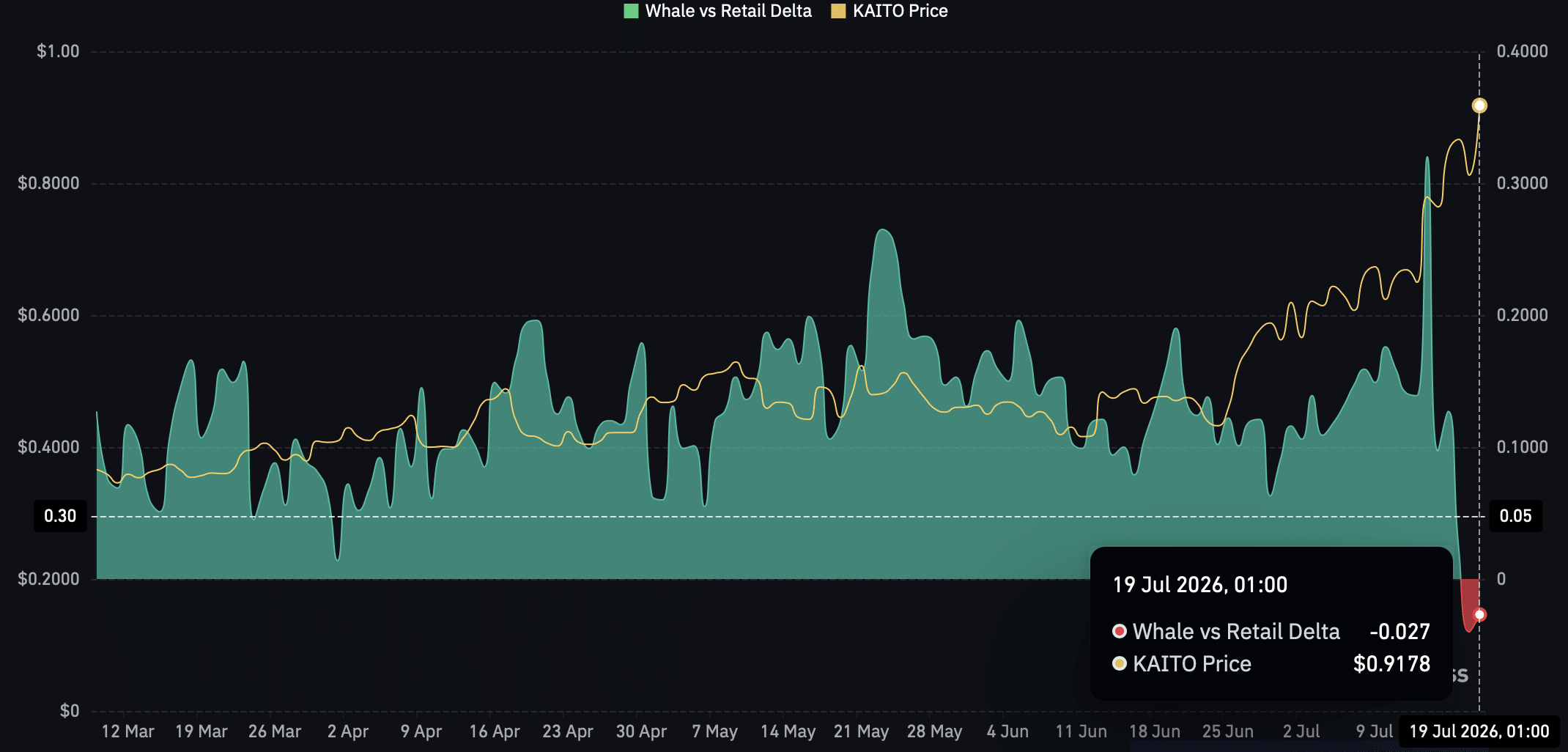
Retail investors have driven much of KAITO’s surge, with data from the whale-retail delta pointing to a clear takeover in the market.

The whale-retail ratio measures which group is driving an asset’s trend, turning green when whales dominate the move and red when retail traders hold the upper hand.

This marks the first time retail investors have taken over the asset since the 14th of January, with whales having dominated for much of the year, and that retail involvement has fed directly into the rally.

KAITO whale retail delta
Source: CoinGlass

Early signs point to a growing base of sellers, though, as spot market data shows sell pressure building gradually.

Data from CoinGlass, whose spot flow metric tracks these sales, records a total sell-off of roughly $3.22 million against total purchases of $2.77 million. That gap between buyers and sellers leaves spot netflow at a net outflow of roughly $447,580.

While the move may reflect profit-taking, it still points to growing seller dominance over the same period.

Perpetual market drives rally, but risk builds

The perpetual market has emerged as a key driver of the rally, with derivatives activity dominating the move.

Open Interest in the perpetual market surged 15% over the past 24 hours, with the balance reaching $122 million at the time of writing as traders pour capital into the market.

The Funding Rate backs this up, holding positive at 0.0021% and showing that most perpetual market capital sits in long positions. That reading has slipped, though, from the previous day’s high of 0.0039% on the 18th of July.

KAITO liquidation heatmapKAITO liquidation heatmap
Source: CoinGlass

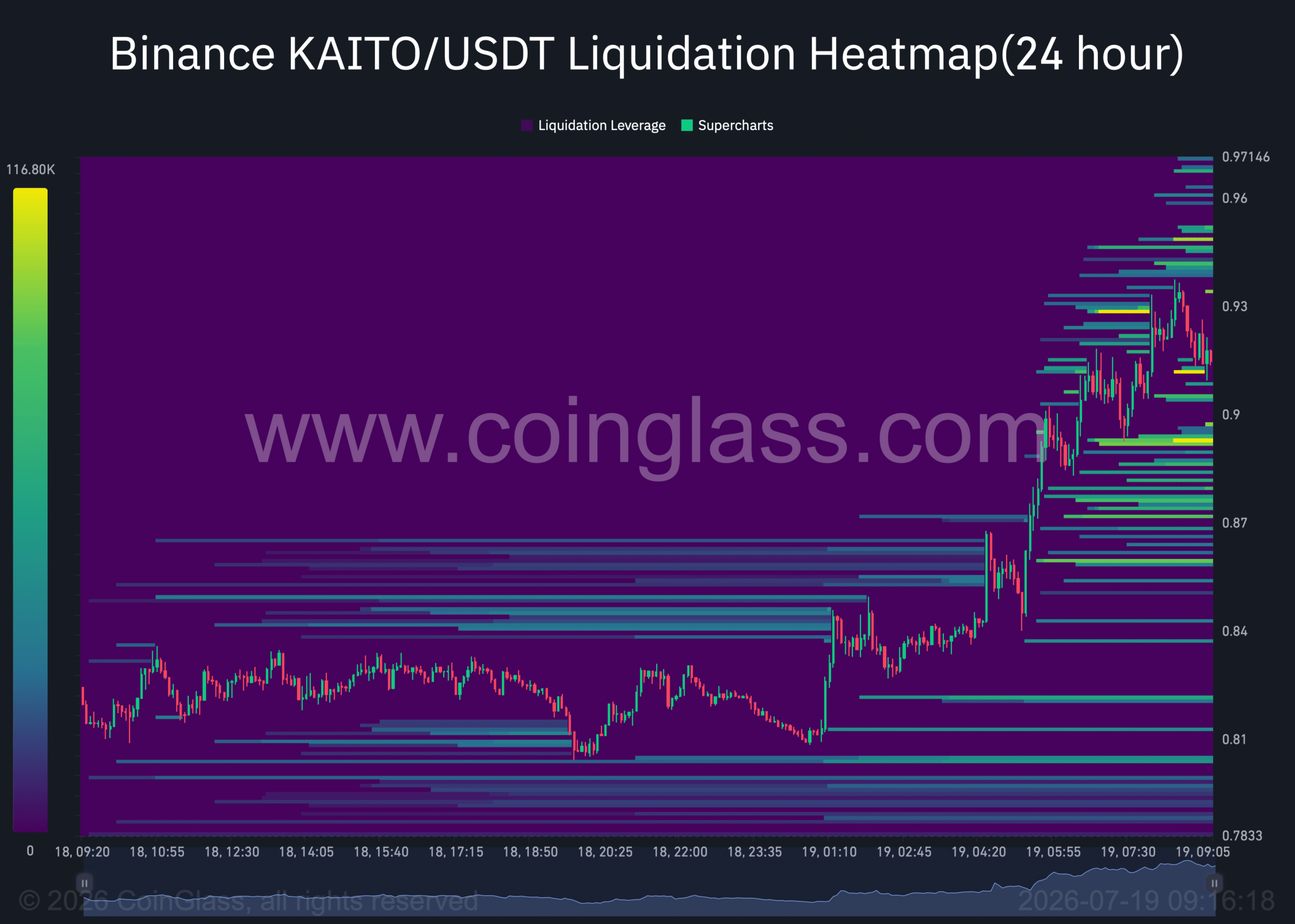
The decline signals shrinking long exposure as short contracts build alongside it, and the liquidation heatmap warns that any pullback could extend well below current levels.

The liquidation heatmap, which maps clusters of interest on the chart that tend to pull price toward them, shows KAITO could slide to $0.78 where the cluster extends on the 24-hour timeframe.

Rally may be a bull trap

The spot profit-taking and the falling Funding Rate suggest traders are positioning for a coming sell-off, raising the prospect that the rally is a bull trap.

A bull trap forms when traders go long on an asset expecting a rally, only for a major sell-off to follow and trigger the stop losses of those long positions.

This view rests on KAITO’s upcoming token unlock, which, according to DeFiLlama’s tracking, will release $15.84 million worth of the asset into the market on the 20th of July, equal to 7.29% of its circulating float.

That surge in supply should shift the supply-demand balance and pressure KAITO lower, putting significant risk on long positions still open at the time.


Final Summary

  • Retail investors have taken the reins of KAITO’s 13% jump, marking their first real grip on the asset since January after months of whales calling the shots.
  • Kaito’s rally sits on shaky ground, with a $15.84 million token unlock landing on July 20 and traders quietly trimming their bullish bets.


Source link

Oil Pulls the Market Lower Again

0
Oil Pulls the Market Lower Again


In this episode of Motley Fool Hidden Gems Investing, Motley Fool contributors Travis Hoium, Lou Whiteman, and Rachel Warren discuss:

To catch full episodes of all The Motley Fool’s free podcasts, check out our podcast center. When you’re ready to invest, check out this top 10 list of stocks to buy.

Missed Nvidia in 2009? This Rare Signal Is Flashing Again. In 2009, a “Double Down” signal flashed for a little-known chipmaker called Nvidia. For the first time in years, that same “Total Conviction” signal is flashing for a company 1/100th the size of Nvidia. Continue »

A full transcript is below.

Missed Nvidia in 2009? This Rare Signal Is Flashing Again

In 2009, a “Double Down” signal flashed for a little-known chipmaker called Nvidia. If you’d invested $5,000 then, you’d be sitting on $2,633,375 today.*

Now, for the first time in years, that same “Total Conviction” signal is flashing for a company 1/100th the size of Nvidia. It’s a key player in the $1.8 trillion space race, and with the stock recently sitting 20% off its highs, the window to get in early is closing fast.

Continue »

*Stock Advisor returns as of July 13, 2026

This podcast was recorded on July 8, 2026.

Travis Hoium: Oil is up, and stocks are down, and Motley Fool Hidden Gems Investing starts now. Welcome to Motley Fool Gems Investing. I’m Travis Hoium, joined today by Lou Whiteman and Rachel Warren. Guys, we’ve got to start with the topic of the day, which is the market is down, oil is up about 5% as we’re recording early on Wednesday. Rachel, this does seem to be a bit of a trend, at least over the past couple of weeks. Nasdaq is down about 5% the Nasdaq-100. We’re starting to see a little bit of a pullback there. Maybe that’s valuation-based. Maybe that’s a little bit of, we’re waiting for earning season to begin. But now we have this oil thing going on. What are the headlines that people need to keep in mind as they’re looking at their investments today?

Rachel Warren: There’s a few factors at play. Obviously, oil and inflation are two big ones. The U.S. just canceled its sanctions waiver on Iranian oil. The ceasefire has been declared over. That basically means less oil is likely to be moving around the world. We’ve seen Brent Crude prices go up, and tech stocks are obviously taking a big hit because U.S. inflation is already quite warm at 4.2%. The worry about some of these spikes is that the Fed will keep interest rates higher for longer. When interest rates stay high, investors are less willing that they might be in other periods to pay those premium prices for the tech companies that move the market and that promise huge profits down the road. You can look at the chip sector this week. Had Samsung reported a massive 19-fold jump in profits with a huge AI demand, but the stock still fell. I think a lot of what we see is this Wall Street being trapped in a short-term 90-day game. A lot of the daily market volume is driven quantitative computer algorithms. When scary headlines hit the tape, those models often trigger those cell orders. I think that’s also something we’re seeing at play right now.

Travis Hoium: Lou, computers have been really running the market for quite a while. Oil is something we talked about six months ago, and it hasn’t turned out to be a huge deal. Is this a huge deal, or is this just the day-to-day volatility that we always see in the market?

Lou Whiteman: Oil has spiked to levels that are still below June 24th prices, just to give some perspective here. A lot of this is headline writing, and a lot of this is ignore the noise. I don’t think we should overread into anything. With all respect, I would be shocked if investors were really worried that oil will change the Fed’s interest rate.

Travis Hoium: A couple of drops in the stock market, and it seems like the policy decisions turn pretty quick.

Lou Whiteman: Well, I think what’s probably going on is uncertainty, plus that, yes, if Iran is back on, then the already fragile consumer could become further stressed, which is a much bigger deal than interest rate. There is thought processes here. But look, we’re up 9% for the year, Nasdaq is up more than that. We are doing just fine. This is normal; we’re coming into earning season. Look, there’s a real risk that the market will be green by the time anyone hears this podcast, it’s so important not to just overthink any one day. In the early days of Twitter, I made a little bot that just said every day, the market is either up or down, and it just pulled the top headline on Yahoo Entertainment. That’s the reason why. Every day, it said stocks fall on Taylor Swift releasing a new album. That to me made more sense than most of the headlines I see explaining why stocks move on any given day.

Travis Hoium: Lou, I wanted to get your thoughts on a dynamic that I think I see in the market that may or may not be confirmed. We’ll know this in hindsight. But it seems like when I started investing in the ’90s, you can go back to all the way back to the Great Depression, and things were relatively correlated. I learned about this in business school. You maybe want to have some uncorrelated stocks, but a lot of stocks were correlated, and so you would have the market is up. Almost everything is up, and over time, your winners would be the ones that are up a little bit more than your losers. But there wasn’t this massive segment of the market that was inversely correlated, as we would say, with the market.

Now we get to this time where in 2022, when a lot of tech stocks crashed, if you were in industrials or energy, you may not even noticed. Some segments of the market were feeling a ton of pain, and some weren’t feeling anything. Now we get to this year. If you were invested in software stocks, some of the best software companies over the past 10, 20 years, you were just getting crushed early in 2026. But if you were invested in neoclouds, in memory, you’re crushing the market. Hundred percent gains aren’t out of the ordinary there. Now we get to this moment where just in the past couple of weeks, I was looking at Micron and Sandisk, two of the hottest stocks. If you’re invested in those stocks, they’re down 21% and 31% respectively from their highs. That can be really painful. Despite the fact that a lot of stocks are up. Are we in a world where the small segments of the market are going to move in really big ways as these themes or momentum goes in and out? Is that a new dynamic that we’re going to see going forward or is this just where we are in 2026 until we get some bigger move that would be caused by massive growth or recession or something like that?

Lou Whiteman: I think that what has changed is your ability to monitor these things. There’s just so many better tools. I think that what you just described as a normal functioning market. Usually, some things are up them, some things are down. There’s always leaders and laggards. It’s really only in a true recession or true downturn, and 2022 was not a true downturn. But if you go back to 2008 or something like, everything was down. It was just the proportion of how much it was down. Look, to this point, would it surprise you to hear that only two sectors of the market are actually in the red this year, consumer discretionary and communications? In fact, tech is the second-highest performing sector so far this year. Double digits, gains, energy, tech, industrials, real estate, materials, consumer staples. We have so many more tools to monitor these things. We look at these things, and again, we are so focused on the short term. Yes, it is technically true that Micron is in a bear market because it’s down more than 20% from its high. It’s also up 200% year to date.

Travis Hoium: Yes.

Lou Whiteman: I want all of my bear markets to involve 200% gains. That’s after the 20% fall. Again, the lesson, I think is, again, we are somewhat overwhelmed by data. There are just things that we couldn’t notice in 1984, that we can notice now. Also, we are so fixated on today.

Travis Hoium: Rachel, is that the way that you say things? Well, what we’re doing? We’re looking at individual stocks and going, hey, this is where the deals are, not just by the market or the Nasdaq-100. But where are those individual opportunities? That maybe brings a little bit of this volatility.

Rachel Warren: I definitely think that’s part of it. I think it’s also important to remember that the type of stocks that were moving the market, 20 years ago, it’s a very different market today. A lot of those biggest stocks are the ones with extreme valuation multiples, it doesn’t mean there aren’t quality underlying businesses there, it doesn’t mean there aren’t real earnings and cash generation power there. But these tend to be extremely volatile businesses that are driving some of the intraday movements in the market. It doesn’t mean that they can’t be great additions to a long-term portfolio. But these are not the blue chip stocks of yesteryear that used to drive those day-to-day market movements.

I think it’s important to understand where that volatility is coming from. Then, of course, assess individually the stocks that you own, the stocks that you want to buy. Company may be down day-to-day, still up significantly like Micron over the next year. Up to you to decide whether that’s a good addition to your portfolio. But as always, I think there are quality businesses that remain amidst the volatility and understanding where that value adds to your portfolio, I think is really key to look beyond the day-to-day red and green and see what drives you closer to your long-term financial goals.

Travis Hoium: A lot of these things are why we’re long-term investors. Keeping your head on straight is often the hardest thing that we do as investors and just being able to focus on 3, 5, 10 years from now, what is going to be a value buying and just hang on for dear life is often the best thing to do. When we come back, we’re going to talk about some new cheap EVs coming to the market. You’re listening to Motley Fool Hidden Gems Investing.

ADVERTISEMENT: Hey, you. What are you up to? Are you mindlessly scrolling other people’s holidays, Majorca, Canary Islands? With Expedia, earn rewards on every trip to use on your next eligible stay. Soon people will be scrolling your holiday pigs. Expedia, the one place you go to go places. Terms apply.

Travis Hoium: Welcome back to Motley Fool Hidden Gems Investing. One of the topics that I think has been fascinating over the past couple of years is what’s going on with the EV market. We have seen over the past few weeks, maybe a month or two, a couple of lower-cost electric vehicles coming to the market. This week, we had Fiat introduce the Topolino. I’m probably saying that in American. I’m sure it sounds different.

Lou Whiteman: Topolino.

Travis Hoium: You’re right, yes. A $14,000, 46-mile range vehicle. Lou, one of my favorite things about this is the image that they have at the top of their page. It doesn’t have a door, it has a rope holding you in the car, I’m sure my kids would love that. But is this the vehicle that may actually prove that there is a lower end for these EVs? Because some of the more expensive ones are doing okay. Do we have a market for a 14, $15,000 electric vehicle?

Lou Whiteman: Do we have a market? Let’s get to that question first, then we’ll get to the Topolino. Because fortunes have been lost, betting that Americans will make practical same choices when it comes to purchasing vehicles. This won’t be different. There’s a reason why this market doesn’t exist. It’s because no one was buying the options they had. In the case of Fiat, this is a golf cart, this is not a vehicle. It’s fine to have a rope instead of a door when you are capped out at 19 miles per hour. It isn’t even road legal, it will come. You can get a kit that makes it road legal and get you up to 25 miles per hour, you’re spending 14 and 15.

Travis Hoium: Then why is Fiat making this? Fiat, by the way, owned by Stellantis. This is a pretty big automaker.

Lou Whiteman: Marketing. I will tell you, I don’t know how it is up there, but down here, there is almost a golf cart per driveway. I really think that they are chasing the country club, take the kids to the pool market here. I really believe that. Maybe you can squint and see a business for Slate, the truck. But them, look, even Honda abandoned the Fit. Why did they do that? It’s one thing to say, Detroit’s just stupid. But Honda’s not stupid. They abandoned the Fit because Americans didn’t want to buy it. The Slate looks intriguing, but you can get entry-level Ford Maverick for 28,145 bucks. Slate says they’re going to be 25 grand. Maverick actually has features, and it’s actually in production, so we know the cost to build. There is a very narrow market for Slate to succeed, if any, and it feels like the easiest way to go here would be Ford can just, I don’t know, knock a few thousand off the Maverick if they see Slate actually generating our profits. The interesting thing here is, I would love for this to be a practical vehicle and a market that exists, but I live in the suburbs, we have kids. This vehicle fits two people, it completely [inaudible].

Travis Hoium: Going 25 miles an hour.

Lou Whiteman: It’s like us buying a moped that the kids can’t even ride on. Rachel, do you have any different view of this? Is there some market for some of these less expensive vehicles in a world where Lou’s right, General Motors, Ford, all of these big companies, they’re making lots of money, but they’re not making money on small vehicles. They’re making money selling giant trucks and SUVs. Guess what? That’s what I see driving around even if there’s just one person.

Rachel Warren: I think that there is a place in the market for a low-cost EV. I just don’t think it looks like either of these offerings that we’re discussing today. I don’t think that the practical utility is there and what we are seeing being brought to market, but I do think that there are consumers that would gravitate towards a practical, accessible, low-cost EV. It doesn’t mean a cheaper version of a Tesla. I think it would be a rewritten definition of what a lot of these vehicles are. We saw how Detroit early EV companies abandoned the entry-level buyers. They moved upmarket to chase a lot of the higher profit margins. Some might say that there’s a benefit to that. Obviously, the vacuum grew wider with the elimination of the federal EV tax credit.

It’s interesting. Fiat’s Topolino, it targets micromobility, like Lou was talking about. It’s very much built for short city trips, gated communities. Maybe you’re going to visit your neighbor on one side of the community to the other. Definitely not built for the highway. Now, Slate, backed by Amazon, their $25,000 electric truck, it has this bare-bones simplicity. They’ve swapped out the dashboard screens for simple phone mount, the manual roll-down windows. What’s interesting about Slate’s model is they claim the base truck will make a profit on Day 1. I think that remains to be seen. But they are basically selling this bare bones frame. Then they have upsells that customers can access through something like almost 200 customizable modular accessories.

Lou Whiteman: That is the point, it’s a blank Slate.

Rachel Warren: It’s basically a blank Slate. No pun intended. I think if and when we see mass adoption of average consumers buying electric vehicles. I don’t think it’s going to be won by adding more luxury technology. I don’t think it’s going to be won by little gadget-centric cars. I think there needs to be basic, affordable transportation that the mass market can access, and I don’t think we’re seeing that yet.

Travis Hoium: Just for disclosure here, it is Jeff Bezos who has invested in Slate. Amazon does not have a stake in Slate. That is a personal investment that Bezos has made. But Amazon invested in Rivian, so they all tie together. Lou.

Lou Whiteman: One thing here, and it’s the bugaboo, is there is a huge engineering challenge. Batteries are really heavy and take a lot of space, which is why it is hard. We’ve seen it done in some ways, but normally, these are the cars with very little range. Again, it’s really hard to get Americans to compromise when they buy vehicles, and even 25 grand is a lot of money. If you’re going to spend 25 grand, hey, you’re not spending 40, but you probably want something that checks all the boxes. It’s just a really hard problem to solve. For all my joking, I’m going to make a bold prediction right now. The Topolino will outsell the Slate. I genuinely believe that. For one, a new Yamaha golf car will run you back 20 grand, so it’s not bad. For two, if you’ve ever been to the villages outside of Orlando or a place like that, everybody has a pimped-out golf cart. They have a Rolls-Royce front seat.

Travis Hoium: Yes, this would fit very well.

Lou Whiteman: This is the market. It has nothing to do with electric vehicle revolutions and stuff like that, but there is actually, I think, a bigger market for this than I would like to admit. I think it will outsell the Slate, but I don’t think either of them is going to solve the U.S. mobility issue.

Travis Hoium: I will say it here, we’ll outsell the Slate if we see 16-year-olds with a rope holding them in driving around town. That’s how you know it’s popular. I don’t know, I think it would be fun when I was younger. But we’ll see how this goes. When we come back, we are going to get to a listener question. You’re listening to Motley Fool Hidden Gems Investing.

ADVERTISEMENT: People who are psychopathic just don’t intrinsically value other people’s welfare that much. Every interaction is about, like, what can I get? What can I get out of this person? What can I get out of this situation? That’s why there’s so much manipulating and lying and exploitation is it’s because people, most of the time are just tools to get whatever the ultimate goal is. All of us know somebody with psychopathy. If you hear the science behind who actually does the most harm, check out Episode 1,293. It might change how you see everyone around you.

Travis Hoium: Welcome back to Motley Fool Hidden Gems Investing. We want you to be involved in the conversation so you can send your questions to us at podcast@fool.com. One of the questions that we got is from Bruce in Daytona Beach, Florida, wants to know about American Tower, ticker symbol is AMT. Couple of concerns, is the debt manageable? Rachel, I want you to tackle that. Then I want to talk about this satellite technology. Is that going to erode or disrupt the traditional land-based tower business? But what do you think about the debt, Rachel?

Rachel Warren: In terms of the debt, the short answer is yes, I think it’s manageable, and part of that’s because of the unique real estate model here. American Tower, the global Cell Tower, Real Estate Investment Trust or REIT. As of the end of Q1, they carried about $45 billion in debt. That might sound a bit terrifying on paper, but the debt is backed by very sticky multi year leasing contracts with the Telecom Giants. Think Verizon, AT&T, T-Mobile. There’s others. These are not carriers that are going to pack up and leave these partnerships. It does give American Tower a very predictable, high-margin cash flows and profits that quite easily cover their interest payments. That hopefully sheds a little bit of light on how that model works.

Travis Hoium: The other thing they’ve been adding is data centers. Closer to customers, these mini little data centers that just sit at the bottom of the tower. As you look at artificial intelligence, where that goes in the future, that could be another growth avenue for them. Lou, let’s talk a little bit about satellites. We’ve been hearing a lot about satellites, all these use cases, one of the biggest use cases today is telecommunications. Is this going to disrupt American Tower’s business? By that, is it going to disrupt the Verizons and the AT&Ts and the T-Mobiles of the world?

Lou Whiteman: Real quick on the debt, one thing to note is, it’s manageable, but in a higher for longer because they roll so much over. As an investor, it could impact returns and profitability because they’re probably paying more interest than they thought. It’s not going to capsize them. Can satellites capsize? That’s the real question. Look, if American Tower didn’t exist today, I think I could make an argument that you wouldn’t need to spend all that money on infrastructure because of satellites. I don’t know if I’d win that argument. I still don’t have physics on my side.

But look, there’s a lot of costs with building a terrestrial network. The thing is that cost is done, and we have that, and it works. Look, as far as replacing terrestrial with satellite, latency is always going to get in the way. The signal has to travel longer. There’s going to be delays. You can do things with technology, but for when there is a tower nearby, this is never a good option. It is always going to be a supplement to that. Here’s where it could play in again. Maybe there isn’t as much growth. Maybe there isn’t a need to put towers in all the areas where it doesn’t feel like we’re going to ever put towers anyway, these rural areas. But any hope that the bull case is we’re going to have a tower on every acre, on the top of every mountain in Colorado or something, that goes away, so the growth story goes away. But same thing for the Verizons, T-Mobiles. This is a good partner, this is not a replacement. The physics doesn’t work. It’s a harder technology to get right.

Travis Hoium: The other thing to understand is the economics of some of these satellite deals. If you look at AST SpaceMobile, they have revenue share deals with the partners that actually own the spectrum. Verizon owns the spectrum to reach your Verizon phone. AST can’t just come in and replace them. They’ve got to license that spectrum from them.

Lou Whiteman: These satellites are built in a way that you do when you need hundreds and hundreds of them. They have a life, maybe three, five years tops. The capex cycle is going to be unending for them. With American Tower, you don’t really see that, you see some maintenance. Any thought that over time, the cost can come down, I just don’t see it.

Travis Hoium: Great question, though. One of those businesses that I think is important to understand and we’ll see how disruptive satellites can be. I think this is one of those areas where I could see connecting my watch to a satellite in the future, or a vehicle maybe that makes more sense. But not necessarily your phone, at least on a day-to-day basis.

As always, people on the program may have interest in the stocks they talk about, and The Motley Fool may have formal recommendations for or against, so don’t buy or sell stocks based solely on what you hear. All personal finance content follows The Motley Fool’s editorial standards. It’s not approved by advertisers. Advertisements are sponsored content and provided for informational purposes only. To see our full advertising disclosure, please check out our show. For Lou Whiteman, Rachel Warren, and Dan Boyd, behind the glass, I’m Travis Hoium. Thanks for listening. We’ll see you here tomorrow.

Lou Whiteman has no position in any of the stocks mentioned. Rachel Warren has positions in Amazon. Travis Hoium has the following options: long December 2027 $20 puts on AST SpaceMobile and long December 2027 $5 puts on Rivian Automotive. The Motley Fool has positions in and recommends AST SpaceMobile, Amazon, American Tower, and Micron Technology. The Motley Fool recommends General Motors, Stellantis, and T-Mobile US. The Motley Fool has a disclosure policy.

Oil Pulls the Market Lower Again was originally published by The Motley Fool


Source link

Box office debut for ‘Odyssey’ tops ‘Oppenheimer’ and is Nolan’s best since ‘Dark Knight Rises’

0
Box office debut for 'Odyssey' tops 'Oppenheimer' and is Nolan’s best since 'Dark Knight Rises'

Christopher Nolan’s “The Odyssey” launched with an estimated $124.5 million in domestic ticket sales and another $139.6 million from overseas, notching an even better debut than “Oppenheimer” and marking the filmmaker’s best opening since 2012’s “The Dark Knight Rises.”

Nolan flexed his singular box-office might with a global debut unlike any other. Few filmmakers alive could pull off a starry, big-budget adaptation of Homer’s epic poem. But in a Hollywood where intellectual property rights rule most hits, Nolan turned one of the world’s oldest works of literature into an unlikely summer blockbuster.

The Universal production was no small gamble on Nolan, coming off the 2023 best picture-winning “Oppenheimer.” With a production budget of $250 million, it’s among the most expensive R-rated movies ever made. Universal is spending some $125 million to market it.

But no behind-the-camera name turns out audiences more than Nolan’s. So great was the hype on “The Odyssey” that IMAX put tickets on sale for some 70 mm showtimes a full year in advance. To satisfy the extraordinary demand for Nolan’s preferred format, IMAX 70 mm, some theaters added midnight and 3 a.m. screenings — and sold them out.

“It’s incredibly rewarding to see the palpable excitement in theaters this weekend,” said Jim Orr, head of domestic distribution for Universal. “Nolan has crafted an epic adventure. It’s on a scale that audiences have responded to extraordinarily well.”

IMAX drives ticket sales

Billed as Nolan’s first feature shot entirely with IMAX cameras, the format drove a huge slice of ticket sales. That included $29.6 million domestically on IMAX and $51.8 million globally, leading to the company’s best weekend ever. IMAX is dedicating its screens entirely to “The Odyssey” for three weeks. Though only 41 IMAX screens can screen “The Odyssey” in 70 mm, they accounted for $6.3 million in ticket sales.

“The IMAX of it all helped turn it from not only a blockbuster, but a global cultural event,” said Rich Gelfond, chief executive of IMAX. “We have tickets on sale for week five in some theaters and some of them have already sold out.”

Since the pandemic, Nolan has been at the forefront of reviving cinemas. His “Tenet” was one of the first big releases to wade back into theaters in 2020. Three years later, “Oppenheimer” and Greta Gerwig’s “Barbie” combined to create arguably the movies’ signature moment of the decade. “Oppenheimer” ultimately grossed $975 million worldwide.

“The Odyssey” arrived in theaters during Hollywood’s best summer since 2019. Ticket sales are running 10.4% ahead of last year, according to Rentrak. The industry is expecting the first $10 billion year at the domestic box office since the pandemic.

Universal sees ‘The Odyssey’ playing into the fall

The only question for “The Odyssey” will be how front-loaded it is, given that many moviegoers have had this weekend circled for months. The film faced no new-release competition over the weekend, and it won’t next weekend, either.

Gelfond said that presales for the movie’s second weekend would rank among their 10 best presales, proof that many moviegoers are waiting to see the film in their preferred format. IMAX 70mm screenings, he said, are largely sold out for the next month, except for some front row seats.

“Christopher Nolan and Tom Cruise may be the two most high-profile ambassadors for the big-screen experience,” said Paul Dergarabedian, head of marketplace trends for Rentrak. “Nolan is a director who’s a star as much as any movie star in front of the camera.”

The audience for “The Odyssey” was notably male, accounting for 59% of tickets sold. But Orr said moviegoers were otherwise “ridiculously broad,” playing across demographics and geography.

“It’s delivering for a 17-year-old dude and it’s delivering for a female that’s 55 and up,” said Orr. “It points to what I’m convinced will be a very long, very successful run throughout not only the rest of the summer but into the fall, too.”

The next movie to pose any competition, ironically, also stars Tom Holland and Zendaya: Sony’s “Spider-Man: Brand New Day” on July 31.

Casting controversy has no apparent effect

“The Odyssey” stars Matt Damon as Odysseus and features Holland as his son, Telemachus; Anne Hathaway as Penelope; Zendaya as Athena; Robert Pattinson as the suitor Antinous and Charlize Theron as the sea nymph Calypso.

Nolan’s casting of “The Odyssey,” including Lupita Nyong’o as Helen and Elliot Page as a soldier, was controversial to some conservative commentators. Elon Musk called Nolan a “coward” over Nyong’o’s casting.

But that criticism had little to no effect on “The Odyssey” becoming one of the big-screen cultural events of the year. Reviews (95% fresh on Rotten Tomatoes) are among the best of Nolan’s career. Audiences gave it an “A” CinemaScore.

PG-rated films followed in the wake of “The Odyssey.” The Walt Disney Co.’s “Moana” landed in a distant second place with $19 million in its third weekend. Following its disappointing $43 million launch, the live-action remake slid 56% on its second weekend. In two weeks it collected $178 million worldwide, a poor result for a film that cost $250 million to make.

“Moana” was trailed by Universal’s “Minions & Monsters” and Disney’s “Toy Story 5,” both of which grossed about $15 million.

Top 10 movies by domestic box office

With final domestic figures being released Monday, this list factors in the estimated ticket sales for Friday through Sunday at U.S. and Canadian theaters, according to Rentrak:

1. “The Odyssey,” $124.5 million.

2. “Moana,” $19 million.

3. “Minions & Monsters,” $14.8 million.

4. “Toy Story 5,” $14.8 million.

5. “Evil Dead Burn,” $5 million.

6. “The Invite,” $3.9 million.

7. “Young Washington,” $3.7 million.

8. “Obsession,” $2.5 million.

9. “Supergirl,” $1.5 million.

10. “Disclosure Day,” $1.5 million.


Source link

Crypto market’s weekly winners and losers – LDO, PUMP, LIT, PI

0
Crypto market’s weekly winners and losers – LDO, PUMP, LIT, PI


This week, the crypto market was mixed.

Bitcoin traded sideways while several altcoins saw strong price swings. A handful of tokens posted solid weekly gains, while others extended their losses after failing to hold key support levels. 

Overall, the week was driven by technical rallies, profit-taking, and continued rotation into select altcoins.

Weekly winners

Lido DAO [LDO] nears a key resistance zone

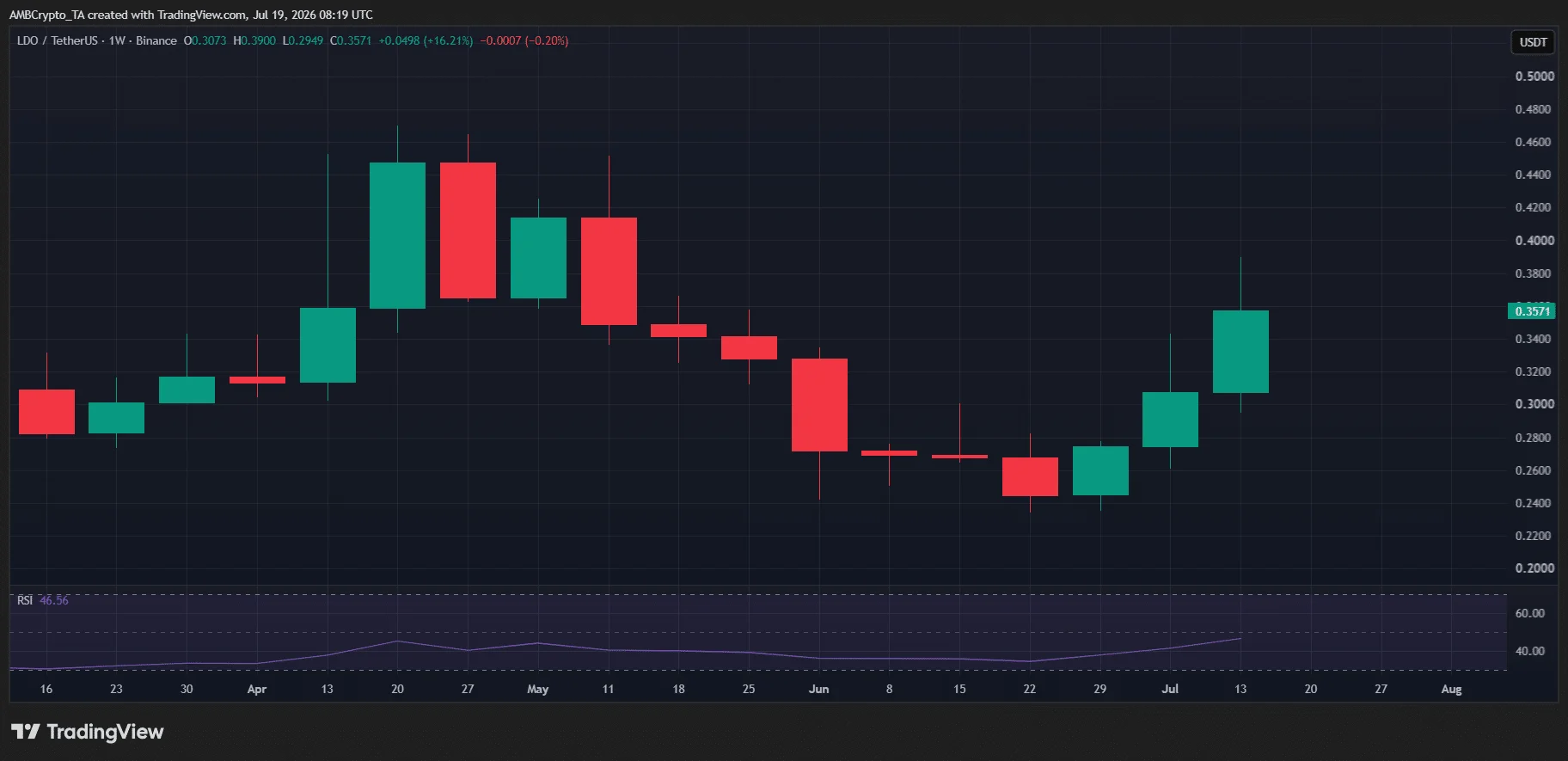
Lido DAO [LDO] led this week’s movers with a 16% rally. Notably, this comes after two straight weeks of upside, pushing LDO’s total gains to 25%. In just 21 days, the token has delivered a solid 40%+ recovery.

Why does this matter? Despite the recent move higher, LDO’s RSI is still far from the extreme overbought zone. This shows the rally has not yet entered a crowded phase, leaving room for further upside if momentum continues.

Technically, this suggests LDO’s move is more than just a random pump. The rally follows a sharp June sell-off, where LDO dropped toward $0.20 and broke below its Q1 lows. The current recovery shows buyers are stepping back in and attempting to reverse the previous downtrend.

LDO
Source: TradingView (LDO/USDT)

If this momentum continues, a breakout toward the $0.40 resistance zone could be on the table. 

For context, LDO faced heavy selling pressure around this level during Q1, making it a critical area for bulls to reclaim. A successful breakout could strengthen the recovery narrative, while another rejection may trigger a period of consolidation as traders reassess the next move.

Is Pump.fun [PUMP] still far from reaching full FOMO?

Pump.fun [PUMP] emerged as the second-biggest weekly winner with a 13% rally. While the RSI remains neutral and PUMP has seen strong trading volume in recent sessions, calling this a full-fledged breakout setup may still be too early.

For over two months, PUMP has been trading below the key $0.002 resistance zone, making this the most important level for bulls to reclaim. However, every weekly push higher has so far been followed by a sharp cooldown phase, showing that accumulation is still not strong enough to support a larger breakout.

In short, though, PUMP is showing early signs of recovery, the structure still needs confirmation. Until buyers can consistently defend higher levels and break through the $0.002 resistance, the token remains in a consolidation phase rather than a confirmed breakout trend. 

Venice Token [VVV]  sees a much-needed weekly relief rally

Venice Token [VVV] took the third spot this week with a 12.3% rally. For VVV, this could be one of its most significant weeks since mid-Q2. From a technical standpoint, VVV has been stuck in a consistent downtrend over the past eight weeks, with every weekly close ending in the red.

However, this week’s gains have clearly pushed VVV back into the spotlight. More importantly, the recovery came right after VVV broke below the key $10 support level, suggesting buyers stepped in at a critical zone. In this context, the rally looks more strategic, with bulls attempting to defend lower levels and build a recovery base.

If this trend holds, VVV could have started its recovery phase. The next key challenge sits around $15, which will determine whether this rebound can turn into a stronger reversal or remain just a short-term relief rally.

Other notable winners

Outside the majors, altcoin movers also stole the spotlight this week.

IOTA [SN9] led the market with a staggering 5,267% gain, followed by Akedo [AKE], which surged 874%, while TENDIES [TENDIES] climbed 615%, rounding out the week’s top performers.

Weekly losers

Lighter [LIT] enters a textbook cooldown phase

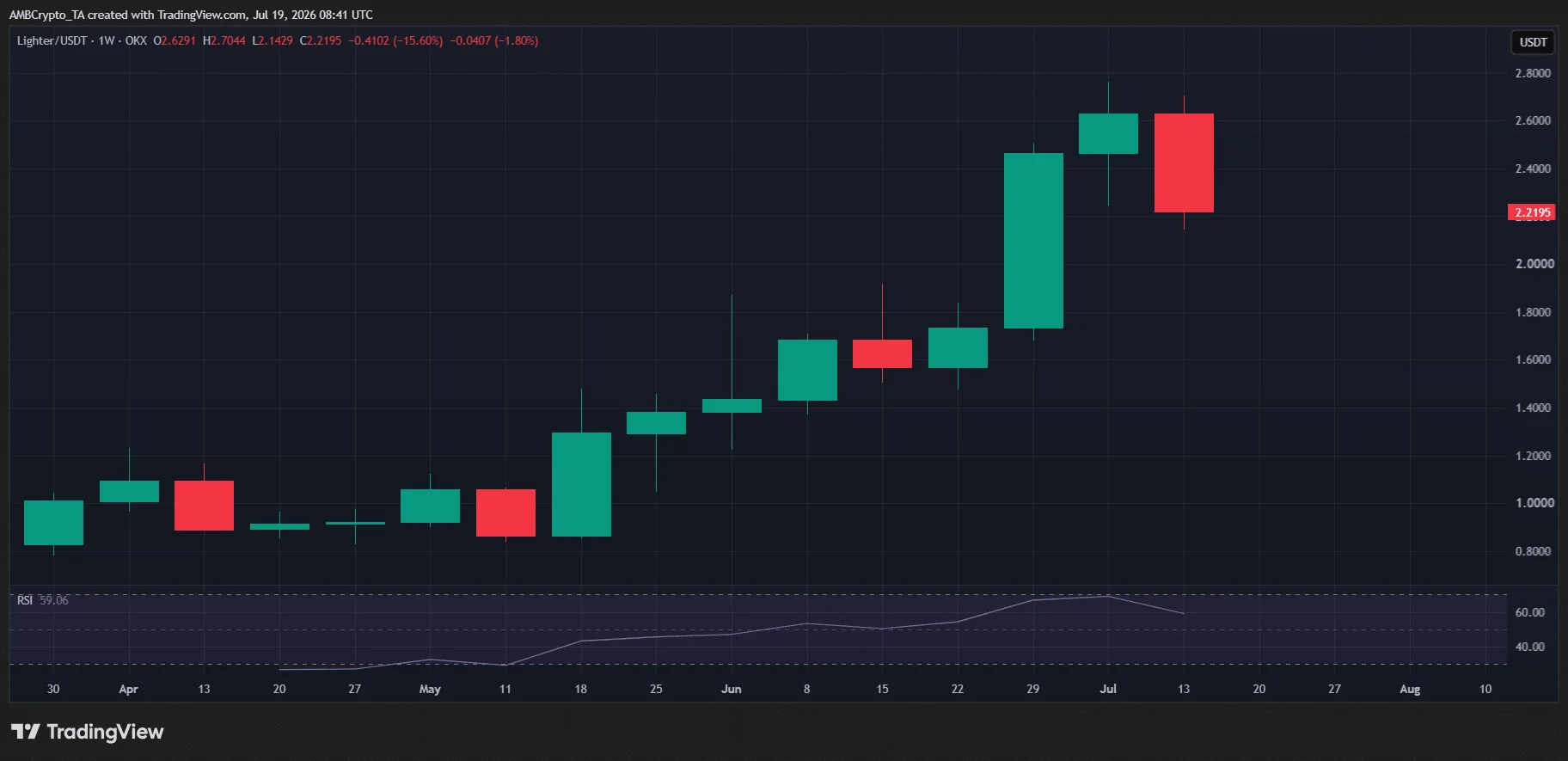
Lighter [LIT] led this week’s losses with a 16% decline. While LIT has seen similar pullbacks after strong weekly rallies since its mid-May breakout, this correction could be slightly different.

Notably, LIT’s drop comes after three straight weeks of upside, where the token rallied over 60% and reached a new all-time high of $2.70. More importantly, the breakout followed a successful retest of the $2 resistance zone, showing bulls were stepping in at key levels, a trend that has supported LIT’s Q2 rally.

However, this time, the RSI had climbed above 70, signaling an overheated move. The pullback toward 52 shows momentum has cooled, but it also suggests the market is resetting rather than  losing strength.

LITLIT
Source: TradingView (LIT/USDT)

Technically, however, this marks LIT’s strongest RSI pullback since its Q2 rally. In essence, this cooldown could become an important setup for LIT’s next move. If buyers step back in and the RSI starts recovering, this reset could fuel another upside attempt. 

Otherwise, this could be the first real sign that LIT has formed a local top.

Pi Network [PI] broke below a key support zone 

Pi Network [PI] emerged as the second-biggest loser this week with a 2.7% decline. While the drop looks modest compared to Lighter’s double-digit losses, PI’s chart looks much weaker, pointing to a stronger bearish bias.

Notably, this marks PI’s fourth straight week of losses. More importantly, the token broke below the key $0.10 support level, putting any near-term bounce under renewed selling pressure and printing a fresh all-time low.

Technically, PI remains firmly in a bearish structure. While the RSI has dropped into oversold territory, that alone doesn’t guarantee a recovery. Unless buyers reclaim the $0.10 level, any bounce could simply be a short-term relief rally rather than the start of a trend reversal, keeping PI as one of the weaker charts in the market right now.

Are Arbitrum [ARB] bulls losing their upper hand?

Arbitrum [ARB] took the third spot among this week’s biggest losers. Unlike PI, however, ARB’s chart hasn’t fully shifted into a bearish structure. The pullback comes after two straight weeks of gains, during which the token rallied more than 25%.

However, this week’s decline followed ARB’s failure to break above the key $0.10 resistance zone, a level that has capped price since the early May cycle. The rejection shows bulls are still struggling to reclaim this area, allowing sellers to regain short-term control.

Technically, ARB is at an important inflection point. If bulls can reclaim the $0.10 resistance zone, the recent pullback could turn into a healthy retest. Otherwise, continued rejection at this level may keep ARB stuck in a broader consolidation phase and hand bears the upper hand in the near term.

Other notable losers

In the broader market, downside volatility hit hard.

Cash Cat [CASHCAT] led the losers with a 72% decline, followed by LAB [LAB], which fell 66.5%, while ETHGas [GWEI] dropped 53.3% as bearish momentum intensified.

Conclusion

This week was a rollercoaster for crypto. Big pumps, sharp dips, and nonstop action. As always, stay sharp, do your own research, and trade smart.


Final Summary

  • Lido DAO [LDO], Pump.fun [PUMP], and Venice token [VVV] led the week in gains.
  • Lighter [LIT], Pi  network[PI], and Arbitrum [ARB] saw significant declines.


Source link