Netflix (NASDAQ: NFLX) shares have been in a slump, and things only got worse after the video streaming company reported its second-quarter results after the closing bell Thursday. After the stock’s 7.3% slide on Friday, the stock is down more than 26% thus far in 2026, and its shares have been nearly cut in half over the past year.
While some investors might be tempted to buy the dip, I wouldn’t rush in yet.
Missed Nvidia in 2009? This Rare Signal Is Flashing Again. In 2009, a “Double Down” signal flashed for a little-known chipmaker called Nvidia. For the first time in years, that same “Total Conviction” signal is flashing for a company 1/100th the size of Nvidia. Continue »
Turning into a cable company
Netflix’s biggest issue in my view is that the company is starting to look more and more like the cable networks it helped disrupt with its streaming service. Its growth now appears to be driven more by price increases than subscriber growth, and the company hasn’t been helping its case by continuing to publicly report on fewer metrics to give investors insight into its business.
The company stopped reporting quarterly subscriber numbers last year, and starting next year, it plans to scale back its reporting of viewership data to just once a year. (It currently does so twice a year.) Viewing hours were up just 2% in the first half of 2026, although that was a slight increase from the 1.5% growth it saw in the first half of 2025.
Meanwhile, like linear TV, Netflix is also starting to lean into live events and advertising. Securing highly anticipated live programming, such as major sporting events, tends to be expensive, and this year is expected to account for over 5% of Netflix’s content spending despite representing only 1% of its viewing hours. However, management believes this type of programming is responsible for strong new member sign-ups, and has made it a foundation of its advertising push.
The company said it is already in “advanced stages” for upfront advertising in the U.S., and is expected to lock in commitments soon. Netflix has been offering lower-cost, ad-supported subscription tiers in certain markets to help drive growth.
For Q2, Netflix saw solid growth, with revenue rising 13% to $12.56 billion. Adjusted earnings per share (EPS) climbed 11% to $0.80. Analysts on average had been looking for EPS of $0.79 on revenue of $12.59 billion, according to estimates compiled by LSEG. Revenue growth, meanwhile, was pretty consistent across regions, ranging from 14% in the U.S. and Canada to 20% in the Asia-Pacific region.
Looking ahead, management is guiding for third-quarter revenue growth to slow to below 12%, and for EPS to come in at $0.82.
Image source: The Motley Fool.
Why I’d stay on the sidelines
Netflix has a solid business that generates strong free cash flow and is growing revenue at low-double-digit percentage rates. However, it is starting to look more like a traditional cable network operator than an industry disrupter.
With the stock trading at a forward price-to-earnings ratio (P/E) of around 20 times analysts’ 2026 estimates, Netflix is reasonably valued. However, I think it needs to find a new type of investor base, as it’s losing its appeal for its previous growth-oriented one. This could be a tough transitional period, and as such, I’d put the stock on my radar, but I’d look for it to drift lower into bargain territory before pulling the trigger.
Should you buy stock in Netflix right now?
Before you buy stock in Netflix, consider this:
The Motley Fool Stock Advisor analyst team just identified what they believe are the 10 best stocks for investors to buy now… and Netflix wasn’t one of them. The 10 stocks that made the cut are built for long-term growth and could produce monster returns in the coming years.
Consider when Netflix made this list on December 17, 2004… if you invested $1,000 at the time of our recommendation, you’d have $371,842!* Or when Nvidia made this list on April 15, 2005… if you invested $1,000 at the time of our recommendation, you’d have $1,244,783!*
That performance is why people listen. With a track record of beating the S&P 500 by 4x, Stock Advisor offers a distinct advantage. Don’t miss the latest top 10 list, available with Stock Advisor, and join an investing community built for the long haul.
Geoffrey Seiler has no position in any of the stocks mentioned. The Motley Fool has positions in and recommends Netflix. The Motley Fool recommends London Stock Exchange Group Plc. The Motley Fool has a disclosure policy.
A year on, the rules aren’t quite ready for implementation, but we have a much clearer idea as to how the regulators are thinking about stablecoins and where they’re likely to land on those rules.
In an emailed statement, Crypto Council for Innovation CEO Ji Hun Kim called the passage of the bill “a landmark moment.”
“A year in, agencies, institutions, and innovators are building on a clearer foundation, and stablecoins are moving rapidly toward mainstream adoption,” he said.
The various regulators have proposed rules out for comment on the different aspects of stablecoin governance and regulation, including a proposal that would require stablecoin issuers to conduct similar know-your-customer checks to more traditional financial firms. The FDIC published 144 questions a few months ago about how it would oversee stablecoin issuers, looking at concerns like custody, capital and liquidity standards. The OCC, for its part, put out its own proposal in February laying out how it was interpreting the law.
There’s still a few months left before these rules start being finalized. And in the meantime, the industry is still working on getting the Digital Asset Market Clarity Act passed.
The text of the combined Clarity Act drafts is not yet public, at least as of Friday night. While industry sources expected the bill to be released last week, the timeline has constantly evolved. On Thursday, Senators Cynthia Lummis and Bernie Moreno were supposed to brief Trump on the bill. There was no public readout of that meeting available after, but both lawmakers tweeted about Trump’s remarks on the election later Thursday.
IBM‘s board faced an uncomfortable decision after learning that the company’s second quarter had fallen well short of expectations.
Directors can now take a breather and wait until the scheduled earnings release and let executives explain the results in detail. Or they could warn investors immediately and risk a violent market reaction.
They opted for disclosure.
IBM (IBM) shares fell more than 25% on July 14, wiping off approximately $69 billion in market value in the company’s worst one-day drop ever. IBM’s market valuation is around $202.5 billion, after the stock ended July 17 at $212.67.
The early data were disappointing but not bad enough on their own to justify the magnitude of the selloff.
IBM estimates revenue for the second quarter to be $17.2 billion, up 1% from a year earlier, and operating earnings of $2.93 a share. Wall Street was looking for about $17.86 billion in sales and $3.02 per share, according to LSEG statistics as cited by Reuters.
What spooked investors was the cause for the shortfall.
Customers shifted spending to servers, storage, and memory that are needed for artificial intelligence infrastructure. And little hardware went to the front of corporate purchase queues, slowing large IBM software and mainframe-related deals.
That suggests a risk that extends well beyond one particularly poor quarter.
Artificial intelligence can weaken IBM without replacing it. It can affect IBM by reducing the technological budgets its clients once spent on traditional software, consulting, and mainframe systems.
First-quarter revenue rose 9% to $15.9 billion. Software revenue increased 11%, infrastructure advanced 15%, and IBM Z revenue jumped 51%. Management maintained its expectation for more than 5% constant-currency revenue growth in 2026 and approximately $1 billion of additional annual free cash flow.
But the preliminary second-quarter data altered that tale quickly.
Software grew at a slower rate of 5%. Consulting revenue was flat. Infrastructure revenue decreased 7%, below management’s prior guidance for a low single-digit decline as the first IBM z17 mainframe launch cycle developed.
IBM claimed the infrastructure drop was worse than expected due to inadequate Z system performance and related transaction processing software.
That counts.
IBM did not say large acquisitions had failed or businesses newly acquired were crumbling. Krishna said HashiCorp and Confluent performed well, while Red Hat revenue growth accelerated to 11%.
There was significant wholesale infrastructure demand for IBM.
Its distributed infrastructure business, including power systems and storage, gained 37% and ended the quarter with a backlog of over $500 million. IBM also claimed that the z17 program was still approximately 130% of the corresponding z16 cycle, despite the quarterly setback.
The trouble was that IBM didn’t translate enough of that demand into the sales mix and timing that investors wanted to see.
Customers moved late-quarter capital investment to supply-constrained servers, storage, and memory ahead of expected price hikes. Many significant transactions did not close on time because the corporation did not respond fast enough, said IBM.
Some deferred deals may still close in later quarters.
That would imply the second-quarter failure was mainly a timing issue, not a sign of lasting demand destruction.
But a corporation that portrays itself as a trusted navigator through complicated technology shifts should know how its greatest customers are allocating their finances.
The board of IBM reportedly grilled Krishna before choosing to send out the early warning. The move might ultimately help the company regain confidence through transparency, but for investors, the decision initially was considered a sign that management had lost visibility into its own sales funnel.
That’s why a small revenue miss set up a massive stock-market reaction.
The quarter didn’t just test IBM’s financial guidance. It did not make the case that the corporation could navigate a shift from traditional enterprise computing to artificial intelligence with any reliability.
AI is squeezing IBM from two directions
So the first challenge is budget competitiveness.
To develop artificial intelligence systems, companies require processors, memory, storage, networking equipment, and data center capacity. If these components are in limited supply, or if their price is likely to rise, consumers may buy them before accepting less urgent software or consultancy projects.
That seems to have been the case in the closing weeks of IBM’s second quarter.
Banks and other big companies focused on infrastructure buys, throwing off the timing of software and mainframe deals IBM anticipated to close. IBM’s warning was among the clearest signals thus far that spending on artificial intelligence may squeeze other business technology expenditures, Reuters said.
So IBM can get a piece of that spend.
The 37% rise in distributed infrastructure shows that consumers were buying some IBM servers and storage solutions. But its strength was not enough to offset weakness in the higher-end mix of mainframes and transaction-processing software.
That points to a big weakness in IBM’s broad portfolio.
The company supplies gear, software, and consulting services that work together. That mix can improve customer ties as tech budgets broaden.
Things become trickier when clients have strong preferences for one group or the other.
IBM could win a storage sale but lose or delay the software and consultancy revenue that was to accompany it. Therefore, spending on artificial intelligence infrastructure can stimulate demand within one IBM division while at the same time hurting another.
The second challenge is product replacement.
AI-powered coding bots and automation technologies could one day lower the costs firms spend for traditional software development, application maintenance, and consultancy services. They could also facilitate the modernization of legacy systems without such heavy reliance on the vendors who built and maintain them.
IBM is especially vulnerable since its hybrid-cloud strategy straddles two computer eras.
Red Hat helps users run applications on private systems and public clouds. IBM consultants help major enterprises modernize their technology while keeping vital software and data that resides on mainframes.
The plan relies on clients continuing to pay IBM to bring their legacy operations together with modern technologies.
If companies require help with securely implementing complex systems, artificial intelligence could make that bridge more useful.
It also could lower the value of the bridge if automation makes it easier to move or if consumers spend their available money elsewhere, such as on infrastructure vendors, cloud platforms, and independent AI developers.
That’s the secret problem underlying IBM’s warning.
The corporation isn’t merely trying to market artificial intelligence. It is vying for its customers’ dollars with artificial intelligence.
IBM has proven to be able to create demand for AI.
The corporation announced a generative AI book of business exceeding $12.5 billion as of the close of 2025. IBM’s definition, however, mixes software transaction revenue and new annual contract value from software subscriptions and consultancy contracts. That does not mean $12.5 billion of reported quarterly or annual AI revenue, however.
IBM still has to translate those contracts and signings into sustainable growth that can offset challenges elsewhere.
More AI:
IBM is increasingly looking to software businesses and technology it has bought, which still hold the most significant money-making potential in the future.
Red Hat has continued to post double-digit growth, while Krishna claimed HashiCorp and Confluent did well throughout the quarter. Those businesses improve IBM’s hybrid cloud, infrastructure automation, and data management position.
IBM is also making a big investment into quantum computing.
The firm says it expects to invest more than $10 billion over five years and is on course to deploy a large-scale fault-tolerant quantum computer in 2029. IBM also revealed plans for a quantum wafer foundry, financed by $1 billion in proposed federal incentives and $1 billion in business contributions.
Those projects could gain strategic importance.
They can’t fix the next couple of quarters.
Investors looking to buy IBM after the selloff face the question of whether the company’s existing software business can pay for long-term objectives as artificial intelligence impacts client spending in real time.
IBM’s latest warning puts its AI transition under pressureAlex Wong / Getty Images
What IBM investors should watch before buying the dip
The first issue is full-year guidance.
It did not revise its annual outlook in the preliminary-results letter. Management said it would disclose full-year estimates when it announces final second-quarter earnings on July 22.
IBM had previously projected more than 5% constant currency revenue growth and $1 billion of incremental free cash flow for 2026 ahead of the warning. A big cut would suggest management believes the expenditure interruption is more than a one-quarter timing issue.
The second question is whether delayed deals pay off.
Many significant transactions did not close within IBM’s projected schedule, said Krishna. Investors will have to figure out whether those clients merely delayed their selections or whether they shifted the money permanently.
A delayed sale can increase revenue over time.
If a project is cancelled, that would mean that artificial intelligence has shifted the customer’s priorities in a more fundamental way.
Third is IBM Z.
The z17 was still ahead of the identical z16 program, but the division had not yet delivered the quarterly results management had expected. Investors should gain more clarity on shipments, capacity expansion, and revenue from transaction-processing software that comes with those systems.
The fourth problem is the quality of software growth.
The 11% growth at Red Hat, plus HashiCorp and Confluent’s showing, is proof that IBM’s modernization portfolio is solid. But shareholders need to take organic performance apart from acquired growth and see if new products can make up for decline in mature software sectors.
Cash flow is important, too.
In the first half, IBM had $4.8 billion in free cash flow. IBM’s debt was $66.4 billion at the end of the first quarter, an increase of $5.1 billion from the end of the year as it invested in the Confluent purchase.
That balance sheet does not mean an imminent crisis.
That means IBM has less space for repeated execution errors as it integrates acquisitions, maintains its dividend, and funds costly artificial intelligence and quantum computing programs.
Artificial intelligence could pressure IBM both by consuming technology budgets and automating work performed by traditional software and consulting vendors.
IBM’s July 22 outlook will help determine whether the miss was temporary or evidence of a deeper turnaround problem.
IBM’s historic decline does not prove the company has become irrelevant.
Its biggest customers still rely on IBM systems for important financial, governmental, and industrial workloads. Red Hat continues to grow, demand for distributed infrastructure remains high, and the z17 program continues to outpace its predecessor on a comparable basis.
But the warning changes the burden of proof.
Krishna’s goal has been to position IBM as the link between old corporate systems and the future generation of cloud, artificial intelligence, and eventually quantum computing.
That middle position looked promising as customers were growing multiple technology expenditures at the same time.
The danger increases when artificial intelligence pressures customers to decide which investments to fund first.
IBM may find that the infrastructure needed for AI eats up the budget before IBM’s software and consultancy businesses can monetize the transition. At the same time, more advanced AI technologies might put longer-term pressure on the older software and services companies that are funding the company’s shift.
A race that IBM can’t win by just sitting around.
There’s a recovery case; if the delayed transactions close, Red Hat will keep double-digit growth, and the firm will preserve its full-year cash-flow objective. Then the size of the selloff could seem extreme relative to a transient disruption to buying.
If IBM decreases yearly projections, demand for transaction processing continues to weaken, or significant customers build up artificial intelligence capabilities themselves without buying the broader IBM portfolio, the bearish case is strengthened.
The question is not whether IBM is in artificial intelligence.
The question is whether the corporation can generate enough AI-related revenue before the technology cannibalizes the companies IBM is utilizing to fund its future.
BUILDon [B] has climbed to the top of the bulls’ watchlist, as traders rotate heavy capital into the token, keeping the asset firmly on the bullish side.
At press time, BUILDon surged 61% in the past day after spending most of the month in the red, though it still carried a 15% loss over the trailing thirty days. The rally holds no clear fundamental catalyst for now, yet on-chain data points to forces that could keep the asset supported.
Spot accumulation underpins the rally
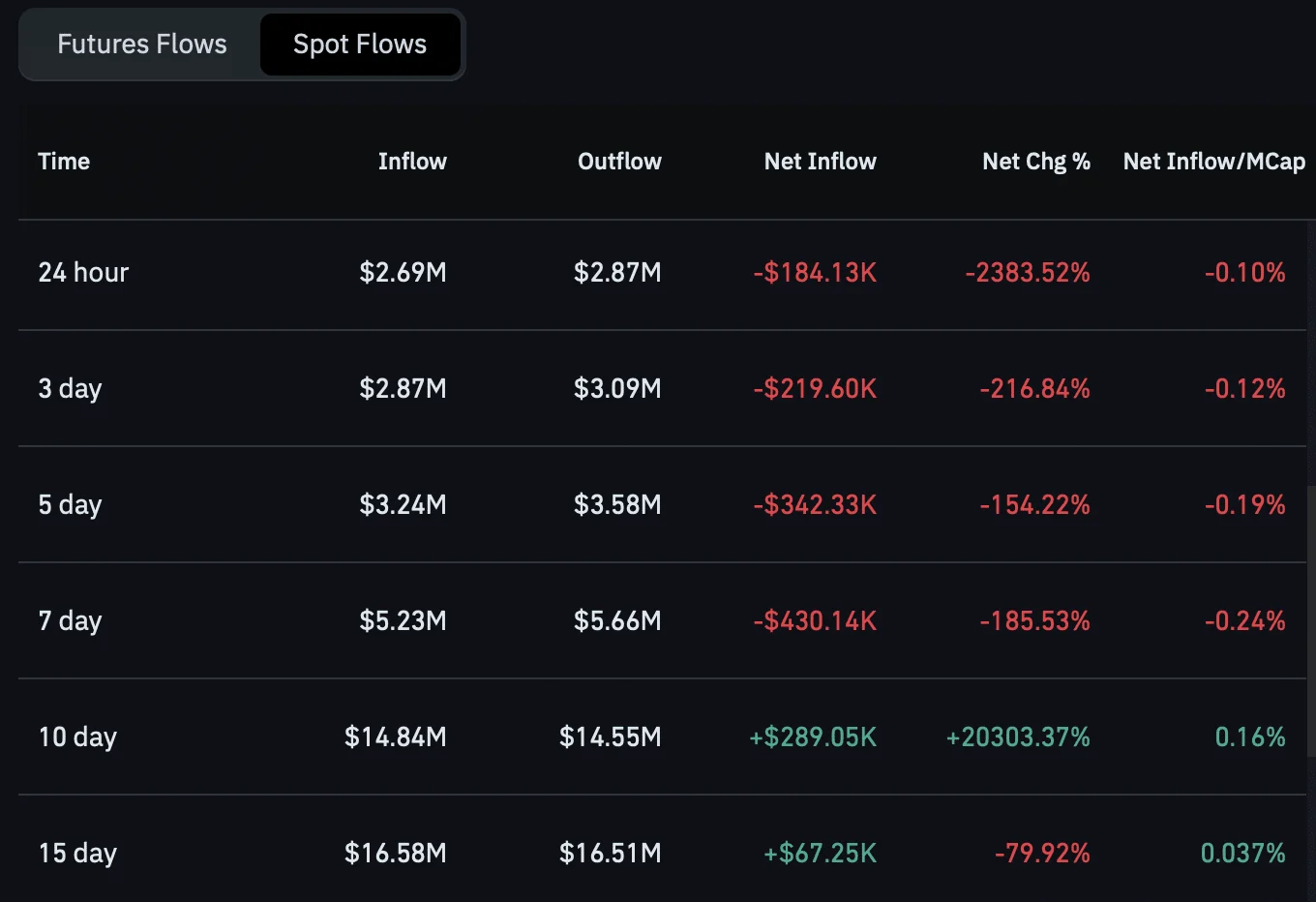
Spot accumulation offers the clearest signal, having built quietly for weeks ahead of the move. Exchange flows over the past seven days show more of the token have exited the market than entered it.
Outflows describe a situation where investors buy an asset and shift it into private wallets for long-term holding. The chart shows the market accumulated roughly $5.66 million worth of BUILDon across those seven days.
Source: TradingView
Investors then pulled $2.87 million worth of the token off exchanges over the last 24 hours as the surge played out, dragging netflow to a negative $184,130 and signaling that buyers outweighed sellers.
The Futures market echoed that sentiment across both capital flow and funding. The open-interest-weighted funding rate prints positive, meaning most leveraged positions in the market come from traders betting long on the asset.
Steady capital inflows add to that, standing ready to fund further upside bets, with $119.51 million in leveraged capital moving onto exchanges to sharpen the bullish tilt.
BUILDon momentum indicators flash bullish
Momentum readings and capital-flow trackers both place the market in a critical phase.
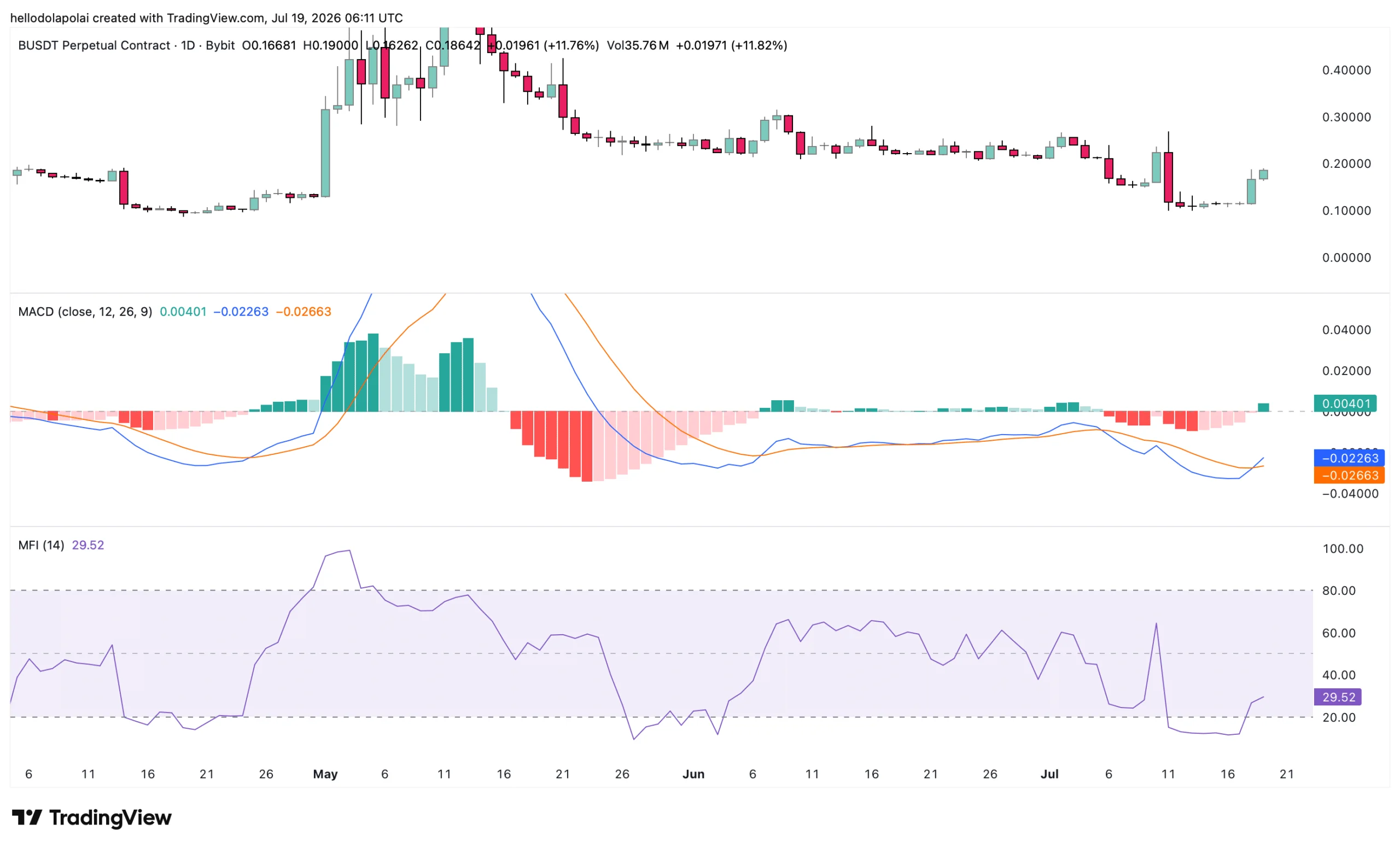
The Moving Average Convergence Divergence (MACD), which tracks an asset’s momentum, has printed a bullish crossover as of writing as the blue MACD line pushes above the orange signal line while trending higher.
Source: TradingView
That setup typically points to sufficient buying power, and if BUILDon sustains it, the token stands a strong chance of extending its rally in the near term.
Capital flow tells a matching story through the Money Flow Index (MFI), which read 29, pointing to fresh capital rotating into the market. With momentum strengthening and capital flowing in more steadily, BUILDon looks well placed to hold the buying power that led the day.
Social sentiment backs the BUILDon move
Sentiment keeps BUILDon’s rally in play. Data from CoinMarketCap shows a surge in the token’s mindshare across social media, and its sentiment reading climbed over the same period.
Mindshare grew 119% in the past day, while the sentiment gauge closes in on peak bullishness at 5.24 on the chart.
These indicators track interest, and the level seen over the past 24 hours suggests the market now sits in a strong bullish phase—one that could stretch its gains into the week as more traders return to the market.
Final Summary
Buildon jumped 61% in a day despite spending most of the month down, with no clear news trigger—the buying is coming from traders quietly stacking the token.
More of the token is leaving exchanges than arriving, a sign holders are moving it into private wallets, while social buzz has spiked 119% in the same window.
This year, Tether rolled out USAT — launched with U.S. standards in mind and issued through U.S. banking partner Anchorage Digital. So far, it remains at a relatively low level of usage.
“Non-compliant stablecoins cannot be used by U.S. institutions when the safe harbor expires in 2028, but we don’t expect the market to wait,” said Kevin Wysocki, head of policy at Anchorage Digital, the crypto-native bank that manages a number of stablecoins. He said the company believes institutional users will move toward “compliant, bank-issued digital dollars well ahead of that deadline.”
Do they have two years?
GENIUS included a three-year grace period for compliance, and two years remain, after which U.S. crypto platforms won’t be able to offer stablecoins whose issuers haven’t checked all the regulatory boxes. However, there seems to be some disagreement over whether foreign issuers are meant to enjoy that same safe harbor. Some lawyers in finance assume that Tether gets until July 18, 2028, to comply, but others have suggested that foreign issuers would have to comply the moment GENIUS officially goes live, which is likely six months from now in January.
“Upon the effectiveness of the GENIUS Act, foreign issuers will need to immediately comply with lawful orders to seize and freeze coins held by illicit actors, but they will have a runway of approximately two more years to prepare for the additional requirements so that their coins may remain eligible for listing on U.S. centralized trading platforms,” said Justin Levine, a lawyer at Davis Polk who advises clients on stablecoin issues, adding that one of those remaining requirements — registration with the Office of the Comptroller of the Currency — is likely to require a “significant undertaking”
Investors face a choice between high-growth disruption and steady government contracting when choosing between Space Exploration Technologies (NASDAQ:SPCX), better known as SpaceX, and BWX Technologies (NYSE:BWXT) for their portfolios in 2026.
SpaceX’s focus on reusable rocketry and satellite internet contrasts with the nuclear manufacturing expertise of BWX Technologies. While one aims to lower the cost of reaching orbit, the other provides critical nuclear solutions for global security and clean energy.
The case for SpaceX
Space Exploration Technologies designs and operates reusable rockets, the Starship platform, and the Starlink broadband service. By March 2026, the company served 10.3 million Starlink subscribers across 164 countries and territories. Its business strategy centers on reducing launch costs through reusability while leveraging its own rockets to deploy a massive satellite constellation.
In its 2025 fiscal year (FY), revenue reached $18.7 billion, representing revenue growth of 33% compared to the previous year. Despite this top-line expansion, the company reported a net loss of $4.9 billion for the period. This performance reflects a shift from the prior year when the company achieved a positive net income during its aggressive expansion phase.
As of its December 2025 balance sheet, the current ratio stands at 1.4x, which measures a company’s ability to cover short-term debts with current assets. The company carries a debt-to-equity ratio of 0.6x, comparing its total debt to the value of shareholder equity. Free cash flow, or the cash remaining after the business pays for its operating activities and investments in physical equipment, was negative $14 billion in FY 2025. Note that stock-based compensation (SBC) represented 28.7% of operating cash flow, which inflates reported cash generation since SBC is a non-cash expense added back in the cash flow statement.
The case for BWX Technologies
BWX Technologies provides specialized nuclear components and services among defense stocks and global security industries. Its primary customer is the U.S. government, which accounted for 68% of consolidated revenues in 2025. Customer concentration like this adds a layer of risk to the business, though it often provides long-term revenue visibility through multi-year contracts.
In FY 2025, revenue reached $3.2 billion, which was an increase of 18% over the prior year. The company reported net income of $329.9 million, resulting in a net margin of 10.3%. This level of profitability has remained relatively stable over the last three fiscal years as the company expanded its manufacturing footprint.
In terms of financial health, the company reported a debt-to-equity ratio of 1.6x as of its December 2025 balance sheet. This figure compares total debt to the value of shareholder equity. Its current ratio stands at 2.3x, suggesting it has ample liquid assets to cover obligations due within one year. The company generated free cash flow of $295.3 million during FY 2025.
Risk profile comparison
SpaceX operates in a capital-intensive industry that requires constant technological breakthroughs. The high cost of developing reusable rockets and the Starship platform presents ongoing financial pressure. The company also faces increasing competition in the satellite internet market from Amazon, which is developing its own satellite constellations to compete with Starlink.
BWX Technologies faces significant concentration risk since the U.S. government remains its largest customer. The company also manages high-consequence nuclear activities under strict oversight from government agencies. Operations often involve fixed-price contracts where rising costs for labor or materials can hurt the net margin. Furthermore, reliance on joint ventures with partners such as Amentum means it has limited control over some large projects.
Valuation comparison
BWX Technologies appears more conservative based on its lower Forward P/E, while Space Exploration Technologies carries a high P/S ratio. The Forward P/E measures the stock price against future earnings estimates, while the P/S ratio compares the price to the company’s annual sales.
Sector benchmark uses the SPDR XLI sector ETF. Valuation metrics sourced from Financial Modeling Prep (FMP) and may differ from other data providers.
Which stock would I buy in 2026?
Deciding to invest in SpaceX or BWX Technologies (BWXT) depends on whether you are a risk taker willing to bet on the spectacular potential of a space-based economy, or prefer the more conservative investment of a defense stock.
SpaceX only became a public company in June while BWXT has a long history of performance that investors can review. That’s one reason why buying shares in the former is a risk. Another is that SpaceX’s debt picture looks poised to change in 2026. Shortly after its IPO, the company announced a $25 billion bond issuance to fund its capital-intensive operations.
BWXT is my pick for the stock to buy in 2026. SpaceX is too speculative at this stage. Meanwhile, BWXT has an enormous opportunity in front of it. The company produces components for nuclear power, and with the rise of artificial intelligence, the demand for electricity is soaring, so much so that the U.S. Department of Energy estimates power shortages by 2030.
Consequently, organizations are turning to nuclear power, creating a huge market for BWXT. In its first quarter earnings report, the company noted a whopping 121% year-over-year increase in sales to the commercial sector to $283.6 million. This reduces BWXT’s reliance on the government while providing a growing revenue stream for the company.
Should you buy stock in Space Exploration Technologies right now?
Before you buy stock in Space Exploration Technologies, consider this:
The Motley Fool Stock Advisor analyst team just identified what they believe are the 10 best stocks for investors to buy now… and Space Exploration Technologies wasn’t one of them. The 10 stocks that made the cut could produce monster returns in the coming years.
Consider when Netflix made this list on December 17, 2004… if you invested $1,000 at the time of our recommendation, you’d have $371,842!* Or when Nvidia made this list on April 15, 2005… if you invested $1,000 at the time of our recommendation, you’d have $1,244,783!*
Now, it’s worth noting Stock Advisor’s total average return is 900% — a market-crushing outperformance compared to 207% for the S&P 500. Don’t miss the latest top 10 list, available with Stock Advisor, and join an investing community built by individual investors for individual investors.
Robert Izquierdo has positions in Amazon. The Motley Fool has positions in and recommends Amazon, Amentum, and BWX Technologies. The Motley Fool has a disclosure policy.
MEXICO CITY, MEXICO – JUNE 11: Shakira performs during the Opening Ceremony before the FIFA World Cup 2026 Group A match between Mexico and South Africa at Mexico City Stadium on June 11, 2026 in Mexico City, Mexico. (Photo by Carl Recine/Getty Images)
Getty Images
The 2026 FIFA World Cup wraps up Sunday, July 19, as Spain and Argentina face off for the championship. The final will also feature plenty of entertainment, including a 90-minute closing ceremony and the first-ever FIFA World Cup Final Halftime Show.
The performance will benefit the FIFA Global Citizen Education Fund, which aims to raise $100 million to expand access to quality education and football opportunities for children around the world.
“We are proud to have Justin Bieber joining Madonna, Shakira and BTS to co-headline the FIFA World Cup 2026 Final Halftime Show in support of the FIFA Global Citizen Education Fund and our mission to expand access to quality education and football opportunities for children around the world,” FIFA President Gianni Infantino said in a statement.
What Does The 90-Minute Closing Ceremony Entail?
CHICAGO, ILLINOIS – JUNE 18: Jennifer Hudson performs during the dedication ceremony for the opening of the Barack Obama Presidential Center, in John Lewis Plaza, on June 18, 2026 in Chicago, Illinois. Barack Obama served as the 44th president of the United States from 2009 to 2017 and was the first African-American to hold the office. (Photo by Taylor Hill/Getty Images)
Getty Images
Before attention turns to the halftime show, a 90-minute closing ceremony will begin at 1:30 p.m. ET.
Jennifer Hudson will perform a special rendition of “The Star-Spangled Banner,” while Robbie Williams, Nicole Scherzinger, Laura Pausini, Tom Cruise and IShowSpeed are also set to take the stage, per FIFA.
Post Malone will also headline a set “designed to celebrate the tournament’s journey and ignite the atmosphere before the world’s attention turns to the two finalists,” according to Infantino.
What Time Is The FIFA World Cup 2026 Final Halftime Show?
The FIFA World Cup 2026 Final Halftime Show will take place during halftime of the final match between Spain and Argentina on Sunday, July 19, at New York New Jersey Stadium, also known as MetLife Stadium.
Kickoff is scheduled for 3 p.m. ET, meaning the halftime show is expected to begin at approximately 3:45 p.m. ET, depending on the pace of the match and any stoppage time.
How To Watch The 2026 FIFA World Cup Final Halftime Show
NEW JERSEY, UNITED STATES – JULY 19: Fans gather prior the FIFA World Cup 2026 Final match between Spain and Argentina at New Jersey Stadium (MetLife Stadium) in East Rutherford, New Jersey, USA, on July 19, 2026. (Photo by Evrim Aydin/Anadolu via Getty Images)
Anadolu via Getty Images
Fans can watch the World Cup final and halftime show on ESPN, Fox Sports, Fox Sports 1, Peacock and Telemundo. The event will also be available to stream on FIFA+.
Who’s Performing At The FIFA World Cup 2026 Final Halftime Show?
INDIO, CALIFORNIA – APRIL 18: (Exclusive Coverage) (FOR EDITORIAL USE ONLY) (NOT TO BE LICENSED FOR ANY STANDALONE OR SPECIAL INTEREST BOOK PUBLISHING USE CONCERNING THE COACHELLA MUSIC FESTIVAL AND/OR STAGECOACH MUSIC FESTIVAL) Justin Bieber performs at the Coachella Stage during the 2026 Coachella Valley Music and Arts Festival at Empire Polo Club on April 18, 2026 in Indio, California. (Photo by Kevin Mazur/Getty Images for Coachella)
Kevin Mazur/Getty Images for Coachella
Some of the world’s biggest music stars will take the stage during FIFA’s inaugural World Cup Final Halftime Show, including:
Justin Bieber
Madonna
Shakira
BTS
Burna Boy
Gustavo Dudamel
PS22 Chorus featuring Coldplay
Characters from Sesame Street and The Muppets
How Long Will The FIFA World Cup 2026 Final Halftime Show Last?
Every match at the 2026 FIFA World Cup includes a 15-minute halftime break. FIFA said the inaugural halftime show will last approximately 11 minutes, meaning the full intermission is expected to run longer than usual. The Athleticreported that the break could last around 20 minutes in total.