Home Blog Page 219

SpaceX vs. BWX Technologies: Which Industrials Stock Is a Better Buy in 2026?

0
SpaceX vs. BWX Technologies: Which Industrials Stock Is a Better Buy in 2026?


Investors face a choice between high-growth disruption and steady government contracting when choosing between Space Exploration Technologies (NASDAQ:SPCX), better known as SpaceX, and BWX Technologies (NYSE:BWXT) for their portfolios in 2026.

SpaceX’s focus on reusable rocketry and satellite internet contrasts with the nuclear manufacturing expertise of BWX Technologies. While one aims to lower the cost of reaching orbit, the other provides critical nuclear solutions for global security and clean energy.

The case for SpaceX

Space Exploration Technologies designs and operates reusable rockets, the Starship platform, and the Starlink broadband service. By March 2026, the company served 10.3 million Starlink subscribers across 164 countries and territories. Its business strategy centers on reducing launch costs through reusability while leveraging its own rockets to deploy a massive satellite constellation.

In its 2025 fiscal year (FY), revenue reached $18.7 billion, representing revenue growth of 33% compared to the previous year. Despite this top-line expansion, the company reported a net loss of $4.9 billion for the period. This performance reflects a shift from the prior year when the company achieved a positive net income during its aggressive expansion phase.

As of its December 2025 balance sheet, the current ratio stands at 1.4x, which measures a company’s ability to cover short-term debts with current assets. The company carries a debt-to-equity ratio of 0.6x, comparing its total debt to the value of shareholder equity. Free cash flow, or the cash remaining after the business pays for its operating activities and investments in physical equipment, was negative $14 billion in FY 2025. Note that stock-based compensation (SBC) represented 28.7% of operating cash flow, which inflates reported cash generation since SBC is a non-cash expense added back in the cash flow statement.

The case for BWX Technologies

BWX Technologies provides specialized nuclear components and services among defense stocks and global security industries. Its primary customer is the U.S. government, which accounted for 68% of consolidated revenues in 2025. Customer concentration like this adds a layer of risk to the business, though it often provides long-term revenue visibility through multi-year contracts.

In FY 2025, revenue reached $3.2 billion, which was an increase of 18% over the prior year. The company reported net income of $329.9 million, resulting in a net margin of 10.3%. This level of profitability has remained relatively stable over the last three fiscal years as the company expanded its manufacturing footprint.



Source link

What Time Is the FIFA World Cup 2026 Halftime Show? How To Watch Live

0
What Time Is the FIFA World Cup 2026 Halftime Show? How To Watch Live


The 2026 FIFA World Cup wraps up Sunday, July 19, as Spain and Argentina face off for the championship. The final will also feature plenty of entertainment, including a 90-minute closing ceremony and the first-ever FIFA World Cup Final Halftime Show.

The performance will benefit the FIFA Global Citizen Education Fund, which aims to raise $100 million to expand access to quality education and football opportunities for children around the world.

ForbesFIFA 2026 World Cup Final Halftime Show Lineup Includes Justin Bieber, Madonna And BTS

“We are proud to have Justin Bieber joining Madonna, Shakira and BTS to co-headline the FIFA World Cup 2026 Final Halftime Show in support of the FIFA Global Citizen Education Fund and our mission to expand access to quality education and football opportunities for children around the world,” FIFA President Gianni Infantino said in a statement.

What Does The 90-Minute Closing Ceremony Entail?

Before attention turns to the halftime show, a 90-minute closing ceremony will begin at 1:30 p.m. ET.

Jennifer Hudson will perform a special rendition of “The Star-Spangled Banner,” while Robbie Williams, Nicole Scherzinger, Laura Pausini, Tom Cruise and IShowSpeed are also set to take the stage, per FIFA.

Post Malone will also headline a set “designed to celebrate the tournament’s journey and ignite the atmosphere before the world’s attention turns to the two finalists,” according to Infantino.

What Time Is The FIFA World Cup 2026 Final Halftime Show?

The FIFA World Cup 2026 Final Halftime Show will take place during halftime of the final match between Spain and Argentina on Sunday, July 19, at New York New Jersey Stadium, also known as MetLife Stadium.

Kickoff is scheduled for 3 p.m. ET, meaning the halftime show is expected to begin at approximately 3:45 p.m. ET, depending on the pace of the match and any stoppage time.

How To Watch The 2026 FIFA World Cup Final Halftime Show

Fans can watch the World Cup final and halftime show on ESPN, Fox Sports, Fox Sports 1, Peacock and Telemundo. The event will also be available to stream on FIFA+.

Who’s Performing At The FIFA World Cup 2026 Final Halftime Show?

Some of the world’s biggest music stars will take the stage during FIFA’s inaugural World Cup Final Halftime Show, including:

  • Justin Bieber
  • Madonna
  • Shakira
  • BTS
  • Burna Boy
  • Gustavo Dudamel
  • PS22 Chorus featuring Coldplay
  • Characters from Sesame Street and The Muppets

How Long Will The FIFA World Cup 2026 Final Halftime Show Last?

Every match at the 2026 FIFA World Cup includes a 15-minute halftime break. FIFA said the inaugural halftime show will last approximately 11 minutes, meaning the full intermission is expected to run longer than usual. The Athletic reported that the break could last around 20 minutes in total.


Source link

Michael Saylor calls Bitcoin’s new BIP-110 proposal ‘a bad idea’

0
Michael Saylor calls Bitcoin's new BIP-110 proposal 'a bad idea'

Michael Saylor, executive chairman and co-founder of Strategy, has come out swinging against a new proposal to clean up Bitcoin’s ‘spam,’ arguing that it could fundamentally alter how the world’s largest blockchain operates.

The Bitcoin Improvement Proposal (BIP) 110, aimed at temporarily restricting arbitrary data to focus on the core monetary functions, is a threat to the main principles of the network, Saylor explained in a comprehensive critique published on X, titled “110 reasons BIP-110 is a bad idea.”

“The proposed cure is more dangerous than the condition,” Saylor said in the recent detailed analysis. “BIP 110 would use consensus to narrow valid activity, constrain future options, complicate deployment, and establish a precedent it cannot later erase.”

Saylor’s primary objection is based on the “no-questions-asked” nature of money. “Bitcoin cannot read intent,” Saylor writes. “The network cannot know whether bytes represent an image, a proof, a contract, metadata, an authentication record, or a future application,” argued.

By banning “spam,” the protocol would effectively elevate human judgment into protocol law, effectively turning Bitcoin’s conservatism upside down.

‘Too aggressive’

Saylor is the latest bitcoin executive to weigh in on this highly debated topic among the Bitcoin community.


Source link

Michael Saylor warns against BIP-110: Is Bitcoin’s utility truly evolving?

0
Michael Saylor warns against BIP-110: Is Bitcoin's utility truly evolving?


Over the years, Bitcoin has evolved from a pure store of value into a more usable asset, with growing adoption in the payments sector.

As a result, consensus protocols and fee-paying transactions are becoming a bigger focus, as outlined in the BIP-110 proposal. However, not everyone is convinced this is the right direction, with Michael Saylor among its biggest critics.

In a post on X, Michael Saylor outlined 110 reasons why he believes BIP-110 is a bad idea.

His criticism targets Version 1.0.0 of the proposal, known as the “Reduced Data Temporary Softfork,” which reached complete status on the 25th of June, 2026. The proposal introduces a soft fork, prioritizing fee-paying Bitcoin transactions over non-financial data.

Bitcoin
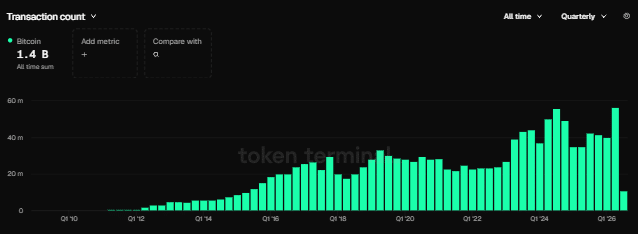
Source: Token Terminal

Notably, the on-chain data already reflects the growing focus on transaction activity.

As the chart above shows, Bitcoin processed well over 56 million transactions in Q2 2026, setting a new quarterly record and surpassing the previous high of 55 million recorded in Q3 2024.

The surge signals growing network usage, reinforcing Bitcoin’s shift beyond its long-term  store-of-value role.

Against this backdrop, it’s easy to see why Michael Saylor doubled down on his criticism of BIP-110. In a follow-up post on X, he argued that Bitcoin’s [BTC] long-term strength lies in deeper adoption by public companies, rather than protocol changes aimed at expanding utility.

Interestingly, when viewed alongside a key on-chain divergence, Saylor’s argument begins to carry more weight.

Bitcoin’s valuation outpaces network adoption

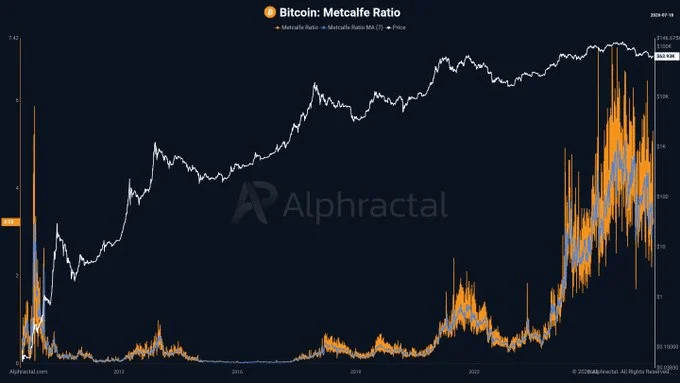
Bitcoin’s valuation is rising faster than its adoption.

This comes even as Bitcoin’s transaction activity reaches a new all-time high. Despite a stronger push toward greater utility through the BIP-110 soft fork, Bitcoin’s market cap continues to grow faster than user activity.

This growing gap suggests that speculation is playing a larger role in driving BTC’s valuation.

As the chart below shows, Bitcoin’s Metcalfe Ratio is currently around 3.23. When the ratio rises, it means the price is moving further away from the growth in network participation.

In essence, BTC’s price is gaining faster than adoption, highlighting the growing speculative side of the current cycle.

BTCBTC
Source: Alphractal

In this context, Saylor’s push for greater BTC exposure among public companies starts to make sense.

As the market focuses more on consensus upgrades, network efficiency, and overall scalability, the debate around Bitcoin’s long-term fundamentals continues to grow.

Meanwhile, rising speculative activity raises questions about whether BTC’s store-of-value narrative needs stronger institutional adoption. 

Taken together, these factors put Bitcoin’s valuation narrative under greater scrutiny, as the market weighs network growth, and adoption against the growing speculation driving the current cycle, creating massive liquidity clusters around key BTC levels.


Final Summary

  • Bitcoin’s network activity is growing, with record transaction levels and more focus on utility through proposals like BIP-110. 
  • Bitcoin’s valuation is rising faster than adoption, showing that speculation is playing a bigger role in BTC’s current cycle.


Source link

D-Wave Quantum’s CEO Sold Over 50,000 Company Shares. Here’s What That Means for Investors.

0
Sonic Automotive President Sells 50,000 Shares


Alan E. Baratz, President and Chief Executive Officer of D-Wave Quantum Inc. (NYSE:QBTS), reported a sale of 52,320 shares on July 14, 2026, according to a recent SEC Form 4 filing.

Transaction summary

Transaction value based on SEC Form 4 weighted average sale price ($18.66); post-transaction value based on July 14, 2026 market close ($18.95).

Key questions

  • What prompted this disposition of shares?
    The transaction was a non-discretionary sale-to-cover, executed by the company to satisfy tax withholding obligations triggered by the vesting of restricted stock units (RSUs). It does not represent a discretionary market trade or a change in the insider’s investment thesis.

  • What is the status of the CEO’s remaining equity incentives?
    Following this filing, Alan Baratz holds ~3.2 million shares directly. This ownership figure includes 1,137,257 unvested restricted stock units, ensuring continued long-term alignment with company performance.

  • What is the company’s current financial profile?
    D-Wave Quantum reported trailing twelve-month revenue of $12.4 million and a net loss of $368.0 million as of the July 14, 2026 transaction date. The company maintains a market capitalization of $7 billion and a 20% one-year total return as of the same close.

  • How significant is total insider ownership?
    Across all reported insiders, the total ownership percentage for the company stands at 0.88%. The CEO’s individual holdings remain a primary component of this total, with a post-transaction market value of $61.54 million as of the July 14, 2026 market close.

Company Overview

Company Snapshot

  • D-Wave Quantum Inc. develops and commercializes quantum computing systems, including its flagship Advantage quantum computer platform, alongside complementary software solutions and cloud-based services such as Leap and Ocean programming tools.

  • The company generates revenue through quantum computing hardware sales, software licensing, cloud service subscriptions, and professional services including its Launch onboarding program designed to facilitate customer adoption of quantum computing technology.

  • D-Wave serves enterprise customers, research institutions, and technology partners across industries seeking to leverage quantum computing capabilities for optimization, simulation, and machine learning applications.

D-Wave Quantum Inc. is a pioneer in the quantum computing hardware sector with a market capitalization of $7.0 billion and a global workforce of 382 employees. The company maintains a differentiated position through its proprietary quantum annealing technology, a gate-based approach, and integrated software ecosystem, enabling customers to access quantum computing resources through both on-premise systems and cloud-based platforms.

Despite early-stage revenue generation of $12.4 million TTM, D-Wave has demonstrated significant market validation and investor confidence, reflected in its 19.71% one-year share price appreciation.

What this transaction means for investors

The July 14 sale of D-Wave Quantum stock by CEO Alan Baratz is not a cause for investor concern, since it was executed to fulfill tax withholding obligations from the vesting of RSUs. In addition, he possessed over three million directly-held shares post-transaction, some of which are RSUs that have yet to vest, indicating he maintains a sizable equity stake in the company.

D-Wave shares rose over the past year thanks to several factors. The company was granted $100 million in funding by the federal government to advance quantum computing research, a testament to its promising technology.

It acquired Quantum Circuits in January, which focuses on a gate-model quantum platform, expanding D-Wave’s capabilities beyond quantum annealing and opening up larger market opportunities. The company also posted record quarterly bookings of $33.4 million, up nearly 2,000% year over year, in the first quarter.

While D-Wave’s technology holds the promise of delivering unprecedented computational capabilities to the computing industry, its business remains deeply unprofitable. In Q1, the company’s operational loss totaled $54.7 million, up substantially from $11.3 million in the prior year.

Should you buy stock in D-Wave Quantum right now?

Before you buy stock in D-Wave Quantum, consider this:

The Motley Fool Stock Advisor analyst team just identified what they believe are the 10 best stocks for investors to buy now… and D-Wave Quantum wasn’t one of them. The 10 stocks that made the cut are built for long-term growth and could produce monster returns in the coming years.

Consider when Netflix made this list on December 17, 2004… if you invested $1,000 at the time of our recommendation, you’d have $371,842!* Or when Nvidia made this list on April 15, 2005… if you invested $1,000 at the time of our recommendation, you’d have $1,244,783!*

That performance is why people listen. With a track record of beating the S&P 500 by 4xStock Advisor offers a distinct advantage. Don’t miss the latest top 10 list, available with Stock Advisor, and join an investing community built for the long haul.

See the 10 stocks »

*Stock Advisor returns as of July 19, 2026.

Robert Izquierdo has no position in any of the stocks mentioned. The Motley Fool has no position in any of the stocks mentioned. The Motley Fool has a disclosure policy.

D-Wave Quantum’s CEO Sold Over 50,000 Company Shares. Here’s What That Means for Investors. was originally published by The Motley Fool


Source link

Kraken launches crypto options, betting simpler products can expand the market

0
Kraken eyes 15% stake in DeFi lender Aave in deal valuing protocol at $385 million

Derivatives account for the vast majority of crypto trading volumes, but options remain a relatively small corner of the market, dominated by a handful of established venues including Deribit, CME Group and Binance. New entrants are increasingly betting that broader adoption of options will follow the institutionalization of digital assets.

The move is the latest step in Kraken’s transformation from a crypto exchange into a broader financial platform offering trading, payments and other digital asset services.

Growing the market, not just market share

Rather than focusing solely on taking market share from incumbent venues, Theodorou believes the larger opportunity is expanding the addressable market by making options easier to use.

“The existing options market in crypto has been built for a narrow slice of the trader base,” Theodorou said.

“Our offering broadens access through a straightforward, dollar-settled contract in the same account clients already use for spot and futures,” she added.

A retail-first approach

According to Theodorou, the slow growth of crypto options is less a demand problem than a product design problem.

“The gap in crypto options isn’t demand, it’s design,” Theodorou said.

She notes that existing crypto options platforms have largely catered to institutional traders and market makers, while retail traders instead have gravitated toward perpetual futures, which became the industry’s dominant speculative product because of their relative simplicity.


Source link

A $1 Billion Reason to Sell AST SpaceMobile Stock Here

0
A $1 Billion Reason to Sell AST SpaceMobile Stock Here


Rocket takes off by Alones via Shutterstock

AST SpaceMobile (ASTS) is a Midland, Texas-based space technology company founded in 2017 by CEO Abel Avellan. Its mission to eliminate the global mobile connectivity gap by building the world’s first and only space-based cellular broadband network capable of operating directly with standard, unmodified smartphones. The company’s BlueBird satellite constellation operates in low Earth orbit, delivering direct-to-device broadband coverage for users on land, at sea, and in flight without requiring any hardware modifications.

AST SpaceMobile has nearly 60 mobile network operator partners covering over three billion subscribers globally, including AT&T (T), Verizon (VZ), Vodafone (VOD), and Rakuten (RKUNF), as well as FCC authorization, to provide Supplemental Coverage from Space across a network of up to 248 satellites. AST represents one of the most ambitious and potentially transformative bets in the global telecommunications infrastructure space.

More News from Barchart

ASTS Stock Tumbles

ASTS shares have a market capitalization of $25.74 billion. Its 52-week range spans a low of $36.08 to a high of $133.86 reached on May 28, 2026, an all-time high reflecting peak investor enthusiasm for the company’s satellite deployment milestones. ASTS has delivered a 4.52% change over the trailing twelve months.

Compared to the Russell 1000 Index, which has posted 10% steady broad-market gains in 2026, ASTS has dramatically underperformed since its May peak, pulling back 59% from its all-time highs. This is partly due to the SpaceX (SPCX) IPO redirecting space sector capital and a $1 billion convertible note offering raised dilution concerns, leaving the stock trading well below its 200-day moving average despite continued operational momentum.

www.barchart.com

ASTS Results Misses Estimates

AST SpaceMobile recorded Q1 2026 revenue of $14.7 million, falling significantly short of the analyst consensus estimate of approximately $38.4 million, while reporting a non-GAAP EPS loss of $0.66, far worse than the estimated -$0.23. The net loss attributable to common shareholders ballooned to $191 million from $45.7 million a year earlier, driven largely by an $88.65 million induced conversion expense on convertible notes and a $55.35 million stock-based compensation charge. Despite the sharp miss, revenue still represented a remarkable 1,952% increase year-over-year (YOY) from $718,000 in Q1 2025.


Source link