Home Blog Page 220

Recent Bitcoin buyers panic-sell amid $90M capitulation: $66K is BTC’s last stand

0
Recent Bitcoin buyers panic-sell amid $90M capitulation: $66K is BTC's last stand


As market pressure persists, investor behavior is becoming just as important as Bitcoin’s price action. According to recent on-chain data, newer Bitcoin [BTC] buyers are increasingly incurring losses rather than waiting for a recovery.

That trend is becoming much clearer. The 30-day average of Bitcoin sent to exchanges at a loss has climbed to 2,450 BTC.

Rather than reflecting routine profit-taking, the shift points to capitulation among investors who bought their coins between $75,000 and $126,000.

Source: CryptoQuant

The pressure becomes even clearer as monthly realized losses reach a record $90 million. That figure exceeds previous capitulation phases. Moreover, it also suggests recent buyers are absorbing larger losses because they entered the market at much higher prices.

Even so, history shows capitulation often emerges near the later stages of market resets. That said, if Short-Term Holder SOPR, UTXOs in Loss, and the Realized Profit/Loss Ratio begin stabilizing, selling pressure could gradually ease.

Until then, weaker hands continue transferring Bitcoin to investors with stronger conviction.

Fresh demand rebuilds support

That transfer of supply is now beginning to reshape Bitcoin’s short-term holder structure. According to recent data, new buyers are stepping in at each opportunity to absorb the available supply rather than a second round of distribution from the STH base.

This trend is being displayed clearly within the area of price between $62,000 and $65,000, where a new cost basis was created when Bitcoin bounced from its low point at $57,000.

The increased demand for the area also lends support to the idea that this range is likely to provide near-term support for Bitcoin.

Source: Glassnode

Although most of this growth was occurring at the end of the recovery period. Therefore, $66,000 represents the confirmation price point for investors to be confident they are in possession of a “new” cost basis for the asset.

If a strong price move breaks through $66,000, then it would likely strengthen the conviction that the upside momentum will continue.

Otherwise, failure to reclaim that level may prompt recent buyers to exit, reviving short-term selling pressure. For now, $66,000 remains the dividing line between continued accumulation and a potential local top.

That transfer of supply is now beginning to test Bitcoin’s recovery. With BTC trading around $64,700-$65,000, attention has shifted to the $66,000 resistance. The Sell-Side Risk Ratio continues declining, signaling growing seller exhaustion.
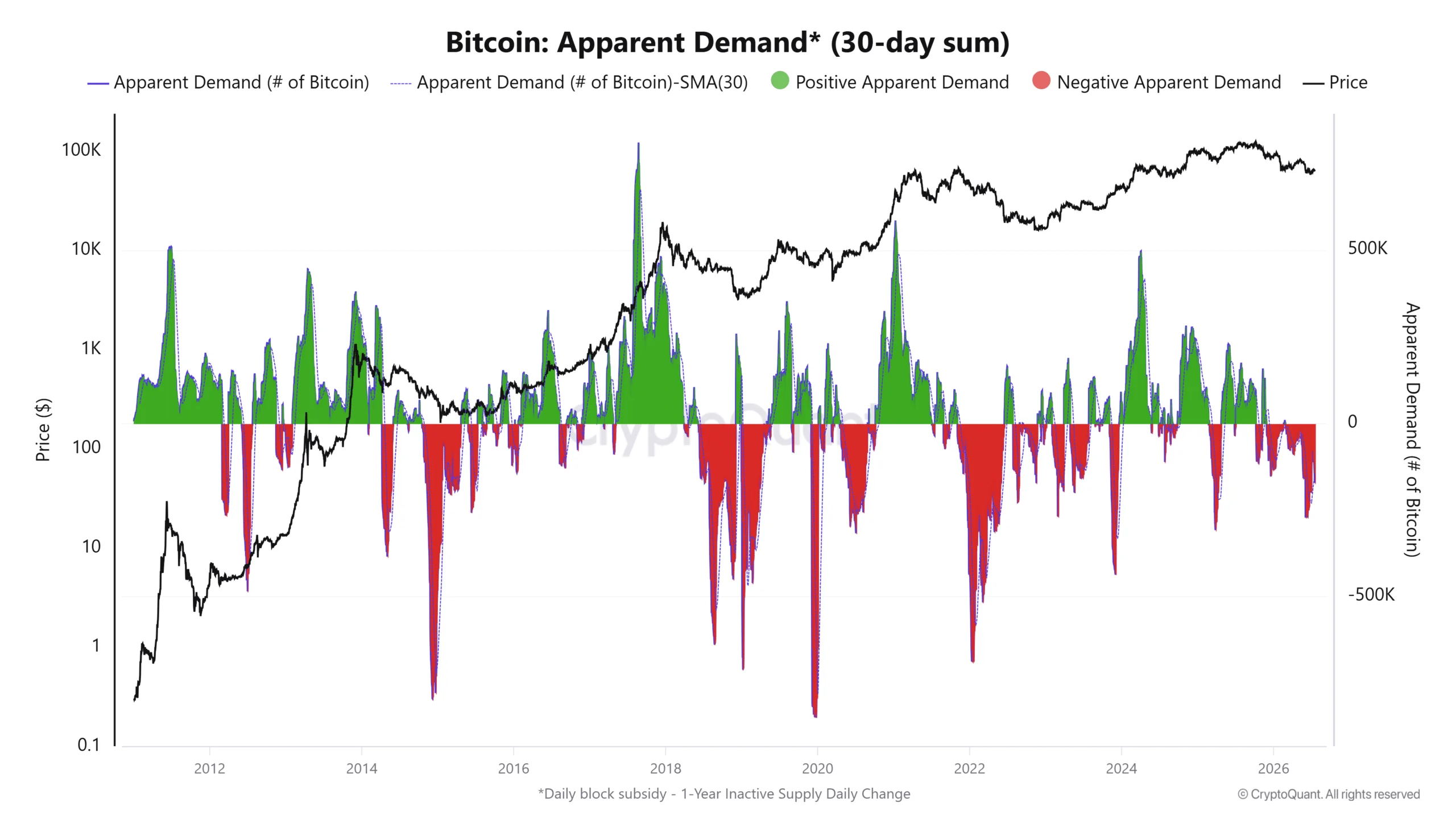
Source: CryptoQuant

Meanwhile, apparent demand has improved from nearly -275,000 BTC to -172,960 BTC. This implies that fresh buying is gradually absorbing supply. Yet, neutral funding rates and range-bound Open Interest suggest stronger Spot demand is still needed to confirm a sustained recovery.


Final Summary

  • Bitcoin seller exhaustion is rising, but $66,000 remains the key level for confirming a sustained recovery.
  • Bitcoin demand is improving, though stronger Spot buying is still needed to validate a trend reversal.




Source link

How Hiring Efficiency Can Make Candidates Feel Invisible

0
How Hiring Efficiency Can Make Candidates Feel Invisible


Opinions expressed by Entrepreneur contributors are their own.

Key Takeaways

  • Most applicant tracking systems don’t automatically reject resumes based on content or formatting. The actual filtering happens when an exhausted human recruiter runs out of time and stops reading.
  • Hiring has two visibility problems: volume and poor communication. While volume is hard to solve, companies can improve the candidate experience now through clearer timelines, acknowledgment and transparency.
  • What’s really happening in modern hiring isn’t a software problem — it’s what occurs when organizations optimize so hard for their own needs that they ignore what the process feels like for applicants.

There’s a widely repeated stat in recruiting circles: 75% of resumes are rejected by applicant tracking systems (ATS) before a human ever sees them. Career coaches cite it, LinkedIn posts recycle it, and job seekers build entire application strategies around it.

It’s almost certainly not true — at least not in the way most people mean it.

When we interviewed 25 U.S. recruiters across industries for our research at Enhancv, 92% told us their systems don’t automatically reject resumes based on content or formatting. The actual filtering happens when an exhausted human recruiter runs out of time and stops reading.

Most hiring leaders don’t fully realize how much this is costing them. There are actually two invisibility problems in modern hiring, not one, and understanding the difference is where solving them begins.

The myth recruiters can’t stop hearing

The ATS-rejection narrative has become so pervasive that it shapes how candidates behave before they even apply. They obsess over keyword density or strip formatting. Some use invisible white text to stuff resumes with phrases they hope will satisfy an algorithm. Forty-one percent of candidates admit to using prompt injections or hidden text to try to bypass AI filters.

What recruiters really want is a resume that’s easy to scan, relevant to the role and written like a human being prepared it.

The real screening mechanism is volume. Entry-level roles routinely pull 400 to 600 applications. Remote tech positions can hit 2,000 before a recruiter has reviewed the first batch. Recruiters spend seconds, not minutes, on initial review. Many stop once they have a shortlist, regardless of what’s still waiting. If you applied on day four to a role that went live Monday, there’s a decent chance you simply never got read.

But that’s a different problem than the one most employers are actually equipped to fix.

The visibility problem companies can control

Volume is structural. It’s slow to solve and mostly beyond what any individual hiring manager can change alone. 

The second problem is entirely within an organization’s control. And it’s doing serious damage.

According to Greenhouse, 46% of job seekers say their trust in hiring has decreased over the past year — not because they didn’t get the job, but because of how the process made them feel. Rejections sent before the posting closed. Weeks of silence. Confirmation emails so generic they may as well have been addressed to “Applicant.” 

I’ve watched this erode something that’s genuinely hard to rebuild, and the cost is measurable: 26% of job seekers have declined offers because of poor communication or unclear expectations. Not compensation, not the role itself. The process.

What automation was supposed to do

There’s an important distinction between using automation to handle scale and using it as a substitute for human judgment. LinkedIn’s research on the future of recruiting found that employers were 54 times more likely than the year before to list “relationship development” as a required skill for recruiters. Efficiency and connection aren’t the same capability — and the market has already figured that out.

SHRM is consistent on this point: Recruiting success depends on blending automation with human oversight, not replacing one with the other. Teams integrating AI save roughly 20% of their work week. The question is what that time gets spent on.

When the system filters out the wrong people

Even when automation isn’t mass-rejecting resumes based on fonts and formatting, the reliance on keyword matching and rigid criteria does create real problems.

Recruiters have described to me what happens with experienced candidates who don’t map neatly onto job descriptions (former general managers applying for senior individual contributor roles, professionals over 40 whose backgrounds read as overqualified, people in career transitions whose most relevant skills appear in unexpected places). Some of them spend a year in silence before realizing that instead of reading their experience, the system is pattern-matching against a template.

The irony is that these are often exactly the candidates a hiring manager would want if they ever got to see the application. But by the time nuance would matter, the pile has already been sorted. According to Pew, 66% of Americans wouldn’t apply for a job if the employer revealed AI was used in the process. Based on what I’ve observed, that skepticism isn’t entirely misplaced.

What leaders can really do about this

The volume problem requires long-term structural thinking — better sourcing, clearer role definitions, faster internal pipelines. None of that happens overnight.

The communication problem can start being fixed this week. 

According to Employ’s 2026 Job Seeker Nation Report, 44% of candidates say not hearing back after applying is their biggest challenge, and ghosting by recruiters has risen to 32%. 

So, tell candidates how your process works and how long it takes. Acknowledge applications like a human wrote the response. When AI is involved in screening, say so. Close the loop with anyone who made it past the initial review but didn’t move forward. None of this is complicated — it’s just discipline.

What candidates remember long after the process ends

What’s really happening in modern hiring isn’t a software problem — it’s what occurs when organizations optimize so hard for their own operational needs that they stop thinking about what the process feels like on the other side.

Candidates who feel seen — even when rejected — remember it. They reapply when circumstances change, refer people in their networks and give you the benefit of the doubt when your Glassdoor score isn’t perfect. That’s a long-term talent asset, and it costs almost nothing to build.

The companies that understand this will keep attracting strong candidates even in difficult markets. The ones that don’t will wonder why their pipeline keeps getting worse.

Key Takeaways

  • Most applicant tracking systems don’t automatically reject resumes based on content or formatting. The actual filtering happens when an exhausted human recruiter runs out of time and stops reading.
  • Hiring has two visibility problems: volume and poor communication. While volume is hard to solve, companies can improve the candidate experience now through clearer timelines, acknowledgment and transparency.
  • What’s really happening in modern hiring isn’t a software problem — it’s what occurs when organizations optimize so hard for their own needs that they ignore what the process feels like for applicants.

There’s a widely repeated stat in recruiting circles: 75% of resumes are rejected by applicant tracking systems (ATS) before a human ever sees them. Career coaches cite it, LinkedIn posts recycle it, and job seekers build entire application strategies around it.

It’s almost certainly not true — at least not in the way most people mean it.

When we interviewed 25 U.S. recruiters across industries for our research at Enhancv, 92% told us their systems don’t automatically reject resumes based on content or formatting. The actual filtering happens when an exhausted human recruiter runs out of time and stops reading.


Source link

Best CD rates today, Sunday, July 19, 2026: Lock in up to 4.10% APY

0
Best CD rates today, Sunday, June 14, 2026: Lock in up to 4% APY


Find out how much you could earn by locking in a high CD rate today. A certificate of deposit (CD) allows you to lock in a competitive rate on your savings and helps your balance grow. However, rates vary widely across financial institutions, so it’s important to ensure you’re getting the best rate possible when shopping around for a CD. The following is a breakdown of CD rates today and where to find the best offers.

Historically, longer-term CDs offered higher interest rates than shorter-term CDs. Generally, this is because banks would pay better rates to encourage savers to keep their money on deposit longer. However, in today’s economic climate, the opposite is true.

Today, Sunday, July 19, 2026, the highest CD rate is 4.10% APY. This rate is offered by Marcus by Goldman Sachs on its 14-month CD.

The amount of interest you can earn from a CD depends on the annual percentage rate (APY). This is a measure of your total earnings after one year, taking into account the base interest rate and how often interest compounds (CD interest typically compounds daily or monthly).

Say you invest $1,000 in a one-year CD with 1.52% APY, and interest compounds monthly. At the end of that year, your balance would grow to $1,015.20 — your initial $1,000 deposit, plus $15.20 in interest.

Now let’s say you choose a one-year CD that offers 4% APY instead. In this case, your balance would grow to $1,040.74 over the same period, which includes $40.74 in interest.

The more you deposit in a CD, the more you stand to earn. If we used the same example of a one-year CD at 4% APY but deposited $10,000, your total balance when the CD matures would be $10,407.42, meaning you’d earn $407.42 in interest. ​​

Read more: What is a good CD rate?

When choosing a CD, the interest rate is usually top of mind. However, the rate isn’t the only factor you should consider. There are several types of CDs that offer different benefits, though you may need to accept a slightly lower interest rate in exchange for more flexibility. Here’s a look at some of the common types of CDs you can consider beyond traditional CDs:

  • Bump-up CD: This type of CD allows you to request a higher interest rate if your bank’s rates go up during the account’s term. However, you’re usually allowed to “bump up” your rate just once.

  • No-penalty CD: Also known as a liquid CD, this type of CD allows you to withdraw funds before maturity without penalty.

  • Jumbo CD: These CDs require a higher minimum deposit (usually $100,000 or more), and often offer a higher interest rate in return. In today’s CD rate environment, however, the difference between traditional and jumbo CD rates may not be much.

  • Brokered CD: As the name suggests, these CDs are purchased through a brokerage rather than directly from a bank. Brokered CDs can sometimes offer higher rates or more flexible terms, but they also carry more risk and might not be FDIC-insured.


Source link

One year of the GENIUS Act: Progress, gaps, and what comes next

0
One year of the GENIUS Act: Progress, gaps, and what comes next


A year after President Donald Trump signed the GENIUS Act into law, regulators still have not completed its implementation. However, regulators have yet to implement it. Agencies were required to finalize implementing rulemakings no later than the 18th of July.

As a result, the OCC, Federal Reserve, FDIC, Treasury Department, and other agencies continue drafting key regulations. Those rules cover issuer reserves, capital requirements, liquidity, custody, risk management, and state-level regulatory designations.

Source: CHAPMAN

Meanwhile, agencies continue gathering public feedback. Customer identification proposals remain open until the 21st of August. The FDIC will close its anti-money laundering consultation on the 4th of August.

Those consultations show regulators are still refining compliance standards. Still, agencies still plan to enforce the GENIUS Act by the 18th of January, 2027.

Until they complete the remaining rules, stablecoin issuers and financial institutions must prepare for a framework that still lacks several implementation details.

Key rules remain unfinished

That regulatory uncertainty continues because agencies have yet to finalize several core operating standards. Although federal agencies proposed rules throughout 2026, they failed to complete them by the 18th of July.

As a result, reserve eligibility, liquidity requirements, custody standards, and risk management frameworks remain under review. Meanwhile, issuers continue operating under statutory baselines and interim regulatory frameworks.

That approach has supported market activity, helping the stablecoin sector expand to roughly over $310 billion. Even so, unresolved liquidity and custody protocols still complicate capital planning, redemption processes, and operational resilience.

Source: DeFiLlama

Therefore, until these regulatory standards are finalized, issuers like Circle and Paxos will be forced to navigate innovation against evolving compliance regulations. This is as the market waits for a fully defined federal regulatory framework.

Institutional adoption gains momentum

Banks are still assessing their options for stablecoin strategies as they wait for the regulatory body to issue its final rulemaking. Meanwhile, Congress is running out of time with less than six months until the GENIUS Act goes into effect on January 18th, 2027.

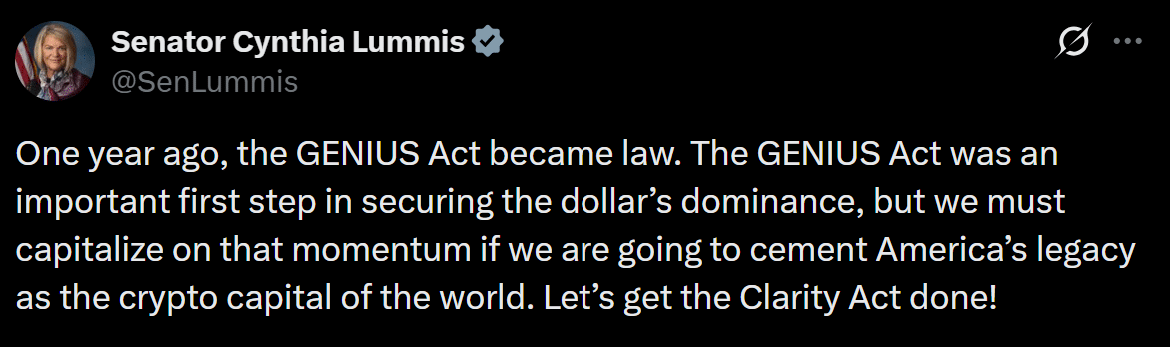
Senator Cynthia Lummis echoed that urgency, calling the GENIUS Act “an important first step.” She also urged her fellow lawmakers to support the CLARITY Act, which would further solidify U.S. leadership in the development of digital assets.

Source: X

Even before regulators finalize the remaining rules, the GENIUS Act has already encouraged institutional participation. Since lawmakers enacted the framework, institutions such as BlackRock and JPMorgan have launched or filed stablecoin reserve funds.

Meanwhile, Visa introduced a platform serving 15,000 institutions, while the first bank-issued on-chain dollar entered the market. Completing the remaining rules will determine how quickly regulated stablecoins achieve broad institutional adoption in the United States.


Final Summary

  • Stablecoins remain in regulatory limbo until agencies finalize the GENIUS Act’s remaining implementation rules.
  • Stablecoins could gain broader institutional adoption as the GENIUS Act and CLARITY Act advance regulatory certainty.


Source link

My in-laws want to sell us their $800,000 home for 50% off — what’s the best way to make this family deal work?

0
My in-laws want to sell us their $800,000 home for 50% off — what's the best way to make this family deal work?


Shutterstock AI/Shutterstock

Buying a home has become increasingly challenging, with mortgage rates (1) and home prices (2) both soaring in recent years. So it’s no surprise that around 25% of young people (3) who actually managed to buy a home had help from their family with a down payment.

But what if your family doesn’t just give you a down payment, but instead they sell you an entire home at a substantial discount?

Must Read

Let’s pretend, for example, that Chris and Megan, who are in their 30s, have been married for a few years, and Megan’s parents want to sell the couple their $800,000 home for $400,000.

Chris and Megan want to figure out the best way to structure the deal so it works out for everyone involved. What should the couple do, and is this a good option for them to get a property of their own?

Structure the deal in the right way

While it may seem like a smart approach for Megan’s parents to just sell them the house for half off, that’s not actually the best method, according to mortgage experts.

“I would not recommend simply lowering the purchase price,” Byron Davis (4), founder of ShopDPA and a mortgage loan originator with Primary Residential Mortgage, Inc., told Moneywise. “Instead, I would recommend structuring the transaction at the property’s full market value using a gift of equity and seller concessions to cover the buyer’s down payment and closing costs.”

Davis told MoneyWise that this approach would be the best option because it would provide the couple with a better loan-to-value ratio, help them qualify for a better mortgage loan and avoid having to pay closing costs out of pocket.

He laid out the situation the couple in our example is facing and explained that, if a borrower has a $400,000 first mortgage on an $800,000 property, this results in a 50% loan-to-value ratio: “Financing only 50% of a property’s value represents significantly less risk than financing 80%, 90% or 95%. That lower risk can translate into more favorable mortgage pricing.”

Sarah DeFlorio, vice president of mortgage banking at William Raveis Mortgage, agreed that the difference between the appraised market value and purchase price should be considered a gift of equity, and said that most mortgage lenders should be fine with doing the deal this way.


Source link

Numerai Buys Back Another $1.2M in NMR as Hedge Fund Assets Reach $700M

0
Numerai Buys Back Another $1.2M in NMR as Hedge Fund Assets Reach $700M


Numerai Buys Back Another $1.2M in NMR as Hedge Fund Assets Reach $700M

Numerai (CRYPTO: $NMR) has completed a third strategic buyback of Numeraire, purchasing another $1.2 million of NMR as the crowdsourced hedge fund expands its assets, contributor base and onchain incentive system.

The latest transaction lifts Numerai’s total NMR repurchases to $3.2 million in less than a year. The company said the buyback was executed through Coinbase Institutional at or near the bid price over several weeks, allowing it to accumulate tokens without placing abrupt pressure on the relatively thin market.

Unlike its previous announcements, Numerai disclosed the purchase only after the full transaction had been completed.’

More From Cryptoprowl:

NMR powers the company’s global data-science tournament, where contributors build machine-learning models designed to forecast equity markets. Participants stake the token behind their predictions, earning additional NMR when their models perform well and risking part of their stake when results fall short.

Numerai combines those submissions into its Stake-Weighted Meta Model, which helps generate trading signals for the firm’s hedge fund. More than 1.1 million NMR is now staked across the network, while the number of active accounts has more than doubled over the past year.

The hedge fund has grown alongside that participation. Numerai now manages about $700 million, up from roughly $560 million at the end of 2025, and trades more than $1 billion each month across 30 global markets.

The buyback is designed to replenish the treasury used for tournament rewards and staking payouts rather than permanently remove tokens from circulation. NMR has a fixed maximum supply of 11 million tokens, with about 3.1 million held in Numerai’s treasury before the latest purchase.

Numerai has also introduced new infrastructure aimed at autonomous AI participation, including Skills, Model Context Protocol integrations and Atomic Blockchain Staking.

The latest purchase links NMR more closely to a hedge fund whose assets, trading activity and machine-learning network are all continuing to expand.

Numeraire (CRYPTO: NMR) is currently trading at $10.07 U.S. per digital token.


Source link

Your Business Has Changed. Has Your Website Kept Up?

0
Your Business Has Changed. Has Your Website Kept Up?


Opinions expressed by Entrepreneur contributors are their own.

Key Takeaways

  • A website can become outdated even when the business is growing and the team is making reasonable updates along the way.
  • Growth changes what a website needs to do. It may need to serve new audiences, explain new services, support sales, build trust and reflect a more mature business strategy.
  • The strongest signal that a site is outdated is often confusion, not only appearance. If sales teams, founders or marketing constantly have to explain what the site should make clear, it may no longer be supporting the business properly.

A company’s website rarely becomes ineffective overnight.

In the work that crosses my desk and in the conversations we have with clients at ArtVersion, this pattern comes up often: The first concern is usually visual, but the deeper issue is that the business has changed and the website has not fully caught up.

The company added a service, and a new audience became important. The sales process changed, and leadership refined the positioning. Marketing launched campaigns for the new market the business entered.

Each update made sense at the time. But after enough small changes, the website may no longer represent the business clearly. That usually means the company grew and the site may have been built for an earlier version of the business. As the company evolves, the website has to explain more, guide more, prove more and support more decisions.

At some point, redesigning a site becomes a business realignment project too.

Growth changes what your website needs to do

In the early stages of a company, a website usually has a straightforward job to explain who the company is, what it offers and why someone should care.

As the business matures, that task becomes more complex. The website now may need to speak to multiple buyer types, support different stages of decision-making, explain a broader service offering, build trust for a wider audience, support recruiting, help sales conversations and strengthen brand perception.

The challenge is that many websites are expanded piece by piece instead of being reconsidered as the business changes.

That is how a site that once felt clear begins to feel crowded and the user journey becomes confusing.

Users do not see the internal history behind all that growth. They only experience what is in front of them. If the path feels unclear, hesitation happens. If the message feels inconsistent, questions about the fit arise. If the value is hard to understand, they move on.

This is why a good-looking website can still underperform.

The warning signs are not always visual

It’s easy to assume you will know when a website needs attention because it looks outdated. Sometimes that is true. But a website can look current and still create confusion.

One sign is explanation fatigue. If your sales or marketing team regularly has to clarify what the company is or what the brand differentiator is, the site may no longer be supporting the business properly.

Another sign is audience drift. The homepage may still speak to the audience your company served three years ago, while the business is now trying to reach a different buyer. The services may be accurate, but may no longer reflect the company’s current priorities.

Navigation is another signal. When menus reflect internal priorities more than customer needs, visitors have to translate the business for themselves. Users should not have to do heavy lifting.

Content can also reveal the gap. Case studies may no longer represent the company’s strongest work. Blog content may attract traffic but fail to support current goals. Service pages may rank in search but describe an older version of the offer.

The site may contain useful information overall, but it is no longer organized around the decisions customers are trying to make.

Start with the business questions

Visual design matters, and that is true for every brand. A website should feel current, credible and aligned with the brand. But when a business has outgrown its website, the process should begin with sharper questions.

  • Who is the site built for?
  • What does that audience need to understand first?
  • Which services or products matter most to the next stage of growth?
  • Where do prospects hesitate?
  • What proof do they need?
  • What should the website help them do next?
  • How would they find us?

Those questions change the role of a redesign. The work becomes less about replacing pages and more about rebuilding clarity.

They also help avoid costly technical errors that need to be addressed in the post-launch phase.

Build for the business you are becoming

A strong redesign should solve for the present while preparing for what comes next.

That means creating a structure that can grow without becoming hard to maintain. Navigation should be clear but flexible, with page content that is easy to update. Design patterns should be consistent enough to scale and also repeatable as new pages are published. SEO should be considered before launch. Analytics should help teams learn from real behavior. And web accessibility and site performance should be part of the foundation.

The best websites are built with enough clarity and structure to support change. The change always happens; it’s just a matter of time when it will accrue.

A website is one of the most important assets a business has. It shapes first impressions, supports sales, builds trust, helps internal teams stay aligned and helps customers understand why they should take the next step.

If the company has grown, expanded, repositioned or matured, the website should evolve with it. That is not a sign that something went wrong. It is often a sign that the business has moved forward.

Key Takeaways

  • A website can become outdated even when the business is growing and the team is making reasonable updates along the way.
  • Growth changes what a website needs to do. It may need to serve new audiences, explain new services, support sales, build trust and reflect a more mature business strategy.
  • The strongest signal that a site is outdated is often confusion, not only appearance. If sales teams, founders or marketing constantly have to explain what the site should make clear, it may no longer be supporting the business properly.

A company’s website rarely becomes ineffective overnight.

In the work that crosses my desk and in the conversations we have with clients at ArtVersion, this pattern comes up often: The first concern is usually visual, but the deeper issue is that the business has changed and the website has not fully caught up.

The company added a service, and a new audience became important. The sales process changed, and leadership refined the positioning. Marketing launched campaigns for the new market the business entered.


Source link