Home Blog Page 221

Your Business Has Changed. Has Your Website Kept Up?

0
Your Business Has Changed. Has Your Website Kept Up?


Opinions expressed by Entrepreneur contributors are their own.

Key Takeaways

  • A website can become outdated even when the business is growing and the team is making reasonable updates along the way.
  • Growth changes what a website needs to do. It may need to serve new audiences, explain new services, support sales, build trust and reflect a more mature business strategy.
  • The strongest signal that a site is outdated is often confusion, not only appearance. If sales teams, founders or marketing constantly have to explain what the site should make clear, it may no longer be supporting the business properly.

A company’s website rarely becomes ineffective overnight.

In the work that crosses my desk and in the conversations we have with clients at ArtVersion, this pattern comes up often: The first concern is usually visual, but the deeper issue is that the business has changed and the website has not fully caught up.

The company added a service, and a new audience became important. The sales process changed, and leadership refined the positioning. Marketing launched campaigns for the new market the business entered.

Each update made sense at the time. But after enough small changes, the website may no longer represent the business clearly. That usually means the company grew and the site may have been built for an earlier version of the business. As the company evolves, the website has to explain more, guide more, prove more and support more decisions.

At some point, redesigning a site becomes a business realignment project too.

Growth changes what your website needs to do

In the early stages of a company, a website usually has a straightforward job to explain who the company is, what it offers and why someone should care.

As the business matures, that task becomes more complex. The website now may need to speak to multiple buyer types, support different stages of decision-making, explain a broader service offering, build trust for a wider audience, support recruiting, help sales conversations and strengthen brand perception.

The challenge is that many websites are expanded piece by piece instead of being reconsidered as the business changes.

That is how a site that once felt clear begins to feel crowded and the user journey becomes confusing.

Users do not see the internal history behind all that growth. They only experience what is in front of them. If the path feels unclear, hesitation happens. If the message feels inconsistent, questions about the fit arise. If the value is hard to understand, they move on.

This is why a good-looking website can still underperform.

The warning signs are not always visual

It’s easy to assume you will know when a website needs attention because it looks outdated. Sometimes that is true. But a website can look current and still create confusion.

One sign is explanation fatigue. If your sales or marketing team regularly has to clarify what the company is or what the brand differentiator is, the site may no longer be supporting the business properly.

Another sign is audience drift. The homepage may still speak to the audience your company served three years ago, while the business is now trying to reach a different buyer. The services may be accurate, but may no longer reflect the company’s current priorities.

Navigation is another signal. When menus reflect internal priorities more than customer needs, visitors have to translate the business for themselves. Users should not have to do heavy lifting.

Content can also reveal the gap. Case studies may no longer represent the company’s strongest work. Blog content may attract traffic but fail to support current goals. Service pages may rank in search but describe an older version of the offer.

The site may contain useful information overall, but it is no longer organized around the decisions customers are trying to make.

Start with the business questions

Visual design matters, and that is true for every brand. A website should feel current, credible and aligned with the brand. But when a business has outgrown its website, the process should begin with sharper questions.

  • Who is the site built for?
  • What does that audience need to understand first?
  • Which services or products matter most to the next stage of growth?
  • Where do prospects hesitate?
  • What proof do they need?
  • What should the website help them do next?
  • How would they find us?

Those questions change the role of a redesign. The work becomes less about replacing pages and more about rebuilding clarity.

They also help avoid costly technical errors that need to be addressed in the post-launch phase.

Build for the business you are becoming

A strong redesign should solve for the present while preparing for what comes next.

That means creating a structure that can grow without becoming hard to maintain. Navigation should be clear but flexible, with page content that is easy to update. Design patterns should be consistent enough to scale and also repeatable as new pages are published. SEO should be considered before launch. Analytics should help teams learn from real behavior. And web accessibility and site performance should be part of the foundation.

The best websites are built with enough clarity and structure to support change. The change always happens; it’s just a matter of time when it will accrue.

A website is one of the most important assets a business has. It shapes first impressions, supports sales, builds trust, helps internal teams stay aligned and helps customers understand why they should take the next step.

If the company has grown, expanded, repositioned or matured, the website should evolve with it. That is not a sign that something went wrong. It is often a sign that the business has moved forward.

Key Takeaways

  • A website can become outdated even when the business is growing and the team is making reasonable updates along the way.
  • Growth changes what a website needs to do. It may need to serve new audiences, explain new services, support sales, build trust and reflect a more mature business strategy.
  • The strongest signal that a site is outdated is often confusion, not only appearance. If sales teams, founders or marketing constantly have to explain what the site should make clear, it may no longer be supporting the business properly.

A company’s website rarely becomes ineffective overnight.

In the work that crosses my desk and in the conversations we have with clients at ArtVersion, this pattern comes up often: The first concern is usually visual, but the deeper issue is that the business has changed and the website has not fully caught up.

The company added a service, and a new audience became important. The sales process changed, and leadership refined the positioning. Marketing launched campaigns for the new market the business entered.


Source link

Venice Token [VVV] likely to continue its long-term uptrend, supported by…

0
Venice Token [VVV] likely to continue its long-term uptrend, supported by...


Native utility and governance token of the private generative AI platform Venice Token [VVV] saw a minor resurgence on Friday, the 17th of July. It rallied by 20.1%, from a 10-week low of $9.81, to reach a local high of $11.79. At the time of writing, the token continued to push higher with momentum.

The trading volume had also been remarkably high on Friday. The VVV/USDT spot pair on Bybit witnessed a volume expansion of just over fourfold between Thursday and Friday.

Jon Venice, Head of Strategy for Venice, announced that two key tokenomics updates were going live on the 17th of July. Firstly, 5% of the money users spend on API credits for the generative AI would go directly towards a buy-and-burn program.

Secondly, the supply target of DIEM, which can be held and staked to provide $1 of daily, renewing AI compute credit, was raised from 38,000 to 40,000. The token is only minted by locking VVV.

This announcement likely spurred the altcoin’s resurgence from the psychological $10 level. How high can this bounce go?

Venice Token maintains its longer-term uptrend

Austin Barack, founder and managing partner at crypto investment fund Relayer Capital, explained the bullish case for VVV.

Venice Token Burn Rally
Source: Austin Barack on X

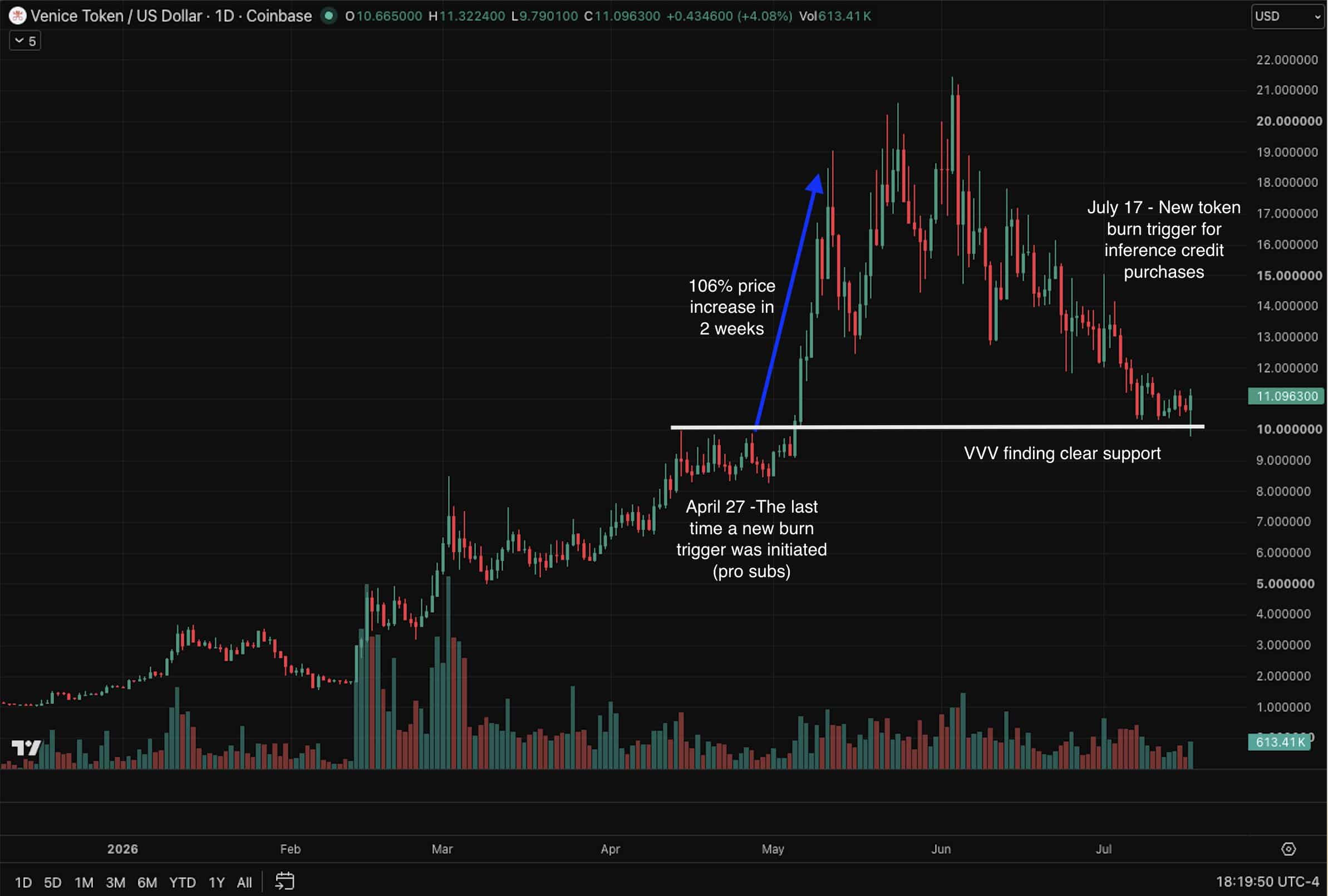
The thesis was simple. VVV has tested the $10 support zone, which was where the previous rally in late April was initiated. If a burn-related catalyst works similarly once again, VVV could run up to $23 next.

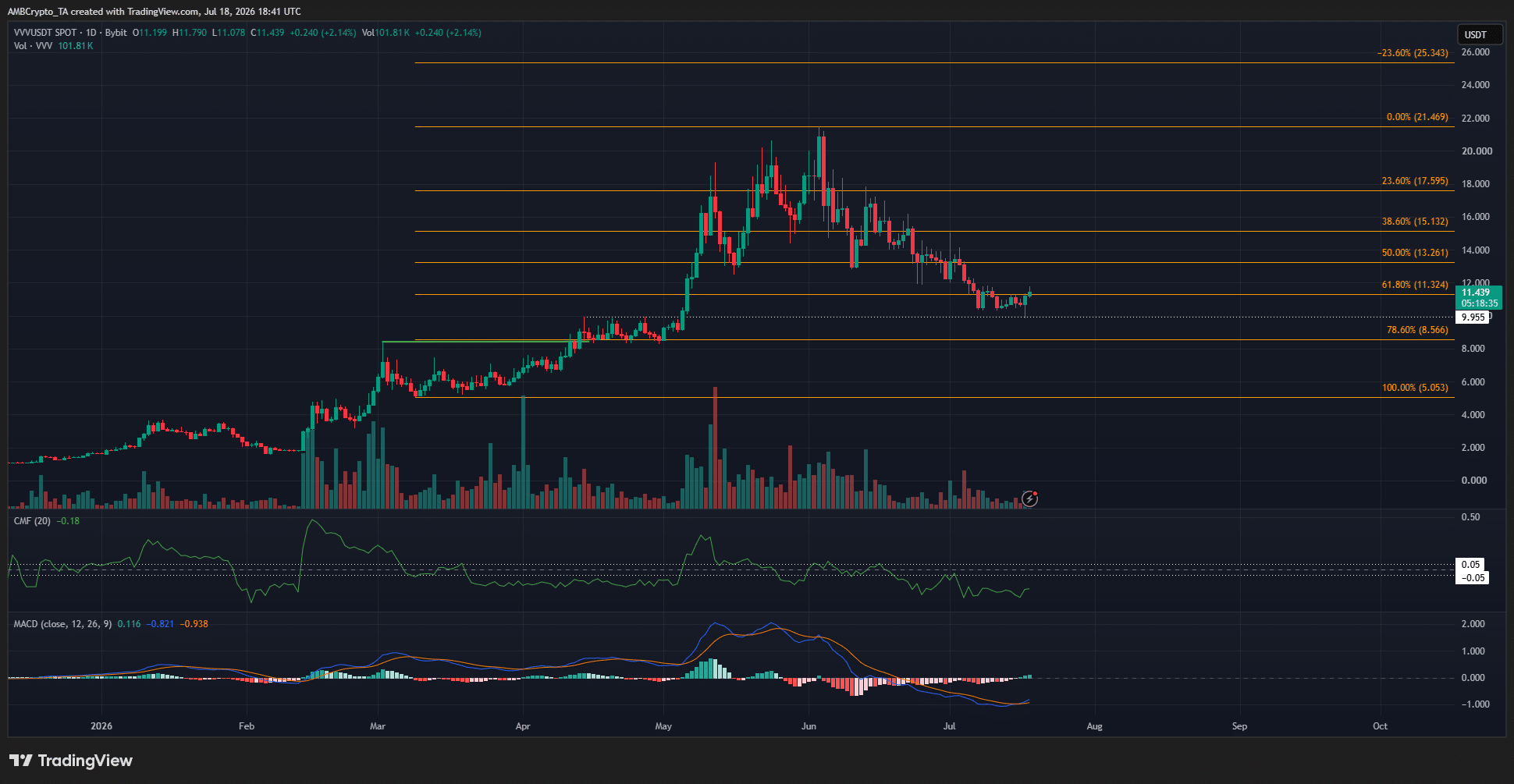
VVV 1-day ChartVVV 1-day Chart
Source: VVV/USDT on TradingView

From a structural point of view, the price action remained firmly bullish on the 1-day timeframe. The swing low at $5.05 was not yet violated. Venice Token has reacted positively from the golden pocket between the 61.8%-78.6% Fibonacci retracement levels.

The MACD and CMF were severely bearish as a result of the steady decline the altcoin faced since late May.

An influx of demand and the resulting upward momentum could turn the indicators around and draw more traders and investors into the uptrend.


Final Summary

  • VVV’s tokenomics updates on Friday, the 17th of July, likely spurred a bullish resurgence from the $10 support zone.
  • A rally back to $21 and possibly as high as $25 can be expected, if the higher timeframe uptrend stays intact.


Source link

Inside Zcash’s new node that targets Visa-scale privacy at 50,000 transactions per second

0
Inside Zcash's new node that targets Visa-scale privacy at 50,000 transactions per second

Throughput targets and Tachyon’s role

The reason for building all this is arithmetic.

Mastercard and Visa process more than 50,000 transactions per second, and the team calls that figure ‘“its floor, not its target.” Zcash’s current cryptography would require a node to take in and verify more than 500 megabytes of data every second to keep up, because every private transaction carries a proof, and proofs are large.

That is roughly a full DVD of data arriving every ten seconds, continuously, and no current Zcash software runs anywhere near that. But the missing piece is the reason each bottleneck exists.

Bowe’s Project Tachyon is tackling this by working on recursive proofs, in which one proof attests to the validity of thousands of others, dramatically reducing the amount of data that must be checked at consensus.

Under Tachyon, a node verifies a single proof instead of the thousands, which the team says reduces the requirement for consensus data from 100 megabytes per second to 500 megabytes, a level they claim is technically achievable with careful engineering.

Wallet bottlenecks and Valar’s PIR solution

Wallets have a different problem. Because Zcash hides who a transaction is for, a wallet cannot ask a server which transactions belong to it without giving itself away. It pulls down everything and tests each one, which is why wallet software tops out at about one transaction per second.


Source link

Mortgage and refinance interest rates today, Saturday, July 18, 2026: Rates lower to start the weekend

0
Mortgage and refinance interest rates today, Saturday, June 13, 2026: All rates moving lower


According to average mortgage rates from the Zillow lender marketplace, the current 30-year fixed rate fell by 4 basis points to 6.48%, the 15-year fixed rate fell by 5 basis points to 5.90%, and the 5/1 ARM fell by 29 basis points to 6.46%.

Read more: Weekly survey of mortgage lenders with the lowest rates: Rates bubble higher

Here are the current mortgage rates today, Saturday, July 18, 2026, according to the latest Zillow data:

  • 30-year fixed: 6.48%

  • 20-year fixed: 6.18%

  • 15-year fixed: 5.90%

  • 5/1 ARM: 6.46%

  • 7/1 ARM: 6.35%

  • 30-year VA: 5.93%

  • 15-year VA: 5.47%

  • 5/1 VA: 5.75%

Remember, these are the national averages and are rounded to the nearest hundredth.

Read more: Discover 8 strategies for getting the lowest mortgage rates

These are today’s mortgage refinance rates, Saturday, July 18, 2026, according to the latest Zillow data:

  • 30-year fixed: 6.48%

  • 20-year fixed: 6.26%

  • 15-year fixed: 5.74%

  • 5/1 ARM: 6.28%

  • 7/1 ARM: 6.36%

  • 30-year VA: 5.80%

  • 15-year VA: 5.70%

  • 5/1 VA: 5.58%

Again, the numbers provided are national averages rounded to the nearest hundredth. Mortgage refinance rates are often higher than rates when you buy a house, although that’s not always the case.

Read more: Want to refinance your mortgage in 2026? Here’s what to do.

Use the mortgage calculator below to see how today’s interest rates would affect your monthly mortgage payments.

Mortgage payment calculator

Mortgage payment breakdown

81% Principal & interest

$2,147


You can bookmark the Yahoo Finance mortgage payment calculator and keep it handy for future use, as you shop for homes and the best mortgage lenders. You also have the option to enter costs for private mortgage insurance (PMI) and homeowners’ association dues, if applicable. These details result in a more accurate monthly payment estimate than if you simply calculated your mortgage principal and interest.

There are two main advantages to a 30-year fixed mortgage: Your payments are lower, and your monthly payments are predictable.

A 30-year fixed-rate mortgage has relatively low monthly payments because you’re spreading your repayment out over a longer period of time than with, say, a 15-year mortgage. Your payments are predictable because, unlike with an adjustable-rate mortgage (ARM), your rate isn’t going to change from year to year. Most years, the only things that might affect your monthly payment are any changes to your homeowners insurance or property taxes.

The main disadvantage of 30-year fixed mortgage rates is the mortgage interest, both in the short and long term.

A 30-year fixed term comes with a higher rate than a shorter fixed term, and it’s higher than the intro rate to a 30-year ARM. The higher your rate, the higher your monthly payment. You’ll also pay much more in interest over the life of your loan due to both the higher rate and the longer term.

The pros and cons of 15-year fixed mortgage rates are basically swapped with those of the 30-year rates. Yes, your monthly payments will still be predictable, but another advantage is that shorter terms come with lower interest rates. Not to mention, you’ll pay off your mortgage 15 years sooner. So you could save hundreds of thousands of dollars in interest over the life of your loan.

However, because you’re paying off the same amount in half the time, your monthly payments will be higher than if you choose a 30-year term.

Learn more: Dig deeper into 15-year vs. 30-year mortgages

Adjustable-rate mortgages lock in your rate for a predetermined period, then adjust it periodically. For example, with a 5/1 ARM, your rate stays the same for the first five years and then goes up or down once per year for the remaining 25 years.

The main advantage is that the introductory rate is usually lower than what you’ll get with a 30-year fixed rate, so your monthly payments will be lower. (Current average rates might not necessarily reflect this, though — in some cases, fixed rates are actually lower. Talk to your lender before deciding between a fixed or adjustable rate.)

With an ARM, you have no idea what mortgage rates will be like once the intro-rate period ends, so you risk your rate increasing later. This could ultimately end up costing more, and your monthly payments are unpredictable from year to year.

But if you plan to move before the intro-rate period is over, you could reap the benefits of a low rate without risking a rate increase down the road.

Read more: Learn whether now is a good time to get an adjustable-rate mortgage

First of all, now is a good time to buy a house compared to a couple of years ago. Home prices aren’t spiking like they were during the height of the COVID-19 pandemic. So, if you want or need to buy a house soon, you should feel pretty good about the current housing market. 

Plus, despite the recent uptick, mortgage rates are lower than they were this time last year.

The best time to buy is typically whenever it makes sense for your stage of life. Trying to time the real estate market can be as futile as timing the stock market — buy when it’s the right time for you.

Learn more: Which is more important, your home price or mortgage rate?

According to Zillow, the national average 30-year mortgage rate is 6.48% right now. Why are Zillow’s rates usually different than those reported by Freddie Mac (which reported 6.55% this week) and elsewhere? Each source compiles rates by different methods, and rates are reported for different time frames. Zillow obtains rates from its lender marketplace and reports them daily, while Freddie Mac pulls information from loan applications submitted to its underwriting system and averages them for the week. However, mortgage rates vary by state and even ZIP code, by lender, loan type, and many other factors. That’s why it’s so important to shop with multiple mortgage lenders.

Are interest rates expected to go down?

According to the latest available forecasts, the MBA expects the 30-year mortgage rate to be between 6.4% and 6.5% through 2026. Fannie Mae predicts a 30-year rate of 6.4% through the end of the year.

Yes, they are, compared to yesterday. According to average mortgage rates from the Zillow lender marketplace, the current 30-year fixed rate fell by 4 basis points to 6.48%, the 15-year fixed rate fell by 5 basis points to 5.90%, and the 5/1 ARM fell by 29 basis points to 6.46%.

In many ways, securing a low mortgage refinance rate is similar to the process you used when you bought your home. Try to improve your credit score and lower your debt-to-income ratio (DTI). Refinancing into a shorter term will also land you a lower rate, though your monthly mortgage payments will be higher.


Source link

Will Hyperliquid’s 3x revenue drop keep HYPE’s price below $60?

0
Will Hyperliquid’s 3x revenue drop keep HYPE's price below $60?


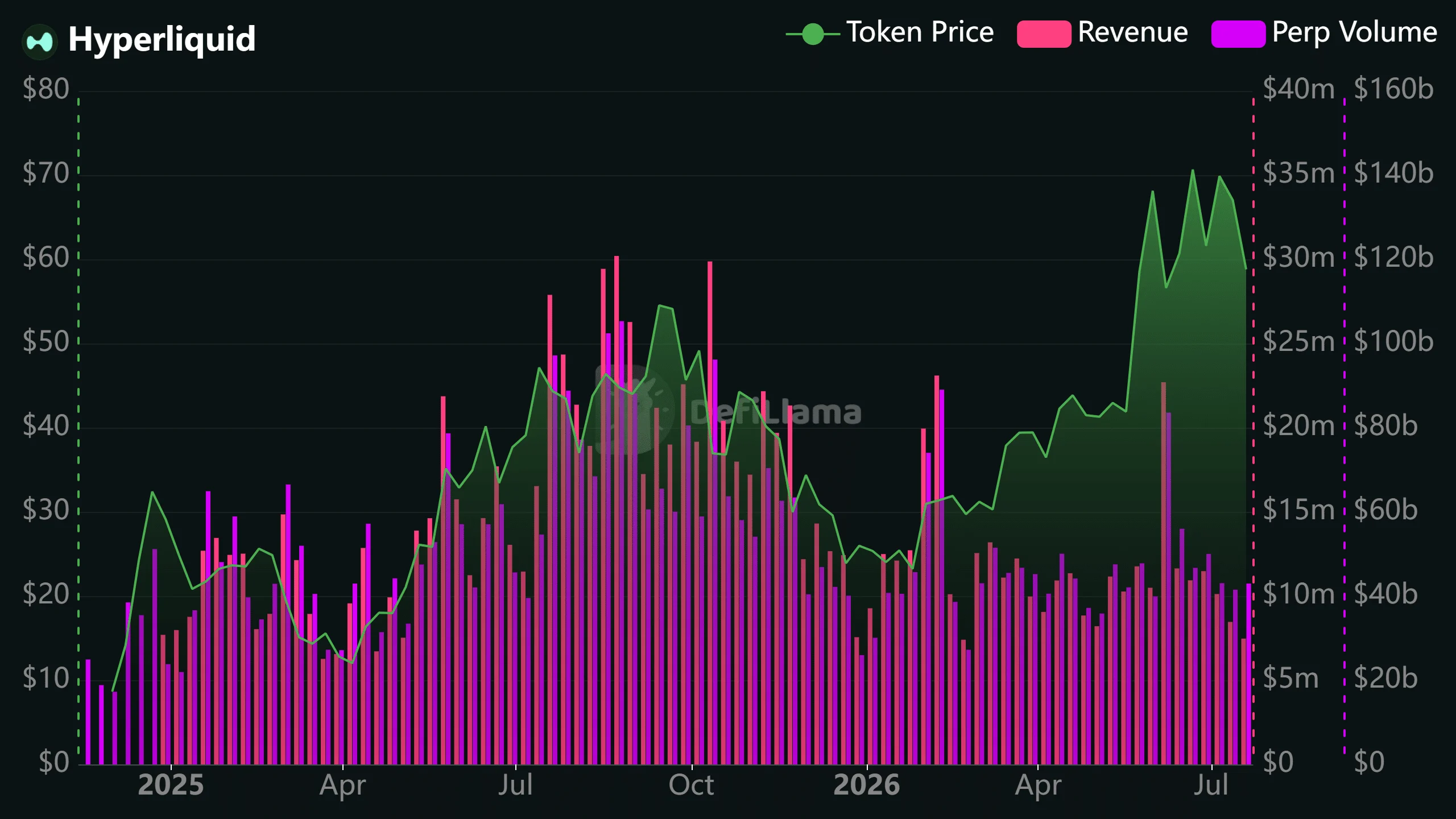
Hyperliquid is having a rough start to Q3, with fundamentals dropping to levels last seen in April. After a strong jump in perpetual volume in early July to $84B, the decentralized exchange’s activity has now dropped to $43B. That’s a 2x decline in traction in less than three weeks. 

Similarly, the overall total Open Interest (OI), measuring the capital inflows of open contracts, slipped from $75B to $65B. That’s a $10B drop in OI in July, further underscoring the slowing traction. 

Amid the cool-off, revenue has decreased by 3x from a weekly average of $23M to $7.5M this week. 

Hyperliquid HYPE
Source: DeFiLlama

As illustrated on the chart, the declining revenue (red) and perp volume (purple) have dragged HYPE token’s price (green) lower. This may be connected to the pace of buybacks amid dropping revenue. 

HYPE buyback drops by half

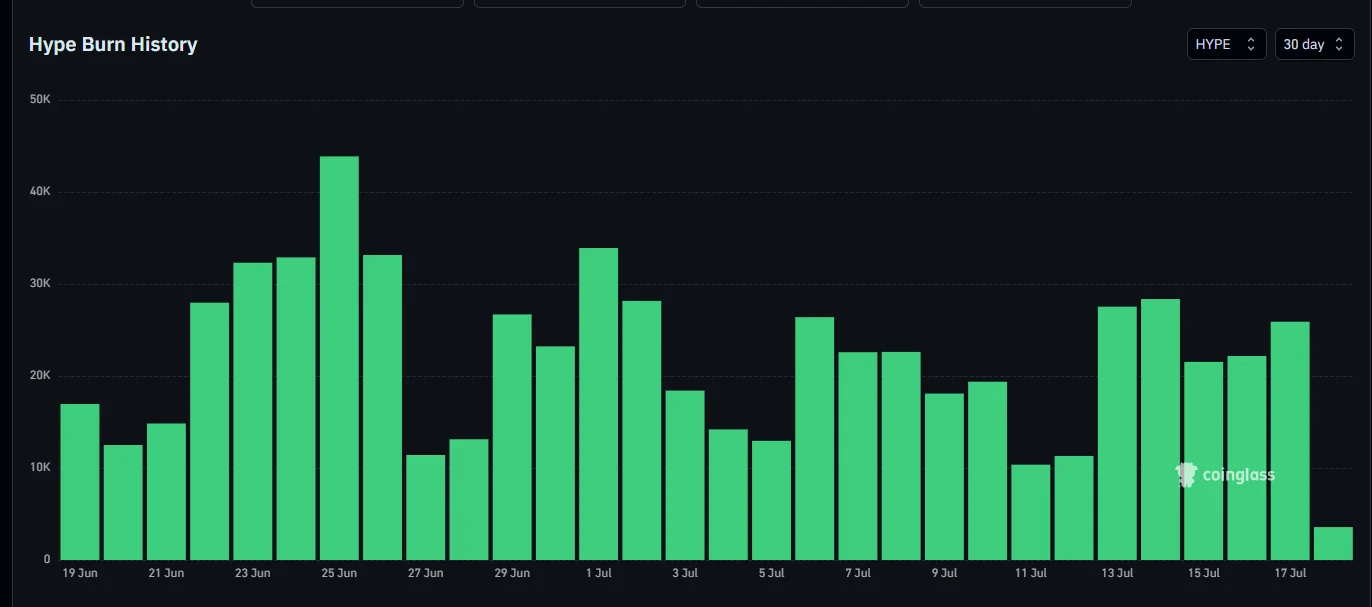
In June, HYPE buybacks rose by 4x from a daily average of 14K tokens to over 44K. The strong buyback and positive ecosystem catalysts and ETF flows boosted the token to a new record high of $76.9 on the Binance platform. 

However, the pace of buybacks has since dropped to around 22K HYPE, marking a sharp decline by half from its mid-June levels. 

Hyperliquid HYPEHyperliquid HYPE
Source: Coinglass 

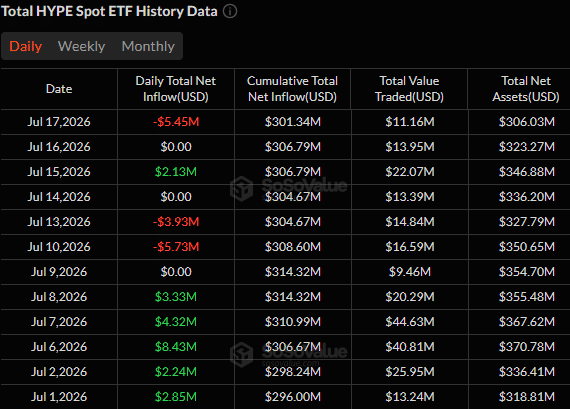
And the U.S Spot HYPE ETF demand has not made the situation any better over the last few days. Since 9th July, the products have seen zero demand or outflows, with 15th July being the exception.

Hyperliquid HYPEHyperliquid HYPE
Source: SoSo Value 

With declining fundamentals, easing buybacks, a16z’s $30M sell-off, and lack of interest from institutional investors, HYPE’s price pullback did not come as a surprise. 

HYPE’s price drops 19% as traction slows down

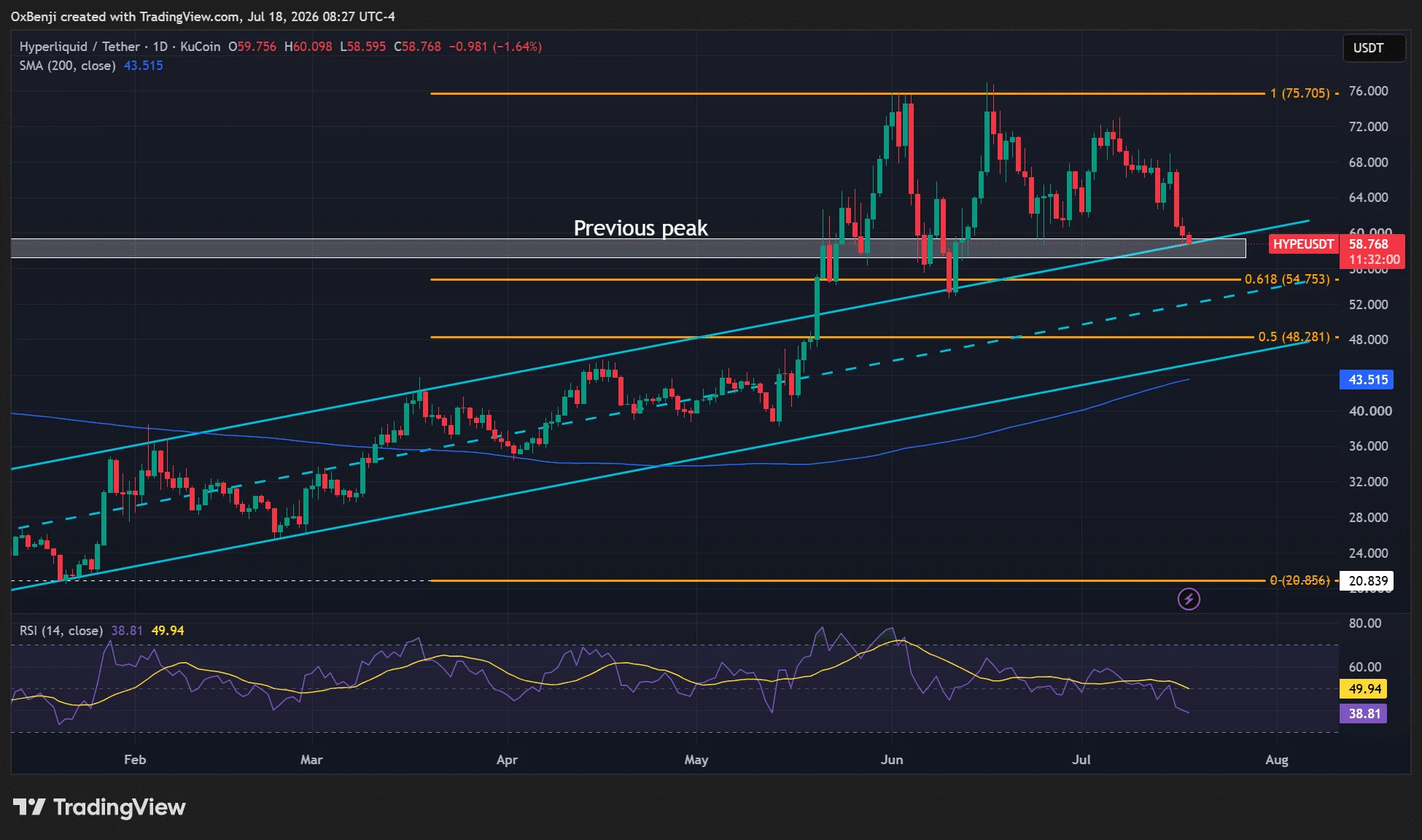
At the time of writing, HYPE was valued at $58, down 19% from a high of $73 in July. Still, the price action was around $60, which acted as a previous price peak last year and a key support in 2026. 

It is still unclear if the $60-support would hold after being tested three times since May. 

A decisive weekly candlestick close below the crucial support would reinforce Hyperliquid [HYPE]’s weakening momentum. 

Hyperliquid HYPEHyperliquid HYPE
Source: HYPE/USDT, TradingView 

In case of an extended decline, $48-$54 could be the next key support zone. Even so, Hyperliquid became an outlier in 2026 and outperformed several tokens in investor returns. Whether it will bounce back strongly if risk appetite improves remains to be seen. 


Final Summary

  • Hyperliquid’s perpetual volume and revenue have dropped by 2x and 3x, respectively. 
  • The slowing fundamentals have weighed on HYPE’s price, triggering nearly 20% in losses


Source link

Apple’s Core Business Cash Flow Machine Will Support Innovation and Diversification

0
Apple’s Core Business Cash Flow Machine Will Support Innovation and Diversification


Apple products on desk by Ake Ngiamsanguan via iStock

Apple’s (AAPL) current business is a cash flow machine. For the first half of fiscal 2026, operating cash flow came to $82.7 billion. This implies annualized cash flow potential of $165 billion. Furthermore, Apple ended the second quarter with a cash buffer of $146.5 billion. 

That robust financial flexibility provides headroom for Apple to make big investments in product development, innovation, and diversification. To that end, one area that seems to be promising for Apple from a long-term perspective is robotics. Back in November 2025, Morgan Stanley opined that Apple’s “robotics revenue can reach $130 billion by 2040.” That points to significant potential, with ample flexibility for Apple to make big investments to accelerate project development. 

More News from Barchart

As a matter of fact, Apple is already expanding its team to work on robotics projects. Jeremy Fishel, a senior principal research engineer at Apple, is reportedly building a team to work on “some of the most difficult, but high-impact challenges in robotics.” Let’s take a closer look at what’s going on with Apple and its recent efforts.

About Apple Stock

Headquartered in Cupertino, California, Apple is a technology giant with a market capitalization of $4.9 trillion. The innovation-driven company is a designer and manufacturer of smartphones, personal computers, tablets, wearables, and accessories. 

For the first six months of fiscal 2026, Apple reported revenue of $254.9 billion, up 16% on a year-over-year (YOY) basis. The iPhone segment remains the key revenue driver for Apple, followed by the Services segment. Other business divisions include Mac, iPad, and wearables and accessories. In terms of geographic diversification, 41% of revenue for the first half of fiscal 2026 came from the Americas, while Europe and Greater China contributed roughly 26% and 18%, respectively. 

With brand-pull and innovation, Apple has delivered sustained growth and value creation. For Q2, the company’s new or updated products portfolio included the iPad Air, iPhone 17e, MacBook Pro, MacBook Air, MacBook Neo, and AirPods Max. Apple’s focus on innovation is also underscored by the fact that, for Q2 2026, research and development expenses equated to about 10% of net sales. 

With steady growth, robust cash flows, and a focus on AI upgrades, AAPL stock has trended higher by 31% in the last six months. 

www.barchart.com

Apple’s AI Comeback

Investment in artificial intelligence is increasingly becoming an area of focus for Apple. Recent reports indicate that Apple is looking for acquisitions in the AI chips space. Earlier this year, the company acquired Q.ai for a consideration of $1.6 billion.

Taking into account a Bloomberg report from August 2025, Apple’s AI comeback is set to include robots, smart speakers, and home-security solutions. The tech giant is reportedly targeting a tabletop robot for 2027.

Apple is also working on AI-powered smart glasses that could potentially boost its wearables segment growth. This product will rival Meta Platforms’ (META) smart glasses in a market that is expected to hit $18.1 billion by 2035, according to Precedence Research.

What Do Analysts Say About AAPL Stock?

Amidst these innovative developments, the outlook appears positive for Apple. Based on 42 analysts with coverage, AAPL stock has a consensus “Moderate Buy” rating. While 23 analysts have a “Strong Buy” rating for the stock, three have a “Moderate Buy,” 14 have a “Hold,” and two analysts have a “Strong Sell” rating. 

The mean price target of $315.63 represents potential downside from current levels near $333 per share. However, the most bullish price target of $400 suggests that AAPL stock could climb as much as 20% from here.

www.barchart.com

On the date of publication, Faisal Humayun Khan did not have (either directly or indirectly) positions in any of the securities mentioned in this article. All information and data in this article is solely for informational purposes. This article was originally published on Barchart.com


Source link

Iran just crossed Trump’s red line for resuming all-out war as fighting worsens with no end in sight

0
Iran just crossed Trump's red line for resuming all-out war as fighting worsens with no end in sight

The deaths of U.S. service members after Iran attacked a base in Jordan followed a week of fighting that has steadily upped the ante and could trigger the resumption of all-out war.

The U.S. military has reinstated a naval blockade and bombed Iran for several consecutive days, concentrating attacks on coastal areas near the Strait of Hormuz. But airstrikes have recently extended to infrastructure, such as railways that could be used to ferry weapons.

On Saturday, the U.S. military announced a new wave of airstrikes in retaliation for the deaths.

“The strikes are designed to further degrade Iran’s ability to threaten commercial shipping in the Strait of Hormuz and swiftly punish Islamic Revolutionary Guard Corps forces who launched attacks against American service members in Jordan last night,” U.S. Central Command said.

At the same time, Iran has launched attacks on commercial ships and at its neighbors across the Persian Gulf region, targeting U.S. military assets. Tehran has also hit energy infrastructure and even water desalination plants.

Still, fighting hasn’t been as extensive as it was during the initial phases of the war. But U.S. deaths previously represented a red line for President Donald Trump.

Early last month—before both sides signed a memorandum of understanding that has since collapsed—he confided to aides that he would consider ending the prior ceasefire and go back to war if Iran kills American troops, according to the Wall Street Journal.

When asked for a comment and whether the U.S. would return to all-out war, the White House only responded with a statement from Central Command announcing the casualties.

Oil prices have jumped as fighting has intensified in recent days, and more war would deliver another shock to global markets.

Consuming countries have drawn down their oil stockpiles to the lowest level in decades with little breathing room left to endure another extended closure of the Strait of Hormuz.

The U.S. established an alternate route through the narrow water to bypass an Iranian corridor, but the renewed fighting has effectively it shut down.

On Friday, no crossings via the U.S.-backed route were detected, and no shadow fleet movements were recorded either, while Iran’s route saw seven transits.

Despite the massive U.S.-Israeli bombardment, the war didn’t bring about an overthrow of Iran’s regime and has failed to fully reopen the strait.

To be sure, Iran’s economy is reeling and conventional forces were decimated, but the Islamic Republic has enough combat power to scare away commercial shipping and isn’t deterred from continuing its attacks.

Meanwhile, hopes for a new round of talks to cobble together another ceasefire are vanishing. Previously, some officials appeared to leave the door open to negotiations despite Tehran’s defiant statements in the face of U.S. strikes.

That’s after pragmatists inside Iran privately admitted that the initial naval blockade had crushed the economy, with the blockade’s resumption reportedly deepening a rift between pragmatists and hard-liners who want to fight more aggressively.

But on Saturday, Iran’s supreme leader warned of “unforgettable lessons” if the U.S. keeps attacking and called Trump’s signature “worthless and invalid.” 

For its part, the U.S. blames Iran for violating the ceasefire agreement by refusing to reopen the strait and attacking ships sailing outside of Tehran’s approved corridor.

The stalemate has raised fears of an endless war, something Trump campaigned on avoiding, as tit-for-tat attacks continue along an escalating spiral.

“The immediate dispute concerns who controls the Strait of Hormuz, but more is at stake,” Ali Vaez, the Iran Project Director at the International Crisis Group, wrote in a New York Times op-ed on Wednesday. “The collapse of even this minimal understanding could remove the last barrier between episodic confrontation and a forever war.”

Gregory Brew, senior analyst for Iran and energy with the Eurasia Group, told Fortune’s Jordan Blum earlier that there’s no military option for reopening the strait, adding that Iran will not let go of its main source of leverage.

He also warned that some form of Iranian fee to cross the strait seems inevitable and that U.S. attacks only strengthen Tehran’s resolve.

“The options are to escalate or cut a deal. And I think the [Trump] administration is likely to do the first, see it fail, and end up with the second,” Brew predicted.


Source link