Home Blog Page 222

Iran just crossed Trump’s red line for resuming all-out war as fighting worsens with no end in sight

0
Iran just crossed Trump's red line for resuming all-out war as fighting worsens with no end in sight

The deaths of U.S. service members after Iran attacked a base in Jordan followed a week of fighting that has steadily upped the ante and could trigger the resumption of all-out war.

The U.S. military has reinstated a naval blockade and bombed Iran for several consecutive days, concentrating attacks on coastal areas near the Strait of Hormuz. But airstrikes have recently extended to infrastructure, such as railways that could be used to ferry weapons.

On Saturday, the U.S. military announced a new wave of airstrikes in retaliation for the deaths.

“The strikes are designed to further degrade Iran’s ability to threaten commercial shipping in the Strait of Hormuz and swiftly punish Islamic Revolutionary Guard Corps forces who launched attacks against American service members in Jordan last night,” U.S. Central Command said.

At the same time, Iran has launched attacks on commercial ships and at its neighbors across the Persian Gulf region, targeting U.S. military assets. Tehran has also hit energy infrastructure and even water desalination plants.

Still, fighting hasn’t been as extensive as it was during the initial phases of the war. But U.S. deaths previously represented a red line for President Donald Trump.

Early last month—before both sides signed a memorandum of understanding that has since collapsed—he confided to aides that he would consider ending the prior ceasefire and go back to war if Iran kills American troops, according to the Wall Street Journal.

When asked for a comment and whether the U.S. would return to all-out war, the White House only responded with a statement from Central Command announcing the casualties.

Oil prices have jumped as fighting has intensified in recent days, and more war would deliver another shock to global markets.

Consuming countries have drawn down their oil stockpiles to the lowest level in decades with little breathing room left to endure another extended closure of the Strait of Hormuz.

The U.S. established an alternate route through the narrow water to bypass an Iranian corridor, but the renewed fighting has effectively it shut down.

On Friday, no crossings via the U.S.-backed route were detected, and no shadow fleet movements were recorded either, while Iran’s route saw seven transits.

Despite the massive U.S.-Israeli bombardment, the war didn’t bring about an overthrow of Iran’s regime and has failed to fully reopen the strait.

To be sure, Iran’s economy is reeling and conventional forces were decimated, but the Islamic Republic has enough combat power to scare away commercial shipping and isn’t deterred from continuing its attacks.

Meanwhile, hopes for a new round of talks to cobble together another ceasefire are vanishing. Previously, some officials appeared to leave the door open to negotiations despite Tehran’s defiant statements in the face of U.S. strikes.

That’s after pragmatists inside Iran privately admitted that the initial naval blockade had crushed the economy, with the blockade’s resumption reportedly deepening a rift between pragmatists and hard-liners who want to fight more aggressively.

But on Saturday, Iran’s supreme leader warned of “unforgettable lessons” if the U.S. keeps attacking and called Trump’s signature “worthless and invalid.” 

For its part, the U.S. blames Iran for violating the ceasefire agreement by refusing to reopen the strait and attacking ships sailing outside of Tehran’s approved corridor.

The stalemate has raised fears of an endless war, something Trump campaigned on avoiding, as tit-for-tat attacks continue along an escalating spiral.

“The immediate dispute concerns who controls the Strait of Hormuz, but more is at stake,” Ali Vaez, the Iran Project Director at the International Crisis Group, wrote in a New York Times op-ed on Wednesday. “The collapse of even this minimal understanding could remove the last barrier between episodic confrontation and a forever war.”

Gregory Brew, senior analyst for Iran and energy with the Eurasia Group, told Fortune’s Jordan Blum earlier that there’s no military option for reopening the strait, adding that Iran will not let go of its main source of leverage.

He also warned that some form of Iranian fee to cross the strait seems inevitable and that U.S. attacks only strengthen Tehran’s resolve.

“The options are to escalate or cut a deal. And I think the [Trump] administration is likely to do the first, see it fail, and end up with the second,” Brew predicted.


Source link

$2.5 billion in BTC call spreads target $72,000 by the month end when the Fed meets

0
$2.5 billion in BTC call spreads target $72,000 by the month end when the Fed meets

“This week we have seen some large blocks in BTC topside call spreads,” Jean-David Péquignot, chief commercial officer at Deribit, told CoinDesk.

Options flow of this size and repetition often reflects institutional positioning rather than retail activity, given the capital required and the precision of the strike selection.

The timing is notable for two reasons. First, it suggests confidence in bitcoin’s recent bounce to $64,000 from under $58,000 earlier this month. More importantly, the trade targets the July 31 settlement, two days after the Federal Reserve’s July 29 interest rate decision. The call spread flow suggests that at least some large traders expect the meeting to serve as a catalyst for a move toward $72,000.

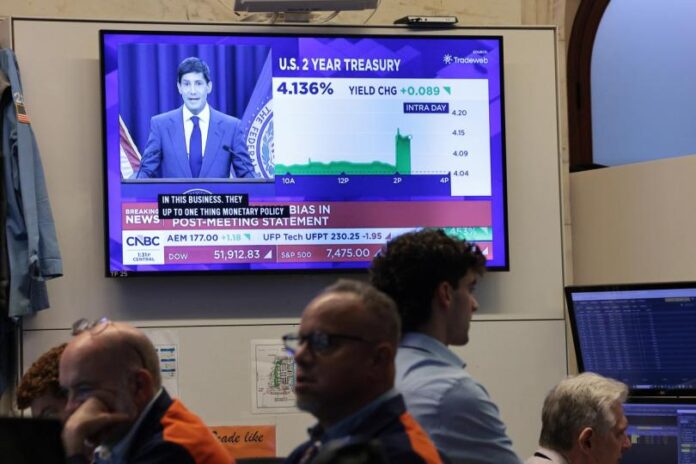
Fed funds futures currently point to a hold at the July meeting, with most trackers putting the probability of the central bank keeping its benchmark rate unchanged at 3.5%-3.75% in the 75%-80% range. The remaining odds are split between a rate hike and, to a lesser extent, a cut.

Rate-hike fears have ebbed following June inflation data, which showed a sharp deceleration in price pressures at both the consumer and producer levels. Much of the relief traces to a sharp pullback in oil prices during the month, tied to a ceasefire between the U.S. and Iran; core inflation, which strips out food and energy, was flat.


Source link

Sellas Life (SLS) Climbs 12% Ahead of ‘Potentially Company-Defining’ Clinical Trial Result

0
Sellas Life (SLS) Climbs 12% Ahead of ‘Potentially Company-Defining’ Clinical Trial Result


Sellas Life Sciences bounced back by 12.26 percent on Friday to close at $13.19 apiece, as investors positioned portfolios ahead of a potentially company-defining clinical data release, supported by takeover speculations and growing institutional interest.

The company is expected to report data from the phase 3 study evaluating its Galinpepimut-S (GPS) treatment candidate in patients with acute myeloid leukemia, as soon as it reaches the 80th patient death—a pre-specified event needed to determine whether GPS actually made a meaningful improvement in terms of overall survival, versus those in the placebo group.

In its latest update, Sellas Life Sciences Group Inc. (NASDAQ:SLS) said that the study had already reached its 78th patient death, suggesting the long-awaited readout could be approaching soon.

With the potential catalyst only a few weeks away, investors appeared increasingly willing to load up on positions ahead of the results, which could reshape its growth story once successful.

Photo by Tima Miroshnichenko on Pexels

Takeover Hint

Investor enthusiasm was further supported by speculation that Sellas Life Sciences Group Inc. (NASDAQ:SLS) is preparing for a potential takeover.

Last month, it told the Securities and Exchange Commission that it amended its employment and severance agreements with three of its executive members, namely President and CEO Angelos Stergiou, Chief Financial Officer John Burns, and Chief Development Officer Dragan Cicic, under which they would receive lump-sum payment benefits in case of a “change of control.”

Specifically, Sellas Life Sciences Group Inc. (NASDAQ:SLS) said that Burns and Cicic are set to receive lump-sum payments equal to 15 months of their base salary, target bonus for the year of termination, and immediate vesting of unvested shares, among others, in case they are not retained by a new owner.

While it did not specifically announce any sale plans, investors interpreted the new employment arrangements as a hint of a potential takeover.

More Institutional Investors Buy In

More institutional investors appear to be buying into shares of Sellas Life Sciences Group Inc. (NASDAQ:SLS).

As of the first quarter of the year, data from Insider Monkey showed that the number of hedge funds with stakes in the company more than doubled to 13 from only 6 in the fourth quarter of 2025.

The funds collectively owned $13.49 million worth of shares in Sellas Life Sciences Group Inc. (NASDAQ:SLS), up from $10.8 million in 2025.

The growing hedge fund interest signaled that more institutional investors are willing to take a slice of the company, even as it remains a high-risk, event-driven investment.


Source link

Assessing Bitcoin’s sideways drift as dormant $290M BTC whale reloads

0
Assessing Bitcoin’s sideways drift as dormant $290M BTC whale reloads


Bitcoin continued trading sideways between $63,000 and $64,000. At press time, BTC traded around $63,923 after gaining 1.82% over 24 hours.

However, Trading Volume fell 46%, reflecting weaker market participation.

Why did this Bitcoin whale return?

As Bitcoin [BTC] traded sideways, one long-term holder returned to the market after a year of inactivity.

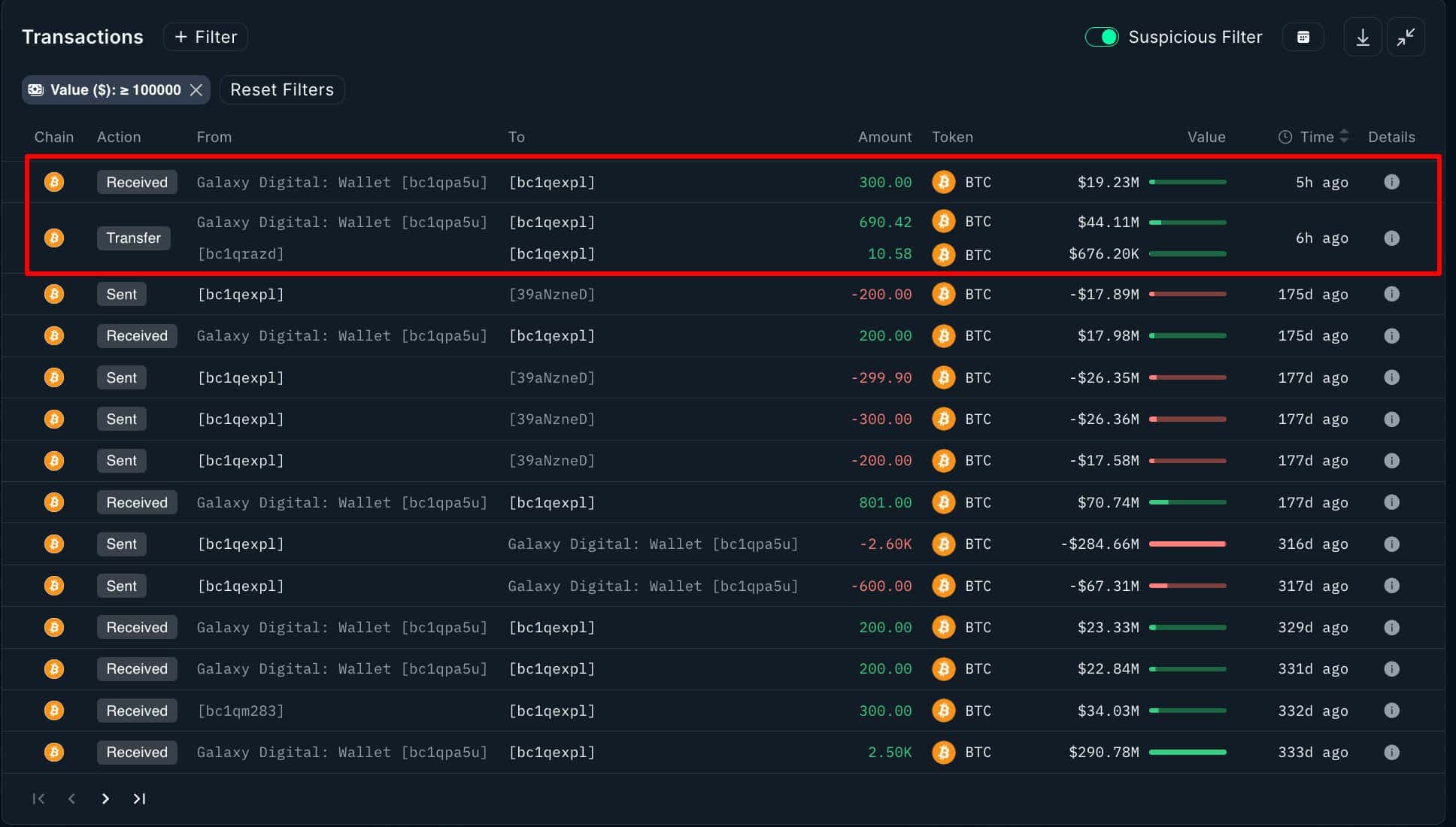
According to Onchain Lens, the whale wallet received another 1,001 BTC worth approximately $64 million. A year earlier, the whale acquired $290 million worth of Bitcoin through Galaxy Digital.

Its return during weaker market conditions suggested renewed confidence, although the transfer alone did not confirm broader whale demand.

Source: Onchain Lens

Are other whales buying BTC?

Interestingly, even though this whale returned, other whales have scaled back significantly and are now sitting on the sidelines. 

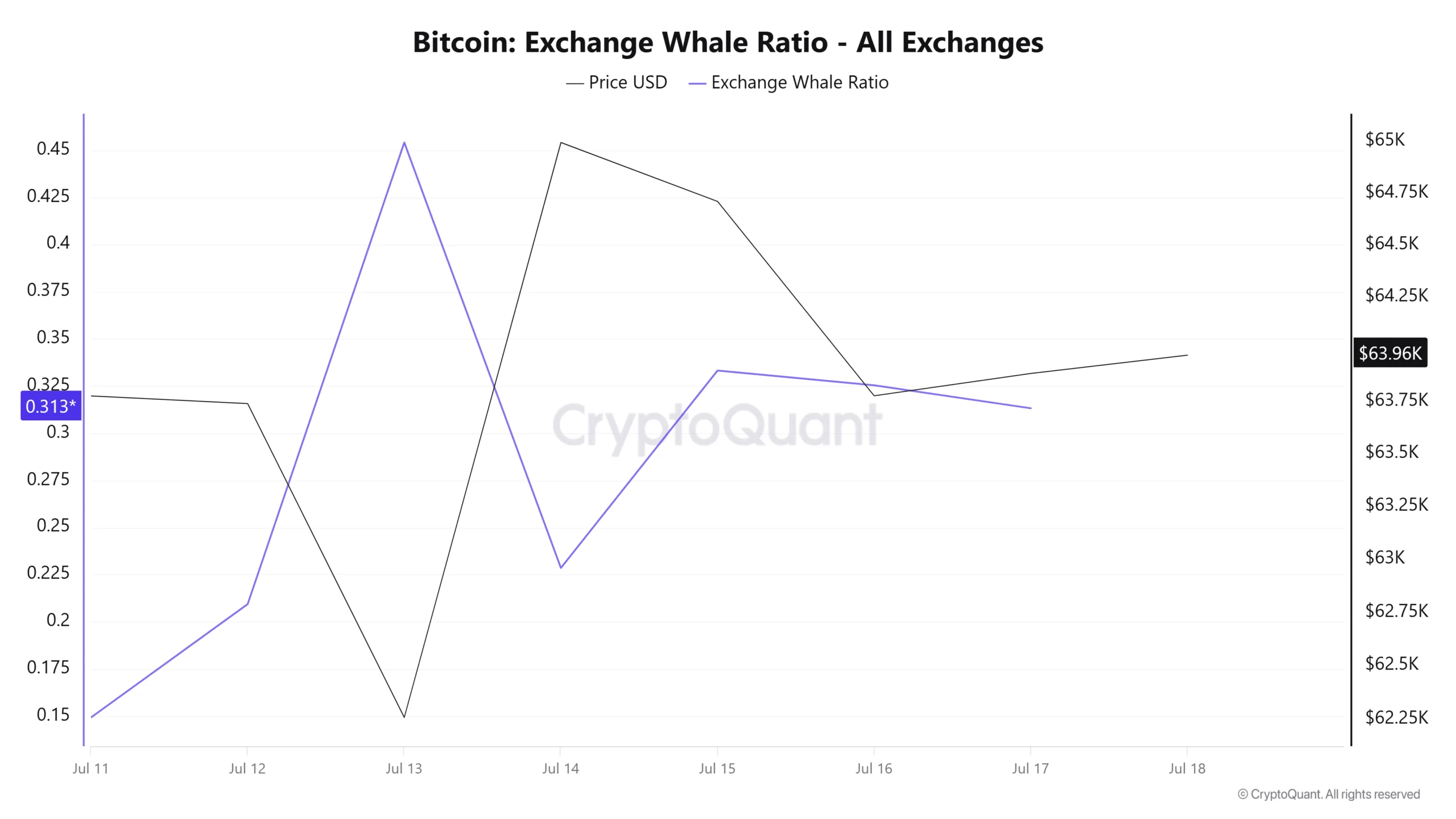
Looking at the Exchange Whale Ratio, this metric has continued to move sideways, holding around 0.3 over the past three days. In the short term, this metric indicates that whales have reduced buying and selling.

Bitcoin exchange whale ratioBitcoin exchange whale ratio
Source: CryptoQuant

The ratio slipped from 0.33 to 0.31. This meant the largest inflows accounted for a slightly smaller share of total deposits.

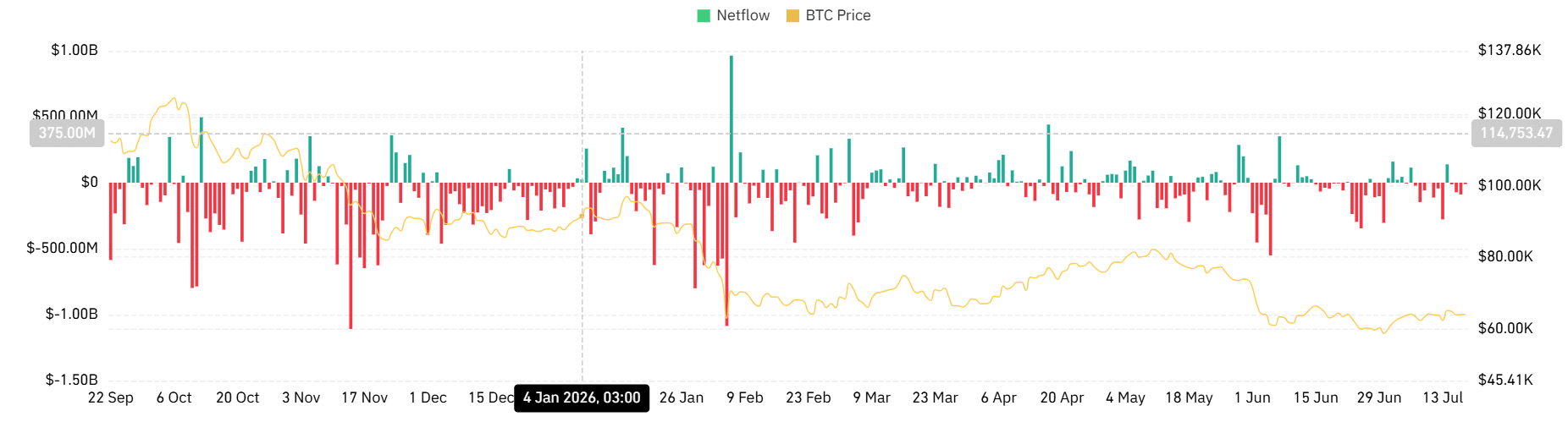
By contrast, Spot Netflow remained negative for four consecutive days, showing that overall exchange outflows exceeded inflows.

Bitcoin NetflowwBitcoin Netfloww
Source: CoinGlass

Spot Netflow stood near -$10.86 million at press time. Continued outflows could reduce immediate selling pressure, but they did not confirm whale accumulation.

What’s next for BTC?

Although some whales still remain active in the market, demand remains weak. The group’s buying activity currently remains below par.

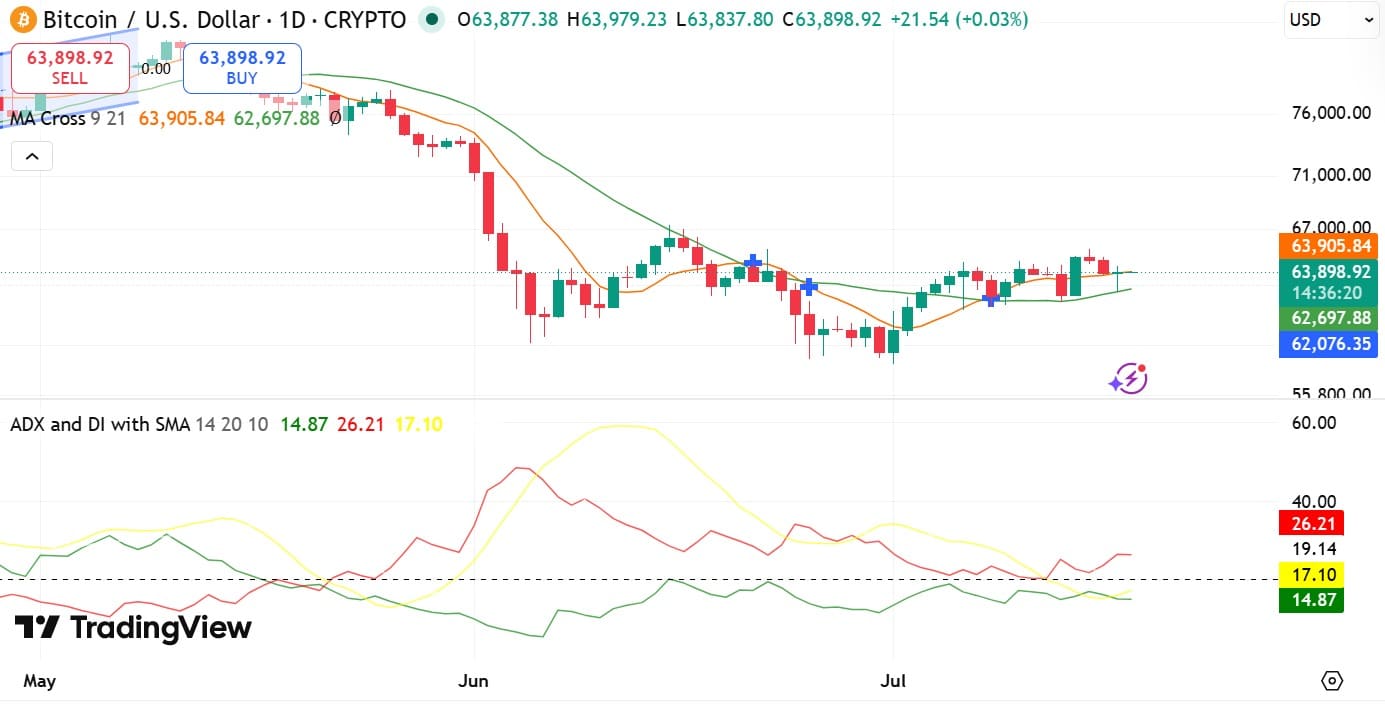
As a result, the downside risk remains elevated. A look at the ADX with the SMA indicator shows the positive index has continued to drop. The +DI fell to 14, while the negative index rose to 26 and the ADX rose to 17.

BTC ADXBTC ADX
Source: TradingView

ADX and -DI rising together suggested that the downward pressure is stronger. Thus, Bitcoin is most likely to see some losses on the price charts.

If whale demand remains weak, as it currently is, BTC is likely to drop below $63k again, towards $62,697, where the Long MA currently sits. To avoid further slippage, BTC must hold above $ 63,906 and flip $64k.


Final Summary

  • A dormant whale received 1,001 BTC worth $64 million after one year of inactivity.
  • Negative Spot Netflow reduced immediate supply, but broader demand and price momentum remained weak.


Source link

Trump targets Brazil’s payments system while dollar stablecoins are quietly overtaking country’s payments

0
U.S. says it seized about $1 billion in Iranian crypto as pressure campaign expands

Dollar-linked stablecoins already account for roughly 90% of crypto transaction volume in Brazil, most of it used for payments and settlement, according to tax authority data.

Brazil processes between $6 billion and $8 billion in crypto each month, much of it using dollar-denominated stablecoins instead of the country’s own currency.

However, even as dollar stablecoins have proliferated, Brazil’s central bank has moved to limit their role in regulated cross-border payments. Resolution 561, effective October 1, is set to bar payment firms from settling cross-border payments in stablecoins or other crypto, closing a back-end channel that had routed reais through dollar tokens. The central bank has cast stablecoins as a threat to monetary sovereignty, tax enforcement and anti-money laundering controls.

Pix now faces pressure from both sides after Washington named it a trade barrier, while Brazilian regulators shield it from growing competition from dollar-backed stablecoins.

Pix, however, may not be competing with stablecoins.

“In practice, they are complementary,” Rodrigo Caggiano, founder of Brazilian real-world asset monitoring platform RWA Monitor, told CoinDesk. “Pix has addressed domestic instant payments well, while stablecoins expand what is possible by operating on blockchain networks.”

U.S. pressure is likely to accelerate Brazil’s regulatory debate on stablecoins and digital financial infrastructure, Caggiano said, as the central bank builds its own tokenized-settlement system, Drex, on similar programmable rails.


Source link

SpaceX (SPCX) Loses Its IPO Premium as a Bigger Supply Test Looms

0
SpaceX (SPCX) Loses Its IPO Premium as a Bigger Supply Test Looms


With investors increasingly questioning whether massive AI and infrastructure spending will generate adequate returns, Space Exploration Technologies Corp (NASDAQ:SPCX) has become one of the stocks caught in the broader valuation reset.

SPCX has dropped below its $135 IPO price after a sharp rally to all-time highs of $225.64. With the stock trading at about $123, it has shed about 45% in share price from its all-time high. It is also down by about 9% from its IPO price.

Valuation Debate

The significant share price pullback, as initial IPO enthusiasm cools, comes as investors increasingly assess whether the price was justified. SpaceX’s valuation assumes flawless execution, which remains a big concern.

The stock has traded at about 45x estimated 2026 sales, far above most large technology companies. Investors are therefore paying for many years of future growth rather than current earnings.

SpaceX (SPCX) Loses Its IPO Premium as a Bigger Supply Test Looms

Source: Pexels

The IPO valuation implied expectations consistent with revenue approaching roughly $178 billion by 2035 and potentially exceeding $500 billion over the following decade. In 2025, the company’s sales rose 33% to $18.67 billion, with Starlink accounting for about 60% of the total.

SpaceX’s premium valuation stems from the expectation that the company will not only dominate commercial launches and satellite internet but also become a major player in AI infrastructure and space. Much of the valuation also depends on Starship becoming fully reusable and the company achieving large Starlink expansion.

Bigger Supply Test

Even as investors continue to question Space Exploration Technologies Corp (NASDAQ:SPCX) valuation, lock-up expiration presents one of the biggest near-term risk. The company created an unusually small public float of about 5% of total shares. Because only about 5% of shares were initially available for trading, scarcity supported the post-IPO price. As hundreds of millions of additional shares become eligible for sale, that scarcity premium could diminish even if the company’s fundamentals remain unchanged

By December, up to 40% of outstanding shares could become eligible for trading. On the other hand, Elon Musk shares will remain locked until mid-next year, meaning the largest insider stake won’t be the source of selling pressure in the near term.

The lock-up expirations are a technical headwind. While it does not affect the company’s fundamentals, it increases the supply of tradable shares, which can put downward pressure on the stock. This is especially the case if demand weakens and insiders sell aggressively.

Bull Case

SpaceX’s prospects as a solid long-term investment hinge on the idea that investors are not buying into a rocket company. Instead, they are betting on a platform that could end up dominating multi-trillion-dollar industries. The company has achieved significant milestones, including Reusable Falcon 9 boosters, industry-leading launch cadence, and rapid Starlink deployment.

Starlink is the financial backbone of SpaceX. It is the primary source of profits, accounting for about 60% of revenues. Starlink also boasts of a powerful moat as it builds, owns, and launches its own rockets and satellites.

Additionally, SpaceX has become a key launch provider for NASA, the US Department of Defense, and intelligence agencies. As of last year, the company had about $22 billion in government contracts, with the vast majority, at $15 billion, derived from NASA. The long-term government contracts provide stable revenue as the commercial business matures.

SpaceX is also expected to eventually participate in several enormous markets, including global broadband, satellite communications, commercial launch services, defense infrastructure, and orbital AI computing.

Bear Case

SpaceX is not in any way a bad company but an outstanding business priced for near-perfect execution. While the company’s valuation briefly exceeded $2 trillion, it has pulled back to about $1.6 trillion amid valuation concerns.

The stock has re-rated significantly as the premium valuation assumed years of exceptional growth from Starlink, launch services, AI initiatives, and Starship. Suggestions that revenue or margins would come in ‘good’ rather than ‘extraordinary’ were always going to hurt the stock.

Some of the risks that continue to weigh on market sentiment for the stock include launch failures or delays, regulatory setbacks, and higher-than-expected development costs. Investors are also becoming increasingly wary of large AI-related spending acquisitions. While the company spent $18 billion in AI infrastructure for GPU clusters and data centers in 2025, there are growing concerns about whether the investments will generate returns to justify the capital intensity.

Similarly, the biggest execution risk is Starship, as a large portion of SpaceX’s long-term valuation assumes it becomes fully reusable and significantly lowers launch costs. Delays or technical setbacks could materially affect future growth expectations.

The fact that a significant portion of SpaceX’s business and revenue also depends on government contracts presents significant risks. Budget cuts, procurement changes, and political shifts could hurt a key revenue stream.

While SpaceX is a dominant player in the sector, competition is also growing from Blue Origin, Rocket Lab, and Amazon’s Project Kuiper, which could eat into its market share.

Verdict

SpaceX’s long-term investment thesis remains compelling, driven by launch leadership, Starlink, and defense opportunities. If it successfully executes on its roadmap, it could become the most valuable industrial and technology company given its exposure to aerospace, telecommunications, defense, and space infrastructure.

However, its drop below IPO price is significant because only about 5% of its shares are publicly traded. Combined with the broader AI selloff and upcoming lockup expirations, limited liquidity means negative developments, such as Starship delays, can trigger price moves much larger than news itself would justify. Investors should be prepared for elevated volatility as the market reassesses the company’s premium valuation.

As such, the near-term risk-reward remains unfavorable until the market absorbs the additional share supply and the company can prove that its heavy spending can reap adequate returns.

Insider Monkey believes that some AI stocks still offer much higher upside than SPCX. We just published a report about an extremely undervalued AI stock. You can check out our report about this cheapest AI stock.

READ NEXT: 9 UK Dividend Growth Stocks to Consider and 12 Best Dividend Stocks to Invest In According to Jim Simons’ Renaissance Technologies.

Disclosure: None. Follow Insider Monkey on Google News.


Source link

France orders country’s internet service providers to block Polymarket

0
France orders country's internet service providers to block Polymarket

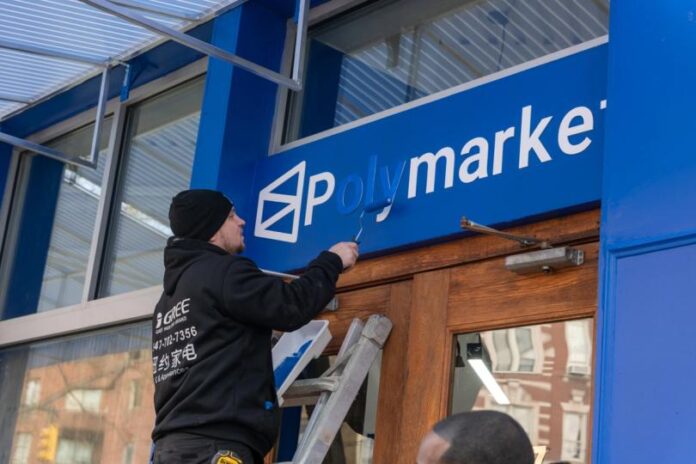
France’s gambling regulator, the Autorité Nationale des Jeux (ANJ), ordered internet service providers to block Polymarket on July 16, treating the prediction market as an illegal gambling site rather than a financial trading venue.

The ANJ said earlier restrictions had failed to keep French users off the platform. Polymarket drew 578,751 visits from 205,057 unique visitors in France in June, according to Similarweb data cited by the regulator, despite a ban on financial transactions in place since November 2024. A VPN was enough to bypass it.

The homepage remained accessible, allowing users to view live markets and odds. The ANJ said the real-time odds display promoted an unauthorized gambling service.

“The site’s homepage, which dynamically displays real-time odds for various events open to betting, thus serves as a major channel for disseminating and promoting Polymarket’s offerings, even though the site’s operations are not authorized in France,” the regulator wrote. Fines can reach 100,000 euros ($114,380).

Polymarket didn’t immediately respond to a comment from CoinDesk.

The ANJ also cited a complaint from France’s weather service, Météo-France, over a tampered temperature sensor tied to weather-based bets, prompting the Paris prosecutor’s cybercrime unit to open an investigation on May 4.


Source link