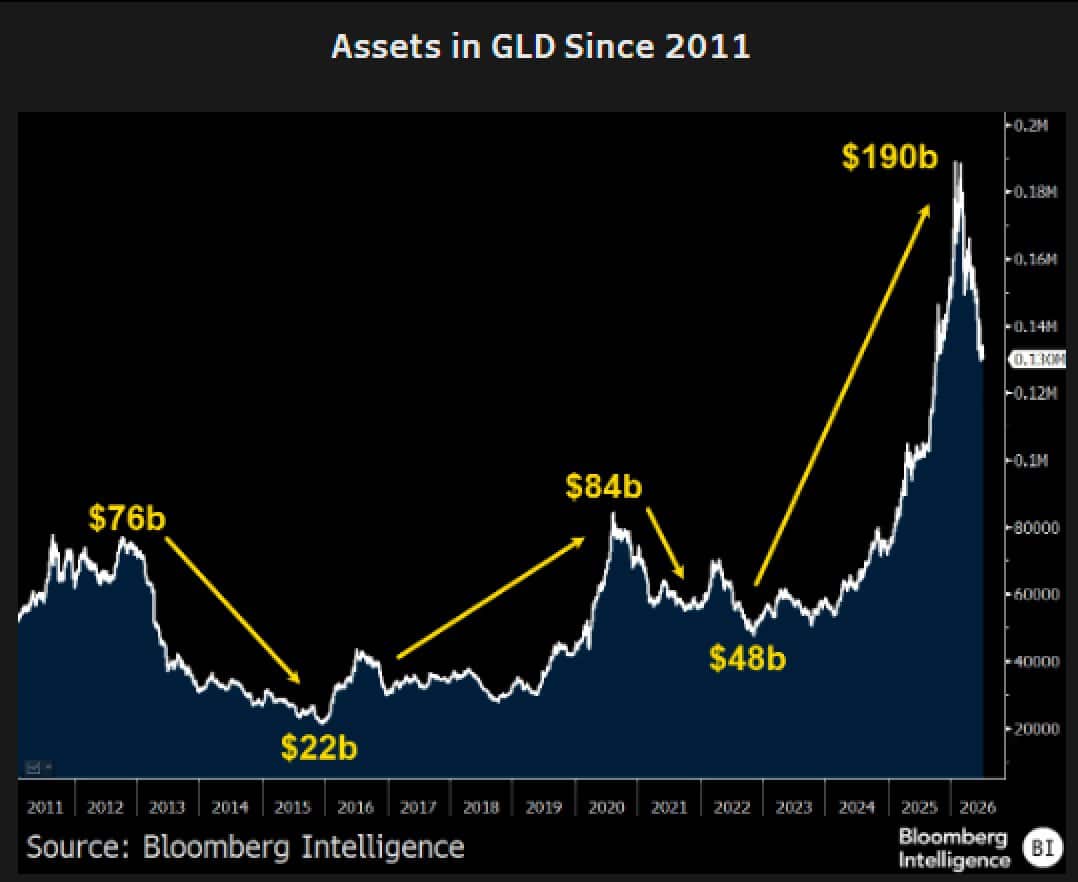
Bitcoin’s institutional demand will come back stronger, according to Bloomberg ETF analyst Eric Balchunas. The analyst noted that U.S. spot BTC ETFs could follow gold ETFs’ ‘triumph and pain’ pattern and would eventually surge to a new record high.
Gold ETFs were briefly the world’s largest ETF in 2011 but spent another eight years in a downtrend trying to reclaim the spot, added Balchunas.
It briefly reclaimed it again in 2024, and a similar ‘two steps forward, one step back’ could happen for BTC.
Bitcoin ETFs may be following the same script: spectacular gains, painful drawdowns and recoveries that may test investors’ patience
Source: Bloomberg
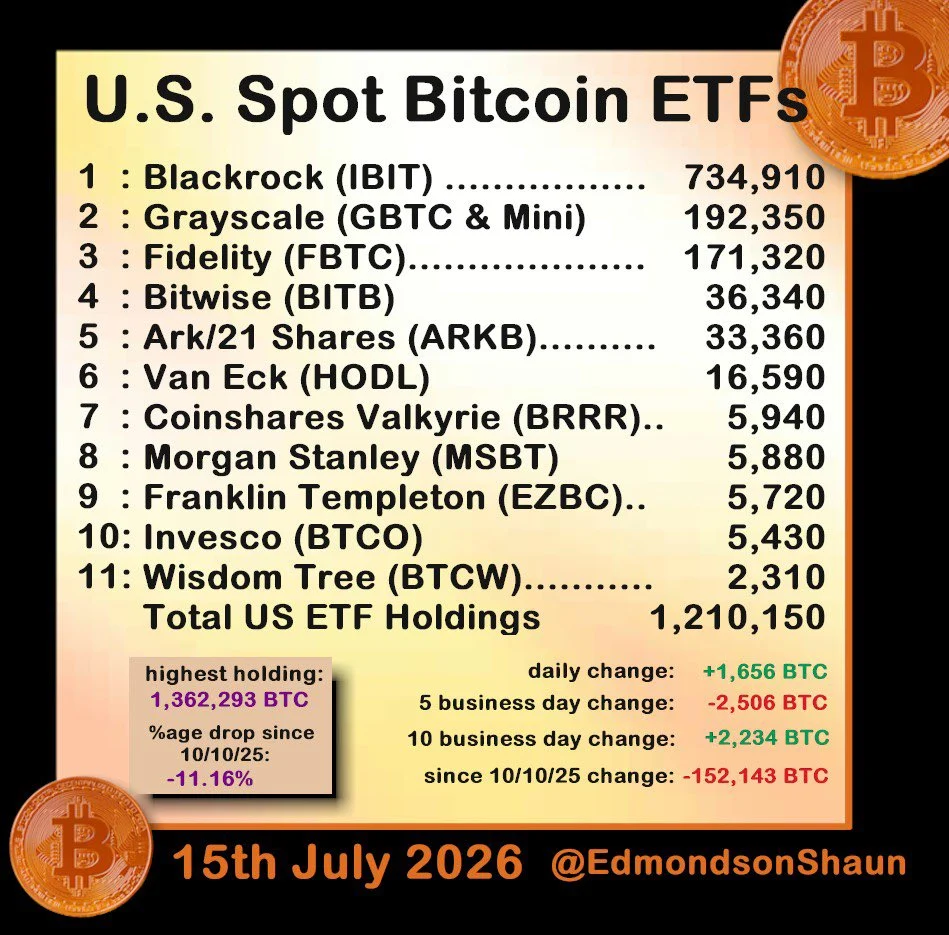
Spot Bitcoin ETF still holding strong, but…The
Bitcoin price has dropped by nearly half from over $126K to $64K. In May and June 2026, the spot BTC ETF outflows hit $7B as the crypto asset briefly slipped below $60K.
Even so, only 10% of spot BTC ETF holders are left, compared to a third of gold ETF investors, Balchunas highlighted.
Source: X
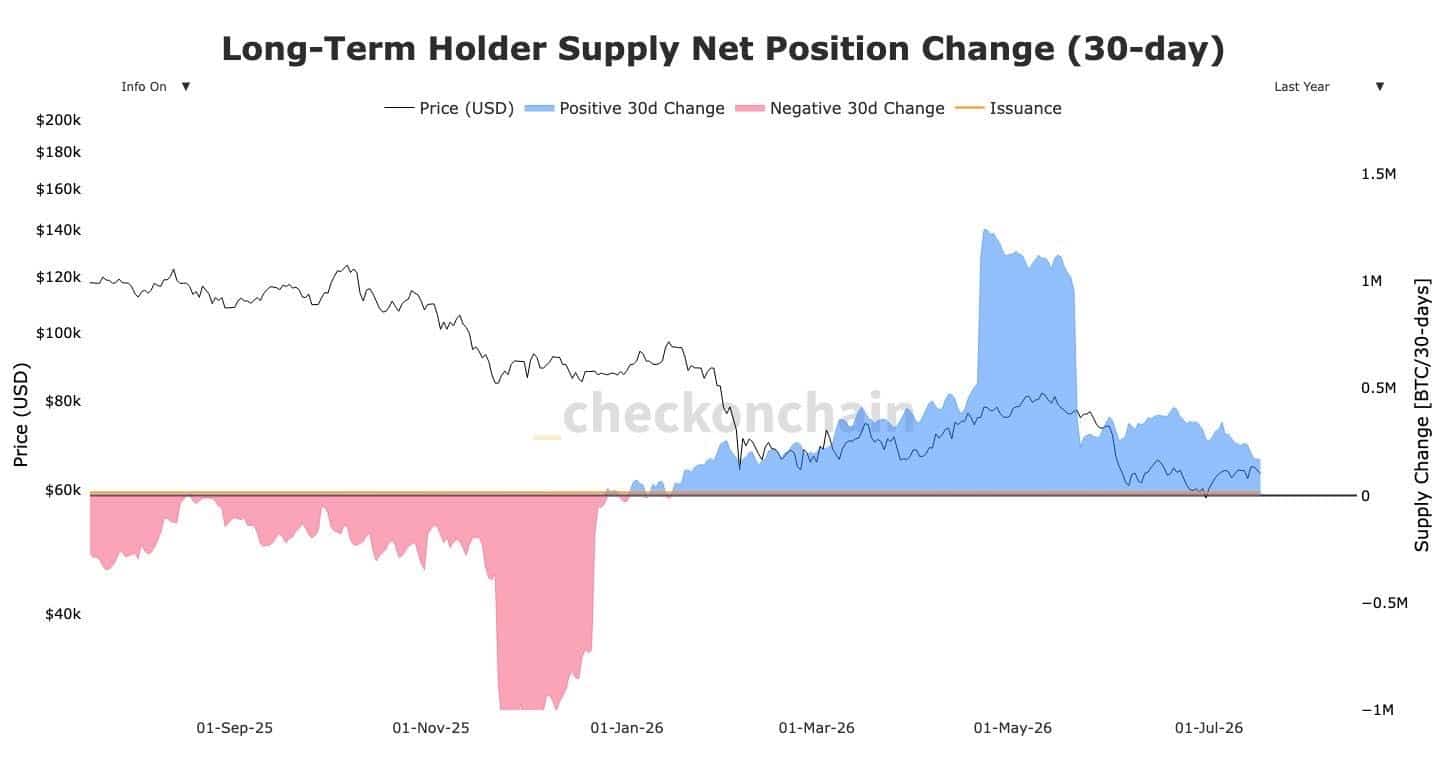
Another positive sign that BTC could show resilience and try to defend $60K support was the long-term holder (LTH) supply. Although they have slowly reduced exposure in the past few weeks, this cohort was not net sellers yet.
According to Bitfinex analysts, BTC’s recent dip below $60K was due to deleveraging and ETF outflows as LTH conviction was still intact. But the analysts warned,
Their 30-day net position stayed positive as ETFs shed nearly $4bn in June. Flows have now turned positive three straight sessions. The risk is LTHs finally flipping to net sellers.
Source: Checkonchain/Bitfinex
That said, amid renewed U.S-Iran escalations, the two safe havens have not seen strong investor interest, as seen earlier in the year. In the past three months, gold ETFs recorded about $11B outflows while spot BTC ETFs bled $6B. In other words, gold bled twice as much as BTC.
It’s unclear whether BTC will attract more capital and behave like a hedge if the West Asia crisis escalations extend into Q3.
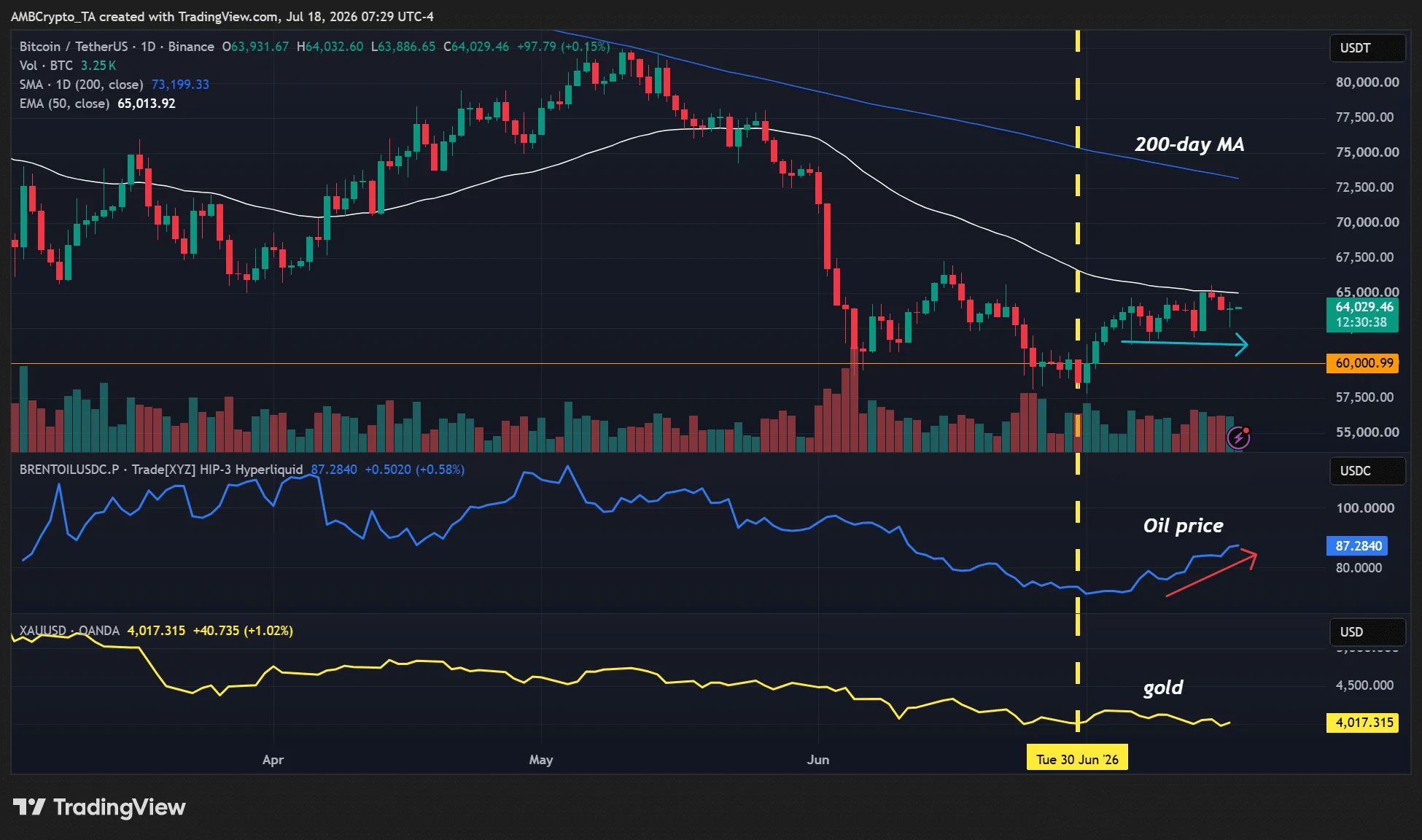
However, the rising oil price above $80 coincided with Bitcoin [BTC]’s sideways structure below $65K, signalling that energy market shocks could still derail the crypto’s upside.
Source: BTC/USDT, TradingView
Final Summary
Bloomberg analyst Eric Balchunas projected U.S. Spot BTC ETFs will surge to a record high, citing gold’s past patterns
In the meantime, rising oil prices could cap BTC’s upside potential amid renewed West Asia escalations
Greece’s Article 5B offers American retirees a flat 7% tax on all foreign-source income for 15 years, covering Social Security, IRA withdrawals, and dividends.
A couple retiring to coastal Greece spends roughly $61,000 a year, about $17,500 less than the average U.S. household.
Retirees must elect the 7% regime in year one and fully sever ties from high-tax states like California or face double taxation with no credit offset.
Are you ahead, or behind on retirement? SmartAsset’s free tool can match you with a financial advisor in minutes to help you answer that today. Each advisor has been carefully vetted, and must act in your best interests. Don’t waste another minute; learn more here.
Someone in their late 50s or early 60s has read one too many articles about the Algarve, run the numbers, and realized Portugal is not what it was five years ago. Rents in Lisbon have doubled, the old Non-Habitual Resident tax break for retirees is gone for new arrivals, and the golden visa route to residency has been narrowed. If not Portugal, then where? The answer, for a growing number of American retirees, is Greece.
Prostock-studio / Shutterstock.com
Why Greece Quietly Won the Argument
Greece introduced a retiree tax regime under Article 5B of its income tax code that Portugal used to offer and no longer does. If you move your tax residence to Greece and receive a pension from a country with a tax treaty with Greece (the United States qualifies), you can elect a flat 7% tax rate on all foreign-source income for 15 years. Social Security, IRA and 401(k) withdrawals, dividends, capital gains, rental income from your old house back home. All taxed at 7% in Greece, with the U.S. still taxing you as a citizen but with foreign tax credits and treaty relief smoothing the overlap.
That single provision is why this scenario works. Without it, Greek marginal rates climb past 40% and the math collapses.
_________________________________
What’s Your Number…?
Here’s a question most people 5y from retirement can’t answer: at your current savings rate, how much do you need, and how long will it actually last? A good advisor can put a date on that in a single meeting. SmartAsset’s free quiz matches you with up to three fiduciary advisors serving your area, so you can get YOUR retirement number now (sponsor)
__________________________________________
What a Year Actually Costs in Chania or Nafplio
Pick a real place, not “Greece.” A couple renting a two-bedroom apartment a few blocks from the water in Chania, Crete, or a stone house in Nafplio in the Peloponnese, is looking at roughly €900 to €1,300 a month in rent unfurnished. Buying is cheaper than most Americans expect: habitable homes in good coastal towns still trade in the €200,000 to €350,000 range, a fraction of the Case-Shiller national index sitting at 332.7 in April 2026, roughly 3.3 times its 2000 baseline.
A working annual budget for a couple, in current dollars:
Housing (rent, utilities, building fees, internet): $18,000
Groceries and household: $9,600, using the USDA Low-Cost Food Plan as a proxy since Greek supermarket and farmers-market prices track it closely
Private health insurance to satisfy residency, plus out-of-pocket care: $6,000 for a couple in their early 60s, dropping once Medicare kicks in and you keep Part B for U.S. trips
Dining, travel within Europe, entertainment: $9,000
Miscellaneous, home maintenance, gifts, replacement car reserve: $6,400
Greek 7% flat tax and U.S. federal tax on withdrawals: $6,000
That is roughly $61,000 a year, or about €53,000 at today’s rate of 0.87 euros per dollar. It is meaningfully below the $78,535 the average U.S. household spent in 2024, and it buys a life most of those households cannot buy at home.
The Portfolio Target
Assume a couple, both 62, waiting until 67 to claim Social Security. Combined benefit at full retirement age lands around $60,000 a year in today’s dollars, indexed by the 2.8% COLA in effect for 2026. A $3,000 monthly benefit today converts to €2,620 in Greece, which covers rent and groceries in Chania.
From 62 to 67, the portfolio funds everything. Call it $61,000 a year for five years, roughly $305,000 drawn during the bridge, held in short Treasury ladders yielding around 4.58% on the 10-year and a conservative dividend ETF sleeve. From 67 onward, Social Security covers the first $60,000, leaving essentially no gap in a normal year and a modest cushion for lumpy expenses.
Using a 3.5% withdrawal rate against the pre-Social Security gap, the portfolio needs to clear roughly $600,000 to $750,000 at retirement to fund the bridge and still have real assets working when benefits begin. Add a $250,000 housing reserve if you plan to buy rather than rent, and the working target is about $900,000 to $1 million in investable assets, plus whatever equity you extract from a U.S. home sale into a low-cost European life.
The Thing Most People Miss
The 7% regime is not automatic. You must affirmatively elect it in your first year of Greek tax residency, prove you were not Greek tax resident in five of the previous six years, and commit to actually moving your tax home. That means spending more than 183 days a year in Greece and letting go of state tax residency in high-tax U.S. states before you leave. Retirees who keep a California or New York domicile out of sentimentality can find themselves paying state income tax on the same withdrawals Greece is taxing at 7%, with no credit on the U.S. side to net it out. The move only works if you make it cleanly.
Do that, and the number is a portfolio near $1 million, a 3.5% withdrawal rate through the Social Security bridge, and a 7% Greek tax election filed in year one.
If You’ve Been Thinking About Retirement, Pay Attention (sponsor)
Retirement planning doesn’t have to feel overwhelming. The key is finding expert guidance, and SmartAsset’s simple quiz makes it easier than ever for you to connect with a vetted financial advisor. Here’s how:
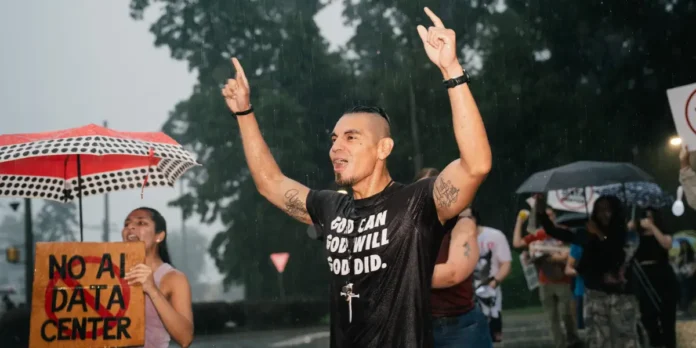
Protesters across the US rallied against the hulking facilities as part of a nationwide demonstration organized by Humans First, a newly founded conservative nonprofit taking on what it calls “Big AI.”
The group planned more than 100 demonstrations throughout the day, from Wasilla in southcentral Alaska to the sunny shores of Naples, Florida. Many states had multiple protests scheduled, including 18 in Texas, where available land, access to an electricity grid, and potential tax breaks have turned it into a prime destination for companies building AI data centers.
Residents of Kenilworth, New Jersey, oppose an incoming data center project.
Paola Chapdelaine/Business Insider
New Jersey hosted two protests, including one in the small borough of Kenilworth. A crowd gathered outside the local municipal court around 10 a.m. to push back against an incoming $1.8 billion AI data center.
The local planning board approved the project last May, but it has faced growing opposition since. A petition to halt construction in April gained over 12,000 signatures. About 8,500 people live in Kenilworth, according to the latest census.
“You think this is pressure? Wait ’til there’s no water pressure,” one protest sign read. Another: “Build community, not data centers.”
Elizabeth Bertot, wearing a “faith, family, freedom” T-shirt, attended the anti-AI data center demonstration organized by Humans First in Kenilworth.
Paola Chapdelaine/Business Insider
Some residents arrived with noise makers — plastic horns, whistles, a drum — while others brought colored chalk to tag the nearby sidewalks. They were undeterred as heavy rain fell later in the day. Donning ponchos and sharing umbrellas, the protesters continued to chant and march.
Demonstrators in Kenilworth marched and chanted through the rain on Saturday.
Paola Chapdelaine/Business Insider
Grassroots efforts
Humans First is led by Amy Kremer, a MAGA darling who has been at the center of some of the most prominent conservative movements since 2009. A former Tea Party member, she cofounded Women for Trump and participated in the Republican National Committee.
She also helped organize the January 6 rally for President Donald Trump in 2021, which later devolved into a riot at the US Capitol. (Kremer neither planned nor participated in the riot.)
In an earlier interview with Business Insider, Kremer said she’s now using her skills as a grassroots organizer to take on the AI industry.
“I think this is the most important fight of our lifetime,” Kremer said last month. “This technology could wipe us off the face of the planet.”
Americans staged protests against AI data center developments across the country on Saturday.
Paola Chapdelaine/Business Insider
The nonprofit advocates an “America First” approach to AI that centers everyday residents in the conversation and empowers them to decide how the technology is developed over time.
“This technology has been built on American data with American taxpayer dollars invested into these companies with American energy and American land,” Kremer said. “We have no voice in how the technology is used or how it impacts our lives, and that’s not right.”
On Saturday, Kremer thanked those who volunteered their time and energy to the demonstrations.
“The data center boom has been sold as inevitable. It is not. Communities have every right to ask what they are giving up and what they are getting in return. America is not for sale, and our communities are not collateral,” Kremer wrote on X.
Demonstrators wave signs in Imperial, California, during Saturday’s nationwide protest against AI data centers.
SANDY HUFFAKER / AFP
The AI divide
Tech leaders have made some grand promises about AI. They have said it will turbocharge the economy, accelerate scientific progress, cure disease, and unburden humans from mundane work.
AI, however, can only advance so far without large data centers, which provide the computing power to run and train the technology. Companies like Anthropic, OpenAI, Google, and Meta rely on data centers to keep their AI products afloat. For them, data centers are essential.
More than 1,400 AI data centers had already been built or approved for construction by the end of 2025. Many more have been proposed in 2026.
David Vanek held a sign opposing a data center development in Kenilworth, New Jersey.
Paola Chapdelaine/Business Insider
AI evangelists say America needs large data centers to support the technology, bolster national security, and gain a competitive edge against China, where researchers are nipping at the heels of the most well-heeled American labs. They also say that hyperscale data centers promote economic growth and create new jobs, particularly during construction.
Critics, however, aren’t sure the rewards outweigh the risks.
Many are concerned that AI data centers cause environmental damage, raise electricity bills, drain water, and degrade the overall quality of life in the communities where they are built.
Some Americans have also criticized their local governments and developers for what they say is a lack of transparency around the approval process. Others simply don’t like AI, which some prominent AI leaders have repeatedly warned could gut white-collar jobs.
In recent months, Americans opposing data centers have launched petitions, swarmed planning meetings, and taken legal action to stop construction. Some cities and towns, and even states, have paused construction, while others have banned new data centers altogether. At the federal level, Democratic Reps. Alexandria Ocasio-Cortez and Bernie Sanders have called for a nationwide moratorium.
While the backlash against AI data centers is bipartisan, Americans don’t always agree on the path to preventing them.
Americans have held protests, launched petitions, and taken legal action to stop the construction of AI data centers.
Paola Chapdelaine/Business Insider
“We do not believe in a nationwide moratorium or even a statewide moratorium. We believe that each community should have a choice in what they put in their community,” Kremer said. “And that’s not happening in a lot of places. It’s being done behind closed doors.”
Tech companies have found favor with President Donald Trump, who has made advancing AI a central part of his agenda. The Trump administration backed the Stargate Project, a $500 billion initiative to build more data centers and accelerate federal permitting.
“I guarantee you that when Republicans are no longer controlling all the chambers, they’re going to be cozying up to the Democrats because, at the end of the day, all they care about is power and control,” Kremer said, referring to tech leaders.
Kremer, however, defended Trump. She says the responsibility falls on Congress.
“It’s Congress’s responsibility, and they need to get their act together and listen to and protect the American people,” Kremer said. “President Trump’s executive orders, and his most recent executive order on testing frontier AI systems, need to go further.”
Jan said many Binance employees, including himself, already keep most of their assets on the exchange. “I could make payments, I could use my debit card to spend whatever I need wherever I want,” he said.
Lines are blurring
Eneko Knorr, co-founder and CEO of Dubai-based stablecoin company Stabolut, said the line between banks and crypto companies is becoming harder to see.
“Today, you see regular banks offering crypto, and crypto platforms offering real bank accounts and normal banking services,” Knorr told CoinDesk. “Of course, the world still runs on regular money, so we all have to make a standard bank transfer to pay rent or the utility bills.”
Knorr said younger customers may choose an app that combines stablecoins with daily banking services.
Rohan Misra, head of the Gulf Cooperation Council region and CEO of AMINA Bank ADGM, said stablecoins are increasingly used for payments and settlement but still need regulated banking infrastructure.
“The wallet alone isn’t the bank account,” Misra said. “The regulated infrastructure around it is.”
Misra also questioned whether self-custody, where users control their private keys, would become the default.
“Self-custody means if someone accesses your private key, your assets are gone with no recourse, no recovery and no insurance,” he said. “That’s cash under a mattress.”
The market got great news from the big banks this week. All five of the largest U.S. banks reported second-quarter earnings on Tuesday, and they were almost uniformly outstanding. But although the U.S. consumer appears healthy, it was market-related activity like initial public offerings (IPOs) that really stood out.
JPMorgan Chase (NYSE: JPM) and Goldman Sachs (NYSE: GS) led the earnings parade as the two top investment banks in the country, and these divisions drove high growth in the quarter; investment banking revenue increased 45% year over year at JPMorgan Chase and 55% at Goldman Sachs.
Missed Nvidia in 2009? This Rare Signal Is Flashing Again. In 2009, a “Double Down” signal flashed for a little-known chipmaker called Nvidia. For the first time in years, that same “Total Conviction” signal is flashing for a company 1/100th the size of Nvidia. Continue »
CEOs at both banks said they see more opportunity around the corner, with artificial intelligence (AI) playing a big role. In fact, JPMorgan Chase CEO Jamie Dimon said he thinks AI spend is going to reach $1 trillion next year.
JPMorgan Chase CEO Jamie Dimon. Image source: JPMorgan Chase.
On the second-quarter earnings call, Dimon posited that total capital expenditure is about $4 trillion, with AI representing a massive amount. “AI went from $400 billion last year to $700 billion this year,” he said. “People project, which so do our people, it will be like a little over a trillion next year and maybe a little reduction in the non-AI capex.”
That implies that in 2027, AI spend will account for more than a quarter of all company spend.
He also cautioned that even though the current market is “getting close to as good as it gets,” investors shouldn’t forget the most important thing: “We just don’t know how long it’s going to last.”
In the near term, though, the AI party is going strong, and investors can look forward to more expansion and matching stock prices.
Should you buy stock in JPMorgan Chase right now?
Before you buy stock in JPMorgan Chase, consider this:
The Motley Fool Stock Advisor analyst team just identified what they believe are the 10 best stocks for investors to buy now… and JPMorgan Chase wasn’t one of them. The 10 stocks that made the cut are built for long-term growth and could produce monster returns in the coming years.
Consider when Netflix made this list on December 17, 2004… if you invested $1,000 at the time of our recommendation, you’d have $371,842!* Or when Nvidia made this list on April 15, 2005… if you invested $1,000 at the time of our recommendation, you’d have $1,244,783!*
The U.S. stablecoin framework, the GENIUS Act, has hit the initial deadline of the 18th of July. Passed into law on the 18th of July 2027, the framework set multiple milestones for its progressive enactment.
For the first year after passage, regulators, including the Federal Reserve and the OCC, were mandated to finalize rulemakings for the GENIUS Act by the 18th of July, 2027.
In 18 months, or by January 2027, the framework should begin taking effect after the regulators publish final rules. Finally, the transition period will end after three years, by mid-2028. After this, there will be no firm allowed to offer or handle stablecoins in the U.S. without GENIUS Act compliance.
Why are the final rules delayed?
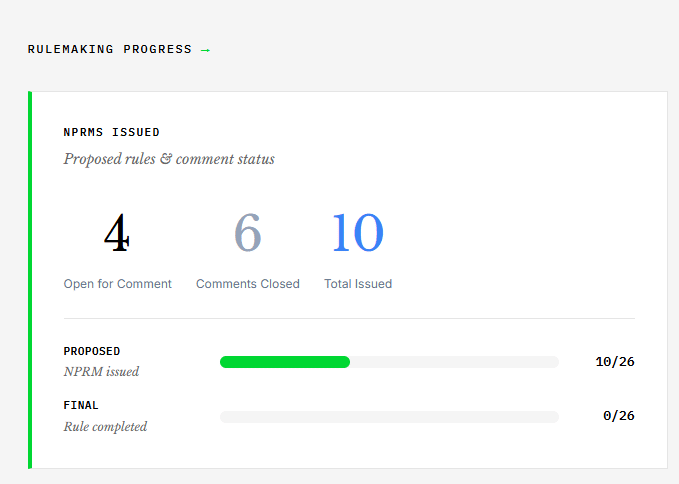
Six regulators have issued 10 rulemaking proposals related to the law. But none of the proposals have been officially completed, at least as of writing. Only six of the proposals have closed their comment period, meaning the regulators could issue final rulings for them.
Source: Paradigm
Still, four other proposals, including Bank Secrecy Act and sanction compliance for FDIC-supervised stablecoin issuers, are still open for comment.
In other words, despite hitting the rulemaking deadline, the GENIUS Act was still far from finalizing key rules.
What’s next for the GENIUS Act?
However, it’s worth noting that in a recent Congress hearing, Kevin Warsh, the chairman of the Federal Reserve, said that the final rules could be issued soon.
We’re racing to put that out (GENIUS Act final rules) by this deadline, this Saturday.
For the banking industry, which has opposed the legislation due to the stablecoin yield loophole, it called for a review of the proposed rules to avoid.
Uneven playing field or opportunities for regulatory arbitrage, unintended policy consequences, or unworkable or incongruous requirements.
How has the stablecoin market responded?
The GENIUS Act is the first formal stablecoins framework in the U.S that aims to advance innovation and protect consumers. To achieve this, it has reserve requirements and anti-money laundering provisions.
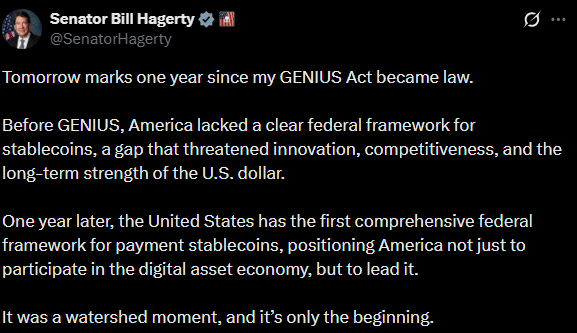
Commenting on the legislation, Senator Bill Hagerty, who co-sponsored it, said,
The United States has the first comprehensive federal framework for payment stablecoins, positioning America not just to participate in the digital asset economy, but to lead it. It was a watershed moment, and it’s only the beginning.
Source: X
Since the law, the stablecoin market supply surged from $250B to over $300B. Even several firms like Fidelity have begun their stablecoin offerings.
Additionally, some crypto platforms like Phantom recorded a 20% increase in stablecoin balance from $2.33B to $2.82B since the GENIUS Act was passed.
It remains to be seen how the growth will accelerate when regulators publish final rules as the legislation enters its second year.
Final SummaryThe
GENIUS Act has entered its second year, but final rules will likely stretch beyond the rulemaking deadline
Stablecoin market supply increased by over $50B after legislation became law, with Sen. Hagerty calling ‘watershed moment’
Supporters of BIP-110 view Bitcoin as a public utility whose scarce block space should be reserved primarily for monetary settlement. Inscriptions and other data-heavy applications represent consumption of a limited resource that should be protected for financial transactions, even if doing so requires introducing new consensus rules.
DOG Mode starts from the opposite premise.
Leonidas argued Bitcoin should remain a neutral marketplace for block space, where any valid transaction is equally legitimate provided the sender pays the prevailing fee. From that perspective, there is no objective distinction between a bitcoin payment and an Ordinals inscription.
Rather than seeking permission through a protocol upgrade, the intention for DOG Mode is to remove policy restrictions that its supporters argue Bitcoin itself never required.
The proposal also raises a more subtle question about Bitcoin’s infrastructure.
If enough nodes begin running different policy software, the network’s mempool — the collection of unconfirmed transactions waiting to be mined — could become increasingly fragmented. Consensus would remain intact, but different parts of the network could relay different transactions, affecting fee estimation and how quickly some transactions reach miners.
That fragmentation already exists to a degree, but DOG Mode could widen those differences by encouraging broader acceptance of transactions that many default nodes currently refuse to relay.