Home Blog Page 226

Will new Uniswap protocol fee proposals drive ‘substantial UNI burn’?

0
Will new Uniswap protocol fee proposals drive ‘substantial UNI burn’?


Uniswap has officially submitted three governance proposals for protocol fee activation across several chains and different versions of the DEX.

The first fee proposal will be for versions 2 (V2) and 3 (V3) on the Robinhood chain. The new Ethereum L2 debuted this month, attracting several DEXes, including Uniswap. About 10 days after launch, Uniswap crossed $1B in trading volume – ultimately showing its growing traction. 

Similarly, the project seeks to activate fees on V4 across Ethereum, Base, Arbitrum, Robinhood, BNB Chain, Polygon and Optimism. Hayden Adams, Uniswap’s CEO, added that a third fee proposal for remaining V4 chains will also be submitted soon. 

Adams said, 

Both direct all new protocol fees into the existing UNI burn mechanism. Based on current volumes, especially Robinhood, we expect the impact on UNI burn to be substantial.

Mixed reactions to Uniswap’s fee proposal

For clarity, fees are what users pay for each swap on the DEX, and they mostly go to liquidity providers (LPs). Protocol revenue (which is partly directed for UNI burn) is a percentage of the swap fees that goes to the project after a governance vote. 

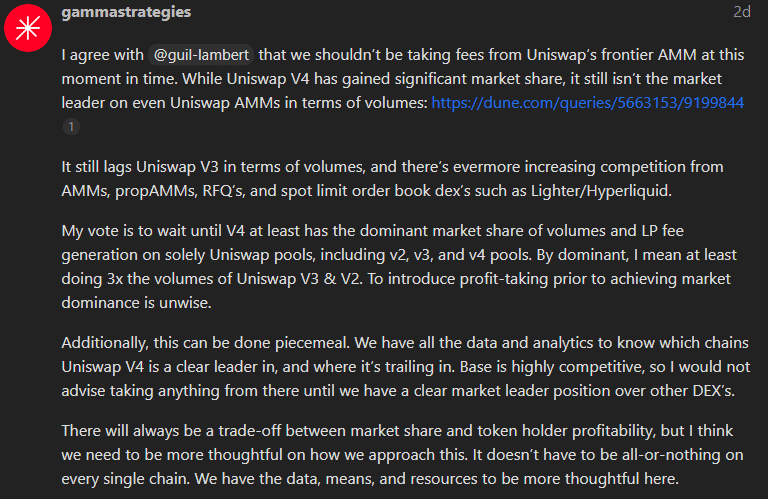
In other words, such proposals would directly reduce fees collected by LPs. As such, it was not surprising that some LP providers like Gamma Strategies opposed V4 fee proposals because they would affect their lifeline. 

Still, Gamma Strategies made a sound argument for their opposition, noting that Uniswap V4 was still not competitive enough and the fees would make it lose to rivals.

It (V4) still lags Uniswap V3 in terms of volumes, and there’s evermore increasing competition from AMMs, propAMMs, RFQ’s, and spot limit order book DEX’s such as Lighter/Hyperliquid.
Uniswap UNI
Source: Uniswap governance 

That said, Uniswap has only activated fees across a few chains and versions. However, most of the fees collected go to LPs.

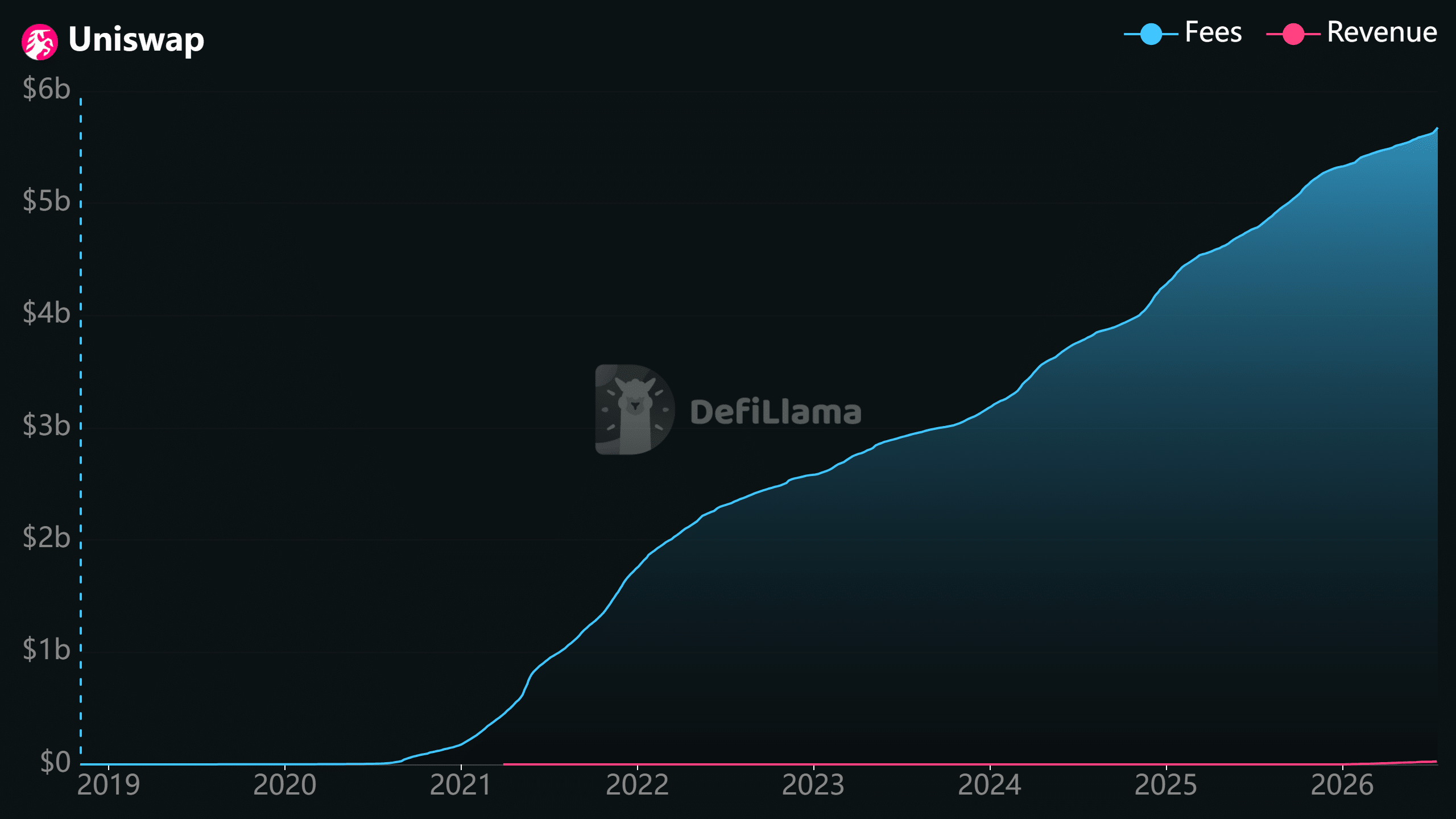
In fact, LPs have made a whopping +$5B in cumulative fees since 2018. Yet, the protocol has made only $25M in cumulative revenue.   
Uniswap UNIUniswap UNI
Source: DeFiLlama 

If the proposal goes through and is balanced with competition, more protocol revenue would translate to more UNI burn rates, as Adams projected. 

That said, the project has now burned a total of 107.49M UNI tokens. UNI burn rate surged 3x from $51K to over $160K in the past week. 

Can UNI extend its July rally?

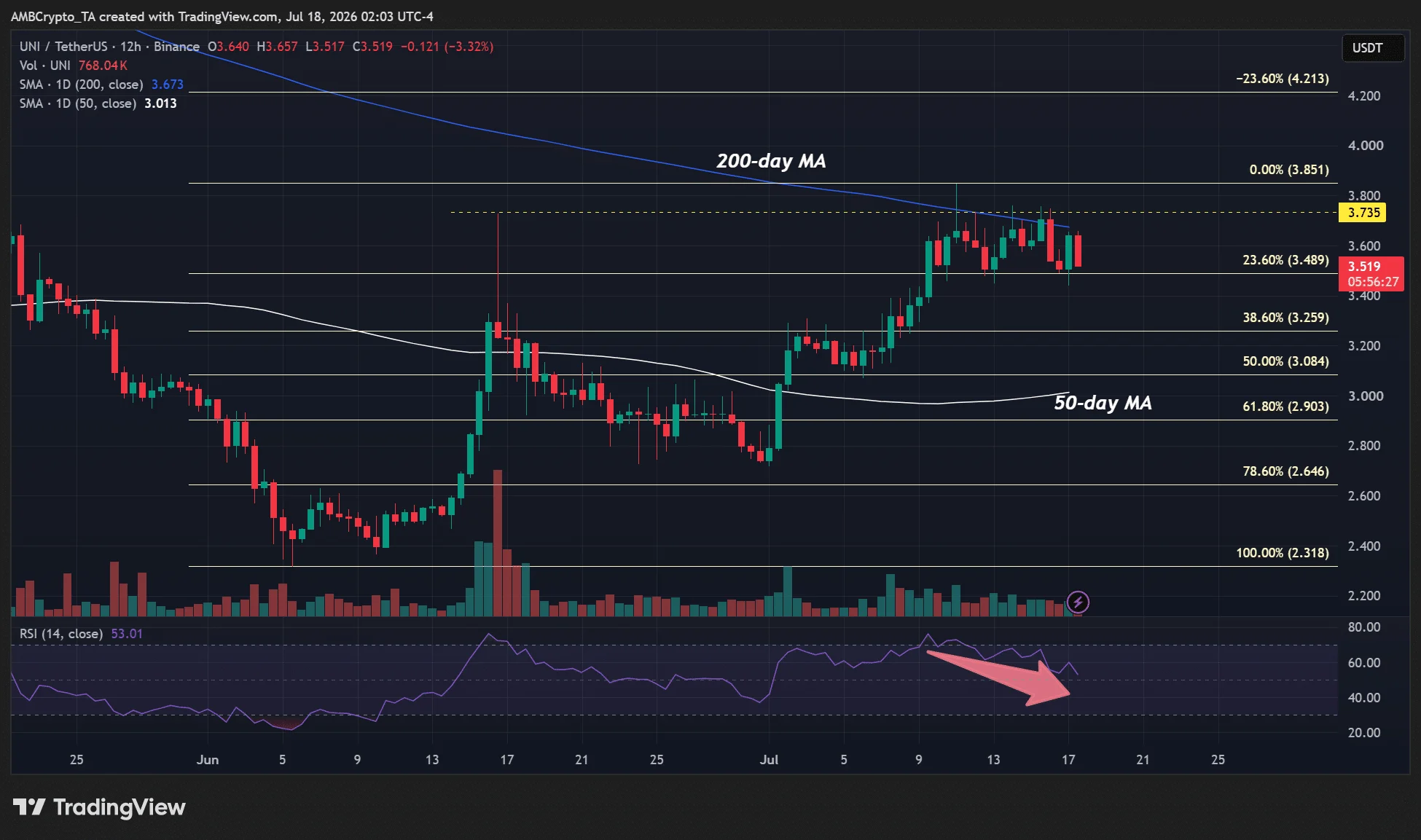
The Robinhood traction was front-run by traders as the Uniswap [UNI] price surged. In July, UNI price surged 41% from $2.7 to $3.8. 

But the bullish strength has eased as the price stalled below the 200-day Moving Average (blue line). As such, price could remain sideways above $3.5 or slip to $3 if Robinhood momentum stabilizes. 
Uniswap UNIUniswap UNI
Source: UNI/USDT, TradingView 

But the next move higher could be triggered by renewed Robinhood momentum and if the fee proposals drive more UNI burn. 


Final Summary

  • Uniswap pushes three fee protocol fee proposals to accelerate UNI burn. 
  • Currently, Uniswap LPs have accrued over $5B while the protocol makes relatively little revenue 


Source link

Netflix tumbles as slowing growth, less viewership data spook investors

0
Netflix tumbles as slowing growth, less viewership data spook investors


By Harshita Mary Varghese

July 17 (Reuters) – Netflix shares sank more than 10% on Friday after the company forecast another quarter of slower revenue gains and scaled back viewership ‌data, fueling fears that its industry-beating growth may have peaked.

The stock was close to ‌a two-year low in early trading, with the decline set to wipe out $35 billion from Netflix’s market value of about $313 ​billion, if losses hold.

In its latest disclosure pullback, the streaming giant cut the frequency of its viewing-hours report to once a year from twice starting 2027, following last year’s scrapping of subscriber counts, leaving investors in the dark as the business faces greater competition from traditional media as well as ‌YouTube.

“Whenever you take away a data ⁠point from investors when results aren’t as good as they have been you will get punished by the market,” said Ben Barringer, head of technology research ⁠at Quilter Cheviot.

Netflix’s failed pursuit of Warner Bros earlier this year has also raised doubts about its next phase of growth amid slow adoption of an ad-supported streaming tier that the company has long ​touted as ​a big growth driver.

The stock has lost 44% since ​hitting an all-time high in June ‌2025, including an over 20% fall just this year.

After a strong content slate in 2025 that included the final season of its hit sci-fi series “Stranger Things” and South Korean drama “Squid Games”, analysts said the company also has a weaker content line-up this year that could weigh on growth.

“Pulling back engagement reporting at the exact moment engagement is in the spotlight gives off a strong ‘nothing to see here’ ‌vibe,” said Forrester research director Mike Proulx.

Keeping subscribers hooked is ​crucial for Netflix as it has long traded at ​a premium to other media companies that ​command a smaller streaming subscriber base and are grappling with the ongoing declines ‌in cable TV.

Netflix trades at nearly 20 ​times expected earnings over ​the next 12 months, compared with 13.5 times for Walt Disney and 6.6 times for Comcast, underscoring the premium investors place on the streaming giant.

Still, at least 18 analysts cut ​their price targets after Netflix ‌forecast quarterly revenue and earnings below Wall Street expectations. The median target, however, remains ​about 40% above Thursday’s closing price.

(Reporting by Harshita Mary Varghese and Joel Jose in ​Bengaluru; Editing by Janane Venkatraman and Devika Syamnath)


Source link

Crypto brokerage firm Alpaca raises $135 million for tokenized stock infrastructure

0
Crypto brokerage firm Alpaca raises $135 million for tokenized stock infrastructure

Crypto brokerage infrastructure firm Alpaca raised $135 million to expand the rails used by exchanges and tokenization platforms to offer U.S. stocks onchain.

Peak XV led Alpaca’s equity round, with participation from Elefund, BNP Paribas’ Opera Tech Ventures and Unbound, according to an announcement on Thursday. The raise follows a $150 million Series D in January that valued the company at $1.15 billion.

Debt financing, primarily from Kraken parent Payward and BMO, brought the total package to $435 million.

Alpaca clears or custodies roughly 94% of tokenized U.S. equities, including products connected to market leaders Binance, Ondo and Dinari. The company said it has more than $1.5 billion of underlying stocks backing tokenized equities held through its infrastructure.

The funding underscores a central constraint facing tokenized equities, where putting a stock onchain does not remove the need for a regulated firm to hold the underlying shares, process corporate actions and connect blockchain transactions to traditional markets.

Its Instant Tokenization Network allows market participants to mint and redeem tokenized stocks against underlying shares around the clock. The products often pair blockchain-based stock exposure with stablecoin funding or redemption, connecting equities to crypto’s 24/7 settlement rails.


Source link

Gold prices today, Friday, July 17, 2026: Gold nosedives to Nov. ’25 levels as Iran airstrikes intensify

0
Gold prices today, Friday, July 10, 2026: Gold finally opens higher this morning


Gold (GC=F) August futures opened at $3,980.10 per troy ounce on Friday, July 17, 2026, down 0.3% from Thursday’s closing price. The gold price moved slightly higher this morning to $3,998.10 at 8:02 a.m. ET.

A sixth straight day of airstrikes against Iranian targets has pushed gold prices down to levels last seen eight months ago in November 2025. While the back-and-forth attacks between the U.S. and Iran aren’t as intense as they were back in March and April, we’ve seen a steady escalation this week, with the U.S. now striking critical roads and bridges, along with key military targets.

Despite the U.S. bombardment, Iran has refused to relinquish control of the Strait of Hormuz, holding firm on their most compelling bargaining chip, and retaliating with their own airstrikes across the Middle East.

Oil prices have risen considerably this week following consecutive days of fighting, prompting many to believe the Fed will raise rates at least once this year to combat rising energy prices caused by the war with Iran. The longer the fighting continues and the Strait of Hormuz remains cut off to oil tankers, the harder it will be for gold prices to gain any true momentum.

The opening price of August gold futures on Friday, July 17, 2026, was 0.3% lower compared to Thursday’s opening price. Here’s a look at how the gold price has changed versus last week, month, and year:  

  • One week ago: -3.4%

  • One month ago: -8.3%

  • One year ago: +20.1%

On Jan. 29, gold’s one-year gain was 95.6%.

24/7 gold price tracking: Don’t forget you can monitor the current price of gold on Yahoo Finance 24 hours a day, seven days a week. 

Want to learn more about the current top-performing companies in the gold industry? Explore a list of the top-performing companies in the gold industry using the Yahoo Finance Screener. You can create your own screeners with over 150 different screening criteria.

A gold investment can add stability and inflation protection to your portfolio. But it can also dilute your gains when stock prices are rising quickly. Finding the right balance between gold’s diversification benefits and profiting from growth potential in other assets can be challenging. 

Even the experts are divided on how to achieve the correct balance. Below, five experts explain their recommended gold allocations, which range from 0% to 20%. 

Learn more: How to invest in gold in 4 steps

Robert R. Johnson, professor at Creighton University’s Heider College of Business, does not advocate gold investing. In his words, “while having a small position in precious metals may dampen portfolio volatility in the short-run, the tradeoff between slightly dampened volatility and the lost long-term return is certainly not a prudent one, particularly for Gen Z/millennials with long investing time horizons.”

Brett Elliott, director of content and SEO at American Precious Metals Exchange (APMEX), recommends setting an allocation that aligns with your investing goals. 

Growth-oriented investors may be comfortable with an allocation of 10% or 15%, according to Elliott. But income investors will prefer a smaller position, because gold provides no yield. A 2% to 5% gold allocation can provide some resiliency without an excessive drag on income potential. 

Learn more: Who decides what gold is worth? How gold prices are determined.

Blake McLaughlin, executive vice president at Axcap Ventures, said historical data support a gold allocation of 5% to 8%. “Gold may not offer the outsized return potential of private investments, but the metal holds a set of attributes that are increasingly hard to ignore,” according to McLaughlin. Those attributes include the metal’s resilience amid economic uncertainty and geopolitical unrest. 

Thomas Winmill, portfolio manager at Midas Funds, believes most investors will benefit from a long-term gold allocation of 5% to 15%. Winmill specifically advocates investing in gold mining companies through a mutual fund. 

Your risk tolerance and current mix of financial versus hard assets can guide you to an appropriate allocation, according to Winmill. 

  1. Risk tolerance: Keep your allocation percentage low if you tend to panic in volatile cycles.  

  2. Financial vs. hard assets: Financial assets are stocks and bonds. Hard assets include tangible items like real estate, gold, collectibles, classic cars, and equipment. If you have no home equity and your wealth is primarily in financial assets, you can set your gold allocation higher. Or, if your home is paid for and more valuable than your stock portfolio, gold investing may not be necessary.  

Learn more: Thinking of buying gold? Here’s what investors should watch for.

Vince Stanzione, CEO and founder at First Information, recommends a 20% gold allocation, specifically in physical gold or a gold ETF. Stanzione argues for a higher exposure to gold as a wealth protection strategy. As he says, “gold keeps with inflation and gold retains its purchasing power,” while paper currencies are devaluing around the world.   

Learn more: Gold IRA: Benefits, risks, and how it differs from a traditional IRA

Whether you’re tracking the price of gold since last month or last year, the price-of-gold chart below shows the precious metal’s change in value so far this year. 


Source link

SHIB’s 2026 price outlook — Here’s what THESE AI models are saying!

0
SHIB's 2026 price outlook — Here's what THESE AI models are saying!


Shiba Inu [SHIB] has been falling on the charts since hitting $0.00003309 in late 2024, when the whole crypto market rallied to the upside. The same is true for its trading volume too, with the same well below its previous levels.

Why is the popoular memecoin in the news right now though? Well, with daily volumes of $52.68 million at press time, AI models are now projecting modest to moderate upside potential by the end of the year.

Shiba Inu, Claude, and Grok AI models forecast on SHIB

As per AI models, SHIB’s price action is expected to pull fair gains by the end of the year.

Shiba Inu AI predicts that the memecoin may see modest upside by the end of the year. While this seems to be a bullish predcition, it’s worth noting that other models are more optimistic than SHIB’s own AI.Claude and Grok AI models, for instance, anticipate moderate gains by the end of 2026.

All the three models agree SHIB will not see an explosive rally this year though.

Both Claude and Grok attribute the projected medium gains to the already existing massive community that continues to grow. Moreover, they agree Bitcoin [BTC] would be a catalyst to SHIB, rallying alongside capital rotation into memecoins.

However, both Claude and Grok believe that adoption across the Shibarium ecosystem is too weak to spark a price breakout. In fact, Grok believes that the ecosystem and broader crypto sentiment will determine SHIB’s direction.

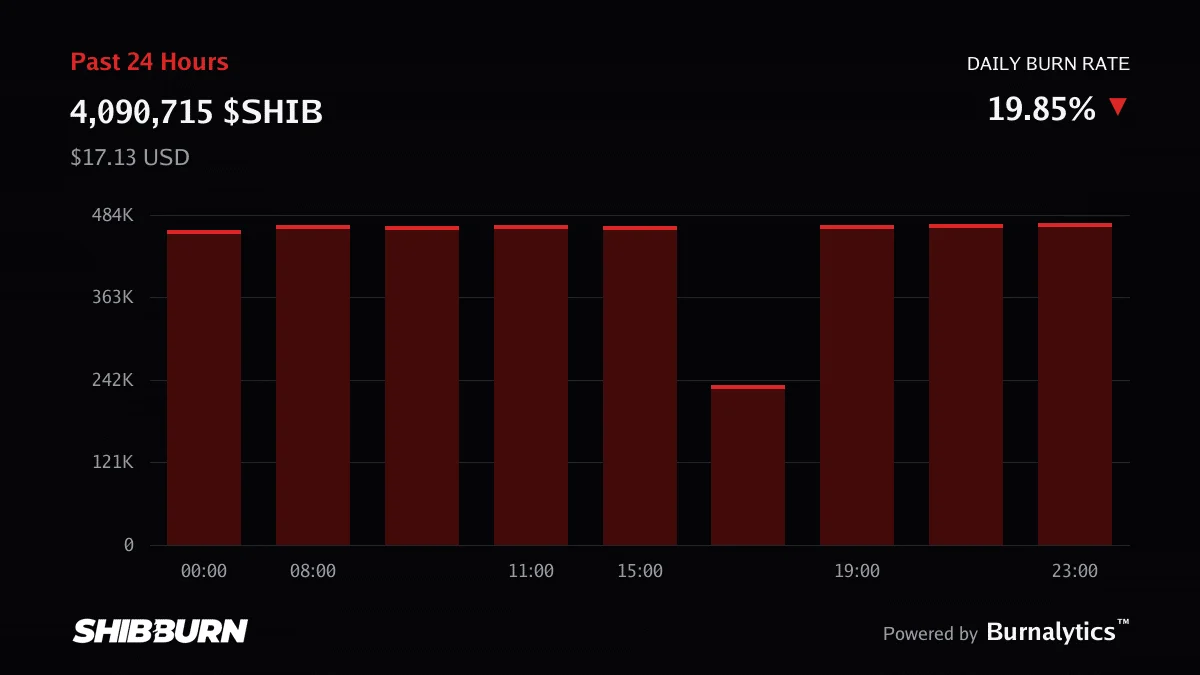
On the other hand, Claude found that network activity has been lagging and token burns have been limited. For instance – As per Shibburn, 4.090 million SHIB worth $17.13 had been burned in the last 24 hours. This alluded to a 19.85% fall in daily burn rate.

Shiba InuSHIB
Source: Shibburn

Can SHIB’s price follow the AI predictions?

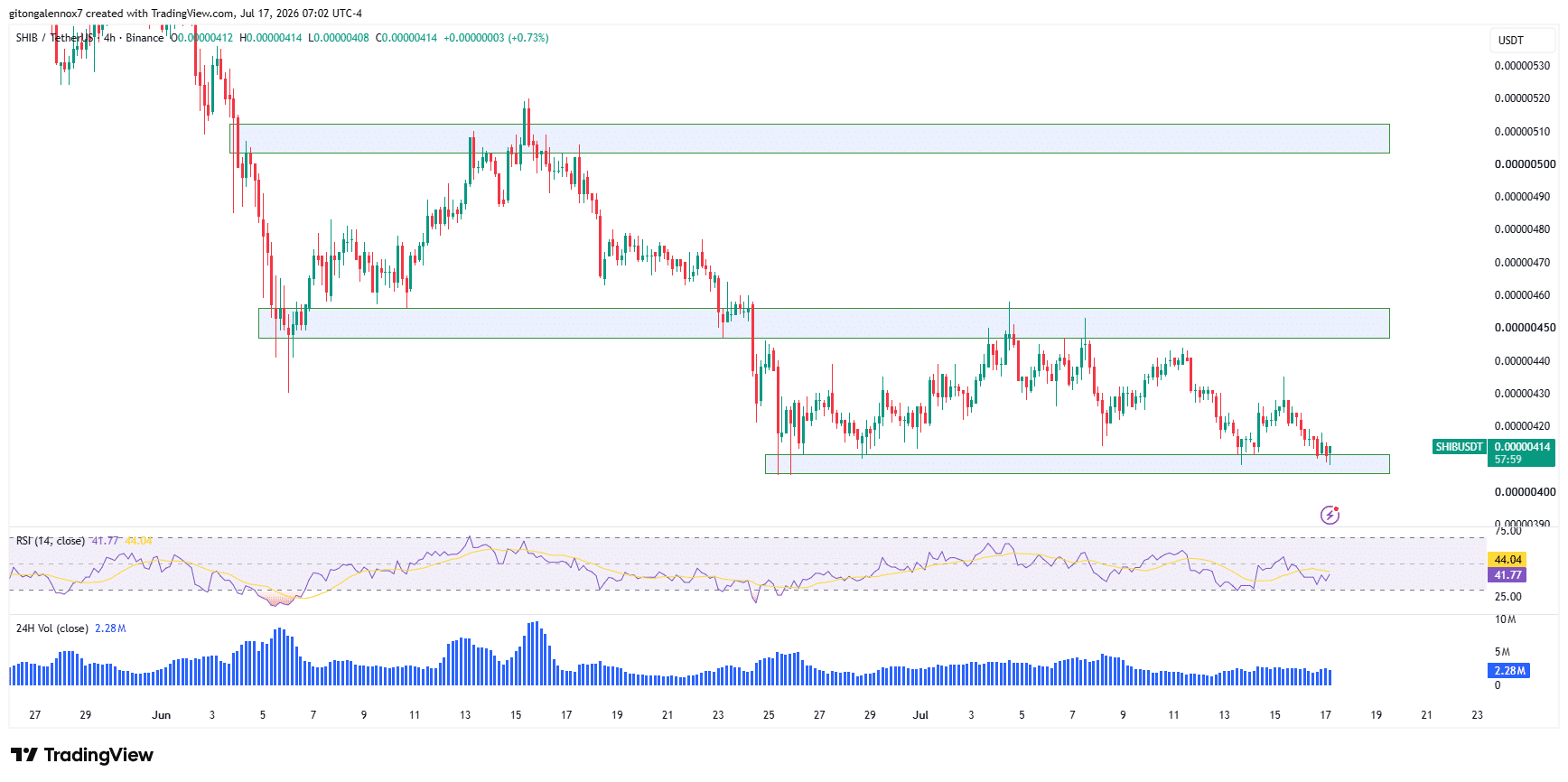
On the smaller timeframes, SHIB’s price has been ranging above the $0.00000412 zone since late June. This hinted at a quiet market.

At the time of writing, the 24-hour volume and the RSI were declining, showing selling activity in the short term. Holding above the support and breaching resistance at $0.0000045 would open the door for a move to $0.00000510.

SHIBSHIB
Source: SHIB/USDT on TradingView

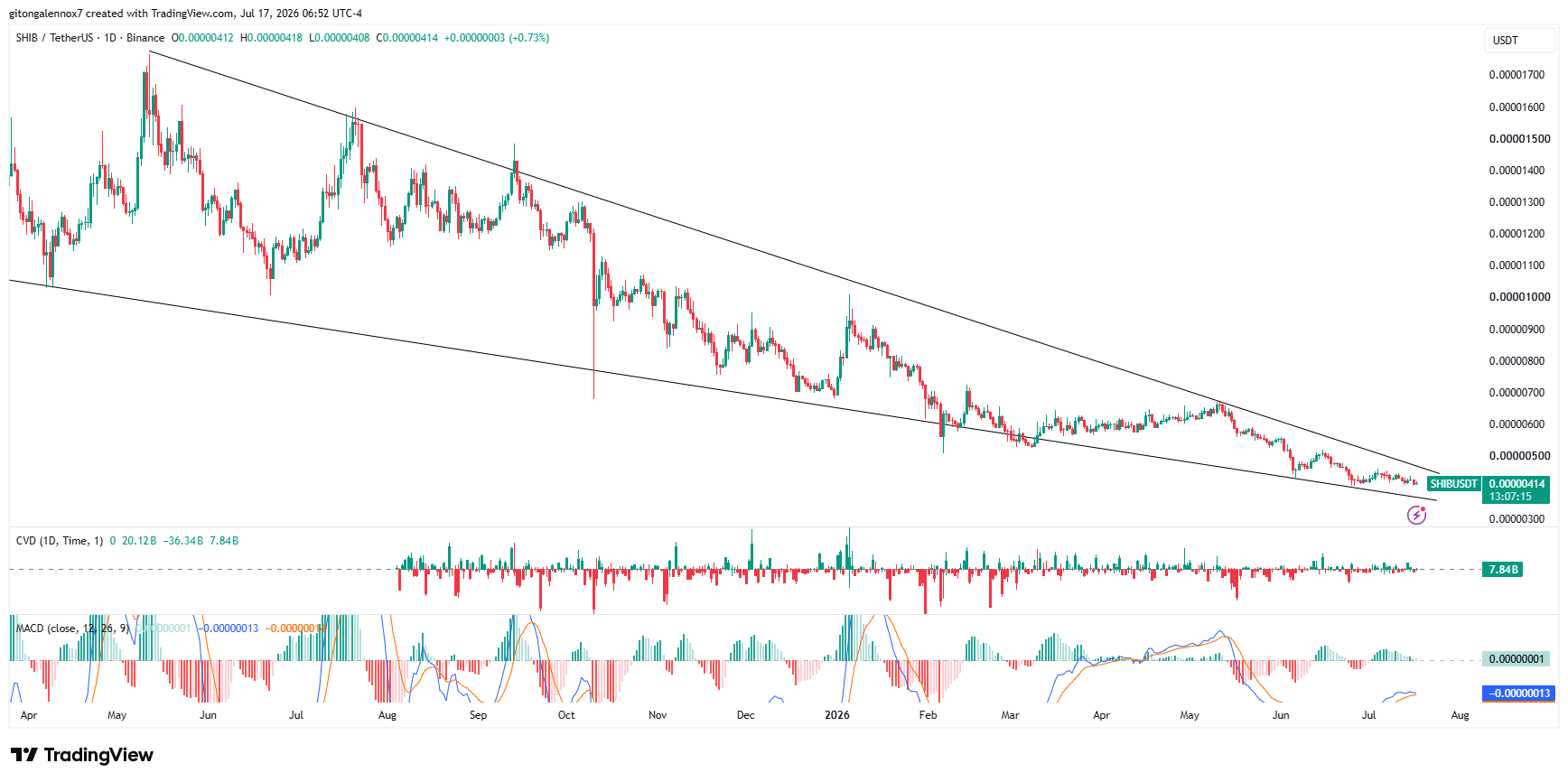
Otherwise, the price action has continued to consolidate in the falling wedge pattern that started in late March 2025. On the daily chart, buyers have been accumulating too, with the CVD indicating that 7.84 billion SHIB tokens were bought in the last 24 hours alone.

Finally, the MACD highlighted buyers in control, although their momentum was minimal.

Shiba InuSHIBShiba InuSHIB
Source: SHIB/USDT on TradingView

These findings only reinforce AI models’ predictions of sizeable gains rather than explosive ones.


Final Summary

  • Three AI models — Shiba Inu, Claude, and Grok — think SHIB’s price may see modest to moderate gains by the end of 2026. 
  • SHIB has been consolidating in the short term while the price tanks on the daily chart despite ongoing accumulation. 


Source link

After Supreme Court loss, Trump tests a new tariff strategy on Brazil and other countries may follow

0
After Supreme Court loss, Trump tests a new tariff strategy on Brazil and other countries may follow

President Donald Trump’s sweeping tariffs were supposed to raise billions of dollars in government revenue while reviving American manufacturing. Instead, after a Supreme Court ruling forced the Trump administration to reimburse much of the money it collected, it’s now looking for workarounds to impose tariffs anyway.

One such workaround will take effect later this month, when the Trump administration imposes 25% tariffs on many imports from Brazil. The fresh tariffs, announced this week, arrived after the Office of the U.S. Trade Representative conducted a yearlong investigation under Section 301 of the Trade Act of 1974 that concluded Brazil had engaged in unfair trade practices.

The move revives a battle the Trump administration has waged specifically against Brazil since last year, when the White House imposed tariffs totaling 50% on certain Brazilian imports after Brazil’s former president, Jair Bolsonaro, was accused of leading a conspiracy to overturn his reelection loss in 2022. Bolsonaro was later sentenced to 27 years in prison.

Still, the administration’s actions against Brazil may also be the beginning of an alternate plan to implement tariffs in line with the President’s wishes despite the questionable effectiveness of such duties so far, experts say.

Tariff disappointment

Since the Supreme Court ruled in February that Trump could not use the International Emergency Economic Powers Act, or IEEPA, to impose tariffs, importers have been issued about $71 billion in refunds, according to the U.S. Treasury’s monthly statement. With $166 billion in refunds set to be paid out in total—and domestic manufacturing having increased a measly 1.1% year-over-year as of June—Trump’s tariffs are turning out to be more of a drag than a boon for government revenues, said James Knightley, ING’s chief international economist.

“The hope was tariffs were going to be a big revenue raiser, and right now it appears that actually tariffs are going to be potentially a loser through the second half of this year,” Knightley told Fortune.

It’s these very lackluster results thus far that may motivate the administration to push even harder to implement its tariffs, Knightley added. 

Just after the Supreme Court struck down many of Trump’s tariffs in February, he implemented a temporary 10% global import surcharge citing section 122 of the Trade Act of 1974, though this measure lasts only 150 days and expires later this month.

The administration is now taking a slower but potentially more lasting approach: investigating countries’ trade practices under Section 301 of the Trade Act of 1974, like it did with Brazil.

The method, although it requires a sometimes slow-moving investigation and gives businesses an opportunity to comment, is effective. Trump used this approach several times during his first stint in office, including to impose 25% tariffs on roughly $250 billion worth of Chinese imports. Although challenged, Trump’s tariffs on China using this method were not struck down by the courts.

Once an investigation is completed, the tariff rates can also be adjusted without restarting the entire process, Melissa Irmen, the director of advocacy for the National Association of Foreign-Trade Zones, told Fortune.

“If you set the tariff at say 15% and it’s deemed that it needs to be modified, then changing it to 30% isn’t the same involved process,” she said.

The administration has proposed tariffs on dozens of trading partners, including the European Union, following investigations into their enforcement of bans on goods made with forced labor. This could mean Brazil is only the first of many economies to be affected by fresh tariffs.

Business effects

That doesn’t mean the new duties will be immune from lawsuits. Irmen said lawsuits could look to argue the administration failed to prove a foreign practice harmed the U.S. economy. They could also question whether tariffs would remedy the alleged harm.

Regardless, importers are tired of the uncertainty. After the rapid tariff implementations under IEEPA imposed last year, companies had to scramble to comply, she said. Just like last time, businesses could once again pay duties for months or years, only to again seek refunds if courts strike them down.

“We may have the same situation where tariffs are implemented, tariffs are collected for a period of time, and by the time the court decision happens, if it does go the way IEEPA went, we may have to see another refund process again,” Irmen said.

Longer investigations may give businesses more time to prepare, but many businesses will still be left wondering what countries or products Trump will target next, throwing a wrench into their long-term planning.

“Uncertainty is just not a good thing in any kind of business planning,” Irmen said.

More tariffs could also raise prices and make it harder for the Federal Reserve to lower interest rates, Knightley added, which would affect businesses overall.

Still, Trump will likely trudge ahead with his tariff plan—even as he has repeatedly insisted the Fed lower rates—because trade policy could soon become one of the only tools left in his arsenal.

Some polls have predicted Democrats may win the House and split the Senate following the midterms. If Republicans lose control of Congress and Trump struggles to pass laws that further his agenda, he may rely more on his executive power, said Knightley.

“If you can’t do tax and spending, you’re going to be more limited to areas where the president has executive powers,” he said. “And trade, of course, is one of those.”


Source link

ETH, XRP, HYPE price news: Ether falls twice as hard as bitcoin and HYPE drops 10%

0
ETH, XRP, HYPE price news: Ether falls twice as hard as bitcoin and HYPE drops 10%

Ether (ETH) fell twice as hard as bitcoin on Friday and hyperliquid’s HYPE fell more than five times as hard, as a selloff in Asian semiconductor shares dragged every major cryptocurrency lower.

Ether dropped 4% to $1,850, though it remains up 4% over seven sessions and is the only major still green on the week. HYPE was the worst of them at $60, down 10% on the day and 12% on the week, its steepest stretch since June. Solana slid 2% to $75 and is off 5% for the week.

XRP eased 2% to $1.09, BNB fell 2% to $571, TRON slipped to 32 cents and dogecoin lost 2%. Bitcoin held up best of the group, down 2% to about $63,400 and 1% on the week after failing twice at $65,000.

The selling started in semiconductors. MSCI’s Asia Pacific equities gauge dropped 3%, heading for its lowest close in two months, while Japan’s Nikkei 225 slumped 5% in its worst session since March. Taiwan Semiconductor was on track for its biggest one-day decline since April 2025 and Japan’s Kioxia sank as much as 16%.


Source link