Home Blog Page 227

ETH, XRP, HYPE price news: Ether falls twice as hard as bitcoin and HYPE drops 10%

0
ETH, XRP, HYPE price news: Ether falls twice as hard as bitcoin and HYPE drops 10%

Ether (ETH) fell twice as hard as bitcoin on Friday and hyperliquid’s HYPE fell more than five times as hard, as a selloff in Asian semiconductor shares dragged every major cryptocurrency lower.

Ether dropped 4% to $1,850, though it remains up 4% over seven sessions and is the only major still green on the week. HYPE was the worst of them at $60, down 10% on the day and 12% on the week, its steepest stretch since June. Solana slid 2% to $75 and is off 5% for the week.

XRP eased 2% to $1.09, BNB fell 2% to $571, TRON slipped to 32 cents and dogecoin lost 2%. Bitcoin held up best of the group, down 2% to about $63,400 and 1% on the week after failing twice at $65,000.

The selling started in semiconductors. MSCI’s Asia Pacific equities gauge dropped 3%, heading for its lowest close in two months, while Japan’s Nikkei 225 slumped 5% in its worst session since March. Taiwan Semiconductor was on track for its biggest one-day decline since April 2025 and Japan’s Kioxia sank as much as 16%.


Source link

Silver prices today, Friday, July 17, 2026: Silver prices hit 8-month lows as airstrikes continue across Iran

0
Silver prices today, Friday, July 17, 2026: Silver prices hit 8-month lows as airstrikes continue across Iran


Silver (SI=F) July futures opened at $55.83 per ounce on Friday, July 17, 2026, down 0.6% from Thursday’s closing price. The silver price moved lower this morning, reaching $55.58 as of 8:13 a.m. ET.

Silver prices opened at eight-month lows this morning as the fighting between the U.S. and Iran intensifies. Compared to one month ago, today’s opening silver price is down over 20%.

For the sixth straight day, the U.S. has struck Iranian targets in retaliation for Iranian attacks on oil tankers attempting to safely navigate the Strait of Hormuz. Iran has refused to relinquish control of the strait despite continued U.S. airstrikes, and has responded in kind with strikes of their own across the Middle East.

With oil prices up nearly 13% over the last five days, inflation is front-page news yet again, prompting many analysts to believe higher interest rates are in store later this year as the Fed grapples with rising prices. Higher rates, even the threat of higher rates, are going to keep a lid on silver prices for some time to come.

The opening price of silver futures on Friday was 0.6% lower compared to Thursday’s closing price. Here’s how today’s opening silver price has changed versus last week, month, and year:

  • One week ago: -6.9%

  • One month ago: -20.6%

  • One year ago: +47.5%

For context, silver’s year-over-year growth was 173.3% on May 14.

24/7 silver price tracking: Don’t forget you can monitor the current price of silver on Yahoo Finance 24 hours a day, seven days a week.

Want to learn more about the current top-performing companies in the silver industry? Explore a list of the top-performing companies using the Yahoo Finance Screener. You can create your own screeners with over 150 different screening criteria.

Do you have to pay taxes on silver? Yes. Silver is a capital asset, so when you sell it for more than you paid, the gain is taxable and reported on Schedule D of your federal return.

Many investors assume holding silver for more than a year qualifies them for the same long-term capital gains rates as stocks (0%, 15% or 20%).

Spoiler: It doesn’t.

The IRS classifies physical precious metals — including bars, rounds, and coins — as collectibles. That classification changes the tax math in a big way.

If you hold silver for one year or less, your profit is taxed as ordinary income. Depending on your tax bracket, that could go as high as 37%.

If you hold silver for more than one year, your gain is taxed at your ordinary income rate — but no more than 28%.

Here’s what that looks like in real life:

  • If you’re in the 10%, 12%, 22% or 24% bracket, your silver gain is taxed at that same rate.

  • If you’re in the 32%, 35% or 37% bracket, you’re capped at 28%.

So if you’re a middle-income earner accustomed to paying 15% on stock gains, silver can cost you more, maybe 22% or 24%, depending on your adjusted gross income.

If you’re in the top brackets, the 28% cap is technically a discount versus 35% or 37% — but it’s still higher than the 20% max long-term capital gains rate on stocks.

That difference adds up quickly when you’re talking five- or six-figure gains.

Learn more: How to avoid taxes when investing in silver

Whether you’re tracking the price of silver since last month or last year, the price-of-silver chart below shows the precious metal’s value journey so far this year.

More silver coverage from the Yahoo Finance team: 


Source link

Bitcoin (BTC) price falls below $63,00 as AI fatigue, Middle East tensions drag crypto, tech stocks lower

0
Bitcoin (BTC) price falls below $63,00 as AI fatigue, Middle East tensions drag crypto, tech stocks lower

The crypto market fell Friday, with bitcoin recovering from a drop below $63,000 to trade down 1.2% since midnight UTC and ether (ETH) losing 1.74%. Total crypto market capitalization shed 1.86% to sit at $2.16 trillion.

The selloff is not isolated to crypto. Nasdaq 100 index futures dropped 1.91% and S&P 500 futures slipped 0.96%, pointing to macro forces driving the move rather than anything crypto-specific. Japan’s Nikkei 225 index dropped 4%, while South Korea’s Kospi stock exchange was closed for Constitution Day.

In a a classic risk-off rotation, the Dollar Index (DXY) rose to 100.75 while gold advanced 0.61% to climb back above $4,000.

The move to the downside can be attributed to a selloff in tech stocks across North America and Asia, as well as mounting tensions in the Middle East.

“The market is ending the week with two bruises: AI fatigue and Hormuz heat,” said Patrick Munnelly at Tickmill Group. “The semiconductor selloff has gone from profit-taking to position-clearing, dragging Asia toward its worst levels in months.”


Source link

All about XRP’s price flashing 2024-style bullish setup and what it means now

0
All about XRP's price flashing 2024-style bullish setup and what it means now


XRP has lately been showing signs that it could turn bullish after a turbulent month. In fact, the month dragged the altcoin to a year-to-date loss of 41%. At the time of writing though, on-chain data seemed to be pointing to the kind of setup that preceded its last major price run.

Whale activity and a network-to-market-capitalisation reading appeared to flag the token as grossly undervalued, mirroring the conditions that fuelled its previous rally.

XRP’s leverage flush echoes 2024 setup

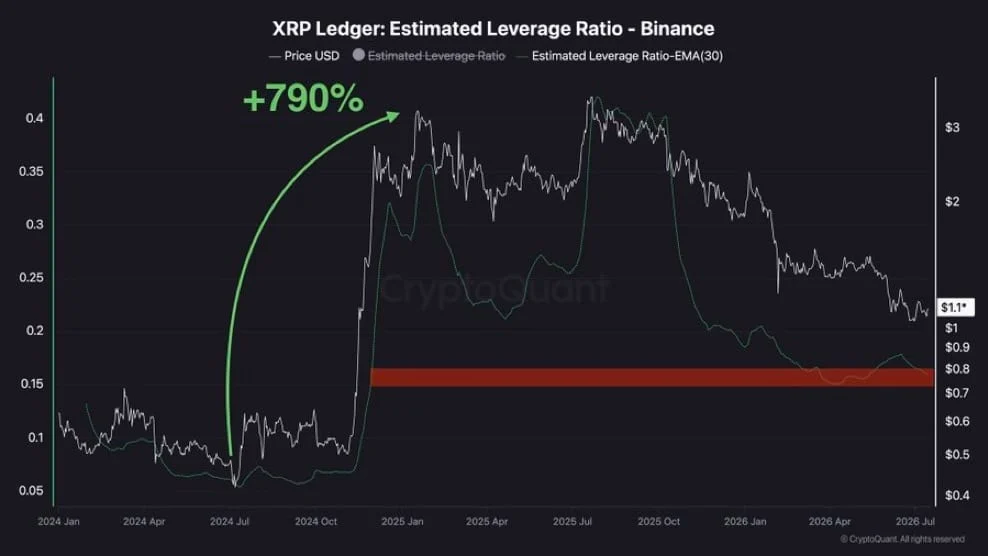
The Estimated Leverage Ratio (ELR) of the XRP Ledger, which measures the depth of leveraged capital channelled into XRP, hinted at the token repeating the pattern that led into its 2024 rally.

During that period, the ELR declined to a low of roughly 0.05 on the chart. A massive flush of leveraged positions in XRP followed, and the price rallied sharply soon after.

Ripple Estimated Leverage Ratio.
Source: CryptoQuant

The flush gave way to a significant run that reached 790%. At press time, CryptoQuant data revealed XRP entering a deleveraging phase once again.

Analysts, however, believe that this is neither a fractal nor a guaranteed sign that XRP will rally.

Even so, XRP’s Open Interest over the past year reflected this unwinding, falling from $10.94 billion to $2.39 billion for a decline of roughly 78%. This marked a clear outflow of leveraged capital worth about $8.55 billion from the market.

Are XRP whales accumulating steadily?

While the leverage flush is no guarantee of a rally, on-chain data also tracked an interesting trend that could support the price overall.

Whales, the investors controlling a significant amount of capital, have come to dominate XRP’s spot average order size. This seemed to imply that they are the most influential force in the market right now.

XRP exchange reserve XRP exchange reserve
Source: CryptoQuant

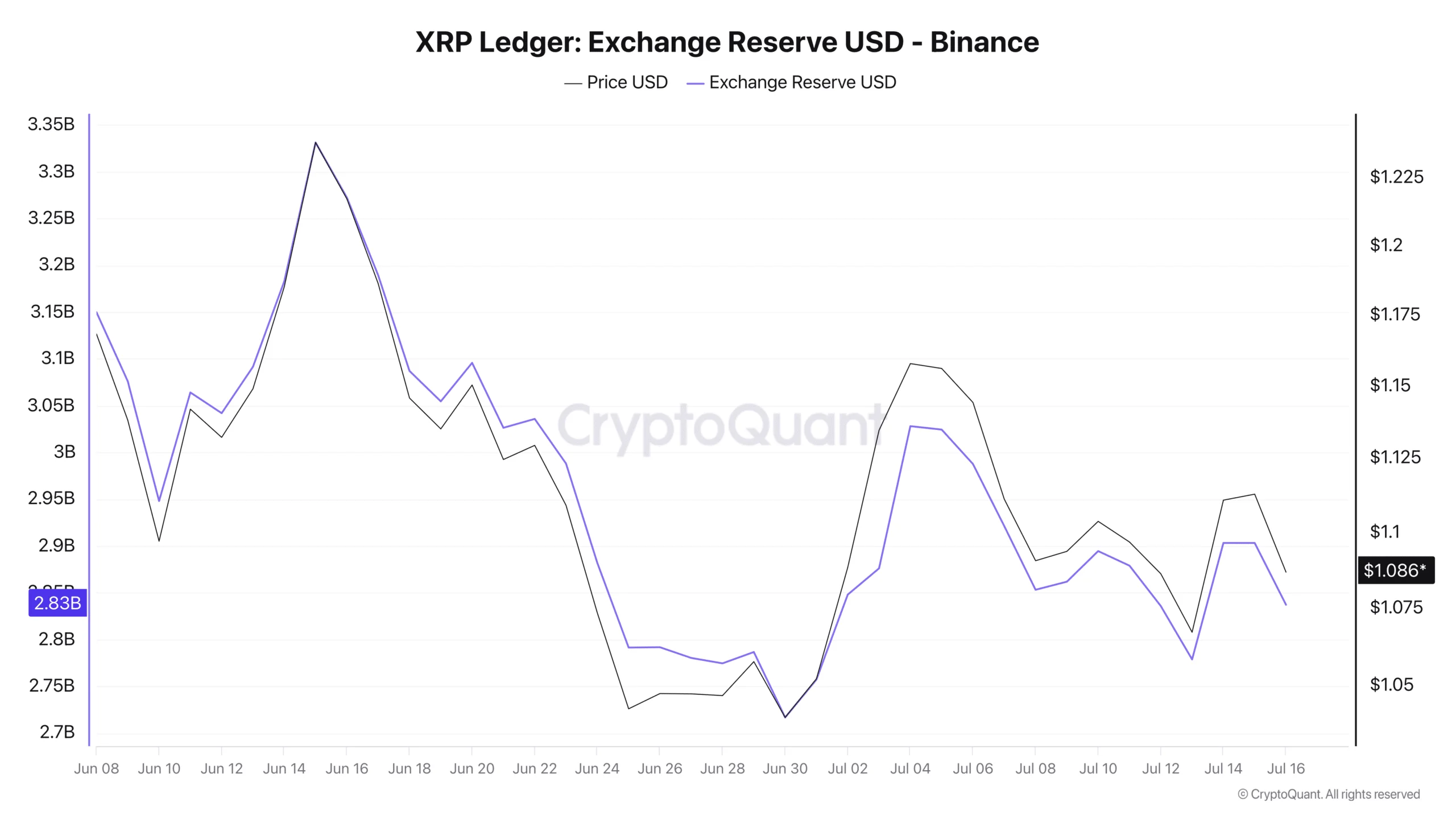
Exchange reserve data can give us clearer context to what this group has been doing though. The chart hinted at a fall in reserves, with the figure falling from 2.62 billion to 2.61 billion from 10 July.

In dollar value, roughly $57 million has flowed out of exchange balances into private wallets, moved by these whale wallets within the same period. A finding like that typically signals an ongoing but gradual accumulation of the asset, adding to its overall structure.

NVT ratio points to undervaluation

Finally, an analysis of the network value to transactions (NVT) data on the chart showed that XRP may be presently undervalued.

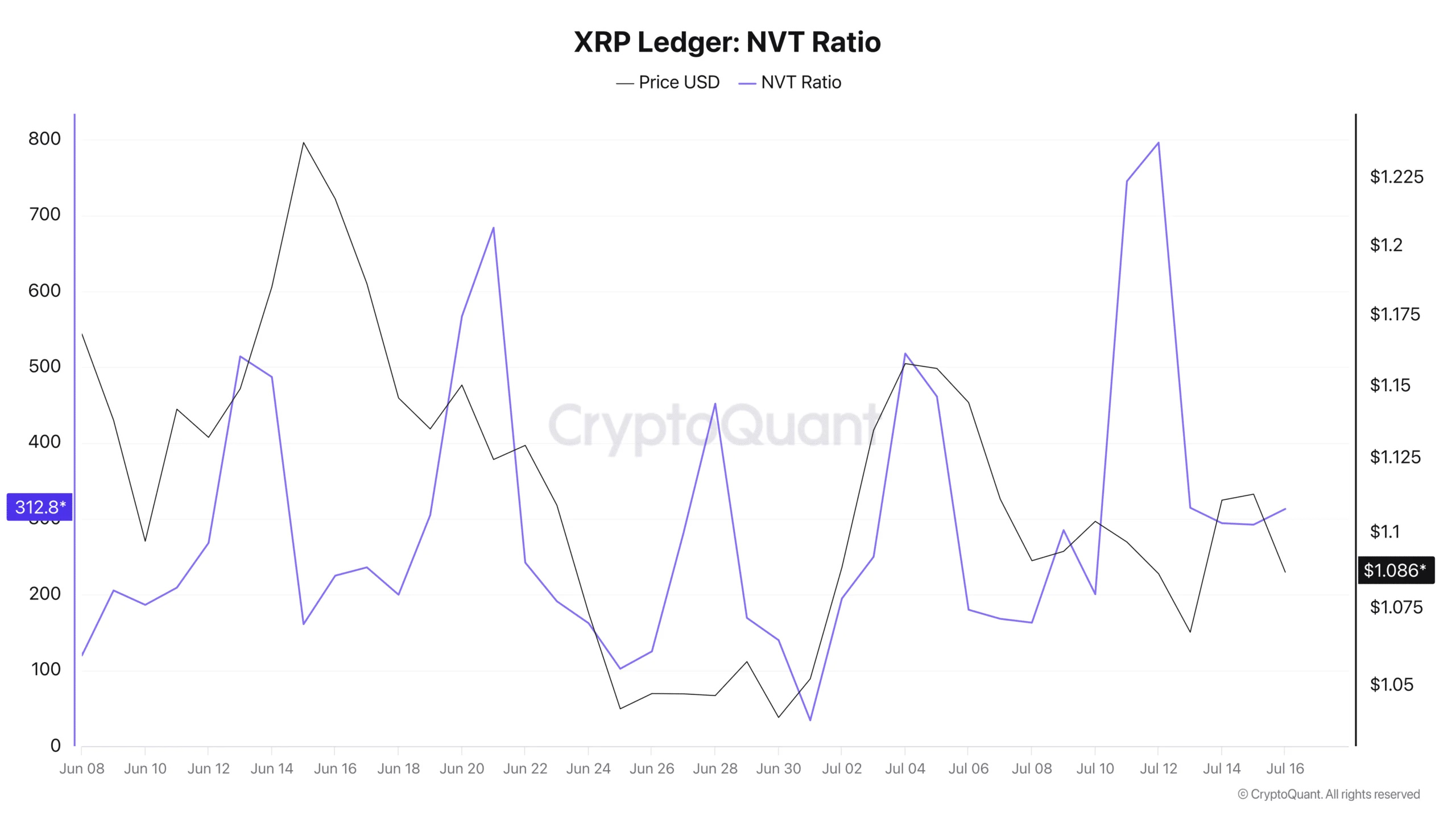
The NVT ratio determines undervaluation or overvaluation by weighing market capitalisation against transaction volume in the market. When the ratio sits on the lower side of its historical range, it implies the asset is undervalued and has been oversold.

XRP NTV ratio. XRP NTV ratio.

At the time of writing, the NVT ratio had a reading of 312.8, implying that network activity in terms of transactions has been minimal.

Until there is a clear uptick in the NVT, a high chance remains that the market stays undervalued. In fact, the reading is also evidence that whales may be purchasing XRP when it is trading at a discount.


Final Summary

  • XRP now replicating the same market conditions that came before its 790% surge in 2024.
  • Large investors are quietly buying and pulling XRP off exchanges.


Source link

Best CD rates today, Friday, July 17, 2026: Up to 4.10% APY return

0
Best CD rates today, Friday, June 19, 2026: Up to 4.20% APY return


See which banks are currently paying the highest CD rates. If you’re looking for a secure place to store your savings, a certificate of deposit (CD) may be a great choice. These accounts often provide higher interest rates than traditional checking and savings accounts. However, CD rates can vary widely. Learn more about CD rates today and where to find high-yield CDs with the best rates available.

Today’s CD rates vary quite a bit. In general, however, CD rates have been declining for quite some time due to the Fed’s decision to cut its benchmark rate three times in the latter part of 2024 and three times in 2025. Even so, with the Fed leaving rates unchanged so far in 2026, some banks are still offering competitive CD rates.

For institutions offering competitive rates, top rates reach about 4% APY. This is especially true for shorter terms of one year or less. 

Today, Friday, July 17, 2026, the highest CD rate is 4.10% APY. This rate is offered by Marcus by Goldman Sachs on its 14-month CD.

Here is a look at some of the best CD rates available today from our verified partners:

Compare these rates to the national average as of July 2026 (the most recent data available from the FDIC):

Compared with today’s top CD rates, national averages are much lower. This highlights the importance of shopping around for the best CD rates before opening an account.

Online banks and neobanks are financial institutions that operate solely via the web. That means they have lower overhead costs than traditional brick-and-mortar banks. As a result, they’re able to pass those savings on to their customers in the form of higher interest rates on deposit accounts (including CDs) and lower fees. If you’re looking for the best CD rates available today, an online bank is a great place to start.

However, online banks aren’t the only financial institutions offering competitive CD rates. It’s also worth checking with credit unions. As not-for-profit financial cooperatives, credit unions return their profits to customers, who are also member-owners. Although many credit unions have strict membership requirements that are limited to those who belong to certain associations or work or live in certain areas, there are also several credit unions that just about anyone can join.

Whether or not you should put your money in a CD depends on your savings goals. CDs are considered a safe and stable savings vehicle — they don’t lose money (in most cases), are backed by federal insurance, and allow you to lock in today’s best rates.

However, there are some drawbacks to consider. First, you must keep your money on deposit for the full term, otherwise you’ll be subject to an early withdrawal penalty. If you want flexible access to your funds, a high-yield savings account or money market account might be a better choice.

Additionally, although today’s CD rates are high by historical standards, they don’t match the returns you could achieve by investing your money in the market. If you’re saving for a long-term goal such as retirement, a CD won’t provide the growth you need to reach your savings goal within a reasonable time frame.

Read more: Short- or long-term CD: Which is best for you?


Source link

Live markets: Bitcoin and Nasdaq trim large early losses

0
Live markets: Bitcoin and Nasdaq trim large early losses

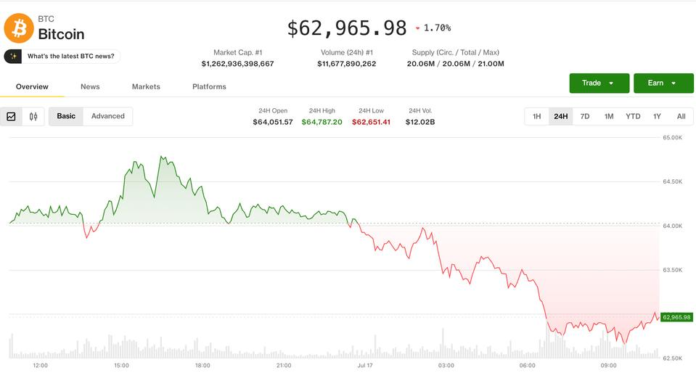
Bitcoin fell to about $63,000 on Friday, down 1.7% over 24 hours and 2.2% on the week, as a deepening selloff in chipmakers dragged risk assets lower, per CoinDesk data. Ether held better at $1,836, still up 2.4% over seven days, while Hyperliquid led the losses at 8% on the day and 12% on the week.

Nasdaq 100 futures dropped 1.8% and S&P 500 contracts fell 0.9% as a semiconductor ETF slid 3% in premarket trading. Taiwanese stocks fell into a technical correction and Asia’s main benchmark hit a two-month low. Europe held up better on lower tech exposure.

The question driving it is the one that has hung over the sector all month. Chipmakers are under scrutiny over whether the hundreds of billions that AI hyperscalers are spending will produce the returns to justify their valuations, and TSMC’s results this week did not settle it.

Crypto is following the same current it has all quarter. This week’s soft inflation print gave bitcoin a lift toward $65,000, but that was a macro trade, and the chip selloff is pulling the other way. The Fed meets July 28 and 29.


Source link

Trump firm plans to sell priority access to Truth Social posts, possibly his own

0
Trump firm plans to sell priority access to Truth Social posts, possibly his own


NEW YORK (AP) — President Donald Trump’s media company is planning to charge for special high-speed access to Truth Social posts, including possibly his own affecting national security and financial markets.

The move announced Thursday would allow Wall Street trading firms and other institutions to get news from top Truth Social contributors in milliseconds so they could profit off subsequent moves in stocks, bonds and interest rates.

Called Truth PSI, the new service comes amid a flurry of other deals by Trump and his family company that critics say are exploiting the presidency for profit. It follows similar offers of paid access on rival platforms, though with one key difference: The most popular Truth Social poster is the president himself and, as the biggest shareholder of the public traded parent company, would directly benefit.

“He’s selling expedited, privileged access to information about what he is doing as president,” said Kathleen Clark of Washington University School of Law and an expert in government conflicts of interest rules. “It’s yet more brazen corruption, an improper exploitation of government power to enrich himself.”

The Trump family company declined to comment about whether the new feature is profiting off the presidency. Truth Social’s public parent, Trump Media & Technology, did not respond to emailed questions, including whether the president’s posts will be excluded from the offering.

A press release states it would allow traders to see “the highest-ranking Truth Social accounts” ahead of others. The president has the most followers — 12.9 million — followed by his oldest son, Don Jr. and, close behind, his son Eric.

The release did not say how much customers would be charged.

In the past few months, Trump has announced major decisions and musings on his platform including posts about the Iran war, tariffs and the U.S. Immigration and Customs Enforcement crackdown in U.S. cities. The Iran posts in particular are impactful because investors are worried that higher oil prices will continue to stoke inflation and possibly force the Federal Reserve to raise interest rates.

Stock in Trump Media & Technology has plunged more than 70% since the president took office last year, erasing $6 billion in shareholder wealth. Those losses, along with billions more of investor losses tied to new Trump family crypto businesses, have drawn scrutiny after Trump’s annual disclosure of his financial holdings shows he took in more than $1 billion in revenue last year in the same companies and offerings.

Conflict of interest laws would bar U.S. government officials from owning a company that profits off their office by selling access to their decisions through public posts, says Washington University’s Clark. But the president and vice-president, she notes, are excluded from the provision.

Despite that, all presidents since the law was passed decades ago have acted as if it applied — selling individual stocks, dumping business holdings or putting their financial assets in a blind trust so they wouldn’t know what was being bought and sold on their behalf while they wielded power — but Trump has refused.

Trump Media has been trying to lift its stock price recently by branching into various businesses, including crypto, financial services and even nuclear fusion. It recently replaced its longtime CEO, former Congressman Devin Nunes, with a seasoned media executive, Kevin McGurn.

In the release, McGurn described the Truth PSI move as part of a “strategy to monetize proprietary assets.” He added that he expected it to become a “meaningful, ongoing source of revenue.”

Trump Media said that it plans to start the service next month and that it has already signed up customers.

The stock rose 0.6% to $9.63 on Thursday. Before Trump took office last year, it closed at $40.


Source link