Home Blog Page 228

What to Know About Taylor Farms Amid Cyclosporiasis Outbreak

0
What to Know About Taylor Farms Amid Cyclosporiasis Outbreak


Taylor Farms, a Taco Bell lettuce supplier, has been linked to a five-state cyclosporiasis outbreak.

Taylor Farms, founded by Bruce Taylor and several partners in 1995, is a California-based fresh produce company that has grown into a multi-billion-dollar enterprise with more than 24,000 employees and 22 production locations across North America.

The privately held company supplies packaged salads, fresh-cut vegetables, meal kits, and other prepared foods to grocery stores, restaurants, and food-service customers. Its products have also been connected to previous foodborne illness investigations, including outbreaks involving salad mix and onions served on McDonald’s Quarter Pounder burgers.

Federal officials have linked shredded iceberg lettuce served at some Taco Bell restaurants to a cyclosporiasis outbreak that has sickened more than 1,600 people across five states.

Taylor Farms did not immediately respond directly to a request for comment from Business Insider.

The company issued a public statement on Friday saying that it was “deeply concerned” for those who became ill and that Taylor Farms de Mexico was voluntarily removing all iceberg lettuce sourced from central Mexico from the US market.

The company added that no Taylor Farms-branded salads or salad kits were associated with the outbreak and that its branded salad kits do not contain iceberg lettuce.

Here’s what to know about Taylor Farms, its founder, its rise in the produce industry, and other major moments in its history.

Taylor Farms traces its origins to Salinas, California, in 1995.

The company was founded in Salinas, California, where it is headquartered.

MattGush/Getty Images/iStockphoto

The company was founded in 1995 in the Salinas Valley of California — often nicknamed the Salad Bowl of America for its fertile farmland — by Bruce Taylor, whose father and grandfather had also worked in the fresh produce industry.

More than 30 years later, Taylor remains the chairman and CEO of the company.


Farmland in Northern California stock photo

Taylor Farms’ growing operations are concentrated in the Salinas Valley and the Yuma region.

Dreamframer/Getty Images/iStockphoto

Before founding Taylor Farms with a group of partners, Taylor also served as CEO of Fresh Express, a fresh produce brand later acquired by Chiquita Brands International.

Taylor still serves as the chairman and CEO of Taylor Farms.

Taylor Farms is a multibillion-dollar company with more than 24,000 employees.


Packages of Taylor Farms salad greens are displayed at a Safeway store on July 16, 2026 in Kings Beach, California. Federal health officials are investigating whether shredded iceberg lettuce supplied by California-based Taylor Farms was the source of a nationwide Cyclospora outbreak that has sickened more than 1,600 people in 34 states, though no definitive link has been confirmed.

Taylor Farms supplies 265 million servings of fresh produce across North America each week.

Justin Sullivan/Getty Images

Taylor Farms is a $7 billion enterprise, according to UC Berkeley, that employs more than 24,000 people and operates 22 production locations across North America.

Its retail, prepared foods, and food service divisions produce bagged salads, meal kits, fresh-cut vegetables, and other ready-to-eat foods.

The company and its network of growers provide an estimated 265 million servings of fresh produce across North America each week, the company said.

The company helped popularize chopped salad kits and expanded by buying other major produce brands.


Packages of Taylor Farms salad greens are displayed at a Safeway store on July 16, 2026 in Kings Beach, California. Federal health officials are investigating whether shredded iceberg lettuce supplied by California-based Taylor Farms was the source of a nationwide Cyclospora outbreak that has sickened more than 1,600 people in 34 states, though no definitive link has been confirmed.

The company helped pioneer branded prepackaged chopped salads.

Justin Sullivan/Getty Images

Taylor Farms introduced the first branded prepackaged chopped salads in 2012, per UC Berkeley.

The company later continued to expand through acquisitions, including the organic produce brand Earthbound Farm in 2019 and the packaged salad brand Eat Smart in 2021.

A massive fire damaged Taylor Farms’ flagship Salinas facility in 2022.


Taylor Farms is completing the installation 2MW of solar power at its facility in San Juan Bautista, California, which will be combined with 6MW of fuel cells from Bloom Energy and a 2MW/4MWh battery into a microgrid designed to power the entire 450,000 sq. ft. facility.

The company’s other facility in San Juan Bautista, California, was modernized with solar power panels in 2022.

Business Wire/AP

In April 2022, a fire broke out at Taylor Farms’ flagship facility in Salinas, California, destroying its 60,000-square-foot leafy-greens processing area

The facility was rebuilt shortly after the fire and reopened a year later, with a new design designed to process over 15 million pounds of produce weekly.

Taylor Farms has previously been linked to major foodborne illness investigations.


Packages of Taylor Farms salad greens are displayed at a Safeway store on July 16, 2026 in Kings Beach, California.

Taylor Farms products were the likely source of 2024 E. coli outbreak involving onions used in McDonald’s Quarter Pounders.

Justin Sullivan/Getty Images

In 2013, restaurant-associated Cyclospora illnesses in Iowa and Nebraska were linked to salad mix produced by Taylor Farms’ Mexico division. During the multistate outbreak, 631 illnesses were reported across 25 states, although the CDC determined that the number of cases likely represented multiple outbreaks linked to different food sources.

Taylor Farms was also linked to an E. coli outbreak in 2024 involving slivered onions served on McDonald’s Quarter Pounders. The company voluntarily recalled yellow onions supplied to McDonald’s and other food-service customers after 104 people were sickened across 14 states, 34 were hospitalized, and one died.

The FDA identified the recalled onions as the likely source of the illnesses.

Federal officials have linked lettuce served at Taco Bell to an outbreak that has sickened more than 1,600 people.


A customer enters a Taco Bell restaurant on July 14, 2026 in La Cañada Flintridge, California.

Federal health officials linked shredded iceberg lettuce served at some of the chain’s locations in five states to more than 1,600 cases of cyclosporiasis.

Mario Tama/Getty Images

The CDC and FDA said shredded iceberg lettuce served at some Taco Bell restaurants in Indiana, Kentucky, Michigan, Ohio, and West Virginia was contaminated with Cyclospora.

As of July 16, the five-state outbreak included at least 1,644 confirmed illnesses, 94 hospitalizations, and no deaths. Not every Taco Bell restaurant in the affected states received the implicated lettuce.

The FDA’s traceback investigation identified a single supplier that provided the restaurants with iceberg lettuce grown in Mexico. Federal officials did not publicly name the supplier, but Taylor Farms said FDA traceback pointed to a specific independent farm affiliated with the company.

Taco Bell said it removed potentially affected lettuce from restaurants in select states and was indefinitely removing the supplier’s lettuce from its nationwide supply chain.

On Friday, Taco Bell said in a public statement that it had completed the removal of all affected Taylor Farms lettuce from its restaurants.

Federal investigations into the cyclosporiasis outbreak continue.


Fresh heads of lettuce are ready to be harvested, in the Salinas Valley of central California.

Investigators are working to determine whether potentially contaminated lettuce reached businesses beyond the Taco Bell locations already identified.

rightdx/Getty Images

The FDA is investigating whether potentially contaminated lettuce from the supplier remains on the market and whether it was distributed to other restaurants, retailers, brands, or businesses. Additional states could be added to the federal advisory as investigators learn more.

Taylor Farms de Mexico said it was voluntarily removing all iceberg lettuce sourced from central Mexico from the US market. The company said its Taylor Farms-branded salad kits do not contain iceberg lettuce.

The CDC is also investigating other clusters and thousands of additional reported Cyclospora illnesses that may not be connected to the lettuce served at Taco Bell. Health officials have warned that the nationwide increase in cases likely involves more than one source.


Source link

85% of concentrated liquidity is underutilized — Meaning for DeFi?

0
85% of concentrated liquidity is underutilized — Meaning for DeFi?


A significant amount of the liquidity that users contribute to decentralized exchanges isn’t really being used to speed up trades, according to a recent report by Dune.

To put things in perspective, concentrated liquidity was created to increase the capital efficiency of decentralized exchanges. This was done by enabling liquidity providers (LPs) to distribute funds within particular price ranges where trading is most likely to take place.

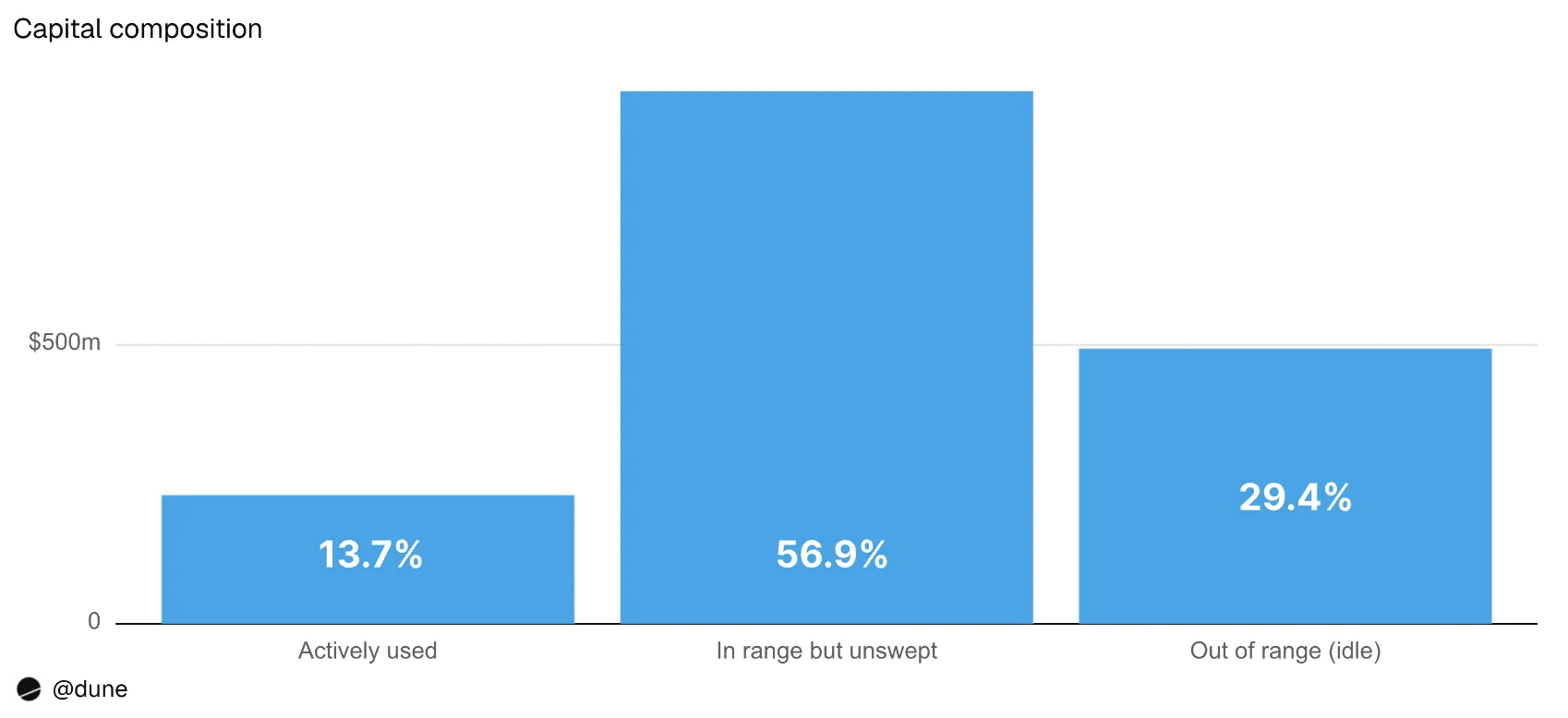
However, the study discovered that during the first half of 2026, an average of 29.4% of liquidity was outside the range of active trading. Thanks to the same, no trading fees were generated.

29.5% of liquidity was outside the range
Source: Dune

This amounted to approximately $542 million in idle capital per week and an estimated $150 million in lost annual fee income for liquidity providers across the four protocols.

For context, the 4 protocols included were Uniswap v3, Uniswap v4, PancakeSwap v3, and Aerodrome Slipstream.

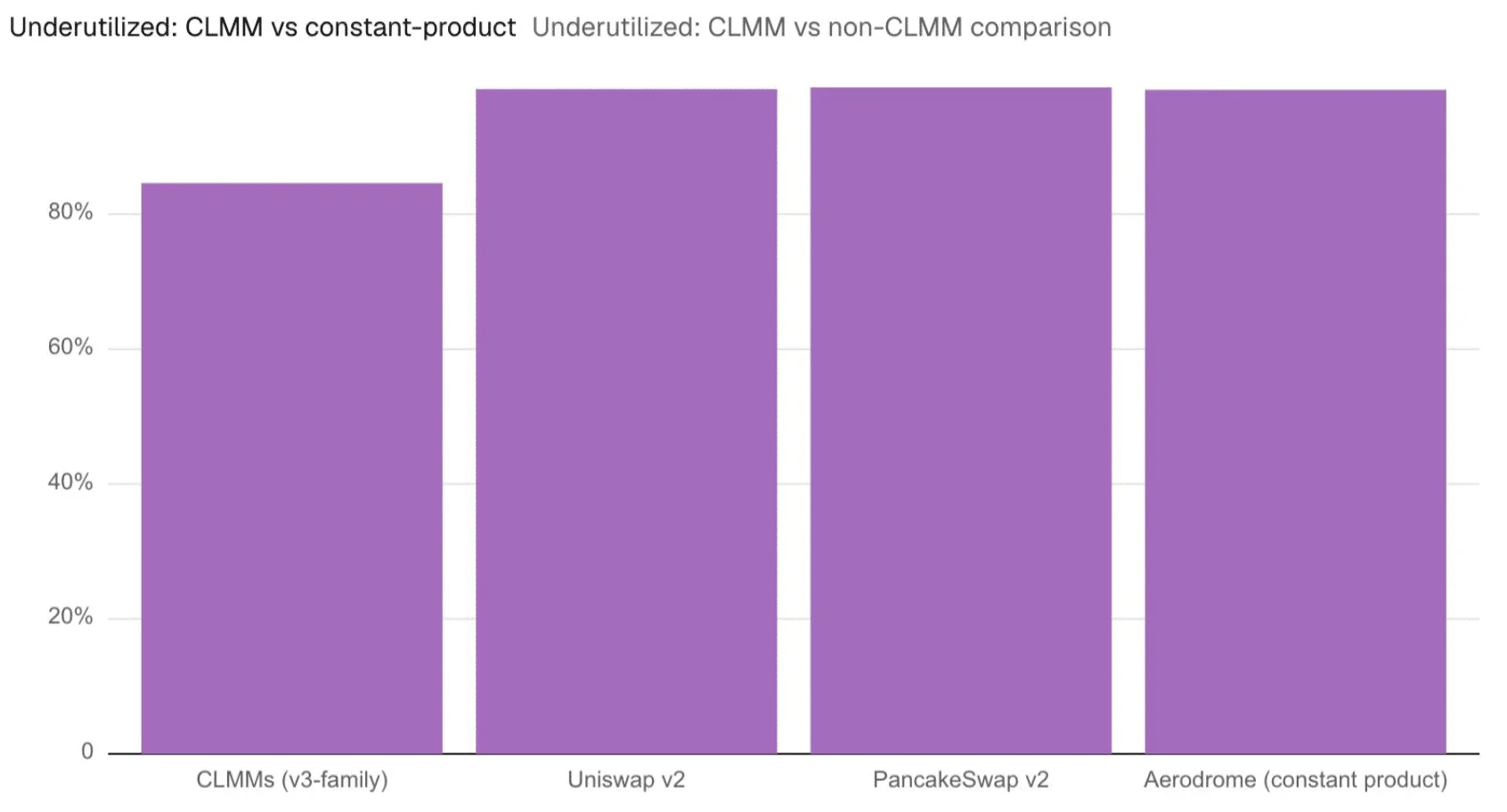
Underutilized concentrated liquidity

Considering technically available but never used liquidity, about 85% of capital was underutilized.

liquidity providers across the four protocolsliquidity providers across the four protocols
Source: Dune

The fact that more than $200 million in idle liquidity had not been repositioned in more than 90 days may be evidence that many LPs do not actively manage their holdings. 

This also suggested that even though concentrated liquidity should increase efficiency, many LPs still find it difficult to maintain their positions in line with market prices. 

Individual investors suffered the most

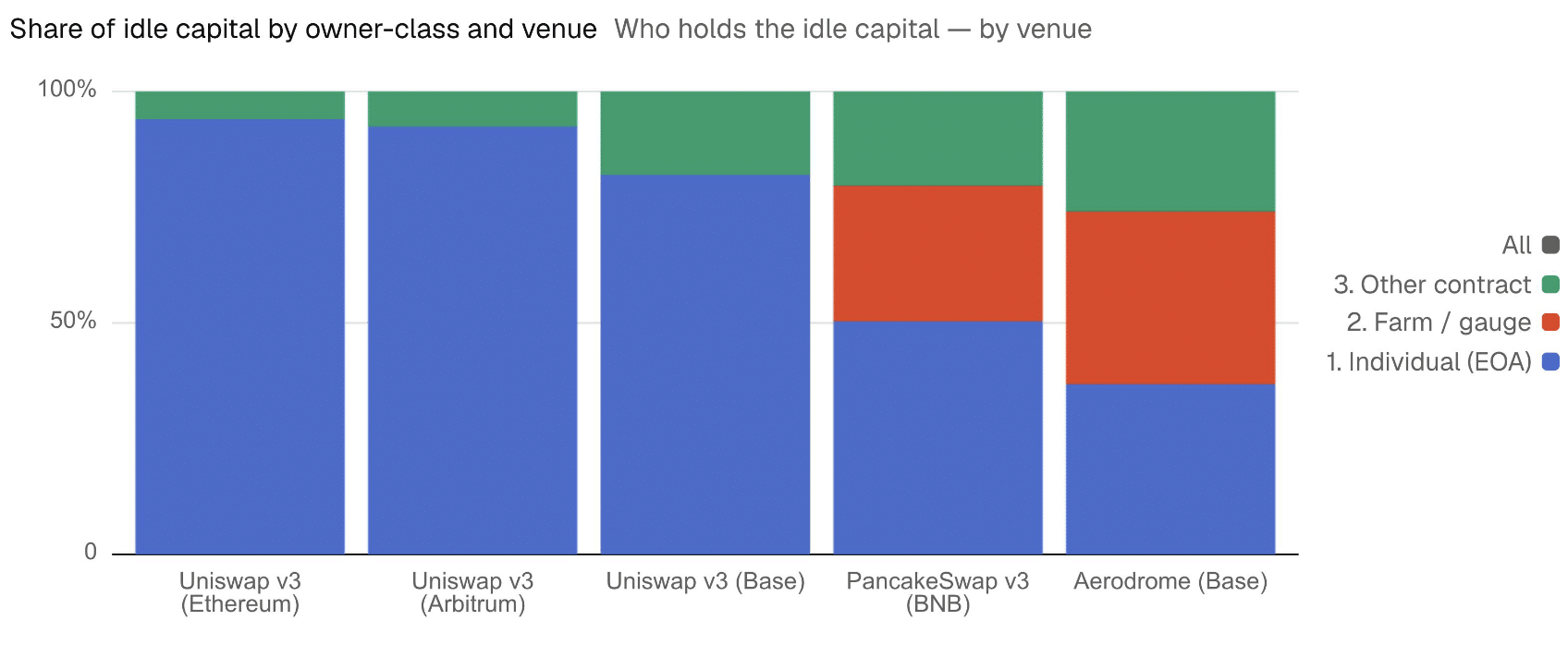
Additionally, the study discovered that automated managers maintained capital activity, while individual investors owned the majority of idle liquidity.

Wallets on Ethereum, for instance, had 94% of idle capital and 91% of Uniswap v3 liquidity. 92% of idle liquidity and 78% of liquidity were under control on Arbitrum. On Base, individual users oversaw 82% of the idle capital, even though smart contracts held roughly 50% of the liquidity.

Share of idle capitalShare of idle capital
Source: Dune

This, because only 6.5% of their positions were out of range, compared to about 30% for wallets. This also indicated that automated managers have been far more successful than individual LPs at maintaining liquidity.

Additional loopholes

Finally, the study found that the idle liquidity issue has not been resolved by Uniswap v4.

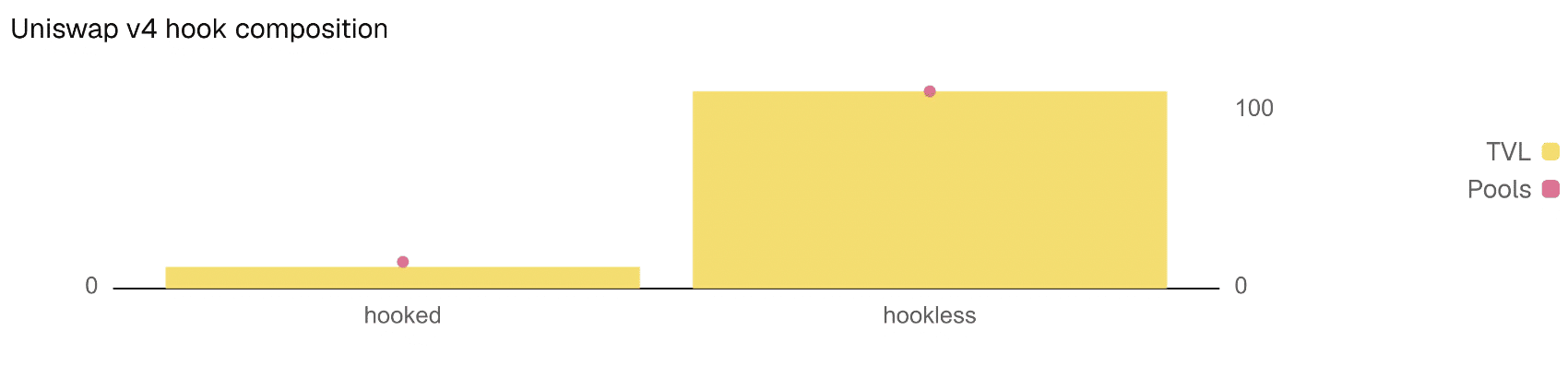
Like Uniswap v3, about 30.5% of its liquidity is still out of range even after hooks were added that might allow idle capital to be used in external yield strategies.

Also, just 10% of v4’s TVL actually uses hooks while none of them produce yield from idle liquidity at the moment.

Uniswap v4Uniswap v4
Source: Dune

Final Summary

  • In H1 2026, approx. 29.5% of liquidity was outside the range of active trading.
  • Instead of AMMs, individual investors owned the majority of idle liquidity.


Source link

SBI’s Coinhako deal advances plan for Asia’s first digital asset empire

0
SBI's Coinhako deal advances plan for Asia's first digital asset empire

“The real prize is the yen side of onchain settlement, one of the most strategic positions in Asian finance over the coming decade, and that is exactly what SBI is building toward,” he added.

One technical limitation remains. JPYSC does not yet support withdrawals to external wallets.

“Regarding JPYSC, its use is currently limited to accounts within SBI VC Trade, and it does not yet support withdrawals to external wallets or remittances and settlements via public blockchains,” the spokesperson said.

For now, that limits JPYSC’s use outside SBI’s own platform. Investors cannot yet move the stablecoin to external wallets or use it to settle transactions across public blockchains.

Sota Watanabe, CEO of Startale Group, which works with SBI Holdings on JPYSC, said the company’s continued investment in digital assets reflects what he sees as growing institutional confidence in blockchain infrastructure.

“SBI Holdings’ continued commitment to digital assets likely signals confidence in the future architecture of global finance,” Watanabe told CoinDesk.

He said blockchain is increasingly being viewed as financial infrastructure rather than an emerging technology, adding that Japan is well-positioned to lead the sector due to its regulatory framework and financial institutions.

SBI expansion

SBI agreed to buy Tokyo-based cryptocurrency exchange Bitbank for around $289 million in June. The acquisition is expected to close in October, subject to regulatory approval. SBI previously acquired crypto exchange Bitpoint in 2022. The firm also led a $76 million Series C funding round for institutional exchange EDX Markets and a $25 million Series C round for crypto risk manager Gauntlet, the spokesperson said.


Source link

Morgan Stanley Expands Retail Crypto Access Through E*TRADE Rollout

0
Morgan Stanley Expands Retail Crypto Access Through E*TRADE Rollout


Morgan Stanley Expands Retail Crypto Access Through E*TRADE Rollout

E*TRADE from Morgan Stanley (NYSE: $MS) has completed the rollout of crypto spot trading, giving eligible clients access to Bitcoin (CRYPTO: $BTC), Ethereum (CRYPTO: $ETH) and Solana (CRYPTO: $SOL) without leaving the brokerage platform.

The service lets users buy, sell and hold the three assets through a linked zerohash account, with digital asset positions displayed alongside stocks and other traditional investments. Trading is priced at 50 basis points, while transfer functionality is expected later this year.

Crypto trading is powered by zerohash through a separate non-brokerage account, with the firm handling execution and custody. Digital asset holdings are not covered by FDIC insurance or the Securities Investor Protection Corporation.

More From Cryptoprowl:

The launch gives Morgan Stanley a wider entry point into retail crypto without requiring E*TRADE to build the trading and custody stack internally. zerohash already provides embedded digital asset infrastructure to brokerages, fintech platforms and wealth products.

“With the rollout of crypto trading on E*TRADE we’re advancing our digital assets strategy and bringing new capabilities to clients in an integrated way,” said Chad Turner, head of Morgan Stanley Wealth Management Platforms.

Morgan Stanley’s latest investor survey found that 32% of respondents ranked an established company they could trust among the most important factors when selecting a crypto platform. Another 26% pointed to the ability to view digital assets alongside traditional investments, directly matching the way E*TRADE has positioned the service.

Digital asset services are expected to transition to Morgan Stanley Digital Trust, National Association, a national trust bank currently in organization. That creates a path for more of the crypto infrastructure to move under Morgan Stanley’s regulated umbrella after the initial zerohash-led rollout.

The crypto launch forms part of a wider E*TRADE platform upgrade that also includes fractional share trading, an expanded IPO center and new tools for active investors. By placing digital assets alongside equities and other traditional investments, Morgan Stanley is folding crypto into a familiar brokerage experience rather than treating it as a separate product.

Morgan Stanley (NYSE: MS) stock is currently trading at $220.66 U.S. per share.


Source link

Cardano hands core software over to outside developers to achieve full decentralization

0
Cardano hands core software over to outside developers to achieve full decentralization

Cardano developer Input Output is handing control of core blockchain infrastructure to outside teams, reducing the network’s dependence on the company that built it, Input Output announced Friday.

Input Output said the handover is the next phase of Cardano’s decentralization. It covers Cardano’s Haskell node, Plutus smart-contract platform, Daedalus wallet, Hydra scaling technology and developer relations.

Specialist companies include Se7en Labs, a development agency specializing in Solana blockchain infrastructure, and Teragone, a specialist software development and cryptographic research team that leads the development of Mithril, a stake-based signature protocol for the Cardano blockchain. Both will take responsibility for some of the components. The handover will begin in August and continue into 2027.

Cardano has already moved protocol decisions and governance to its community. Input Output said the next step is to spread responsibility for developing and maintaining the software.

“The last stage of the Voltaire era is full decentralization of node and reference blueprint development,” Input Output CEO and Cardano founder Charles Hoskinson said in the statement.


Source link

FTX schedules another $900M creditor payout, taking announced distributions past $9.7B

0
FTX schedules another $900M creditor payout, taking announced distributions past $9.7B


FTX will distribute approximately $900 million to eligible creditors on July 31, marking the bankrupt crypto exchange’s fifth distribution under its Chapter 11 reorganization plan.

The latest payout will take announced distributions across FTX’s second through fifth repayment rounds to at least $9.7 billion. The figure excludes the initial February 2025 distribution to Convenience Class creditors, for which FTX did not specify an aggregate amount.

FTX creditors to receive another $900 million

FTX and the FTX Recovery Trust announced on July 17 that the fifth distribution will cover eligible holders of allowed claims across Convenience and Non-Convenience Classes.

To qualify, creditors must have completed the required pre-distribution steps by the June 16 record date. Eligible creditors should receive their funds through their selected provider.

Under the latest distribution, allowed Class 5A Dotcom Customer Entitlement Claims will receive an additional 9%, taking cumulative distributions to 105%.

U.S. Customer Entitlement Claims will receive an additional 5%, bringing the cumulative total to 105%. General Unsecured Claims and Digital Asset Loan Claims will each receive 3%, bringing their cumulative distributions to 103%.

Convenience Claims, meanwhile, will have received cumulative distributions of 120%.

Announced FTX distributions cross $9.7 billion

The latest announcement extends a creditor repayment process that began in February 2025.

FTX’s second distribution, completed in May 2025, involved more than $5 billion, followed by approximately $1.6 billion in September. The Recovery Trust subsequently announced another approximately $2.2 billion for its fourth distribution in March 2026.

Including the $900 million scheduled for July, FTX has therefore announced at least $9.7 billion across its second through fifth distributions.

The total amount distributed or scheduled since repayments began is higher, as that calculation excludes FTX’s first distribution to Convenience Class creditors in February 2025.

FTX has not yet announced the record or payment dates for its next distribution.

Preferred shareholders also set for second payment

The July 31 distribution will coincide with another payment to eligible FTX preferred equity holders.

The Preferred Shareholder Remission Fund Trust will distribute $18 million to eligible holders who met the requirements by the June 16 record date.

The latest payment will bring total distributions from the fund to $95 million.

FTX said additional details showing the amounts distributed by individual creditor classes will be filed with the bankruptcy court shortly after the July 31 payment.


Final Summary

  • FTX will distribute approximately $900 million to eligible creditors on July 31, bringing announced payouts across its second through fifth distribution rounds to over $9.7 billion.
  • Following the fifth distribution, Dotcom and U.S. customer claims will have reached 105% cumulative distributions, while Convenience Claims will stand at 120%.


Source link

Strong Results Reinforce Micron Technology’s (MU) Importance in AI Infrastructure Buildout

0
Strong Results Reinforce Micron Technology’s (MU) Importance in AI Infrastructure Buildout


Janus Henderson Investors, an investment management company, released its second-quarter 2026 investor letter for the “Global Sustainable Equity Fund”. A copy of the letter can be downloaded here. Global equities experienced a robust quarter, with the Fund returning 16.17%, outperforming the Index’s 13.16% gain and the Peer Group’s 12.98% return. An overweight in information technology, particularly AI infrastructure, and underweight positions in energy, materials, and consumer staples were the key drivers. AI significantly contributed to returns, especially among chipmakers. Information technology was the top performer in the quarter with over 30% returns, alongside strong performances from financials and industrials. The portfolio focuses on high-quality companies with competitive advantages and exposure to long-term trends, positioning it to manage evolving investment opportunities and risks. For insights into their key selections for 2026, please review the Strategy’s top five holdings.

In its Q2 2026 investor letter, Janus Henderson Global Sustainable Equity Fund highlighted Micron Technology, Inc. (NASDAQ:MU). Micron Technology, Inc. (NASDAQ:MU) is a leading semiconductor company that manufactures memory and storage products, delivering solutions for a wide range of applications. On July 15, 2026, Micron Technology, Inc. (NASDAQ:MU) closed at $904.28 per share. The one-month return of Micron Technology, Inc. (NASDAQ:MU) was -22.62%, and its shares gained 674.70% over the past 52 weeks. Micron Technology, Inc. (NASDAQ:MU) has a market capitalization of $1.02 trillion.

Janus Henderson Global Sustainable Equity Fund stated the following regarding Micron Technology, Inc. (NASDAQ:MU) in its Q2 2026 investor update:

“The largest positive contributors included Seagate, Micron Technology, Inc. (NASDAQ:MU) and TSMC. We added Micron to the portfolio towards the end of 2025. This quarter, Micron’s shares returned more than 240% after results reinforced the growing strategic importance of memory to the AI infrastructure buildout. Its earnings benefited from stronger pricing, improving demand and a more constructive outlook, as demand for memory continues to outpace industry supply additions. Growth is being driven by high-bandwidth memory for AI accelerators, agentic workloads and data caching. Micron’s latest energy-efficient memory products also allow AI workloads to run with higher performance and lower power consumption, while long-term customer agreements may improve earnings visibility and reduce cyclicality.”

Micron Technology, Inc. (NASDAQ:MU) is in 17th position on our list of 40 Most Popular Stocks Among Hedge Funds Heading Into 2026. According to our database, 154 hedge fund portfolios held Micron Technology, Inc. (NASDAQ:MU) at the end of the first quarter, up from 137 in the previous quarter. While we acknowledge the potential of Micron Technology, Inc. (NASDAQ:MU) as an investment, we believe certain AI stocks offer greater upside potential and carry less downside risk. If you’re looking for an extremely undervalued AI stock that also stands to benefit significantly from Trump-era tariffs and the onshoring trend, see our free report on the best short-term AI stock.

In another article, we covered Micron Technology, Inc. (NASDAQ:MU) and shared the list of best stocks to buy for high returns. Amid rapid AI infrastructure growth, ClearBridge Large Cap Growth Strategy initiated a position in Micron Technology, Inc. (NASDAQ:MU) during Q2 2026. In addition, please check out our hedge fund investor letters Q2 2026 page for more investor letters from hedge funds and other leading investors.

READ NEXT: 33 Stocks That Should Double in 3 Years and 15 Stocks That Will Make You Rich in 10 Years.

Disclosure: None. This article is originally published at Insider Monkey.


Source link