Janus Henderson Investors, an investment management company, released its second-quarter 2026 investor letter for the “Global Sustainable Equity Fund”. A copy of the letter can be downloaded here. Global equities experienced a robust quarter, with the Fund returning 16.17%, outperforming the Index’s 13.16% gain and the Peer Group’s 12.98% return. An overweight in information technology, particularly AI infrastructure, and underweight positions in energy, materials, and consumer staples were the key drivers. AI significantly contributed to returns, especially among chipmakers. Information technology was the top performer in the quarter with over 30% returns, alongside strong performances from financials and industrials. The portfolio focuses on high-quality companies with competitive advantages and exposure to long-term trends, positioning it to manage evolving investment opportunities and risks. For insights into their key selections for 2026, please review the Strategy’s top five holdings.
In its Q2 2026 investor letter, Janus Henderson Global Sustainable Equity Fund highlighted Micron Technology, Inc. (NASDAQ:MU). Micron Technology, Inc. (NASDAQ:MU) is a leading semiconductor company that manufactures memory and storage products, delivering solutions for a wide range of applications. On July 15, 2026, Micron Technology, Inc. (NASDAQ:MU) closed at $904.28 per share. The one-month return of Micron Technology, Inc. (NASDAQ:MU) was -22.62%, and its shares gained 674.70% over the past 52 weeks. Micron Technology, Inc. (NASDAQ:MU) has a market capitalization of $1.02 trillion.
Janus Henderson Global Sustainable Equity Fund stated the following regarding Micron Technology, Inc. (NASDAQ:MU) in its Q2 2026 investor update:
“The largest positive contributors included Seagate, Micron Technology, Inc. (NASDAQ:MU) and TSMC. We added Micron to the portfolio towards the end of 2025. This quarter, Micron’s shares returned more than 240% after results reinforced the growing strategic importance of memory to the AI infrastructure buildout. Its earnings benefited from stronger pricing, improving demand and a more constructive outlook, as demand for memory continues to outpace industry supply additions. Growth is being driven by high-bandwidth memory for AI accelerators, agentic workloads and data caching. Micron’s latest energy-efficient memory products also allow AI workloads to run with higher performance and lower power consumption, while long-term customer agreements may improve earnings visibility and reduce cyclicality.”
Micron Technology, Inc. (NASDAQ:MU) is in 17th position on our list of 40 Most Popular Stocks Among Hedge Funds Heading Into 2026. According to our database, 154 hedge fund portfolios held Micron Technology, Inc. (NASDAQ:MU) at the end of the first quarter, up from 137 in the previous quarter. While we acknowledge the potential of Micron Technology, Inc. (NASDAQ:MU) as an investment, we believe certain AI stocks offer greater upside potential and carry less downside risk. If you’re looking for an extremely undervalued AI stock that also stands to benefit significantly from Trump-era tariffs and the onshoring trend, see our free report on thebest short-term AI stock.
In another article, we covered Micron Technology, Inc. (NASDAQ:MU) and shared the list of best stocks to buy for high returns. Amid rapid AI infrastructure growth, ClearBridge Large Cap Growth Strategy initiated a position in Micron Technology, Inc. (NASDAQ:MU) during Q2 2026. In addition, please check out our hedge fund investor letters Q2 2026 page for more investor letters from hedge funds and other leading investors.
Christopher Nolan’s long-awaited adaptation of The Odyssey has finally arrived in theaters. The film brings Homer’s legendary Greek epic to the big screen and marks the director’s first feature since the Oscar-winning Oppenheimer.
Matt Damon stars as Odysseus, the King of Ithaca, whose long journey home after the Trojan War is filled with mythical creatures, powerful gods, and other dangerous obstacles. The star-studded cast includes Anne Hathaway, Tom Holland, Robert Pattinson, Lupita Nyong’o, Samantha Morton, Zendaya and Charlize Theron.
The Odyssey crossed $17.6 million in preview screenings, the biggest preview haul of 2026 so far, and is expected to earn between $90 million and $100 million during its opening weekend. That would mark Nolan’s biggest opening since The Dark Knight Rises, which debuted to $160 million in 2012, according to Variety.
The movie is already earning widespread acclaim from both critics and audiences. Just one day after its theatrical debut, the film holds a 96% critics’ score on Rotten Tomatoes. Reviewers have praised Nolan’s ambitious vision, with many also spotlighting Damon’s performance.
Among the positive reviews, The Los Angeles Times’ Amy Nicholson praised Nolan’s fresh take on the classic, writing that “Nolan refuses to tremble before the canon. Grabbing mighty scissors, he cuts and rejiggers Homer and a bit of Virgil to transform the classical texts into his type of tale: one fixated on memory, self-identity, destructive genius and the slippage of time.”
Can’t make it to the theater or planning to watch The Odyssey again from home? Here’s everything to know about when the film is expected to arrive on digital platforms and Peacock.
How To Watch The Odyssey Right Now
The Odyssey (2026)
Courtesy of Universal Pictures UK
The Odyssey premiered exclusively in theaters on Friday, July 17. For now, the only way to watch Nolan’s latest film is on the big screen. Check your local theater for showtimes.
When Will The Odyssey Begin Streaming On Peacock?
The Odyssey (2026)
Courtesy of Universal Pictures UK
Because The Odyssey is being distributed by Universal Pictures, the film is expected to stream on Peacock after its theatrical run.
Although an official streaming date has not been announced, Universal has recently released many of its films on Peacock about three to four months after their theatrical debuts. Based on that timeline, The Odyssey could arrive on the platform sometime in October or November 2026.
Several of the studio’s recent releases have followed a similar schedule. Wicked: For Good began streaming on Peacock on March 20, 2026, about four months after its November 2025 theatrical debut. Jurassic World Rebirth and How to Train Your Dragon also followed similar release windows, while The Super Mario Galaxy Movie is expected to make its Peacock debut after nearly four months in theaters.
When Will The Odyssey Be Released On Digital?
The Odyssey (2026)
Universal Pictures
Don’t want to wait until fall to watch The Odyssey from home? You may not have to. Before the film eventually arrives on Peacock, it will likely be released first through premium video on demand (PVOD), giving fans an earlier chance to watch at home.
Viewers can expect to rent or purchase the film on digital platforms such as Prime Video, Apple TV and Fandango at Home. New theatrical releases are typically priced between $24.99 and $29.99 to purchase, or between $19.99 and $24.99 to rent.
Studios often release films digitally about 45 to 65 days after premiering in theaters. Based on that timeline, The Odyssey could become available to watch at home as early as late August or as late as mid-September 2026.
Check out the official trailer for The Odyssey below.
“Both Stripe and PayPal do approximately the same amount of payment volume, but Stripe has about one-fifth the net revenue,” Hadick said. “From a financial perspective, this is obviously accretive, and it helps them connect their merchant processing business, which is at risk of being commoditized, with a broad subset of PayPal’s more than 400 million accounts.”
Hadick also cautioned that executing a deal of that size would be difficult. “M&A integration in something of this size is incredibly hard,” he said.
Beyond merchant payments
Eric Queathem, CEO of Velocity, said the acquisition would also give Stripe access to one of the world’s largest consumer payments ecosystems, providing a platform to expand beyond merchant payments.
The proposed acquisition would also determine who controls the consumer side of blockchain-based payment infrastructure, complementing Stripe’s existing merchant network and stablecoin capabilities.
Several executives said the competitive focus has shifted from proving blockchain technology works to controlling distribution.
Pankaj Bengani, founder and CEO of Meld, agreed with Larbi that the race is on.
“The race has shifted from proving the technology works to owning distribution,” said Bengani, adding that “stablecoins have graduated from experiment to core payments infrastructure.”
Citi analysts reached a similar conclusion in a research note, writing that stablecoin competition has become “a default-setting game,” with scale accruing to whichever stablecoin becomes the default across the largest merchant, consumer wallet or autonomous transaction base, rather than to the issuer with the best technology.
Budgeting is especially challenging for people who have unpredictable or varying income. For example, if you’re a freelancer or a seasonal worker, it might be impossible to predict what you’ll earn from month to month. Those fluctuations can make budgeting feel like trying to hit a moving target.
As a financial educator and former NFCC-certified credit counselor, I’ve helped thousands of people build budgets, including many with irregular incomes. The key is building a budget that’s flexible enough to handle both good months and lean ones, so you can stay on top of your bills without sacrificing your long-term financial goals.
What is an irregular income?
If you have an irregular income, your income changes from month to month or from paycheck to paycheck. Unlike someone who earns a salary or has a fixed income, people with variable incomes can see their earnings change based on how many hours they work, how many sales they make, or other factors that fluctuate.
Here are some types of workers who typically have fluctuating income:
The main financial challenge for people with variable income is dealing with slow months.
During good months, you might feel a sense of financial freedom, and you may even be tempted to overspend. But during slow months, you might feel like your finances are going to fall apart. If you don’t have a plan in place, you’re likely to make decisions that hurt your long-term finances, such as using credit cards to cover necessities or taking on buy now, pay later loans.
It’s important to understand the minimum amount of money you need to make each month to meet your financial obligations. Once you pinpoint that figure, you’ll be able to anticipate when you’re earning enough to cover bills, or if you need to find extra income.
To complete this step, I recommend reviewing your financial statements to identify all of your monthly expenses, and then entering them into a spreadsheet (or on a piece of paper) with two separate categories:
Essentials: These are the costs you need to cover no matter what, such as housing, utilities, food, transportation (gas, car insurance, etc.), and medical care. It also includes minimum debt payments, taxes (for self-employed people), and other expenses that come up every few months, such as insurance premiums and vehicle registration.
Non-necessities: These are expenses you can forego if money is tight, such as dining out, travel, and shopping.
A common mistake I’ve seen people with variable incomes make is budgeting for what they hope to earn, rather than what they actually earn. Instead of applying wishful thinking, I recommend being very conservative about what you expect to make, and then treating anything more as a bonus.
To do this, calculate how much you’ve taken home each month over the last six to 12 months. Then consider the slowest month to be your baseline income.
If you’re not sure how much you’ve been making, take a look at all of your sources of income, including income you deposited to a bank account and money you may have kept elsewhere. If you’re self-employed, you’ll need to make sure you subtract your business expenses and taxes.
If you truly can’t pinpoint your income information, it’s crucial to start tracking it right away. For example, for servers and bartenders, I recommend noting down the total tips you’ve received after each shift. That way, you can not only start tracking your earnings, but you can also start recognizing patterns, like which shifts or seasons are the slowest for you.
Step 3: Build a budget around your lowest income month
This next step is a lot simpler than it seems. No matter what your situation is, building a budget just means comparing two items: your income and your expenses.
If you’ve already done the first two steps listed above, then you’ve done the hard part. Now you just need to compare your baseline income to your monthly essentials.
First, look to see if your baseline income is enough to cover your essentials. If it’s not, then you need to make some adjustments. For example, you may need to look for a second job and start saving up for the lean months.
If you make more than enough to cover essentials, that’s great news. Now, you need to decide which of your non-necessities you want to cover. If you don’t have money saved for emergencies, I highly recommend starting there.
Step 4: Use your surplus to create an emergency fund
If you have varying or unpredictable income, it’s absolutely crucial to build an emergency savings fund. You can think of this fund as a sort of income replacement plan for your slow months.
How much money should you save? My recommendation for people with fluctuating income is to save six months’ worth of your monthly essential expenses. For example, if your essentials add up to $4,500 a month, the goal is to save $27,000.
When you have this amount in savings, you can move forward with confidence, knowing that you won’t have to struggle financially if you’re not earning money for a while.
However, don’t be discouraged if it feels impossible to save that amount. If you’re just getting started with savings, focus on making it a habit to set some money aside each pay period. Then, you can celebrate smaller savings milestones, like saving enough to cover one month’s rent or enough for two months’ worth of essentials.
Step 5: Pay down debt
If you have any high-interest debt — anything with 8% APR or higher — I recommend paying down your balances as soon as you have at least one month worth of your essential expenses in savings.
Why? The interest rates on these debts can be real budget killers. For example, if you carry a balance of $5,000 on a credit card with 21% APR (that’s the current average rate), you’ll be charged roughly $87 a month in interest. Meanwhile, $5,000 sitting in a high-yield savings account will earn less than $20 per month.
With the right tools, budgeting can be a lot easier. You don’t need to use anything complicated to create and track your budget, and you don’t need to pay for apps. Depending on your preferences, any of the following can help:
A notes app or document where you can easily input your tips or other earnings after each shift.
A spreadsheet where you can compare your income and expenses and easily adjust the numbers.
Specialized budgeting apps, such as ServerLife or Goodbudget.
Common budgeting mistakes to avoid
In my experience working directly with clients on their budgets, I see a lot of people making the same mistakes. Here are some common mistakes that are easy to make when you’re managing variable income:
Guessing about your income instead of tracking the numbers.
Basing your budget on your highest-earning months.
Not saving money during high-income months.
Taking on personal debt to cover business expenses.
Forgetting to save money for taxes.
The best advice I can give you for managing varying income is to have a plan for your money. That doesn’t mean you have to constantly evaluate every dollar you earn and every purchase you make. But it does mean you should have a clear idea of how much you’re earning, how much you need for essentials each month, and what you’ll do with any extra money you make.
Ethereum’s [ETH] attempted rebound faced rejection at $1,944 three days ago. The pullback pushed ETH to $1,819 before it recovered slightly.
At press time, Ethereum traded near $1,823 after falling 3.6% over 24 hours. The decline attracted substantial whale activity, although sellers retained control of the market.
Are whales buying the ETH dip?
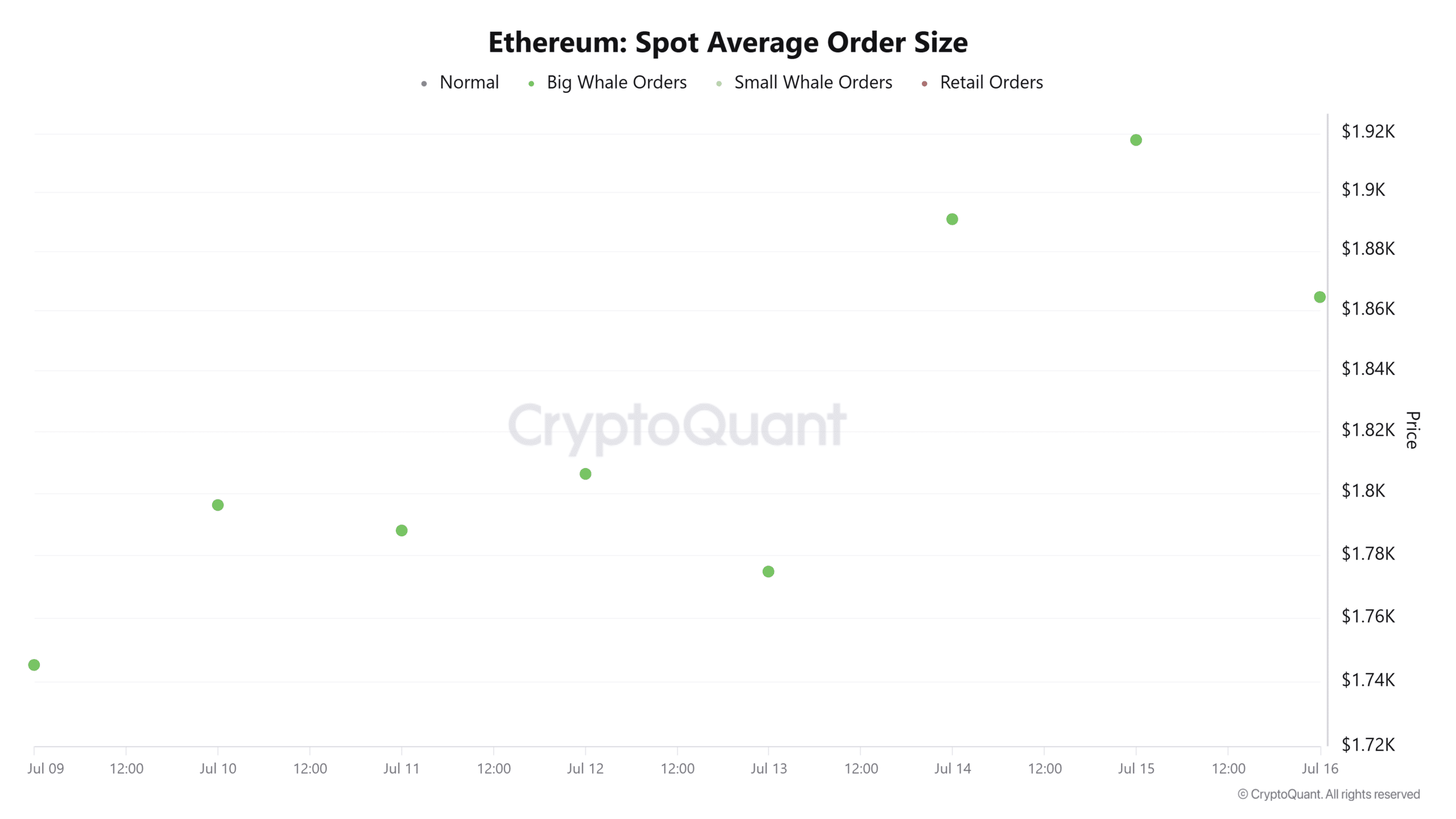
CryptoQuant’s Spot Average Order Size recorded large whale orders for seven consecutive days.
However, the metric captured both buying and selling activity. Therefore, it confirmed whale participation without establishing a clear direction.
Lookonchain also reported that two newly created wallets withdrew 20,000 ETH from Coinbase Prime. The withdrawal was worth $37.72 million and occurred in two batches of 10,000 ETH.
Source: CryptoQuant
According to the tracker, the associated whale had accumulated aggressively during the previous three days.
On the 16th of July, the whale purchased 30,000 ETH, worth $57.6 million. Its three-day accumulation reached 89,396 ETH, valued at approximately $164.88 million.
Buying during a decline suggested that the whale expected stronger prices. However, one entity’s activity could not confirm broader confidence.
Source: CoinGlass
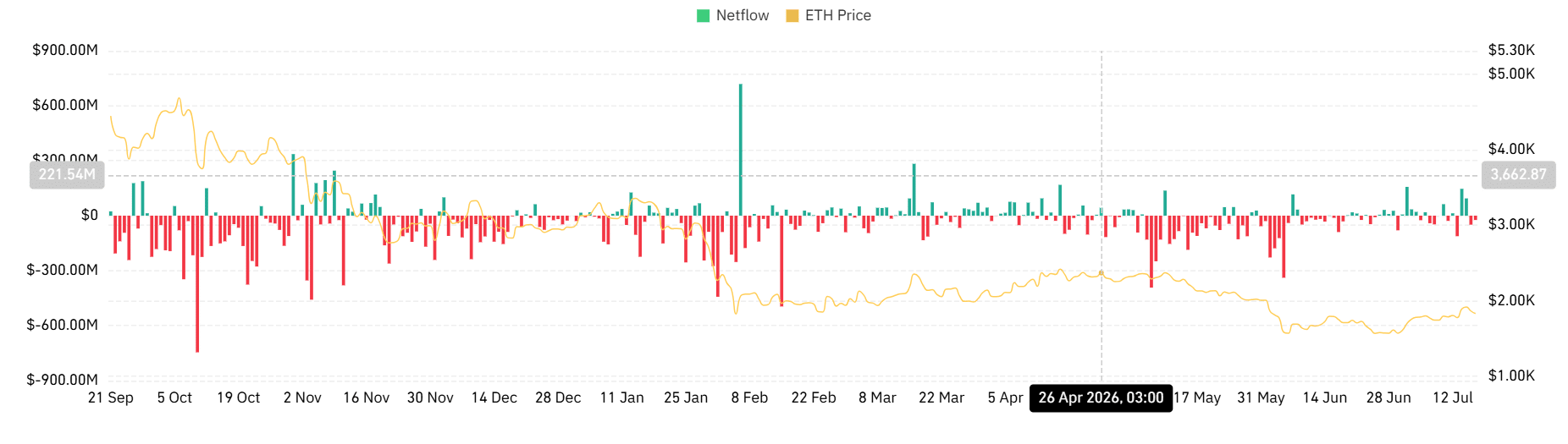
CoinGlass data showed that Ethereum’s Spot Netflow remained negative for two consecutive days.
At press time, Spot Netflow stood at -$23.6 million, compared with -$49 million the previous day. Therefore, net outflows continued but slowed considerably.
Negative Spot Netflow indicated that more ETH left exchanges than entered them. This trend aligned with the reported whale withdrawals. Even so, Exchange Outflows alone could not establish that every withdrawal represented accumulation.
Can whales defend $1.8K?
Whales absorbed some selling pressure, but Ethereum’s broader structure remained weak.
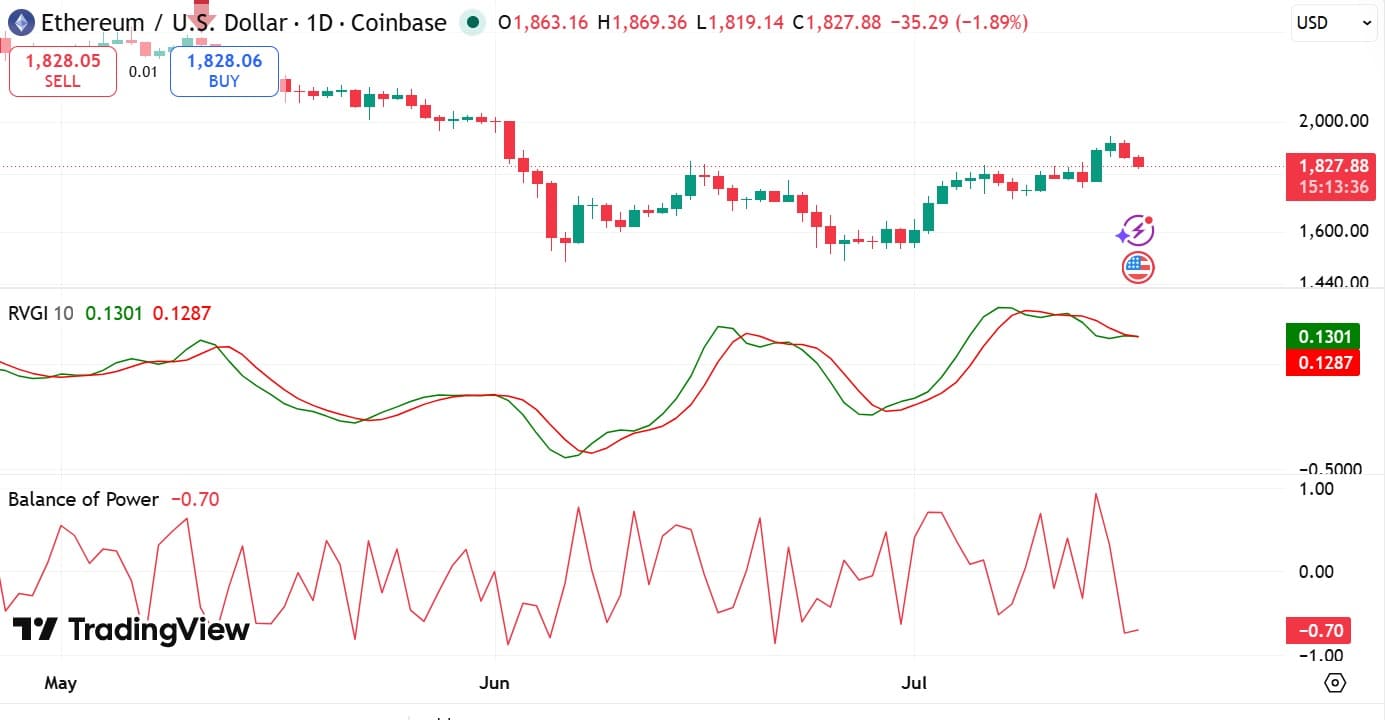
The Balance of Power fell from 0.93 to -0.61, shifting into negative territory. That reading indicated that sellers controlled short-term price action despite the whale demand.
Source: TradingView
Continued weakness could push Ethereum [ETH] below $1,800 and toward $1,774. However, sustained buying could help Ethereum defend $1,800 and reclaim $1,928. A recovery above $1,928 could reopen the path toward $2,000.
Final Summary
A whale accumulated 89,396 ETH, worth $164.88 million, over three days.
Ethereum remained vulnerable below $1,944 despite whale demand and continued Exchange Outflows.
The lack of an ethics provision remains one of the biggest sticking points. Sen. Ruben Gallego (D-Ariz.), one of two Democrats who voted to advance the bill out of the Senate Banking Committee, has repeatedly said he will not support the legislation on the Senate floor without a bipartisan ethics provision. Other Democrats have raised similar concerns over conflicts of interest involving public officials and digital assets.
As of Friday, there had been no public readout from Thursday’s White House meeting, and no bipartisan ethics language had emerged, leaving one of the bill’s largest obstacles unresolved.
If passed, the Clarity Act would establish a federal framework for digital asset markets by drawing a clearer line between assets regulated by the Securities and Exchange Commission (SEC) and those overseen by the Commodity Futures Trading Commission (CFTC). Supporters argue the measure would replace years of regulation through enforcement with rules written by Congress.
Industry executives reiterated that message during a House hearing Friday marking one year since the chamber passed the legislation.
“The community has already done the hard work,” Nova Labs executive Sarah Aberg told lawmakers, arguing that regulatory uncertainty delayed investment in the Helium wireless network after the SEC sued the company in a case that was later settled. “Clarity is not a call for deregulation; it is a call for the right regulation from the right regulator.”
IQQQ’s daily-resetting calls returned 24% over the trailing year, beating QYLD’s 21% while capturing more of QQQ’s 27% gain.
Long-term compounders should skip the overlay entirely, given that QQQ’s 97% five-year return outpaces anything a covered-call structure can deliver in a sustained bull run.
Are you ahead, or behind on retirement? SmartAsset’s free tool can match you with a financial advisor in minutes to help you answer that today. Each advisor has been carefully vetted, and must act in your best interests. Don’t waste another minute; learn more here.
Most covered-call ETFs sell the same trade in different packaging. You get monthly income; you give up upside when the market runs. Global X NASDAQ 100 Covered Call ETF (NASDAQ:QYLD) holders learned this the expensive way over the last decade.
Pla2na / Shutterstock.com
ProShares Nasdaq-100 High Income ETF (NASDAQ:IQQQ) softens that bargain with financial engineering that matters. Instead of writing calls that expire monthly, IQQQ writes calls that reset daily, letting the fund step back into the market’s upside far more frequently than its slower cousins. The question is whether IQQQ earns its keep or repackages the same tradeoff at a higher expense ratio.
The Daily-Reset Machinery
IQQQ has Nasdaq-100 exposure and layers a covered call overlay on top. The overlay is implemented through total return swap agreements rather than by trading options contracts directly, a structural choice with real tax consequences. Distributions are largely treated as a return of capital, meaning holders often receive more favorable tax treatment than ordinary dividend income.
The mechanical trick is timing. A traditional buy-write fund like QYLD writes an at-the-money call once a month and hopes the index does not run away before expiration. If the Nasdaq rips 8% in three weeks, the fund has already sold its upside. IQQQ writes short-dated (essentially 0DTE, out-of-the-money) calls that reset daily, so a big up-day only caps that single day’s gain before the fund re-participates the next morning. In choppy or grinding-higher markets, that difference compounds.
_________________________________
What’s Your Number…?
Here’s a question most people 5y from retirement can’t answer: at your current savings rate, how much do you need, and how long will it actually last? A good advisor can put a date on that in a single meeting. SmartAsset’s free quiz matches you with up to three fiduciary advisors serving your area, so you can get YOUR retirement number now (sponsor)
__________________________________________
Does It Actually Preserve Upside?
Over the trailing year, Invesco QQQ Trust (NASDAQ:QQQ) returned 26%. IQQQ returned 23%. QYLD returned 20%. IQQQ captured most of the Nasdaq’s climb while writing calls daily and beat the traditional covered-call approach by roughly three percentage points. On this stretch, the daily-reset thesis worked.
The income side held up too. IQQQ paid $2.559396 per share in trailing-twelve-month distributions and projects to an annualized $5.51004. Payments are monthly and lumpy, ranging from $0.027464 in August 2025 to $1.551822 in May 2025, which is what a strategy pegged to option premium capture looks like.
What You Are Actually Buying
Beneath the overlay sits a portfolio that is north of 60% technology, anchored by mega-cap stocks. This is concentrated megacap tech with an option layer bolted on, not diversified income by any stretch. The fee for that engineering is roughly 0.55%, meaningfully above plain QQQ but in line with active covered-call peers.
The tradeoffs are real. In a parabolic melt-up, daily calls still cap each day’s gain, and enough capped days in a row will leave you well behind QQQ. Cain Lee at Seeking Alpha rated the fund a Hold, noting “limited downside protection and underperformance” compared to QQQ in volatile markets. He is right that call premiums cushion rather than hedge. In a real drawdown, IQQQ will fall with the Nasdaq minus whatever premium it collected on the way down.
Who It Fits
IQQQ is one of the more thoughtful answers to the covered-call dilemma, but it is still an answer, not an escape. If you are an income-focused investor who wants Nasdaq-100 exposure, understands the swap structure, accepts the 0.55% fee, and specifically wants more upside participation than QYLD has offered, IQQQ earns a look as a 5% to 10% income sleeve. Retirees who need monthly checks and are willing to trade a couple points of annual return for them will find the design coherent.
Anyone whose primary goal is long-term compounding should keep buying QQQ and skip the overlay. Over the last five years, QQQ returned 95%, and no covered-call structure will keep up with that in a sustained bull market. The daily reset narrows the gap. It does not close it.
If You’ve Been Thinking About Retirement, Pay Attention (sponsor)
Retirement planning doesn’t have to feel overwhelming. The key is finding expert guidance, and SmartAsset’s simple quiz makes it easier than ever for you to connect with a vetted financial advisor. Here’s how: