Home Blog Page 230

Finally, a Covered-Call ETF That Doesn’t Kill Your Upside? Here’s the Catch

0
Finally, a Covered-Call ETF That Doesn’t Kill Your Upside? Here’s the Catch


Quick Read

  • IQQQ’s daily-resetting calls returned 24% over the trailing year, beating QYLD’s 21% while capturing more of QQQ’s 27% gain.

  • Long-term compounders should skip the overlay entirely, given that QQQ’s 97% five-year return outpaces anything a covered-call structure can deliver in a sustained bull run.

  • Are you ahead, or behind on retirement? SmartAsset’s free tool can match you with a financial advisor in minutes to help you answer that today. Each advisor has been carefully vetted, and must act in your best interests. Don’t waste another minute; learn more here.

Most covered-call ETFs sell the same trade in different packaging. You get monthly income; you give up upside when the market runs. Global X NASDAQ 100 Covered Call ETF (NASDAQ:QYLD) holders learned this the expensive way over the last decade.

Pla2na / Shutterstock.com

ProShares Nasdaq-100 High Income ETF (NASDAQ:IQQQ) softens that bargain with financial engineering that matters. Instead of writing calls that expire monthly, IQQQ writes calls that reset daily, letting the fund step back into the market’s upside far more frequently than its slower cousins. The question is whether IQQQ earns its keep or repackages the same tradeoff at a higher expense ratio.

The Daily-Reset Machinery

IQQQ has Nasdaq-100 exposure and layers a covered call overlay on top. The overlay is implemented through total return swap agreements rather than by trading options contracts directly, a structural choice with real tax consequences. Distributions are largely treated as a return of capital, meaning holders often receive more favorable tax treatment than ordinary dividend income.

The mechanical trick is timing. A traditional buy-write fund like QYLD writes an at-the-money call once a month and hopes the index does not run away before expiration. If the Nasdaq rips 8% in three weeks, the fund has already sold its upside. IQQQ writes short-dated (essentially 0DTE, out-of-the-money) calls that reset daily, so a big up-day only caps that single day’s gain before the fund re-participates the next morning. In choppy or grinding-higher markets, that difference compounds.

_________________________________

What’s Your Number…?

Here’s a question most people 5y from retirement can’t answer: at your current savings rate, how much do you need, and how long will it actually last? A good advisor can put a date on that in a single meeting. SmartAsset’s free quiz matches you with up to three fiduciary advisors serving your area, so you can get YOUR retirement number now (sponsor)


Source link

Inside Robinhood’s high-stakes bet to ‘democratizing’ its 10 million casual users onto blockchain finance

0
Inside Robinhood’s high-stakes bet to 'democratizing' its 10 million casual users onto blockchain finance

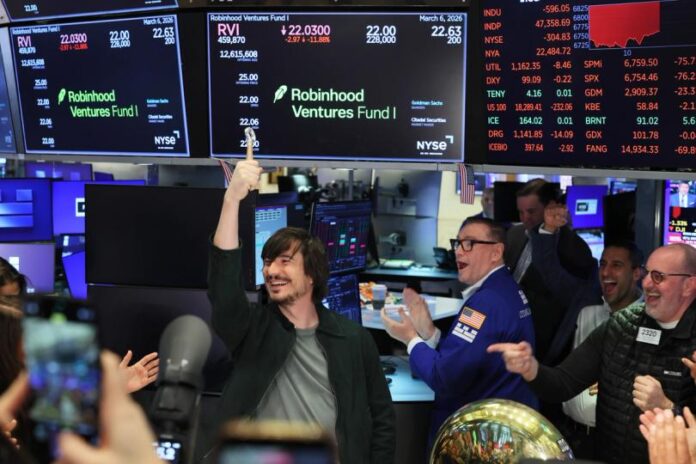
Tokenized real-world assets (RWAs) account for just $12.66 million in active market capitalization despite the recent spike in trading activity.

Much of that larger activity, instead, came from memecoin traders piling into a new token, CASHCAT, named after Robinhood’s former company mascot. The token rallied by more than 2,100% in its first week, briefly reaching a $156 million market cap, which is 12 times larger than the chain’s entire tokenized real-world asset market.

It’s worth noting, though, that memecoins are volatile and hype-driven by nature, often lacking durable growth. That lack of sustainability was evident on Wednesday, when Noxa, the token launcher that spawned CashCat, announced it had stopped operating while directing all revenue to creators. The shutdown does not determine the fate of Robinhood Chain, but it underscores how quickly activity built around memecoin launches can disappear.

Ironically, Robinhood CEO Vlad Tenev told CNBC on July 2 that memecoins were a dead end – assets with no utility that serve no purpose. Six days later, he posted that Robinhood Chain “works great for memes too,” presumably after seeing CASHCAT’s success.

Asked about the apparent contradiction, the company did not directly address it. “The early activity on Robinhood Chain is exciting: developers are building, users are engaging, and the chain is performing as designed,” Lee said.


Source link

Can FARTCOIN rebound from its 13% decline? THESE metrics suggest…

0
Can FARTCOIN rebound from its 13% decline? THESE metrics suggest…


Fartcoin [FARTCOIN] fell roughly 13% over the past few days as sellers strengthened their grip. That decline reinforced expectations of a steeper sell-off. However, the derivatives setup appeared less straightforward.

Shorts benefited from the decline, yet whale positioning and Funding Rates supported a possible near-term rebound.

Is FARTCOIN nearing a bottom?

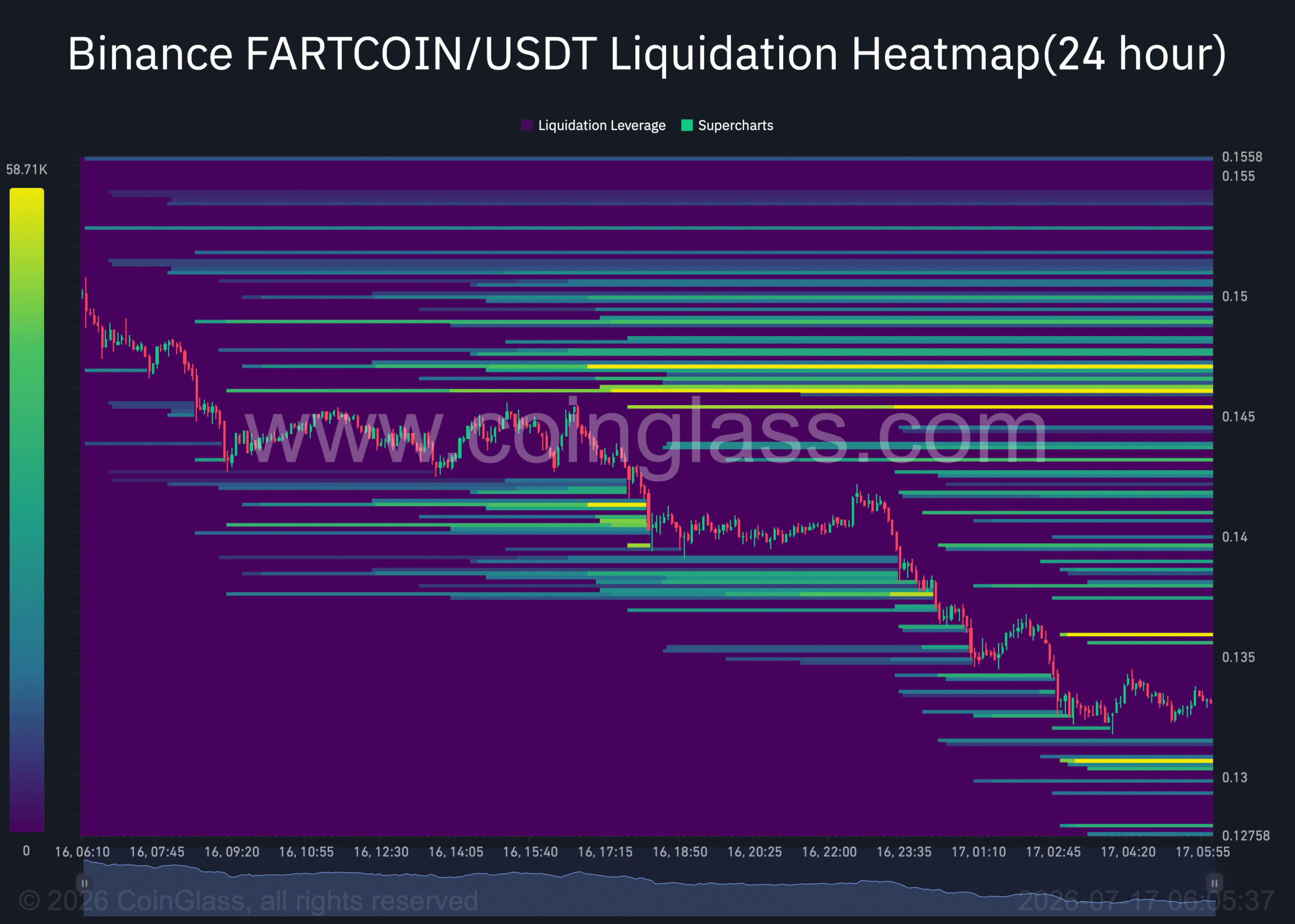
Binance’s 24-hour Liquidation Heatmap suggested FARTCOIN could be approaching a local bottom. A modest liquidation cluster sat near $0.130, slightly below the memecoin’s press-time price.

These clusters represent areas where leveraged positions could face liquidation. They can attract price, but they do not guarantee reversals.

Fartcoin liquidation heatmap.
Source: CoinGlass

If FARTCOIN tests this level, the memecoin could rebound toward the larger overhead clusters.

The strongest concentrations appeared between approximately $0.145 and $0.147. These levels could become upside targets during a recovery.

On top of that, CoinGlass’ Whale-Retail Delta showed that whales dominated the recent move. Whales could accumulate after driving prices lower. If that happens, FARTCOIN may record a stronger recovery.

Why are shorts still vulnerable?

Shorting FARTCOIN appeared profitable during the decline, but that position carried growing risk.

CoinGlass data showed roughly $942,000 in long liquidations across centralized exchanges. Short liquidations reached only $18,000. Therefore, long liquidations were about 52 times larger than short liquidations.

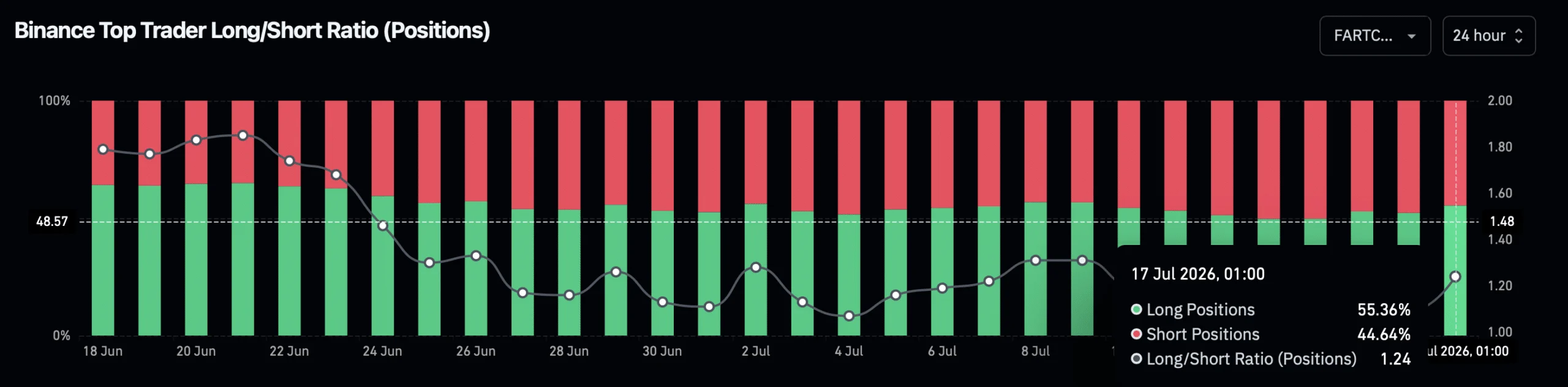
FARTCOIN Binance whale long to short ration. FARTCOIN Binance whale long to short ration.
Source: CoinGlass

That disparity could encourage more traders to enter short positions. However, Binance’s top traders maintained a bullish bias.

Long accounts represented 56.07% of the total, while long positions accounted for 55.36%.

The Top Trader Long/Short Ratio for positions stood at 1.24. This confirmed that larger traders remained tilted toward longs. Therefore, further upside could expose crowded short positions to liquidations.

Are traders expecting a rebound?

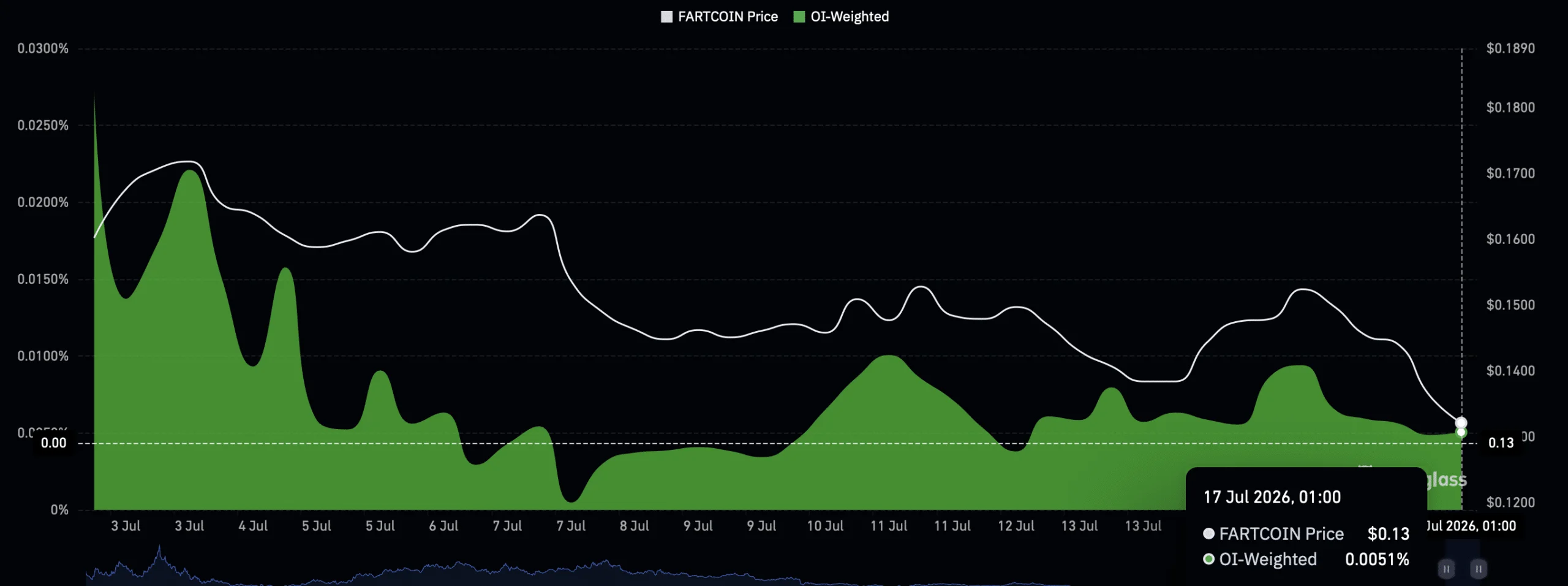
FARTCOIN’s OI-Weighted Funding Rate remained positive at 0.0051% at press time. The metric had recovered slightly after declining during the previous day.

Fartcoin funding rate chart. Fartcoin funding rate chart.
Source: CoinGlass

A positive Funding Rate meant long traders paid shorts, reflecting stronger demand for leveraged long exposure. This positioning supported the rebound case, although it did not guarantee an immediate recovery.

FARTCOIN must hold the lower liquidity zone before targeting the larger clusters above.


Final Summary

  • FARTCOIN fell 13%, but whale positioning remained bullish.
  • Long liquidations exceeded short losses by roughly 52 times.


Source link

Netflix Just Changed How Often It Reports Engagement. Should Investors Worry?

0
Netflix Just Changed How Often It Reports Engagement. Should Investors Worry?


On the surface, Netflix‘s (NASDAQ: NFLX) second-quarter earnings report wasn’t terrible. Revenue came in slightly below expectations, but grew 13% year-over-year, and earnings per share grew by 11% and came in ahead of what analysts had been looking for. Membership growth, pricing increases, and ad revenue growth all contributed to the double-digit growth.

Even when it comes to forward guidance, there’s not much to complain about. It gave a full-year outlook in line with its previous forecast and narrowed (but did not lower) its 2026 revenue guidance.

Missed Nvidia in 2009? This Rare Signal Is Flashing Again. In 2009, a “Double Down” signal flashed for a little-known chipmaker called Nvidia. For the first time in years, that same “Total Conviction” signal is flashing for a company 1/100th the size of Nvidia. Continue »

However, there was one item that investors seemed to have fixated on-Netflix’s user engagement. And the stock fell by about 10% shortly after the earnings release.

Image source: Getty Images.

A reporting shift is bothering investors

The company’s conference call featured several analyst questions about user engagement, a key focus for investors. And to put it mildly, it seems like the market didn’t love the answers. For starters, Netflix called its user engagement “healthy” and said that there wasn’t any significant change in viewership for the second season of some of its series versus the first.

On the other hand, management said it would reduce the frequency of its engagement reports, changing the cadence of its “What We Watched” reports from semiannual to annual starting in 2027. So, investors will still see engagement figures, only less frequently.

Now, Netflix claims the shift is to keep the focus on metrics such as revenue and profit. But the reality is that Netflix has been under scrutiny in recent years over whether or not engagement is declining. Reducing how often investors get fresh engagement data at a time when many are questioning it isn’t exactly a good look.

Is this a smart move by Netflix?

There’s a case to be made that this is a smart move. It isn’t exactly unprecedented either. The company stopped reporting subscriber counts in 2025 to focus on revenue and profit, and there’s a legitimate point that looking at engagement hours alone can be misleading — for example, Netflix reported that live programming makes up 1% of viewing hours but pulls in the most advertising dollars.

Of course, this only works if the company can deliver on revenue growth, advertising growth, profit margins, and other metrics management wants investors to focus on. But with revenue guidance for the third quarter falling a bit short of expectations, there are some big questions surrounding whether that will be the case.

Should you buy stock in Netflix right now?

Before you buy stock in Netflix, consider this:

The Motley Fool Stock Advisor analyst team just identified what they believe are the 10 best stocks for investors to buy now… and Netflix wasn’t one of them. The 10 stocks that made the cut could produce monster returns in the coming years.

Consider when Netflix made this list on December 17, 2004… if you invested $1,000 at the time of our recommendation, you’d have $400,964!* Or when Nvidia made this list on April 15, 2005… if you invested $1,000 at the time of our recommendation, you’d have $1,272,955!*

Now, it’s worth noting Stock Advisor’s total average return is 930% — a market-crushing outperformance compared to 210% for the S&P 500. Don’t miss the latest top 10 list, available with Stock Advisor, and join an investing community built by individual investors for individual investors.

See the 10 stocks »

*Stock Advisor returns as of July 17, 2026.

Matt Frankel, CFP® has no position in any of the stocks mentioned. The Motley Fool has positions in and recommends Netflix. The Motley Fool has a disclosure policy.

Netflix Just Changed How Often It Reports Engagement. Should Investors Worry? was originally published by The Motley Fool


Source link

How Higher Ed Is Adapting to the Needs of Non-Traditional Students

0
How Higher Ed Is Adapting to the Needs of Non-Traditional Students


Opinions expressed by Entrepreneur contributors are their own.

Key Takeaways

  • Adult learners are reshaping higher education through demand for flexible, career-focused learning pathways.
  • Institutions are embracing modular programs, competency-based education and personalized support to improve outcomes.
  • Employer demand for practical skills is accelerating lifelong learning and non-traditional student enrollment.

Higher education was built around a fairly simple model: students finish school, enter college full-time and move into the workforce a few years later. That model still exists. But it no longer reflects how most people experience higher education today.

A growing share of learners are working professionals, career switchers, parents and adults returning to education after time in the workforce, across many institutions. They are no longer sitting at the edges of the system. They are becoming central to how colleges think about enrollment, program design and long-term strategy.

According to an Education Data Initiative post analyzing U.S. higher education enrollment data for the 2022–2023 academic year, more than 14 million non-traditional students are currently enrolled, underscoring how significantly adult learners are reshaping higher education today.

This shift is not just about who is showing up on campus. It is changing what higher education is expected to do.

Why are adult learners returning to higher education?

Adult learners are increasingly drawn back to higher education because the payoff is becoming harder to ignore. According to Lightcast’s Moving Up and Moving Forward: Advancing Mobility for Adult Learners, adults who return to education are 22% more likely to experience upward mobility and see an average 140% increase in annual salary compared to working adults who do not re-enter formal learning.

But the motivation is not just financial. For many non-traditional students, higher education is no longer a separate phase of life. It runs alongside work, family and other ongoing responsibilities.

Two-thirds of adult learners pursue bachelor’s degrees, while about 28% enroll in associate’s degree programs and around 6% go on to complete a master’s degree or PhD. Across both bachelor’s and associate’s pathways, the most common fields of study are business, management and marketing, followed by health professions and related programs, according to the same report.

Because of that, their expectations look different. They are less focused on the traditional idea of the “college experience” and more focused on practical career outcomes and growing income capacity. The key questions are whether the learning is applicable, whether it can fit into their schedules and whether their prior experience is recognized rather than overlooked.

In many ways, education becomes less of a linear journey and more of a series of steps taken over time, often shaped by career needs and life transitions.

What these learners expect from institutions

When you look across adult and working learners, a few expectations show up consistently.

Flexibility comes first. Fixed class times, rigid course sequences and semester-bound pacing often do not align with the realities of working life.

Relevance is just as important. Learners are increasingly asking a simple question: how does this help me move forward in my career?

Pace also matters. Many adult learners already bring years of experience into the classroom, which makes a one-size-fits-all learning speed feel unnecessary.

Finally, recognition matters, especially when it comes to prior learning and professional experience. For many, the ability to convert what they already know into academic credit can be the difference between starting over and moving forward.

How institutions are adapting

Higher education is not changing in one single leap. Instead, it is evolving through a series of connected adjustments.

The most visible shift is in delivery. Online, hybrid, evening and self-paced programs are expanding quickly, often designed with working students in mind. Flexibility is no longer an add-on. It is increasingly built into the core structure of programs.

For institutions, there is also a strong case that admitting and designing for adult learners is not just about expanding access, but about improving outcomes. Emerging research from the University of Kansas and Florida International University found that “students older than 25, those working full-time, commuters and students with dependents demonstrated better academic outcomes, including retention, six-year graduation rates and cumulative GPA,” suggesting that non-traditional student characteristics often associated with risk may actually align with stronger persistence and completion.

At the same time, a bigger change is emerging in how progress is defined. While the credit-hour system still underpins most institutions, more colleges are experimenting with competency-based education, where students move forward by demonstrating mastery rather than simply completing time in class.

It is a subtle but important shift. It moves institutions from tracking participation to validating capability.

From courses to competencies and modules

As institutions rethink program design, many are also breaking degrees into smaller and more flexible units. Instead of treating a degree as a fixed sequence of courses, learning is increasingly organized around competencies or modular components.

That opens up more flexible pathways. Students can earn certificates or microcredentials along the way and stack them toward larger qualifications over time.

For adult learners, especially, this makes education feel more manageable. It lowers the barrier to re-entry and allows learning to happen in steps rather than all at once.

Employers are reinforcing the shift

The labor market is also shaping this direction.

Employers are putting more weight on skills and demonstrated ability than on credentials alone. Job roles are increasingly defined around competencies, and in some cases, employers are working directly with institutions to help shape program outcomes.

According to the OECD’s Trends in Adult Learning: New Data from the 2023 Survey of Adult Skills findings, employers increasingly value adult learners for the qualities they bring to the workplace. Apart from academic credentials, the qualities that stand out in these learners are stronger motivation, practical experience, adaptability and a mature approach to problem-solving. Their ability to connect classroom learning with real-world challenges makes them particularly attractive to organizations seeking employees who can contribute quickly and navigate complex work environments. As a result, institutions that successfully attract and support adult learners may be better positioned to align with evolving employer needs and workforce demands. 

The often overlooked redesign: student support

Academic change is only part of the story. Institutions are also rethinking how they support students who are not living on campus or studying full-time.

Advising is becoming more continuous and more personalized, especially for students balancing multiple responsibilities. Career support is increasingly embedded into programs rather than treated as a final step. And digital systems are playing a bigger role in keeping students connected when their learning is spread across time and place.

In short, support is shifting from being location-based to learner-based.

A broader institutional shift

Taken together, these changes point to something larger than program redesign.

Higher education is slowly moving away from a model built around a single, concentrated phase of life. In its place, a more continuous system is emerging, one where learning is revisited, updated and layered over time.

Non-traditional students are not just expanding access to higher education. They are quietly reshaping their assumptions.

And in doing so, they are pushing institutions toward a future where education is less of a stage and more of a lifelong system.


Key Takeaways

  • Adult learners are reshaping higher education through demand for flexible, career-focused learning pathways.
  • Institutions are embracing modular programs, competency-based education and personalized support to improve outcomes.
  • Employer demand for practical skills is accelerating lifelong learning and non-traditional student enrollment.

Higher education was built around a fairly simple model: students finish school, enter college full-time and move into the workforce a few years later. That model still exists. But it no longer reflects how most people experience higher education today.

A growing share of learners are working professionals, career switchers, parents and adults returning to education after time in the workforce, across many institutions. They are no longer sitting at the edges of the system. They are becoming central to how colleges think about enrollment, program design and long-term strategy.

According to an Education Data Initiative post analyzing U.S. higher education enrollment data for the 2022–2023 academic year, more than 14 million non-traditional students are currently enrolled, underscoring how significantly adult learners are reshaping higher education today.


Source link

Bitcoin faces fresh headwinds as China’s Kimi beats Claude, GPT in coding benchmark

0
Bitcoin faces fresh headwinds as China’s Kimi beats Claude, GPT in coding benchmark

The part that rattles valuations is the license. K3 is open-weight, with the full model due for public release on July 27. Anyone will be able to download it, run it on their own hardware, and pay nobody.

Anthropic released Fable 5 last month, and OpenAI shipped GPT-5.6 a week ago, both closed and metered. The assumption underwriting hundreds of billions of dollars in AI infrastructure spending is that frontier capability stays scarce, expensive and American.

A free Chinese model at the top of a coding leaderboard is a direct argument against that.

Meanwhile, Moonshot’s domestic rivals took it worst, with Z.ai falling about 27% and MiniMax about 16%.

For crypto, the headwinds run through the tape rather than through anything onchain. Bitcoin has spent this entire week taking direction from semiconductors.

Last Friday, it rose 4% on the day South Korea’s Kospi jumped 8% and SK Hynix priced $26.5 billion of American depositary shares. This Friday, it fell because a model release in Beijing made the same trade look expensive.

There is, however, a more concrete exposure underneath.

Bitcoin miners have spent two years repositioning themselves as AI data center landlords, signing long-term leases with model developers on the assumption that demand for training and inference compute keeps rising.


Source link

Bitcoin and ethereum prices today, Friday, July 17, 2026: Prices ease as conflict in Iran escalates

0
Bitcoin and ethereum prices today, Friday, July 3, 2026: 'Green' July off to a solid start


Bitcoin (BTC-USD) opened at $63,788.52 on Friday, July 17, 2026, down 1.4% from Thursday’s opening price. The value of bitcoin fell to $63,130.40 by 8:33 a.m. ET.

Ethereum (ETH-USD) opened at $1,863.16 on Friday, July 17, 2026, down 2.8% from Thursday’s opening price. The value of ethereum moved down to $1,832.29 as of 8:33 a.m. ET.

Bitcoin’s time above $65,000 and ethereum’s time over $1,900 was short-lived this week as a sixth day of U.S. airstrikes against Iran has dulled risk-based investments like crypto.

The prices of ethereum and bitcoin have resettled this morning at levels seen earlier in the week, and remain higher than week-ago levels.

Geopolitical tensions across the Middle East are affecting investors of all stripes as the critical Strait of Hormuz remains effectively closed, sending oil prices back up.

The price of bitcoin this morning was down 1.4% from Thursday’s opening figure. Here’s a look at how the opening bitcoin price has changed versus last week, month, and year:

  • One week ago: +0.9%

  • One month ago: -2.8%

  • One year ago: -46.3%

The all-time high for bitcoin was $126,198.07 on Oct. 6, 2025. The all-time low value for bitcoin was $0.04865 on July 14, 2010. 

The price of ethereum this morning was down 2.8% compared to Thursday’s open. Here’s how the opening ethereum price has changed versus last week, month, and year:

  • One week ago: +6.8%

  • One month ago: +4.1%

  • One year ago: -44.7%

The all-time high for ethereum was $4,953.73 on Aug. 24, 2025. The all-time low value for ethereum was $0.4209 on Oct. 21, 2015. 

Bitcoin, ethereum, and other cryptocurrencies are rapidly evolving. Follow the latest developments from Yahoo Finance and others here.

So, you put a little mad money into bitcoin a few years ago. Now, your crypto-fueled profit means you have a sweet nest egg to put toward a house.

But can you buy a house with crypto rather than using cash or a traditional mortgage loan? What are the roadblocks? And what about taxes?

President Trump wants the United States to be “the crypto capital of the world.” In that spirit, in late June, Director of the Federal Housing Finance Agency (FHFA) William J. Pulte ordered Fannie Mae and Freddie Mac to “prepare their businesses to count cryptocurrency as an asset for a mortgage.”

The FHFA supervises Fannie Mae and Freddie Mac, the government-sponsored companies that fund a major portion of the mortgage industry.

Pulte said the housing system “needs a massive upgrade,” adding, “I want people who own cryptocurrency to be able to buy homes like everyone else. I believe cryptocurrency is an asset. I believe Americans should be able to use their crypto if they want to. It’s time the housing system caught up.”

This signals what could be a fundamental change to how cryptocurrency may be used to qualify for a mortgage.

Learn more: Want to buy a house with crypto? Here’s what to expect

Whether you’re brand new to tracking the value of bitcoin and ethereum or a more seasoned crypto investor, Yahoo Finance’s price-of-bitcoin chart and price-of-ethereum chart below show a visual history of how the currencies’ value continues to move and evolve.

More information on crypto from the Yahoo Finance team: 


Source link