
Home Blog Page 231

FinTech Week Awards & Expo Singapore 2026 to Bring Together 1,000+ Global FinTech Leaders This September

0
FinTech Week Awards & Expo Singapore 2026 to Bring Together 1,000+ Global FinTech Leaders This September


The People Events is pleased to announce the 4th FinTech Week Awards & Expo Singapore 2026, taking place on 16–17 September 2026 at Crowne Plaza Changi Airport, Singapore. Building on the success of its previous global editions, including the widely acclaimed Dubai event, the Singapore edition will bring together the world’s leading fintech innovators, financial institutions, investors, regulators, policymakers, and technology providers to shape the future of financial services.

Held under the theme “Finance. Innovation. Future.”, the two-day international event will serve as a premier platform for thought leadership, business networking, strategic partnerships, and industry recognition. Participants will gain valuable insights into the latest trends and technologies transforming the global financial ecosystem while connecting with key decision-makers from across the fintech value chain.

The event is expected to welcome 1,000+ senior professionals, 70+ internationally renowned speakers, and delegates from 30+ countries, creating an unparalleled environment for collaboration, investment, and innovation. Attendees will include C-level executives, founders, banking leaders, investors, regulators, policymakers, technology providers, and emerging fintech innovators from around the world.

The conference agenda will feature visionary keynote addresses, expert-led panel discussions, fireside chats, startup showcases, networking sessions, and the prestigious FinTech Week Awards Ceremony, recognising outstanding achievements and innovation across the global fintech industry. Key discussion areas will include digital banking, payments innovation, artificial intelligence, blockchain, digital assets, regtech, financial inclusion, cybersecurity, embedded finance, and the future of financial infrastructure.

“Singapore has firmly established itself as one of the world’s foremost fintech hubs and a gateway to the Asia-Pacific financial ecosystem,” said a representative from The People Events. “Through the 4th FinTech Week Awards & Expo Singapore, we aim to create a world-class platform where industry leaders, innovators, investors, and policymakers can exchange ideas, forge strategic partnerships, and accelerate the next wave of financial innovation.”

In addition to its conference programme, the event will feature an international exhibition showcasing cutting-edge solutions from fintech companies, banks, payment providers, AI innovators, regtech firms, blockchain platforms, and financial technology leaders. The exhibition will offer exhibitors and sponsors direct access to senior decision-makers and qualified buyers seeking innovative technologies and strategic partnerships.

Whether launching a new solution, expanding into international markets, seeking investment, or building strategic alliances, FinTech Week Awards & Expo Singapore 2026 provides a unique opportunity to engage with the organisations and individuals driving the future of global finance.

Event Details

  • Event: FinTech Week Awards & Expo Singapore 2026
  • Dates: 16–17 September 2026
  • Venue: Crowne Plaza Changi Airport, 75 Airport Boulevard, Singapore 819664
  • Theme: Finance. Innovation. Future.
  • Website: https://fintech.peoplevents.uk

Confirmed Speakers

  • Ranvir Singh – Founder, Chairman & CEO, Kissht
  • Anna Zotova – Chief Risk Officer (CRO) & Money Laundering Reporting Officer (MLRO), xpate
  • Doreen Fadli – Deputy Director, Market Development & Innovation Department, Labuan FSA
  • Melanie Lennert – CEO & Co-Founder, CRO2go
  • Shelli Ryan – CEO, Ad Hoc Communication Resources
  • David Hanna – CEO, Finmo
  • Chee Keong Teo – Associate Partner, Blockchain & Digital Assets Leader, EY
  • Laksh Gangwani – Chief Growth Officer, ViewTrade
  • Serkan Turan – CEO, Yolparam
  • Julia Chin – Founder & CEO, JFourth Solutions (Malaysia & Singapore)

  • David B. Wang – Head of Loyalty Partnerships & General Manager, HeyMax
  • Annabelle Lin – Co-Founder & Chief Revenue Officer, Nextvestment
  • Jessica Maria Rota – Founder, AEVA Strategy
  • Marina Wasserman – Founder & Director, Movements.Capital
  • Vivien Tan Hui Yui – Senior Vice President, Alliance Bank
  • Raj Senapati – Global Head of BFSI, Payments & Cards, Xoxoday
  • Dr. Deepika Chaudhary – Assistant Professor, K.R. Mangalam University
  • Jan Lorenc – CEO, CurrencyFair
  • Shady Zitoun – CEO & Co-Founder, BitKnz
  • Vadim Timokhin – Founder & CEO, XChangeLab

  • Monica Millares – Founder, Purpose Driven FinTech
  • Oliver von Wolff – Founder & CEO, Helion Capital | Founder & Director, Mjoelnir Capital
  • Yi Hahn Chin – SVP, Head of FX & Money Movement Innovation, Boku
  • Alvin Yeoh – Senior Product Manager, HSBC
  • Kevin Lee – Founder & CEO, TrustPlus AI
  • Meera Vidyut – Head of APAC, AML Watcher
  • Sereen Teoh – Founder & CEO, SurplusLoop
  • Yiannos Ashiotis – Managing Partner & Co-Founder, Pnyx Hill & GRC Partners
  • Frank Zielkowski – Founder & CEO, NARRUX / aiTrate Group
  • Ming Wang Lim – Founder, Modern Strategy

  • Isabelle Mustapic – Founder, Ora et Labora Advisory | Co-Chair, WIFA
  • Dr. Simon Liu – Chief Data & AI Officer, TrustDecision
  • Aaron Sim – Head of Business Development, APAC, Remitly
  • Avalon Ingram – Digital Assets Business Lead, Swift
  • Anton F. – Leads Institutional Business, Glassnode
  • Najla Albarrak – Chief Executive Officer, Wazin International Investment Consulting Company
  • Guneet Kaur – Banking Transformation & Product Leader
  • Farah Jaafar – Board Director | Corporate Advisor | Financial Centre Strategist | Digital Finance Leader

For Media & Sponsorship Enquiries

Karan Singh

Event Manager | Fintech Week Awards & Expo 2026 Email: Karan_s@singaporeevent.com Call/WhatsApp: +44 1442 781082 / +44 7440 562683

Anushka Bhadoriya

Email: fintech@peoplevents.uk

Delegate Relation Manager | Fintech Week Awards & Expo 2026 Website: https://fintech.peoplevents.uk

About The People Events

The People Events is a global leader in high-impact B2B conferences and exhibitions. With a focus on innovation, leadership, and industry transformation, we bring together decision-makers and disruptors to create opportunities that shape the future.

 Disclaimer: This is an Event Partner post and should not be treated as news/advice.


Source link

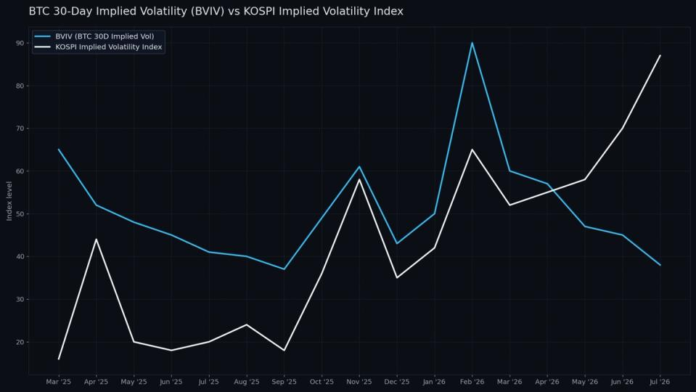
AI frenzy losing steam leaves BTC price less volatile than South Korea’s Kospi: Crypto Daily

0
AI frenzy losing steam leaves BTC price less volatile than South Korea's Kospi: Crypto Daily

For bitcoin supporters, the reality that BTC is steadier than the Kospi is a notable victory. Still, the largest cryptocurrency remains twice as volatile and risky as the S&P 500 index, whose 30-day volatility index (VIX) sits below 20%. Perhaps the true milestone for bitcoin bulls will be the day when the VIX becomes more expensive than the BVIV.

In the meantime, bitcoin’s price remains under pressure, trading below its widely followed 50-day moving average, though there is a glimmer of optimism. According to analytics firm Nansen, the wallets that typically move first and in the largest size during geopolitical flare-ups have not meaningfully shifted into stablecoins.

“This is consistent with prior Middle East flare-ups: Short-term leveraged longs get flushed, and then accumulation resumes,” Nicolai Sondergaard, a research analyst at Nansen, said in an email.

Other market observers are urging a focus on the forthcoming hearings in Washington D.C.

“The Clarity Act faces what could be its final test today, the industry insisting its gets done while the bill snags on Trump conflict of interest provisions and fresh Senate hurdles before the August recess. This is the regulatory clarity the institutional bid has been waiting for,” analysts at Marex said.


Source link

Mortgage and refinance interest rates today, Friday, July 17, 2026: Rates are mixed today

0
Mortgage and refinance interest rates today, Friday, July 3: Rates mostly higher again today


According to the Zillow lender marketplace, mortgage rates are mixed today. The average 30-year fixed-rate mortgage rose by 3 basis points to 6.52% today, Friday, July 17, 2026. The average 15-year fixed rate fell by 1 basis point to 5.95%. The average 5/1 ARM rose by 1 basis point to 6.75%.

Read more: Weekly survey of mortgage lenders with the lowest rates: Rates bubble higher

Here are the current purchase rates, according to the latest Zillow data, for Friday, July 17, 2026:

  • 30-year fixed: 6.52%

  • 20-year fixed: 6.31%

  • 15-year fixed: 5.95%

  • 5/1 ARM: 6.75%

  • 7/1 ARM: 6.26%

  • 30-year VA: 5.90%

  • 15-year VA: 5.71%

  • 5/1 VA: 5.83%

Remember, these are national averages and have been rounded to the nearest hundredth. 

These are the latest refinance rates, according to the latest Zillow data, for Friday, July 17, 2026:

  • 30-year fixed: 6.50%

  • 20-year fixed: 6.42%

  • 15-year fixed: 5.88%

  • 5/1 ARM: 6.61%

  • 7/1 ARM: 6.35%

  • 30-year VA: 5.91%

  • 15-year VA: 5.53%

  • 5/1 VA: 5.77%

Again, the numbers provided are national averages rounded to the nearest hundredth. Mortgage refinance rates are often higher than rates when you buy a house, although that’s not always the case.

Learn more: Dig deeper into the 7 home refinance options

Your mortgage rate plays a large role in how much your monthly payment will be. Use this mortgage calculator to see how your mortgage amount, rate, and term length will impact your monthly payments:

Mortgage payment calculator

Mortgage payment breakdown

81% Principal & interest

$2,145


You can bookmark the Yahoo Finance mortgage payment calculator and keep it handy for future use, as you shop for homes and lenders.

A mortgage interest rate is a fee for borrowing money from your lender, expressed as a percentage. You can choose from two types of rates: fixed or adjustable.

A fixed-rate mortgage locks in your rate for the entire life of your loan. For example, if you obtain a 30-year mortgage with a 6% interest rate, your rate will remain at 6% for the entire 30-year term unless you refinance or sell.

An adjustable-rate mortgage locks in your rate for a predetermined period and then adjusts it periodically. Let’s say you get a 7/1 ARM with an introductory rate of 6%. Your rate would be 6% for the first seven years, then the rate would increase or decrease once per year for the last 23 years of your term. Whether your rate goes up or down depends on several factors, such as the economy and housing market.

At the beginning of your mortgage term, most of your monthly payment goes toward interest. Your monthly payment toward mortgage principal and interest stays the same throughout the years. However, less and less of your payment goes toward interest, and more goes toward the mortgage principal or the amount you originally borrowed.

Read more: Determine whether an adjustable-rate vs. fixed-rate mortgage is better for you

A 30-year fixed-rate mortgage is a good choice if you want a lower mortgage payment and the predictability that comes with having a fixed rate. Just know that your rate will be higher than if you choose a shorter term, and you will pay significantly more in interest over the years.

You may want to consider a 15-year fixed-rate mortgage if you aim to pay off your home loan quickly and save money on interest. These shorter terms come with lower interest rates, and since you’re cutting your repayment time in half, you’ll save a lot in interest in the long run. But you’ll need to be sure you can comfortably afford the higher monthly payments that come with 15-year terms.

Read more: Learn how to decide between a 15-year and 30-year fixed-rate mortgage

Typically, an adjustable-rate mortgage might be suitable if you plan to sell before the introductory rate period ends. Adjustable rates usually start lower than fixed rates, and then your rate will change after a predetermined amount of time. However, 5/1 and 7/1 ARM rates have been similar to (or even higher than) 30-year fixed rates recently. Before getting an ARM just for a lower rate, compare your rate options from term to term and lender to lender.

Some rates are decreasing, but not all. The average 30-year fixed-rate mortgage rose by 3 basis points to 6.52% today, Friday, July 17, 2026. The average 15-year fixed rate fell by 1 basis point to 5.95%. The average 5/1 ARM rose by 1 basis point to 6.75%.

According to Freddie Mac, the average 30-year mortgage rate was 6.55% through Wednesday, up from 6.49% a week earlier. A year ago, the average 30-year mortgage rate was 6.75%.

According to the latest forecasts, the MBA expects the 30-year mortgage rate to be between 6.4% and 6.5% through 2026. Fannie Mae predicts a 30-year rate of 6.4% through the end of the year.

Mortgage rates are likely to remain little changed in 2027. The MBA forecasts 30-year fixed rates of 6.5% for all of 2027. However, Fannie Mae is more optimistic, predicting average rates will be between 6.3% and 6.4% throughout 2027. 


Source link

Current price of oil as of July 17, 2026

0
Current price of oil as of July 17, 2026

At 5:50 a.m. Eastern Time today, oil was priced at $86.09 per barrel with Brent serving as the benchmark (we’ll explain different benchmarks later in this article). That’s an increase of $1.45 compared with yesterday morning and around $16 higher than the price one year ago.

Oil price per barrel % Change
Price of oil yesterday $84.64 +1.71%
Price of oil 1 month ago $80.56 +6.86%
Price of oil 1 year ago $70.10 +22.81%
Price of oil yesterday
Oil price per barrel $84.64
% Change +1.71%
Price of oil 1 month ago
Oil price per barrel $80.56
% Change +6.86%
Price of oil 1 year ago
Oil price per barrel $70.10
% Change +22.81%

Will oil prices go up?

It’s impossible to forecast oil prices with detailed precision. Many different elements affect the market, but ultimately it boils down to supply and demand. When worries about economic recession, war, and other large-scale disruptions increase, oil’s path can shift fast.

How oil prices translate to gas pump prices

Gas prices at the pump don’t only track crude oil. They also include what it takes to refine and move that fuel, the taxes layered on top, and the extra markup your local station adds to stay in business.

Since crude oil generally makes up a majority of the per-gallon cost, changes in its price have an outsized impact. When oil surges, gas prices typically rise in tandem. But when oil retreats, gas prices often lag on the way down, a trend sometimes described as “rockets and feathers.”

The role of the U.S. Strategic Petroleum Reserve

In case of emergency, the U.S. has a store of crude oil known as the Strategic Petroleum Reserve. Its primary purpose is energy security in case of disaster (think sanctions, severe storm damage, even war). But it can also go a long way toward softening crippling price hikes during supply shocks.

It’s not a long-term answer and is more meant to provide temporary relief, assisting consumers and keeping critical parts of the economy running, like key industries, emergency services, public transportation, etc.

How oil and natural gas prices are linked

Both oil and natural gas are key sources of the energy we use every day. Because of this, a big change in oil prices can affect natural gas. For example, if oil prices increase, some industries may swap natural gas for some segments of their operations where possible, which increases demand for natural gas.

Historical performance of oil

To gauge oil’s performance, we often turn to two benchmarks:

  • Brent crude oil, the main global oil benchmark.
  • West Texas Intermediate (WTI), the main benchmark of North America

Between these two, Brent better represents global oil performance because it prices much of the world’s traded crude. And, it’s often the best way to track historical oil performance. In fact, even the U.S. Energy Information Administration now uses Brent as its primary reference in its Annual Energy Outlook.

Looking at the Brent benchmark across several decades, oil has been anything but steady. It’s seen spikes due to factors such as wars and supply cuts, and it’s also seen crashes from global recessions and an oversupply (called a “glut”). For example:

  • The early 1970s brought the first big oil shock when the Middle East cut exports and imposed an embargo on the U.S. and others during the Yom Kippur War.
  • Prices dropped in the mid-1980s for reasons such as lower demand and more non-OPEC oil producers entering the industry.
  • Prices spiked again in 2008 with increased global demand, but it soon plummeted alongside the global financial crisis.
  • During the 2020 COVID lockdown, oil demand collapsed like never before—bringing prices below $20 per barrel.

All to say, oil’s historical performance has been anything but smooth. Again, it’s hugely affected by wars, recessions, OPEC whims, evolving energy initiatives and policies, and much more.

Energy coverage from Fortune

Looking to stay up-to-date regarding the latest energy developments? Check out our recent coverage:

Frequently asked questions

How is the current price of oil per barrel actually determined?

The current price of oil per barrel depends largely on supply and demand, including news about potential future supply and demand (geopolitics, decisions made by OPEC+, etc.). In the U.S., prices also move based on how friendly an administration is to drilling, as it can affect future supply. For example, 2025 saw the Trump administration move to reopen more than 1.5 million acres in the Coastal Plain of the Arctic National Wildlife Refuge for oil and gas leasing, reversing the Biden administration’s policy of limiting oil drilling in the Arctic.

How often does the price of oil change during the day?

The price of oil updates constantly when the “futures” markets are open. A futures market is effectively an auction where people agree to buy or sell oil in the future. As long as people and companies are trading contracts, the oil price is changing.

How does U.S. shale oil production affect the current price of oil?

In short, shale is rock that contains oil and natural gas. Think of shale as energy yet to be tapped. The more shale the U.S. accesses, the more energy we’ll have—and the more easily oil prices can keep from spiking as much thanks to a greater supply.

How does the current price of oil impact inflation and the broader economy?

When oil is expensive, it tends to make everyday items cost more. This can be related to energy (your heating, gas utilities, etc.), but it’s also due to the logistics involved with making those items accessible to you. Shipping, for example, can affect the price of things at the grocery store, as it’s more expensive to get those products from warehouses and farms onto the shelf.


Source link

Airbnb CEO Brian Chesky’s X account hacked; attacker posted AI-slop on asset tokenization

0
Airbnb CEO Brian Chesky's X account hacked; attacker posted AI-slop on asset tokenization

Airbnb CEO Brian Chesky said his X account was hacked, and the attacker posted a thread promoting tokenized real-world assets (RWAs) that was criticized as being heavily AI-assisted.

The now-deleted posts argued that tokenization could make buildings, bonds and funds easier to divide, trade and settle. The thread referenced trading platform Robinhood’s push into tokenized assets.

The posts did not mention a token sale, wallet or token address or investment link, making the compromise less obvious than a typical crypto account takeover.

“To the person who hacked my account earlier this week: thanks for all the new crypto followers,” Chesky wrote after regaining access. “To my new crypto followers: I’m going to be a very disappointing follow.”

Airbnb reported the incident to X, which secured the account. It isn’t clear how the attacker gained access or who was responsible.


Source link

Probly Announces Its Prediction-Market Integration With TxFlow L1

0
Probly Announces Its Prediction-Market Integration With TxFlow L1


Probly, an on-chain prediction market application built around real-time events and changing expectations, today announced its deployment on TxFlow L1 through TxFlow Improvement Protocol 3, known as TIP3. At launch, Probly supports more than 5,000 events and 12,000 markets across six current categories: World Cup Sports, Geopolitics, Crypto, Finance, Economy, and Politics. As of July 13, 2026, Probly has 172 active live markets available for same-day trading, led by high-frequency Crypto “Up or Down” rolling markets across BTC, ETH, SOL, and XRP. These markets run across five-minute, 15-minute, one-hour, and four-hour cycles, with each live market marked by a LIVE badge and real-time countdown. Sports live markets are expected to roll out next.

Before It Happens: Onchain Signals for What Comes Next

The name Probly comes from “probably,” the word people use when the outcome of an event remains uncertain. It is also inspired by P(A), the mathematical notation used to represent the probability of an event. Each Probly market reflects changing expectations based on ongoing market activity and newly available information.

Before an event reaches its final outcome, the interface shows how its associated probability indicator develops over time. Probly brings together live event information, probability movements, event timelines, countdowns, and resolution details within a streamlined interface designed to reduce the technical complexity commonly associated with onchain applications.

Probly’s current market scope spans World Cup Sports, Geopolitics, Crypto, Finance, Economy, and Politics, with category classification subject to ongoing adjustment as the platform expands. Its live market offering currently focuses on continuously refreshed short-duration crypto prediction markets referencing BTC, ETH, SOL, and XRP. Probly is also the first prediction market application developed through TxFlow Improvement Protocol 3, or TIP3. TIP3 is the TxFlow L1 standard that defines how prediction market Channels connect to the network. Probly uses TxFlow L1 for application execution and to record relevant market, resolution, and settlement data on-chain.

The Rise of Onchain Prediction Markets Across Crypto and Real-World Events

Prediction markets are gaining greater attention as tools for organizing event-based information, measuring changing expectations and presenting real-time probability signals. The sector includes widely discussed platforms such as Polymarket and Kalshi. Their visibility has contributed to broader media and industry interest in prediction markets, event markets, collective intelligence, probability forecasting and real-time event information.

Probly enters the sector with a different technical architecture, operating as an on-chain application built directly on TxFlow L1 through TIP3. Under this model, probability indicators, market records, resolution information, and USDC settlement processes can operate within a connected blockchain infrastructure environment.

Probly. Before It Happens.

Media Contact

PR Manager

torygarcia@probly.com

Important Notice

This announcement is provided for general informational purposes only. It does not constitute an offer, solicitation, recommendation or invitation to enter into any transaction, event contract, wager, derivative, or other product.

Nothing in this announcement constitutes investment, financial, legal or trading advice. References to market information, probability indicators, settlement infrastructure, or product functionality should not be interpreted as a recommendation to participate in any market.

References to third-party companies, platforms and products are provided solely for general industry context. They do not imply affiliation, endorsement, or partnership.

Probly’s availability, functionality, event coverage, account features, wallet support and eligibility requirements may vary by jurisdiction. Access is subject to applicable laws, regulations, product rules, geographic restrictions and eligibility requirements.

No person should access or use the application in a jurisdiction where doing so would be prohibited or would require an authorisation that has not been obtained.

Disclaimer: This is a paid post and should not be treated as news/advice.  


Source link

Bitcoin and ethereum prices today, Thursday, July 16, 2026: Prices rise, ethereum becomes ‘increasingly compelling’

0
Bitcoin and ethereum prices today, Thursday, June 18, 2026: Prices sliding despite Iran peace deal


Bitcoin (BTC-USD) opened at $64,720.36 on Thursday, July 16, 2026, down 0.4% from Wednesday’s opening price. The value of bitcoin fell to $64,065.98 by 8:26 a.m. ET.

Ethereum (ETH-USD) opened at $1,917.05, up 1.5% from yesterday’s opening price. The price of ethereum moved down to $1,877.39 by 8:26 a.m. ET.

The prices of bitcoin and ethereum are having a bit of a shining moment this week, just as gold and silver prices continue to struggle. Since the softer-than-expected CPI report earlier this week, crypto prices have found significant room to rise.

Some investors are growing increasingly confident in a crypto rebound, with ethereum leading the charge. And this isn’t the first time ethereum has led bitcoin in a price recovery.

Yahoo Finance’s Ines Ferré reports:

“I continue to believe the tactical backdrop for crypto is improving, with ETH increasingly standing out as one of the more attractive ways to express that view,” Fundstrat digital asset strategist Sean Farrell said on Tuesday night.

Ethereum, which has jumped 7% over the past five days compared to bitcoin’s nearly 2% rise, is becoming “increasingly compelling,” Farrell said, given the “historical precedent for ETH leading broader crypto recoveries.”

During the 2022 bear market, ethereum began outperforming bitcoin several months before bitcoin eventually reached its market bottom, suggesting a similar pattern could be emerging.

Read more: Bitcoin jumps to $65,000: ‘Backdrop for crypto is improving’

The price of bitcoin this morning was 0.4% lower than yesterday’s open. Here’s a look at how the opening bitcoin price has changed versus last week, month, and year:

  • One week ago: +4%

  • One month ago: -2.4%

  • One year ago: -45%

The all-time high for bitcoin was $126,198.07 on Oct. 6, 2025. The all-time low value for bitcoin was $0.04865 on July 14, 2010. 

The price of ethereum this morning was 1.5% higher compared to Wednesday’s open. Here’s a look at how the opening ethereum price has changed versus last week, month, and year:

  • One week ago: +1%

  • One month ago: +6.8%

  • One year ago: -38.9%

The all-time high for ethereum was $4,953.73 on Aug. 24, 2025. The all-time low value for ethereum was $0.4209 on Oct. 21, 2015. 

Bitcoin, ethereum, and other cryptocurrencies are rapidly evolving. Follow the latest developments from Yahoo Finance and others here.

A bitcoin or crypto credit card generally works just like any other credit card. When you apply and get approved, you’ll be assigned a credit limit, and you can use your card to make purchases. If you don’t pay your total balance by your card’s monthly due date, you’ll start to accrue interest at your assigned APR.

The difference is the types of rewards you’ll earn. Instead of earning airline miles, rewards points, or cash back on your spending, you’ll earn crypto. The percentage back you earn on each purchase — such as 3% back on gas or 2% back at restaurants — is converted from U.S. dollars to bitcoin or another cryptocurrency at the current market value. You can then access your rewards through your connected crypto account.

For example, say you make a $500 purchase that earns 3% bitcoin rewards. You’ll earn $15 in U.S. dollars on that purchase. With a bitcoin credit card, your $15 may be converted at the current bitcoin value (about 0.00014 bitcoin in October 2025) and deposited in your crypto account.

The biggest benefit of crypto rewards is the potential for growth over time. Let’s say you had a total bitcoin rewards balance worth $100 USD at the end of 2024. By early October 2025, the value of those same rewards would have increased to about $114 — even if you didn’t earn any additional rewards over that time.

Learn more: Do you need a bitcoin credit card? What you can gain (and lose) by earning bitcoin rewards on spending

Whether you’re brand new to tracking the value of bitcoin and ethereum or a more seasoned crypto investor, Yahoo Finance’s price-of-bitcoin chart and price-of-ethereum chart below show a visual history of how the currency’s value continues to move and evolve. 

More on crypto from the Yahoo Finance team: 


Source link