Home Blog Page 225

Tokenization has become a strategic priority for 84% of financial firms

0
Tokenization has become a strategic priority for 84% of financial firms

On Wednesday, DTCC completed its first live production trades involving tokenized securities, marking a major step toward bringing blockchain technology into traditional financial markets.

Broadridge’s findings suggest those efforts are influencing the broader industry. Sixty-eight percent of respondents said tokenization will at least partially reshape financial markets within the next three to five years, while nearly one-third plan to increase investment in tokenization projects by 26% to 50% or more over the next two years.

The survey also found firms are not preparing for an all-onchain future. Instead, 92% expect digital and traditional assets to coexist for the foreseeable future, and 69% plan to integrate tokenization into existing infrastructure rather than build separate blockchain-native systems.

That mirrors the approach taken by many large financial institutions, which have generally focused on connecting blockchain networks to existing trading, custody and settlement systems instead of replacing them.

Adoption remains uneven across the industry. Forty-four percent of capital markets firms said they already have tokenization initiatives in production or operating at scale, compared with 20% of asset managers and 9% of wealth managers.

The survey also pointed to where firms expect tokenization to gain traction first. About 80% of respondents believe tokenized mutual funds and money market funds will play a meaningful role within five years, reflecting the rapid growth of tokenized Treasury products. By comparison, only about half expect tokenized equities to achieve similar adoption over that period.


Source link

Amazon’s $25 Billion Bond Sale Created 3 More Reasons for Me to Keep Buying

0
Amazon’s $25 Billion Bond Sale Created 3 More Reasons for Me to Keep Buying


Quick Read

  • Amazon’s (AMZN) $25B bond drew $62B in demand, and at 35x interest coverage, the company keeps $102B cash free for AI and acquisitions.

  • Amazon’s Q1 EPS beat consensus by 61% for its fifth straight win, outpacing Microsoft (MSFT) and Alphabet (GOOGL) on operating leverage.

  • TTM free cash flow collapsed 95% to $1.2B as capex surged, but AWS’s $364B contractual backlog makes the spending already economically justified.

  • Act now: the analyst who called NVIDIA in 2010 just named his top 10 AI stocks — and Amazon didn’t make the cut. Grab the names FREE today.

I keep hitting the buy button on Amazon (NASDAQ:AMZN), and the $25 billion bond sale gave me three fresh reasons to keep going. I have owned this stock for years, and every time management pulls a lever this obvious, I add. The market treated the debt raise like a warning. I read it like a receipt.

Den Dubinko / Shutterstock.com

The Cost of Capital Arbitrage I Keep Waiting For

The 10-year Treasury sits at 4.55%, in the 94th percentile of the past 12 months. That yield looks rich in a vacuum, yet Amazon’s interest coverage ratio is 35.17x, which means the company can absorb this coupon in its sleep. Peak demand on the offering hit $62 billion, 2.48 times oversubscribed, across eight tranches maturing from 2029 to 2066. Institutional buyers effectively fought each other to hand Amazon 40-year money. That preserves the $101.82 billion of cash on the balance sheet for acquisitions, chip design, and whatever Andy Jassy sees next. Debt funds the concrete. Cash stays weaponized.

Act now: the analyst who called NVIDIA in 2010 just named his top 10 AI stocks — and Amazon didn’t make the cut. Grab the names FREE today.

The Capex Is Already Pre-Sold

This is where I get loud with friends who think Amazon is overspending. The roughly $200 billion 2026 capex plan funds physical data center capacity backed by AWS’s $364 billion commercial backlog. AWS grew 28% year over year in Q1, the fastest in 15 quarters, at a 37.7% operating margin. Anthropic is contracted for up to 5 GW of Trainium capacity. OpenAI committed roughly 2 GW starting 2027. Project Rainier is deploying 500,000-plus Trainium2 chips. The chips business already runs at a $20 billion annual revenue rate, growing triple digits. The bonds pay for buildings that are already leased in economic terms.

Peak Debt, Then the Runway Clears

Management framing this as the final debt tap of the year removes an overhang I was already discounting. Operating cash flow hit $139.51 billion in 2025 against $131.82 billion of capex. Debt-to-assets improved from 30.3% in 2022 to 18.7% in 2025 even while the asset base doubled. Once capex intensity normalizes, free cash flow snaps back and the multiple has room to breathe.

Why Amazon, Not Microsoft or Alphabet

I looked hard at Microsoft (NASDAQ:MSFT) and Alphabet (NASDAQ:GOOGL). Both are quality. Neither has the same operating leverage story from here. Amazon’s North America retail margin expanded to 7.9% from 6.3%, international operating income grew 40%, and Q1 EPS of $2.78 beat the $1.73 consensus by 60.69%. That is a fifth consecutive beat. I also passed on Walmart (NYSE:WMT) because retail alone cannot compound against a business where advertising just crossed $70 billion in trailing revenue growing 24%. Amazon pays no dividend, and that suits me. Every retained dollar funds Trainium, robotics, and Leo satellites.

The Risk I Own Openly

Free cash flow collapsed. TTM free cash flow fell 95% to $1.2 billion as property and equipment purchases jumped $59.3 billion year over year. If AWS demand ever wavers, that capex looks foolish. I keep buying because the $364 billion backlog is contractual, the Bedrock platform processed more tokens in Q1 than in all prior years combined, and interest coverage of 35x leaves room for a bad year.

Analysts carry a $314.35 average target against my $249.89 cost basis today. That gap is my margin of safety, and the bond sale just financed the growth that closes it. My buy button stays warm.

Act now: the analyst who called NVIDIA in 2010 just named his top 10 AI stocks — and Amazon didn’t make the cut. Grab the names FREE today.

Contact editorial@247wallst.com for any questions or corrections.


Source link

Mapping Bitcoin’s path to $100K as demand sends mixed signals

0
Mapping Bitcoin’s path to $100K as demand sends mixed signals


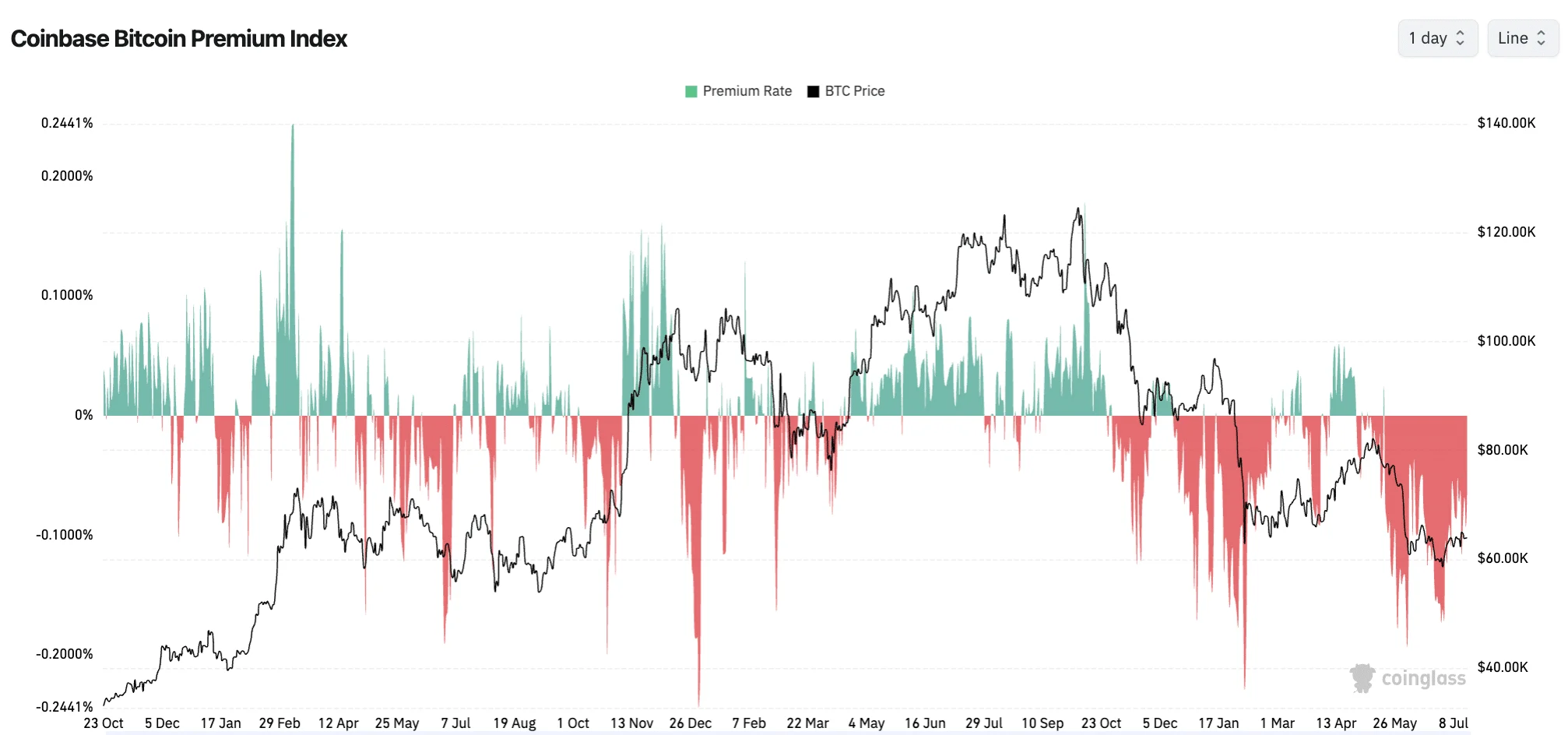
The Coinbase Bitcoin Premium Index has been negative for 60 days in a row since the 19th of May, which has put a lot of pressure on Bitcoin right now.

As per CoinGlass’s most recent reading, the index has experienced the longest streak on record, reaching -0.1025%. This indicates that Bitcoin has been trading at a lower price on Coinbase than on Binance for the past two months.

What does this mean for Bitcoin? 

Such a long streak was last seen between the 16th of January and the 24th of February, which lasted approximately 40 days. That was followed by a notable 30-day period around the market crash on the 11th of October.
.

Coinbase Bitcoin Premium Index
Source: CoinGlass

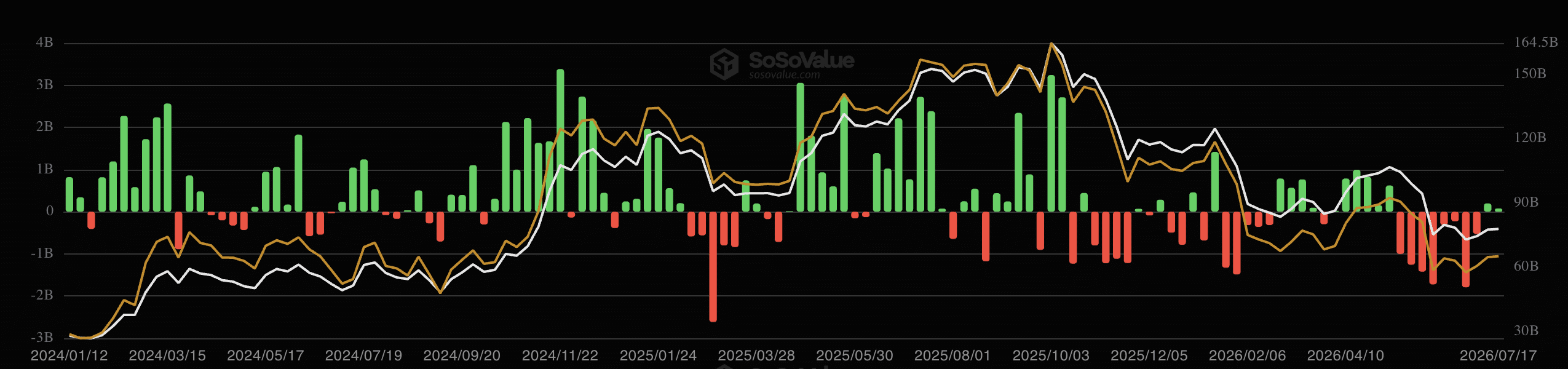
That said, such prolonged negative readings are concerning as they have historically corresponded with times when ETF outflows have occurred. 

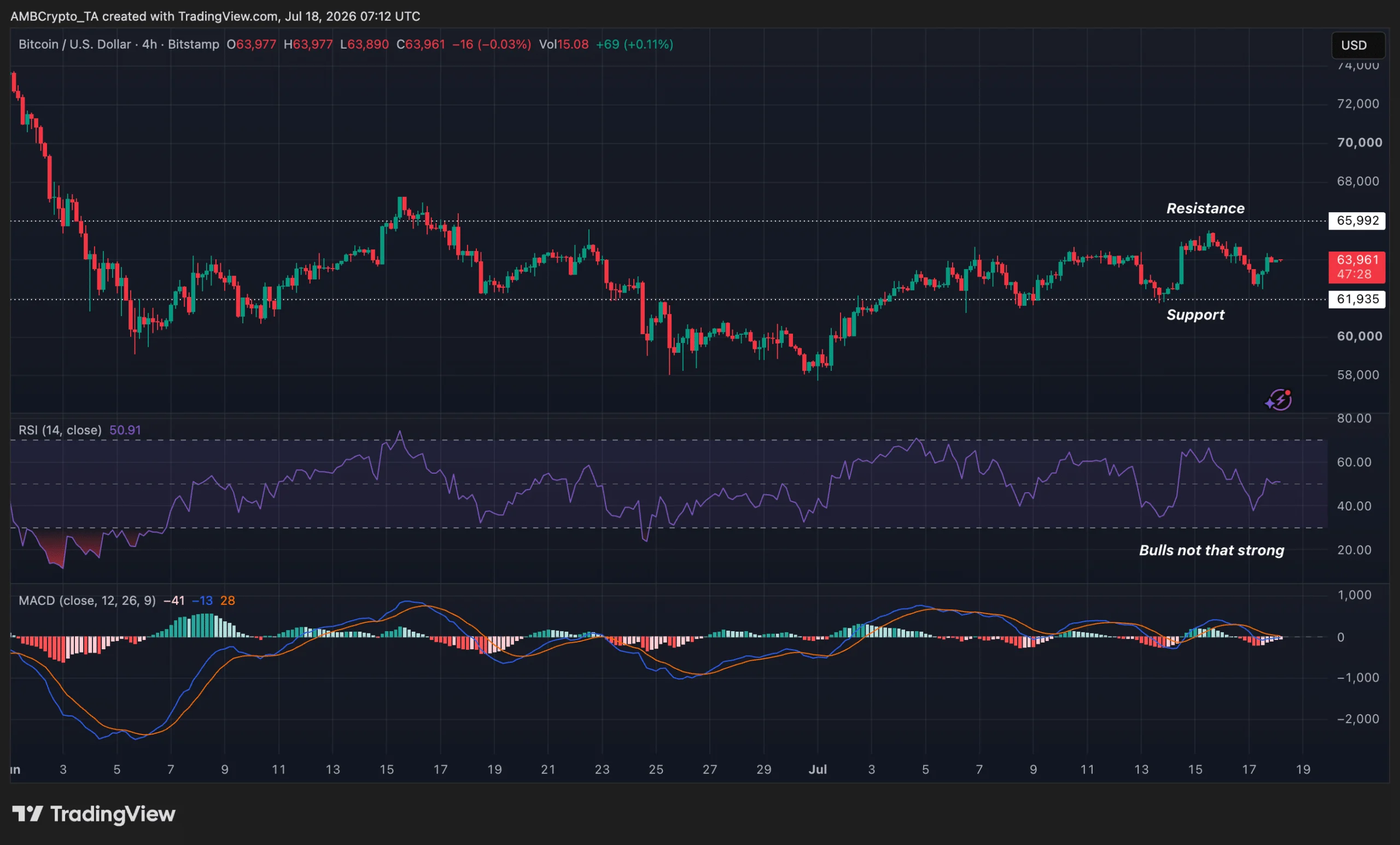
This comes as the price of Bitcoin increased by 1.8% over the previous day, trading at $63,935.02 at press time.

However, the drop from $76,954 last seen on 19th May raises concerns. The RSI and MACD indicators further suggested that despite the hike, the bulls were not strong enough.

Bitcoin Trading ViewBitcoin Trading View
Source: Trading View

In contrast, during the same time period, the Bitcoin ETF saw maximum outflows. However, with net inflows of $197 million from 6th to 10th July, the ETFs managed to end the eight-week outflow trend

BTC ETFs inflowsBTC ETFs inflows
Source: SoSo Value

Bitcoin’s risk index provides an interesting nuance

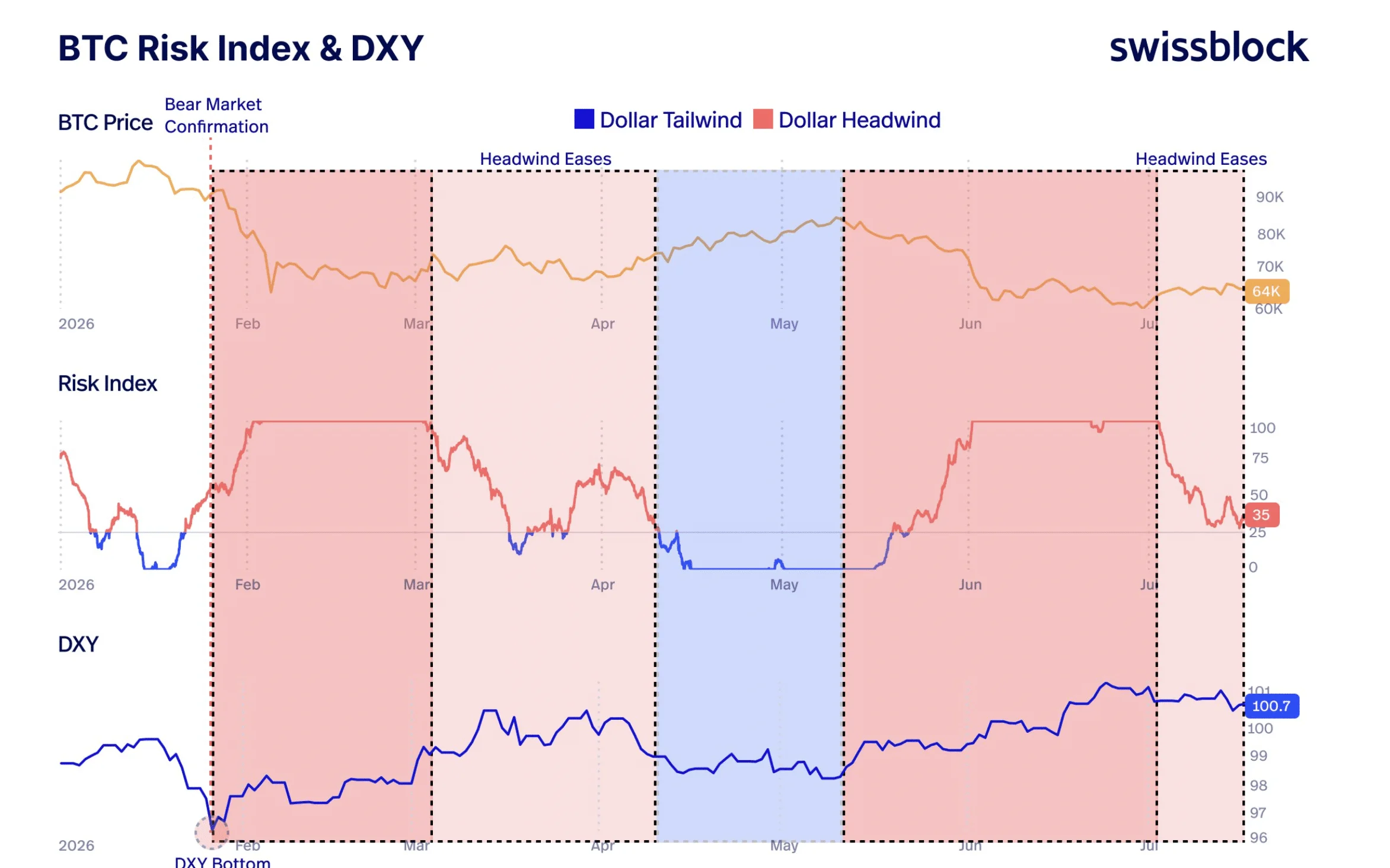
Meanwhile, this year, the U.S. Dollar Index (DXY) and the Bitcoin Risk Index have been very similar. With less appetite for risky assets and tighter liquidity, Bitcoin entered a risk-off phase as the dollar gained strength.

The only significant rebound of the year occurred when the DXY declined, resulting in a more advantageous environment. Naturally, one of the main macro headwinds for Bitcoin may be abating now that the dollar is losing ground and the Bitcoin Risk Index is cooling. 

BTC Risk IndexBTC Risk Index
Source: Swissblock

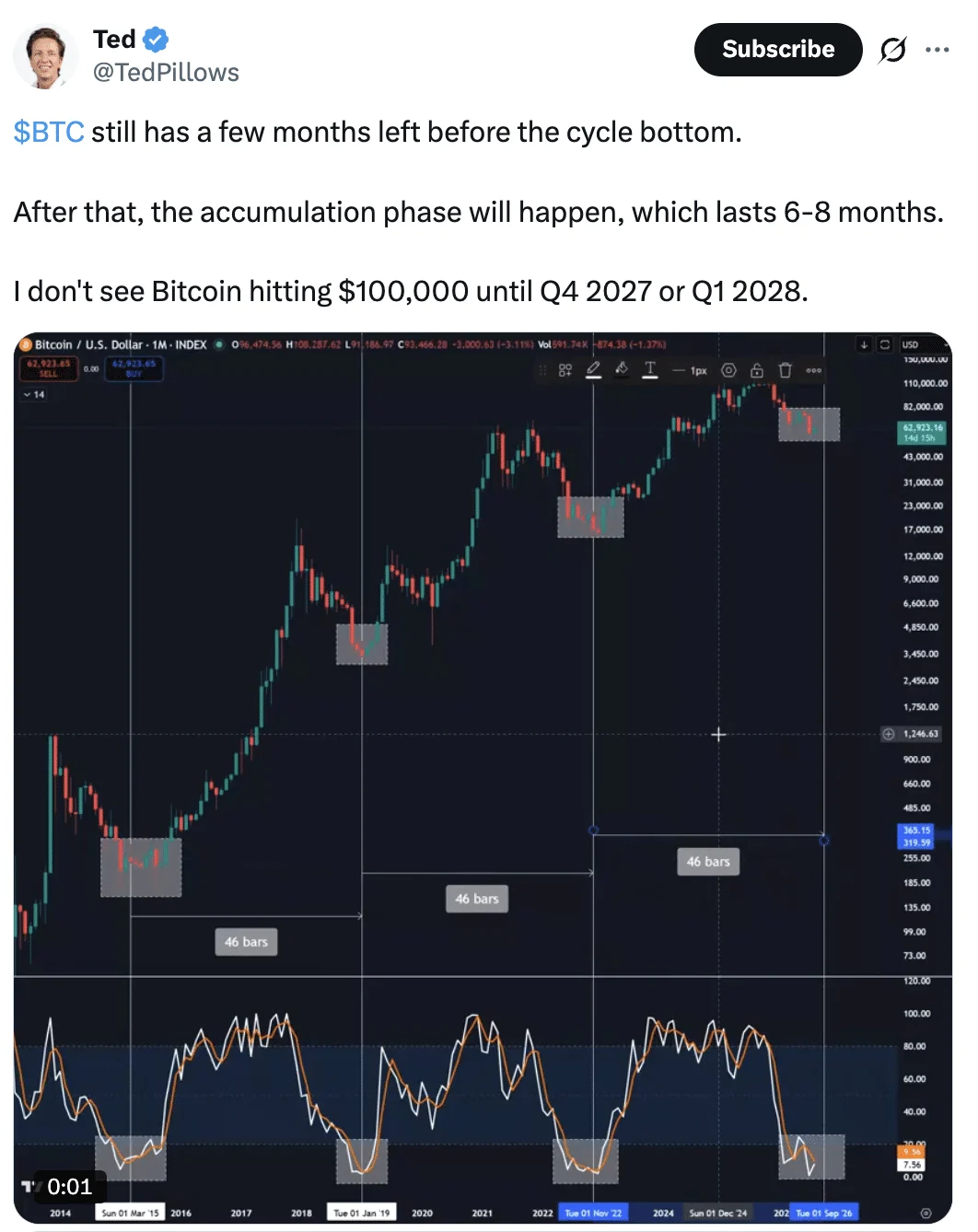
However, analysts predict that the cycle bottom will form over the next few months rather than right away. 

$BTC still has a few months left before the cycle bottom.$BTC still has a few months left before the cycle bottom.
Source: Ted/X

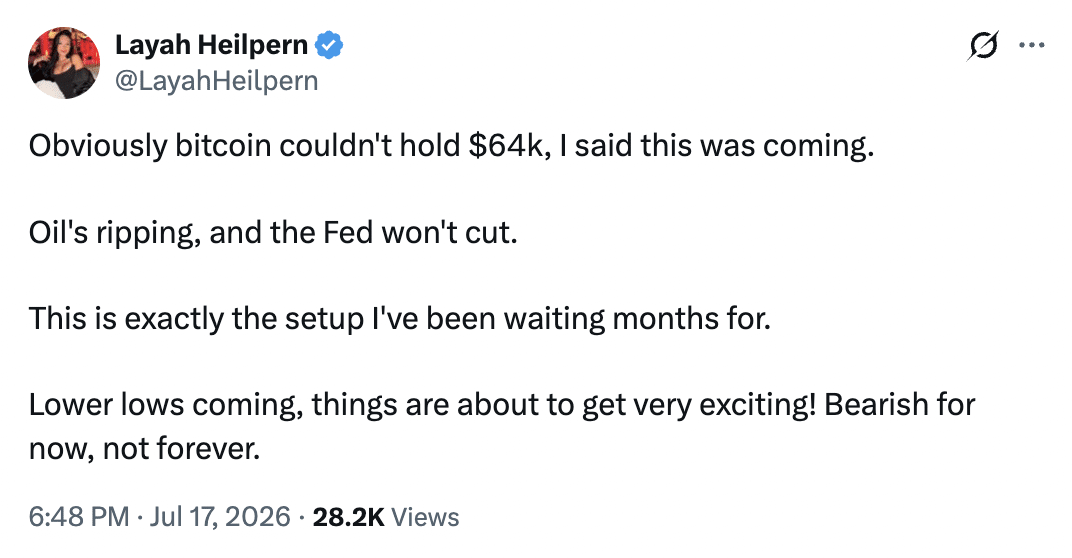
Similar to this, another analyst says that Bitcoin’s failure to hold the $64,000 support level validates their prediction of additional declines. 

Layah HeilpernLayah Heilpern
Source: Layah Heilpern/X

Is $100k possible?

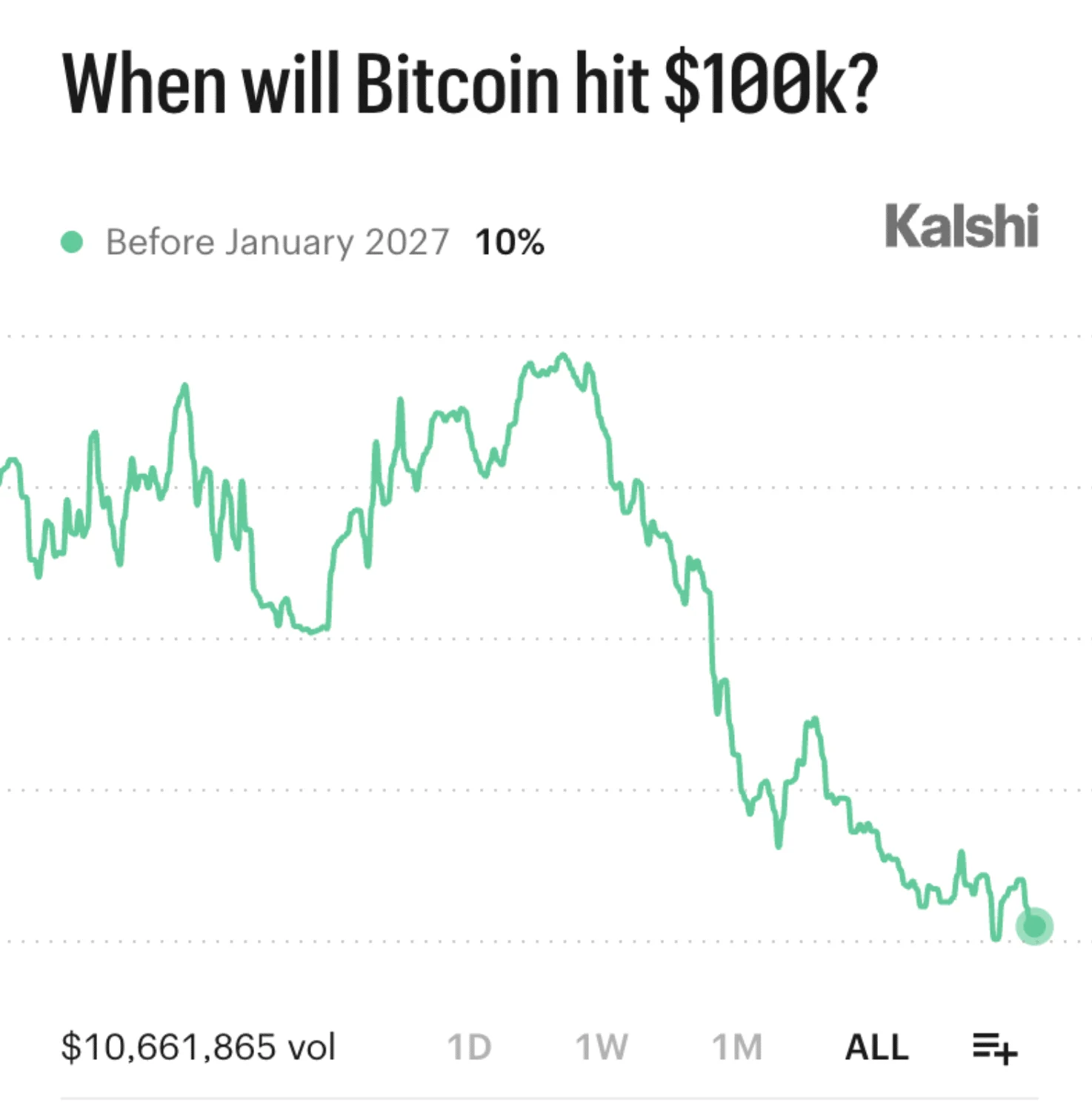
Nonetheless, Kalshi traders gave Bitcoin a 10% chance of reaching $100,000 before year-end.

This marked the event’s lowest implied probability on record. It suggested traders saw only a one-in-ten chance of that outcome.

Will BTC hit $100kWill BTC hit $100k
Source: Kalshi

At the same time, Fidelity Research analyst Zack Wainwright believes that a larger portion of the circulating supply is being held by investors with strong convictions rather than active traders.

However, over 40% of this supply of long-term holders is underwater, which means that they were purchased at prices higher than the current market value of Bitcoin and are now sitting at unrealized losses. 


Final Summary

  • Though Bitcoin has seen a hike in the past 24 hours, it has dropped from $76k to $63k from 19th May to press time.
  • Many analysts believe that Bitcoin is starting to form a bottom, and further declines are expected. 


Source link

Best CD rates today, Saturday, July 18, 2026: Best account provides 4.10% APY

0
Best CD rates today, Saturday, June 20, 2026: Best account provides 4% APY


Find out how much you could earn by locking in a high CD rate today. The Federal Reserve cut its federal funds rate three times in 2025. So far in 2026, the Fed has left interest rates alone, and so now could be your last chance to lock in a competitive CD rate before rates move further. CD rates vary widely across financial institutions, so it’s important to ensure you’re getting the best rate possible when shopping around for a CD.

The following is a breakdown of CD rates today and where to find the best offers.

Generally, the best CD rates today are offered on shorter terms of around one year or less. Online banks and credit unions, in particular, offer the top CD rates.

Today, the highest CD rate is 4.10% APY. This rate is offered by Marcus by Goldman Sachs on its 14-month CD.

Here is a look at some of the best CD rates available today:

The amount of interest you can earn from a CD depends on the annual percentage rate (APY). This is a measure of your total earnings after one year, taking into account the base interest rate and how often interest compounds (CD interest typically compounds daily or monthly).

Say you invest $1,000 in a one-year CD with 1.52% APY, and interest compounds monthly. At the end of that year, your balance would grow to $1,015.20 — your initial $1,000 deposit, plus $15.20 in interest.

Now let’s say you choose a one-year CD that offers 4% APY instead. In this case, your balance would grow to $1,040.74 over the same period, which includes $40.74 in interest.

The more you deposit in a CD, the more you stand to earn. If we used the same example of a one-year CD at 4% APY but deposited $10,000, your total balance when the CD matures would be $10,407.42, meaning you’d earn $407.42 in interest. ​​

Read more: What is a good CD rate?

When choosing a CD, the interest rate is usually top of mind. However, the rate isn’t the only factor you should consider. There are several types of CDs that offer different benefits, though you may need to accept a slightly lower interest rate in exchange for more flexibility. Here’s a look at some of the common types of CDs you can consider beyond traditional CDs:

  • Bump-up CD: This type of CD allows you to request a higher interest rate if your bank’s rates go up during the account’s term. However, you’re usually allowed to “bump up” your rate just once.

  • No-penalty CD: Also known as a liquid CD, this type of CD allows you to withdraw funds before maturity without penalty.

  • Jumbo CD: These CDs require a higher minimum deposit (usually $100,000 or more), and often offer a higher interest rate in return. In today’s CD rate environment, however, the difference between traditional and jumbo CD rates may not be much.

  • Brokered CD: As the name suggests, these CDs are purchased through a brokerage rather than directly from a bank. Brokered CDs can sometimes offer higher rates or more flexible terms, but they also carry more risk and might not be FDIC-insured.


Source link

The 6-Step Playbook for Building an AI-Powered Startup Without Burning Through Cash

0
The 6-Step Playbook for Building an AI-Powered Startup Without Burning Through Cash


Opinions expressed by Entrepreneur contributors are their own.

Key Takeaways

  • The old “raise big, hire fast” playbook is dead: non-engineers can now run engineering functions with AI, cutting the need for early outside capital.
  • Hire for EQ and range, build B2B products with high switching costs, and treat profitability — not scale — as the north-star metric.

AI has disrupted the business landscape almost overnight. According to Stanford’s 2025 AI Index Report, AI adoption by organizations grew from 55% in 2023 to 78% by late 2024 — a 23% jump in a single year. And it isn’t just penetration that’s growing. The functionality companies are getting out of AI is expanding, too. As the tools evolve, their uses diversify, driving efficiency up and overhead down.

The impact is especially pertinent to tech-enabled startups, where founders operate on lean budgets and every dollar invested is coveted. Startups can now build “AI Lean” — my term for leveraging AI capabilities to reduce overhead and expenses across multiple areas of the organization, thereby requiring less upfront expenditure and, therefore, less external funding. By tapping into AI’s efficiencies, today’s startups can grow organically, keeping resources at a minimum as they scale. Their paths to profitability become more tangible and their need for outside financing less pressing. Founders gain more agency, growing their companies on their own timelines while maintaining significant control throughout the growth lifecycle.

As entrepreneurs leverage AI efficiencies to build the enterprises of the future, here are six key actions to take when building AI Lean.

Conduct an overall AI usability assessment

AI can impact many functions of the organization, eliminating the need for excess resources while making the work of the team you already have more effective. Used well, AI can play a pivotal role in coding, product development, marketing, data analysis, operations and even recruiting — saving critical time and capital. To understand where AI can plug in, founders should conduct an AI assessment that reviews every organizational function and maps out where and when AI can have an impact, along with the benefits and risks of leveraging it in each.

Update the talent rubric and hire accordingly

AI is replacing traditional engineering functions that tech companies once fought tooth and nail to staff. Non-engineers can now leverage AI to manage engineering work, using tools like Claude to operate as their engineering teams. That shift has placed newfound importance on softer, people-led skills. Founders should look to hire teammates with updated superpowers: multi-talented, nimble and able to manage several roles at once. In this new AI-led tech climate, candidates’ EQ (emotional quotient), communication skills and adaptability are the traits AI can’t replace — and the ones founders should weigh most heavily.

Build products with low CAC and high retention

The B2C tech landscape has become extremely crowded. According to SQ Magazine, there are over 1.8 million iOS apps alone, all competing for coveted but limited space on our iPhones. To build beyond the noise, tech creators need to create need goods, not want goods. The most effective way to do that is to move products out of the purely B2C landscape and instead build B2B or B2B2C platforms, where users are themselves businesses that acquire their own customers on your behalf. Once on the platform, businesses face higher switching costs — to leave, they’d have to move themselves and their customer bases to a competitor. The moat becomes far more pronounced.

Focus on autonomy, not just scale

Growth for growth’s sake is, in many cases, an outdated tech model. The new AI lean companies are focused on efficiency as a gateway to autonomy. To build one, founders must intentionally map their paths to profitability while retaining as much control of the company as possible. By leveraging AI to handle most of the engineering and administrative workload, founders can operate leanly and keep overhead low. They also give themselves more runway to reach product-market fit.

Stay lean and nimble with funding

Rapid AI adoption has reduced the need for significant upfront funding at efficient startups. As founders navigate this new environment, keeping the burn rate low is essential. Venture capital can often be replaced with friends-and-family money, especially at the early stage. The best path is frequently the quickest path to profitability: low overhead and purposeful organic growth.

Prioritize lifestyle to avoid burnout

The burnout epidemic is real. Sifted surveyed 138 founders and found 54% had experienced burnout in the past 12 months, 46% described their mental health as “bad” or “very bad” and 75% reported anxiety in the same period. Even more startling: 94% of founders reported some mental health issue in the past year. Sifted noted that “fundraising remains the most common challenge founders face,” which is why the first step to reducing burnout is to operate AI lean — removing the need for significant early outside capital. The second is to prioritize work/life wellness by setting intentional boundaries and creating time and space to decompress. That’s what allows founders and their teams to play the long game and see their startups through to fruition.

The AI lean startup has become the new face of the entrepreneurial world. The once-significant roadblocks of time, funding and resources have been bulldozed, opening paths for technology founders willing to pave roads where, not long ago, there were none. Healthy and nimble have replaced scaled and heavily funded as the north-star metrics, especially in the early stages. AI lean entrepreneurs have a new way to build — this time on their terms.

Key Takeaways

  • The old “raise big, hire fast” playbook is dead: non-engineers can now run engineering functions with AI, cutting the need for early outside capital.
  • Hire for EQ and range, build B2B products with high switching costs, and treat profitability — not scale — as the north-star metric.

AI has disrupted the business landscape almost overnight. According to Stanford’s 2025 AI Index Report, AI adoption by organizations grew from 55% in 2023 to 78% by late 2024 — a 23% jump in a single year. And it isn’t just penetration that’s growing. The functionality companies are getting out of AI is expanding, too. As the tools evolve, their uses diversify, driving efficiency up and overhead down.

The impact is especially pertinent to tech-enabled startups, where founders operate on lean budgets and every dollar invested is coveted. Startups can now build “AI Lean” — my term for leveraging AI capabilities to reduce overhead and expenses across multiple areas of the organization, thereby requiring less upfront expenditure and, therefore, less external funding. By tapping into AI’s efficiencies, today’s startups can grow organically, keeping resources at a minimum as they scale. Their paths to profitability become more tangible and their need for outside financing less pressing. Founders gain more agency, growing their companies on their own timelines while maintaining significant control throughout the growth lifecycle.

As entrepreneurs leverage AI efficiencies to build the enterprises of the future, here are six key actions to take when building AI Lean.



Source link

Galaxy launches onchain yield vaults for institutions

0
Galaxy launches onchain yield vaults for institutions

Galaxy Digital (GLXY) has launched an institutional vault curation business on decentralized lending protocol Morpho, expanding its push into onchain finance with a product designed to help clients earn yield on idle stablecoin balances without managing decentralized finance (DeFi) infrastructure themselves.

The offering, called Galaxy Curator, is available through Fireblocks Earn, giving the custody platform’s more than 2,400 institutional clients access to curated onchain lending strategies from within their existing treasury and custody workflows, the company said in a press release Thursday.

The launch targets a longstanding challenge for institutional crypto holders. Large stablecoin balances often remain uninvested between settlements, deployments and operational holds due to the complexity and risk associated with directly interacting with decentralized finance protocols.

The rollout comes as professional vault curation has emerged as one of the fastest-growing segments of DeFi, with asset managers, trading firms and fintechs racing to package institutional-grade onchain yield products. Over the past year, firms including Bitwise, Gauntlet, Steakhouse Financial, Wintermute, Dialectic and RockawayX have launched or expanded curated vault offerings on Morpho.


Source link

Will new Uniswap protocol fee proposals drive ‘substantial UNI burn’?

0
Will new Uniswap protocol fee proposals drive ‘substantial UNI burn’?


Uniswap has officially submitted three governance proposals for protocol fee activation across several chains and different versions of the DEX.

The first fee proposal will be for versions 2 (V2) and 3 (V3) on the Robinhood chain. The new Ethereum L2 debuted this month, attracting several DEXes, including Uniswap. About 10 days after launch, Uniswap crossed $1B in trading volume – ultimately showing its growing traction. 

Similarly, the project seeks to activate fees on V4 across Ethereum, Base, Arbitrum, Robinhood, BNB Chain, Polygon and Optimism. Hayden Adams, Uniswap’s CEO, added that a third fee proposal for remaining V4 chains will also be submitted soon. 

Adams said, 

Both direct all new protocol fees into the existing UNI burn mechanism. Based on current volumes, especially Robinhood, we expect the impact on UNI burn to be substantial.

Mixed reactions to Uniswap’s fee proposal

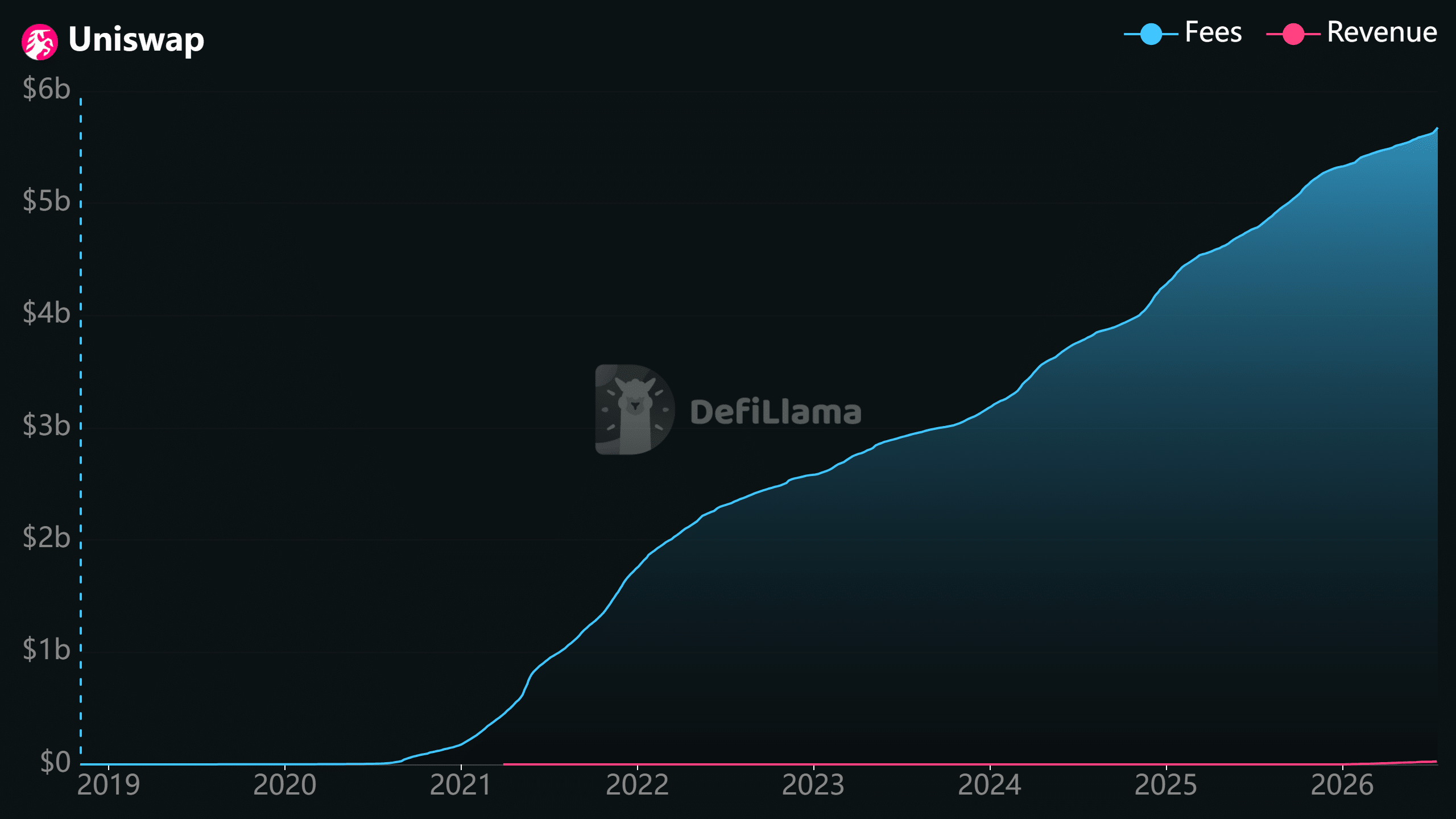
For clarity, fees are what users pay for each swap on the DEX, and they mostly go to liquidity providers (LPs). Protocol revenue (which is partly directed for UNI burn) is a percentage of the swap fees that goes to the project after a governance vote. 

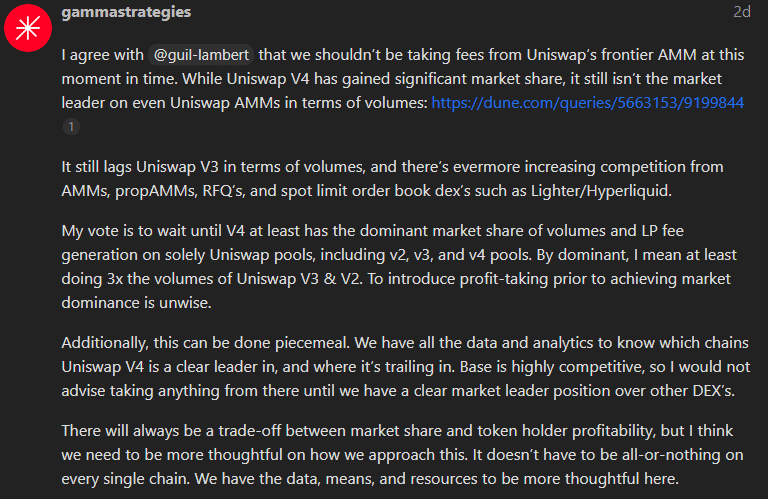
In other words, such proposals would directly reduce fees collected by LPs. As such, it was not surprising that some LP providers like Gamma Strategies opposed V4 fee proposals because they would affect their lifeline. 

Still, Gamma Strategies made a sound argument for their opposition, noting that Uniswap V4 was still not competitive enough and the fees would make it lose to rivals.

It (V4) still lags Uniswap V3 in terms of volumes, and there’s evermore increasing competition from AMMs, propAMMs, RFQ’s, and spot limit order book DEX’s such as Lighter/Hyperliquid.

Uniswap UNI
Source: Uniswap governance 

That said, Uniswap has only activated fees across a few chains and versions. However, most of the fees collected go to LPs.

In fact, LPs have made a whopping +$5B in cumulative fees since 2018. Yet, the protocol has made only $25M in cumulative revenue.   

Uniswap UNIUniswap UNI
Source: DeFiLlama 

If the proposal goes through and is balanced with competition, more protocol revenue would translate to more UNI burn rates, as Adams projected. 

That said, the project has now burned a total of 107.49M UNI tokens. UNI burn rate surged 3x from $51K to over $160K in the past week. 

Can UNI extend its July rally?

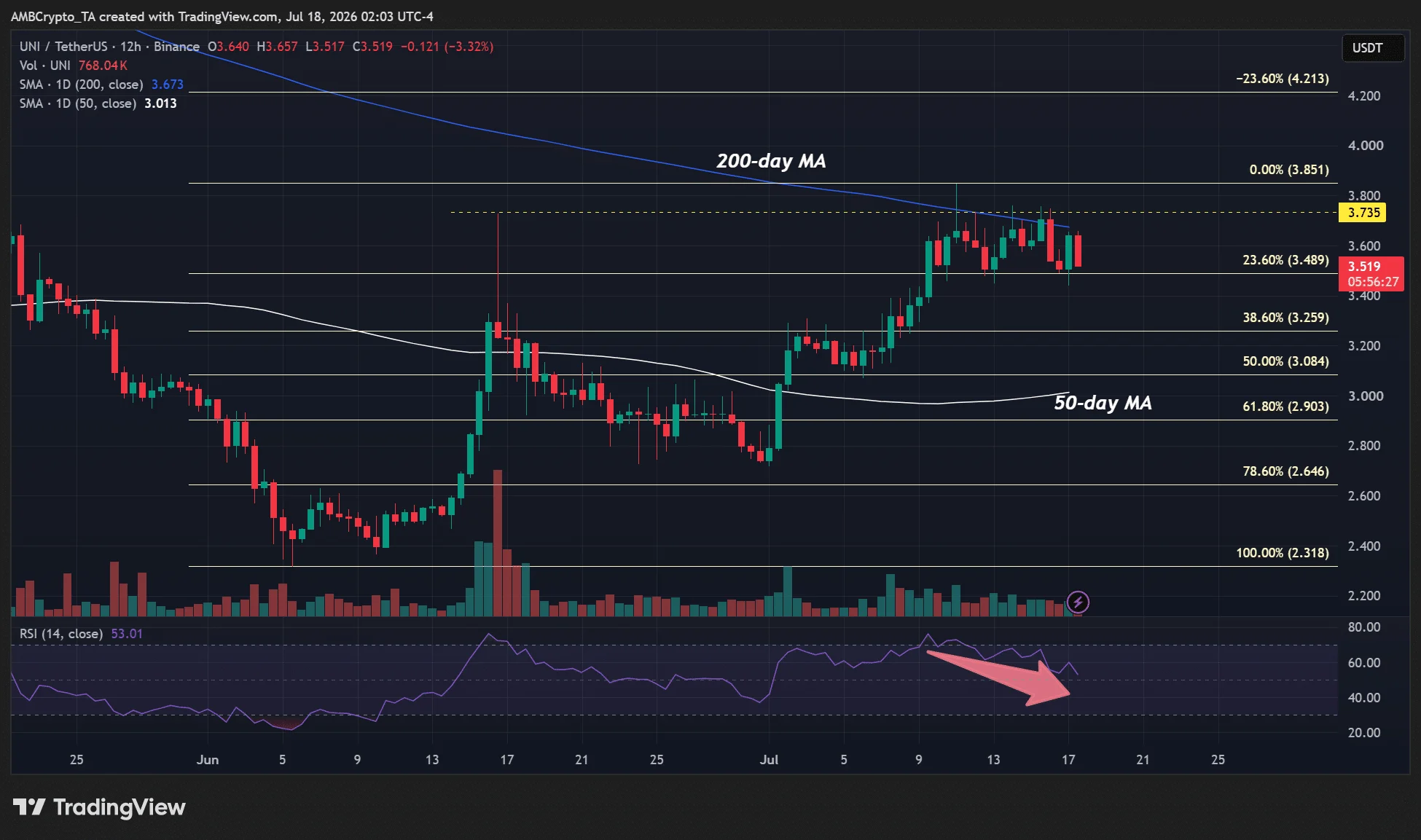
The Robinhood traction was front-run by traders as the Uniswap [UNI] price surged. In July, UNI price surged 41% from $2.7 to $3.8. 

But the bullish strength has eased as the price stalled below the 200-day Moving Average (blue line). As such, price could remain sideways above $3.5 or slip to $3 if Robinhood momentum stabilizes. 

Uniswap UNIUniswap UNI
Source: UNI/USDT, TradingView 

But the next move higher could be triggered by renewed Robinhood momentum and if the fee proposals drive more UNI burn. 


Final Summary

  • Uniswap pushes three fee protocol fee proposals to accelerate UNI burn. 
  • Currently, Uniswap LPs have accrued over $5B while the protocol makes relatively little revenue 


Source link