Home Blog Page 235

Oakmark Global Fund Bets on Owens Corning’s (OC) Dominant Market Position in Roofing

0
Oakmark Global Fund Bets on Owens Corning’s (OC) Dominant Market Position in Roofing


Harris Oakmark recently released its second-quarter 2026 investor letter for the “Oakmark Global Fund”. A copy of the letter can be downloaded here. It is a non-diversified fund that focuses on long-term capital appreciation by investing in common stocks of U.S. and non-U.S. companies. In the second quarter, the fund (Investor Class) delivered a return of 7.89%, lagging the benchmark, the MSCI World Index’s 13.76% return. Energy and industrials were the top performance contributors at the sector level, while health care and consumer discretionary detracted from performance. AI remains a key market theme. The firm focuses on evaluating companies based on their competitive advantages, long-term cash flow potential, and valuation, not predictions. In addition, you can check the Fund’s top five holdings to determine its best picks for 2026.

In its Q2 2026 investor letter, Oakmark Global Fund highlighted Owens Corning (NYSE:OC). Owens Corning (NYSE:OC) is a leading building products company that operates through Roofing, Insulation, and Doors segments. On July 14, 2026, Owens Corning (NYSE:OC) closed at $142.86 per share, reflecting a market capitalization of $11.44 billion. Owens Corning (NYSE:OC) posted a one-month return of 15.55%, while its shares gained 1.73% over the past 52 weeks.

Oakmark Global Fund stated the following regarding Owens Corning (NYSE:OC) in its Q2 2026 investor update:

“Owens Corning (NYSE:OC) is one of the world’s largest building products companies, specializing in roofing, insulation, and doors. We like that Owens Corning has a dominant market position in roofing that has historically benefited from attractive pricing, scale advantages, the nondiscretionary nature of the product, and contractor loyalty. In our view, market participants underappreciate the quality of the roofing segment and are overly concerned with the insulation segment’s exposure to new housing starts. Economic uncertainty and cyclical forces have weighed on sentiment for the industry, presenting the opportunity to invest in a quality business with a management team that is taking advantage of their underpriced stock through share buybacks.”

Is Aspen Aerogels, Inc. (ASPN) The Small Cap Stock with Huge Upside Potential?

Owens Corning (NYSE:OC) is not on our list of 40 Most Popular Stocks Among Hedge Funds Heading Into 2026. According to our database, 43 hedge fund portfolios held Owens Corning (NYSE:OC) at the end of the first quarter, compared to 53 in the previous quarter. In Q1 2026, Owens Corning (NYSE:OC) reported revenue of $2.3 billion, a 10% year-over-year decrease due to market environment. While we acknowledge the potential of Owens Corning (NYSE:OC) as an investment, we believe certain AI stocks offer greater upside potential and carry less downside risk. If you’re looking for an extremely undervalued AI stock that also stands to benefit significantly from Trump-era tariffs and the onshoring trend, see our free report on the best short-term AI stock.


Source link

$1.9 trillion asset manager T. Rowe Price bets on active management with first multi-token crypto ETF

0
$1.9 trillion asset manager T. Rowe Price bets on active management with first multi-token crypto ETF

T. Rowe Price has brought what it said is the industry’s first actively managed multi-token spot crypto exchange-traded fund (ETF) to the market.

The T. Rowe Price Active Crypto ETF (TKNZ) began trading on Thursday, giving investors exposure to a portfolio of crypto assets rather than a single token. The launch marks a milestone for the Baltimore-based asset manager, which oversees $1.9 trillion in assets, as it expands its product lineup into digital assets.

Unlike the spot bitcoin and ether (ETH) exchange-traded funds that have dominated the market over the past two years, TKNZ is designed to hold a diversified basket of cryptocurrencies, including bitcoin, ether, BNB, XRP, solana (SOL) and Hyperliquid (HYPE), among other digital assets.

The fund also differs from most crypto investment products because it is actively managed. Instead of tracking a fixed index, portfolio managers can adjust allocations based on market conditions, research and risk assessments. T. Rowe Price said the strategy is intended to capture changes in market leadership and momentum as capital rotates among different cryptocurrencies.


Source link

Prediction: This Under-the-Radar Dividend Stock Is Going to Skyrocket After Aug. 4

0
Prediction: This Under-the-Radar Dividend Stock Is Going to Skyrocket After Aug. 4


Del Monte Corporation (NYSE: DMC) recently got a new name and a new ticker, but thatʻs not all thatʻs new. The produce distributor has a new focus that should propel the stock higher when earnings come out on Aug. 4.

Over the past year, Del Monte has restructured and reorganized, buying the assets of the former Del Monte Foods, which went bankrupt in 2025. Del Monte Foods and Fresh Del Monte Produce, former ticker FDP, had been separate companies for the past 37 years, but this acquisition brought them back together. The reunion prompted the company to change its name back to Del Monte Corporation.

Missed Nvidia in 2009? This Rare Signal Is Flashing Again. In 2009, a “Double Down” signal flashed for a little-known chipmaker called Nvidia. For the first time in years, that same “Total Conviction” signal is flashing for a company 1/100th the size of Nvidia. Continue »

Image source: Getty Images.

Is there 82% upside for Del Monte stock?

The acquisition of Del Monte Foods is targeted to be accretive to net sales by about $600 million and adjusted earnings before interest, taxes, depreciation, and amortization by roughly $23 million in 2026.

That will help fuel an anticipated 13% to 15% year-over-year increase in net sales in 2026 — thatʻs after a 4.9% decrease in net sales in the first quarter. It excludes the divestiture of the Mann packaging business, which Del Monte sold off in December 2025. But the outlook suggests that revenue will surge over the next three quarters.

Del Monte doesnʻt have a lot of analyst coverage, but an analyst who does cover it anticipates revenue of $1.3 billion in the second quarter, which would be a 26% increase over the first quarter. And earnings are anticipated to move significantly higher in 2027.

Del Monte also has an excellent dividend, paying out a high yield of 4.24%. It has raised its dividend for six straight years.

The analyst covering it rates it a buy with a price target of $52 per share, which would suggest 82% upside. If the second-quarter earnings report on Aug. 4 is as strong as expected, and earnings gains follow in 2027, this cheap stock with a high-yield dividend could have some legs.

Missed Nvidia in 2009? This Rare Signal Is Flashing Again

In 2009, a “Double Down” signal flashed for a little-known chipmaker called Nvidia. If you’d invested $5,000 then, you’d be sitting on $2,642,724 today.*

Now, for the first time in years, that same “Total Conviction” signal is flashing for a company 1/100th the size of Nvidia. It’s a key player in the $1.8 trillion space race, and with the stock recently sitting 20% off its highs, the window to get in early is closing fast.


Source link

Hasbro Relaunches Play-Doh for Adults After Earlier Attempt Failed

0
Hasbro Relaunches Play-Doh for Adults After Earlier Attempt Failed


Hasbro tried selling Play-Doh to adults once before with scents literally named “mom jeans” and “overpriced latte.” It was a disaster. Now the 102-year-old toy company is trying again with Blooms by Play-Doh, a new line that guides adults through turning putty into floral arrangements, the Wall Street Journal reports.

The earlier attempt, 2020’s Grown-Up Scents line, failed because it looked too much like the kids’ version despite different branding, said Hasbro CMO Jason Bunge, who admitted the company had struggled to “age up” with its own fan base. This time, Hasbro built an entirely new brand name and is skipping traditional ads in favor of 200 influencers.

“Paid media doesn’t work for us anymore,” Bunge said, noting Hasbro recently brought its media buying in-house. The move is part of a broader turnaround: Hasbro’s most recent quarter posted 13% revenue growth to $1 billion, driven largely by “Magic: The Gathering,” even as core toy sales stayed flat.

Hasbro tried selling Play-Doh to adults once before with scents literally named “mom jeans” and “overpriced latte.” It was a disaster. Now the 102-year-old toy company is trying again with Blooms by Play-Doh, a new line that guides adults through turning putty into floral arrangements, the Wall Street Journal reports.

The earlier attempt, 2020’s Grown-Up Scents line, failed because it looked too much like the kids’ version despite different branding, said Hasbro CMO Jason Bunge, who admitted the company had struggled to “age up” with its own fan base. This time, Hasbro built an entirely new brand name and is skipping traditional ads in favor of 200 influencers.

“Paid media doesn’t work for us anymore,” Bunge said, noting Hasbro recently brought its media buying in-house. The move is part of a broader turnaround: Hasbro’s most recent quarter posted 13% revenue growth to $1 billion, driven largely by “Magic: The Gathering,” even as core toy sales stayed flat.


Source link

Bitcoin rallies to $65K, but long-term holders send a warning sign

0
Bitcoin rallies to $65K, but long-term holders send a warning sign


For the current macro-driven rally to turn into a bull rally, investor conviction will be the key factor.

From the macro perspective, Bitcoin’s reclaim of the $65k level came alongside a softer-than-expected CPI report, signaling that inflation is cooling.

Historically, this type of macro relief has acted as a bullish catalyst, as investors, particularly long-term holders, begin to position for easier monetary conditions. With CPI coming in weaker, Bitcoin’s rally clearly highlighted this shift in market sentiment.

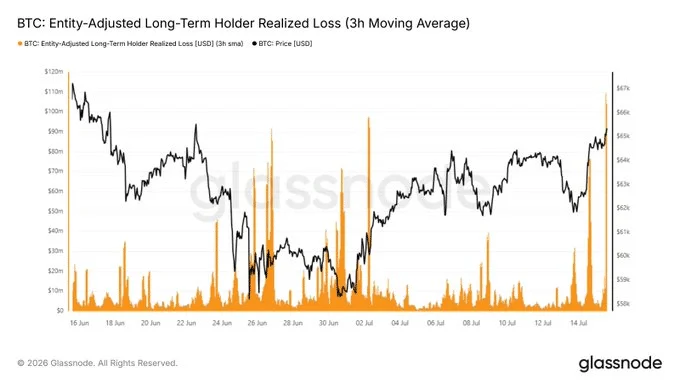
However, on-chain data suggests that long-term holders are still struggling to maintain their conviction. As BTC pushes toward $66k, LTH realized loss volume is rising sharply.

This indicates that cycle-top buyers are using the relief rally as an exit opportunity, selling into strength instead of waiting for a full recovery.

Bitcoin
Source: Glassnode

Adding to the pressure, Glassnode recently highlighted another key signal.

According to the report, short-term holders who bought near the recent lows are now taking profit at volumes last seen around the May peak.

Together, these two forces are creating resistance for Bitcoin’s rally: Cycle-top buyers are reducing losses, while local-bottom buyers are locking in gains. With both groups selling into the same recovery, Bitcoin clearly needs stronger demand to absorb the supply.

What’s more, rising speculative liquidity around these key zones is fueling more friction for the rally. In short, it looks like Bitcoin [BTC] is entering a high-stakes setup at a time when conviction is starting to fade.

Naturally, the question becomes: Is BTC’s $65k breakout the start of a bull trend, or just another relief rally?

Bitcoin’s post-CPI rally faces a conviction test

After three straight quarters of downtrend, the CPI report clearly helped trigger a risk-on move.

From a technical standpoint, Bitcoin is up over 9% so far in Q3, marking its first green quarter after averaging nearly 20% losses across the previous three quarters. Against this backdrop, rising profit-taking is expected, as short-term holders look to secure gains after the strong recovery.

However, long-term hodlers realizing losses shows that this cohort is still not viewing BTC’s recovery as the start of a new trend. Instead of “buying the dip,” some are using the bounce to reduce exposure.

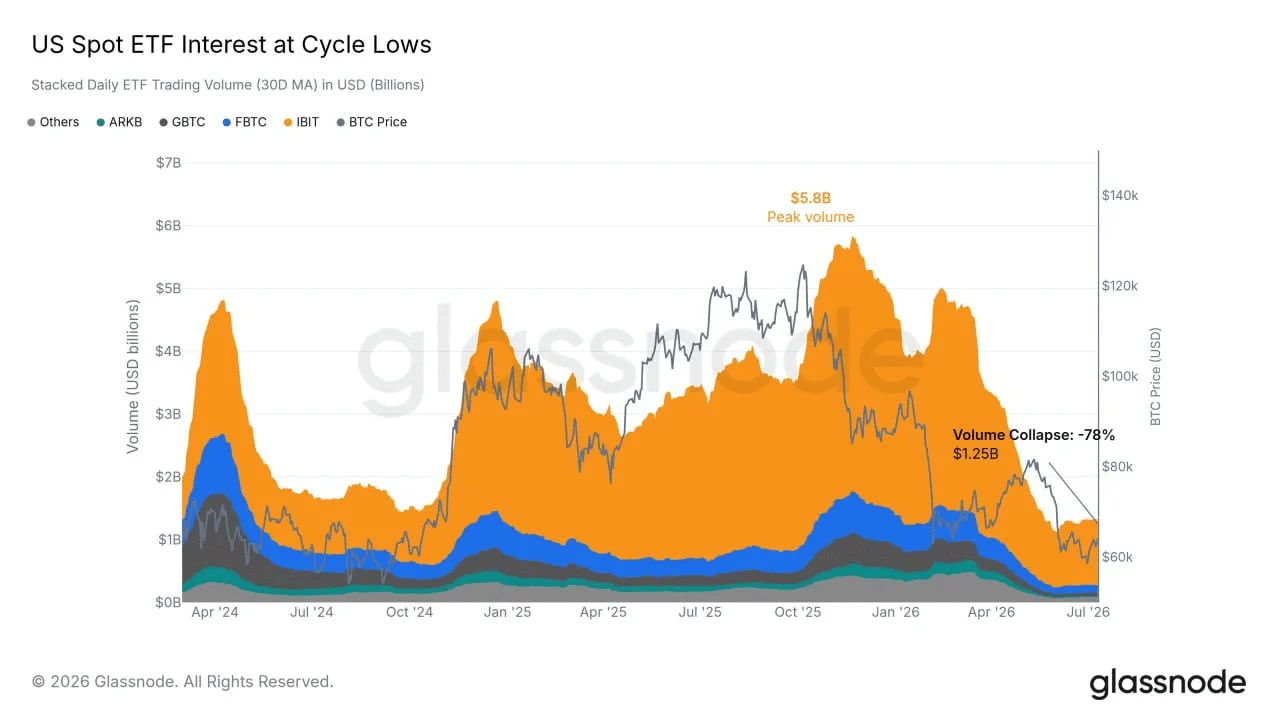
Notably, this setup is now playing out on-chain as well. Bitcoin spot ETF volume has collapsed 78% from its peak, with daily volume dropping to $1.2 billion versus $4.4 billion at the top.

This decline suggests that ETF-driven demand has cooled, leaving the market with weaker liquidity as BTC attempts to sustain its recovery. 

btcbtc
Source: Glassnode

In essence, Bitcoin’s current setup highlights a growing demand-supply imbalance.

While selling pressure continues to rise, buyers have not stepped in strongly enough to absorb the supply, especially as LTHs typically act as a key source of demand during market dips.

Without stronger accumulation from this cohort, BTC’s consolidation around $65k risks turning into a bull trap rather than the start of a sustained breakout.


Final Summary

  • Bitcoin’s $65k rally faces a key test as long-term holders sell into the recovery instead of buying the dip.
  • ETF demand has slowed, while selling pressure rises, creating a risk that BTC’s breakout could turn into a bull trap.


Source link

Why Stripe’s $53 billion PayPal bid is a high-stakes play to own the future of digital payments

0
Why Stripe’s $53 billion PayPal bid is a high-stakes play to own the future of digital payments

If Stripe owns PayPal, Bridge becomes the shared infrastructure layer under PYUSD, OpenUSD and Tempo. That’s infrastructure consolidation, not token competition, and it’s a much bigger deal than the acquisition headline suggests.”

That sort of infrastructure scale could allow Stripe to introduce lower settlement fees and checkout incentives for PYUSD, while Tempo could gradually steer users toward OUSD.

“This potentially strengthens Tempo considerably,” said Niamh Byrne, chief commercial officer at blockchain developer platform Alchemy. “If OpenUSD gains meaningful traction, it could increase the strategic importance of Tempo and position it as more than another blockchain.”

However, even if Stripe does combine multiple prominent stablecoin projects under one roof, commentators do not foresee major disruption to the stablecoin sector in the immediate future.

“Circle’s cross-chain interoperability is operationally proven at institutional scale, whereas Tempo is an unproven layer-1 still in early development,” Citi said in its note. “It is our understanding that Bridge/Tempo relies on third parties for interoperability capabilities.”

Tether’s USDT, meanwhile, holds a 60% share of the stablecoin market, dwarfing even USDC, let alone PYUSD, which is in itself something of a “mic drop” to suggestions of a threat from distant competitors. Notwithstanding that, USDT derives its prominence from the retail sector and emerging markets rather than institutions and corporates.


Source link

State Street Q2 Earnings Call Highlights

0
State Street Q2 Earnings Call Highlights


Key Points

  • Interested in State Street Corporation? Here are five stocks we like better.

  • State Street posted strong Q2 2026 results, with earnings per share of $3.65 versus $2.17 a year ago and revenue up 17% to a record $4 billion. Management highlighted record fee revenue, record net interest income, and strong performance across servicing, investment management and markets.

  • The company raised its full-year outlook, now expecting fee revenue growth of 12% to 13% and net interest income growth of 14% to 15%. It also increased expenses guidance, but still expects about 500 basis points of positive operating leverage and a pre-tax margin near 32%.

  • State Street set ambitious medium-term targets, including a 35% pre-tax margin and mid-20s return on tangible common equity over the cycle. Executives said growth will come from core businesses, alternatives, digital assets and wealth services, supported by a technology and AI-driven transformation program.

State Street (NYSE:STT) reported sharply higher second-quarter 2026 earnings and raised its full-year outlook, as executives pointed to record fee revenue, record net interest income and continued momentum across investment servicing, investment management and markets.

Chief Executive Officer Ron O’Hanley said the quarter reflected “disciplined execution, deep client engagement, and continued momentum across our businesses.” The company reported second-quarter earnings per share of $3.65, up from $2.17 in the prior-year period. Excluding prior-year notable items, earnings grew 44% year over year, according to O’Hanley.

3 Space Stocks That Could Outshine SpaceX After Its IPO

Total revenue rose 17% from a year earlier to a record $4 billion. Chief Financial Officer John Woods said fee revenue increased 16% to $3.2 billion, while net interest income rose 18% to $860 million, supported by a 17-basis-point increase in net interest margin to 113 basis points.

Expenses increased 10% year over year to $2.7 billion, excluding notable items, primarily due to higher revenue-related costs and continued strategic investments. The results lifted pre-tax margin by 470 basis points to 34%, while return on tangible common equity rose more than six percentage points to about 26%.

Servicing, Management and Markets Drive Growth

The SK Hynix IPO and 2027’s AI Memory Squeeze

State Street’s investment servicing business posted second-quarter servicing fees of $1.5 billion, up 13% year over year. Woods said the increase reflected approximately 7% organic growth from client activity, flows and net new business, with additional support from higher average market levels and currency translation.

Assets under custody and administration ended the quarter at a record $57.9 trillion, up 18% from a year earlier. Servicing fee sales totaled $87 million, with Woods citing continued demand across regions and strength in strategic growth areas, including alternatives.

These 3 Water ETFs Could be Quiet Winners From Infrastructure Spending

In investment management, fees rose 29% year over year to $772 million, supported by roughly 9% organic growth and higher average market levels. Assets under management reached a record $6.3 trillion, up 23% year over year, while net inflows totaled $114 billion. Woods said the quarter marked the fifth consecutive quarter of positive organic growth, led by $66 billion of index ETF inflows and $35 billion of cash inflows.

State Street also launched 38 new products and solutions during the quarter, including a tokenized money market solution and a stablecoin reserves fund. O’Hanley highlighted that SPYM, the company’s low-cost S&P 500 ETF, was selected by the U.S. Department of the Treasury as the exclusive default ETF for Trump Accounts.

Markets revenue also strengthened. FX trading services revenue increased 27% year over year, excluding a prior-year notable item, to $494 million, driven by record client volumes. Securities finance revenue rose 19% year over year on higher client lending balances. Software services revenue declined 14%, excluding a prior-year notable item, reflecting elevated on-premises renewal activity in the prior year, though Woods said software and data revenue rose 10%.

Outlook Raised for 2026

State Street raised its full-year outlook, excluding notable items. The company now expects fee revenue growth of 12% to 13%, up from its prior forecast of 7% to 9%. Net interest income is expected to grow 14% to 15%, compared with a previous outlook of 8% to 10%.

Woods said the improved net interest income outlook primarily reflected stronger average deposit balances. The company expects expenses to rise by roughly 8%, up from the prior 5% to 6% forecast, reflecting higher revenue-related costs and continued investment.

Based on its current outlook, State Street expects roughly 500 basis points of positive operating leverage in 2026 and a pre-tax margin of approximately 32%. The company continues to expect an effective tax rate of about 22% and a total payout ratio of roughly 80%, subject to board approval and other factors.

State Street’s capital position remained stable, with standardized CET1 and Tier 1 leverage ratios of 10.8% and 5.3%, respectively, at quarter end. The company returned $631 million to shareholders during the quarter through $400 million of share repurchases and $231 million in declared common dividends. Following the Federal Reserve’s stress test results, State Street announced a 10% increase in its quarterly common dividend to $0.92 per share beginning in the third quarter.

Company Sets Medium-Term Margin and Return Targets

Executives also outlined new medium-term financial targets, including a 35% pre-tax margin and return on tangible common equity in the mid-20s “over the cycle.” O’Hanley said the company’s next phase of growth will be driven by three strategic pillars: growth in core businesses, initiatives in alternatives, digital assets and wealth services, and a technology- and AI-enabled transformation of the operating model.

Woods said investment services is expected to contribute approximately 300 basis points of enterprise margin expansion over the medium term through organic revenue growth and productivity initiatives. Investment management is expected to contribute about 200 basis points, supported by ETFs, index investing, fixed income, wealth, alternatives and tokenization. Markets is expected to add about 100 basis points through geographic expansion, product innovation and efficiency initiatives.

The company expects its transformation program to deliver approximately $1 billion of run-rate benefits by 2029, with about 75% coming from expense productivity and 25% from revenue. Woods said the company anticipates about $500 million of one-time costs, mostly related to severance, as part of the transformation.

During the question-and-answer session, Woods said State Street expects positive operating leverage of 100 to 150 basis points on average over the medium term, which could allow the company to reach the 35% margin target toward the earlier end of its three- to five-year framework. He said the company’s net interest income is expected to rise in the low- to mid-single digits over the medium term, supported by low-single-digit balance sheet growth and net interest margin moving toward the upper end of its 110- to 115-basis-point range.

Executives Discuss Digital Assets and AI

O’Hanley described State Street’s digital asset strategy as focused on serving as infrastructure for clients moving between traditional and digital finance. He said the company is “picking our spots” based on client demand, including tokenized money market funds. Woods said State Street’s digital asset platform is designed to support wallet management and the on- and off-ramps between traditional finance and on-chain activity.

On artificial intelligence, Woods said AI will be embedded into State Street’s operating model, including the use of agentic capabilities in cross-functional teams. He also said the company expects AI tools to improve software developer productivity by 30% to 40%, with additional productivity gains across eligible employees through standardized AI tools.

O’Hanley said the company is entering its next phase “from a position of strength,” citing the scale of its custody, asset management, ETF and markets franchises. “These are the targets that we’re aiming for,” he said. “They’re ambitious, but we’re going to hit them.”

About State Street (NYSE:STT)

State Street Corporation is a global financial services company that provides a range of investment servicing, investment management and investment research and trading services to institutional investors. Its principal activities include custody and fund administration, securities lending, performance and risk analytics, trading and execution services, and foreign exchange. The company also offers investment management through State Street Global Advisors, a major provider of exchange-traded funds and institutional investment strategies.

State Street serves a broad client base of asset managers, insurance companies, pension funds, endowments, and other institutions across North America, Europe, Asia and other global markets.

This instant news alert was generated by narrative science technology and financial data from MarketBeat in order to provide readers with the fastest reporting and unbiased coverage. Please send any questions or comments about this story to contact@marketbeat.com.

The article “State Street Q2 Earnings Call Highlights” was originally published by MarketBeat.

View MarketBeat’s top stocks for July 2026.


Source link