Home Blog Page 254

Bitcoin and ethereum prices today, Monday, July 13, 2026: Strong price openings backtracking this morning

0
Bitcoin and ethereum prices today, Monday, June 8, 2026: Moving up after bitcoin prices fell below $60,000


Bitcoin (BTC-USD) opened at $63,745.37 on Monday, July 13, 2026, 0.2% lower than Sunday’s opening price. As of 9:30 a.m. ET this morning, the price of bitcoin moved down to $62,555.13.

Ethereum (ETH-USD) opened at $1,805.49 on Monday, July 13, 2026, up 1% from Sunday’s opening price. The price of ethereum moved lower this morning to $1,770.99 as of 9:30 a.m. ET.

The prices of bitcoin and ethereum both opened strongly this morning but have since moved lower following a weekend of conflict in the Middle East between the U.S. and Iran.

Ethereum opened at its highest level in over a month this morning, but it’s too soon to tell how much of the recent price strengthening will be lost after the latest round of hostilities.

The opening price of bitcoin dropped each day last week, and while this morning’s opening price reversed that negative trend, some of that renewed value has been whittled away after this weekend’s strikes across the Middle East.

The price of bitcoin this morning was 0.1% lower than Sunday’s opening price. Here’s a look at how the opening bitcoin price has changed versus last week, month, and year:

  • One week ago: +0.3%

  • One month ago: +0.3%

  • One year ago: -45.7%

The all-time high for bitcoin was $126,198.07 on Oct. 6, 2025. The all-time low value for bitcoin was $0.04865 on July 14, 2010. 

The price of ethereum this morning was 1% higher than Sunday’s open. Here’s a look at how the opening ethereum price has changed versus last week, month, and year:

  • One week ago: +1.3%

  • One month ago: +8.4%

  • One year ago: -38.6%

The all-time high for ethereum was $4,953.73 on Aug. 24, 2025. The all-time low value for ethereum was $0.4209 on Oct. 21, 2015. 

Bitcoin, ethereum, and other cryptocurrencies are rapidly evolving. Follow the latest developments from Yahoo Finance and others here.

Bitcoin is a type of cryptocurrency, which is a currency that exists only in digital form and operates without government or banking oversight. By comparison, the U.S. dollar, the EU euro, the Canadian dollar, and other national currencies have paper versions and are issued by their respective governments.

Bitcoin relies on a public digital ledger that validates and records transactions and verifies bitcoin ownership. This ledger is called the blockchain, and it is globally distributed — that is, decentralized — across a broad, worldwide network of servers.

Decentralization is a fundamental aspect of cryptocurrencies. Decentralization facilitates peer-to-peer payments with no banking intermediary, enhanced security, and defense against manipulation attempts.

Learn more: What is Bitcoin, and how does it work?

There are several ways to buy Bitcoin. You can go through a crypto exchange, a fintech app, or a traditional brokerage that will allow you to buy into a bitcoin ETF.

Before placing a trade, though, decide what you actually want: full ownership of your bitcoin and private keys — or easy price exposure inside a familiar, regulated system.

Whichever avenue you take, it’s important to remember that bitcoin remains a high-risk, highly volatile asset compared to many other investments. Prices can surge or drop quickly, sometimes without warning. If you’re considering buying bitcoin, assume volatility is part of the deal.

Learn more: Is bitcoin’s price volatility an investing opportunity? Here’s how to buy bitcoin.

Whether you’re brand new to tracking the value of bitcoin and ethereum or a more seasoned crypto investor, Yahoo Finance’s price-of-bitcoin chart and price-of-ethereum chart below show a visual history of how the currencies’ value continues to move and evolve.

More on crypto from the Yahoo Finance team: 



Source link

Pi Network sinks 12% as capital flush deepens – Is a new all-time low in play?

0
Pi Network sinks 12% as capital flush deepens - Is a new all-time low in play?


Pi Network [PI] ranks among the biggest losers from the capital flush that swept the crypto market over the weekend.

The sell-off has dragged PI down nearly 12%, and the pressure shows little sign of easing as seller momentum builds. CoinMarketCap data puts trading volume up 129% at $17.7 million, underlining the strength behind the move.

The bigger concern is that PI could print a new all-time low, undercutting the one it set in the early hours of Monday, the 13th of July.

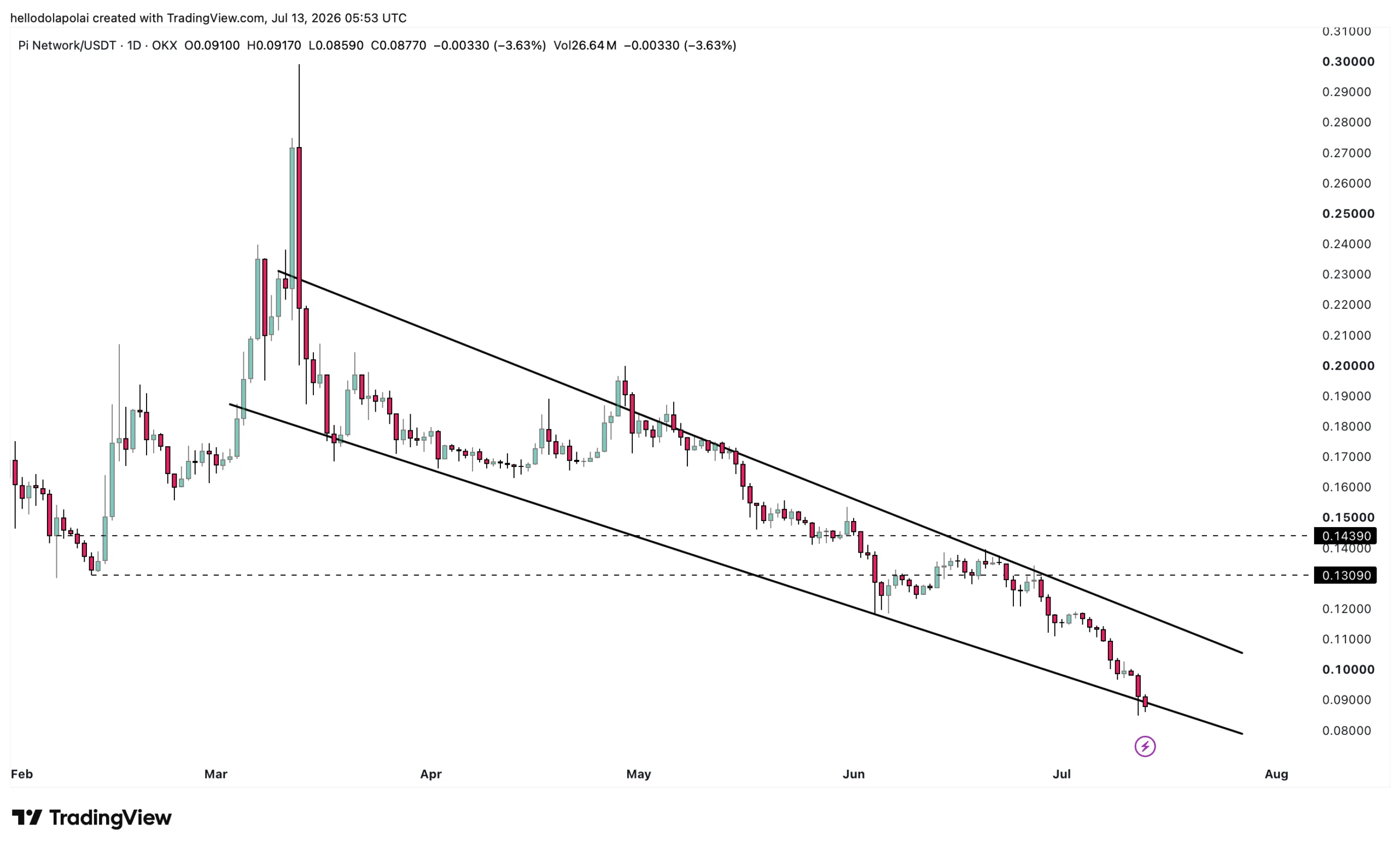
PI’s descending channel keeps an all-time low in play

A fresh all-time low stays firmly in play, given how PI has reacted to the support level it recently breached.

The token has traded inside a descending channel for months, consolidating lower between parallel support and resistance lines. Such structures often precede a stronger upswing, yet they break to the downside just as readily.

PI trading chart.
Source: TradingView

For PI, the odds now favor a breakdown, and the outcome hinges on whether the price closes above or below the support line it is currently testing. A close beneath that line, with selling pressure intact, points to further downside, while a reclaim would keep PI ranging within the channel.

Bears tighten their grip as outflows deepen

The bears hold full control, with sell-side volume climbing steadily.

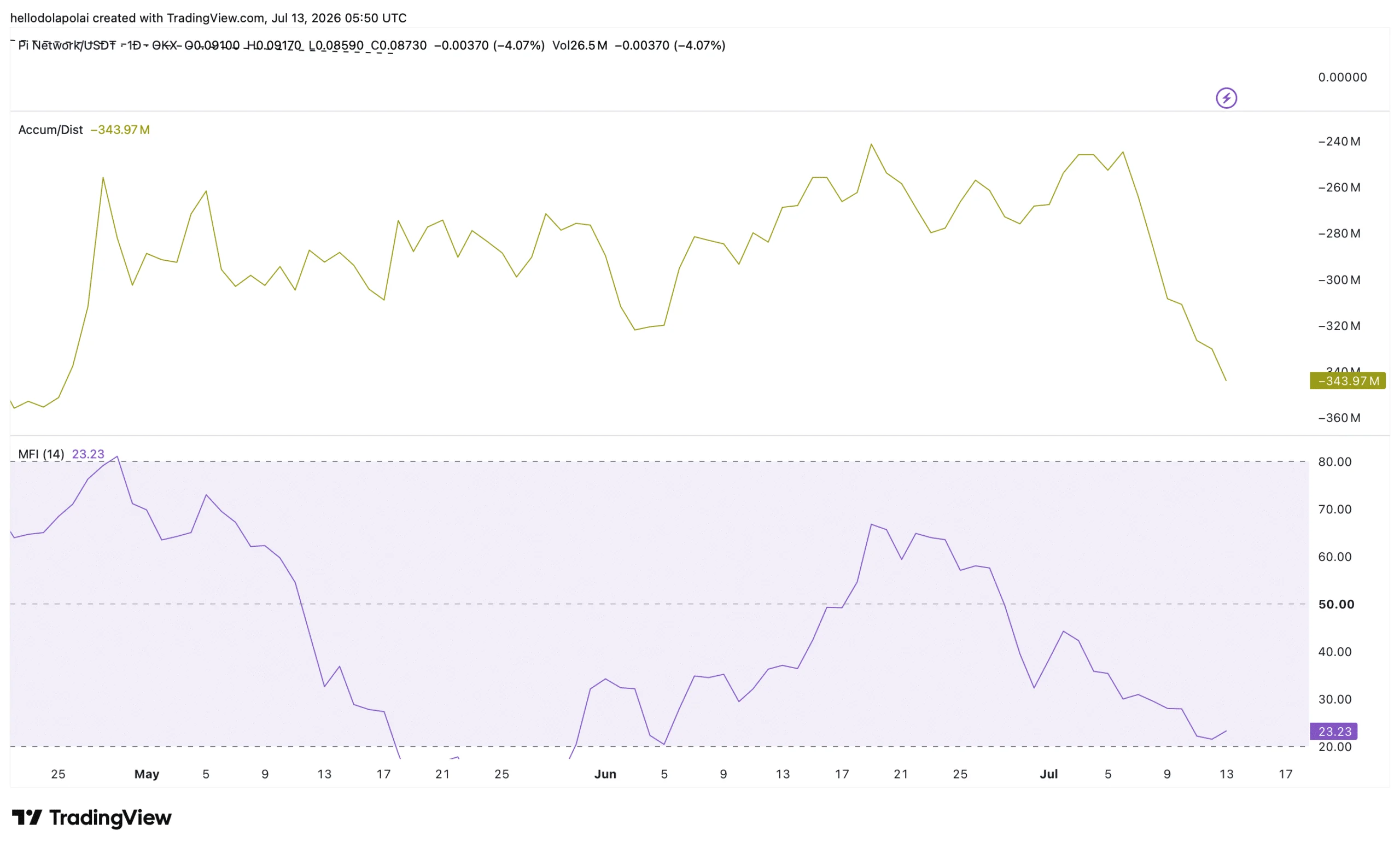
The Accumulation/Distribution indicator, which reads whether buyers or sellers dominate an asset’s trades, confirms their grip, with its cumulative reading down to -343 million at press time.

PI indicator analysis chart. PI indicator analysis chart.
Source: TradingView

The Money Flow Index, which tracks capital moving into and out of an asset, has slid sharply alongside it. The MFI now reads 23, near the low end of the 20-to-50 capital-outflow zone, though it has ticked up slightly.

Should the MFI hold in that lower band without breaking 20, sell pressure and capital outflows could intensify. A move below 20 would instead mark PI as oversold, opening the door to a rebound and fresh inflows.

Funding Rate points to deeper losses

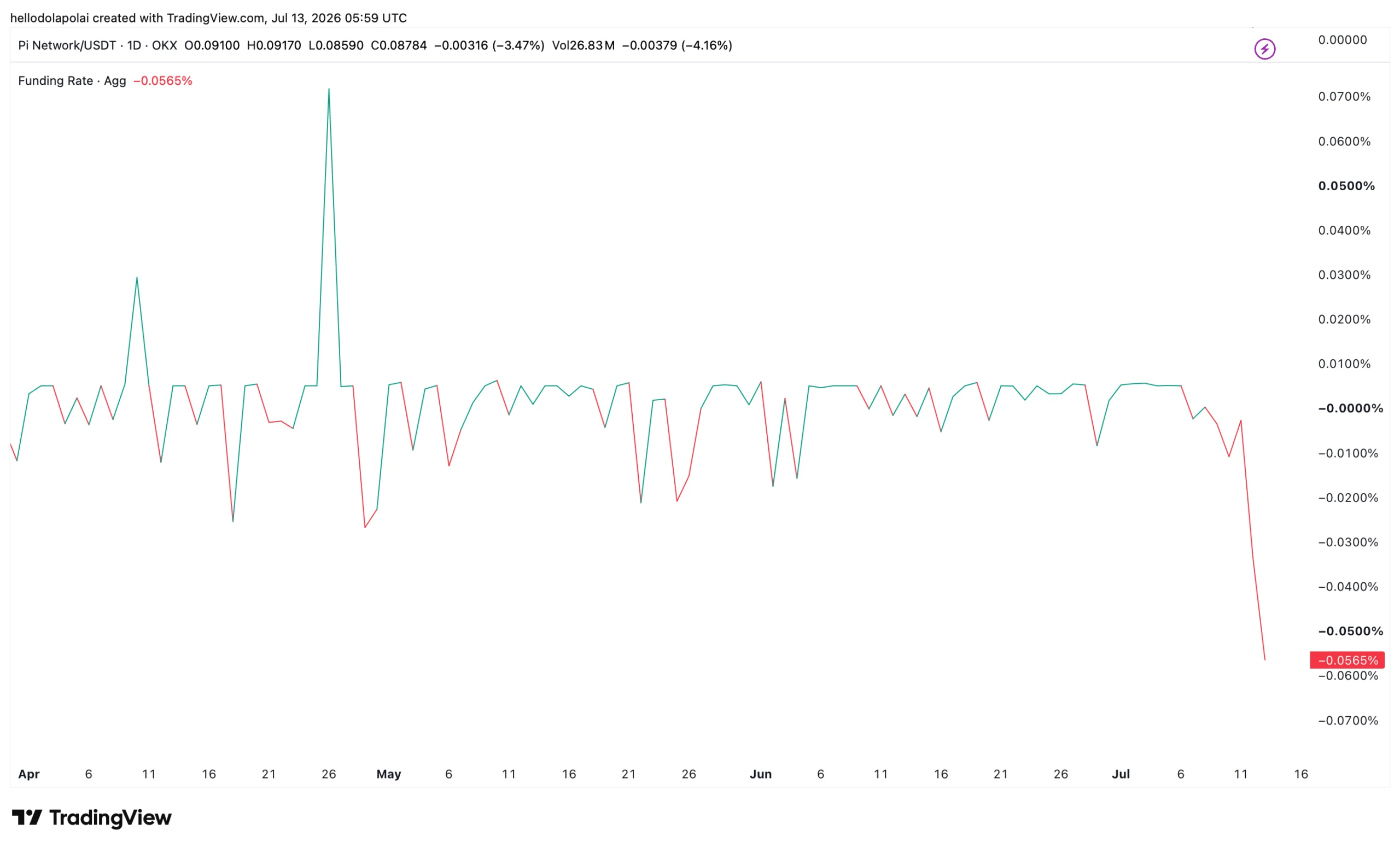
The Funding Rate, which tracks whether traders position their capital bullishly or bearishly, shows the market leaning heavily to the downside. At the time of writing, the rate had plunged to roughly -0.0565%, with capital concentrated on the short side.

PI funding rate chart. PI funding rate chart.
Source: TradingView

A deepening bearish tilt, at a moment when market momentum is already fragile, suggests PI stays on its downward path and logs further losses.


Final Summary

  • PI dropped almost 12% over the weekend as trading volume jumped 129% to $17.7 million, and sellers show no sign of slowing.
  • Accumulation/Distribution, Money Flow Index, and Funding Rate readings all lean bearish, keeping a new all-time low firmly on the table unless PI reclaims its current support.


Source link

Circle’s (CRCL) OCC approval fails to ease core concerns, Mizuho says

0
Circle takes banking step with U.S. trust bank approval

Circle Internet Group’s (CRCL) final approval from the Office of the Comptroller of the Currency to establish First National Digital Currency Bank is a positive milestone, but investors may be overestimating its significance, according to Japanese investment bank Mizuho.

“While a positive development, we believe the market reaction is likely overly optimistic, as this does not resolve fundamental issues that have been hurting the stock of recent,” analysts led by Dan Dolev said in the Friday report.

Shares of the stablecoin issuer closed 5% higher on Friday following the news. The stock on Monday has given back most of those gains, trading 4.7% lower at $63.03 at publication time.

Mizuho reiterated its neutral rating, arguing that the regulatory approval does not resolve the fundamental issues weighing on the stock.

Those challenges include a decline in USDC’s market capitalization since March 2026, which the bank said raises questions about the stablecoin’s growth trajectory.


Source link

Rivian Vs. Tesla: Buy Rivian to Exploit California’s Protectionist Subsidy That Snubbed Tesla

0
Rivian Vs. Tesla: Buy Rivian to Exploit California’s Protectionist Subsidy That Snubbed Tesla


Quick Read

  • California’s $135M EV subsidy exempts California-based Rivian from the $50K price cap while Austin-based Tesla gets shut out entirely on premium tiers.

  • Rivian stock surged 25% in one week despite an 8.5% bankruptcy probability and 80% bearish Reddit sentiment heading into R2 external deliveries.

  • Act now: the analyst who called NVIDIA in 2010 just named his top 10 AI stocks — and Tesla didn’t make the cut. Grab the names FREE today.

Rivian (NASDAQ: RIVN) and Tesla (NASDAQ: TSLA) both closed the books on Q1 FY2026. Rivian posted $1.38B in revenue and a widening EBITDA loss, while Tesla delivered $22.39B revenue and $941M in GAAP operating income. California just handed Rivian a policy wedge Tesla cannot access, which reframes the comparison entirely.

Mliu92 / Wikimedia Commons

R2 Ramp Meets Robotaxi Machine

Rivian’s quarter was carried by its Software & Services segment, up 49% year over year to $473M on the Volkswagen JV, alongside 10,365 deliveries (+20% YoY). The automotive segment slipped into a $62M gross loss as regulatory credit sales fell $100M. CEO RJ Scaringe framed R2 as the pivot, calling out the $4.5 billion DOE loan for the Georgia plant.

Tesla’s story was margin recovery. Automotive gross margin expanded to 21.1% from 16.2%, FSD active subscriptions jumped 51% YoY to 1.28 million, and Unsupervised Robotaxi went live in Dallas and Houston. Free cash flow reached $1.44B (+117%).

Business Driver

Rivian

Tesla

Main Growth Engine

R2 SUV launch, Software & Services

FSD subscriptions, AI/robotaxi

Q1 FY26 Revenue

$1.38B (+11.4%)

$22.39B (+15.8%)

Cash on Hand

$4.83B

$44.7B

Government Backing

$4.5B DOE loan, $1B VW equity

None on state rebates

California Draws a Line Around Rivian

California’s newly minted $135 million first-time EV buyer incentive program was structured with a price-cap loophole that exempts only California-headquartered pure-play EV makers from the standard $50,000 MSRP ceiling. Rivian, based in Irvine, California, qualifies. Tesla, now in Austin, does not on its premium tiers.

Act now: the analyst who called NVIDIA in 2010 just named his top 10 AI stocks — and Tesla didn’t make the cut. Grab the names FREE today.

The timing lines up with Rivian’s R2 Performance trim (656 hp, 330-mile range) hitting external deliveries in coming weeks. Tesla, meanwhile, absorbs the loss of that specific channel while defending a trailing P/E of 358 and forward P/E of 200.

The Next Test Is R2 Sell Through

I will be watching whether R2 external deliveries convert California’s subsidy loophole into real volume, and whether Rivian’s 62,000 to 67,000 delivery guide holds. You should track Tesla’s Cybercab pilot and Optimus install pace, though prediction markets currently price just a 12.5% chance of Optimus release by year end 2026.

Rivian’s Setup Versus Tesla’s Cash Engine

The stock is up 25.37% in the past week and 44.76% over one year, and the consensus target sits at $18.50, roughly where shares trade. Skepticism remains: Reddit sentiment on r/stocks skewed very_bearish in 80% of recent observations, and the bankruptcy contract on Polymarket still sits at 8.5%. Tesla offers cash flow durability with a $44.7B cash pile and 21.1% automotive gross margin, while Rivian’s exposure to a state-level subsidy that excludes Tesla represents a distinct policy-driven catalyst tied to R2 external deliveries.

Act now: the analyst who called NVIDIA in 2010 just named his top 10 AI stocks — and Tesla didn’t make the cut. Grab the names FREE today.

Contact editorial@247wallst.com for any questions or corrections.


Source link

Last summer, I signed up my kids for too many camps. This summer, we leaned into getting bored.

0
Last summer, I signed up my kids for too many camps. This summer, we leaned into getting bored.


The author decided to sign her kids up for fewer summer camps this year.

  • I have three kids, 8 and under, and like many parents, I struggle to keep them engaged all summer.
  • Last year, we signed them up for nine consecutive weeks of camp.
  • We were all exhausted by the end, so we decided to scale it back this summer.

By the time September rolled around and my kids’ school started again, we were all exhausted. But not from hearing my kids say “I’m bored” for the 11th time in an hour during summer break, but rather because we overcommitted to too many summer camps.

I had to have major surgery in early July and figured sending my kids to nine consecutive weeks of camp was a great idea. They’d be out of the house, entertained with their friends.

Instead, the summer felt like a continuation of the school year, with no real break. So this summer, we decided to send them only to camp for a week, and everyone is happier.

I grew up doing nothing in the summer

I’m from Argentina, and our seasons are opposite to those in the US. My summer break would run from mid-December to mid-February, and my parents sent me to zero camps. We would go to the beach, we would take a two-week family vacation, and for the rest of the time, I was expected to entertain myself. I would devour book after book, go to the movies regularly, and one summer I learned how to knit; another, I learned how to play dominoes with my grandmother.

After moving to the US and having kids, I was caught off guard by how much planning goes into summers here. On the one hand, many households have two working parents, so there’s a need for someone to watch the kids. But on the other hand, it feels like there’s no room for kids to just get bored.

We signed them up for too many camps

At first, my kids would attend a couple of weeks of camp at their Montessori preschool. They would hang out with the same friends, play around a sprinkler, and eat ice pops every day. We sent them there more for the social aspect than anything else — we wanted them to have friends since we had just relocated from New York to Maine, and it felt like the easiest way to create a community.

As they grew older, we started exploring camps that leaned into their personal interests. Last summer, we asked our kids what camps they wanted to go to. It ranged from a pottery camp, a soccer camp, a mystical creatures camp, and more.

Because I was having a hysterectomy and wasn’t going to be able to do much parenting, we figured it was the perfect time to say yes to all their requests. After a two-week trip in Sicily, we came back to the US for nine straight weeks of camp.

We leaned into ‘get bored’ this year

At first, my kids were having so much fun at camp. But as the weeks went on, they all grew tired of the same routine. And I’m not going to lie, my husband and I were also getting tired of it.

From the constant shuttling of kids from one location to the next, to making and packing three lunches, snacks, and water bottles, to constantly running laundry to keep up with camp shirts, towels, and specific clothes they needed to bring. I felt like I was doing way more than during the school year.

So this summer, we decided to swing the pendulum all the way to the other side and lean into a summer of nothing. We signed our kids up for one week of camp so they could still see their friends, and besides a two-week family trip, the rest of the summer is empty.

We’ve encouraged our kids to call their friends on their landline and make plans. That has turned into them making independent playdates with our neighbors who have kids. We have traded off having the kids in our house or theirs. We’ve had days where my kids just spend hours building with Lego blocks and leaning into imaginative play. I’ve taken them to see “Toy Story 5” and the new Minions movie.

The biggest surprise for me has been that, when together and not rushing, my kids fight less with each other. And the biggest gift has been getting so much more family time than in any other summer before, which to me feels like the whole point of summer anyway.

Read the original article on Business Insider


Source link

Bolivia weighs adding Tether’s USDT to its national payments system

0
Tether puts $23 billion gold stockpile to work

Bolivia is considering adding Tether’s USDT stablecoin to its national payments system, marking another step in the country’s shift from banning crypto transactions to allowing regulated digital asset use.

Economy Minister José Gabriel Espinoza said at a press conference on Monday that the government is evaluating whether USDT could circulate alongside the boliviano, the country’s fiat currency, and the U.S. dollar.

The proposal remains under technical review and the government has not published implementation rules or granted the stablecoin legal-tender status, local news outlet La RazĂłn reported.

Officials are developing a framework for banks, digital wallets and payment providers, according to Espinoza. Any rollout would require stronger anti-money laundering controls as Bolivia remains on the Financial Action Task Force’s grey list, which subjects the country to increased monitoring over shortcomings in its financial crime regime.

The proposal comes amid a sharp rise in crypto adoption after Bolivia’s central bank lifted restrictions on transactions in June 2024. Central bank data shows that crypto transaction volume climbed from $46.5 million in the first half of 2024 to $294 million during the same period last year. Total transaction volume rose 630% after restrictions were removed, the central bank has said.


Source link