Home Blog Page 256

What Taiwan Semiconductor’s Earnings Can Say About Its 2026 Outlook

0
What Taiwan Semiconductor’s Earnings Can Say About Its 2026 Outlook


Taiwan Semiconductor’s second quarter earnings could cure—or aggravate—AI investing jitters. The chip foundry is the undisputed leader in the manufacture of high-performance AI chips and advanced packaging technology that helps chips work together more efficiently.

TSMC’s customers are the largest drivers of AI capital spending, so the company has a close view on the demand dynamics shaping the industry. For that reason, investors and analysts are watching TSMC’s earnings, capital budget and commentary closely to gauge the health and trajectory of the AI buildout.

Evaluating TSMC’s 2026 Momentum

In 2026, Taiwan Semiconductor is converting strong AI-related demand into solid revenue and profit gains. In the first quarter, TSMC reported a year-over-year revenue gain of 35.1% in New Taiwan dollar terms. Gross margin increased to 66.2% from 58.9% in the prior year quarter, supporting a diluted EPS gain of 58.3%. Capital expenditures were slightly below the prior quarter’s spend, and 6% higher than the same quarter last year.

The company’s high-performance computing platform, which includes AI solutions, produced 61% of revenue. The next-largest platform in the quarter was smartphone, accounting for 26% of revenue.

TSMC Financial Snapshot And Forward Milestones

Taiwan Semiconductor reports in New Taiwan dollars and uses a weighted average exchange rate to convert quarterly metrics into U.S. dollars. The U.S.-traded security is an ADR trading on the NYSE as TSM. Each ADR represents five ordinary shares, so there are separate figures for EPS and earnings per ADR.

The table below summarizes the key financial metrics for the first quarter and projected 2026 values for revenue, gross margin and capital expenditures.

Key Focus Areas For TSMC’s Second Half Of 2026 Guidance

Capital Spending

Capital spending represents risk and reward at TSMC. Company leadership has said the capital spending is “always correlated” with higher growth opportunities. But the capital-intensive nature of foundry business is inherently risky. During periods of high demand, TSMC must expand capacity while innovating to enable faster, more efficient processing.

In the first quarter, TSMC said its 2026 capital spending budget would land toward the high end of its $52 billion to $56 billion guidance range. A reduction from that range could signal a more cautious growth outlook.

AI/HPC/5G Demand

TSMC has identified AI, high-performance computing, and the 5G buildout as megatrends driving the industry. Demand created by these trends, led by AI, drives the company’s capital spending budget and its outlook.

In the first quarter 2026 earnings call, TSMC chairman and CEO C.C. Wei characterized AI demand as “extremely robust.” Analysts expect to hear more of the same in the second quarter update.

Advanced Packaging Capacity

TSMC’s advanced packaging technology, CoWoS, is increasingly becoming a competitive differentiator and growth story. CoWoS is the industry standard method for integrating multiple chips into a single unit to create performance gains.

The problem is that CoWoS production is constrained, even more so than chip output. Nvidia has reportedly booked 60% of TSMC’s CoWoS capacity through 2026 plus more than half of the 2026-2027 expansion.

TSMC is addressing the bottleneck by building advanced packaging facilities in Arizona and “ramping up two new packaging facilities in Taiwan” according to CNBC. Analysts will want to know the progress of these buildouts.

N2 Ramp Progress

N2 is the latest generation of TSMC’s chip technology, which should command the highest pricing and margins. Prior generations N3, N4, and N5 are less powerful and efficient for high-performance applications but remain in demand for other uses.

The company began high-volume manufacturing of N2 in the fourth quarter of 2025. In the first quarter earnings call, Wei noted that N2 was ramping successfully at two sites, supported by smartphone, AI and HPC demand. Analysts will be watching for more data on N2 margins and how that affects the company’s overall profitability.

Gross Margin Outlook

TSMC recorded a gross margin increase for the first quarter of 2026 and guided second quarter gross margin in the range of 65.5% to 67.5%. The company predicted that N2 production ramp costs and overseas fab expansion could dilute gross margins by 2% to 3% for the full year of 2026.

The margin dilution could continue over the next few years as TSMC continues to ramp and optimize its production capacity. The company’s ability to project N2-related dilution for the second half of 2026 will help analysts evaluate future margin guidance.

What Experts Say About TSMC’s Outlook

Analysts are largely positive about Taiwan Semiconductor’s outlook. Average revenue estimates imply year-over-year sales growth in excess of 35% for the next two quarters. The average 2026 revenue estimate is $5.2 trillion, which would be a 36.5% gain over 2025.

EPS estimates also indicate expected growth. Analysts project $3.83 for the second quarter EPS for a 55% gain over the prior-year result of $2.47. The consensus estimate for 2026 is $15.91 per share, which is 49.3% improvement over 2025.

The Bull Case For H2 2026

Counterpoint estimated that Taiwan Semiconductor owned 73% of chip foundry demand in the first quarter of 2026. That dominance is fueled by TSM’s reputation as a critical design and manufacturing partner to the world’s largest tech companies. That positioning largely ensures that TSMC will profit from ongoing chip demand, which is currently strong and expected to remain that way for years.

The company’s advanced packaging technology should continue to be a differentiator, despite the capacity constraints. There are competing technologies, but they are less mature. And because switching platforms requires a full chip redesign, customers who build around CoWoS tend to stay.

These trends position TSMC for strong growth in the second half of 2026 and beyond.

The Bear Case For H2 2026

TSMC’s annual report filed with the SEC notes that “foundry customers generally do not place purchase orders far in advance” because the technology evolves so quickly. That means the company has limited protection from a massive spending slowdown. Should AI chip demand suddenly dry up, TSMC’s financial performance would reflect the change within a few quarters.

A dramatic slowdown in the short term would be difficult to manage, since it would coincide with heavy capacity investment and rising competition.

Escalating tensions between China and Taiwan represent another threat to TSMC, though probably not an immediate one. China has long expressed its intention to take control of Taiwan, which is currently a self-governing province. Most of TSMC’s manufacturing facilities are in Taiwan, and a military conflict would likely disrupt production.

In March 2026, U.S. intelligence said China is not planning on invading in 2027—but there is no guarantee.

Is TSM Stock One To Buy Now?

Taiwan Semiconductor is a primary beneficiary of the massive AI investments being made by the world’s largest tech companies. So far, TSMC has managed this period of high demand well, maintaining strong profitability while making strategic capacity investments and advancing its technology. Investors like to see that careful balance between managing current operations well while pursuing future growth.

But to invest in TSM stock now, you must believe that AI and HPC demand will remain strong for the foreseeable future. The company is funneling billions into capacity expansions, and those fabs need to be well-utilized. A sharp downturn in demand could lead to excess capacity down the road, at a time when competitors are investing heavily to close the gap.

TSMC is a solid, well-run company with a positive outlook. The second quarter earnings probably report won’t change that conclusion. But it should provide important feedback on how far and fast the AI spending trend will go. You can use that feedback to assess how risky TSMC’s capital budget is and whether this AI stock fits your investment criteria.


Frequently Asked Questions (FAQs)


Source link

Valmet lands Sun Paper board line order in China

0
Valmet lands Sun Paper board line order in China


Finland-based Valmet has secured an order from Sun Paper to supply a complete board production line, along with automation systems and life cycle support, for the company’s mill in Nanning, China.

According to Valmet, the installation is intended to expand Sun Paper’s containerboard output while supporting “energy- and resource-efficient” operation.

Commissioning of the line is planned for late 2027.

According to Valmet, the combination of advanced technologies, automation and life cycle services is designed to enable dependable, high-volume production of kraft and testliner while helping the machine achieve its efficiency objectives.

The scope of supply covers an entire board machine, extending from headboxes through to winders, and incorporates several technologies described as distinctive in the region.

Among the featured systems is the Sleeve roll technology, aimed at improving dewatering efficiency in the forming section.

The technology relies on forming fabric compression to promote smarter energy use.

The company further said the dryer section of the board machine will use a new compact geometry intended to deliver efficient board drying together with strong runnability systems.

Production reliability, capacity goals and roll quality will be backed by the inclusion of two winders.

The agreement further covers services intended to support a steady production base and long-term life cycle performance for the board machine.

These services include spare parts, digital services and paper machine clothing.

The order also provides for upgrades to other machinery already in operation at the customer’s facilities.

Sun Paper vice-general manager and chief engineer Ying Guangdong said: “The high-capacity machine concept and the selected advanced technologies support our targets for energy-efficient and stable production. We expect these solutions to deliver strong performance while reducing energy consumption and ensuring our capacity goals.”

Last month, Valmet launched its 3D Fiber technology, expanding the company’s offering in the moulded fibre packaging market. The system is designed to produce lightweight but rigid items from cellulose fibres such as trays, plates and food packaging.

“Valmet lands Sun Paper board line order in China” was originally created and published by Packaging Gateway, a GlobalData owned brand.


Source link

U.S. CPI, JPMorgan, Citi earnings reports: Crypto Week Ahead

0
U.S. CPI, JPMorgan, Citi earnings reports: Crypto Week Ahead

U.S. inflation data and financial-sector earnings are set to steer crypto markets in the week ahead, with investors looking for fresh signals on interest rates, economic growth and risk appetite.

June’s consumer price index lands Tuesday, followed by producer prices on Wednesday, giving markets two opportunities to consider the Federal Reserve’s interest-rate policy path.

Markus Levin, co-founder of XYO, told CoinDesk that softer CPI and PPI readings could strengthen the case for easier monetary policy, which has historically supported bitcoin and the broader crypto market. A stronger-than-expected inflation print, however, could push out rate-cut expectations and potentially send bitcoin below $60,000, he said.

“Investors will also be watching earnings from major U.S. banks, including JPMorgan, Citigroup and Wells Fargo, as their results often provide one of the clearest snapshots of the health of the U.S. economy,” Levin said.

”Strong loan demand, healthy consumer spending and stable credit quality would reinforce the view that economic growth remains resilient, supporting broader risk appetite.”

Renewed U.S.-Iran tensions and the risk of disruption around the Strait of Hormuz are also likely to influence events, injecting further volatility through oil prices and other risk markets.

What to Watch

(All times ET)

  • Crypto
    • July 13: Ethereum developers to review progress on testing the planned Glamsterdam upgrade.
    • July 14: Jito’s expected to make self-custody Solana trading app, JTX, accessible for early users.
  • Macro
    • July 14, 08:30 a.m.: U.S. Core Inflation Rate MoM for June est. 0.2% (Prev. 0.3%)
    • July 14, 08:30 a.m.: U.S. Core Consumer Price Index YoY for June est. 2.9% (Prev. 2.9%); MoM est. 0.3% (Prev. 0.2%)
    • July 14, 08:30 a.m.: U.S. Consumer Price Index YoY for June (Prev. 4.2%); MoM est. -0.1% (Prev. 0.5%)
    • July 14, 10 a.m.: U.S. Fed Chair Warsh presents semiannual monetary policy report to Congress.
    • July 14, 10 p.m.: China GDP Growth Rate YoY for Q2 est. 4.4% (Prev. 5%)
    • July 15, 8:45 a.m.: U.S. Fed Williams speech titled “The Future of Market Liquidity and Functioning”
    • July 15, 9:45 a.m.: Bank of Canada Interest Rate Decision (Prev. 2.25%)
    • July 16, 08:30 a.m.: U.S. Initial Jobless Claims for period ending July 11 (Prev. 215K)
    • July 17, 5 a.m.: Eurozone Consumer Price Index YoY Final for June est. 2.8% (Prev.3.2%)
    • July 17, 10 a.m.: U.S. Michigan Consumer Sentiment Prel for July (Prev. 49.5)
  • Earnings
    • July 15: BlackRock (BLK), pre-market, $12.55

Token Events

  • Governance Votes & Calls
    • Aave DAO is voting to adopt a standardized technical asset listing framework to ensure consistent, transparent safety baselines for assets across Aave V3, V4 and Horizon. Voting ends on July 13.
    • Ssv.network DAO is voting to reduce the floor price for its incentivized mainnet program (IMP) rewards from $10 to $8 per SSV. Voting ends on July 14.
    • Threshold Network DAO is voting to reorganize its committee, split multisig responsibilities, and eliminate contributor compensation to save $649,000. Voting ends July 15.
    • Cratos DAO is voting to extend the current mobile app token reward standard deadline from July 31 to Aug. 31, delaying the planned halving until Sept. 1 to help sustain user acquisition. Voting ends on July 16.
    • ENS DAO is voting to allocate $1.69 million to fund the SPP3 infrastructure cohort and compensate the selection committee. Voting ends on July 16.
    • Arbitrum DAO is voting on the election of members for the Oversight and Transparency Committee (OAT). Delegates can freely allocate their voting power among the 13 eligible candidates using a weighted voting system. Voting ends on July 17.
  • Unlocks
    • July 15: Connex (CONX) to unlock 1.45% of its circulating supply worth $28.67 million.
    • July 16: Arbitrum (ARB) to unlock 1.46% of its circulating supply worth $8.62 million.
    • July 17: DeBridge (DBR) to unlock 11.43% of its circulating supply worth $10.13 million.
  • Token Launches
    • July 13 – Credible (CRED) community sale opens on MetaDAO. The raise targets $2 million in community demand.

Conferences


Source link

Bitcoin ETFs end 8-week outflow streak with $197M inflows – Details

0
Bitcoin ETFs end 8-week outflow streak with $197M inflows - Details


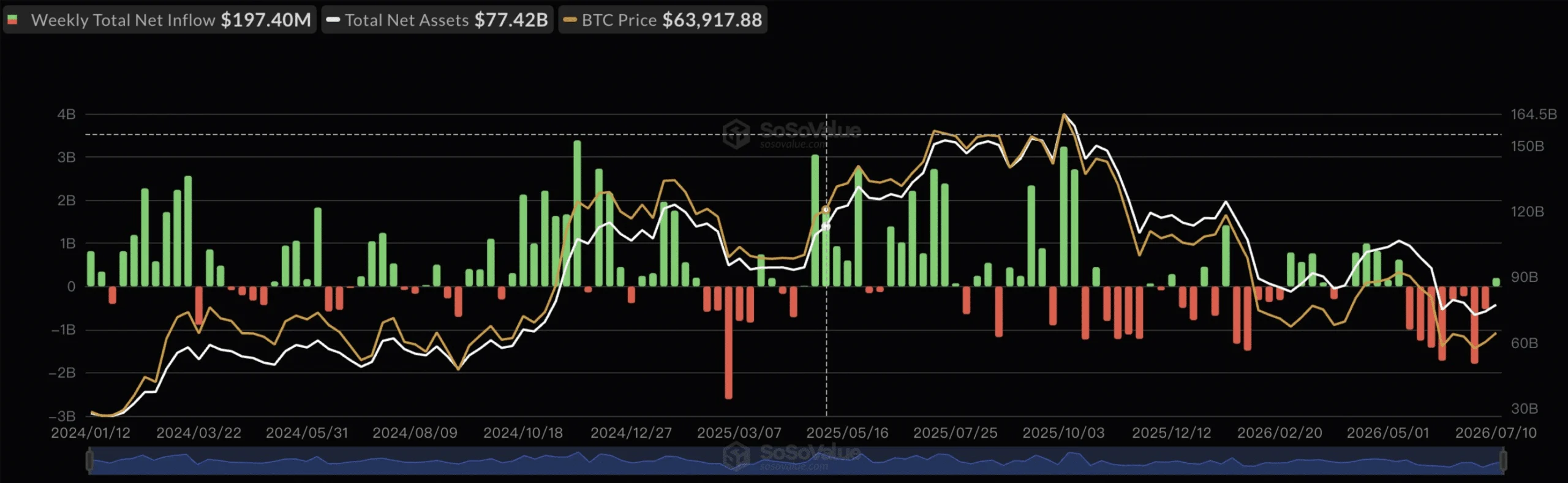
U.S. spot Bitcoin [BTC] ETFs recorded net inflows of $197 million between the 6th and 10th of July, breaking an eight‑week outflow streak. On the 6th of July alone, ETFs posted $265.7 million in inflows, the largest since early May.

BlackRock’s IBIT led with $209.4 million in inflows that day, while Grayscale’s GBTC posted the largest outflows at $44.5 million. However, on the 7th of July, the inflows dropped to $21.5 million, with IBIT contributing $54.8 million and Fidelity’s FBTC seeing $24.9 million in outflows. 

BTC ETFs saw inflows after 8 weeks
Source: SoSo Value

ETF momentum shift analysis

On the 8th of July, BTC ETFs shifted back to outflows, with $84.9 million in withdrawals. Similarly, on the 9th of July, outflows further rose to $95.3 million. On the 10th of July, however, inflows resumed, with BTC ETFs seeing an influx of $90.4 million. 

Thus, with $351 million in inflows, IBIT triumphed over the past week, while GBTC recorded the highest outflows of $108.2 million, followed by FBTC with $103.1 million. While ETF flows shifted, Bitcoin’s price swung between $63,650 and $64,400 before settling at $62,758.75 as of writing.

However, the volatility was insufficient to show whether the price was being driven up by the ETFs or whether the price was the factor that caused ETFs to move from outflows to inflows. 

Did other altcoin ETFs mirror BTC ETFs? 

While Bitcoin ETFs experienced inflows, Spot Ethereum [ETH] ETFs saw a similar pattern, with net inflows of $84.42 million, ending eight weeks of outflows. The only day with net sales was the 9th of July, when investors offloaded $52.08 million as Ethereum fell to $1,748. 

ETH ETFs inflows after 9 weeksETH ETFs inflows after 9 weeks
Source: Farside Investors

In this case as well, the highest inflows were seen by BlackRock’s ETHA, while the highest outflows were recorded by Fidelity’s FETH. Lastly, XRP ETFs reported $7.18 million in net outflows, whereas HYPE ETFs and Spot Solana [SOL] ETFs both managed to log $10.36 million and $930,400 in inflows, respectively. 


Final Summary

  • Bitcoin ETFs finally broke their 8-week outflow streak, but the price action was still screaming bearish noises.
  • Except for XRP ETFs, other altcoins, including Ethereum, Hyperliquid, and Solana ETFs, recorded inflows. 


Source link

He works two hours a month to make six figures a year — why he says ditching the 9-to-5 is ‘the ultimate power’

0
He works two hours a month to make six figures a year — why he says ditching the 9-to-5 is ‘the ultimate power’


wirestock/Envato

Some workers have been mandated back to the office after settling into work-from-home life, while others are finding that cubicle life and working 9-to-5 isn’t for them. Perhaps that’s why the idea of earning passive income has such allure.

And some Americans are making big money — passively. Greg Keogh, in his 30s, told (1) The Wall Street Journal that he got into the world of passive income because he couldn’t stand commuting and dressing in office attire.

Must Read

After talking to a dog owner, he was inspired to invent a larger-than-normal lint roller for pets, which he now sells on Amazon. He’s been at it seven years, making about $50,000 to $115,000 a year — and he only spends about two hours a month doing it.

Now Keogh can spend his days doing what he wants, while still making a steady stream of income. “That is the ultimate power,” he told WSJ.

But it doesn’t mean you should quit your day job just yet. In fact, for many Americans, passive income or side hustle money serves as a complement to a day job or a bridge to self-employment.

Passive income versus side hustles

Passive income generates earnings with minimal work after you make an upfront investment in time and/or money. For example, Keogh invented something that people want to buy, creating a passive income source.

You can earn passive income through investing (say, in stocks or real estate), garnering royalties on intellectual property, creating digital products that can be sold repeatedly (such as an online course) or through affiliate marketing, where you earn a commission when you promote other people’s products.

A common way to earn passive income is through renting out your home or car through online platforms such as Airbnb and Turo.

A side hustle, on the other hand, typically requires putting in the hours, whether you’re freelancing or driving for a rideshare service. It’s also not scalable. After all, if you’re a rideshare driver, you can’t drive 24 hours a day, so there’s a cap on what you can earn.

Passive income streams can scale, but you typically have to put in some effort upfront. And you typically need some sort of expertise to set yourself apart in a crowded marketplace.


Source link

Bitcoin slips below $63,000 in an Asian-session leverage flush

0
Live BTC markets: An 'altcoin season' signal flashed, but bitcoin's slide is what set it off

Bitcoin fell to about $62,800 on Monday, down 1.4% over 24 hours, after sliding from roughly $64,300 during Asian morning hours, per CoinDesk data.

Nothing new drove it. Bitcoin has traded between roughly $59,000 and $66,000 for a month, and the Asian-session drop was a leverage flush inside that range. The liquidations were minor, running at about a sixth of what the market recorded at its worst over the past 30 days, per CoinGlass.

SK Hynix fell in Seoul the same day, but for its own reasons. The memory chipmaker’s shares dropped after its U.S. trading debut, with traders pointing to profit-taking and a shift into the new American depositary receipts. The stock is down more than 30% from its June record after a run that took it up more than 25-fold since the end of 2022.

The two moves are not directly linked today, but they have shared a direction for weeks.

Bitcoin has traded as crypto’s highest-beta risk asset while the AI and chip trade set the tone for global risk appetite, and analysts at Anchorage Digital attribute roughly 30% of the pressure on bitcoin to capital rotating into AI.

The June inflation print lands July 14, and the Fed meets July 28 and 29, the two events most likely to decide whether risk assets, crypto and chip stocks alike, get relief or another leg down.


Source link

The Next Bull Market Could Be Built on Inventory Replenishment

0
The Next Bull Market Could Be Built on Inventory Replenishment


The Middle East is once again at the center of global energy markets due to the renewed military confrontation involving Iran. Markets, however, should recognize that, unlike in previous crises, the world is entering this new phase with a significantly weaker strategic safety net. At present, crude oil prices still respond to headlines surrounding military operations, shipping incidents, and diplomatic statements. Still, it is now time that markets should no longer overlook the structural consequences of the past months. The world’s emergency buffer has been substantially depleted. Crude oil prices and supply during the first phase of the Iran crisis have been largely absorbed by the release of strategic petroleum reserves, rerouting exports, and (unexpected) weaker demand in Asia. Right now, we are in a new and much more dangerous phase, in which everything will prove considerably more challenging, mainly because governments, oil companies, and refiners will increasingly have to rebuild depleted reserves while geopolitical uncertainty remains elevated.

This distinction between Phase I and II is critical. For decades, geopolitical shocks were generally assessed through the lens of lost production or disrupted exports. The main focus of analysts has been calculating how many barrels might disappear from the market, while also assessing whether Saudi Arabia, the United Arab Emirates, or other producers are holding enough spare production capacity to compensate. Even though this methodology remains relevant, it is no longer sufficient or fully applicable. In the coming weeks and months, the most important question will be how many additional barrels will need to be purchased to restore strategic resilience. We are witnessing a market shifting from being dominated by emergency releases to one increasingly driven by mandatory replenishment.

Related: People Are Talking About Contango While Oil Markets Are Far From Recovered

The above is being substantiated or even reinforced by the recent military developments, as renewed U.S. military operations against Iranian targets, followed by Iranian retaliation against American and allied interests across the Gulf, demonstrate clearly how quickly regional tensions can threaten confidence in maritime trade. Even though Hormuz is not yet closed for a long period, shipping companies, charterers and insurers have to reassess operational risks again. Freight rates, war-risk premiums and voyage planning have become increasingly sensitive to military developments. The latter is the case even when crude exports continue to flow. The primary lesson at present is clear: physical supply need not disappear entirely for markets to become structurally tighter. The cost of every barrel transported, however, will increase solely due to persistent uncertainty.

The United States has relied heavily on its Strategic Petroleum Reserve to cushion previous disruptions. This has been effective in reducing immediate market volatility, but it has also fundamentally changed the role of the SPR itself. After serving as an emergency stockpile awaiting a catastrophic event, the SPR has now become an active market-management instrument. The ultimate result of this shift is that today’s stabilization inevitably creates tomorrow’s demand.

This is frequently misunderstood, as shown in the last few weeks. At present, a significant proportion of recent SPR releases has taken place through exchange agreements rather than straightforward sales. These arrangements with companies receiving crude today oblige the contractual parties to return equivalent volumes later, together with additional premium barrels. The reality is that the current transactions function more like secured loans than as permanent disposals. While they are very effective in providing immediate liquidity to the physical market, they also create future purchasing obligations. Every borrowed barrel ultimately becomes another barrel that must be bought back.

This will also have profound implications for future oil balances. At present, it seems, the market has celebrated emergency releases as additional supply. This means it did not fully account for the fact that these barrels have not disappeared from future demand calculations. Instead, demand has effectively been shifted forward. The only thing that governments and companies have purchased is time, not solving the underlying structural imbalance.

While the media is focusing on the United States, the latter is not the only actor facing this challenge, as members of the International Energy Agency (IEA) have coordinated emergency stock releases. Europe, Japan, and South Korea all relied to varying degrees on strategic inventories accumulated over decades. Until now, these actions have prevented a more severe supply shock. However, they also have reduced the collective emergency cushion available for future crises. The political willingness to undertake such extensive releases has diminished considerably, as governments now recognize that rebuilding depleted reserves will become increasingly expensive if geopolitical instability persists.

Asia’s largest oil consumer, China, has introduced an additional layer of complexity. Global crude consumption has been softened, especially during phase I of the Iran conflict, due to China’s relatively weak refinery activity and subdued industrial demand.  This, however, may not continue indefinitely. When Chinese refinery runs recover, and economic activity gradually improves, there will be additional import demand coinciding with strategic reserve rebuilding across OECD countries. The market will see a convergence of buyers rather than a simple recovery in consumption.

Analysis already shows that strategic reserve replenishment alone could support global crude demand well into 2028. It is even stated that this will potentially add between roughly 500-750K bpd of additional purchasing requirements. These are not speculative barrels, but policy-driven acquisitions. Governments will ultimately have to undertake them if they wish to restore credible emergency protection. A new structural source of demand is created for the market.

The current market analysis is still driven by a misconception: the view that spare production capacity is the decisive stabilizing factor. Saudi Arabia and the United Arab Emirates undoubtedly retain the technical ability to increase output. OPEC+ has repeatedly highlighted its flexibility and willingness to respond to market developments. However, production capacity cannot eliminate geopolitical risk on its own. Every additional barrel still depends on pipelines, export terminals, offshore loading facilities, electricity networks, desalination plants and secure shipping routes. It is important to understand that modern energy systems are networks of interconnected infrastructure, not isolated oil wells. Their vulnerability extends far beyond production itself.

These developments explain why physical oil markets increasingly diverge from financial markets during periods of heightened geopolitical tension. Futures prices often respond to expectations regarding production balances. Physical buyers focus instead on delivery certainty, freight availability, insurance coverage, and logistical reliability. The current Iran crisis has shown that physical crude repeatedly traded at significant premiums over benchmark futures whenever maritime security deteriorated. Those premiums reflected confidence (or, better stated, the lack of it) far more than outright production shortages.

The same dynamic is starting to appear again. Shipowners continue to reassess Gulf voyages, insurers remain cautious regarding war-risk exposure and charterers increasingly factor geopolitical uncertainty into freight negotiations. Iran (or the US) doesn’t even need to close the Strait of Hormuz anymore; current factors have already resulted in structurally higher crude transportation costs. The market is gradually replacing a supply-risk premium with a logistics-risk premium.

Strategic Indicator

Current Situation

Strategic Implication

U.S. Strategic Petroleum Reserve

Lowest level in more than four decades

Reduced emergency flexibility

SPR Exchange Agreements

Borrowed barrels must be returned with premium

Creates structural future crude demand

OECD Strategic Inventories

Lower following coordinated releases

Less capacity for another major intervention

Commercial Inventories

Below long-term comfort levels in several regions

Increased physical market volatility

Hormuz Shipping

Elevated military and insurance risks

Higher freight and delivery costs

Strategic Reserve Rebuilding

Expected to continue through at least 2028

Sustained structural demand of roughly 0.5–0.7 mb/d

The most important consequence will not emerge during the current conflict, but after. Governments will need to replenish strategic reserves, while traders will try to rebuild working inventories. Refiners will increase precautionary stockholding, while Asian importers are expected to expand strategic storage while market conditions allow. When all of these purchases overlap, the result is clear. Each represents incremental demand that competes for the same physical barrels.

This creates a fundamentally different outlook from previous oil cycles. Instead of heading to a market balancing recovering demand against expanding supply, we are looking at the coming months or even years at a world that enters a period in which consumption, commercial inventory rebuilding, and strategic reserve replenishment reinforce one another. The expected result is a firmer price floor than many current forecasts assume.

The strategic dilemma facing Washington already illustrates the challenge perfectly. Continuing with additional SPR releases is technically possible if the conflict escalates. Washington will, however, need to deal with politics as well, as each new release increases future replenishment requirements, reducing confidence in the reserve’s ability to respond to an even larger emergency. Within the coming months, markets will start to end their demand, assess how many barrels remain available for release, and ask whether the reserve itself has become strategically insufficient. This, which is a major psychological transition, is more important than the absolute inventory level.

For Europe, the implications extend well beyond crude prices. Gulf stability remains a major factor in the region’s diesel balances, refinery margins, LNG shipping, petrochemical feedstocks, and maritime insurance. Asian economies face similar exposure, as China, India, Japan and South Korea continue to depend heavily on uninterrupted exports from the Middle East.

History demonstrates that oil crises rarely conclude when production recovers. The end comes when confidence returns, which is, at present, the scarcest commodity in global energy markets. Governments no longer assume that strategic reserves can be deployed repeatedly without consequence, while refiners start to question the resilience of just-in-time supply chains.

This is why the next sustained oil bull market could look different from previous cycles. It may not begin with the dramatic loss of several million barrels per day from global production. Maybe as a surprise to some, it may develop quietly as governments issue tenders to refill depleted strategic reserves, companies purchase crude to satisfy exchange obligations, refiners rebuild operational inventories, and importing nations strengthen energy security through precautionary stock accumulation. Most of these barrels will not be consumed, but disappear into storage. From the perspective of the physical market, however, the effect is remarkably similar.

The irony is striking. SPRs were designed to prevent oil crises, but now could become one of the principal drivers of the next phase of higher oil prices. The world has not exhausted its petroleum resources. It has reduced its strategic flexibility. To rebuild that flexibility will require hundreds of millions of barrels, years of disciplined purchasing, and tens of billions of dollars. If renewed confrontation with Iran persists while governments, traders and refiners all attempt to restore their insurance coverage simultaneously, the next oil shock will not be driven solely by a lack of supply. It will be driven by intensified competition for every available barrel needed to rebuild the world’s depleted energy safety net.

By Cyril Widdershoven for Oilprice.com

More Top Reads From Oilprice.com

Oilprice Intelligence brings you the signals before they become front-page news. This is the same expert analysis read by veteran traders and political advisors. Get it free, twice a week, and you’ll always know why the market is moving before everyone else.

You get the geopolitical intelligence, the hidden inventory data, and the market whispers that move billions – and we’ll send you $389 in premium energy intelligence, on us, just for subscribing. Join 400,000+ readers today. Get access immediately by clicking here.


Source link