Home Blog Page 257

The Next Bull Market Could Be Built on Inventory Replenishment

0
The Next Bull Market Could Be Built on Inventory Replenishment


The Middle East is once again at the center of global energy markets due to the renewed military confrontation involving Iran. Markets, however, should recognize that, unlike in previous crises, the world is entering this new phase with a significantly weaker strategic safety net. At present, crude oil prices still respond to headlines surrounding military operations, shipping incidents, and diplomatic statements. Still, it is now time that markets should no longer overlook the structural consequences of the past months. The world’s emergency buffer has been substantially depleted. Crude oil prices and supply during the first phase of the Iran crisis have been largely absorbed by the release of strategic petroleum reserves, rerouting exports, and (unexpected) weaker demand in Asia. Right now, we are in a new and much more dangerous phase, in which everything will prove considerably more challenging, mainly because governments, oil companies, and refiners will increasingly have to rebuild depleted reserves while geopolitical uncertainty remains elevated.

This distinction between Phase I and II is critical. For decades, geopolitical shocks were generally assessed through the lens of lost production or disrupted exports. The main focus of analysts has been calculating how many barrels might disappear from the market, while also assessing whether Saudi Arabia, the United Arab Emirates, or other producers are holding enough spare production capacity to compensate. Even though this methodology remains relevant, it is no longer sufficient or fully applicable. In the coming weeks and months, the most important question will be how many additional barrels will need to be purchased to restore strategic resilience. We are witnessing a market shifting from being dominated by emergency releases to one increasingly driven by mandatory replenishment.

Related: People Are Talking About Contango While Oil Markets Are Far From Recovered

The above is being substantiated or even reinforced by the recent military developments, as renewed U.S. military operations against Iranian targets, followed by Iranian retaliation against American and allied interests across the Gulf, demonstrate clearly how quickly regional tensions can threaten confidence in maritime trade. Even though Hormuz is not yet closed for a long period, shipping companies, charterers and insurers have to reassess operational risks again. Freight rates, war-risk premiums and voyage planning have become increasingly sensitive to military developments. The latter is the case even when crude exports continue to flow. The primary lesson at present is clear: physical supply need not disappear entirely for markets to become structurally tighter. The cost of every barrel transported, however, will increase solely due to persistent uncertainty.

The United States has relied heavily on its Strategic Petroleum Reserve to cushion previous disruptions. This has been effective in reducing immediate market volatility, but it has also fundamentally changed the role of the SPR itself. After serving as an emergency stockpile awaiting a catastrophic event, the SPR has now become an active market-management instrument. The ultimate result of this shift is that today’s stabilization inevitably creates tomorrow’s demand.

This is frequently misunderstood, as shown in the last few weeks. At present, a significant proportion of recent SPR releases has taken place through exchange agreements rather than straightforward sales. These arrangements with companies receiving crude today oblige the contractual parties to return equivalent volumes later, together with additional premium barrels. The reality is that the current transactions function more like secured loans than as permanent disposals. While they are very effective in providing immediate liquidity to the physical market, they also create future purchasing obligations. Every borrowed barrel ultimately becomes another barrel that must be bought back.

This will also have profound implications for future oil balances. At present, it seems, the market has celebrated emergency releases as additional supply. This means it did not fully account for the fact that these barrels have not disappeared from future demand calculations. Instead, demand has effectively been shifted forward. The only thing that governments and companies have purchased is time, not solving the underlying structural imbalance.

While the media is focusing on the United States, the latter is not the only actor facing this challenge, as members of the International Energy Agency (IEA) have coordinated emergency stock releases. Europe, Japan, and South Korea all relied to varying degrees on strategic inventories accumulated over decades. Until now, these actions have prevented a more severe supply shock. However, they also have reduced the collective emergency cushion available for future crises. The political willingness to undertake such extensive releases has diminished considerably, as governments now recognize that rebuilding depleted reserves will become increasingly expensive if geopolitical instability persists.

Asia’s largest oil consumer, China, has introduced an additional layer of complexity. Global crude consumption has been softened, especially during phase I of the Iran conflict, due to China’s relatively weak refinery activity and subdued industrial demand.  This, however, may not continue indefinitely. When Chinese refinery runs recover, and economic activity gradually improves, there will be additional import demand coinciding with strategic reserve rebuilding across OECD countries. The market will see a convergence of buyers rather than a simple recovery in consumption.

Analysis already shows that strategic reserve replenishment alone could support global crude demand well into 2028. It is even stated that this will potentially add between roughly 500-750K bpd of additional purchasing requirements. These are not speculative barrels, but policy-driven acquisitions. Governments will ultimately have to undertake them if they wish to restore credible emergency protection. A new structural source of demand is created for the market.

The current market analysis is still driven by a misconception: the view that spare production capacity is the decisive stabilizing factor. Saudi Arabia and the United Arab Emirates undoubtedly retain the technical ability to increase output. OPEC+ has repeatedly highlighted its flexibility and willingness to respond to market developments. However, production capacity cannot eliminate geopolitical risk on its own. Every additional barrel still depends on pipelines, export terminals, offshore loading facilities, electricity networks, desalination plants and secure shipping routes. It is important to understand that modern energy systems are networks of interconnected infrastructure, not isolated oil wells. Their vulnerability extends far beyond production itself.

These developments explain why physical oil markets increasingly diverge from financial markets during periods of heightened geopolitical tension. Futures prices often respond to expectations regarding production balances. Physical buyers focus instead on delivery certainty, freight availability, insurance coverage, and logistical reliability. The current Iran crisis has shown that physical crude repeatedly traded at significant premiums over benchmark futures whenever maritime security deteriorated. Those premiums reflected confidence (or, better stated, the lack of it) far more than outright production shortages.

The same dynamic is starting to appear again. Shipowners continue to reassess Gulf voyages, insurers remain cautious regarding war-risk exposure and charterers increasingly factor geopolitical uncertainty into freight negotiations. Iran (or the US) doesn’t even need to close the Strait of Hormuz anymore; current factors have already resulted in structurally higher crude transportation costs. The market is gradually replacing a supply-risk premium with a logistics-risk premium.

Strategic Indicator

Current Situation

Strategic Implication

U.S. Strategic Petroleum Reserve

Lowest level in more than four decades

Reduced emergency flexibility

SPR Exchange Agreements

Borrowed barrels must be returned with premium

Creates structural future crude demand

OECD Strategic Inventories

Lower following coordinated releases

Less capacity for another major intervention

Commercial Inventories

Below long-term comfort levels in several regions

Increased physical market volatility

Hormuz Shipping

Elevated military and insurance risks

Higher freight and delivery costs

Strategic Reserve Rebuilding

Expected to continue through at least 2028

Sustained structural demand of roughly 0.5–0.7 mb/d

The most important consequence will not emerge during the current conflict, but after. Governments will need to replenish strategic reserves, while traders will try to rebuild working inventories. Refiners will increase precautionary stockholding, while Asian importers are expected to expand strategic storage while market conditions allow. When all of these purchases overlap, the result is clear. Each represents incremental demand that competes for the same physical barrels.

This creates a fundamentally different outlook from previous oil cycles. Instead of heading to a market balancing recovering demand against expanding supply, we are looking at the coming months or even years at a world that enters a period in which consumption, commercial inventory rebuilding, and strategic reserve replenishment reinforce one another. The expected result is a firmer price floor than many current forecasts assume.

The strategic dilemma facing Washington already illustrates the challenge perfectly. Continuing with additional SPR releases is technically possible if the conflict escalates. Washington will, however, need to deal with politics as well, as each new release increases future replenishment requirements, reducing confidence in the reserve’s ability to respond to an even larger emergency. Within the coming months, markets will start to end their demand, assess how many barrels remain available for release, and ask whether the reserve itself has become strategically insufficient. This, which is a major psychological transition, is more important than the absolute inventory level.

For Europe, the implications extend well beyond crude prices. Gulf stability remains a major factor in the region’s diesel balances, refinery margins, LNG shipping, petrochemical feedstocks, and maritime insurance. Asian economies face similar exposure, as China, India, Japan and South Korea continue to depend heavily on uninterrupted exports from the Middle East.

History demonstrates that oil crises rarely conclude when production recovers. The end comes when confidence returns, which is, at present, the scarcest commodity in global energy markets. Governments no longer assume that strategic reserves can be deployed repeatedly without consequence, while refiners start to question the resilience of just-in-time supply chains.

This is why the next sustained oil bull market could look different from previous cycles. It may not begin with the dramatic loss of several million barrels per day from global production. Maybe as a surprise to some, it may develop quietly as governments issue tenders to refill depleted strategic reserves, companies purchase crude to satisfy exchange obligations, refiners rebuild operational inventories, and importing nations strengthen energy security through precautionary stock accumulation. Most of these barrels will not be consumed, but disappear into storage. From the perspective of the physical market, however, the effect is remarkably similar.

The irony is striking. SPRs were designed to prevent oil crises, but now could become one of the principal drivers of the next phase of higher oil prices. The world has not exhausted its petroleum resources. It has reduced its strategic flexibility. To rebuild that flexibility will require hundreds of millions of barrels, years of disciplined purchasing, and tens of billions of dollars. If renewed confrontation with Iran persists while governments, traders and refiners all attempt to restore their insurance coverage simultaneously, the next oil shock will not be driven solely by a lack of supply. It will be driven by intensified competition for every available barrel needed to rebuild the world’s depleted energy safety net.

By Cyril Widdershoven for Oilprice.com

More Top Reads From Oilprice.com

Oilprice Intelligence brings you the signals before they become front-page news. This is the same expert analysis read by veteran traders and political advisors. Get it free, twice a week, and you’ll always know why the market is moving before everyone else.

You get the geopolitical intelligence, the hidden inventory data, and the market whispers that move billions – and we’ll send you $389 in premium energy intelligence, on us, just for subscribing. Join 400,000+ readers today. Get access immediately by clicking here.


Source link

USDT usage at 35% in 2026 – What’s the key factor driving investors to stablecoins?

0
USDT usage at 35% in 2026 - What's the key factor driving investors to stablecoins?


Despite crypto adoption rising rapidly, investor sentiment is currently favoring stability over risk. The desire for a safe investment choice is increasingly evident, as evidenced by the increase in Tether [USDT] usage as the dominant form of currency throughout the entire market.

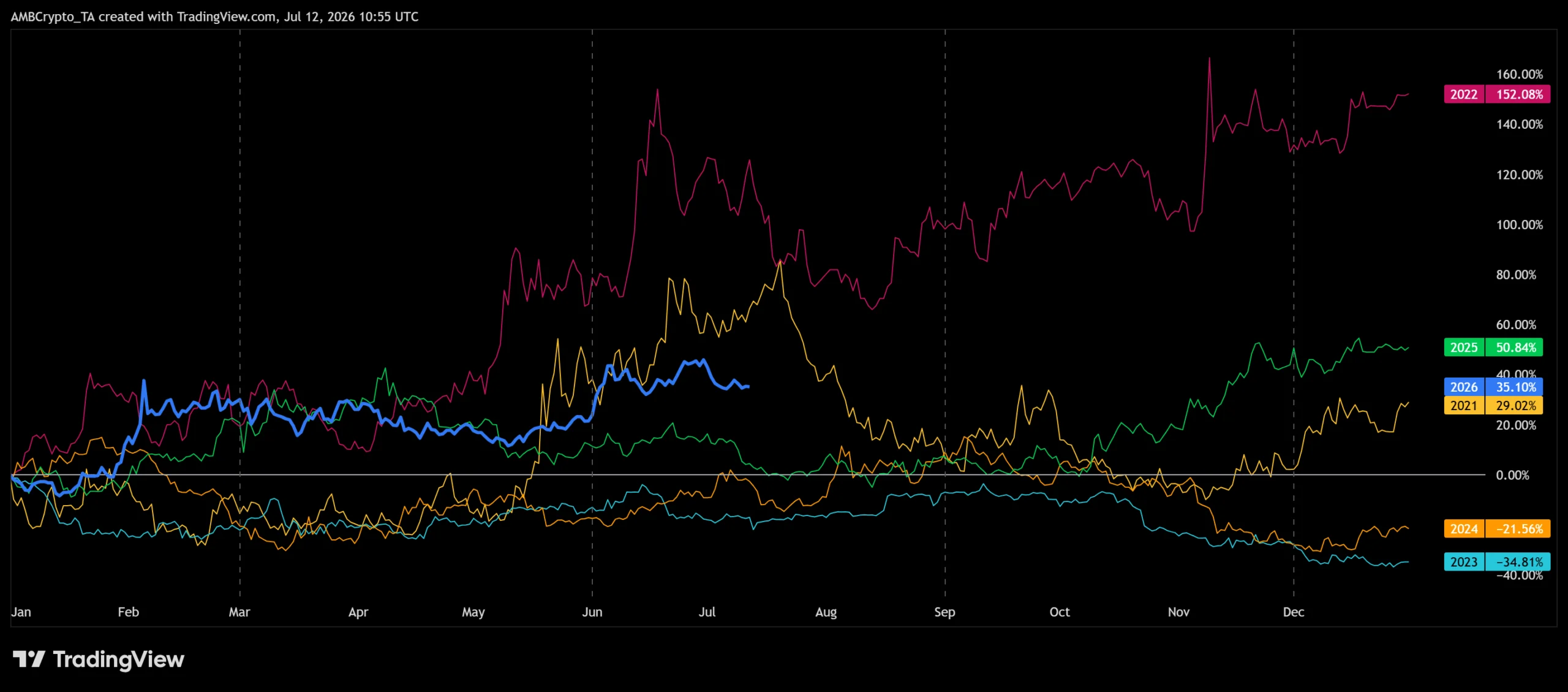
Seasonal data shows USDT usage at 35.1% by July 2026, outperforming 2021’s 29.0% in the same period.

Source: TradingView

It also stands well above 2024, during which usage remained in negative territory.

Cross-border payments drive stablecoin utility

That growing stablecoin preference is no longer reflecting caution alone. It is increasingly supporting real economic activity across blockchain networks.

As global payment firms expand stablecoin settlement, users are interacting with these assets far more frequently than in previous cycles.

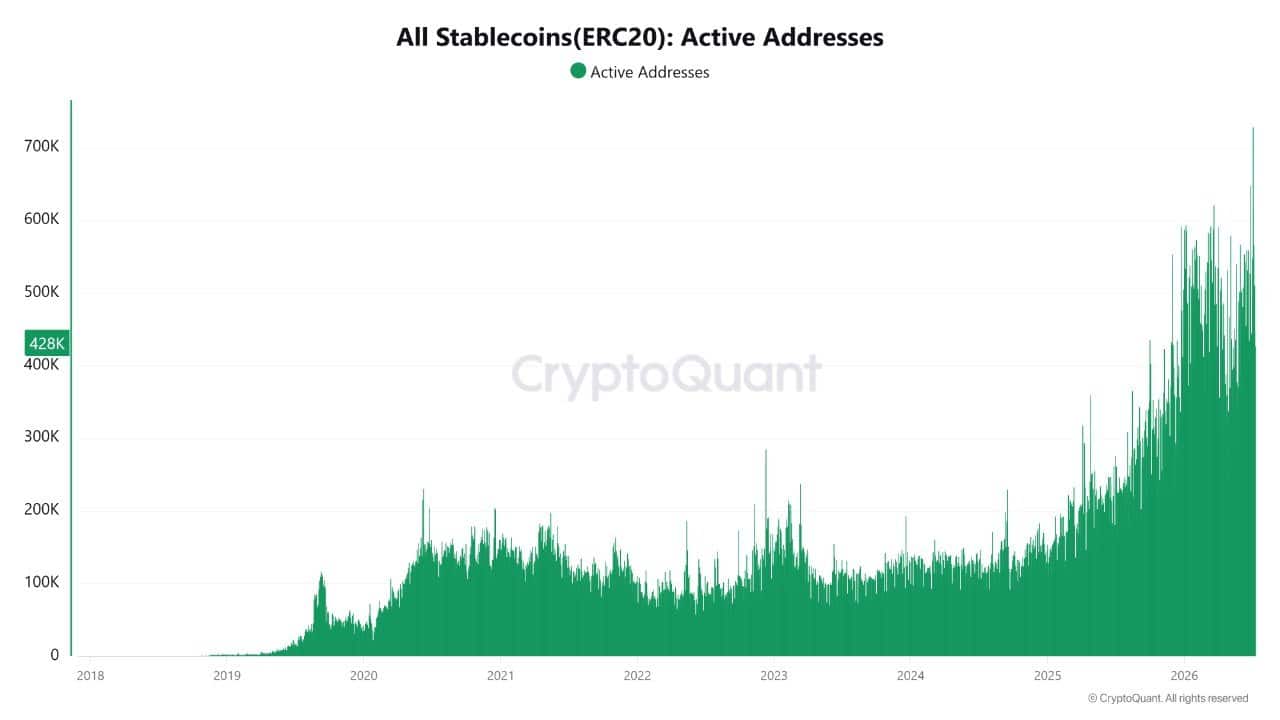
That shift is clear in the amount of ERC-20 stablecoin activity, which has increased significantly. Active addresses have surged, hovering between 400,000 and 700,000 daily since 2025.

Source: CryptoQuant

Stablecoins are being increasingly utilized by enterprises to support their cross-border settlement processes and treasury operations. This expansion coincides with Visa, Mastercard, PayPal, and Stripe integrating stablecoins into cross-border payment infrastructure.

Meanwhile, the market has expanded to nearly $312 billion, reinforcing that demand now extends beyond crypto-native participants. If payment adoption accelerates, transaction utility could emerge as a primary growth driver.

As stablecoins gain wider acceptance in global payments, corporate adoption is beginning to strengthen blockchain’s long-term foundation.

The primary motivation for corporations to develop financial products utilizing stablecoins is no longer solely the cost savings associated with reducing settlement costs.

However, institutional investors have yet to rotate their investment into Bitcoin [BTC] or Ethereum [ETH]. This indicates continued preference by institutional investors for cost-efficient transactional outcomes versus speculative returns.

If sustained, corporates will play an increasingly pivotal role in blockchain adoption. This will be through delivering stability through real-world utility rather than cycle-driven speculation.


Final Summary

  • USDT’s demand increasingly reflects payment utility alongside defensive investor positioning.
  • Stablecoin adoption continues expanding as corporate integration strengthens blockchain’s long-term utility.


Source link

Simba 3.2 Takes No.1 Spot on Voice AI’s Toughest Benchmarks

0
Simba 3.2 Takes No.1 Spot on Voice AI's Toughest Benchmarks


Opinions expressed by Entrepreneur contributors are their own.

For years, the rule in text-to-speech has been simple. If you wanted the best-sounding voice for your product, you paid enterprise pricing. If you wanted cheap, you accepted robotic. If you wanted fast, you gave up something on both. That rule just broke.

The trade-off every product team has been forced to make

If you have ever built a voice agent, a phone system, or a real-time reader, you know the drill. You audition four or five models. One sounds incredible and costs more than your infrastructure. One is affordable and sounds like a GPS from 2009. One is fast, but only in three languages. You pick the least bad option and ship.

Then the invoice arrives.

And every quarter, your CFO asks the same question: why is voice the single most expensive line item in the stack?

What just changed on the leaderboards

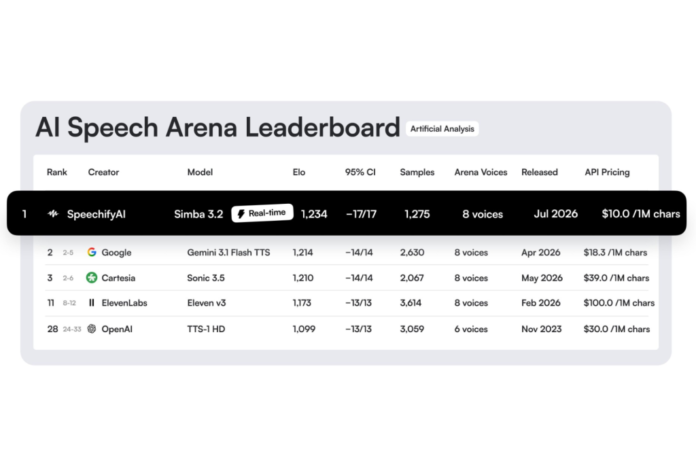
This week, Speechify’s Simba 3.2 moved to first place on the Artificial Analysis text-to-speech leaderboard, ranking above ElevenLabs, Cartesia, OpenAI, and Google DeepMind. On Voice Arena, the blind-listener benchmark modeled on Chatbot Arena, it sits at the top for real-time models at its price point.

Neither leaderboard is run by Speechify. Neither uses self-reported scores. Native speakers hear two clips without knowing which model made which, and they vote for whichever sounds more natural.

Simba 3.2 is now the highest-rated real-time voice model a team can put in production today.

Here is where it gets uncomfortable for the incumbents.

The three numbers that matter

For anyone building with voice, only three things ever really mattered: quality, latency, and cost. Every model release has forced a compromise on at least one of them.

1. Quality. Simba 3.2 is ranked number one on Artificial Analysis and on top for quality and price on Voice Arena. Both benchmarks are independent. Both are blind.

2. Latency. It is a streaming-native model with lower time-to-first-byte than its predecessors, built for voice agents that respond in real time rather than after a pause that ruins the conversation. All sub-100ms. 

3. Cost. It is listed at $10 per one million characters, dropping to $6 per one million characters on the Scale tier. That makes it the cheapest model in the Artificial Analysis top ten, over fifteen times more affordable than ElevenLabs and roughly six times more affordable than Cartesia, according to the company.

Best-sounding, fastest, and cheapest have almost never described the same model. Now they do.

Credit: Speechify

Why this happened

The usual story with AI models is that the lab optimizes for the benchmark, prices for enterprise buyers, and lets the developer platform inherit whatever margin is left over. Speechify built it in the opposite order.

The same voice technology has been running inside a consumer product used by more than sixty million people for years. That audience does not tolerate a robotic voice, a two-second delay before the first word, or the kind of unit economics that only work at enterprise pricing. Every A/B test in that product fed back into the model.

“We made the architecture decisions at the beginning that most labs put off until later,” explained Raheel Kazi, an engineering leader at Speechify. “We never wanted to sacrifice on cost to chase quality, or sacrifice on quality to chase latency. We took the harder route on purpose. Hitting SOTA on all three at once is what that decision was always for.”

“This is the underdog story for API providers,” Luke Oliff, Head of Developer Relations at Speechify, said in a press release. “We spent years making our models run efficiently because our consumer business demanded it, tens of millions of listeners, with some of the best voices on the planet. That work is why we can now put the best-rated model in the world on our API at about as cheap as it comes. Most labs are built for the benchmark and priced for the enterprise. We built for listeners and priced for production.”

What Artificial Analysis and Voice Arena actually test

Neither leaderboard is the kind of benchmark a vendor can game.

Artificial Analysis runs on live serverless API endpoints, four times a day at random times, using a randomly selected voice, a unique 500-character prompt, and a standardized audio sample rate. Latency is measured end-to-end, all the way to when the audio file lands locally. 

Voice Arena uses the same blind pair-comparison principle across six languages, with a balanced voice slate per model rather than each vendor’s best-sounding default. The methodology was developed with input from Prof. Shinji Watanabe of Carnegie Mellon University.

On both boards, quality is scored the same way. Pairs of clips generated from identical text are played to native speakers in blind comparisons. Listeners choose which sounds more natural. Votes get aggregated into an Elo rating. No self-reported score, no vendor-selected clip, no internal panel, and no provider pays for inclusion or ranking.

For a model to sit near the top of both, it has to satisfy an objective performance evaluation and a blind human preference vote across multiple languages. Simba 3.2 does.

SpeechifyAI Agents and Speechify’s Developer Platform

Alongside the leaderboard result, Speechify is launching Voice Agents for businesses and a developer platform, both at speechify.ai. The model powering both is the same one running its consumer apps.

Simba 3.2 is a streaming-native model with low time-to-first-byte, fine-grained emotional control, and SSML prosody, engineered to sound natural in real-time voice applications. According to the company, more voices, additional languages, and an even lower-cost tier are already on the roadmap.

“Simba 3.2 is our best model yet, now available on Speechify.ai,” Cliff Weitzman, CEO and Founder of Speechify, shared in a public post. “It’s built to power voice agents at scale and perfected from millions of A/B tests we run in our consumer platform. In TTS APIs, three things matter: cost, quality, and latency. Simba 3.2 has achieved SOTA on this trifecta. Beyond excited for you to experience it firsthand to power your experiences.”

So is this the end of paying enterprise prices for voice?

For the teams that have already spent six figures on a voice bill this year, the answer is starting to look obvious.

For the teams that haven’t yet, the question is how long they are willing to keep paying for a trade-off that no longer exists.

Voice AI used to make you choose. It doesn’t anymore.

For years, the rule in text-to-speech has been simple. If you wanted the best-sounding voice for your product, you paid enterprise pricing. If you wanted cheap, you accepted robotic. If you wanted fast, you gave up something on both. That rule just broke.

The trade-off every product team has been forced to make

If you have ever built a voice agent, a phone system, or a real-time reader, you know the drill. You audition four or five models. One sounds incredible and costs more than your infrastructure. One is affordable and sounds like a GPS from 2009. One is fast, but only in three languages. You pick the least bad option and ship.

Then the invoice arrives.


Source link

BTC price news: What recent U.S.-Iran strikes mean for bitcoin, ether, solana

0
Bitcoin shoots higher on Iran peace deal, with Strait of Hormuz set to open

The moves priced a single fear, that a wider war keeps oil elevated and forces the Federal Reserve to hold rates higher for longer. Minutes of the Fed’s June meeting show a few policymakers saw a case for raising rates before backing a hold. Gold fell because a higher-for-longer path lifts real yields and dulls the appeal of metal that pays nothing, and bonds fell for the same reason.

But bitcoin sat all of it out. Ether was little changed at about $1,800, up 2% on the week, and the rest of the majors barely moved on the day, with Solana the weakest at $76, down 5% over seven days. XRP held $1.09 and dogecoin sat near $0.07.

The one crypto-relevant thread runs through Korean stocks. SK Hynix shares plunged 12% in Seoul after the chipmaker’s U.S.-listed shares surged 13% on their Friday debut, a reversal that helped drag the Kospi down 7%. That chip trade drove the rally that lifted bitcoin on Friday, and its sharp reversal on Monday still left crypto flat, in either direction.

Bitcoin has now held a tight range through a weekend of strikes, a Monday selloff in every asset that usually reacts to war, and a hawkish repricing of the Fed. That is a marked change for a market that once sold off fast on a single Hormuz headline. It is no longer trading the war at all, taking its direction from dollar liquidity and the chip cycle while oil, gold and rates do the reacting.


Source link

Spectrum makes significant decision as customer losses mount

0
Spectrum makes significant decision as customer losses mount


Spectrum, which is owned by Charter Communications, has decided to make another significant workforce change as it continues to battle mounting customer losses in its cable TV and internet business.

Charter revealed in its latest earnings report that Spectrum lost 120,000 internet customers and 60,000 cable TV customers in the first quarter of this year. Amid these losses, the company’s revenue dipped by 1% year over year.

The decline in customers comes after Spectrum increased the monthly prices of its TV Select packages by $5 and several older internet plans by $2 in July last year. On social media platform Reddit, customers have also flagged what they see as stealthy price hikes for Spectrum’s internet service this year.

“The operating environment for new sales, in particular internet, continues to be competitive,” Charter Chief Financial Officer Jessica Fischer said during an earnings call in April.

She also said Charter is betting on its $34.5 billion acquisition of Cox Communications, which received approval from the Federal Communications Commission in February, to help repair its business.

The acquisition will enable Charter to invest billions of dollars in upgrading and expanding Spectrum’s network nationwide. 

Spectrum suffers another round of layoffs

As Charter works to reverse Spectrum’s customer losses, it continues to cut jobs, with its latest round affecting hundreds of employees.

In a WARN notice filed on July 8, Charter announced its decision to “discontinue the operation of its network operations center” in Town and Country, Missouri, resulting in the layoff of 107 Spectrum employees. 

According to a recent report from Fox 2, the center is a regional office for Spectrum’s business, finance and corporate support teams. Also, Spectrum clarified to the news outlet that the office building is not closing entirely, as teams not affected by the layoffs will continue working at that location. 

The layoffs will officially take place on Sept. 8 and will primarily affect employees and managers in network engineering operations. 

To lessen the blow of the job cuts, Spectrum is outsourcing back-office roles to manage remote network monitoring. It will also offer laid-off employees a comparable role in the St. Louis area for at least the next eight months.

Related: Spectrum suffers heavy loss as customers ditch service

The latest round of layoffs comes after Spectrum closed its call center facility in Appleton, Wisconsin, in March, which resulted in 313 employees losing their jobs. 


Source link

Why Bitcoin miners are holding 1.19M BTC despite 10% mining stock losses

0
Why Bitcoin miners are holding 1.19M BTC despite 10% mining stock losses


Bitcoin [BTC] has spent days consolidating at the time of writing and was on the edge of a decisive move. The asset has failed to reclaim the $64K level for a third consecutive time, and the momentum behind each attempt has weakened.

Bitcoin will need far stronger momentum to force a rally, and several factors will decide whether that happens. Among them, the role of miners cannot be dismissed, since their actions tend to shape market direction.

Bitcoin mining stocks stay under water

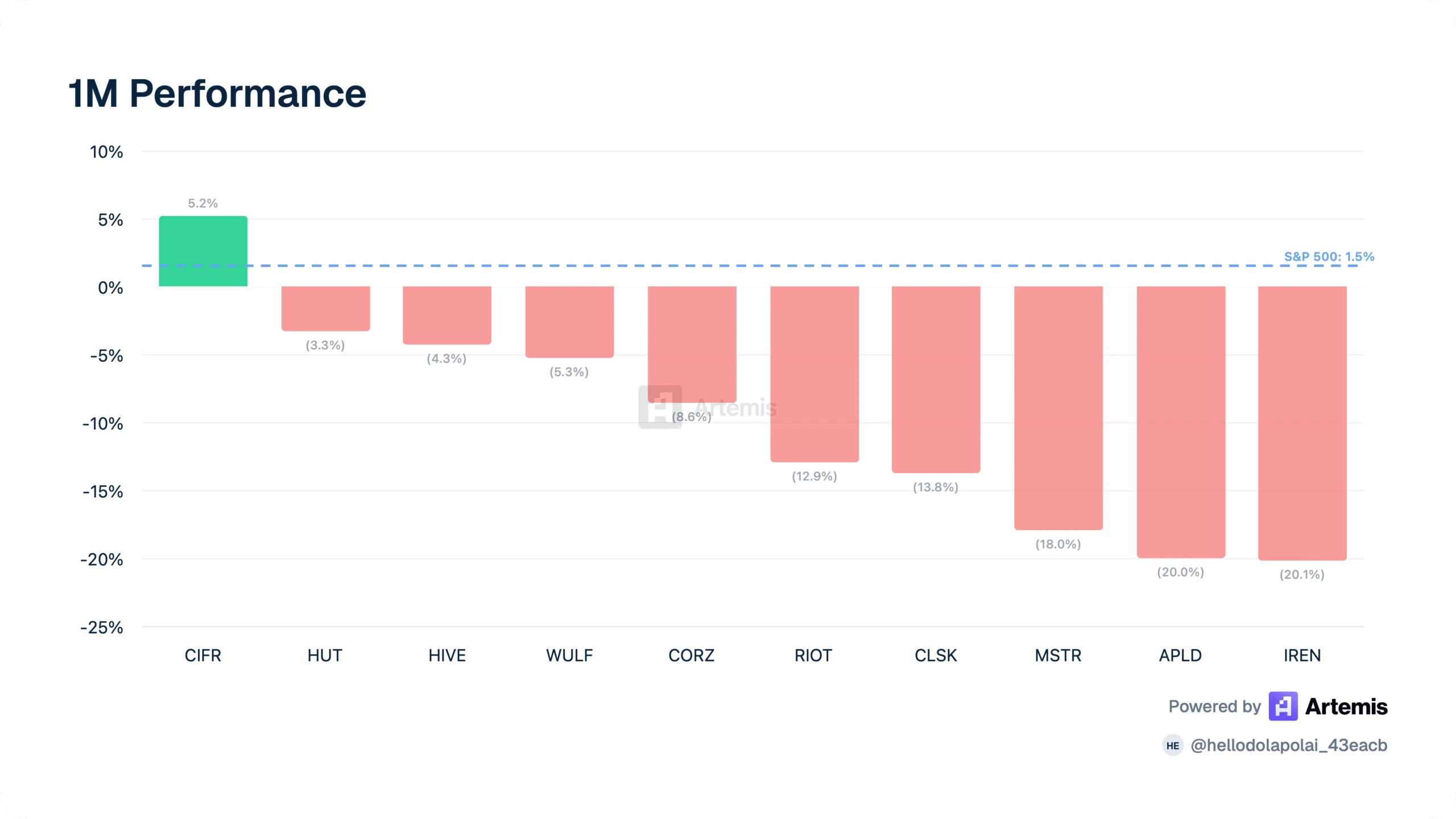
Bitcoin miners, responsible for securing the network, have traded underwater for weeks. Notably, over the past month alone, the Artemis Theme Tracker recorded a 10% decline across these Bitcoin mining stocks.

Artemis - Bitcoin miner Performance
Source: Artemis

The tracker follows eleven Bitcoin mining stocks currently valued at $102.9 billion. Iris Energy [IREN] and Applied Digital [APLD] have absorbed the steepest losses over the past month, down 20.1% and 20%, respectively, while Hut 8 Mining and Hive Digital Technologies have slipped 3.3% and 4.3%.

Cipher Mining [CIFR] stood as the only name in the category to hold net positive, rising 5.2% over the same period and outperforming the S&P 500, which gained 1.5% across the month.

The question is whether miners will offload their BTC, particularly as mining costs climb; paired with Bitcoin’s underperformance, that pressure could build further.

What will Bitcoin miners do

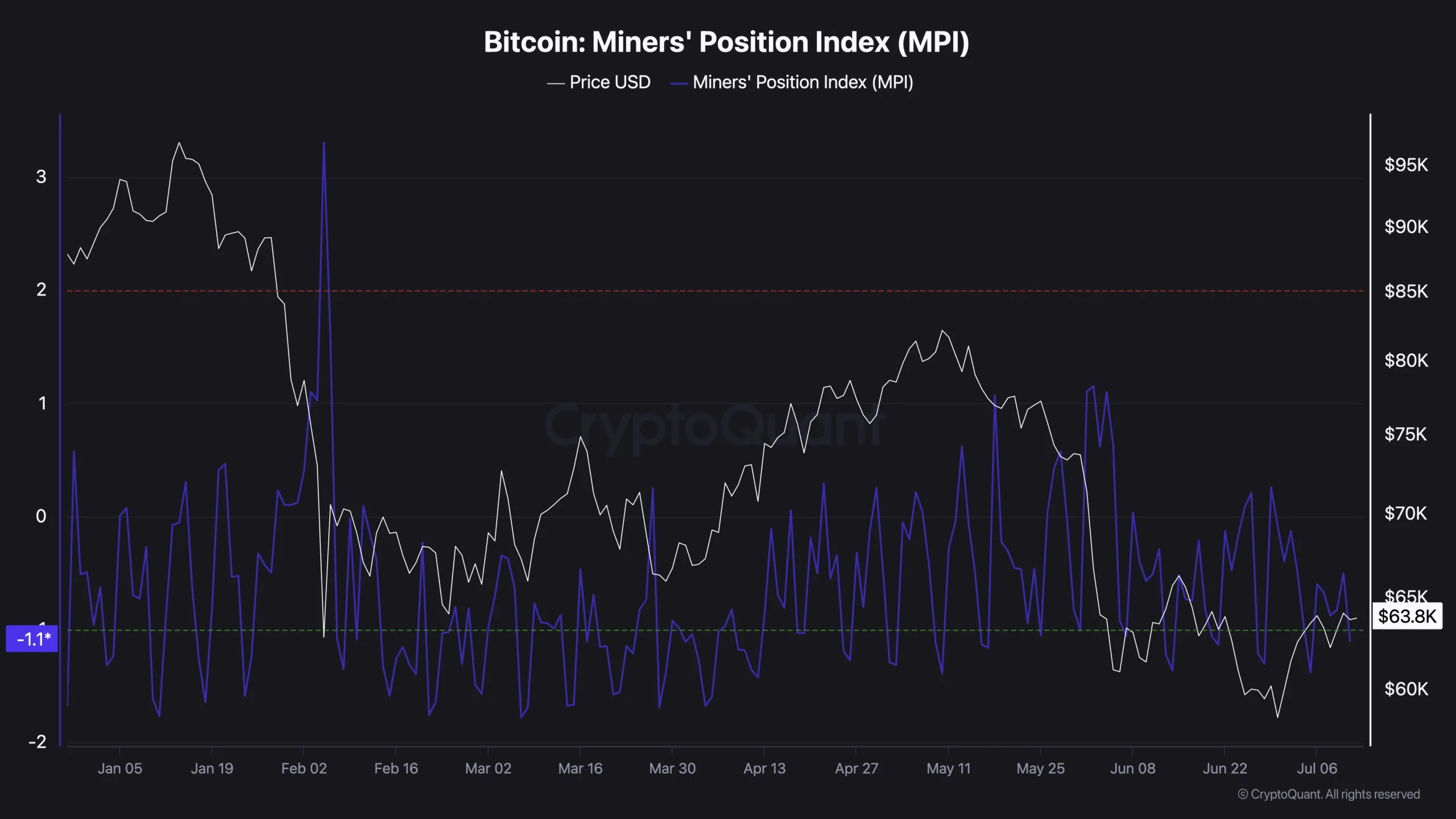
Miners have kept their Bitcoin positions steady despite the growing threat of selling in the market. At press time, the Bitcoin Miners’ Position Index (MPI) reflected near‑term confidence with a reading of -1.1, with miners continuing to accumulate. 

The metric measures the ratio of total miner outflows in USD to their one-year moving average, and a reading below that average typically signals that miners are holding their assets.

Bitcoin Miners' Position Index (MPI)-2Bitcoin Miners' Position Index (MPI)-2
Source: CryptoQuant

The Miner Supply Ratio, which tracks how much of Bitcoin’s supply miners hold, has likewise been climbing, an overall sign of accumulation.

The climb began on the 8th of July and has continued since, with the supply ratio reaching 0.05951 at press time. A sustained rise would reinforce a supportive dynamic for Bitcoin, provided miners keep their assets off the market.

Miners hold their reserves steady

Miners remain central to Bitcoin’s price performance, as their decision to sell or hold can steer direction.

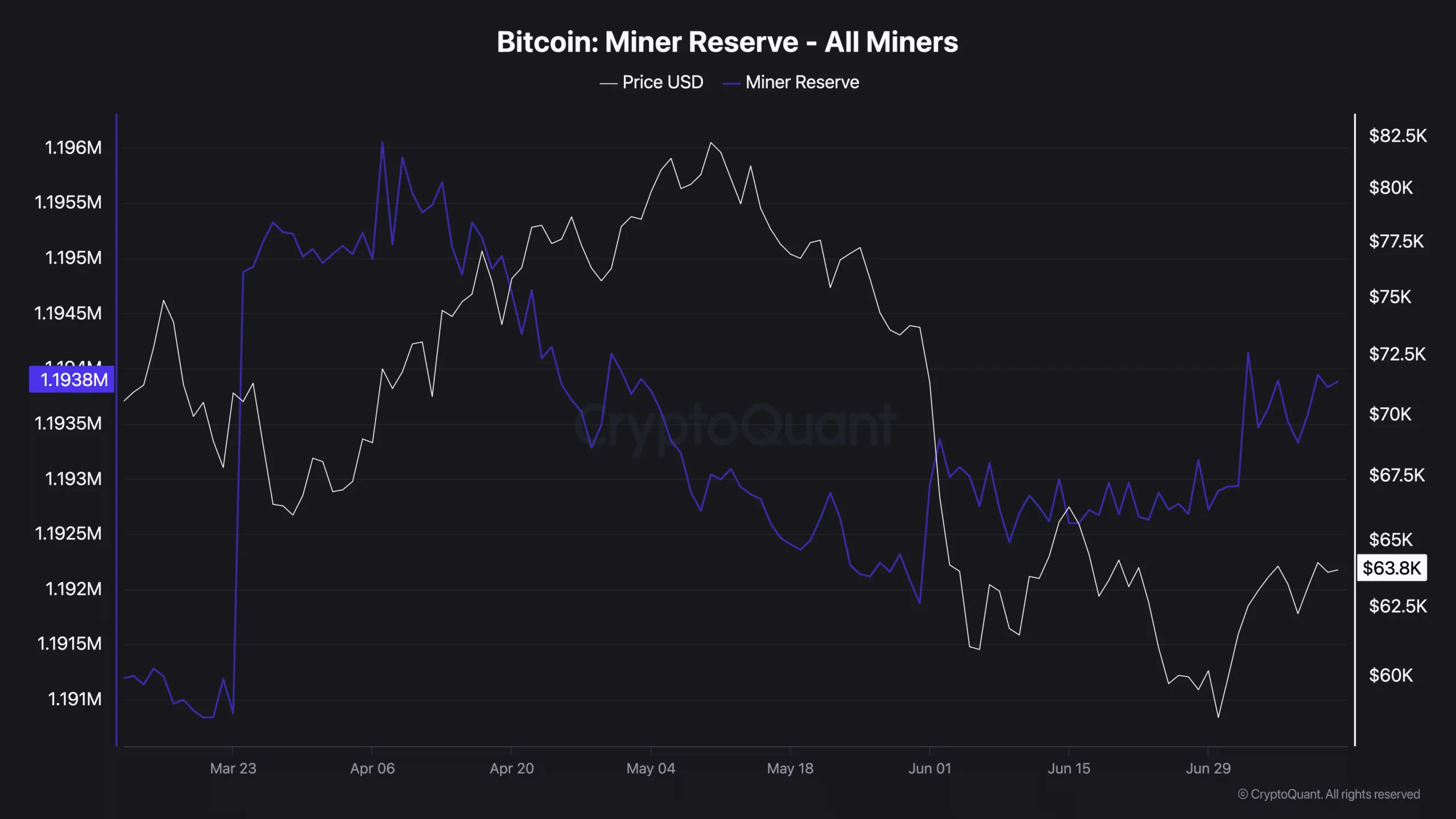
The group controls roughly 1.1933 million Bitcoin, just over 5% of the total supply in the market, and any move to sell could weigh on the asset and drag it lower.

Bitcoin Miner Reserve - All Miners-2Bitcoin Miner Reserve - All Miners-2
Source: CryptoQuant

Currently, though, this group is doing the opposite despite the decline in Bitcoin’s price over the past weeks. Their holdings have edged up to 1.1938 million, one of the highest levels since early May.


Final Summary

  • Bitcoin miners are accumulating rather than selling, with holdings edging up to 1.1938 million BTC, even as mining stocks trade under water.
  • Bitcoin has failed to reclaim $64,000 for a third straight time, and with the Miners’ Position Index at -1.1, miner conviction remains one of the few supports underpinning the asset.


Source link

Costco and Walmart capture grocery-store crowns

0
Costco and Walmart capture grocery-store crowns


With prices rising, budgets tightening, and increased job security fears, Americans have become cautious about where they buy their groceries.

The Food Industry Association’s (FMI) June Grocery Shopper Snapshot surveyed 1,516 consumers to gather their actual insights. Some key results include:

  • By a margin of 2 to 1, Americans say they are worse off, as opposed to better off, than they were one year ago with respect to their household finances.

  • Only 26% of shoppers say they are living comfortably and can save money. 

  • Macroeconomic issues are weighing on shoppers as concerns about inflation (71% very or extremely) and the overall U.S. economy (66%) reached new highs.

  • The job market is a concern for nearly half of grocery shoppers (49%). 

Gas prices have also forced people to make changes.

“Americans’ concerns about gas prices spiked in the past six months, from 43% very or extremely concerned in December to 69% this month.  A similar proportion of grocery shoppers (70%) say their spending on gas has increased in the first half of 2026,” FMI reported.

Against that backdrop, some clear winners have emerged in the grocery space, with one group of shoppers picking Costco, while two others opted for Walmart.

Costco and Walmart top new grocery survey

Costco was the grocery retailer where the largest share of higher-income Americans reported doing most of their grocery shopping, according to a recent YouGov survey.

“Eleven percent of respondents earning at least $150,000 a year said Costco was their primary grocery store. Fourteen percent selected “other,” while Kroger followed at 10% and Walmart Supercenter at 8%,” the survey showed.

The warehouse retailer, known for its bulk goods and discounted prices, topped the rankings, despite requiring shoppers to pay an annual membership fee.

California-based food industry analyst Phil Lempert explained to Fox News Digital why Costco was winning over these customers.

“Wealthier households typically are larger households,” he said. “So it fits perfectly with the model of Costco having larger sizes. Also, wealthier people shop more often, and what they want is value. One of the reasons they have more money is that they’re frugal.”

Just because a household has money does not mean its members shop at the priciest chains.

More Costco:

“Even though the hype says that these wealthier shoppers are going to the Erewhons and the Whole Foods of the world, not necessarily,” Lempert said.


Source link