U.S. stock futures dipped late Sunday while oil prices rose, but didn’t spike, as investors kept their cool after a weekend packed with new fighting in the Persian Gulf.
Futures tied to the Dow Jones industrial average fell 100 points, or 0.19%. S&P 500 futures were down 0.27%, and Nasdaq futures lost 0.48%.
U.S. oil futures rose 3.2% to $73.70 a barrel, while Brent crude also climbed 3.2% to $78.45. Gold dropped 0.7% to $4,085 per ounce.
Bob McNally, founder and president of Rapidan Energy, told CNN that crude oil markets have been “blowing off this geopolitical risk for years” and described Sunday’s rise in prices as “pretty tame.”
Traders are confident that the worst of the Hormuz conflict is over and see the beginnings of a recovery in ship crossings as well as oil production around the Gulf, he explained, adding that the stock market hasn’t cared about Iran since April.
“So there’s a lot of complacency, a lot of confidence, built into the market right now about oil,” McNally, a former White House energy adviser, said.
On Sunday evening, U.S. Central Command announced yet another set of strikes on Iran, aimed at “degrading their ability to attack civilian mariners and commercial ships freely transiting the Strait of Hormuz.”
It marked the fifth round of attacks in the past week and the third over the last 24 hours, signaling that the operational tempo is quickening.
The latest wave came after the Islamic Revolutionary Guard Corps targeted a commercial ship, prompting U.S. forces to intercept an Iranian missile and drone.
Earlier on Sunday, the U.S. conducted a “few strikes” on Iranian missile and air-defense systems as well as small boats around the strait.
Before then, U.S. forces had already hit 300 targets over three prior rounds, with Saturday alone seeing 140 targets bombed, including missile and drone sites, naval capabilities, ammunition storage facilities, communication networks, and coastal surveillance locations, Central Command said.
For its part, Iran has paired its attacks on commercial ships with salvos against its Gulf Arab neighbors, including Bahrain, Kuwait, Qatar, Jordan and Oman.
Iran has argued that the memorandum of understanding signed with the U.S. last month gives it authority to regulate ship traffic and has attacked ships that are not using a regime-backed corridor that runs along the Iranian coast.
But the U.S. has demanded that freedom of navigation in Hormuz must be fully restored and established an alternate corridor that hugs Oman’s coast. Since early May, U.S. forces have helped more than 800 commercial vessels and 400 million barrels of crude oil transit the strait.
The standoff has fueled increasingly violent skirmishes as Iran seeks to preserve its main source of leverage, namely the ability to effectively shut down Hormuz traffic.
For Sal Mercogliano, a Campbell University professor who specializes in military and maritime history, the recent combat was an ominous sign, as he called the ceasefire a “facade.”
“And it’s been a facade for quite a while,” he said on a YouTube post on Sunday. “And one of the things I fear is that we’re finding ourselves in this undeclared naval war. And an undeclared naval war can escalate.”
As recently as February 2026, the company was out there signing deals. A new power purchase agreement with Hankook Tire. Existing contracts with Nestle, Cargill, Mars, and Auchan. A solar pipeline of over a gigawatt under construction in Poland. Nobody looking at it from the outside would have seen what was coming.
Three months later it had €1.1 million in the bank and $952 million in debt. On May 29, 2026, GoldenPeaks Poland Holding and 39 affiliated entities walked into the U.S. Bankruptcy Court for the Southern District of Texas and filed for Chapter 11, according to Bloomberg Law.
What brought GoldenPeaks Poland to bankruptcy court
What brought the company down started with a subsidiary. Spectris Energy was a wholly owned affiliate that handled engineering, construction, and day-to-day operations across GoldenPeaks’ entire Polish solar portfolio.
In January 2026, Spectris ran into trouble of its own. Rising component costs, higher interest rates, and currency swings pushed it into remedial proceedings in a Warsaw court. Polish tax authorities froze its bank accounts. Suppliers walked. Spectris went dark.
GoldenPeaks had no employees of its own. Construction, operations, accounting, financing, land leasing, all of it ran through affiliated companies. When Spectris collapsed, GoldenPeaks had nobody left to run its solar farms.
More Bankruptcy:
It scrambled to sign an emergency deal with a third-party Polish firm called Ergy to take over operations. That deal was signed 16 days before the bankruptcy filing.
The grid made things worse. Poland’s transmission system operator had been restricting how much solar power could feed into the grid, a problem that had been cutting into GoldenPeaks’ revenue for months. The company was generating electricity that the grid couldn’t always absorb, which meant the cash flow the debt structure depended on kept coming up short.
Then there was the refinancing that never happened. GoldenPeaks had been trying to raise equity or refinance its debt since at least mid-2025. It held informal sale discussions that summer, ran an RFP to banks, picked a preferred bidder, and still couldn’t close a deal.
An equity raise in early 2026 attracted too little interest and was dropped. On May 19, it asked senior lenders for standstill agreements. Nobody signed. With a key standstill set to expire on May 31, the company filed Chapter 11 two days before that deadline.
The financial governance problems court filings reveal
When restructuring firm Alvarez and Marsal came in to assess the situation, what they found wasn’t pretty. The company had been operating with multiple Chief Financial Officers with overlapping mandates. No standalone financial statements existed for any of the debtor entities. Financial controls were fragmented. There was no budget reporting, no construction cost supervision.
Alvarez and Marsal described in court filings how GoldenPeaks units had unraveled “precipitously” and how liquidity had “evaporated” within weeks. In court papers, the company reported assets between $1 billion and $10 billion against liabilities of $500 million to $1 billion, according to IndexBox. Its funded debt alone came to $952 million, and it had less than €1.1 million in unencumbered cash when it filed.
What brought the company down started with a subsidiary.Mario/Getty Images
Brookfield’s role as lender and lead bidder in the GoldenPeaks sale
Brookfield Asset Management was already GoldenPeaks’ controlling shareholder going into the bankruptcy. It was also the company’s most junior prepetition lender, with about $294 million outstanding.
On June 3, 2026, Brookfield proposed a $162.8 million debtor-in-possession loan to keep the lights on during the restructuring, according to PV Tech.
That put Brookfield in a position other creditors didn’t love. It was the controlling shareholder, the prepetition lender, the DIP lender, the DIP agent through its affiliate BID Administrator LLC, and it held two of five board seats.
When the court also approved it as the stalking horse bidder on July 9, other creditors objected and said the whole setup was tilted in Brookfield’s favor. The judge didn’t agree.
Brookfield already owns a stake in Polenergia, a Polish renewable energy company it bought into in 2021. A successful bid for GoldenPeaks would expand that Eastern European footprint. And because it can credit the debt it’s already owed toward its purchase price, it’s not writing fresh checks the way an outside bidder would have to.
What happens next with GoldenPeaks’ 664 megawatt solar portfolio
The 664 megawatts of operational solar capacity is still running. The power purchase agreements with Nestle, Cargill, Mars, Mondelez, Auchan, and Hankook Tire are still in place. GoldenPeaks has a further 592 megawatts in construction or development.
Bankruptcy doesn’t kill any of that. It just decides who gets to own it going forward.
With Brookfield as the stalking horse, its bid sets the floor. Any competing buyer has to beat that number to take the assets away. Whether other investors show up and what they’re willing to pay is what the auction will answer.
The Financial Post reported the court approved Brookfield’s role on July 9, over creditor objections.
GoldenPeaks built something real in Poland. The problem was it built it on a structure that couldn’t survive losing the one company holding it all together. When Spectris went down, there wasn’t enough cash or time to replace it.
Renewed geopolitical tensions in the Middle East triggered a brief risk-off move, sending Bitcoin [BTC] and altcoins lower before BTC recovered and held above the $63,000 support level, highlighting its resilience.
Against this backdrop, protocol-based altcoins dominated the winners’ list with strong double-digit rallies, while most of the week’s biggest losers came from speculative assets, reflecting a clear rotation toward fundamentally stronger projects.
Weekly winners
How did DeXe [DEXE] reinforce its bullish structure?
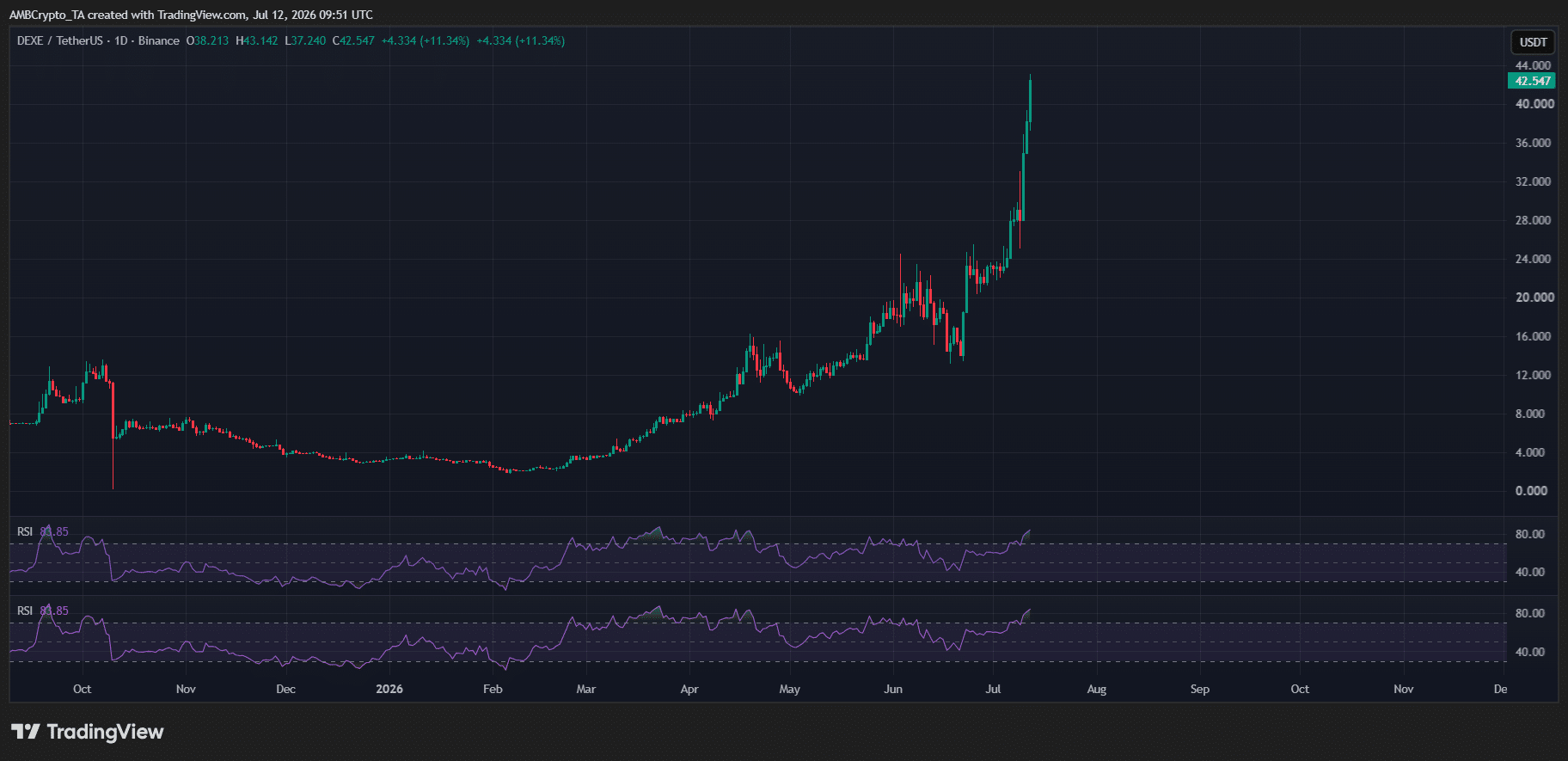
DeXe [DEXE] led this week’s gainers with a massive 73% rally, marking its strongest weekly performance on record. The move reflects strong investor demand for decentralized governance protocols despite mixed sentiment across the broader crypto market.
From a technical perspective, DEXE is now approaching the $50 resistance level, putting another breakout within reach. However, the rally is also beginning to flash signs of exhaustion. At press time, the RSI has pushed deep into overbought territory, suggesting buyers may be getting stretched.
At the same time, DEXE has gained 73% in less than four trading days, highlighting an aggressive buying spree that often precedes a period of cooling. With the broader market turning risk-off again as geopolitical tensions weigh on sentiment, short-term profit-taking could increase.
Source: TradingView (DEXE/USDT)
If that happens, $35 is the first key support level to watch. However, if buyers continue to absorb selling pressure, DEXE could still break above $50 and extend its rally.
Overall, DEXE enters the week with strong momentum but elevated risk as technicals become overextended.
Arbitrum [ARB] is approaching a KEY resistance zone
Arbitrum [ARB] was the second-biggest gainer this week, climbing 20% after posting an 8% rally the week before. The back-to-back gains suggest buyers are steadily taking control, with bullish momentum continuing to build. Technically, ARB still doesn’t look overheated.
Despite the strong move, the weekly RSI remains below overbought territory, suggesting there is still room for the rally to extend. The daily chart also continues to print higher highs, showing buyers remain in control. The next key level to watch is the $0.10 resistance zone. ARB hasn’t reclaimed this level since losing it during the late May correction, making it an important technical barrier.
If buying pressure continues at its current pace, a breakout above $0.10 looks increasingly likely. That would open the door for another leg higher, making ARB one of the stronger technical setups to watch this week.
Lighter [LIT] continues to outrun bearish control
Lighter [LIT] secured the third spot among this week’s top gainers with a 5% rally. While the gain was smaller than the week’s biggest winners, it suggests LIT has continued to hold onto its recent strength.
Technically, the more important development is that LIT has broken above the $2.70 resistance level. This comes after the token rallied more than 50% over the past two weeks, showing buyers are still willing to accumulate even after a strong uptrend.
The successful reclaim of resistance also shifts market sentiment in favor of the bulls. If buying pressure continues, the breakout could attract fresh momentum traders, increasing the chances of a move toward $3.
Other notable winners
Outside the majors, altcoin movers also stole the spotlight this week.
TCC [TCC] led the market with a staggering 66,301% gain, followed by Cash Cat [CASHCAT], which surged 3,928%, while Yei Finance [CLO] climbed 76%, rounding out the week’s top performers.
Weekly losers
How did Bonk [BONK] erase its previous week’s gains?
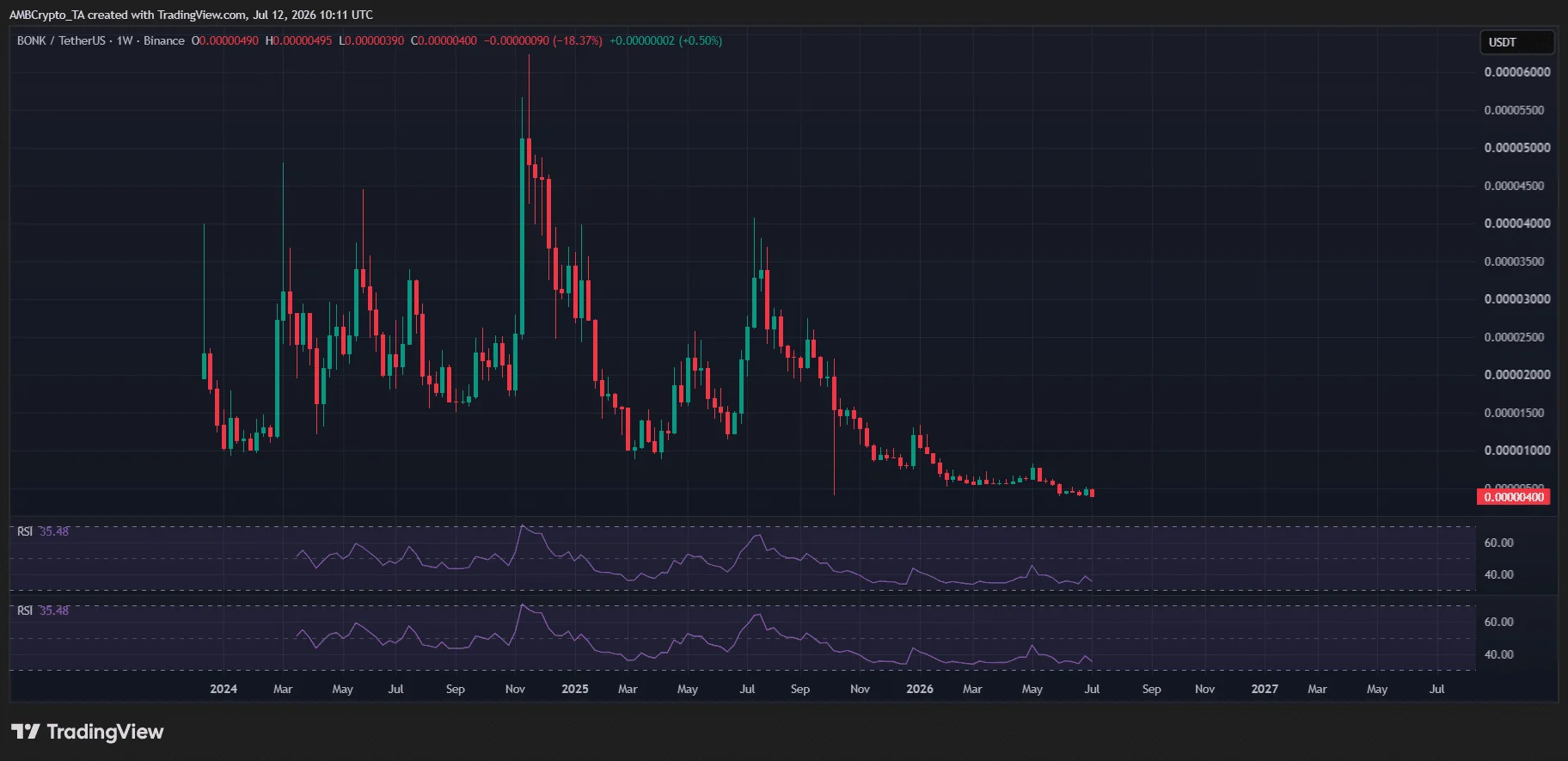
Bonk [BONK] led this week’s losers with an 18% decline, completely wiping out last week’s 18.6% rally. The move is another reminder of the sharp swings that are common across the meme coin sector.
What’s interesting is that the sell-off came despite 110 million BONK being burned this week. That suggests the token burn wasn’t enough to shift sentiment. Technically too, BONK looks weak. The weekly chart has been printing lower lows since the mid-Q3 2025 cycle, showing the broader downtrend remains intact.
Even though the RSI was deep in oversold territory as of writing, buyers have yet to step in with enough conviction to reverse the trend. This week’s decline also pushed BONK to a new all-time low around $0.0000039, reinforcing the bearish structure.
Source: TradingView (BONK/USDT)
Unless market sentiment improves or buyers reclaim key resistance levels, BONK is likely to remain under pressure, making it one of the weaker technical setups heading into next week.
Audiera [BEAT] is testing the strength of a KEY support
Audiera [BEAT] was the second-biggest loser this week, dropping 12% after posting two straight weeks of gains. Despite the pullback, BEAT is still holding above levels it reclaimed during its recent breakout, suggesting bulls haven’t lost control just yet.
Technically, the focus is now on the $2.00–$2.50 support zone. Since mid-May, buyers have consistently stepped in around this area, triggering several weekly rebounds and keeping the broader uptrend intact. That makes this week’s decline look more like a cooldown than a trend reversal.
If bulls defend support once again, BEAT could build enough momentum for another run at the $3.50 resistance. A successful breakout above that level would confirm another higher high and keep BEAT among the stronger bullish setups to watch next week.
Why did Jupiter [JUP] post its weakest weekly rally in over a month?
Jupiter [JUP] was the third-biggest loser this week, falling just over 10%. The pullback came after numerous weeks of gains and pushed the token back below the $0.25 resistance level.
Technically, though, the trend still favors the bulls. JUP continues to hold a pattern of higher highs and higher lows, suggesting the broader uptrend remains intact. The next key level to watch is $0.20, where buyers have consistently stepped in during previous pullbacks.
That puts JUP in a healthy consolidation phase rather than a full trend reversal. If bulls continue to defend support, the current pullback could provide the base for another move higher.
A reclaim of $0.25 would strengthen the bullish structure and increase the chances of another breakout, making JUP one of the key altcoins to watch heading into next week.
Other notable losers
In the broader market, downside volatility hit hard.
LAB [LAB] led the losers with a 96% decline, followed by ETHGas [GWEI], which fell 54%, while BUILDon [B] dropped 47.7% as bearish momentum intensified.
Conclusion
This week was a rollercoaster for crypto. Big pumps, sharp dips, and nonstop action. As always, stay sharp, do your own research, and trade smart.
Final Summary
DeXe [DEXE], Arbitrum [ARB], and Lighter [LIT] led the week in gains.
Bonk [BONK], Audiera [BEAT], and Jupiter [JUP] saw significant declines.
If you asked me at the start of the year how I would rank Advanced Micro Devices (NASDAQ: AMD), Broadcom (NASDAQ: AVGO), and Nvidia (NASDAQ: NVDA) in terms of potential stock performance, I would have put Nvidia at the top, Broadcom in the middle, and AMD in last place. So far in 2026, my projection that Broadcom would be in the middle has panned out, but AMD has been a massive winner while Nvidia has been a loser.
There’s still a lot of time left in 2026, but which one of these three artificial intelligence (AI)-related stocks is the best buy now?
Missed Nvidia in 2009? This Rare Signal Is Flashing Again. In 2009, a “Double Down” signal flashed for a little-known chipmaker called Nvidia. For the first time in years, that same “Total Conviction” signal is flashing for a company 1/100th the size of Nvidia. Continue »
Let’s take a look at this trio and rerank them for the rest of 2026 and into 2027.
Image source: Getty Images.
AMD and Nvidia are competing in the same field
All three of these stocks are being heavily spurred on by massive AI spending. AMD and Nvidia approach this problem from the same perspective, as each offers graphics processing units (GPUs) that excel in computing scenarios with variable, complex workloads. However, Nvidia’s products have downright dominated the field to date, and it holds a commanding lead in the data center space.
Broadcom is taking a completely different approach. Instead of a broad-purpose computing unit like a GPU, it has partnered directly with a handful of AI hyperscalers to design a custom AI chip tailored to the workloads each firm sees. This creates a chip that often offers better cost-performance than GPU-based computing, driving its rising popularity.
Broadcom expects major growth next year as new clients launch their custom AI chips. Currently, Broadcom’s major customer is Alphabet, with its Tensor Processing Units (TPUs). However, Broadcom is also making custom AI chips for Meta Platforms, Anthropic, and OpenAI, and production for those chips is scheduled to ramp up late this year and into next.
So, which of these is the best horse to back from a business approach? I’m still bearish on AMD, as it has a major uphill battle to win space in data centers when so many ecosystems have already been developed around Nvidia’s. Between Nvidia and Broadcom, it’s tough because many companies will stick with GPU-based training for its flexibility. Still, custom AI chips will likely become quite popular over the next few years as AI hyperscalers look to optimize their spending. As a result, I’m giving this one to Nvidia and Broadcom as a tie.
Winners: Nvidia and Broadcom
Nvidia is still dominating the growth game
From a growth standpoint, Nvidia still stands alone at the top, growing far faster than the other two.
Lastly, let’s look at valuation. Because all three of these stocks are rapidly growing, the best way to value them is by using earnings projections. For the current fiscal year, AMD’s stock is far more expensive than either Broadcom’s or Nvidia’s. Furthermore, Broadcom is also more than 50% more expensive than Nvidia’s.
Investors should sell AMD shares for Nvidia shares
I think the biggest takeaway here is that AMD’s 2026 rally has likely gotten ahead of itself, and investors are discounting Nvidia far too much, as its display is being far more successful than AMD’s. Broadcom is still a solid stock pick with strong growth head, but it just isn’t as good a deal as Nvidia right now.
Should you buy stock in Nvidia right now?
Before you buy stock in Nvidia, consider this:
The Motley Fool Stock Advisor analyst team just identified what they believe are the 10 best stocks for investors to buy now… and Nvidia wasn’t one of them. The 10 stocks that made the cut could produce monster returns in the coming years.
Consider when Netflix made this list on December 17, 2004… if you invested $1,000 at the time of our recommendation, you’d have $395,679!* Or when Nvidia made this list on April 15, 2005… if you invested $1,000 at the time of our recommendation, you’d have $1,294,805!*
Now, it’s worth noting Stock Advisor’s total average return is 929% — a market-crushing outperformance compared to 211% for the S&P 500. Don’t miss the latest top 10 list, available with Stock Advisor, and join an investing community built by individual investors for individual investors.
Keithen Drury has positions in Alphabet, Broadcom, Meta Platforms, and Nvidia. The Motley Fool has positions in and recommends Advanced Micro Devices, Alphabet, Broadcom, Meta Platforms, and Nvidia. The Motley Fool has a disclosure policy.
In the last 48 hours, LAB’s [LAB] sharp decline has shifted focus from market sentiment to the source of the selling pressure.
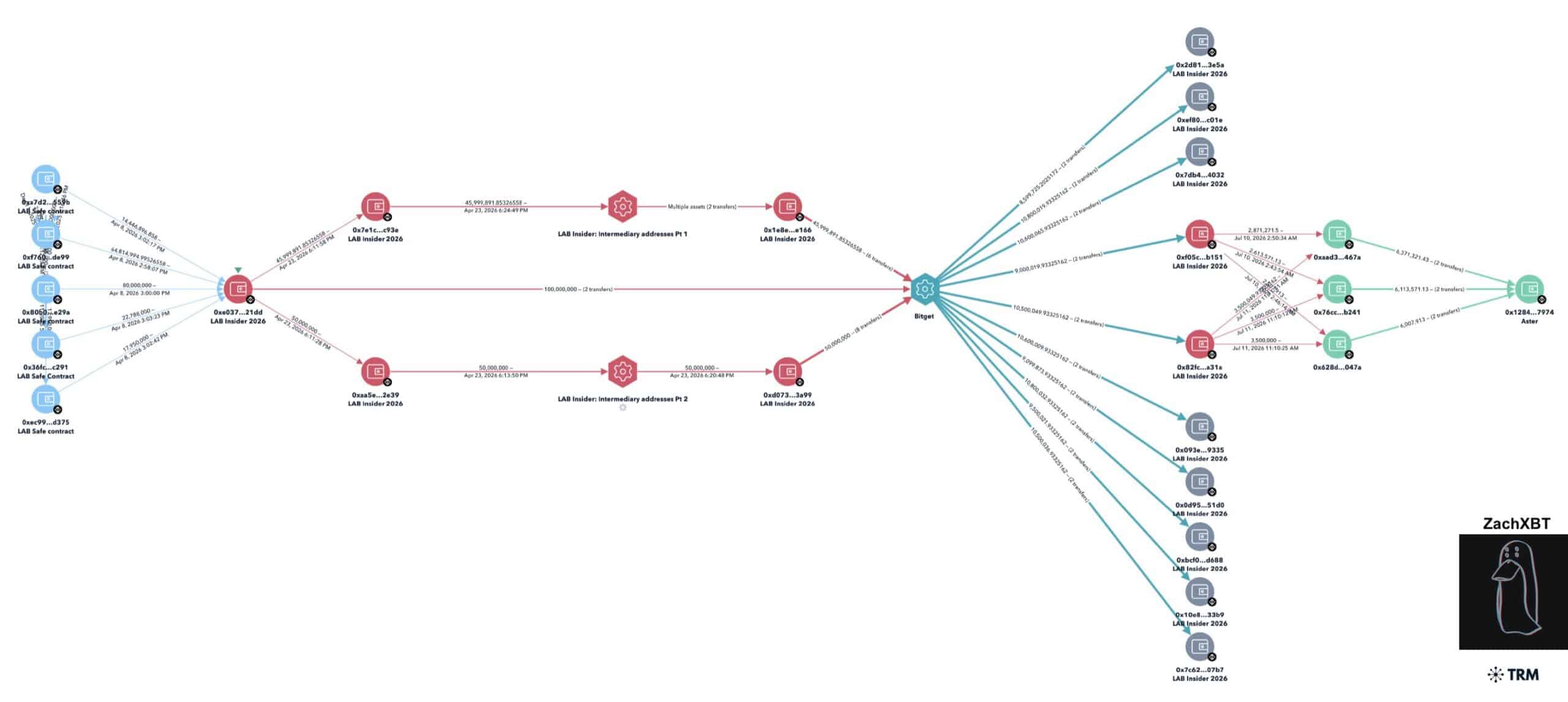
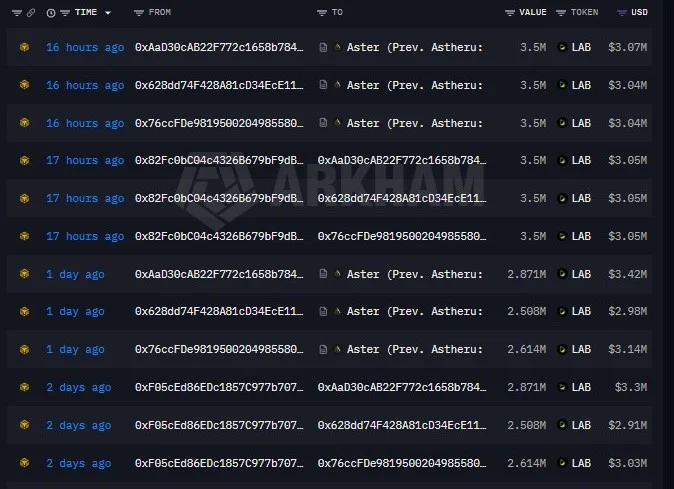
A new on-chain investigation by ZachXBT found that the sudden sell-off was not caused by random wallet dumping. Instead, it was executed via a planned coordination process with money flowing from the LAB team’s funded accounts.
Source: ZachXBT on X
ZachXBT also found that over 196 million LAB were moved out of the LAB team account in April. Later on, the tokens later flowed through Bitget before reaching the Aster account. Moreover, within the last 48 hours, the same entity moved an additional 18.4 million LAB worth approximately $18.3 million. This fueled the decline, driving another 54% drop from $1.20 to $0.55 for LAB as of writing.
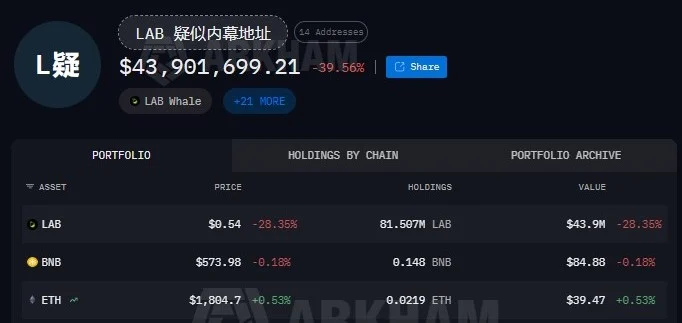
Additionally, the same wallets now hold an estimated 81.5 million LAB. As long as those positions are active, any large transfer could trigger renewed selling pressure.
Price structure continues reflecting distribution
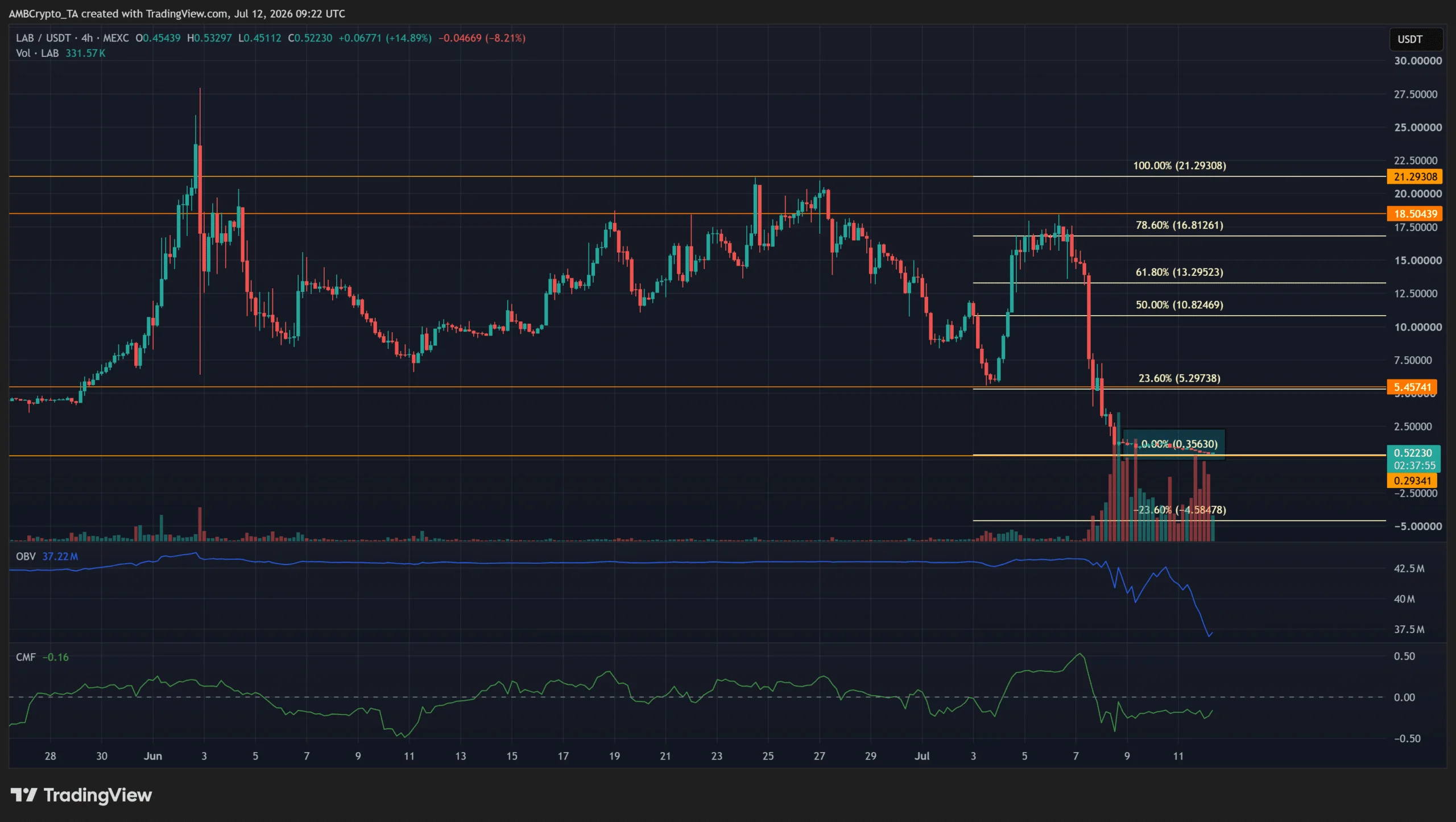
That persistent distribution also continued shaping LAB’s technical structure, leaving every recovery vulnerable to renewed selling. After collapsing from its $21.29 peak, the token briefly rebounded to the 78.6% Fibonacci retracement near $16.81. Yet sellers immediately regained control and triggered another sharp decline.
The breakdown then sliced through the 61.8%, 50%, and 23.6% retracement levels without attracting sustained buying. This amplified the weakening conviction. LAB has since stabilized around the $0.48–0.52 zone. This was just above the 0% Fibonacci base near $0.36, where buyers are attempting to slow the decline.
Source: LAB/USDT on TradingView
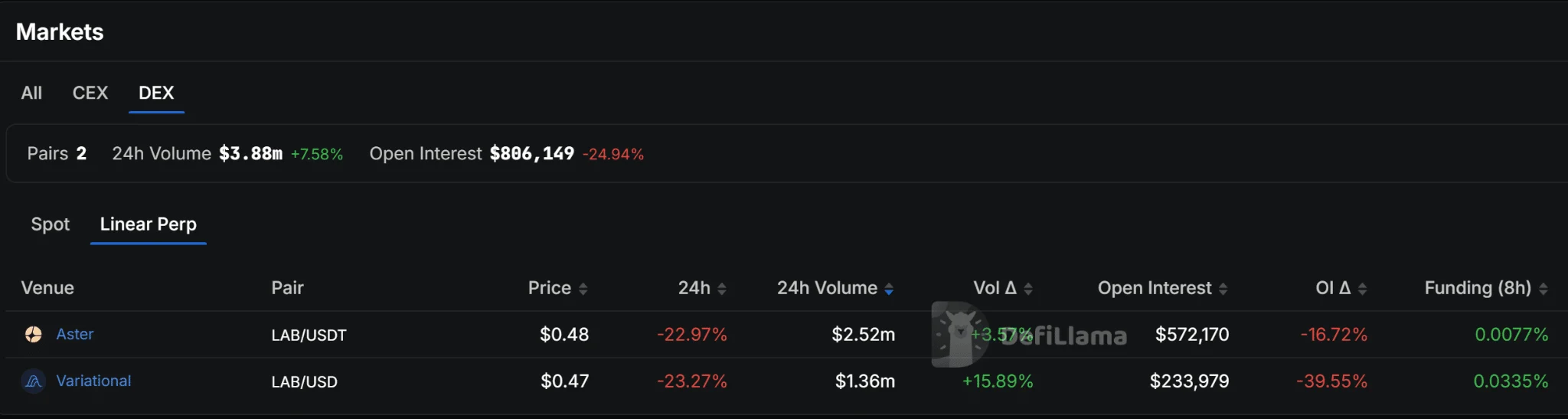
However, derivatives still reflect caution. While 24-hour trading volume rose 7.6% to $3.88 million, Open Interest dropped 24.9% to $806,149 as of writing. This suggested that traders were closing positions rather than building fresh exposure.
Source: DeFiLlama
Unless buyers reclaim the 23.6% Fibonacci level at $5.30 with sustained demand, the current range may represent temporary exhaustion instead of the beginning of a durable recovery.
Insider supply keeps LAB investors on edge
Although insider-linked selling has already reshaped LAB’s market structure, fresh wallet transfers show the overhang persists. Another $9.15 million moved to Aster, briefly pushing the price to $0.5012 before rebounding.
Source: X
That quick rebound suggests buyers absorbed part of the immediate selling pressure. Even so, the broader concern remains unresolved because the same entity still controls 81.507 million tokens, valued at roughly $43.9 million.
Source: X
Yet with 81.507 million LAB still held, every transfer remains a potential catalyst for renewed selling pressure across the token’s market.
Final Summary
LAB remained under pressure as insider-linked wallets still hold 81.5 million tokens, sustaining fears of further distribution.
LAB’s recovery remained fragile while weakening derivatives signal fading buying conviction.
It’s a dream for most people to earn the title of “millionaire.” There’s a perception that in order to reach the $1 million mark, you need to either win the lottery or be the beneficiary of a major inheritance.
In reality, building an investment portfolio to $1 million is far more attainable than you might think. I won’t tell you that it’s easy, though. It requires years of steady contributions, discipline, and investing your money in the right thing.
Missed Nvidia in 2009? This Rare Signal Is Flashing Again. In 2009, a “Double Down” signal flashed for a little-known chipmaker called Nvidia. For the first time in years, that same “Total Conviction” signal is flashing for a company 1/100th the size of Nvidia. Continue »
But if you have a plan, you can reach this target. If you have just a few hundred dollars per month to commit to this goal, it’s time to get started.
Image source: Getty Images.
The path to $1 million by investing just $300 per month
When getting started, a financial calculator can be invaluable. I like this one. Plug in a few numbers, and you’ll find out quickly exactly what it takes to get there.
For long-term investing goals, I like the Vanguard Total Stock Market ETF (NYSEMKT: VTI). Instead of focusing only on large-cap stocks, it invests in the entire investable U.S. stock universe, more than 3,000 stocks in all. Using a diversified equity fund like this one captures the potential of the full U.S. economy without exposing yourself to undue risk from any single company. And you don’t need to worry about picking winners!
Over the past century, the U.S. stock market has returned roughly 10% per year. While there’s no guarantee that this is what stocks will return in the future, it’s a reasonable assumption.
With these numbers in place, we can use our financial calculator. If you assume that the Vanguard Total Stock Market ETF can return 10% annually, you start with a balance of zero, and invest $300 per month, it will take just short of 34 years to reach the $1 million mark.
That kind of time frame, of course, means the earlier you start, the better. But even if you don’t start early, you can still get there (or at least make strong progress). The biggest lever to pull is how much you contribute. Increasing the monthly contribution from $300 to $500, for example, shortens the timeline to 29 years. The more you contribute, the faster you get there.
The monthly contribution amount may not be that daunting either. If you have a $60,000 salary and contribute 10% of your paycheck to a workplace retirement plan like a 401(k), that’s a $500 monthly contribution right there. Plus, it’s tax-advantaged, and you might get a company match on top of it to grow your savings even faster.
The idea of making yourself a millionaire may seem daunting on its own. Break it down to numbers and what you need to do to get there, though, and you’ll find the goal is much more achievable than you think.
Should you buy stock in Vanguard Total Stock Market ETF right now?
Before you buy stock in Vanguard Total Stock Market ETF, consider this:
The Motley Fool Stock Advisor analyst team just identified what they believe are the 10 best stocks for investors to buy now… and Vanguard Total Stock Market ETF wasn’t one of them. The 10 stocks that made the cut are built for long-term growth and could produce monster returns in the coming years.
Consider when Netflix made this list on December 17, 2004… if you invested $1,000 at the time of our recommendation, you’d have $395,679!* Or when Nvidia made this list on April 15, 2005… if you invested $1,000 at the time of our recommendation, you’d have $1,294,805!*
That performance is why people listen. With a track record of beating the S&P 500 by 4x, Stock Advisor offers a distinct advantage. Don’t miss the latest top 10 list, available with Stock Advisor, and join an investing community built for the long haul.
David Dierking has positions in Vanguard Total Stock Market ETF. The Motley Fool has no position in any of the stocks mentioned. The Motley Fool has a disclosure policy.
Republican lawmaker Lindsey Graham, who died on Saturday at the age of 71, had a major influence on corporate tax rates, tariff policies, and defense spending.
Graham’s office said in a statement on Sunday that the four-term senator died after a “brief and sudden” illness. Graham, an ally of President Donald Trump, had just returned from a trip to Kyiv, where he had met with Ukrainian President Volodymyr Zelenskyy.
In his 23 years in the Senate, Graham helped shape a protectionist, national-security-driven approach to trade and business-friendly policies that lowered corporate tax rates. His interventionist foreign policy views also translated into support for increased defense spending. Billions of dollars in military spending ultimately flowed to his home state of South Carolina.
Here’s how the late lawmaker impacted American businesses and the US economy.
Corporate taxes
Graham was instrumental in pushing corporate tax cuts through Congress over the last decade. He was a major supporter of the 2017 Tax Cuts and Jobs Act, which lowered the corporate tax rate from 35% to 21%.
During Graham’s unsuccessful 2016 run for president, he made cutting corporate taxes a central part of his campaign. During a Republican primary debate in 2015, Graham argued that the corporate tax rate should be lowered to prevent businesses from relocating overseas and to help create jobs for middle-class Americans.
“The best way to grow the middle class is to make it a good place to create a job,” he said during a debate at the time.
During Trump’s second term, Graham, who chaired the Senate Budget Committee, helped clear a path in Congress for the president’s 2025 tax-and-spending package, known as the One Big Beautiful Bill, which made permanent many of the corporate tax cuts the two leaders spearheaded in 2017 and restored or expanded other business-friendly policies.
Nine days before his death, the senator published a statement celebrating the first anniversary of making those tax cuts permanent.
“One year ago, President Trump signed the One Big Beautiful Bill into law, delivering the largest tax cut for working and middle-class families in American history,” Graham wrote. “As the Senate Budget Chairman, I was proud to lead this effort alongside my Senate and House Republican colleagues. We also ended taxes on tips and overtime and delivered no taxes on Social Security benefits for over 35 million seniors.”
Fair trade
While a broad supporter of free trade policies, Graham broke from some other Republicans in his calls to use tariffs to punish countries that, in his view, operated unfairly.
In 2005, during his first term in the Senate, Graham called for aggressive tariffs against China for manipulating currency and stealing intellectual property. His views helped influence Trump’s own tariff policies, which became a pillar of his administration’s strategy in his second term.
Graham, like Trump, argued that tariffs should be used as leverage over other governments. Graham supported using tariffs to force countries like Mexico and Canada to increase border security, both as a way to manage illegal immigration and stem the flow of fentanyl into the country.
Trump’s sweeping tariffs ultimately caused some headaches for American businesses, which struggled with supply chain uncertainties and rising prices. And the Supreme Court ruled in February that Trump’s use of the International Emergency Economic Powers Act to unilaterally issue sweeping tariffs on US imports was illegal.
In response to that ruling, Graham said it was “undeniable” that the tariffs were having their intended effect.
“One of the chief reasons that our border is so secure is President Trump threatened to put tariffs on countries that were allowing illegal immigrants to pour in through our southern border and held them accountable for the problem,” Graham wrote in a statement. “When it comes to finding fentanyl and other dangerous products coming into the country, President Trump has used tariffs extremely effectively.”
Defense spending
Graham was one of the Senate’s most vocal advocates for increased defense spending.
After the Trump administration outlined its initial 2027 budget plans, which included a total request for $1.5 trillion for the US military, the largest single-year military funding in modern US history and a near 45% increase from the previous year, Graham called Trump “second to none” on national security.
“President Trump’s budget is truly historic when it comes to defense spending. It is the most robust increase in defense spending in many years, and it is more than justified by the threats we face throughout the world,” he wrote in a statement in April.
Graham’s support for robust defense spending stemmed from his interventionist views on national security. He supported the Iraq war and opposed the withdrawal from Afghanistan. He supported Ukraine and called for sweeping sanctions and tariffs on Russia, as well as any country buying Russian oil. He also backed military support for Israel and the continuing war on Iran.
His support for military spending also benefited his home state of South Carolina, which grew a large military footprint during Graham’s time in the Senate. In 2024, South Carolina received nearly $7 billion in military spending through things like payroll, contracts, and construction, according to the Defense Department.
A 2022 state-commissioned study found that the military supported over 250,000 jobs in the states and generated an annual economic impact of some $35 billion.
Federal defense dollars have supported major bases, nuclear-weapons work, and aviation manufacturing in South Carolina. As a member of the Senate Appropriations Committee, Graham pushed money toward construction and military programs that helped secure and expand bases like Fort Jackson and Marine Corps Air Station Beaufort.
In 2023, Graham said his work to bring military spending to South Carolina “will pay dividends for our state for years to come.”