Home Blog Page 260

‘We’re trying to defend Bitcoin’: Why BIP-110 is losing community support

0
'We're trying to defend Bitcoin': Why BIP-110 is losing community support


Bitcoin Improvement Proposal (BIP-110), the contentious Bitcoin [BTC] soft fork, is back in the news, and many industry experts are talking about it. 

This time, Blockstream CEO Adam Back contended that misconceptions about Bitcoin’s architecture are fueling discussions over BIP 110 and the OP_RETURN policy. Acknowledging many BIP 110 proponents as well-intentioned newcomers, he added,

If these are the people with #110 in their handles, I’m sad to see them about to fork off and get disillusioned without understanding why bitcoin rejected 110 robustly.

For background, BIP-110 was implemented in December 2025. This was done to prevent arbitrary data, such as Ordinals inscriptions, which resemble non-fungible tokens, from spamming the network and to maintain Bitcoin’s primary function as a peer-to-peer cash system.

Back acknowledges that spam is a genuine issue. However, he argues that Bitcoin already addresses it through market‑driven mechanisms. This includes things like transaction fees, miner incentives, and decentralized consensus, rather than restrictive rules. 

Does BIP‑110 clash with Bitcoin ethos?

The CEO further argued that BIP 110 also goes against the permissionless nature of Bitcoin. He concluded that anyone who disagrees with its direction can fork the network and impose their own regulations.

Moreover, he contends that a fork based on BIP 110 is unlikely to be successful. This, he believes, would happen due to the lack of widespread community support and the fact that it goes against the fundamental ideas of Bitcoin.

He added,

It would be sad if bitcoin lost people disillusioned due to simple lack of understanding of what’s going on there, we’re all trying to defend bitcoin and keep it on mission.

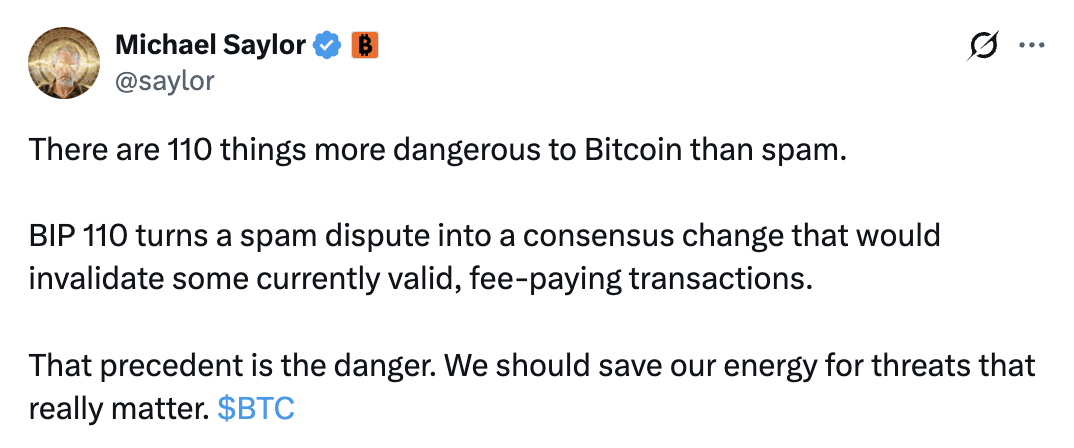
Echoing similar sentiments, Strategy’s Michael Saylor said, 

Saylor opposes BIP-110
Source: Michael Saylor/X

Market dynamics raise further concerns

This criticism came after only 10 blocks out of 2,016 supported the temporary upgrade on the 4th of July. 

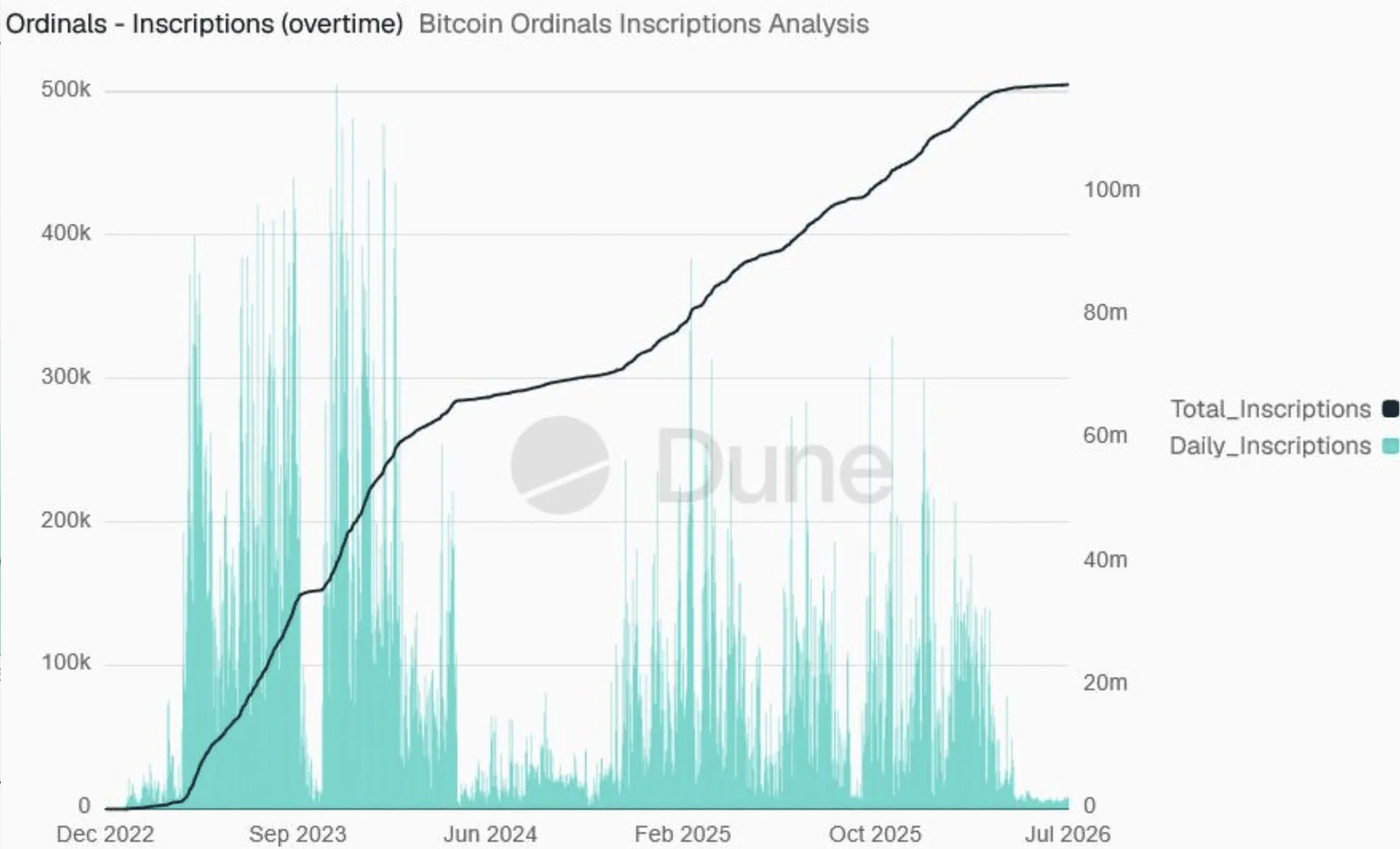
Adding further pressure, Ordinals activity has dropped to all‑time lows. For the past month, fewer than 10,000 Ordinals have been added to the Bitcoin blockchain each day. 

Change in daily Ordinals inscriptionsChange in daily Ordinals inscriptions
Source: Dune Analytics

Finally, Bitcoin’s price has fallen 45% over the past year, from its peak of $124,500 to $63,901.24 at press time.


Final Summary

  • Adam Back criticizes BIP-110 in light of false beliefs about the architecture of Bitcoin rather than malicious intent.
  • Saylor stands supporting Back’s argument as even Ordinals activity falls to its all-time lows.


Source link

Stablecoins see biggest drop since 2022 crypto winter led by Tether (USDT), Circle’s USDC decline

0
Stablecoins see biggest drop since 2022 crypto winter led by Tether (USDT), Circle's USDC decline

The combined market capitalization of major stablecoins fell from roughly $166 billion in March 2022 to $122 billion by September 2023, RWA.xyz data shows — a decline of over 26% as investors pulled money from the digital asset market.

Tether’s USDT fell from $78 billion to $65 billion between March and November 2022. For USDC, the downtrend took much longer to play out, falling from $55 billion in July 2022 to below $24 billion by November 2023, exacerbated by its banking partner Silicon Valley Bank’s collapse in 2023 March.

The implosion of TerraUSD, the algorithmic stablecoin of the Terra-Luna crypto project, also wiped out $18 billion from the stablecoin market.

The current decline is only a temporary setback in a long-term uptrend, one analyst said.

“The recent decline in stablecoin market cap represents a relatively small pullback in what we believe is a long-term growth market,” said Paul Howard, senior director at trading firm Wincent.

“Short-term fluctuations in liquidity are normal, but they don’t change our view that stablecoins will continue to play an increasingly important role in the digital asset ecosystem,” he added.

Increasing stablecoin competition

Looking beyond the headline decline, the trend appears more nuanced.

Part of the slowdown reflects a changing competitive landscape. As stablecoins move beyond crypto trading and into mainstream payments, new issuers have entered the market following regulatory progress such as the GENIUS Act in the U.S.


Source link

The One Trait That Actually Predicts Startup Success (Hint: It’s Not Age)

0
The One Trait That Actually Predicts Startup Success (Hint: It's Not Age)


Opinions expressed by Entrepreneur contributors are their own.

Key Takeaways

  • The startups that scale and endure aren’t led by the fastest movers — they’re led by founders who know how to turn hard-won experience into sharper judgment and discipline.
  • If you lack experience in a critical area, the fastest way to close the gap isn’t to learn it the hard way — it’s to bring in advisors, hires or board members who’ve already been down that road.

Startup culture has, for years, promoted a narrow image of success: fast-moving founders, bold bets and the idea that you can figure things out as you go. That narrative is compelling and sometimes accurate, but it leaves out something far more predictive of long-term success: the value of experience in the room.

When you look at companies that actually scale and endure, one factor shows up consistently. It is not age, but applied experience. The real question is whether founders know how to use experience as an advantage.

The data tells a more useful story

The stereotype of the young, first-time founder persists, but the numbers point in a different direction. Here’s a stat that tends to shatter the way people think about startups: MIT notes that among “firms in the top 1/10 of the top 1%, in terms of growth, the average founder’s age is 45.” More importantly, founders with prior industry and operational experience are significantly more likely to build high-growth companies.


Young founders can, of course, succeed, but experience, whether it comes from past startups, operating roles or deep industry exposure, materially improves their odds. In practice, the strongest founding teams combine speed with judgment rather than relying on speed alone.

Clarity is what experience actually buys you

In early-stage companies, the biggest risk is often distraction. With too many opportunities and plausible paths forward, teams often spread themselves thin and lose momentum.

Experience sharpens prioritization. Leaders who have operated inside growing companies tend to make clearer decisions about what not to do because they have seen how quickly focus can drift and how difficult it is to regain. If you are building a company, make trade-offs explicit. Before adding a new initiative, decide what gets deprioritized. That discipline is what turns opportunity into progress.

Pattern recognition is a hidden form of speed

Startups pride themselves on moving quickly, but speed without pattern recognition often leads to repeated mistakes. Hiring the wrong leader, expanding too early or misreading demand are common problems across companies. Experience allows you to recognize these patterns earlier and respond with more confidence. Instead of solving every problem from scratch, experienced operators draw from prior outcomes.

You can build this capability internally by capturing lessons in real time. After key decisions such as hires, launches or pivots, document what worked and what did not. Over time, you create institutional experience even as a young company.

Discipline is what turns ideas into execution

Flexibility is valuable early on, but inconsistency quickly becomes a liability. Missed timelines, shifting priorities and unclear ownership are rarely strategic failures. They are execution breakdowns. Experience introduces structure where it matters. Leaders who have scaled teams understand how to create operating rhythms that support execution without slowing the business down.

For founders, this often comes down to a few fundamentals: stable weekly priorities, clear ownership and consistent check-ins focused on outcomes. Discipline protects your agility.

Resilience changes how decisions get made

Every startup faces volatility. The difference is how leaders interpret and respond to it. Without experience, it is easy to overreact by treating setbacks as crises or short-term wins as validation. Experience adds context. Leaders who have seen multiple cycles understand that progress is uneven, which allows them to stay focused and make more measured decisions.

One practical approach is to separate signal from noise. When something changes in your business, determine whether it reflects a real trend or a temporary event. Your response should match that distinction.

Experience matters most as you scale

The early stage rewards creativity and speed. Scaling rewards coordination and judgment. As companies grow, communication becomes more complex, decision-making slows and small misalignments compound. Many teams struggle simply because their operating model has not evolved.

Experience helps founders anticipate these shifts. It informs when to introduce process, how to structure teams and how to balance autonomy with alignment. The key is to design for scale before friction forces you to. Access to decades of experience creates a shortcut to hard-won answers. Why suffer through the headaches when you can find somebody who has already been down this road before?

Strong founders are deliberate about surrounding themselves with people who have seen what they have not, whether through co-founders, early hires or advisors. Waiting to figure it out later increases the cost of learning. Instead, identify where your experience gaps are today and address them early. That decision alone can accelerate your trajectory.

Expand the definition of a strong founder

This isn’t a choice between fresh thinking and experience — the best companies build both into the team from day one.

Take a medical software startup I work with. The founders are passionate, and the product works well, but none of them comes from a medical background. That gap could have been a liability. Instead, they moved quickly to bring in industry veterans as advisors — people who could kick the tires early and flag the hurdles before they became expensive mistakes.

The lesson scales beyond healthcare: if you don’t have the experience in-house, buy it. Bring on an advisor, hire an operator who’s scaled a similar business, or put a seasoned executive on your board before you need one. Waiting until a blind spot becomes a crisis is the expensive way to learn it. Founders who do this move fast without moving blindly. They still take risks — they just understand the trade-offs going in.

Startups will always celebrate speed and bold bets. But the companies built to last run on something quieter: better judgment, tighter discipline and a clear-eyed read of how businesses actually grow. If you want that edge, don’t wait to accumulate it yourself. Audit your team today for where your experience gaps are, and go find the people who’ve already closed them.

That is what experience brings into the room. In a market where everyone is moving fast, it may be the advantage that compounds the most over time.

Key Takeaways

  • The startups that scale and endure aren’t led by the fastest movers — they’re led by founders who know how to turn hard-won experience into sharper judgment and discipline.
  • If you lack experience in a critical area, the fastest way to close the gap isn’t to learn it the hard way — it’s to bring in advisors, hires or board members who’ve already been down that road.

Startup culture has, for years, promoted a narrow image of success: fast-moving founders, bold bets and the idea that you can figure things out as you go. That narrative is compelling and sometimes accurate, but it leaves out something far more predictive of long-term success: the value of experience in the room.

When you look at companies that actually scale and endure, one factor shows up consistently. It is not age, but applied experience. The real question is whether founders know how to use experience as an advantage.

The data tells a more useful story

The stereotype of the young, first-time founder persists, but the numbers point in a different direction. Here’s a stat that tends to shatter the way people think about startups: MIT notes that among “firms in the top 1/10 of the top 1%, in terms of growth, the average founder’s age is 45.” More importantly, founders with prior industry and operational experience are significantly more likely to build high-growth companies.


Source link

Retirees have questions for financial advisers. Here’s what they want to know.

0
Retirees have questions for financial advisers. Here's what they want to know.


Increasingly, retirees are turning to financial advisers for the first time to help navigate an array of issues as they step out of the workforce.

Nearly half want guidance on saving and investing after leaving their workplace retirement plan, according to a report published by the Employee Benefit Research Institute (EBRI).

Roughly a third want advice for what to do with the money in their former workplace plan, while nearly 3 in 10 want a withdrawal strategy that turns savings into retirement income. Others seek help with taxes, long-term care planning, debt reduction, or estate planning.

“Going from a dependable regular income to no income stream at all can be terrifying,” said Andrea Billquist, a financial planner in College Park, Texas. “With this new retirement reality, many quickly realize that they have more questions than answers and identify that they would like advice and support to make the right steps.”

Yahoo Finance reached out to financial advisers about what questions are top of mind for these former do-it-yourself folks.

Do I need to move my retirement account from my employer’s plan?

Not always, but you may have a better selection of investments in a self-directed individual retirement account (IRA) you open at a financial services company like Vanguard, Fidelity, or T. Rowe Price. 

Rolling over a 401(k) can be a strategic move to consolidate retirement savings. Most advisers will help you set up a direct rollover, transferring the funds directly from the old 401(k) or employer plan to an IRA, avoiding taxes and penalties.

“I walk people through rolling it into an IRA, leaving it in place, or splitting the difference, based on the actual fund lineup, not a blanket rule,” said Jeff Judge, a financial planner based in Forest Hills, Md.

Will my savings last? 

“Many retirees and near-retirees reach out for the first time because they’re trying to answer one core question: ‘Am I going to be OK?'” said Brenna Baucum, a financial planner in Salem, Ore.

“They are looking for clarity. They want to understand what they can spend, what risks they need to plan for, and whether their money can support the life they want to live.”

A financial adviser would likely start by looking holistically at your total assets, such as retirement accounts, savings, outside investments, and real estate, including the value of your home.

Then they’d review your monthly budget and outgoing expenses, followed by your long- and short-term needs and goals.


Source link

Bitcoin nears the $58,000 floor that has marked every cycle bottom since 2015

0
Bitcoin nears the $58,000 floor that has marked every cycle bottom since 2015


Jurrien Timmer, Fidelity’s director of global macro, says bitcoin is drifting toward the bottom edge of the model he has used to track it for years.

That model is the power law, which plots bitcoin’s entire price history on a logarithmic chart bounded by three curves — an upper resistance line, a middle trendline, and a lower support line that has caught every major bottom since 2015.

On Timmer’s latest chart the support line sits near $58,000, and bitcoin at about $62,700 is closing in on it.

The lower panel is where he expects accumulation. It tracks how far bitcoin trades above or below the power law trendline, and that gap has swung to negative 56%, a depth the chart labels the accumulation zone and one that lined up with the 2018 and 2022 lows. The 52-week reading on the bitcoin-to-gold ratio has fallen just as far, to around negative 100%.

Timmer is not calling a bottom just yet. He has said the speculative premium that pushed bitcoin past $120,000 last year is largely gone, that global money supply growth is slowing, and that he sees no catalyst for a reversal until liquidity returns.


Source link

70% of S&P 500 Tech Stocks Are Down 20% or More from Their All-Time Highs

0
70% of S&P 500 Tech Stocks Are Down 20% or More from Their All-Time Highs


A close-up shot of an emergency fire alarm by Lucian Coman via Shutterstock

Of the roughly 500 stocks in the S&P 500 Index ($SPX), about 72 are in the technology sector. Considering there are 11 sectors, and the average number of stocks per sector is 45, that means the S&P 500 is skewed toward tech. 

Tech stocks continue to be the “anchor tenant” of the S&P 500, with a dominant 37% weighting. That’s more than the next three sectors – Financials, Communication Services, and Industrials – combined. In fact, you can even add up the bottom 7 sectors and still not reach the total weighting of tech. 

More News from Barchart

Once we take a second to marvel at how well tech investing has done over the years, and the brute force with which its giant companies have taken over the S&P 500 index, there’s an issue to address. You see, many of those tech stocks are so big that if they falter, they are likely to take the index down with them. 

And right now, 60% of tech stocks are currently in a “bear market” if we use the traditional definition. They are down 20% from their highs. That headline is an attention-grabber. 

But I wanted to see if this is one of those skin-deep types of market wounds, or something bigger. Because in my view, if mega-cap tech stocks fall hard and don’t get up quickly, it is more likely to be other tech stocks, smaller ones, which pick up the slack. 

The whole concept of a “broadening out” trade is frankly lost on me. Why? Because that’s what I see in the charts. 

www.barchart.com

The other reason I say this is because of what we see above. For the past three years, the Invesco S&P 500 E.W. Technology ETF (RSPT), which tracks the average tech stock, has performed in line with the SPDR S&P 500 Technology Sector ETF (XLK), the one which has the three-headed monster of Apple (AAPL), Microsoft (MSFT), and Nvidia (NVDA) at the top. 

The next few tiers down in market cap size need to be the reinforcements. But all they are doing recently is reinforcing the idea that it’s big tech or bust. The aforementioned data point, that 60% of those 70+ tech stocks within the S&P 500 are down at least 20% from their highs, has some uncomfortable roommates in the data point department. Here they are:


Source link

Inside Bonzo Lend’s $9M exploit – Why secure smart contracts couldn’t stop it

0
Inside Bonzo Lend's $9M exploit - Why secure smart contracts couldn't stop it


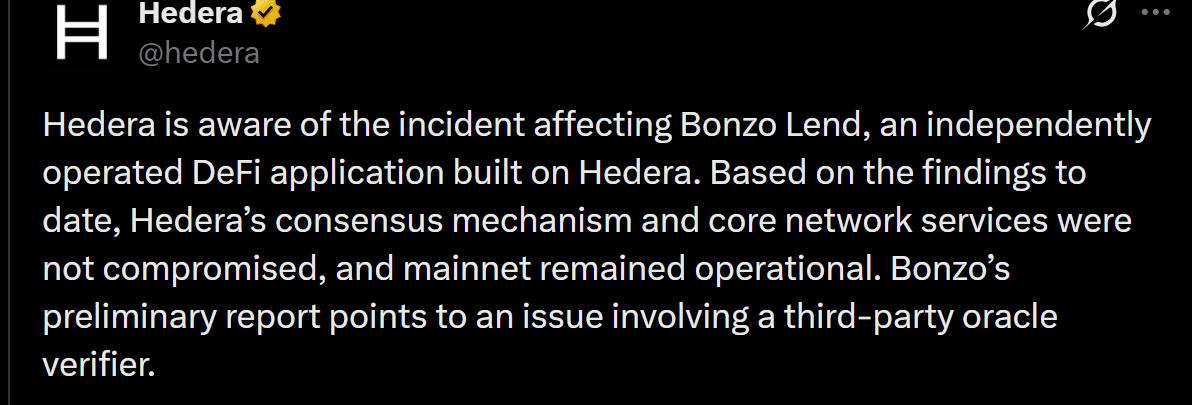
Bonzo Lend, a non-custodial lending and borrowing protocol built on the Hedera [HBAR] network, was recently exploited. The exploit happened after an oracle exploit enabled the attacker to borrow assets exceeding the posted collateral. As a result, Bonzo Lend suffered losses of $9.05 million.

Preliminary findings linked the breach to a flaw in Supra’s signature verification, enabling manipulation of SAUCE price feeds. The attacker then secured undercollateralized loans before the protocol halted activity.

Source: Hedera on X

In a post on X, Hedera confirmed Bonzo Lend’s smart contracts and Hedera’s core network were not compromised. That discovery narrowed the failure to external oracle infrastructure rather than blockchain security.

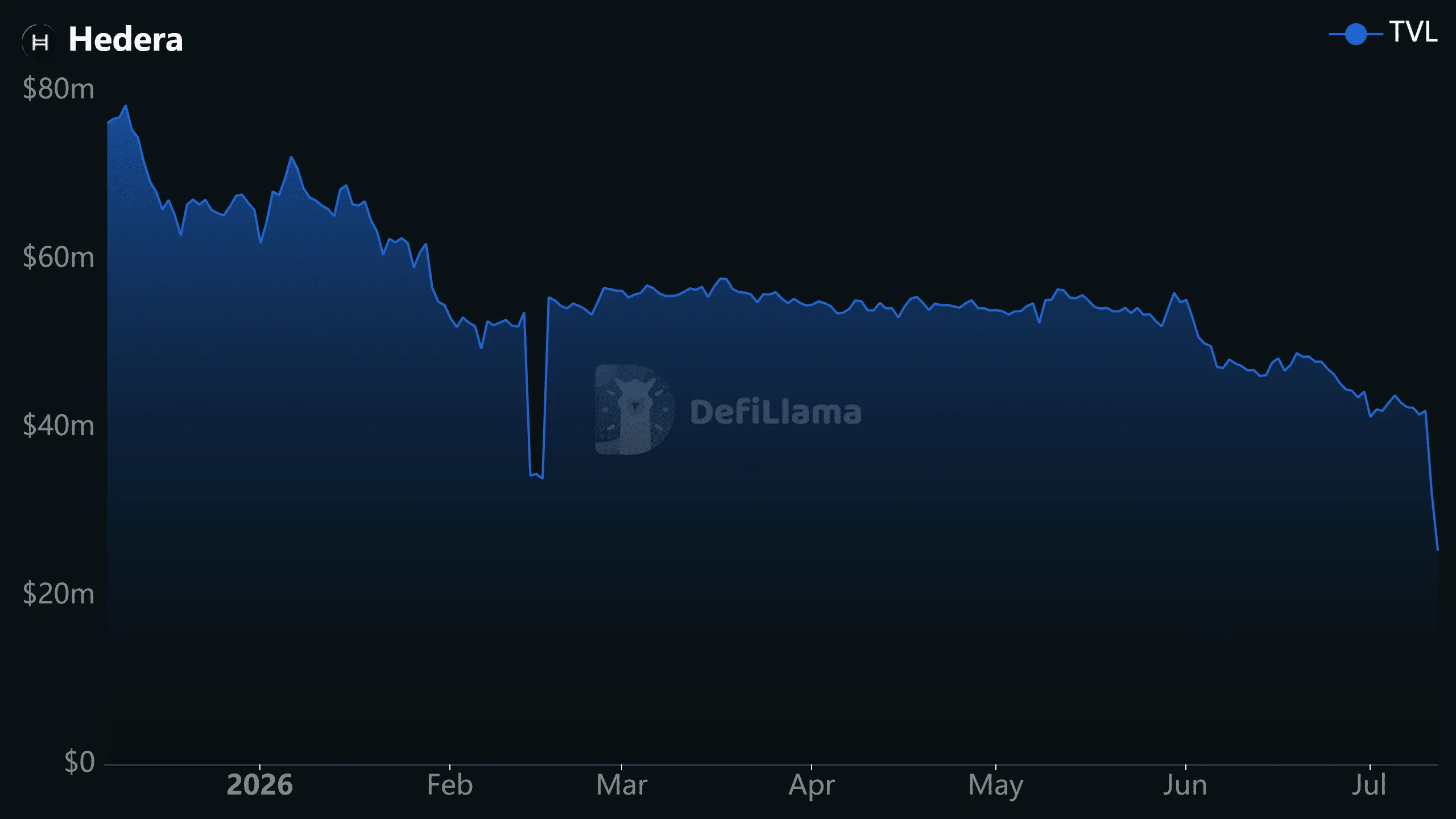
Meanwhile, the exploit quickly spilled into market sentiment. At press time, HBAR fell to about $0.068, while Hedera’s DeFi TVL plunged 21.43% to $25.4 million. This drawdown reflected capital withdrawals despite the network itself remaining uncompromised.

Source: DeFILlama

Nevertheless, the exploit exposed the growing importance of resilient price oracles. As recovery efforts continue, stronger oracle safeguards and verification standards will likely become essential for protecting DeFi lending protocols.

Oracle flaw exposes DeFi risk 

The audit of Bonzo Lend’s smart contracts determined that there were no issues related to it. Still, it also identified how the attack was successful. Although the protocol had read a manipulated SAUCE price to calculate collateral exactly as defined by the protocol, it had done so precisely as designed.

Auditors eliminated flash loans and market manipulation based upon their observations of SAUCE trading volumes having peaked at only a couple of thousand dollars.

Instead of using those methods, the attacker exploited the protocol’s reliance on trusted oracle inputs. Although the code executes flawlessly, attackers can still weaponize protocol rules against users and protocol owners. That pattern reflects a recurring DeFi risk where the rules themselves become weaponized despite flawless code execution. Such protocol logic exploits remain a recurring category in DefiLlama’s hacks database.

Therefore, such a recurring pattern is driving protocols to adopt economic simulations, formal verification, and bug bounties, in addition to traditional smart contract audits.


Final Summary

  • Hedera oracle exploit exposed critical risks in trusted price feeds.
  • HBAR showed correct protocol logic can still enable multimillion-dollar exploits.


Source link