Bonzo Lend, a non-custodial lending and borrowing protocol built on the Hedera [HBAR] network, was recently exploited. The exploit happened after an oracle exploit enabled the attacker to borrow assets exceeding the posted collateral. As a result, Bonzo Lend suffered losses of $9.05 million.
Preliminary findings linked the breach to a flaw in Supra’s signature verification, enabling manipulation of SAUCE price feeds. The attacker then secured undercollateralized loans before the protocol halted activity.
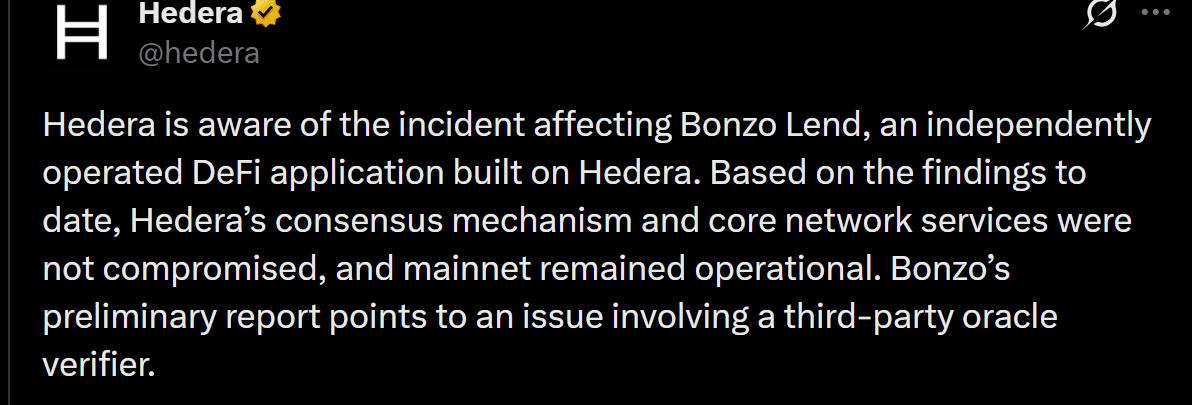
Source: Hedera on X
In a post on X, Hedera confirmed Bonzo Lend’s smart contracts and Hedera’s core network were not compromised. That discovery narrowed the failure to external oracle infrastructure rather than blockchain security.
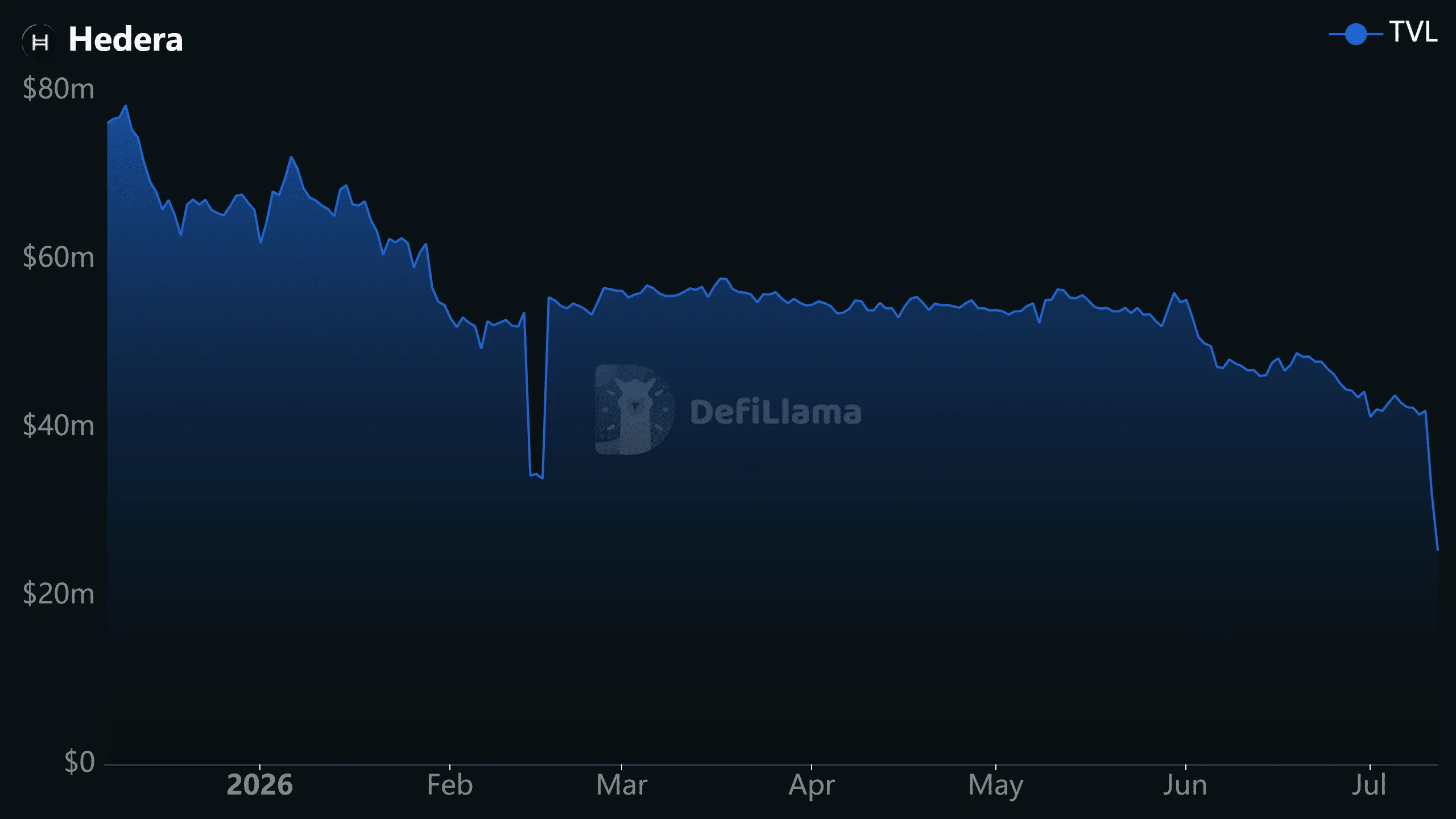
Meanwhile, the exploit quickly spilled into market sentiment. At press time, HBAR fell to about $0.068, while Hedera’s DeFi TVL plunged 21.43% to $25.4 million. This drawdown reflected capital withdrawals despite the network itself remaining uncompromised.
Source: DeFILlama
Nevertheless, the exploit exposed the growing importance of resilient price oracles. As recovery efforts continue, stronger oracle safeguards and verification standards will likely become essential for protecting DeFi lending protocols.
Oracle flaw exposes DeFi risk
The audit of Bonzo Lend’s smart contracts determined that there were no issues related to it. Still, it also identified how the attack was successful. Although the protocol had read a manipulated SAUCE price to calculate collateral exactly as defined by the protocol, it had done so precisely as designed.
Auditors eliminated flash loans and market manipulation based upon their observations of SAUCE trading volumes having peaked at only a couple of thousand dollars.
Instead of using those methods, the attacker exploited the protocol’s reliance on trusted oracle inputs. Although the code executes flawlessly, attackers can still weaponize protocol rules against users and protocol owners. That pattern reflects a recurring DeFi risk where the rules themselves become weaponized despite flawless code execution. Such protocol logic exploits remain a recurring category in DefiLlama’s hacks database.
Therefore, such a recurring pattern is driving protocols to adopt economic simulations, formal verification, and bug bounties, in addition to traditional smart contract audits.
Final Summary
Hedera oracle exploit exposed critical risks in trusted price feeds.
HBAR showed correct protocol logic can still enable multimillion-dollar exploits.
Two of Bitcoin’s most influential figures came out against it on Saturday. Strategy founder Michael Saylor posted that “there are 110 things more dangerous to Bitcoin than spam,” arguing the proposal “turns a spam dispute into a consensus change that would invalidate some currently valid, fee-paying transactions.” The precedent, he wrote, is the real danger.
There are 110 things more dangerous to Bitcoin than spam.
BIP 110 turns a spam dispute into a consensus change that would invalidate some currently valid, fee-paying transactions.
That precedent is the danger. We should save our energy for threats that really matter. $BTChttps://t.co/LoSkl9XSo1
Adam Back, the Blockstream co-founder whose hashcash design is cited in the bitcoin white paper, made a similar case at greater length, addressed to the newcomers backing the proposal.
“Bitcoin respectfully says no to what you want,” he said, adding that their real recourse, if unconvinced, is to group together and fork away, but that “bitcoin won’t be joining it.”
The support data shows what the broader market really thinks. BIP 110 does not rely on the usual path of overwhelming miner approval, but uses a user-activated soft fork, a mechanism in which nodes enforce a rule whether or not miners agree, set to a 55% miner-signaling threshold rather than the traditional 95%.
Backing is absent even at that significantly lower bar.
Miner signaling has never risen above about 1% in any period and stands at zero in the current one, with no major mining pool behind it, according to the BIP 110 signaling monitor.
Among the nodes that store and relay the chain, adoption sits in the low single digits, carried almost entirely by Bitcoin Knots, an alternative to the dominant Bitcoin Core software.
Find out how much you could earn by locking in a high CD rate today. A certificate of deposit (CD) allows you to lock in a competitive rate on your savings and helps your balance grow. However, rates vary widely across financial institutions, so it’s important to ensure you’re getting the best rate possible when shopping around for a CD. The following is a breakdown of CD rates today and where to find the best offers.
Overview of CD rates today
Historically, longer-term CDs offered higher interest rates than shorter-term CDs. Generally, this is because banks would pay better rates to encourage savers to keep their money on deposit longer. However, in today’s economic climate, the opposite is true.
Today, Sunday, July 12, 2026, the highest CD rate is 4.10% APY. This rate is offered by Marcus by Goldman Sachs on its 14-month CD.
How much interest can I earn with a CD?
The amount of interest you can earn from a CD depends on the annual percentage rate (APY). This is a measure of your total earnings after one year, taking into account the base interest rate and how often interest compounds (CD interest typically compounds daily or monthly).
Say you invest $1,000 in a one-year CD with 1.52% APY, and interest compounds monthly. At the end of that year, your balance would grow to $1,015.20 — your initial $1,000 deposit, plus $15.20 in interest.
Now let’s say you choose a one-year CD that offers 4% APY instead. In this case, your balance would grow to $1,040.74 over the same period, which includes $40.74 in interest.
The more you deposit in a CD, the more you stand to earn. If we used the same example of a one-year CD at 4% APY but deposited $10,000, your total balance when the CD matures would be $10,407.42, meaning you’d earn $407.42 in interest.
When choosing a CD, the interest rate is usually top of mind. However, the rate isn’t the only factor you should consider. There are several types of CDs that offer different benefits, though you may need to accept a slightly lower interest rate in exchange for more flexibility. Here’s a look at some of the common types of CDs you can consider beyond traditional CDs:
Bump-up CD: This type of CD allows you to request a higher interest rate if your bank’s rates go up during the account’s term. However, you’re usually allowed to “bump up” your rate just once.
No-penalty CD: Also known as a liquid CD, this type of CD allows you to withdraw funds before maturity without penalty.
Jumbo CD: These CDs require a higher minimum deposit (usually $100,000 or more), and often offer a higher interest rate in return. In today’s CD rate environment, however, the difference between traditional and jumbo CD rates may not be much.
Brokered CD: As the name suggests, these CDs are purchased through a brokerage rather than directly from a bank. Brokered CDs can sometimes offer higher rates or more flexible terms, but they also carry more risk and might not be FDIC-insured.
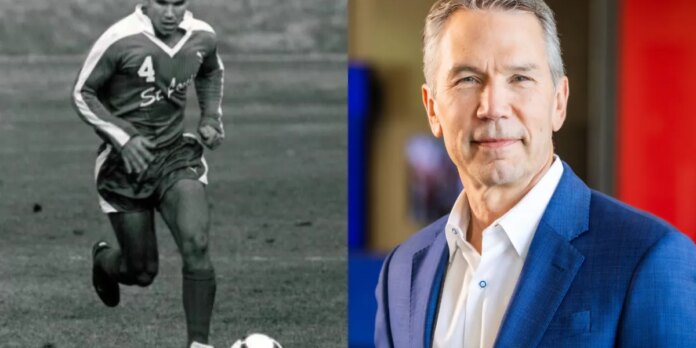
Jim Kavanaugh never became a global soccer icon like Lionel Messi or Cristiano Ronaldo. Unlike Messi and Ronaldo, one of whom still graces our screens on the World Cup stage, Kavanaugh’s playing days ended decades ago. But the former U.S. national team player does share one distinction with the two soccer superstars: They’re all billionaires.
Six years after representing the United States during the 1984 Summer Olympics, Kavanaugh traded the soccer pitch for the boardroom and co-founded World Wide Technology, a Missouri-based technology giant that generates $20 billion in annual revenue as of 2025. Like the two soccer players, the 63-year-old said he like many other entrepreneurs are able to build a successful business because they share the same qualities that separate elite athletes from the rest: a willingness to outwork the competition.
“If you want to be great—you can’t put in an average or sub-average level of input and work ethic,” Kavanaugh told Fortune.
“If you’re willing to put the time and the effort in and you have the desire to continue to learn, and you apply that in areas that you actually enjoy doing— the odds and the probability of you being successful is very good,” he added.
For Kavanaugh, though, talent alone has never been enough. The people who ultimately succeed are the ones who continue pushing through setbacks while making everyone around them better. That, he argued, is where leadership comes in—and why he sees two different approaches between Messi’s and Ronaldo’s success.
“From a values perspective and a team orientation, I feel like Messi brings the best out of Argentina,” Kavanaugh said. “I’m not sure that Ronaldo does the same for his team and country, but that actually takes it to the importance of leadership: there’s all different ways—some leaders are very vocal, some lead by example.”
Kavanaugh believes Messi embodies the latter: someone who inspires rather than commands. He believes the Argentine captain motivates teammates through his actions—a leadership style that helped Argentina win the 2022 World Cup and make another deep run at this year’s tournament. Basically, talk is cheap.
“I think leadership is, especially in business and in sport, it is something that is very powerful when it’s done the right way,” Kavanaugh said. “It can really move people and organizations and companies in a very, very positive way.”
Rejection helped turn Kavanaugh into a soccer Olympian—and a billionaire businessman
Though Kavanaugh today boasts a net worth of $7.7 billion and is part owner of St. Louis’s Major League Soccer Club, his success was far from guaranteed.
The son of a Missouri bricklayer, Kavanaugh grew up learning the value of hard work and responsibility long before he stepped onto a professional soccer field—or the corner office.
“There are athletes that are born with all these natural athletic capabilities,” he said, adding that he was “not one of them.”
Instead, Kavanaugh knew that he could train himself to compete with those who were naturally talented. As a kid, he looked forward to practice and hated when bad weather forced sessions to be canceled. Because his family couldn’t afford college, earning an athletic scholarship wasn’t just an opportunity—it was his path to higher education.
In the early 1980s, he landed a spot at Saint Louis University, where he caught the eye of U.S. national team scouts. Kavanaugh went on to represent the United States at the 1983 Pan American Games and the 1984 Summer Olympics. But reaching the sport’s highest levels didn’t spare him from failure.
Jim Kavanaugh (squatting on the bottom row, third from the right) was part of the U.S. national soccer team in the early-to-mid 1980s.
Courtesy of World Wide Technology.
“I got cut numerous times throughout my younger career,” he said. “But I continued to grind through it, get better.”
“The higher you play, the more you’re going to get critiqued by coaches, and the more direct and challenging it can be,” he added. “You either perform—or there are consequences.”
Those experiences, Kavanaugh said, taught him that resilience—not raw talent—is often what separates people who keep advancing from those who plateau. Learning to respond to failure, he added, ultimately proved more valuable than avoiding it.
He takes this lesson into the boardroom and with everyone he works with.
“I look at young kids coming up today [and ask], ‘Are you running towards work, or are you running away from it, and are you trying to avoid it?’” The latter, he said, is a “problem.”
In an era of rapid AI-driven change, Kavanaugh said having effective leadership—including a team-based culture—is “more important than ever.”
Great opportunities rarely arrive at convenient times
When push comes to shove, resilience may mean that work-life balance won’t always resemble a perfect 9-to-5 schedule. Kavanaugh said while he believes work-life balance is important to strive for, there are seasons when work inevitably takes priority.
Building World Wide Technology, which has repeatedly appeared on Fortune’s list of the 100 Best Companies to Work For, often meant working 12- to 18-hour days for extended stretches. Those long hours and hard work were necessary when there was just one last shot at the goal.
“You need to strike when the opportunity is there,” he said. “At times they will go away and not come back.”
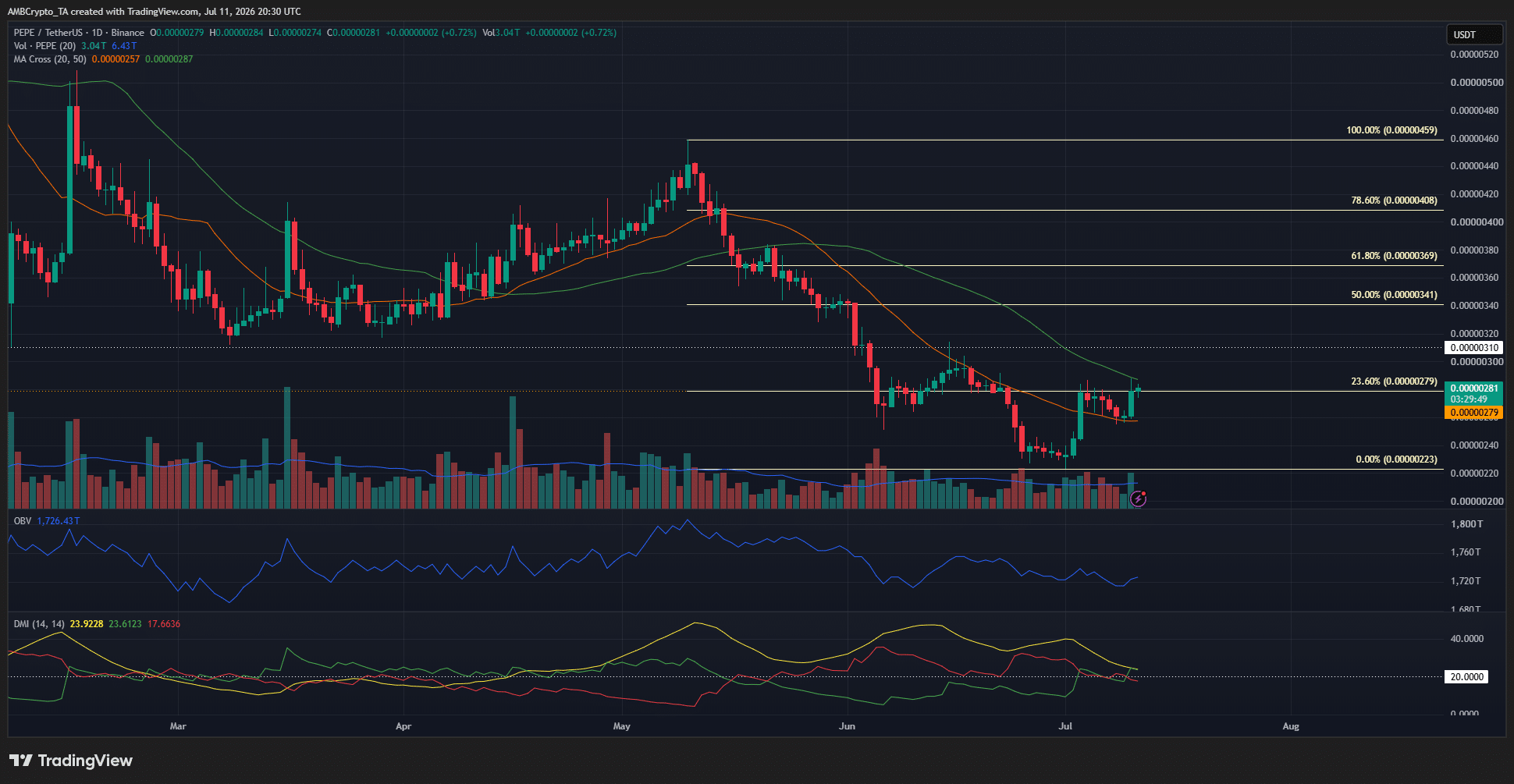
Pepe [PEPE] has rallied by 9.77%, from $0.00000256 to $0.00000281, since the 9th of July. This bounce was within the larger bounce that began on the 1st of July and has taken the popular memecoin up 26% so far.
The trading volume in the past 24 hours has fallen by 47%, suggesting that the flurry of activity to end the weekend has begun to fade. Weekends generally see reduced trading volume, which can sometimes lead to heightened volatility.
Here’s what traders can expect from PEPE in July.
PEPE bounce has the potential to go much higher
Source: PEPE/USDT on TradingView
The Directional Movement Index saw the +DI climb above 20, and the ADX was also above 20. Together, they signaled that an uptrend was taking shape.
Yet, the price action on the 1-day chart was bearish. The swing structure was bearish; the memecoin was setting new lows and lower highs. Zooming out, we can observe that this has been the case since January 2025.
Even extended rallies, such as the 185% move from April to May 2025 or the 82.4% rally in four days in January 2026, have come within this broader bearish context.
The price was right below the 50-day Moving Average, testing it as a dynamic resistance. The OBV has struggled to make new highs since May, signaling a lack of buying pressure in the market.
If the 23.6% Fibonacci retracement level at $0.0000028 can be flipped to support, like in mid-June, there would be some chance for PEPE bulls.
Should traders sell PEPE now?
Source: PEPE/USDT on TradingView
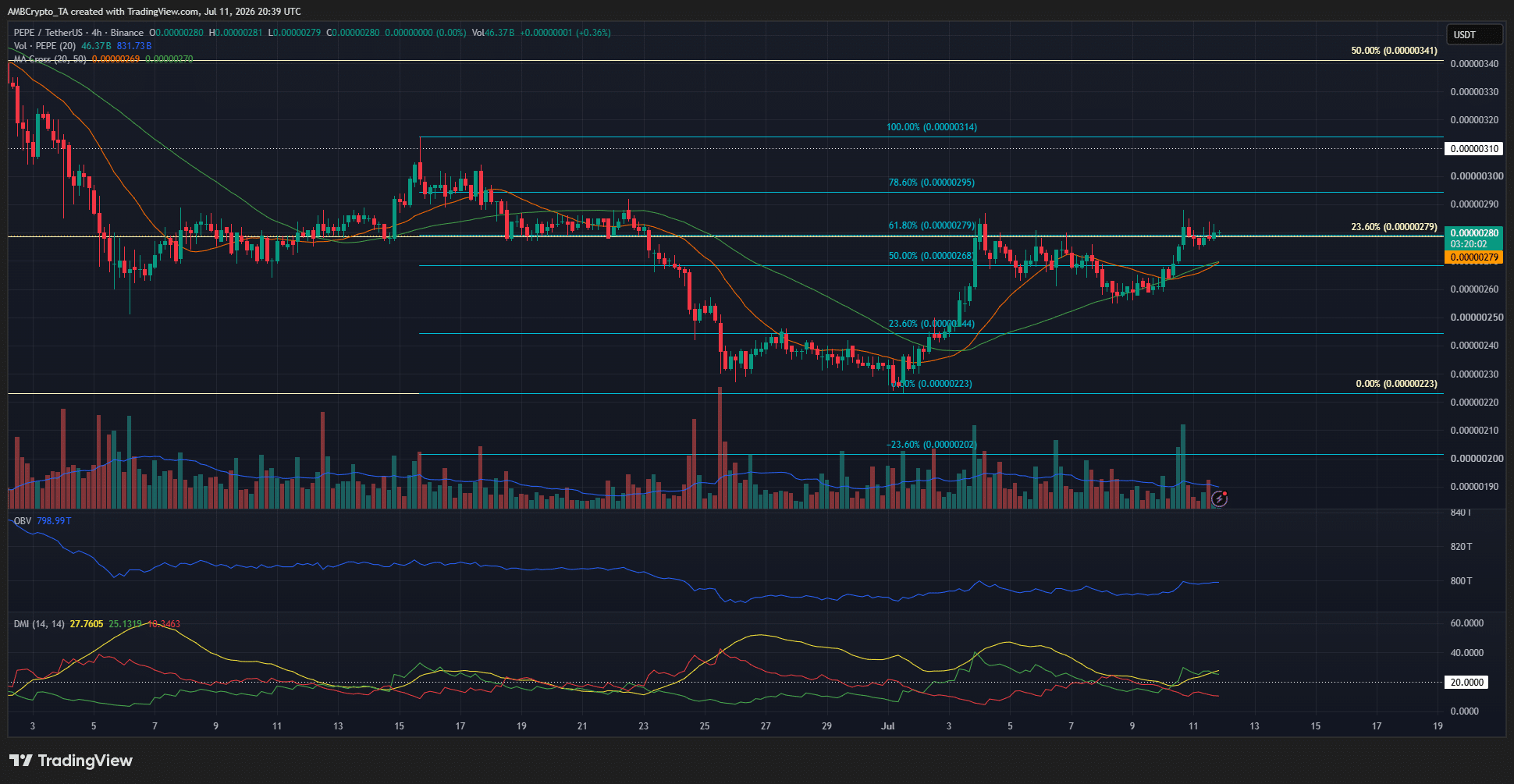
Based on the 4-hour timeframe’s swing structure, another set of Fibonacci retracement levels (cyan) was plotted. They showed that the 78.6% retracement level at $0.00000295 was a key resistance to watch out for.
Swing traders should expect the current bounce to end around the $0.0000030 resistance zone. This bearish idea would be invalidated upon an H4 session close above the $0.00000314 swing high.
Final Summary
The PEPE price action was bearish in the higher timeframes, but there is potential for a sharp bounce.
As things stand, the $0.0000030 area is likely to see the bearish trend take control once more.
Ripple came close to shutting down rather than fighting the U.S. Securities and Exchange Commission, Chief Executive Brad Garlinghouse said, describing a decision he and co-founder Chris Larsen faced after the agency sued the company in 2020.
Speaking at the University of Kansas School of Business earlier this week, Garlinghouse said the two seriously considered winding Ripple down and distributing its XRP holdings to shareholders. He described that as the easier path, against a government he said had “infinite power and resources.”
Ripple holds a large amount of XRP, and Garlinghouse said the company could have handed it to shareholders on a pro rata basis and dissolved, effectively ending the case by ending the company.
But they chose to fight because shutting down would have cost hundreds of jobs. “I’m glad in retrospect, but that was not obvious at the time,” he said.
Union Pacific Corporation (NYSE:UNP) is one of the Best Railroad Stocks to Invest In According to Billionaires. As of Q1 2026, 24 billionaires held the stock. On July 7, Union Pacific and Norfolk Southern told the Surface Transportation Board that they were willing to divest ownership stakes in smaller railroads as part of their proposed $85 billion merger. Reuters reported that the transaction would create the first U.S. coast-to-coast freight rail operator if approved.
How Union Pacific (UNP) Is Addressing Regulatory Hurdles to Advance Its Coast-to-Coast Rail Network Strategy
The companies said they would not control the Terminal Railroad Association of St. Louis, the Kansas City Terminal Railway, or the TTX Company after the merger and would divest ownership interests if directed by regulators. For Union Pacific, the filing keeps attention on network structure, regulatory approval, and the potential to reduce interchange delays across key freight hubs. The risks remain real because shippers, state attorneys general, and rival railroads have raised concerns. Still, this filing is the most consequential fresh development around the stock.
Union Pacific Corporation (NYSE:UNP) operates a major freight railroad network across the western United States, serving agricultural, automotive, chemicals, energy, industrial, and intermodal markets.
While we acknowledge the potential of UNP as an investment, we believe certain AI stocks offer greater upside potential and carry less downside risk. If you’re looking for an extremely undervalued AI stock that also stands to benefit significantly from Trump-era tariffs and the onshoring trend, see our free report on thebest short-term AI stock.