Home Blog Page 262

BTC, ETH, XRP price news: Bitcoin, ether little changed as U.S. launches fresh Iran strikes

0
BTC, ETH, SOL price news: Bitcoin holds near $64,000 amid US-Iran ceasefire talks

The muted response is the pattern now. When Iran first closed the Strait of Hormuz in early March, Brent crude jumped past $100 a barrel for the first time in four years and later peaked near $120, and bitcoin sold off sharply on each escalation.

Part of that is timing. Oil, equities and bonds are closed for the weekend, so bitcoin is the only large market open to price the strikes in real time, and it is treating them as close to a non-event.

The fuller cross-asset reaction, in crude especially, might not show until Monday. Roughly a fifth of the world’s seaborne oil moves through Hormuz, and Brent had already carried a risk premium into the weekend after tanker traffic through the strait stayed below normal.

The real test comes Monday, however, if crude reopens with a sharp gap higher while bitcoin holds its ground. A calmer oil open would say the strait closure is being read as a threat Tehran has made and walked back before.


Source link

Best CD rates today, Saturday, July 11, 2026: Best account provides 4.10% APY

0
Best CD rates today, Saturday, June 20, 2026: Best account provides 4% APY


Find out how much you could earn by locking in a high CD rate today. The Federal Reserve cut its federal funds rate three times in 2025. So far in 2026, the Fed has left interest rates alone, and so now could be your last chance to lock in a competitive CD rate before rates move further. CD rates vary widely across financial institutions, so it’s important to ensure you’re getting the best rate possible when shopping around for a CD.

The following is a breakdown of CD rates today and where to find the best offers.

Generally, the best CD rates today are offered on shorter terms of around one year or less. Online banks and credit unions, in particular, offer the top CD rates.

Today, the highest CD rate is 4.10% APY. This rate is offered by Marcus by Goldman Sachs on its 14-month CD.

Here is a look at some of the best CD rates available today:

The amount of interest you can earn from a CD depends on the annual percentage rate (APY). This is a measure of your total earnings after one year, taking into account the base interest rate and how often interest compounds (CD interest typically compounds daily or monthly).

Say you invest $1,000 in a one-year CD with 1.52% APY, and interest compounds monthly. At the end of that year, your balance would grow to $1,015.20 — your initial $1,000 deposit, plus $15.20 in interest.

Now let’s say you choose a one-year CD that offers 4% APY instead. In this case, your balance would grow to $1,040.74 over the same period, which includes $40.74 in interest.

The more you deposit in a CD, the more you stand to earn. If we used the same example of a one-year CD at 4% APY but deposited $10,000, your total balance when the CD matures would be $10,407.42, meaning you’d earn $407.42 in interest. ​​

Read more: What is a good CD rate?

When choosing a CD, the interest rate is usually top of mind. However, the rate isn’t the only factor you should consider. There are several types of CDs that offer different benefits, though you may need to accept a slightly lower interest rate in exchange for more flexibility. Here’s a look at some of the common types of CDs you can consider beyond traditional CDs:

  • Bump-up CD: This type of CD allows you to request a higher interest rate if your bank’s rates go up during the account’s term. However, you’re usually allowed to “bump up” your rate just once.

  • No-penalty CD: Also known as a liquid CD, this type of CD allows you to withdraw funds before maturity without penalty.

  • Jumbo CD: These CDs require a higher minimum deposit (usually $100,000 or more), and often offer a higher interest rate in return. In today’s CD rate environment, however, the difference between traditional and jumbo CD rates may not be much.

  • Brokered CD: As the name suggests, these CDs are purchased through a brokerage rather than directly from a bank. Brokered CDs can sometimes offer higher rates or more flexible terms, but they also carry more risk and might not be FDIC-insured.


Source link

Ethereum faces retail selling despite $84.4M ETF buying – What’s next for ETH?

0
Ethereum faces retail selling despite $84.4M ETF buying - What's next for ETH?


A growing disparity between institutional and retail investors could set the tone for Ethereum [ETH] heading into the new week. At press time, the asset climbed just 1.1% over the past day and posted impressive double-digit gains across the past thirty days.

That sentiment may be turning, though, as rising tension in the perpetual futures market hints that retail investors are shifting bearish and selling into the weekend.

Institutional flows turn bullish

Ethereum has held fairly steady around $1,800 over the past day, with institutional investor flows serving as one major contributor.

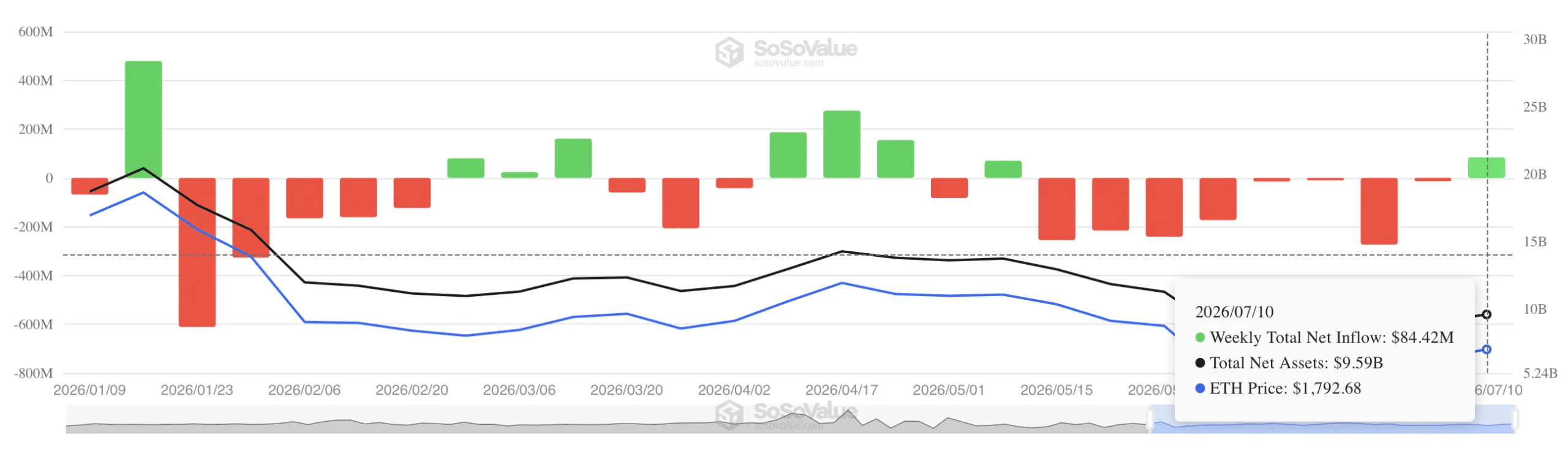
At the close of Friday’s trading session, SoSoValue reported that these investors recorded a weekly netflow of $84.4 million in net buying. That marked the first weekly net buy across the past nine weeks of trading.

spot U.S. Ethereum ETF
Source: SosoValue

During the week, only one day saw net sales, the 9th of July, when investors offloaded $52.08 million as Ethereum fell to $1,748.

Therefore, a turnaround of this kind, after such a long stretch of selling, often signals that institutional investors are recalibrating their outlook and may look to add capital to spot U.S. Ethereum ETFs. That fresh demand could help push the asset’s price higher in the near term.

Retail investors shift the other way

Retail investors, meanwhile, have continued to move in the opposite direction, opposing the bullish outlook that institutions have leaned into.

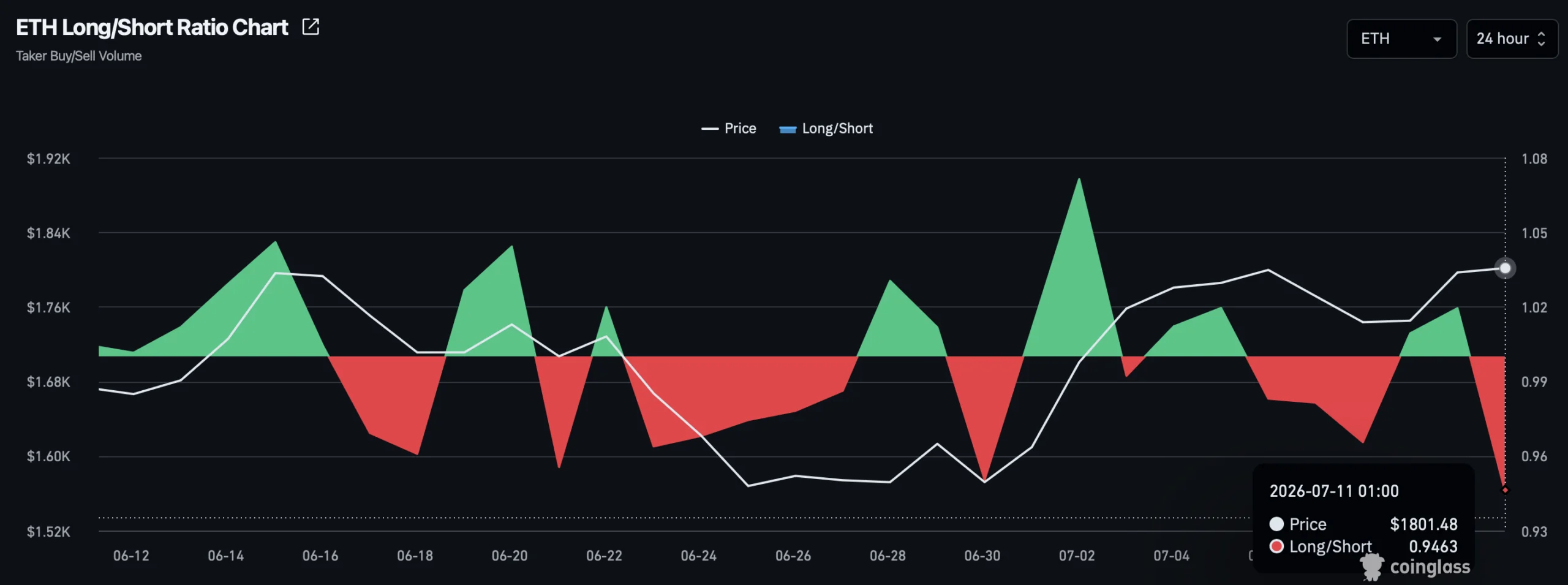
Over the past 24 hours, selling volume has risen across the Ethereum perpetual market. At the time of writing, the Long/Short Ratio that tracks this had fallen to 0.946.

Ethereum long-to-short ratioEthereum long-to-short ratio
Source: CoinGlass

Whenever the ratio drops below 1, as it has here, it points to a growing base of sellers in the market. The bigger concern, though, remains the mounting pressure building on key venues OKX and Bybit.

According to CoinGlass, whales, the high-liquidity players across these exchanges, carried an “extremely bearish” tag. For context, the two exchanges control $4.10 billion and $1.19 billion in total perpetual trading volume, respectively.

Moreover, a bearish stance from these players adds further weight to ETH and could drag the asset lower on the chart.

Short sellers step into ETH

Some retail investors are already positioning bearishly, and data shows one trader has opened a massive short worth $12.43 million on ETH ahead of further losses.

For now, though, overall liquidation data suggests those short sellers could still be at risk. The market’s total liquidations continue to work against short traders, who lost $11.49 million over the period compared with $8.30 million on the long side.

If anything, the data shows the market still leans more bearish than bullish. And while retail traders are attempting to set the tone for a decline, they could just as easily bear the brunt of it.


Final Summary

  • Institutional investors bought Ethereum for the first time in nine weeks, a sign that big money may be warming back up to the asset.
  • Retail traders moved the opposite way, selling into the weekend and setting up a tug-of-war that could decide ETH’s next move.


Source link

What Smart People Are Saying About Apple’s Lawsuit Against OpenAI

0
What Smart People Are Saying About Apple's Lawsuit Against OpenAI


The AI talent war may now be worthy of a Hollywood adaptation.

In a new lawsuit that reads like a corporate crime thriller, Apple accused OpenAI of poaching former Apple employees, conducting “show and tell” interviews, and accessing confidential documents to accelerate its consumer hardware push.

The complaint centers on OpenAI’s hiring of an Apple employee who Apple says kept a company laptop, exploited a security bug to access internal systems after leaving, downloaded confidential files, and helped others leaving for OpenAI to evade Apple’s exit checks.

The complaint also says OpenAI asked candidates to bring physical components to interviews and used a shared supplier to replicate a proprietary Apple metal-finishing process.

In a brief statement on Friday, OpenAI said it had “no interest” in the secrets of other companies. “We remain focused on building innovative technology that empowers people everywhere,” a spokesperson said.

The bombshell lawsuit between two of the premier tech companies in the world, which were once partners, has generated a lot of reaction. Here’s what smart people are saying about the latest legal battle in Big Tech.

Jean Gan, AI governance leader

Jean Gan, director of legal, compliance, and enterprise risk at Savills Singapore Group and a Ph.D. researcher focused on AI and law, said that protecting trade secrets, particularly in California, is difficult.

“Look at how Apple pleaded this. California courts have largely rejected the inevitable disclosure doctrine, and the state won’t enforce non-competes, so Apple can do nothing about the 400 former employees now at OpenAI,” she wrote on LinkedIn. “So every allegation rests on conduct: retained devices, unauthorized access, misused documents, coached evasion. In a jurisdiction where talent moves freely by design, trade secrets law is the only legal perimeter left around institutional knowledge, and Apple has pleaded squarely inside it.”

She also said that the complaint highlights a serious risk to company secrets: the supply chain.

“Apple alleges OpenAI had a manufacturing partner perform a proprietary Apple metal-finishing technique and misled that partner into believing Apple had consented. That leak ran through a shared supplier. No employee needed to carry anything out the door. Supply chains move trade secrets just as easily as departing staff do, and few confidentiality frameworks treat them with the same rigor.”

Paul Semenza, professor and tech analyst

Paul Semanza, a professor and chair of the Engineering Management and Leadership Department at Santa Clara University and an analyst who focuses on tech hardware, said Apple is unlikely to settle this suit quietly.

“Getting an existing Apple employee to take the risk of bringing parts to an interview seems more like a test of how desperate they are to work at OpenAI than anything else,” he wrote on LinkedIn. “Targeting Apple’s supply chain is a declaration of war. And given that Apple fought Samsung for years over rounded corners, it is hardly surprising to see Apple listing metal finishing as an example of IP theft. The question here is how this gets settled, given that, unlike with Samsung, Apple is unlikely to be interested in cross-licensing anything from OpenAI.”

Alistair Barr, author of BI’s Tech Memo newsletter

Alistair Barr, the author of Business Insider’s Big Tech newsletter, professed little sympathy for Apple in a post on Saturday.

“Cue the tiny violins; someone may have stolen something from Apple,” he wrote. “It’s a sorry tale, but one the tech giant knows very well. Maybe too well.”

Barr goes on to detail similar lawsuits filed against Apple. “Over the years, Apple has itself faced lawsuits from companies accusing it of using remarkably similar tactics: recruiting away key employees and then using their knowledge to build competing products.”

Rohit Mittal, cofounder of Helium Ventures

Rohit Mittal, the cofounder and CEO of Helium Ventures, a firm that acquires software businesses, wrote on X:

“Did not have Apple suing OpenAI on my bingo card for this year. They were the first to partner and integrate ChatGPT into their ecosystem. Crazy that Apple couldn’t resolve this amicably and had to sue. Apple and Google have been partners for decades, but never heard about a lawsuit between them.”

Parker Ortolani, product manager

Parker Ortolani, the associate director of product development at Penske Media, wrote on X: “well sun valley just got extra awkward.”

This past week, tech and media executives gathered in Sun Valley for the annual Allen & Co. conference, an invite-only gathering often called “summer camp for billionaires.”

The event is often a place for dealmaking behind closed doors. Apple’s lawsuit became public just as the conference was ending and the executives began to leave.

Stephen Robles, podcaster

Stephen Robles, the co-host of the Primary Tech podcast, responded on X to a post from Drew Pusateri, OpenAI’s director of strategic communications, in which he shared the company’s statement that “we have no interest in other companies’ trade secrets.”

Robles pushed back, arguing that OpenAI’s decision to hire Jony Ive, the famed iPhone designer whose company OpenAI also acquired and is named in Apple’s suit, suggests an interest in Apple’s products.

“‘We have no interest in other companies’ secrets,’ while hiring Jony Ive to make you a device rings pretty hollow.”

Ive, the designer behind many of Apple’s most iconic products, left the company in 2019 and later partnered with OpenAI CEO Sam Altman to develop AI hardware. OpenAI acquired Ive’s startup, io, in 2025, positioning Ive as a potential competitor to his former employer.

Max Weinbach, tech journalist

Max Weinbach, a tech journalist and analyst at Creative Strategies, wrote on X that the lawsuit focuses more on the alleged conduct of Chang Liu, a former senior electrical engineer at Apple, and Tang Tan, a former vice president at Apple, rather than on OpenAI itself.

“This really seems like the suit is against Liu and Tan personally and OAI by extension,” he wrote. “Apple seems to really be pushing Liu and Tan as the bad actors and OAI, because it owns IO, rather than OAI was asking them to do all of this stuff. Nuance, but feels worth mentioning.”

Paul Lembo, tech executive

Paul Lembo, the chief technology officer at Broadcom, wrote on LinkedIn:

“Apple suing OpenAI for trade secret theft. Damn. Tim Cook is not Elon. He doesn’t play. Knowing this was imminent was another reason for OpenAI not to IPO,” he wrote. “The ex-employee theft angle can be hard to prove in court, but again, I expect Apple to bring heavy lumber to the bbq. We will see.”

Livia Judith Szabo, venture capitalist

Livia Judith Szabo, the founder and executive chair of the venture capital firm Moshulu Enterprise Partners, wrote on LinkedIn:

“The Apple vs. OpenAI lawsuit is a masterclass in partner-competitor risk for VCs and M&A professionals.

Yesterday’s filing (July 10, 2026) reads like a due diligence nightmare.
Trade secrets, 400+ poached engineers, and a hardware chief accused of coaching new hires on how to dodge exit security checks.
Two once-close partners, now suing each other in federal court, weeks before OpenAI’s expected IPO.

The lesson for founders raising serious capital: your IP and talent-transition protocols will get read line by line in diligence. Fix them before someone else’s lawyers find them for you. This is exactly the kind of risk we flag before term sheets get signed, not after.”

Peter Rojas, tech and media executive

Peter Rojas, a senior vice president at Mozilla leading new products, wrote on LinkedIn:

“I don’t know how strong Apple’s claims are, but I doubt they would be this aggressive if they weren’t deeply concerned that OpenAI was planning on making a phone. I still think it’s a better move for OpenAI than some sort of AI wearable.”

Sahil Patel, marketing executive

Sahil Patel, the social lead at Okara, an AI marketing agent, wrote on X:

“apple is probably the last company you want to fight in court. they’ve got some of the best lawyers in tech and $140b in cash. apple doesn’t file nor lose lawsuits very often. they definitely have a very strong case and will fight this aggressively. this is not going to end well.”




Source link

Pizza chain closing up to 50 locations after years of declines

0
Pizza chain closing up to 50 locations after years of declines


A major pizza chain is preparing to close dozens of restaurants once again as its parent company works to eliminate underperforming locations following what executives describe as a “challenging period” for the business.

The restructuring is part of a broader effort to improve the performance of its corporate-owned restaurants, with the first shutdowns expected to begin during the week of July 13 and continue over the next several months.

The move comes as pizza chains across the industry grapple with higher operating costs, shifting consumer spending, and intense competition. In recent months, brands including Pizza Hut and Papa Johns have also announced significant store closures as they reshape their networks.

Now, another well-known pizza chain is joining a growing list of brands reducing their restaurant footprints.

Papa Murphy’s confirms restaurant closures

During MTY Group’s second-quarter fiscal 2026 earnings call, CEO Eric Lefebvre said the company plans to close 68 underperforming corporate-owned restaurants over the next six to nine months.

Up to 50 of those locations are expected to be Papa Murphy’s restaurants, while the remaining closures will affect other MTY Group brands.

Here’s some of my previous coverage of pizza chain closures:

Founded in 1979, MTY Group (MTY) is one of North America’s largest restaurant franchisors, operating more than 80 restaurant brands, including Papa Murphy’s, Wetzel’s Pretzels, Cold Stone Creamery, and others, across Canada, the U.S., and international markets.

Some restaurants are scheduled to close permanently during the week of July 13, though Lefebvre said the company is taking a measured approach to minimize disruption for employees, landlords, and suppliers.

“We’ve been slowly but gradually disposing of some stores where it makes sense for us,” said Lefebvre. “It’s not fire sale, but we’re also in the process where we can reduce the corporate store portfolio.”

He added that additional restaurant closures remain possible if other locations continue to underperform.

Why Papa Murphy’s is closing stores

According to Lefebvre, the company evaluated each restaurant individually based on its long-term financial outlook and local market conditions. The locations selected for closure collectively generated more than CAD 10 million in losses.

“Where we saw a path to improve, we chose to continue investing efforts into making our existing assets as productive as they can be,” said Lefebvre. “Where the fundamentals no longer support that path, we made the decision to close stores.”

Although the closures will temporarily shrink MTY Group’s overall restaurant count, executives believe the move will strengthen the business by reducing losses and allowing the company to focus on locations with stronger long-term growth potential.

The company estimates closure and lease termination costs of between CAD 10 million and CAD 12 million. While those expenses will weigh on free cash flow in the short term, MTY Group expects the restructuring to improve profitability going forward.

Executives also said the shutdowns are unlikely to have a meaningful impact on same-store sales because the affected restaurants were performing well below the system average.

Papa Murphy’s confirms plans to close up to 50 restaurants.Shutterstock

Papa Murphy’s has been shrinking for years

The latest closures continue a multiyear downsizing effort for Papa Murphy’s, which has struggled to regain momentum in an increasingly competitive pizza market.

About two years ago, MTY Group repossessed three groups of Papa Murphy’s restaurants that it believed could be turned around. After investing in those locations, the company ultimately concluded that many of the markets were no longer viable and decided to close the stores instead.

As a result, Papa Murphy’s total store count declined from 1,168 restaurants in 2023 to 1,014 in 2025, according to the company’s franchise disclosure document. Most of those reductions involved franchise locations.

The chain ended 2025 with just 49 company-owned restaurants, meaning the latest restructuring will affect the majority of its corporate-operated stores. 

During the second quarter of fiscal 2026, MTY Group reported:

  • Revenue declined 8.2% year over year.

  • Same-store sales fell 2.1%. 

  • System sales decreased 3.5%.

  • Franchise segment revenue dropped 4%.

  • The company operated 7,040 locations, with approximately 97% franchised or managed under operator agreements.

Other pizza chains are also reducing their footprints

Papa Murphy’s is far from the only pizza chain trimming its restaurant base.

  • Pizza Hut: Closed approximately 250 restaurants during the first half of 2026, NRN reported.

  • Papa Johns: Plans to close up to 300 locations through the end of 2027, Fast Company reported.

The latest closures highlight how even established pizza chains continue to rethink their footprints as operators balance rising costs with softer consumer demand.

Related: Iconic seafood chain files lawsuit after bankruptcy

This story was originally published by TheStreet on Jul 11, 2026, where it first appeared in the Restaurants section. Add TheStreet as a Preferred Source by clicking here.


Source link

Bitcoin nears cycle bottom despite record $8B Spot ETF outflows – Why?

0
Bitcoin nears cycle bottom despite record $8B Spot ETF outflows – Why?


At press time, Bitcoin [BTC] was trading at $64,099.20, indicating a recovery from the decline below the $60k mark, but there are still concerns lingering. CoinShares’ Head of Research, James Butterfill, in his recent report, emphasized the three-front headwind facing Bitcoin.

One of the main issues, according to Butterfill, is the shaky ceasefire between Iran and Israel, which hasn’t done much to allay worries about a new Middle East war.

He said,

In markets like this, the turn often begins when forced selling is exhausted rather than when the headline backdrop improves.

Concerns were further heightened by the minutes of the most recent Federal Reserve meeting, which concluded that interest rates remained unchanged at 3.50% to 3.75%. 

Because of tariffs, disruptions around the Strait of Hormuz, and robust demand for AI, the Fed’s top concern remained inflation, with core PCE inflation at 3.3% in April and an estimated 3.4% in May. However, there was little justification for policymakers to loosen monetary policy, as the U.S. unemployment rate was 4.3% in May and then decreased to 4.2% in June. 

Is Bitcoin nearing the bottom? 

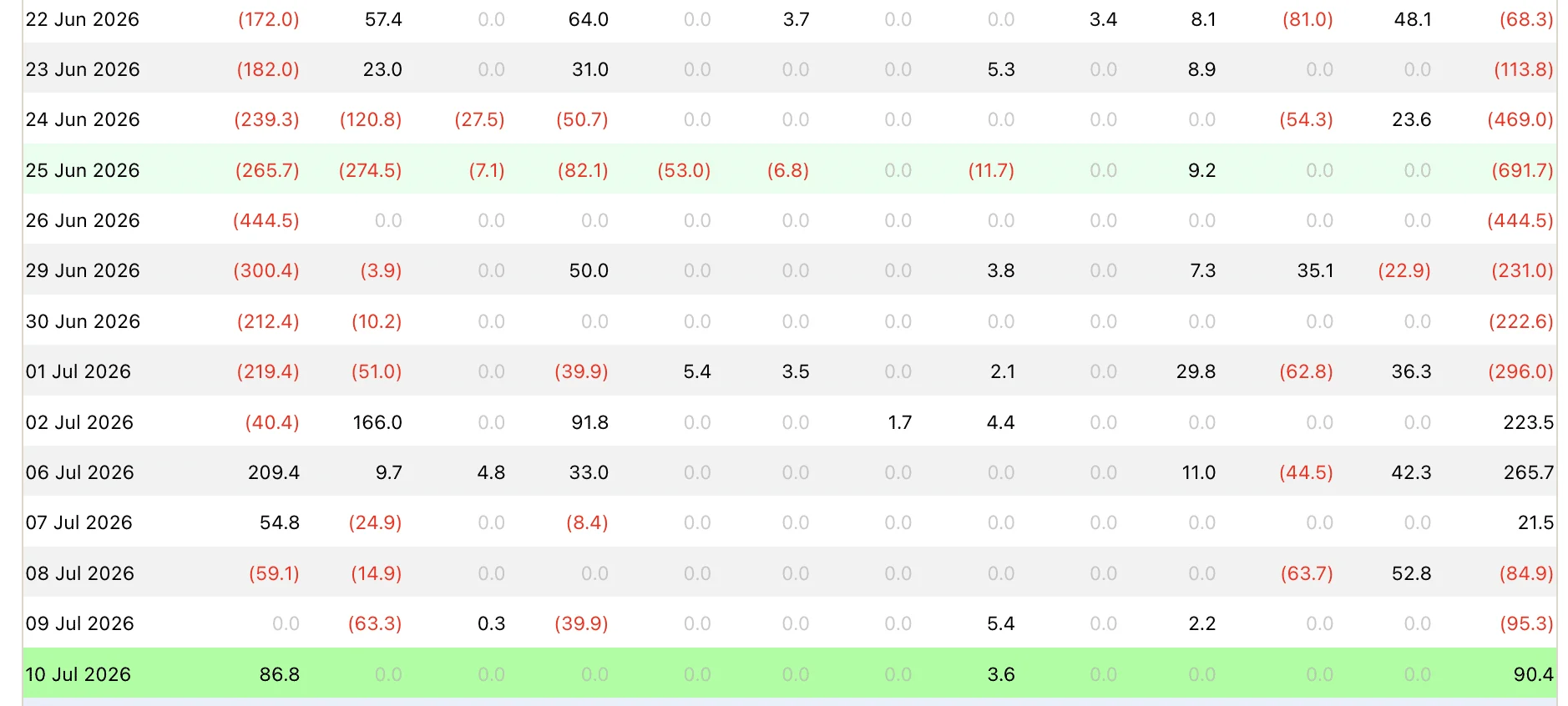
Butterfill, however, finds preliminary indications that Bitcoin might be approaching a bottom despite these obstacles. The reason behind this is that the Spot Bitcoin ETFs have experienced the longest withdrawal streak on record, with net outflows of about $8 billion over the last eight weeks.

However, recent inflows over the past three trading sessions indicate that institutional selling pressure might be lessening.

BTC ETFs outflows outpace
Source: Farside Investors

Meanwhile, there are no longer as many worries about Strategy’s Bitcoin sales. A much bigger sale of 3,588 BTC in early July had little effect on the market, with Bitcoin eventually rising toward $63,800.

Regarding regulations, Butterfill notes that there is waning hope for the CLARITY Act, which is still pending a Senate floor vote. The approval is further predicted to push Bitcoin to new heights. 

Hence, Butterfill concluded it best when he said,

The market remains under pressure, but not broken.

Final Summary

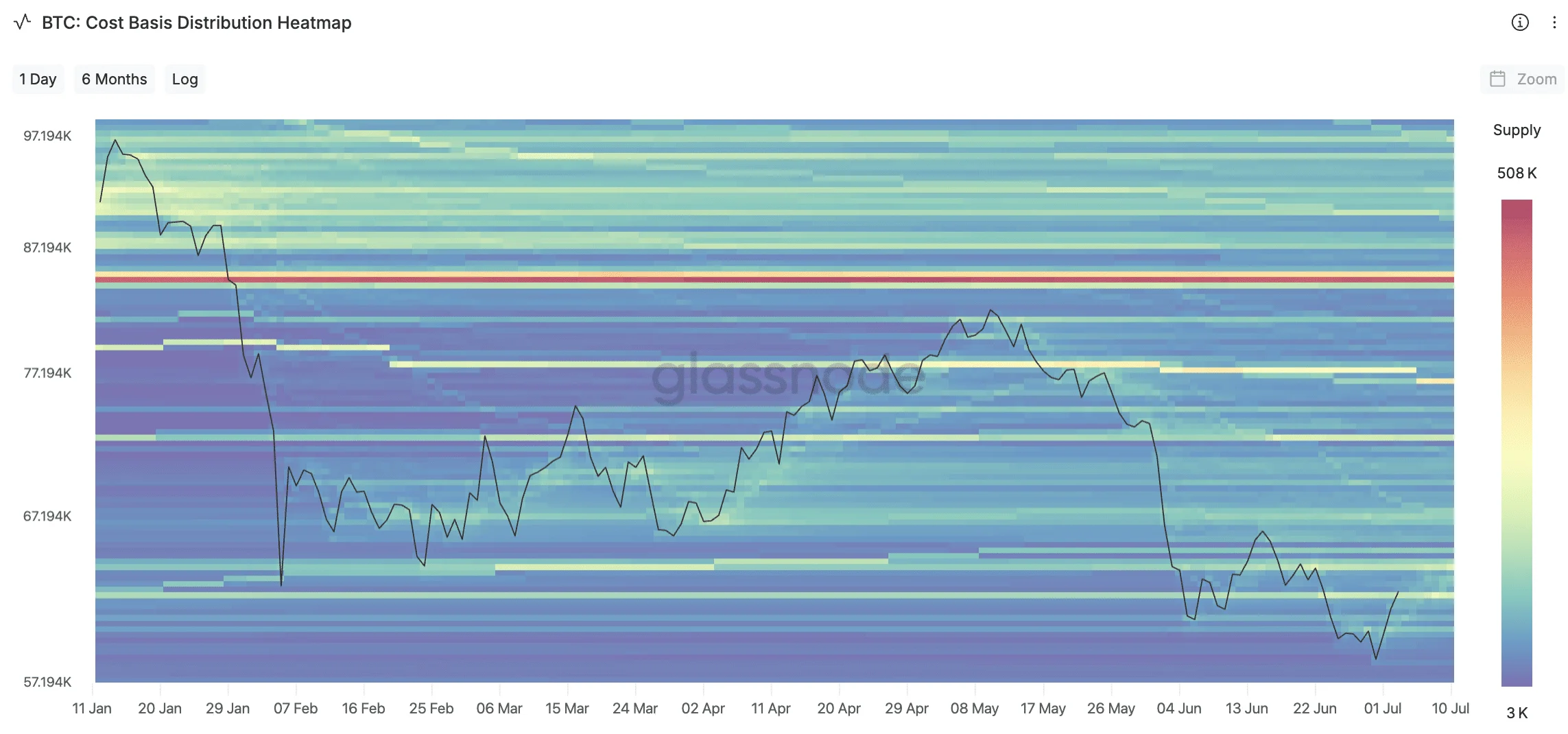
Meanwhile, the BTC Cost Basis Distribution Heatmap displays that the $77k cost-basis cluster has now become a significant resistance zone after supporting prices in April and May.

BTC cost basis distribution heatmapBTC cost basis distribution heatmap
Source: Glassnode

Since many holders might sell at break-even, a much larger supply cluster around $84k to $85k also represents significant overhead resistance.

Meanwhile, new accumulation in the $60k–$63k range indicates that buyers are establishing a new support base. While sustained buying above $77k would improve the bullish outlook, overall, Bitcoin is still below significant historical cost-basis levels, indicating cautious sentiment.


Final Summary

  • Middle East tensions and the 3.50% to 3.75% Fed rate are playing a major role behind Bitcoin’s weak momentum.
  • Spot Bitcoin ETF outflows and the BTC sell-off by Strategy suggest that Bitcoin might be nearing its bottom. 


Source link

Stock Indexes Settle Higher as Geopolitical Risks Ease

0
Stock Indexes Settle Higher as Geopolitical Risks Ease


The S&P 500 Index ($SPX) (SPY) on Friday closed up +0.42%, the Dow Jones Industrial Average ($DOWI) (DIA) closed up +0.29%, and the Nasdaq 100 Index ($IUXX) (QQQ) closed up +0.33%.  September E-mini S&P futures (ESU26) rose +0.43%, and September E-mini Nasdaq futures (NQU26) rose +0.35%. 

Stock indexes settled higher on Friday, with the S&P 500 posting a 5-week high.  Stocks turned higher on Friday after crude prices whipsawed lower when President Trump said US officials told Iran that the ceasefire is “over,” but the US would continue peace talks with Iran.  Easing geopolitical tensions also boosted stocks, following an American official who said talks between the US and Iran over a permanent peace deal are continuing, as the US remains committed to a diplomatic solution with Iran.   

More News from Barchart

Market sentiment also improved on Friday after South Korea’s SK Hynix jumped more than +12% in its first day of trading in the Nasdaq 100, which helped chipmakers recover from early losses.  Gains in stocks were limited on Friday amid weakness in cybersecurity stocks. 

The outlook for strong Q2 earnings, which will begin to be released next week, is a bullish factor for stocks.  Forecasts compiled by Bloomberg Intelligence suggest Q2 earnings may increase by +23%, close to Q1’s blowout earnings of +30%, which was more than double the +12% analysts had expected.  AI spending is expected to account for most of earnings, with AI infrastructure stocks set to contribute nearly 60% of the S&P 500’s earnings-per-share growth in Q2.   

WTI crude oil (CLQ26) fell nearly -1% on Friday after an American official said talks between the US and Iran over a permanent peace deal are continuing, as the US remains committed to a diplomatic solution with Iran despite this week’s hostilities.  Also, Al Jazeera reported Friday that Qatar said it supports all efforts to defuse US-Iran tensions.  Losses in crude were limited after Iran vowed to respond to the US attacks this week on Iran’s rail and maritime infrastructure.  On Wednesday, President Trump said the ceasefire with Iran is over, raising the prospect of persistent hostilities in the region that could disrupt energy supplies.  The US on Tuesday also revoked the Iran oil waiver that allowed buyers to purchase and transport Iranian oil legally.

The markets are discounting a 32% chance of a +25 bp rate hike at the next FOMC meeting on July 28-29.

Overseas stock markets settled mixed on Friday.  The Euro Stoxx 50 closed down -0.23%.  China’s Shanghai Composite fell from a 1-week high and closed down -1.00%.  Japan’s Nikkei-225 Stock Average closed up +1.20%.

Interest Rates

September 10-year T-notes (ZNU6) on Friday closed down -7.5 ticks, and the 10-year T-note yield rose +1.4 bp to 4.565%.  T-notes moved lower on Friday after the S&P 500 rallied to a 5-week high, curbing safe-haven demand for government debt securities.  Also, easing geopolitical risks reduced safe-haven demand for T-notes after President Trump said the US would continue peace negotiations with Iran.   

Losses in T-notes were limited on Friday as crude oil prices fell nearly -1%, which lowered inflation expectations and is a supportive factor for T-notes.  Also, bond dealer short covering boosted T-note prices, as dealers lifted short positions in T-notes that hedged this week’s new Treasury supply of $119 billion in T-notes and T-bonds.

European government bond yields moved lower on Friday.  The 10-year German bund yield fell -1.9 bp to 3.065%.  The 10-year UK gilt yield fell -2.5 bp to 4.872%.

Italy May industrial production fell -0.3% m/m, weaker than expectations of -0.2% m/m and the biggest decline in 4 months.

Swaps are discounting a 12% chance of a +25 bp ECB rate hike at its next policy meeting on July 23.

US Stock Movers

The weakness in cybersecurity stocks weighed on the broader market.  Okta (OKTA) closed down more than -6%, and CrowdStrike Holdings (CRWD) closed down more than -5% to lead losers in the Nasdaq 100.  Also, Zscaler (ZS) closed down more than -4%, and Palo Alto Networks (PANW) and Fortinet (FTNT) closed down more than -3%.  In addition, Cloudflare (NET) closed down more than -2%. 

EquipmentShare.com (EQPT) closed up more than +17% after raising its full-year adjusted core Ebitda estimate to $1.95 billion to $2.06 billion from a previous estimate of $1.88 billion to $2.00 billion.  The company also announced a $500 million share buyback program. 

WD-40 Co (WDFC) closed up more than +10% after boosting its full-year net sales forecast to $652 million to $667 million from a previous forecast of $630 million to $655 million. 

Meta Platforms (META) closed up more than +5% to lead gainers in the S&P 500 and Nasdaq 100 after research firm SemiAnalysis posted a positive report on the company’s AI computing business.

Jackson Financial (JXN) closed up more than +5% after Jeffries upgraded the stock to buy from hold with a price target of $140.

Nvidia (NVDA) closed up more than +4% to lead gainers in the Dow Jones industrials after the US Commerce Department said the UAE qualifies for easier treatment under US export control laws, which paves the way for the country to buy advanced AI chips from Nvidia. 

Circle Internet Group (CRCL) closed up more than +4% after receiving approval from the US Comptroller of the Currency to establish “First National Digital Currency Bank,” a national trust bank that will offer digital asset services. 

Weyerhaeuser (WY) closed up more than +4% after Raymond James upgraded the stock to strong buy from outperform with a price target of $30.

Sensient Technologies (SXT) closed down more than -3% after holder Freemont Capital announced the sale of as much as $237.7 million shares of Sensient via an unregistered block trade. 

Netflix (NFLX) closed down more than -2% after the Wall Street Journal reported on steps the company is considering to counter signs of declining subscriber engagement.

Delta Air Lines (DAL) closed down more than -2% after reporting Q2 passenger revenue of $15.61 billion, below the consensus of $15.63 billion. 

Earnings Reports(7/13/2026)

American Resources Corp (AREC), Anavex Life Sciences Corp (AVXL), FB Financial Corp (FBK).

On the date of publication, Rich Asplund did not have (either directly or indirectly) positions in any of the securities mentioned in this article. All information and data in this article is solely for informational purposes. This article was originally published on Barchart.com


Source link