Circle (CRCL), the issuer of the world’s second largest stablecoin USDC, received approval from the U.S. Office of the Comptroller of the Currency (OCC) to establish a national trust bank.
National trust banks are authorized to provide users with custody and fiduciary services but do not accept consumer deposits or make loans like traditional commercial banks.
Shares are higher by 14% in pre-market trading.
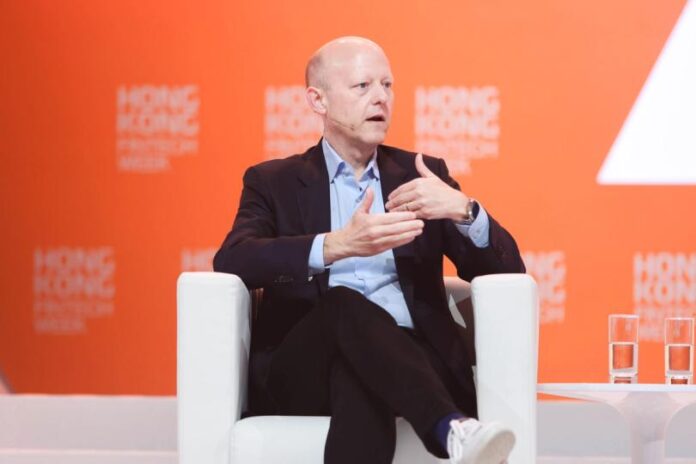
“OCC approval to establish Circle National Trust marks a defining step in bringing blockchain technology and digital assets into the core of the U.S. financial system,” Circle CEO Jeremy Allaire said Friday in a statement announcing the milestone. “Federal oversight of our trust bank sets a new standard for transparency, governance, and scale for Circle’s infrastructure.”
La Martiniquaise-Bardinet has taken full ownership of Dutch alcohol-free cocktail brand Sir James 101.
Financial terms were not disclosed.
The French drinks group acquired a minority stake in Sir James 101 three years ago and has now bought full control of the brand from its Dutch owner Brand Captains.
According to a statement from La Martiniquaise-Bardinet, Sir James 101 is “the market leader” by volume in Belgium, “and ranks third in the Netherlands”.
Cyril Cahart, managing director of La Martiniquaise-Bardinet France and the CEO of La Martiniquaise Benelux, said: “The alcohol-free cocktail and festive category continues to show strong growth, both within the Benelux and internationally.
“Therefore, the continued international development and growth of the non-alcoholic portfolio within the group is of strategic importance.”
Sir. James 101’s products are produced at Sodiko, a Belgian drinks producer which is owned by La Martiniquaise-Bardinet, the group told Just Drinks.
La Martiniquaise-Bardinet added that it plans “to position Sir James 101 as a truly global brand”, selling it through “all key distribution channels, including on-trade, off-trade and travel retail”.
Launched in 2019 by Vincent Yilmaz and Rambert de Lange via Brand Captains, Sir James 101 is also sold across the US, UK, France, Switzerland, and Italy.
The Cutty Sark whisky owner said in its statement it also planned to expand the brand into Austria, Ukraine, Germany and Poland.
The acquisition adds to La Martiniquaise-Bardinet’s existing non-alcoholic portfolio, which includes D’Artigny Sparkling, Venezzio Spritz RTD and Warner’s non-alcoholic gin range.
Lieven Stevens, the managing director at La Martiniquaise Benelux, said Sir James 101’s previous owner Brand Captains would still be” involved in supporting export activities in close collaboration with all sister companies or export departments”.
The move follow several investments by the company across categories and markets.
In May, the group took a 40% stake in Spanish company Street Liquors, producer of the Plata o Plomo brand, with an option to increase its holding within three years.
In July 2025, it also acquired a majority stake in UK gin producer Warner’s Distillery, expanding its presence in craft spirits and non-alcoholic drinks.
“La Martiniquaise-Bardinet buys non-alc brand Sir James 101 outright ” was originally created and published by Just Drinks, a GlobalData owned brand.
Opinions expressed by Entrepreneur contributors are their own.
Key Takeaways
Overwhelm is a leadership challenge, not a personal weakness.u003cbru003e
You can’t control the pace of change, but you can control how you respond to it.u003cbru003e
Reduce mental load instead of just trying to work harder.
Talk to any founder, manager or entrepreneur right now, and you will hear the same word. Overwhelm. People are trying to keep up with a pace that never slows.
AI is reshaping industries before leaders can absorb the last change. Even the high performers who usually stay calm under pressure say they feel stretched thin. Leadership capacity is dropping at the exact moment when demands are rising. Many workplaces feel like they are running out of room to breathe.
Overwhelm is not a personal failure. It is a structural reality. Leaders are trying to make good decisions while the ground keeps shifting under them. Economic conditions change without warning. New tools appear faster than people can learn them. Policies and regulations move in ways that force teams to rethink plans they made only days earlier. Supply chains wobble and require constant recalibration. The volume of change is so high that even experienced leaders feel like they are running a race where the course keeps moving.
I kept thinking about this during marathon training. The breakthrough didn’t happen during a long run. It happened on a rest day. Training had a rhythm. Some days focused on endurance. Some days focused on speed. Some days focused on strength. And then there were planned days off, which were just as important as the work. That recovery is the missing piece in today’s workplace. Most leaders operate in environments that never pause and never reset. Overwhelm keeps building because there is no chance to regain capacity. We cannot slow the world down, but we can learn to move through it with steadiness. That is the work of endurance.
Why this matters now
Overwhelm is becoming the defining condition of modern work. The pace of change is now faster than the pace of human adaptation, and that gap is widening. AI is accelerating decisions, expectations and competitive pressure. Markets are shifting in weeks instead of quarters. Teams are being asked to absorb more information than their cognitive systems were designed to handle.
Leaders who do not adjust will see slower decision cycles, rising conflict and declining performance. The organizations that thrive will be the ones whose leaders build endurance skills that match the speed of the environment. This is not about surviving chaos. It is about learning to operate confidently inside it.
What overwhelm looks like for leaders today
The familiar challenges are still here. Work-life balance. Office politics. Managing personalities. Endless decisions. Constant context switching.
What is new is the speed and instability surrounding them. One colleague told me, “The strategy we launched on Monday doesn’t work by Wednesday.” Another said, “I’m not between a rock and a hard place. I’m in a rock tumbler.” These comments are not exaggerations. They are honest descriptions of what overwhelm feels like in real time.
Leaders need a training plan for a world that does not include rest days. Endurance comes from small, repeatable practices that help you stay steady under prolonged strain.
Below are five endurance skills that reduce overwhelm at the source.
1. Reduce cognitive load at the source
Most leaders try to manage overwhelm by working harder. Endurance leaders reduce the inputs that create overwhelm in the first place.
Practical moves:
Shrink the number of priorities in play at any moment.
Collapse decision pathways so teams know exactly how choices get made.
Remove optional meetings and optional reporting.
Standardize anything that repeats.
This is not time management. It is load management, which is the real antidote to overwhelm.
2. Shorten the distance between signal and action
Overwhelm grows when leaders sit in ambiguity. Endurance leaders shorten the time between noticing a problem and addressing it.
Practical moves:
When something feels off, act within twenty-four hours.
When a project drifts, reset expectations immediately.
When a team is confused, clarify the path the same day.
This prevents small issues from becoming system-wide strain.
3. Build a recovery rhythm into the workweek
Most leaders think recovery is a luxury. Endurance leaders treat it as infrastructure.
Practical moves:
Protect one meeting-free block every day.
Add a weekly capacity check with your team.
Use microbreaks to reset your cognitive system before it hits overload.
Overwhelm grows when leaders lose sight of the destination. Endurance leaders use purpose as a filter.
Practical moves:
Ask whether the work moves you toward the mission before saying yes.
Remove tasks that do not serve the purpose.
Reconnect your team to the mission weekly.
Purpose is directional clarity. It cuts overwhelm in half.
The world is moving fast. You can still finish strong.
A world without enough rest breaks is not ideal. But it is the world we have. Leaders need endurance. Not the heroic kind. The practical kind. The kind built through small habits that help you stay steady in a world that keeps accelerating.
These practices will not slow the world down. They will help you move through it without losing yourself. And they will help you lead others who are feeling the same overwhelm you are.
Key Takeaways
Overwhelm is a leadership challenge, not a personal weakness.u003cbru003e
You can’t control the pace of change, but you can control how you respond to it.u003cbru003e
Reduce mental load instead of just trying to work harder.
Talk to any founder, manager or entrepreneur right now, and you will hear the same word. Overwhelm. People are trying to keep up with a pace that never slows.
AI is reshaping industries before leaders can absorb the last change. Even the high performers who usually stay calm under pressure say they feel stretched thin. Leadership capacity is dropping at the exact moment when demands are rising. Many workplaces feel like they are running out of room to breathe.
Overwhelm is not a personal failure. It is a structural reality. Leaders are trying to make good decisions while the ground keeps shifting under them. Economic conditions change without warning. New tools appear faster than people can learn them. Policies and regulations move in ways that force teams to rethink plans they made only days earlier. Supply chains wobble and require constant recalibration. The volume of change is so high that even experienced leaders feel like they are running a race where the course keeps moving.
A group of crypto and Web3 firms that includes OKX, MetaMask, Matter Labs and Genlayer have formed the “Internet Court” to reach dispute resolutions between AI agents.
These days, AI agents negotiate and pay one another without humans in the loop, but as with human-to-human transactions, agent-to-agent transactions will run into contractual disagreements.
The problem is that agentic systems have no way to settle these disputes, and traditional courts are not built to handle such cases. Hence the need for the 27-firm-backed protocol, led by the Genlayer Foundation, which makes AI-based payments, escrow and dispute resolution interoperable, according to a press release.
Agentic commerce is not prepared for the potential fallout when agents disagree at machine speed, according to David Riudor, CEO and co-founder of the GenLayer Foundation. “Internet Court is the shared place agents can turn to when a deal goes wrong. Machine-speed money needs machine-speed adjudication,” he said.
A key problem the dispute protocol solves is interoperability between a variety of AI commerce systems. Agentic commerce is certainly charging ahead but the infrastructure underpinning this new economy is still highly fragmented.
According to the Zillow lender marketplace, the average 30-year fixed-rate mortgage rose by 12 basis points to 6.47% today, Friday, July 10, 2026. The average 15-year fixed rate fell by 3 basis points to 5.86%. The average 5/1 ARM rose by 11 basis points to 6.46%.
Here are the current purchase rates, according to the latest Zillow data, for Friday, July 10, 2026:
30-year fixed: 6.47%
20-year fixed: 6.39%
15-year fixed: 5.91%
5/1 ARM: 6.46%
7/1 ARM: 6.49%
30-year VA: 5.90%
15-year VA: 5.57%
5/1 VA: 5.59%
Remember, these are national averages and have been rounded to the nearest hundredth.
Current mortgage refinance rates
These are the latest refinance rates, according to the latest Zillow data, for Friday, July 10, 2026:
30-year fixed: 6.47%
20-year fixed: 6.29%
15-year fixed: 5.84%
5/1 ARM: 6.54%
7/1 ARM: 6.67%
30-year VA: 5.75%
15-year VA: 5.54%
5/1 VA: 5.44%
Again, the numbers provided are national averages rounded to the nearest hundredth. Mortgage refinance rates are often higher than rates when you buy a house, although that’s not always the case.
Your mortgage rate plays a large role in how much your monthly payment will be. Use this mortgage calculator to see how your mortgage amount, rate, and term length will impact your monthly payments:
Mortgage payment calculator
You can bookmark the Yahoo Finance mortgage payment calculator and keep it handy for future use, as you shop for homes and lenders.
How mortgage interest rates work
A mortgage interest rate is a fee for borrowing money from your lender, expressed as a percentage. You can choose from two types of rates: fixed or adjustable.
A fixed-rate mortgage locks in your rate for the entire life of your loan. For example, if you obtain a 30-year mortgage with a 6% interest rate, your rate will remain at 6% for the entire 30-year term unless you refinance or sell.
An adjustable-rate mortgage locks in your rate for a predetermined period and then adjusts it periodically. Let’s say you get a 7/1 ARM with an introductory rate of 6%. Your rate would be 6% for the first seven years, then the rate would increase or decrease once per year for the last 23 years of your term. Whether your rate goes up or down depends on several factors, such as the economy and housing market.
At the beginning of your mortgage term, most of your monthly payment goes toward interest. Your monthly payment toward mortgage principal and interest stays the same throughout the years. However, less and less of your payment goes toward interest, and more goes toward the mortgage principal or the amount you originally borrowed.
A 30-year fixed-rate mortgage is a good choice if you want a lower mortgage payment and the predictability that comes with having a fixed rate. Just know that your rate will be higher than if you choose a shorter term, and you will pay significantly more in interest over the years.
You may want to consider a 15-year fixed-rate mortgage if you aim to pay off your home loan quickly and save money on interest. These shorter terms come with lower interest rates, and since you’re cutting your repayment time in half, you’ll save a lot in interest in the long run. But you’ll need to be sure you can comfortably afford the higher monthly payments that come with 15-year terms.
Typically, an adjustable-rate mortgage might be suitable if you plan to sell before the introductory rate period ends. Adjustable rates usually start lower than fixed rates, and then your rate will change after a predetermined amount of time. However, 5/1 and 7/1 ARM rates have been similar to (or even higher than) 30-year fixed rates recently. Before getting an ARM just for a lower rate, compare your rate options from term to term and lender to lender.
Are mortgage rates decreasing?
Some rates are decreasing, but not all. According to the Zillow lender marketplace, the average 30-year fixed-rate mortgage rose by 12 basis points to 6.47% today, Friday, July 10, 2026. The average 15-year fixed rate fell by 3 basis points to 5.86%. The average 5/1 ARM rose by 11 basis points to 6.46%.
Mortgage interest rates today: FAQs
What are mortgage interest rates doing today?
According to Freddie Mac, the average 30-year mortgage rate was 6.49% through Wednesday, up from 6.43% a week earlier. A year ago, the average 30-year mortgage rate was 6.72%.
How low will mortgage rates go in 2026?
According to the latest forecasts, the MBA expects the 30-year mortgage rate to be between 6.4% and 6.5% through 2026. Fannie Mae predicts a 30-year rate of 6.4% through the end of the year.
How low could mortgage rates go by 2027?
Mortgage rates are likely to remain little changed in 2027. The MBA forecasts 30-year fixed rates of 6.5% for all of 2027. However, Fannie Mae is more optimistic, predicting average rates will be between 6.3% and 6.4% throughout 2027.
Hyperliquid and Solana-based wallet Phantom have urged the U.S derivatives market regulator, Commodity Futures Trading Commission [CFTC], to modernize its regulations.
Source: HPC
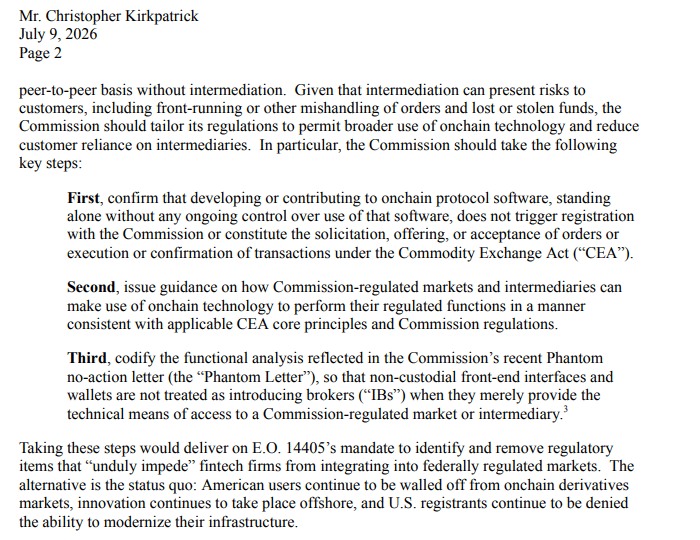
In a letter sent to the CFTC, the DeFi players requested three things. First, the agency should not treat a non-custodial software developer (users control funds, not the platform) as a broker.
In other words, creating on-chain protocols should not automatically trigger CFTC registration as an exchange or clearinghouse. Put plainly, they want developer protections.
Second, the no-action relief granted to self-custodial wallets, as issued to Phantom in March 2026, should be made formal guidance.
An industry coalition made a similar argument and pushed in April. If adopted, non-custodial DeFi front-ends like Phantom would not need broker-dealer or exchange registration to handle even U.S tokenized stocks.
Finally, they want the CFTC to create a framework that allows regulated entities to use blockchain for trading and settlement.
Why are DeFi firms seeking exemptions?
The letter was a response to the CFTC’s request for information regarding issues that are preventing fintechs from partnering with its regulated entities.
Some of the issues raised by Hyperliquid and Phantom are DeFi exemptions, some of which are being deliberated in the CLARITY Act. In fact, even the SEC is exploring a similar “innovation exemption” for tokenized assets trading.
The DeFi players cautioned that failure to explore these recommendations would reinforce the status quo, with dire consequences.
The alternative is the status quo: American users continue to be walled off from onchain derivatives markets, innovation continues to take place offshore, and U.S. registrants continue to be denied the ability to modernize their infrastructure.
Why DeFi exemptions request could be delayed
But these requests, even if granted, could trigger legal challenges from traditional market participants. The Chicago Mercantile Exchange (CME) has already sued the CFTC over its approval of Kalshi’s crypto perpetuals (perps).
CME argued that perps are swaps rather than futures, meaning the contracts should fall under its regulatory framework. That stance prompted the CFTC to reconsider how it defines swaps.
Hyperliquid Policy Center founder Jake Chervinsky called the CME lawsuit anti-competitive and a “shocking misjudgement.”
Citadel Securities and the umbrella body representing traditional exchanges have also opposed DeFi exemptions, particularly for tokenized asset trading. They argue regulators should treat every platform as a broker based on its function, not its underlying technology.
In short, DeFi platforms handling U.S. tokenized stocks should meet the same disclosure requirements and legal obligations as traditional exchanges.
Like CME, other traditional market participants could sue the agency if it grants the requested DeFi exemptions, particularly because lawmakers have not codified them and the CLARITY Act’s future remains uncertain.
Final Summary
Hyperliquid and Phantom have requested CFTC for formalized exemptions for DeFi front-ends
But with the CLARITY Act still in limbo, CME and other traditional players will continue to legally challenge the regulator over such requests.
Prediction market Polymarket applied for a license to offer U.S. users margin trading, enabling them to place bets with less upfront capital, Bloomberg reported Thursday.
Polymarket’s U.S. affiliate, Coming Home GBA LLC, filed for a futures commission merchant license with the National Futures Association, Bloomberg said, citing a company representative. Polymarket will also require authorization from the Commodity Futures Trading Commission (CFTC) for changes to its rulebook that would allow trading without fully collateralized positions.
Prediction market platforms like Polymarket and Kalshi offer yes-or-no wagers on the outcomes of events, such as weather, sports and elections. Margin trading lets investors open positions with less upfront capital, a practice common in traditional markets. Kalshi received clearance to offer margin trading in March.
Polymarket’s application comes as prediction markets continue to grow. Volumes hit $51 billion last year and are on pace to reach about $240 billion in 2026. Wall Street broker Bernstein recently said it expects volume to rise to $1 trillion by 2030 as the sector evolves from niche wagering into wide-based “information markets” spanning sports, crypto, politics and the economy.