Consumers’ flight from brick-and-mortar stores in malls became a major problem for retailers as internet sales and e-commerce began taking business away from physical stores in the 1990s.
Malls were hit even harder from the shutdowns during the Covid-19 pandemic, with retail slowly recovering over the last six years.
Boatworks at Tahoe LLC, a Lake Tahoe shopping mall and hotel owner, filed for Chapter 11 bankruptcy protection to avoid a foreclosure auction that was scheduled for Aug. 12.
The owner of Boatworks Mall and Inn at the Boatworks in Tahoe City, Calif., files for bankruptcy. PeopleImages / Getty Images
Boatworks at Tahoe files for bankruptcy
The Tahoe City, Calif., owner of Boatworks Mall and the adjacent 34-room Inn at Boatworks on Lake Tahoe’s North Shore filed its petition in the U.S. Bankruptcy Court for the Eastern District of California on Aug. 11, listing $10 million to $50 million in assets and debts.
Citizens National Bank of Texas in January filed a notice of default against Boatworks at Tahoe on its $14.4 million loan after the debtor failed to pay property taxes and provide proof of insurance. The debtor is managed by San Francisco firm MJD Capital Partners, according to SFGate.
“Staying open is crucial for the business, the employees, and the community,” MJD Capital Partners’ Marie Murphy said in a statement. “A Chapter 11 reorganization of the LLC that owns this iconic project legally prevents foreclosure while the business restructures.”
Bankruptcy halts legal action
MJD’s Chapter 11 filing invokes an automatic stay on all legal actions against the debtor while the bankruptcy case proceeds. The debtor plans to remain open while it reorganizes its assets in bankruptcy.
“We continue to believe a mixed-use redevelopment is the best way to revitalize Boatworks and preserve its unique character,” Murphy said. “Foreclosure would be a major blow to the area. For over four decades, Boatworks has been Tahoe City’s place to be. With this reorganization, we intend to continue our efforts to ensure that legacy continues.”
Owner planned property redevelopment
MJD purchased the property in 2019 with plans for a rebuild of the property. The developer planned to demolish the property in 2024, which included an 80-room hotel, 31 condominiums, and 8,000 square feet of retail space, but the project never proceeded.
A planned redevelopment would have moved the mall’s retail closer to street level and away from the adjacent marina, according to Katherine Hill, executive director of the Tahoe City Downtown Association.
“Our board is committed to supporting our businesses in Tahoe City. We see the Boatworks Mall as an important part of our community,” Hill told SFGate.
Boatworks Mall consists of a mix of retail, office and non-profit operations, including women’s boutique Camila’s at Tahoe, resort wear shop The Lucky Horseshoe, Steve Schmier’s Jewelry, Tahoe City Chocolates candy shop, Acorn Home Furnishings and Design, souvenir shops Tahoe T-Shirtery and Tahoe Boho, makeup and eyelash shops, and training and yoga studios.
The upscale mall also houses The Snow Sports Museum and Placer County Library Tahoe City branch, as well as an architectural firm and general construction contractor.
The Inn at the Boatworks opened in 1958, and the mall opened 20 years later in 1978.
Another upscale mall files bankruptcy
Boatworks isn’t the only upscale mall facing financial issues, as Blackhawk Plaza in Danville, Calif., filed for Chapter 11 protection in the U.S. Bankruptcy Court for the Central District of California in March amid defaulted loans and lawsuits.
The Blackhawk area in Danville is an upscale community for which the Blackhawk Plaza accommodated with high-end retail tenants and restaurants, until many began closing following the Covid-19 pandemic.
Investment firm The Ramanujan Group LLC purchased the shopping center at the height of the Covid-19 pandemic in 2020 for $28.3 million. The debtor defaulted on loans totaling $28 million and $3 million from Preferred Bank and $5 million from Nano Bank, according to SiliconValley.com.
The moves followed CoinDesk’s report late Thursday that the Securities and Exchange Commission (SEC) was set to further delay its anticipated “innovation exemption,” which is expected to make it easier for companies to offer trading in tokenized securities. Concerns from the White House and Wall Street over the proposal’s legal footing and potential market impact have held up the plan.
Adding to the uncertainty, the SEC canceled a meeting scheduled for Friday where commissioners planned to consider whether to propose new rules creating a tailored offering regime for certain investment contracts involving crypto assets.
The impact wasn’t limited to stocks. The innovation exemption had also been expected to provide some regulatory relief for trading through decentralized finance venues, meaning the delay reaches beyond publicly traded tokenization companies. Uniswap’s UNI (UNI), the native token of the decentralized exchange, fell 7% over the past 24 hours, making it the weakest performer in the CoinDesk 20 Index both Friday and this week.
For comparison, the Nasdaq 100, S&P 500 and bitcoin BTC$62,827.39 were all mostly flat during the day.
A ‘speed bump,’ not the end of the tokenization trade
The setback could stretch out the timeline for U.S. tokenization, but it doesn’t necessarily change the longer-term story, according to Owen Lau, managing director and senior analyst at Clear Street.
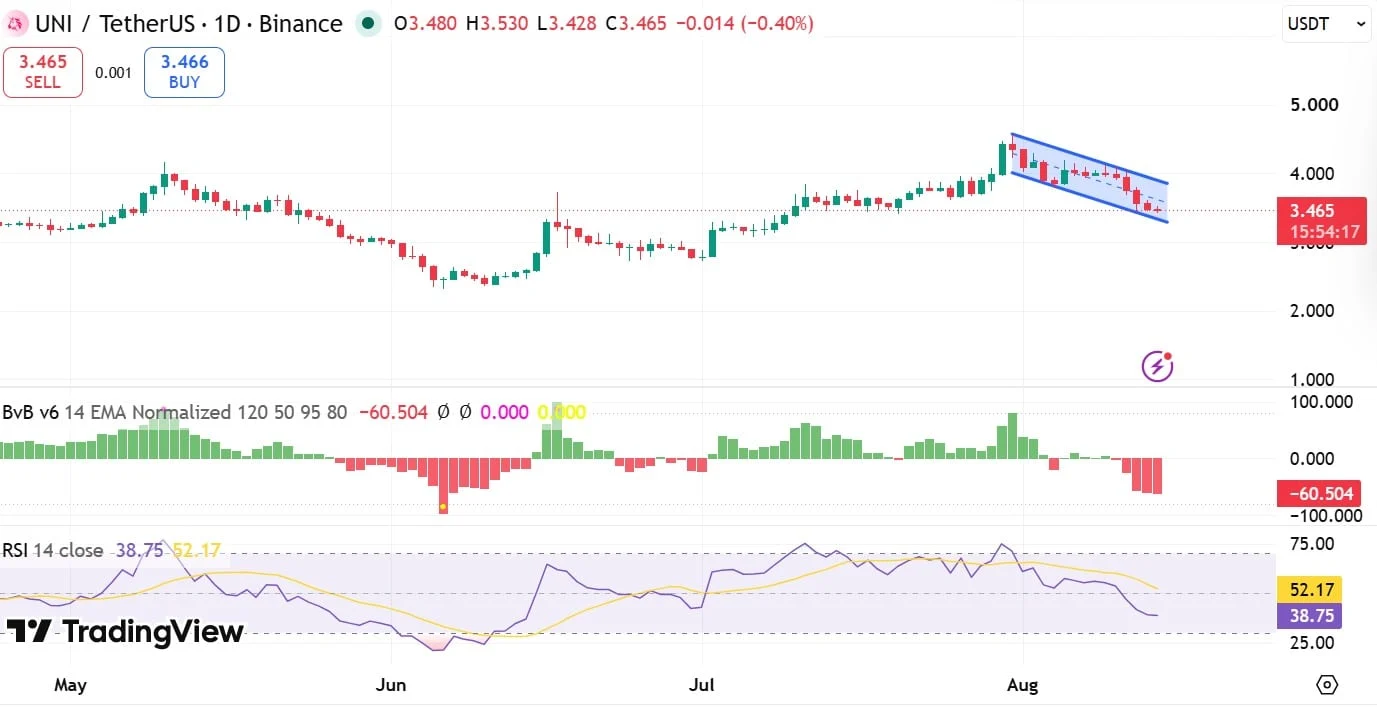
Uniswap [UNI] faced intense bearish pressure over the past two weeks. After facing rejection at $4.50, the altcoin entered a descending channel and fell to a $3.40 low.
Over the same period, UNI’s Trading Volume dropped 42% to $154 million, showing weaker market activity.
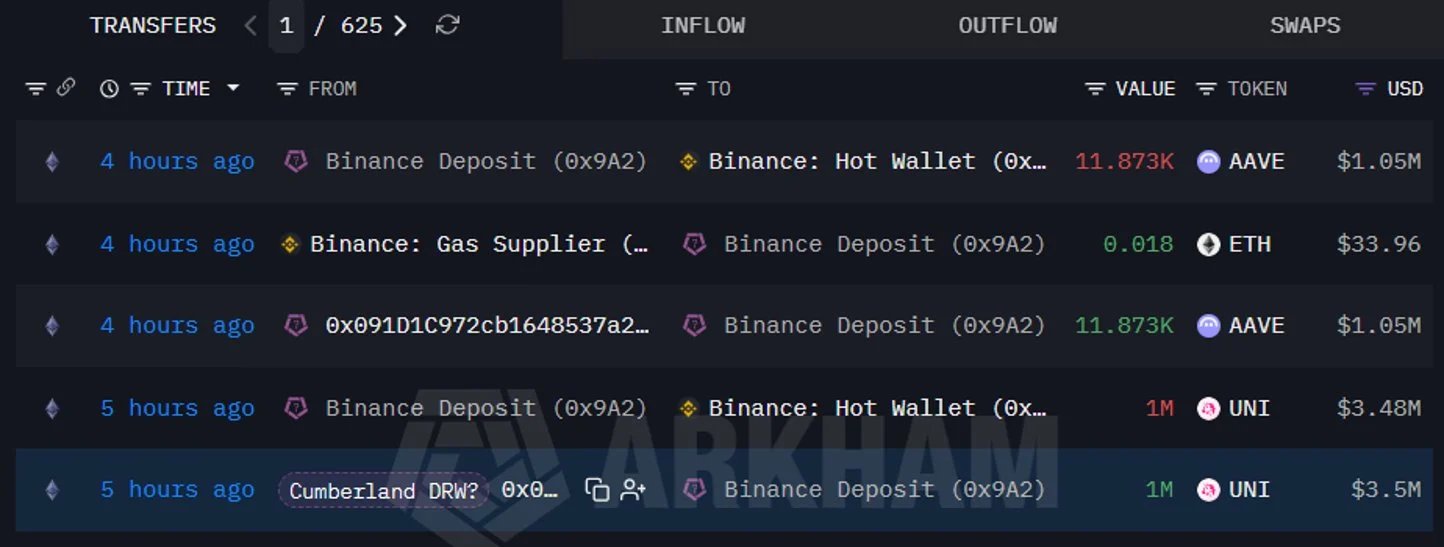
UNI represented most of those assets. The wallet moved 1 million UNI worth $3.48 million to Binance. It also deposited 1.5 million UNI worth $5.25 million into Bybit through three separate transactions.
Source: Arkham
In total, the wallet moved 2.5 million UNI worth $8.73 million to exchanges.
Even after those transfers, the wallet held 1.22 million UNI worth $4.23 million. However, its remaining balance did not confirm whether further sales would follow.
The Cumberland-linked wallet was not alone. Two days earlier, a long-term holder sold 9.29 million UNI worth $33.46 million. The holder reportedly executed the sale through Coinbase Prime.
Together, these transactions increased UNI’s potential sell-side supply during an already weak market.
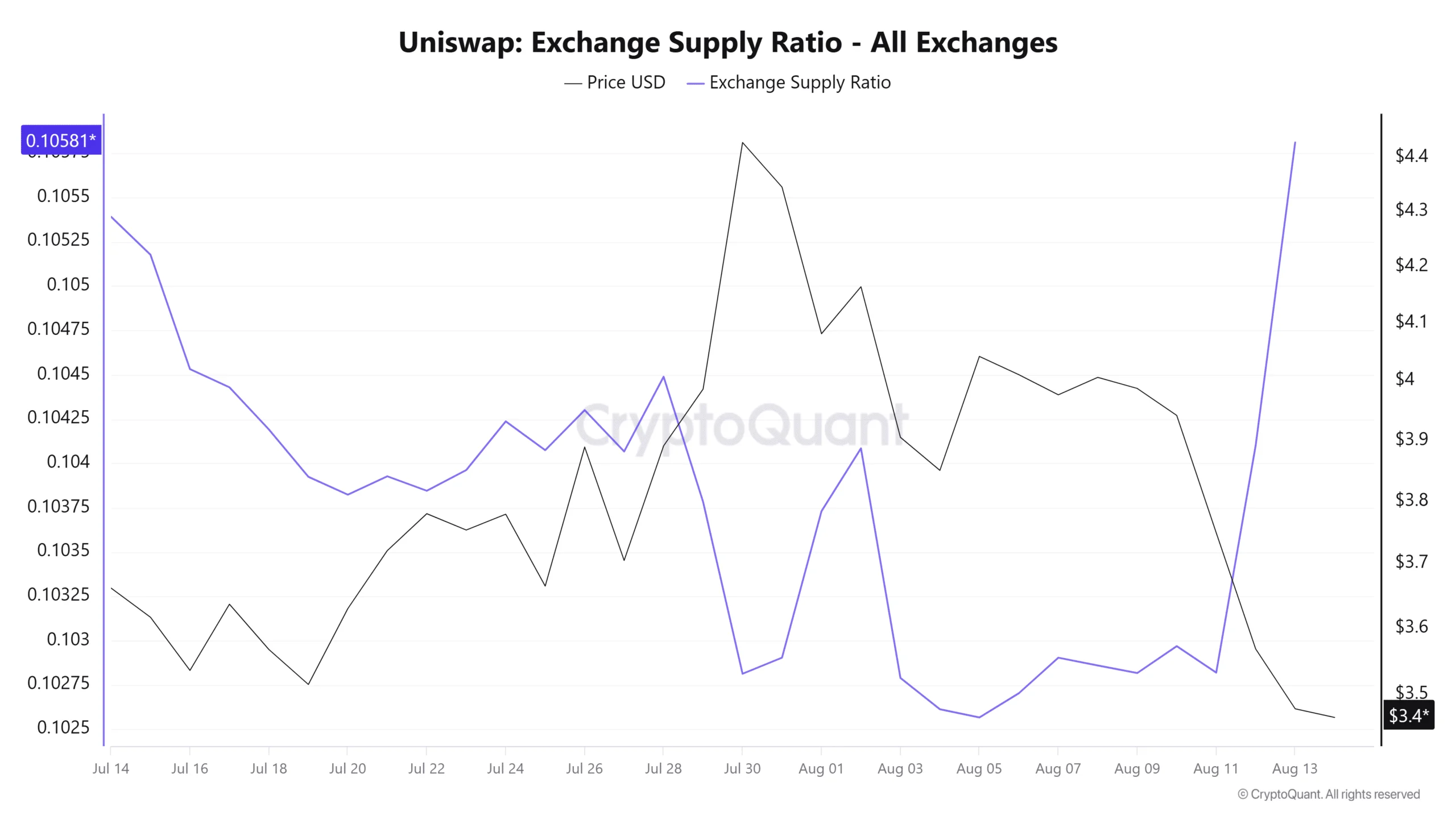
Source: CryptoQuant
On top of that, Uniswap’s Exchange Supply Ratio rose for three consecutive days. The metric reached a monthly high of 0.105, showing that a larger share of UNI’s supply sat on exchanges.
This could raise near-term selling risk. However, exchange deposits alone do not confirm completed sales.
UNI also declined for five consecutive days, reinforcing its bearish market structure.
Can UNI price hold above $3?
Uniswap [UNI] remained under pressure from whales and institutional holders. Meanwhile, visible buying demand remained limited. The Bulls V Bears indicator confirmed this bearish control.
The metric stayed negative for five consecutive days, reaching approximately -60 at press time.
Source: TradingView
At the same time, UNI’s Relative Strength Index [RSI] declined to 38. An RSI below 50 signaled weak momentum, although UNI had not yet entered oversold territory.
These conditions could extend UNI’s decline if large holders continue sending tokens to exchanges.
In that case, UNI may test the $3 support level. However, renewed demand could help defend $3.40.
Final Summary
A Cumberland-linked wallet moved 2.5 million UNI worth $8.73 million to exchanges. Another long-term holder sold 9.29 million UNI worth $33.46 million.
Continued selling could push Uniswap toward $3, while renewed demand may protect $3.40.
As of 11:39 AM ET, the S&P 500 (SNPINDEX:^GSPC) has fallen 0.21% to 7,782.65, and the Nasdaq Composite (NASDAQINDEX:^IXIC) is down 0.50% to 26,664.30 as investors balance recent record highs against soft retail data. The Dow Jones Industrial Average (DJINDICES:^DJI) has slipped 0.19% to 53,735.56.
Gold is up 1.26% to $4,351.26 and the 10-Year Treasury yield is trading up 0.05% to 4.69%. Energy, real estate, and basic materials lead the sector gainers, as technology and healthcare stocks fall.
Today’s biggest moves
Reddit jumped 14% this morning after news that the social media platform will join the S&P 500. Valneva surged 22% following yesterday’s earnings and news that European regulators validated its Lyme disease vaccine application. Semiconductor shares like Micron Technology are gaining on AI optimism. T-Mobile US slipped on a brokerage downgrade that cited revenue risks.
What this means for investors
Two consumer releases weighed on stocks this morning: July retail sales fell for the first time in nine months, and August consumer sentiment dipped to 51, from 55.2 in July. The University of Michigan’s consumer sentiment index showed consumers are concerned about inflation and business conditions, and slowing sales suggest that continued elevated oil prices are weighing on people’s wallets.
On the one hand, a decline in confidence, combined with this week’s slower inflation data, makes a Federal Reserve rate cut less likely, and can boost risk appetite. However, stock markets wavered today because that decline also raised concerns about economic weakness and the sustainability of recent index highs.
Even so, the S&P is on track for a third consecutive weekly gain after breaking the 7,800-point level yesterday, as technology and artificial intelligence (AI) stocks deliver strong earnings and demonstrate resilience. For investors, diversification and careful risk management are key.
Should you buy stock in Invesco QQQ Trust right now?
Before you buy stock in Invesco QQQ Trust, consider this:
The Motley Fool Stock Advisor analyst team just identified what they believe are the 10 best stocks for investors to buy now… and Invesco QQQ Trust wasn’t one of them. The 10 stocks that made the cut could produce monster returns in the coming years.
Consider when Netflix made this list on December 17, 2004… if you invested $1,000 at the time of our recommendation, you’d have $421,943!* Or when Nvidia made this list on April 15, 2005… if you invested $1,000 at the time of our recommendation, you’d have $1,382,819!*
Now, it’s worth noting Stock Advisor’s total average return is 983% — a market-crushing outperformance compared to 216% for the S&P 500. Don’t miss the latest top 10 list, available with Stock Advisor, and join an investing community built by individual investors for individual investors.
Emma Newbery has no position in any of the stocks mentioned. The Motley Fool has positions in and recommends Micron Technology and Reddit. The Motley Fool recommends T-Mobile US. The Motley Fool has a disclosure policy.
Customers of Leumi and its mobile banking unit, Pepper, will be able to buy, hold and sell bitcoin BTC$63,102.81, ether ETH$1,882.92 and solana (SOL) through a section of the Leumi Trade app, according to a Friday announcement.
Galaxy Digital (GLXY) will provide trading and services through GalaxyOne Institutional, its platform for banks and asset managers. Leumi has also signed an agreement to use Galaxy’s custody infrastructure, formerly known as GK8, to support the offering.
The tie-up gives Galaxy a banking partner in Israel and places Leumi among a growing group of financial institutions bringing crypto access inside customer platforms. By embedding trading within its capital-markets app, the bank is betting that clients will favor a regulated banking interface over standalone crypto exchanges.
Maya Ravia, Leumi’s head of strategy, described digital assets as an increasingly integral part of the global financial system. Galaxy Israel CEO Lior Lamesh said early movers among banks would help define finance’s shift toward open, programmable infrastructure.
The companies did not disclose commercial terms, fees or customer eligibility requirements. CoinDesk has reached out to Bank Leumi for further comments.
Ewan McGregor and Anne Hathaway in “The End of Oak Street.”
Warner Bros.
The End of Oak Street, a new sci-fi adventure thriller starring Anne Hathaway and Ewan McGregor, has won acclaim from Rotten Tomatoes critics.
Written and directed by David Robert Mitchell (It Follows) and produced by J.J. Abrams, The End of Oak Street opens in theaters on Friday. Set in the early 1980s in the fictional Detroit suburb of Flowervale, Mich., Denise (Hathaway) and Greg (McGregor) Platt are living a seemingly perfect, idyllic life with a teen daughter (Maisy Stella) and pre-teen son (Christian Convery). Beneath the surface, though, there’s trouble in the marriage.
Suddenly, though, the Platts need to band together in a fight for survival when a cosmic event opens up a time portal and absorbs their entire neighborhood, transporting it back to prehistoric times. Before too long, dinosaurs start roaming Flowervale and wreaking havoc with every human they see. As the neighborhood begins to crumble, the Platts find hope to get back to their place in time in one piece.
As of Friday, The End of Oak Street has earned an 85% “fresh” critics’ score on Rotten Tomatoes’Tomatometer based on 185 reviews, while audiences have given it a 71% “fresh” Popcornmeter score based on 100-plus verified user ratings. RT’s Critics Consensus and Audience Summary are still pending.
What Are Individual Critics Saying About ‘The End Of Oak Street’?
Kyle Smith of the Wall Street Journal is among the top critics on RT who give The End of Oak Street a “fresh” score, writing, “The director, David Robert Mitchell, dismisses plausibility and sticks to a refreshingly modest goal: dumb fun. Once it gets going, Oak Street makes the audience squirm, scream and laugh for nearly an hour, and I had a great time.”
Detroit News critic Adam Graham also gives the film a “fresh” score, writing on RT, “The End of Oak Street knows the dinosaurs don’t matter, it’s the people running from who are important. That craft and care makes all the difference.”
Jake Coyle of The Associated Press refers to Steven Spielberg’s famed production company in his “fresh” review on RT, writing, “Much of the pastiche delight of the 1980s-set The End of Oak Street … is how it absorbs an Amblin-style blockbuster spirit and conjures, without winking irony or belabored homage, a summer thrill ride seemingly designed for the drive-in.”
Barry Hertz of the Globe and Mail also deems the film fresh, writing in his RT review summary, “The End of Oak Street wisely plays it straight and smart — or at least smart enough to know that there are great joys to be had in dumb fun done well.”
Kristy Puchko of Mashable is among the top critics on RT who give The End of Oak Street a “rotten” score, writing, “If you’re looking for carefree summer fun, look elsewhere. The End of Oak Street is not fun. It’s bleak, brutal, and ultimately infuriating.”
Amy Nicholson of the Los Angeles Times isn’t a fan of The End of Oak Street, either, writing in her “rotten” RT review summary, “How great if this type of four-quadrant filmmaking didn’t have to cosplay as a begotten relic — if it could take courage from these dinosaurs and thrive in our modern times.”
Odie Henderson of the Boston Globe also gives the film a “rotten” score, writing on RT, “There are so many nods to movies like E.T., Poltergeist, and Jurassic Park that I refuse to call this pastiche an homage; this is an unabashed rip-off. Mitchell commits shameless theft of better movies.”
Christian Convery and Maisy Stella in “The End of Oak Street.”
Warner Bros. Pictures
‘The End Of Oak Street’ – A Mini-Review
Rotten Tomatoes critics largely got their collective viewpoint right with The End of Oak Street. Originally titled Flowervale (which oddly seems reminiscent of Cloverfield), The End of Oak Street is a pleasantly surprising summer movie romp that playfully finds inspiration in not only the works of Steven Spielberg, but one of his protégés, J.J. Abrams, who, not coincidentally, is the film’s lead producer.
In short, writer-director David Robert Mitchell’s skillfully made picture feels like Jurassic Park meets E.T. meets Super 8 meets Cloverfield, all of which were crafted by Spielberg and Abrams (and for younger audiences, you can throw the Duffer Brothers’ Stranger Things into the mix).
As such, The End of Oak Street is far from original, but the idea of those worlds colliding feels refreshing after what seems like endless, repetitive trips back to Jurassic Park/Jurassic World.
What especially feels refreshing is that the film is a throwback to the films of the 1980s, which will no doubt have audiences feeling nostalgic about those much simpler times. Mitchell nails the time period and tone of said period, combined with a unique enough story that inventively weaves in T-Rexes, Pterodactyls and a variety of other deadly dinosaurs, along with a terrific cast led by Anne Hathaway and Ewan McGregor.
In a weird way, The End of Oak Street could also be considered a tiny homage to Sid & Marty Kroft’s Saturday morning classic Land of the Lost, but a warning to parents, it’s a PG-13 movie that’s not exactly suitable for young kids.
Ethereum core developers are under scrutiny for allegedly blocking out dissenting voices against the controversial staking rewards cap proposal (EIP-8363).
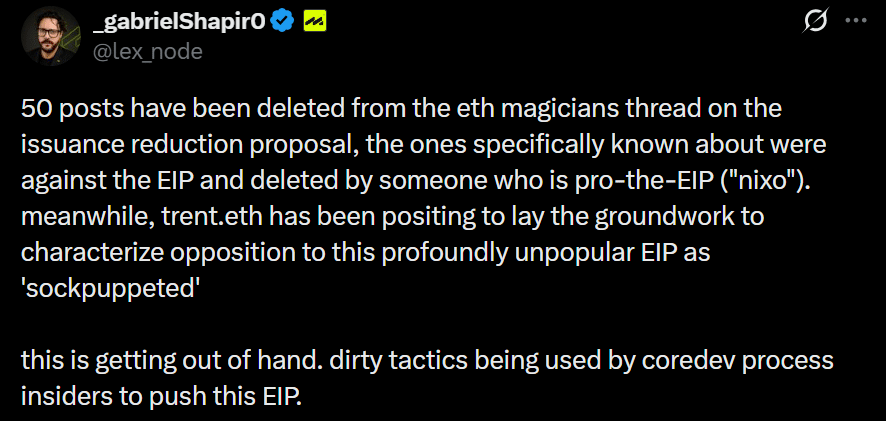
Pro-crypto attorney Gabriel Shapiro claimed that one Ethereum core developer deleted about 50 EIP-8363 comments. He claimed that critics wrote most of those comments and one Ethereum core developer deleted them.
For him, the move suggested that developers were deploying “dirty tactics” as the situation got “out of hand.”
Source: X
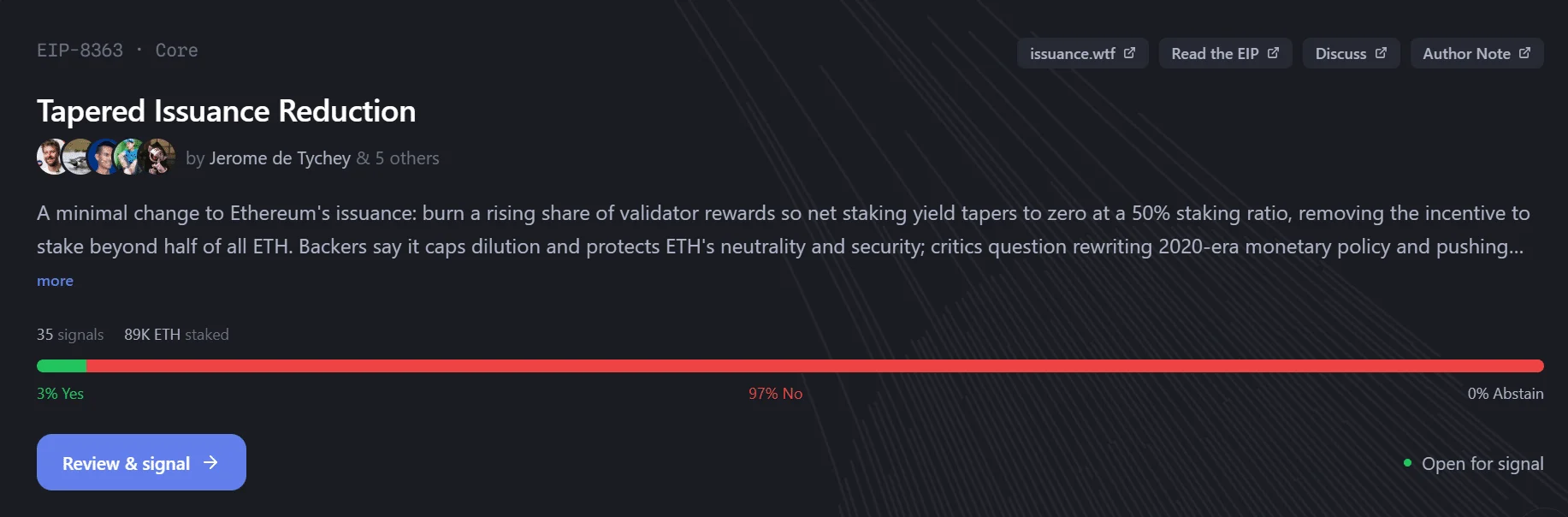
Ethereum EIP-8363 has only 3% support
For perspective, the forum in question is called ETH Magicians. IResearchers, developers, and community members often use it to discuss technical upgrades and improvement proposals.
In their defense, one of the developers blamed for deleting the posts said the purging exercise was meant to remove duplicate accounts (he called them sockpuppet accounts).
According to the developer, the so-called sockpuppet accounts have been spun up by critics to argue against the issuance proposal (EIP-8363) using AI slop.
Another analyst said the censorship move was wrong and would encourage even more opposition.
For his part, Aave CEO Stani Kulechov said the core developers’ tactics were “concerning.” Kulechov and Ether.Fi’s Mike Silagadze led the DeFi community to oppose the staking rewards cap proposal. According to them, the proposal would affect Ethereum credit markets and solo stakers.
Source: ETHV
As of writing, validators were only signaling 3% support for the proposal. The rest of the 97% were against the staking rewards cap plan.
In other words, the community sentiment was still close to unanimous against the proposal, which seeks to cap rewards at zero if the staking ratio hits 50% of the total ETH circulating supply.
Currently, there is massive staking demand, which has hit a record staking ratio of 35%. This means the 50% target under the proposal could be quickly hit; its impact will be immediate.
It remains to be seen whether the proposal will be re-adjusted to factor in the community and DeFi outcry.
Ethereum fast-tracks post-quantum era push
Separately, Ethereum core developers plan to advance quantum resistance technology from 2027 and fully deploy it on the L1 by 2028.
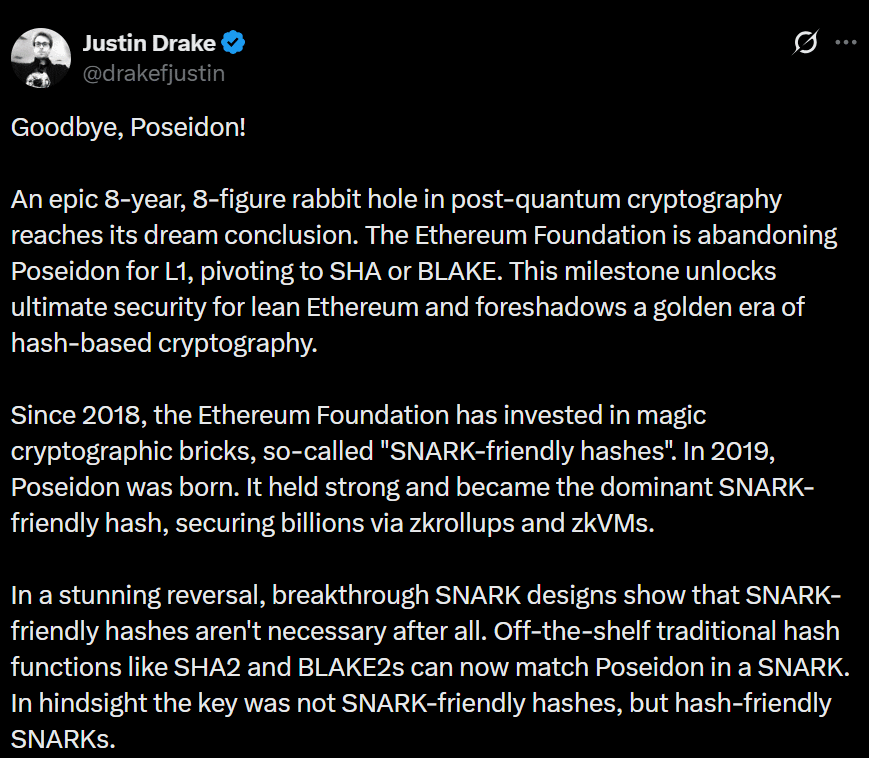
According to researcher Justin Drake, the Ethereum Foundation has abandoned the nearly decade-old Poseidon for SHA or BLAKE security hashing system to help with the faster transition.
The EF post-quantum team is moving at breakneck speed with binary fields. The Strawmap now points to a production-grade leanVM in 2027, with CL, DL, EL deployments in 2028.
Source: X
That said, ETH struggled below $1.9K amid the ongoing debate on EIP-8363. It remains to be seen how the price will react to ongoing updates around the proposal.
Final Summary
Ethereum core developers are under scrutiny for allegedly censoring criticism against EIP-8363
The network will move forward with a post-quantum era push starting next year, with possible L1 deployment scheduled for 2028