HIVE Digital Technologies (HIVE) shares jumped 10% in pre-market trading on Thursday after the company announced a $220 million, three-year GPU cloud contract with Bell Canada and AI firm Cohere, as the company continues its transition away from pure-play bitcoin mining.
The deal will see HIVE’s BUZZ High Performance Computing unit deploy 2,304 Nvidia Grace Blackwell GPUs at Bell’s AI Fabric facility in Merritt, British Columbia, forming the dedicated compute layer for Cohere’s enterprise AI models serving Canadian government and corporate clients.
The deployment is expected to go live from late 2026 to early 2027, adding roughly $70 million in annual recurring revenue (ARR). Combined with approximately $35 million of current realised ARR, HIVE’s contracted HPC revenue target now exceeds $100 million, a clear signal that its infrastructure pivot is gaining serious commercial momentum.
Strategy’s (NASDAQ: $MSTR) dividend-paying preferred stock (NASDAQ: $STRC) is crashing as investors worry about the sustainability of the monthly distribution.
Strategy’s preferred stock finished trading on June 16 at $91.79 U.S., its third-lowest level since trading began in July 2025.
STRC stock has been designed to trade as close as possible to its $100 U.S. par value. However, it has remained below that level for an extended period.
More From Cryptoprowl:
The last time the preferred stock traded at par was on May 15 of this year, its ex-dividend date.
Like most dividend stocks, STRC often declines on its ex-dividend date before gradually recovering. But the stock has not regained par since going ex-dividend on June 15 of this year.
The ex-dividend date is the cutoff after which new buyers are no longer entitled to the upcoming dividend payment.
Analysts say that Strategy’s preferred stock, which is backed by the company’s Bitcoin (CRYPTO: $BTC) holdings, is slumping as the cryptocurrency’s price slumps.
The preferred stock has largely traded in tandem with Bitcoin, and BTC remains 50% below its all-time high of $126,000 U.S.
There are also concerns about Strategy’s ability to continue covering the cost of the monthly dividend. Strategy has enough cash on hand to pay seven months of dividends.
The dividend yield on STRC stock is currently at 11.50%, one of the highest levels among publicly traded securities. Some analysts say the distribution is not sustainable.
However, rather than bow to its critics, Strategy has doubled down on its dividend strategy with the preferred stock.
The company recently announced plans to switch STRC stock to a bi-monthly (twice-a-month) dividend schedule.
The annualized yield on the preferred stock remains at 11.50%, but the payout frequency is now being split into two installments per month starting in July.
MSTR stock is down 67% over the past 12 months and trading at $124.98 U.S. a share.
Google, for example, has warned organizations to begin preparing for the transition to post-quantum cryptography and has been integrating quantum-safe cryptographic standards into parts of its infrastructure with a 2029 completion target. The U.S. National Institute of Standards and Technology (NIST) has been leading efforts to standardize post-quantum algorithms and has set timelines for the eventual retirement of certain legacy cryptographic systems.
Within crypto, several major ecosystems have elevated quantum preparedness as a strategic priority. The Ethereum Foundation earlier this year announced a dedicated post-quantum security initiative aimed at researching migration paths for blockchain’s vast ecosystem of wallets, applications and validators. Solana developers likewise published proposals exploring how users and the network could transition to quantum-resistant cryptography if the threat becomes more immediate.
The Algorand Foundation noted that blockchain networks need to begin making preparations well before a so-called “Q-Day,” the hypothetical moment when a quantum computer becomes capable of breaking the cryptography currently used to secure digital assets.
The foundation said its roadmap builds on work it began in 2022, extending those efforts to the rest of the protocol, with the goal of achieving what Algorand describes as broad quantum resilience by the end of 2027. The foundation said it expects to reach that milestone before NIST retires certain legacy cryptographic standards and three years ahead of a timeline set by the U.S. National Security Agency for national security systems.
L-R: Denise Burse, Deborah Joy Winans, Charlayne Woodard and Olivia Washington in Angry, Raucous, and Shamelessly Gorgeous at Geffen Playhouse. Directed by LaTanya Richardson Jackson.
Jeff Lorch
Lauded and award-winning playwright Pearl Cleage created sharp-witted Angry, Raucous, and Shamelessly Gorgeousin 2018 to explore an intergenerational conversation among Black women of all ages and to offer a feminist critique of how Black women were portrayed in August Wilson’s early plays, providing a soulful and comedic take on art, activism, and aging on your own terms.
Now, the play makes its way to Los Angeles at the Geffen Playhouse, with opening night on June 18th and running through July 12th. “I’m very interested in how we forge a conversation between younger generations and ours; how do we begin to talk about the work that we do. I wanted very much to talk about the fact that women in my generation, whom I can say without any fear of contradiction have done and continue to do such amazing work, really need to celebrate themselves,” she said to me during our Zoom interview. “We went through a lot to get all of these changes to happen, and we went through a lot to help our brothers, and understand that they had to fight against, sexism and racism, and and it really started there trying to figure out what, what would be a spark that could, that could have a young woman and an older woman who were engaged in the same kind of work to talk about, and how do we understand each other.”
Pearl Cleage (she/her), playwright, Angry, Raucous, and Shamelessly Gorgeous.
Quintin Jackson
Cleage likens her desire to hear more of Black women’s voices and perspectives to her experiences in the civil rights, Black arts, freedom struggle, anti-war, and women’s movements decades earlier, during which she took a critical look at misogyny and feminism. “We stayed as long as it was helpful to us, and then we left and started talking among ourselves, because then race ceases to be a factor. It’s like in a group of men and women trying to talk about something serious; it’s very different if you take the men out, and it’s only the women talking.”
She continued, “I remember going to see for colored girls who have considered suicide/when the rainbow is enuf for the very first time, and I, I wept loudly throughout that, and I was trying to be, you know, quiet because I’m in a theater, I don’t want to disturb people, but it was so absolutely true to what I knew it felt like to be a young black woman, it was like, oh my god, she put all of it on the stage. She’s telling everything, and at first there’s like, oh my god, oh my god, now they’ll know all our secrets. And then by the time that play is over, you feel like, thank goodness, now they know. That’s what we want: when we go to the theater, that realization that somebody’s telling the truth.”
L-R: Denise Burse, Charlayne Woodard and Deborah Joy Winans in rehearsal for Angry, Raucous, and Shamelessly Gorgeous at Geffen Playhouse.
Isaak Berliner
That feeling Cleage references in watching for colored girls who have considered suicide/when the rainbow is enuf, was my experience with viewing her play. The play was a meditation on ownership: of one’s work, one’s story, and one’s right to begin again. At its core, the play sits in Black sisterhood, grief, and redemption, while insisting on the audacity it takes to reclaim the trajectory of your own life.
The performances by icons Denise Burse, Deborah Joy Winans, Charlayne Woodard, and Olivia Washington were intentional, sharp, and all-consuming—commanding attention in a way that made the entire room lean in and stay there.
What lingers most is how the play quietly confronts you: your purpose, your participation in community, and the ways patriarchal expectations still shape how we move through the world—and what it might look like to break free.
This work demands that you think critically about your life’s work—and how to expand both it and yourself. It invites an unapologetic reckoning. Angry, Raucous, and Shamelessly Gorgeous challenges the audience to reflect on the different stages of their lives and whether they will be able to transition gracefully into them when the time comes, or be resistant and stubborn. It also encourages the audience to question the art we’ve grown to love and consume.
The premise of the play centers on Anna Campbell (Woodard), a trailblazing actress decorated with accolades but in a financially precarious situation. Upon returning to her hometown, Atlanta, Georgia, with hopes of executing a career-defining comeback, she collides with a younger performer (Olivia Washington) who challenges her past, her politics, and her place in the movement.
Charlayne Woodard in Angry, Raucous, and Shamelessly Gorgeous at Geffen Playhouse. Directed by LaTanya Richardson Jackson.
Jeff Lorch
In the play, while you hear of male characters, there’s no physical representation of them, which Cleage says is intentional. “Part of that is because men have a lot of platforms and a lot of space, because they still control so much of how we move through the world. They have a lot of space to tell their stories, and sometimes, you know, writing a play, it’s like, no, I don’t want to hear that voice anymore; I want to hear all the different voices that we have, just as women, and they’re so interesting to me,” she said.
Additionally, Cleage shared that she sees a lot of herself in the character she writes. “I always see parts of myself in the characters in my place, because they all start in my brain, you know, they start in my own imagination, so they’re always representations of different things that I’m thinking about, or things that are driving me crazy, like aging,” she shared. “I also want us to continue to confront our own judgmental ideas about who is considered an artist. No matter what our initial judgment of Pete (Washington) might be, is such a likable, strong, brave, interesting, charismatic character that after a while, you don’t care what she does to earn a living, you want her to be able to do it at the highest level that she can do it, which is what I want for all the young women who are are stepping onto these stages and into these spaces – to be their bad ass selves. There’s space big enough for them to show us what they got,” Cleage stated.
L-R: Olivia Washington, Denise Burse and Deborah Joy Winans in Angry, Raucous, and Shamelessly Gorgeous at Geffen Playhouse. Directed by LaTanya Richardson Jackson.
Jeff Lorch
The women-led and directed play, guided by seasoned actress LaTanya Richardson Jackson, takes an introspective look at Black women’s representation in theater and addresses male playwrights, something Cleage was tempted to do for a while. “We still get to say to them, our stories are as important as your stories. It seems like such an obvious thing to say, but that’s a big part of what is still the conversation between men and women: at times men don’t understand that our stories are equally important, interesting, vibrant, sexy, contradictory, and all those things are there in the work and the stories of women, because we’re fully formed human beings,” she said. “Even the idea of which was very fun for me to say, ‘Okay, I’m gonna say something about August Wilson,’ because I’m a Black theater girl. I understand that August begin to critique August Wilson without understanding the role that he played and the role that he continues to play in the lives of us who consider ourselves to be American theater artists and world theater artists, but that doesn’t mean that we can’t also bring a sisterly feminist womanhood critique not only to the plays but also to the beautiful, wonderful charismatic brothers who put those plays on.”
As far as the name of the play, which is striking, Cleage found inspiration through wordplay. “Five years ago, there was an exhibition in New York, and the headline was an exhibition of work by a black woman artist, visual artist, and the headline talking about the exhibition was Angry, Raucous, and Shamelessly Gorgeous, and I thought, ‘Wow, what a great phrase for something,” I loved it, because it’s angry, of course, you have to have rage, because there’s so much injustice that you want to fix, raucous, because it’s always more effective and more fun to be loud and rowdy when you’re protesting something, and shamelessly gorgeous, because we still want to be fabulous while we do it. We still want to be able to sweep into a room and, you know, have stars behind us,” she enthusiastically said.
Cleage and the play’s director, Jackson, had known each other for years and both attended Spelman College, so it was a no-brainer for them to collaborate on the play. “Our job is to tell the story. We got to tell the story. The playwright has given us the words, but our emotional resonance and our emotional investment tell the story,” Jackson told me. “That’s our job as actors. That’s what we’re called to do: to find what’s inside that allows us to dig in and let it out. It’s like when people are grappling with how a scene should go, who they’re going to be in the scene.”
Director LaTanya Richardson Jackson in rehearsal for Angry, Raucous, and Shamelessly Gorgeous at Geffen Playhouse.
Jeff Lorch
Her advice to the younger generation of actors? Confidence. “In 2026 I encourage all of you, be about it, be shameless in that regard, we can, you know, everyone has lived without shame, you know, in a different context, denotatively, contextually, but right now we have to not – I want to use shameless in the context of not being, not being ashamed, not worrying about how you’re showing up, as long as you’re showing up in a positive, and you know, a positive way that is moving the culture forward. You need to show up and take it,” Jackson said.
Cleage hopes audiences of all ages take away from this play and experience the power of open communication and understanding. “It’s worth it to try to have risky conversations with people that you’re curious about, but don’t necessarily know. It’s worth it across lines of race, across lines of age, across lines of different kinds of work you do, but those conversations are ultimately what bind us if, at the heart of those conversations, is a mutual determination to tell the truth. I hope people are intrigued by the fact that these women are coming to a common truth they can agree on, and that they also realize what we were talking about earlier: we can talk about the most serious topics in the world and still laugh together,” she stated.
If you asked your brokerage for a piece of the SpaceX initial public offering (IPO) last week, you probably got one, just not the size you were hoping for.
That alone makes this deal strange. On a typical hot IPO, an estimated 95% of the shares go to large institutions such as banks, leaving everyday investors to buy in only after trading opens, often at a higher price (1), according to estimates from Jay Ritter, a University of Florida finance professor who tracks new listings (2).
Must Read
This time, every eligible customer who put in a request through Robinhood, Charles Schwab, Fidelity and SoFi got at least one share of SpaceX’s record $86.2 billion offering (3).
SpaceX set aside up to 30% of the deal for retail investors worldwide — well above the 5-10% (4) that usually reaches individuals (5). But “at least one share” is doing a lot of work in that sentence. Demand for the shares ran past $100 billion, so most retail investors came away with just a handful of shares.
Now that the stock has popped, many investors may be tempted to buy more on the open market. Whether that’s smart comes down to a few things first-day buyers tend to skip.
How much retail investors actually got
Robinhood gives the clearest picture. A total of 855,424 of its customers requested shares through its IPO Access platform, and the firm filled every request. That’s small for a brokerage with 27.7 million funded accounts at the end of May, and the people who got in didn’t necessarily get much.
And it wasn’t just in the U.S. In the U.K., retail buyers asked for nearly $1 billion of stock and received about $364 million. In the end, the final retail share was about 20%, so even in an IPO built to be friendly to regular investors, most people walked away with less than they asked for (3).
The price action explains the FOMO. SpaceX priced at $135 a share on Thursday night and opened at $150 on Friday, an 11% jump (6). It rose as much as 30% during the day before closing up 19% at $160.95, valuing the company at about $2.1 trillion (7) — the largest U.S. IPO on record, surpassing Alibaba’s $21 billion debut in 2014 (8). It shot to a new high of 218.76 on Tuesday, June 16, but came back to Earth quickly. As of midday Wednesday, it was trading around $190 and falling.
The 19% closing number isn’t as dramatic as it looks. From 1980 through 2025, new U.S. stocks have popped by an average of 19% on their first day of trading, based on Jay Ritter’s data, so SpaceX’s 19% is right at the historical average (1).
What Jim Cramer says about buying in now
Jim Cramer, host of CNBC’s “Mad Money,” says it’s not too late to buy, but with one condition. Treat SpaceX as “a different kind of stock, not a short- or even medium-term investment,” he said, and “you’ve got my blessing (9).”
Cramer’s only recommending this if you’re buying to hold long-term. “If it comes down, then you should buy more because the upside is conceivably unfathomable,” Cramer said. He also praised lead banks Goldman Sachs and Morgan Stanley for balancing institutional and retail demand and avoiding a messier first-day spike.
The catch is the price you’d pay to follow that advice. Buying now means paying nearly 50% more than IPO investors did, for a company whose prospectus shows a $41.3 billion accumulated deficit and a $4.27 billion loss in the first quarter of this year. A smooth debut doesn’t necessarily mean the stock is cheap.
If you got IPO shares and you’re tempted to sell into the jump, read your broker’s fine print first. Robinhood treats a sale within 30 days as “flipping” and can lock you out of its IPO Access program for 60 days (10), and Fidelity flags sales within 15 calendar days, and will ban you permanently after a third flipping (4). SoFi uses 30-day windows too, and it also imposes a permanent ban after a third violation (11).
If you sell too early, you can lose your spot at the next hot listing — like OpenAI and Anthropic, which are both expected to go public soon (12). The one exception is Charles Schwab, which has no anti-flipping rule.
If you want to buy more on the open market, there’s one thing that could help push the price up soon. Nasdaq changed its rules so SpaceX can join the Nasdaq-100 after just 15 trading days instead of waiting the usual three months (13). That means index funds will have to buy SpaceX’s shares, which could bump up the price temporarily. But this is a one-time well-telegraphed event, so it’s not a reason to over-pay. You should also know that S&P declined to fast-track SpaceX in (14) — the S&P 500 won’t admit a company until it’s profitable, and SpaceX saw a net loss of $4.9 billion last year (15).
Cramer’s advice is simple. If you’re willing to hold SpaceX for years and see price drops as a chance to buy more, then it makes sense. But if you’re trying to catch the pop and sell, you’re fighting against both the high price and possibly your broker’s rules.
You May Also Like
Join 250,000+ readers and get Moneywise’s best stories and exclusive interviews first — clear insights curated and delivered weekly. Subscribe now.
Article Sources
We rely only on vetted sources and credible third-party reporting. For details, see ourethics and guidelines.
CNBC (1), (5), (7), (9), (14); University of Florida Warrington College of Business (2); Yahoo Finance UK (3); Fidelity Investments (4); Yahoo Finance (6); Renaissance Capital (8); Robinhood (10); SoFi (11); Reuters (12); Morningstar (13); Wealth Professional Canada (15)
On Wednesday, the 17th of June, Japanese crypto exchange CoinTrade announced the launch of staking for Algorand. The annual percentage rate of the staking yield would be 4.4%, the announcement revealed.
Source: CoinTrade on X
The $875 million market cap Layer-1 token was in a long-term downtrend, pointed out technical analyst Chart Nerd in a post on X.
Source: Chart Nerd on X
The massive, multi-year falling wedge from the 2021 highs. The current support was at the $0.08-$0.085 area.
Based on Elliot Wave Theory, a fifth wave downward to $0.057 is possible.
Such a drop could be the final sweep of the cycle’s low and could result in a bullish breakout from the wedge in the long-term, the analyst concluded.
As things stand, the final leg downward is brewing and could arrive later in 2026. Here are the important support and resistance zones to watch out for in the coming days and weeks.
Algorand might see a bounce from oversold territory
Source: ALGO/USDT on TradingView
The swing points on the 1-day timeframe were at $0.145 and $0.079.
Marked in orange, neither level has been disturbed. The rally in April, which came as a result of the chain’s readiness for post-quantum computing, did not threaten the swing high set earlier in 2026.
The recent retracement below the $0.10 round-number support saw a bounce over the past week. The MFI fell into oversold territory but has since climbed back toward the neutral zone.
Meanwhile, the OBV was steadily climbing higher.
Source: CryptoQuant
The 3-month Spot Taker CVD showed neither buyers nor sellers had the upper hand. The idea ran against the OBV’s uptrend in recent months.
Traders’ call to action- Wait for a bounce to sell
Source: ALGO/USDT on TradingView
The $0.095 and $0.105 areas were the nearby support/resistance zones to watch. If the $0.105 former demand, now supply zone, is cleared, it would indicate a move as high as $0.128 is possible, based on the retracement levels plotted.
Traders should be wary of going long given the wider crypto market sentiment, but also should not FOMO into an Algorand [ALGO] relief rally if it occurs.
Final Summary
The Algorand staking launch on CoinTrade, combined with oversold conditions, could have helped during the recent days’ gains.
The higher timeframe trend remained bearish, but a bounce past $0.105 and as high as $0.128 was possible.
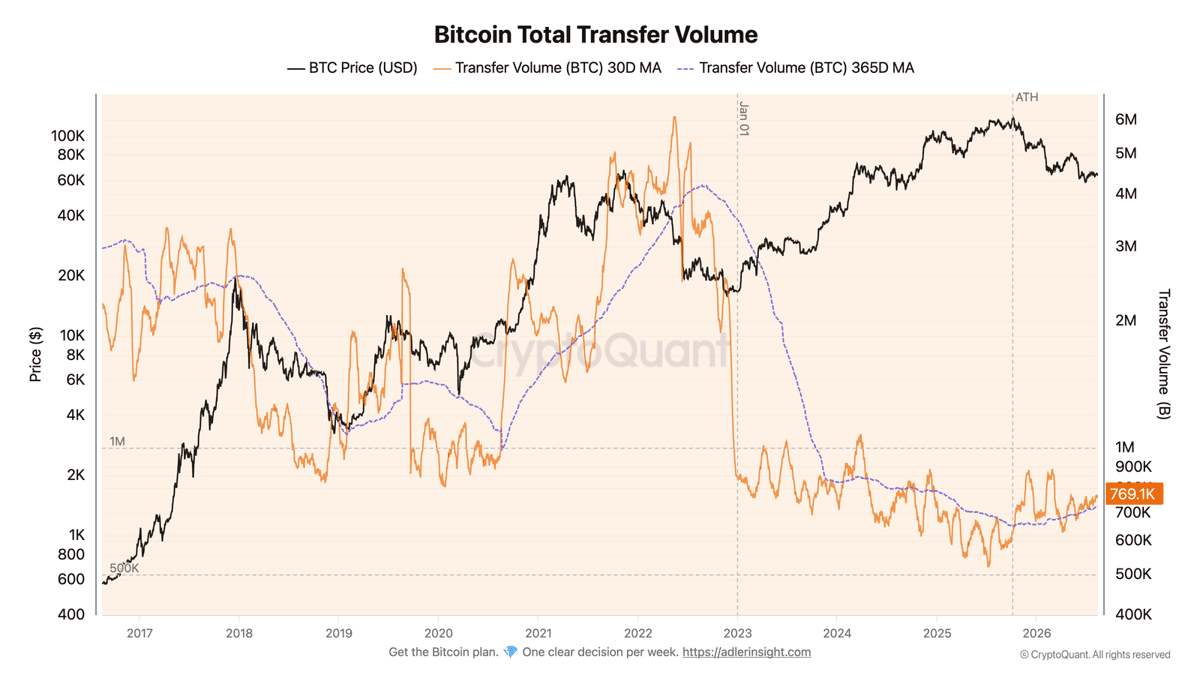
The win rate of a cycle-aware approach is lower than buy-and-hold, winning not by being right more often, but by avoiding the months when bitcoin loses 20%, 30%, or 40%. Those months cluster, and stepping aside during them is not timing the market; it is about reading the cyclical structure of the asset.
We have made three public, timestamped market calls since 2022: the October 2022 cycle bottom, the July 2023 projection of a $125,000 target and the October 2025 bear signal, each grounded in the same signal framework. The methodology is not infallible. But it is systematic, auditable and structurally better suited to bitcoin’s cyclical nature than the passive approach most advisors currently deploy.
Bitcoin rewards those who understand its cycle. Advisors who treat it like any other asset are leaving risk-adjusted returns on the table and exposing clients to drawdowns that, in practice, end portfolios rather than weather them.
If blockchain technology succeeds, are investors owning the right things?
For years, investors assumed that if a blockchain ecosystem grew, its native token would naturally appreciate. Increasingly, I’m not convinced that’s always true. Technology can become indispensable while value accrues elsewhere to sequencers, applications, stablecoin issuers or liquidity layers.