Home Blog Page 287

The UK has finally shown it’s serious about crypto

0
The UK has finally shown it’s serious about crypto

Then-Prime Minister Rishi Sunak announced the UK’s ambitions to be a “global cryptoasset hub” all the way back in 2022. Since then, that goal has seemed more like a distant aspiration rather than actuality. But several recent announcements suggest the gap between fantasy and reality might finally be narrowing.

Within days of each other, the Financial Conduct Authority (FCA) and Bank of England have taken major regulatory steps toward proving that the UK is serious about that goal, setting out rules designed to create a workable climate for both consumer and institutional crypto adoption.

The FCA finalized their crypto rules last month, offering guidance for crypto firms’ capital requirements, admissions and disclosures, and the wider conduct framework. Separately, the Bank of England has scrapped the previously proposed limits imposed on holdings of fiat-pegged stablecoins, as well as lowering the reserve requirement issuers must hold at the central bank from 40% to 30%.

Together, they are the clearest signal yet that the UK intends to build a leading crypto regime rather than simply talking about it.

Chet Shah is the CEO of Wirex Limited, a FCA-regulated fintech firm based in London.

A reputation earned the hard way

It’s no secret that the UK’s crypto industry has lagged behind on the global stage for the past few years. The Bank of England’s earlier stablecoin proposals, set out in November 2025, faced strong industry backlash for being too restrictive to support growth. Those plans included restricting individuals to holding no more than £20,000 of systemic sterling stablecoins, while businesses were capped at £10 million. Many argued that this was too conservative to allow stablecoins to be utilized at scale, and would fundamentally hold back the UK’s competitiveness.


Source link

Bitcoin Dips Below $60,000 and History Points to What Comes Next

0
Bitcoin Dips Below $60,000 and History Points to What Comes Next


As soon as Bitcoin (CRYPTO: BTC) dipped below the $60,000 price level in June, alarm bells went off. Bitcoin hasn’t been this low since October 2024. It’s now down nearly 50% since hitting an all-time high of $126,000 in October 2025.

If history is any guide, though, Bitcoin may have already bottomed out. It’s certainly a risky move, but buying Bitcoin now may turn out to be one of the smartest investments you make this year. Here’s why.

Missed Nvidia in 2009? This Rare Signal Is Flashing Again. In 2009, a “Double Down” signal flashed for a little-known chipmaker called Nvidia. For the first time in years, that same “Total Conviction” signal is flashing for a company 1/100th the size of Nvidia. Continue »

Bitcoin’s famous four-year cycle

Let’s start with the obvious: Bitcoin is highly cyclical, trading in four-year cycles of boom and bust. The timing is not Swiss-clock accurate, but Bitcoin typically has three very good years before having one very bad year.

Just look at the historical data. Bitcoin had good years in 2019, 2020, and 2021 before collapsing entirely in 2022. Bitcoin had good years in 2015, 2016, and 2017, before collapsing entirely in 2018. The same pattern played out from 2011 to 2014.

Image source: Getty Images.

That’s why the current period of significant price decline doesn’t worry me as much as it does other crypto investors. In simple terms, Bitcoin was “due” for a year-long collapse, and now we’re seeing it play out in real time.

That’s the bad news. The good news is that market sentiment can turn on a dime when it comes to Bitcoin. Just think back to the doom and gloom of 2022, during the so-called crypto winter. Everyone, it seemed, was convinced that Bitcoin was going to zero. The crypto bears were out in force, trying to convince everyone that Bitcoin was worthless.

But Bitcoin delivered triple-digit returns in 2023 and 2024, before soaring to a new all-time high of $126,000 in 2025. At that point, plenty of hyper-bullish crypto investors started to claim that the Bitcoin four-year cycle was a relic of the past. They were convinced that it was “up only” from here on out. But long-term Bitcoin investors knew better.

Get ready for a near-term Bitcoin recovery

Still not convinced? Consider that a number of high-profile analysts, including Cathie Wood of Ark Invest, are already starting to call a “bottom” on Bitcoin. Some are going one step further and setting out bullish price targets for 2026.

Standard Chartered, for example, is now convinced that Bitcoin will hit $100,000 by year-end. Investment firm Bernstein thinks Bitcoin could hit $150,000. Tom Lee of Fundstrat thinks Bitcoin might hit $250,000.

OK, you can ignore that last price target. It’s truly outlandish. But I’m on the side of crypto analysts predicting a strong year-end rally for Bitcoin. The historical data is just too convincing to ignore.

Should you buy stock in Bitcoin right now?

Before you buy stock in Bitcoin, consider this:

The Motley Fool Stock Advisor analyst team just identified what they believe are the 10 best stocks for investors to buy now… and Bitcoin wasn’t one of them. The 10 stocks that made the cut are built for long-term growth and could produce monster returns in the coming years.

Consider when Netflix made this list on December 17, 2004… if you invested $1,000 at the time of our recommendation, you’d have $395,679!* Or when Nvidia made this list on April 15, 2005… if you invested $1,000 at the time of our recommendation, you’d have $1,294,805!*

That performance is why people listen. With a track record of beating the S&P 500 by 4xStock Advisor offers a distinct advantage. Don’t miss the latest top 10 list, available with Stock Advisor, and join an investing community built for the long haul.

See the 10 stocks »

*Stock Advisor returns as of July 11, 2026.

Dominic Basulto has positions in Bitcoin. The Motley Fool has positions in and recommends Bitcoin. The Motley Fool recommends Standard Chartered Plc. The Motley Fool has a disclosure policy.

Bitcoin Dips Below $60,000 and History Points to What Comes Next was originally published by The Motley Fool


Source link

Robinhood Chain flips Hyperliquid – 2 metrics show speculative interest

0
Robinhood Chain flips Hyperliquid – 2 metrics show speculative interest


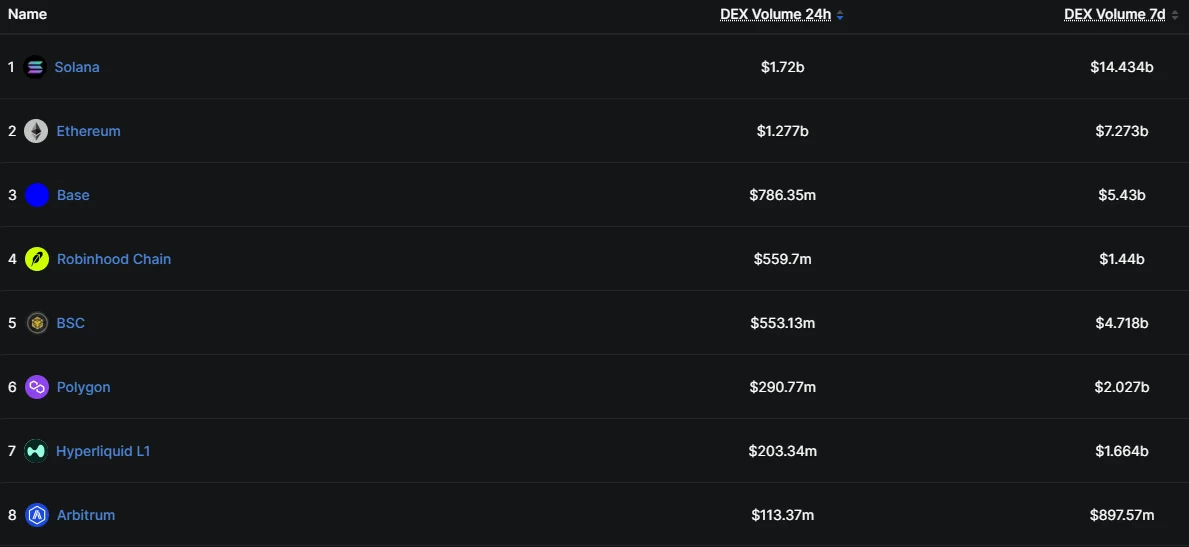
The new Ethereum Layer 2 (L2) Robinhood Chain has surpassed Hyperliquid and BNB Chain in speculative interest. 

A week ago, Robinhood’s DEX volume (which tracks trading volume and broader speculative interest) was less than $10M. 

As of writing, the daily DEX volume has hit a record level of $600M, making it the fourth dominant chain in speculative activity. 

In the past two days, it has effectively surpassed BNB Chain and Hyperliquid on this front thanks to Robinhood’s CEO’s memecoin bet

Robinhood Chain
Source: DeFiLlama

As Robinhood Chain-based memecoins like CashCat [CASHCAT] went viral and posted massive gains, the FOMO attracted users and capital inflows. 

Robinhood’s memecoin frenzy sparks L2 debate

If the memecoin mania persists, it could surpass Base in DEX volume to become the third-largest place for speculative trading. 

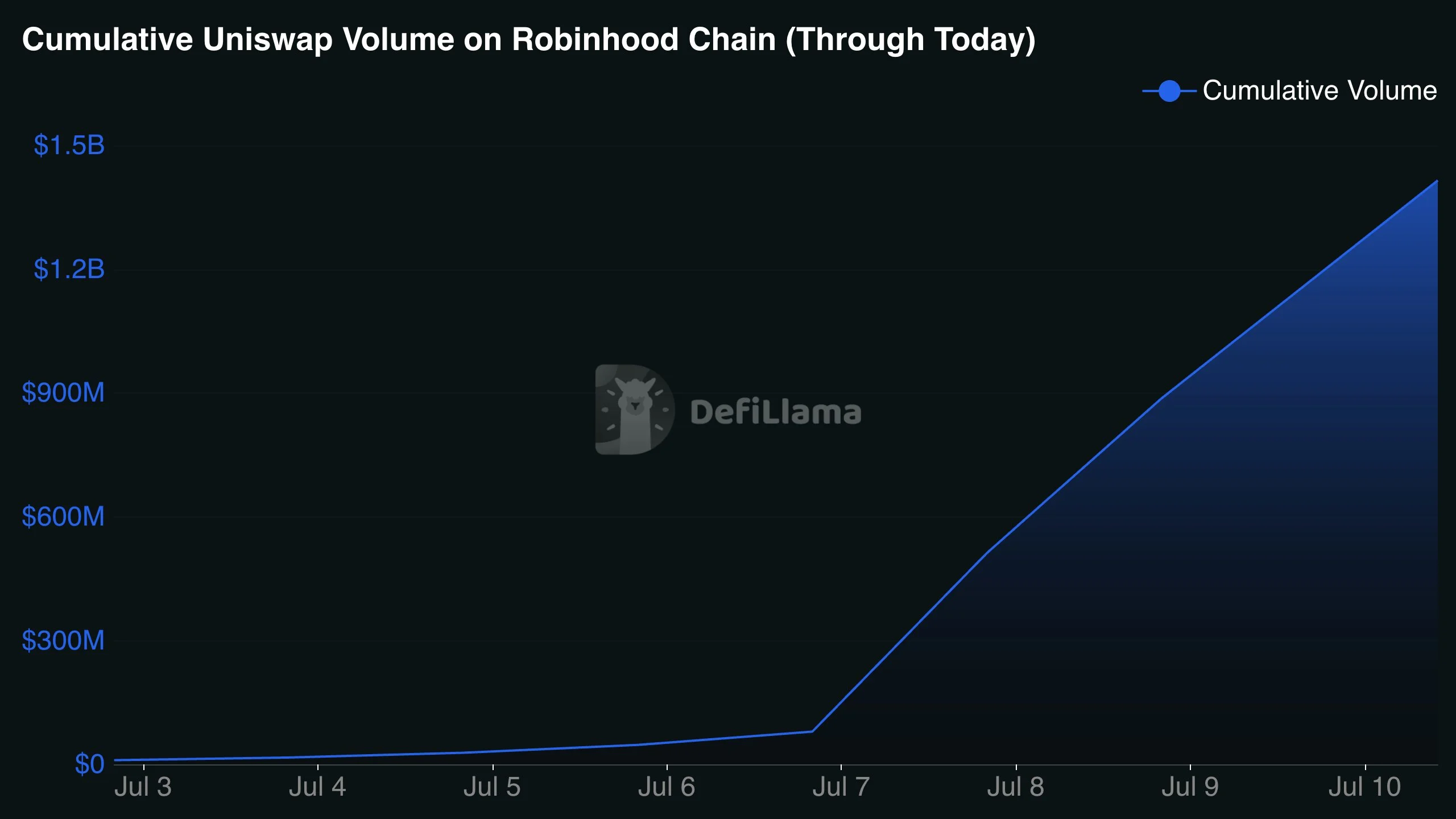
Worth pointing out that Uniswap crossed $1B in volume on Robinhood Chain since launch, further underscoring how crazy the memecoin mania is on the new L2. 

Robinhood chain Robinhood chain
Source: DeFiLlama 

But critics have been opposing the memecoin push. Most questioned the need for another Ethereum Layer 2 (L2) if its use case is risky memecoin speculation. The debate has since evolved to whether L2 growth benefits ETH’s value.   

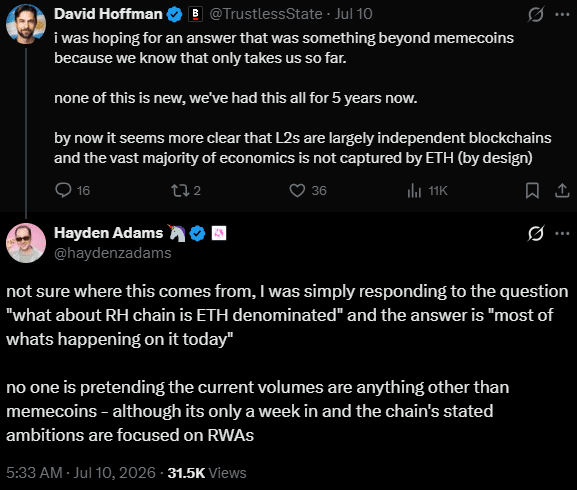
For Bankless’ David Hoffman, L2s aren’t helpful to ETH. 

By now it seems more clear that L2s are largely independent blockchains and the vast majority of economics is not captured by ETH (by design).

Uniswap CEO Hayden Adam countered that most of the pairs on the chain are denominated in ETH and will eventually help burn more ETH, especially if the RWA narrative picks up momentum. 

robinhood chain robinhood chain
Source: X

Do Layer 2s actually help Ethereum?

The L2 roadmap has been under heavy criticism. With corporate chains such as Stripe’s Tempo, SWIFT, and more, the criticism has deepened. 

For lawyer Gabriel Shapiro, the entire roadmap was ‘poorly executed’ to benefit ETH value. 

The roadmap was just very poorly executed so that it’s mostly negative to ETH & leaves the L2s with too much optionality to become L1s, no real lock-in.

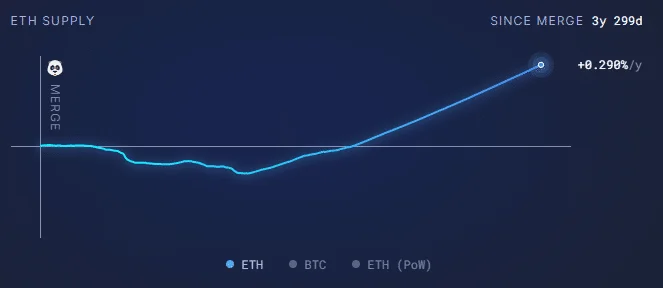
Ethereum’s best shot at scaling was through L2s, and recent upgrades have made them cheaper and attracted more traffic.

But this has also reduced the number of ETH burned, making the asset inflationary and denting its ‘store of value’ narrative

Robinhood Chain Ethereum L2sRobinhood Chain Ethereum L2s
Source: Ultrasoundmoney 

Whether the renewed L2 debate will drag ETH’s market sentiment and price remains to be seen. As of writing, Ethereum [ETH] traded at $1.8K, a key inflection point that could trigger the next leg of price recovery or another pullback. 


Final Summary

  • Robinhood L2 has become the fourth largest on-chain place for speculative trading, flipping BNB Chain and Hyperliquid  
  • Amid the hype, Ethereum L2s are under scrutiny again for being non-beneficial to ETH’s value 


Source link

ETH news: Ethereum Foundation says AI found bug that could take validators offline

0
ETH news: Ethereum Foundation says AI found bug that could take validators offline

This was quickly fixed and disclosed as ‘CVE-2026-34219′ with credit to the team. The broader concern, however, was separating the agents’ real bugs from the ones that were confidently masquerading as such.

“The surprise was how little of the work went into finding them, and how much went into telling the real bugs from the ones that just looked real,” wrote Nikos Baxevanis, who authored the post.

The difficulty started with what an agent produces. A fuzzer, the standard tool that hurls malformed data at software until something breaks, returned a crash and a record of where it happened, which an engineer can confirm in minutes.

An agent, however, returns a created narrative. It traces how the flaw could be reached, argues why it matters, proposes a severity rating and supplies working code that demonstrates the attack. All of it arrives in fluent prose, reading the same whether the bug is real or invented.

Three kinds of false positive kept recurring, according to the Foundation.

The first was a crash that only occurs in a test build, where the compiler switches on safety checks that the shipped software does not carry, so nothing breaks for real users.

The second was an attack that only works if the dangerous value is planted inside the program by hand, because every route an outsider could take to deliver it rejects the value first. The third came from formal verification, the practice of proving mathematically that code behaves correctly, where a proof passed by demonstrating something trivially true and told the reviewers nothing about the software.


Source link

Got $10,000? Broadcom vs Marvell: Only One Will Match The AI Hype

0
Wall Street Thinks AI Is Slowing. Wall Street Is Wrong


Quick Read

  • AVGO generated $10.8 billion in AI silicon revenue, up 143% year over year, while MRVL converted 76% of its $2.4 billion quarter from data centers.

  • Broadcom’s 46% free cash flow margin funds buybacks and dividends; Marvell’s acquisition spree cut GAAP net income by 81% last quarter.

  • Act now: the analyst who called NVIDIA in 2010 just named his top 10 AI stocks — and Broadcom didn’t make the cut. Grab the names FREE today.

Broadcom (NASDAQ: AVGO) and Marvell Technology (NASDAQ: MRVL) both just delivered AI-fueled quarters, but the businesses behind the tickers look nothing alike.

Quality Stock Arts / Shutterstock.com

Broadcom is a $1.76 trillion platform pairing custom silicon with VMware software. Marvell is a focused data center specialist leaning into optics and interconnects. Both reported AI acceleration. Only one has scale to match the hype.

Custom XPUs Carry Broadcom. Optics Carry Marvell.

Broadcom’s Q2 FY2026 landed with $22.19 billion in revenue, up 47.87% year over year, with non-GAAP EPS of $2.44. The real story sits inside semiconductors.

AI silicon revenue reached $10.8 billion, growing 143%, driven by custom AI accelerators (XPUs) and Ethernet networking silicon sold to a small group of hyperscalers. CEO Hock Tan told investors “the momentum continues and in Q3 we expect semiconductor revenue from AI to grow over 200% year-over-year to $16.0 billion.” That is a bold call for one quarter.

Marvell’s Q1 FY2027 came in at $2.418 billion, up 27.57%, with the data center segment now 76% of revenue at $1.83 billion.

CEO Matt Murphy pointed to “exceptional AI-related bookings” across 800G and 1.6T scale-out optics, 51.2T Ethernet scale-out switches, scale-up optical solutions for NPO and CPO applications, scale-across datacenter interconnect modules, and custom XPU and XPU-attach solutions. Translation: Marvell wants to own the wiring between accelerators.

Act now: the analyst who called NVIDIA in 2010 just named his top 10 AI stocks — and Broadcom didn’t make the cut. Grab the names FREE today.

Scale vs. Specialization

Business Driver

Broadcom

Marvell

Main growth engine

Custom AI XPUs and Ethernet

800G/1.6T optics, DCI, XPU-attach

AI mix of revenue

$10.8B AI semis

$1.83B data center

Software leg

VMware, $7.18B

None

Next quarter guide

$29.4B, +84% YoY

$2.7B, ~35% YoY

Broadcom’s 46% free cash flow margin and 69% adjusted EBITDA margin let it fund a growing dividend and a $10 billion buyback authorization.

Marvell is spending differently: it closed acquisitions of Celestial AI and XConn Technologies in February 2026, and raised $2 billion in convertible preferred. The tradeoff showed up in GAAP net income, which fell 80.61% on a $331.8 million contingent consideration charge. Growth by M&A is not free.

What I’m Watching Next

Broadcom needs to actually hit that $16 billion AI number in Q3. Since the June 3 report, AVGO has fallen 22.5% to $370.78, suggesting investors are pricing in real execution risk.

Marvell, by contrast, is up 16.1% since its May 27 earnings report, helped by S&P 500 inclusion. I want to see whether Murphy can convert 800G optics bookings into sustained gross margin inside the guided 58.25% to 59.25% range.

Why I Lean Broadcom for Quality, Marvell for Torque

If you want durable AI exposure with a software cushion and a real dividend, Broadcom is the cleaner story to me. The cash flow is enormous, and analyst targets sit at $523.73 versus today’s price, with 44 buy ratings. I stay skeptical of the 200%+ AI guide until we see it.

If you want higher variance and can stomach dilution, Marvell fits a turnaround-plus-growth profile better, especially with a P/E near 85 that only works if optics scale as promised. The two stocks suit different risk appetites rather than a combined position.

Act now: the analyst who called NVIDIA in 2010 just named his top 10 AI stocks — and Broadcom didn’t make the cut. Grab the names FREE today.

Contact editorial@247wallst.com for any questions or corrections.


Source link

High rents are forcing non-college-educated men to live at home and fall out of the labor market

0
High rents are forcing non-college-educated men to live at home and fall out of the labor market

There’s a version of American manhood that used to run on a simple script: leave home, get a job, build a life. Now, however—and rather increasingly—men are falling out of the workforce, just as women outnumber them for the third time in history. This, coupled with the lowest labor force participation rate in years, is causing huge concern for economists who are predicting real-world consequences for years to come.

Men are nearly twice as likely as women to be living with their parents, and a new study says it’s particularly harmful for noncollege-educated men, who are less likely to hold jobs compared to their college-educated counterparts.

As rents have surged across the country, more and more men are moving home, and once there, many stop working. In fact, one in six noncollege men (16%) now live with their parents, compared to 8% of college-educated men. A recent working paper from Gabrielle Penrose, a graduate student fellow at the American Institute for Boys and Men, follows six decades of U.S. Census data and draws a direct line between rising housing costs and the decline of male labor force participation.

“There are very real economic forces that are limiting the options for noncollege-educated men in the United States,” Penrose told Fortune. “Some of what we’re seeing is simply rational responses to a system that’s pricing them out.”

Since 1960, real rents in the United States have risen 150%. Over that same period, wages for men without college degrees have barely moved, thanks to automation, globalization, and the collapse of manufacturing. Penrose’s paper details that when rents rise, more Americans are forced back into the parental home. Men move home at nearly twice the rate of women. And noncollege-educated men who end up there, the data shows, are increasingly dropping out of the workforce.

For Scott Winship, a senior fellow and the director of the Center on Opportunity and Social Mobility at the American Enterprise Institute (AEI), the issue is doubly concerning because noncollege-educated men may face more disadvantages today than what they would have experienced in the ’60s when Penrose first started looking.

“Today, there are many fewer noncollege men than there were a generation ago, and so we should absolutely be concerned about noncollege-educated men today,” Winship told Fortune. “They are a more disadvantaged group than they were in previous generations, just because the share of young adults with a bachelor’s degree is up to 40% or so now, versus in the past, when it was much lower. And so that makes me worry.”

How are rent prices driving men to live at home?

A 10% increase in local rents raises the likelihood a non-college-educated man moves in with his parents by 1.1 percentage points. Penrose used geographic constraints like mountains, coastlines, and lakes as a research instrument in her paper and found that in areas where terrain limits construction and squeezes housing supply, costs are higher for reasons entirely unrelated to local wages or job prospects.

“In some areas, housing costs are higher not because people are earning more and driving up prices, but because there are limits to supply, because of geography: lakes, coastlines,” she said. “Housing is just more expensive there simply because it’s harder to build there.

“It would be surprising if cities with higher housing costs didn’t have more men living at home just because, almost by definition, they’re less affordable,” said Winship, who has studied men’s earnings over time at the AEI.

Simultaneously, the environment is almost enabling it, her paper says. Baby boomer parents, sitting on significant housing wealth, are better positioned than ever to absorb adult children.

“Providing for your adult children when they’re priced out of the housing market is kind of a ‘normal good,’ as economists call it, something people spend more on as they get richer,” Penrose said. “Parents are earning more, and their sons are earning less.”

The data backs it up, according to Brandi Snowden, the National Association of Realtors’ director of member and consumer survey research.

“Baby boomers continued to make up the largest share of recent homebuyers,” she told Fortune while referring to NAR’s 2026 Generation Trends report that showed one-quarter of baby boomers purchased a multigenerational home recently. “This allowed them to care for aging parents or relatives and accommodate adult children that may be moving back into their house, or who have never left.”

The share of men between 25 and 45 living with their parents has nearly doubled since the 1960s, from 7% to 12% today. Women’s rate has also risen, but remains flat at 7%. And the reason the effect falls harder on men than women comes down largely to children. When Penrose isolates women without college degrees who don’t have children at home, their patterns begin to mirror men’s almost exactly.

“When I look at women without a college degree who do not have children, their labor force participation and their rates of living with parents start to look much more like these men,” she said. “The difference is young children.”

Why are young men falling out of the labor force?

The most consequential finding in Penrose’s paper is what happens after men move in. Men living with their parents are 20 percentage points less likely to be in the labor force than those living independently. That same 10% rent increase is associated with a 0.5 percentage point decline in labor force participation. Initial estimates suggest housing costs could explain roughly a third of the total employment decline among noncollege men.

“That’s not too surprising to me, just because if you’re looking at adults in their twenties or even thirties who are living at home, you’re looking at sort of the most disadvantaged guys in their cohort,” said Winship of Penrose’s findings. “So it makes sense that they’ve got other barriers to finding work, to keeping work—and that they’d be more likely to permanently drop out of the workforce.”

One in five noncollege men in their early thirties live with their parents, and the rate remains elevated into their forties, with roughly 14% at age 40. Among nonworking men at home, a quarter have never held a job at all, up from one in five in 1980.

“Some of the pushback I was getting is people saying: ‘Maybe men are using it as a launchpad,’” Penrose said. “That doesn’t seem to be the case. These men who are living with their parents are completely detached from the labor market.”

Zoning restrictions and limits on construction don’t just make cities expensive, they inadvertently suppress workforce participation among the men least equipped to absorb the cost. 

“Policies that restrict housing construction inadvertently weaken labor force participation by raising the price of independence,” Penrose wrote in the report.

“When we think about housing policy, maybe we’re just thinking about affordability, but it’s also about getting people in the position where they’re able to access the labor market,” she said. “Policies that would make housing cheaper in cities like New York should increase participation for men, particularly men without college degrees.”

Winship agreed with Penrose’s point, saying high cost of living cities like New York and San Francisco are often where people can find more job opportunities—but it comes with the double-edged sword of higher rents.

“It points to a real villain in the story, which is just these land use regulations and zoning that constrain how much housing can be built,” Winship said. “Unfortunately, it’s often the cities that are most economically dynamic and have a lot of amenities, that are actually better at promoting upward mobility, that have these problems with zoning. So that’s definitely an area where policymakers should take a look.”

What happens to marriage rates?

Women, for the third time ever in history, now outnumber men in the workforce. And as women earn more than their male counterparts, they perform more labor at home. Winship echoed previous reports of a growing distancing from traditional values of marriage as a major reason for this phenomenon.

“I think, sort of the sleeper issue, is the decline in marriage. In the past, a lot of these younger men and working class men would have been married, and therefore they could have tolerated higher housing costs without having to move back home,” Winship said. “But because marriage has declined so much, you have a lot of single men, especially among young adults, and more so among working class adults. And when housing is expensive, they’re much more likely to find that financially burdensome than in the past. I think that is kind of underlying a lot of the findings of the paper.

“If you’re a young man looking at the situation, you don’t see in the future that you’re going to need to be responsible for a family,” he concluded. “And they don’t really know what their role is in this new world where they’re not going to be the primary breadwinner. And so that pushes toward working less and potentially living at home with their parents. I think marriage really is the sleeper issue here.”

More on labor force participation rates:


Source link

Bitcoin treasury company Empery Digital sold about half of BTC stack

0
Bitcoin treasury company Empery Digital sold about half of BTC stack

Empery Digital (EMPD) on Friday announced the sale of 1,400 bitcoin for $62,200 each, generating $87.1 million in proceeds.

Earlier in July, the company said it would need $65 million to close its 25% ownership in a group acquiring a Midwest facility to be converted into an AI data center.

Empery was among the hastily formed SPAC deals during the 2025 digital asset treasury company frenzy. The results for the group haven’t been pretty, with most seeing share prices collapse by 90% or more from the 2025 highs.

In what could be part of the bottoming process for bitcoin and crypto, a growing group of these companies has become sellers of the digital assets they acquired in 2025.

Empery continues to hold 1,514 bitcoin but said it has no plans to accumulate more and may sell additional BTC to fund other opportunities.

“Going forward, we plan to continue to allocate capital to similar hyperscaler-anchored opportunities,” said co-CEO Ryan Lane.


Source link