Empery Digital (EMPD) on Friday announced the sale of 1,400 bitcoin for $62,200 each, generating $87.1 million in proceeds.
Earlier in July, the company said it would need $65 million to close its 25% ownership in a group acquiring a Midwest facility to be converted into an AI data center.
Empery was among the hastily formed SPAC deals during the 2025 digital asset treasury company frenzy. The results for the group haven’t been pretty, with most seeing share prices collapse by 90% or more from the 2025 highs.
In what could be part of the bottoming process for bitcoin and crypto, a growing group of these companies has become sellers of the digital assets they acquired in 2025.
Empery continues to hold 1,514 bitcoin but said it has no plans to accumulate more and may sell additional BTC to fund other opportunities.
“Going forward, we plan to continue to allocate capital to similar hyperscaler-anchored opportunities,” said co-CEO Ryan Lane.
Gary Dickerson raised AMAT’s 2026 semiconductor equipment growth forecast past 30%, while ONTO locked a $240 million HBM purchase agreement running through 2027.
Teradyne’s Q1 revenue surged 87% to $1.28 billion with roughly 70% tied directly to AI demand, as net income jumped 303%.
Applied Materials (NASDAQ:AMAT) just told the Street its semiconductor equipment business will grow more than 30% in calendar 2026, an upward revision from a prior bar of 20%. That is the sound of an AI fab CapEx supercycle shifting from thesis to invoice, and the picks-and-shovel names selling into every foundry, HBM stack and gate-all-around node are the ones cashing the checks. Five stocks sit directly under that spending fire hose. Here is where the money is moving, in order.
Intel
1. Onto Innovation: The Advanced-Packaging Sleeper
Onto Innovation (NYSE:ONTO) is the name most retail investors still cannot spell, but it sits at the exact chokepoint AI needs: inspection and metrology for HBM stacks, 2.5D logic and gate-all-around devices. When TSMC and SK hynix bolt an accelerator together, Onto’s Dragonfly and Atlas tools decide whether the die passes or scraps. That is process control leverage on the fastest-growing corner of the fab, well beyond commoditized deposition.
The Q1 FY26 earnings report did the talking. Revenue hit a record $291.95 million, up 9.5% year over year, with the advanced nodes business tracking roughly 25% full-year growth. Onto also locked a volume purchase agreement worth more than $240 million with a leading HBM manufacturer running through 2027. CEO Mike Plisinski flagged “the accelerating adoption of our Atlas G6 OCD system for next-generation logic and memory devices” as the tell.
July 16 is the Final Day to Tap Into the Lithium Boom (sponsor) General Motors, POSCO, and 50,000+ everyday investors have already backed lithium producer EnergyX.
Here’s why you should do the same before their July 16 investment deadline: lithium prices are up 75% this year, with demand projected to grow a staggering 5X by 2040.
The stock action agrees. ONTO closed at $321.44 on July 10 after ripping nearly 94% higher year to date and more than 212% over the past year. The analyst target sits at $369.60 with seven of seven analysts at a Buy or Strong Buy rating. The bigger surprise is what a $479 billion incumbent is telling investors about 2026.
2. Applied Materials: The Heavyweight Raising Its Own Bar
Applied Materials is the broadest AI-fab exposure in the group. Deposition, ion implant, CMP, epitaxy, advanced packaging: If a wafer moves, Applied touches it. Gate-all-around transistor transitions and HBM DRAM stacking both pull disproportionate dollars per wafer, and Applied’s Precision Selective Nitride PECVD and Trillium ALD tools were built for exactly that geometry.
Q2 FY26 delivered a fourth straight beat: non-GAAP EPS of $2.86 versus $2.66 expected, revenue of $7.91 billion, up 11.4% year over year, and non-GAAP operating margin expanding to 32.1% from 30.7%. CEO Gary Dickerson bluntly raised the ceiling: “we now expect our semiconductor equipment business to grow more than 30% in calendar 2026.”
Shares reflect the move: AMAT closed at $602.50 on July 10, up 124.09% year to date. Forward P/E of 36 is not cheap, but with 28 Buy ratings against a single Strong Sell, the Street is not blinking. The next name goes narrower and hits harder on memory.
3. Lam Research: Etch, Deposition, and the HBM Stack
Lam Research (NASDAQ:LRCX) owns the etch and deposition tools required to build 3D NAND and stack HBM DRAM dies without wrecking yield. Every incremental HBM3E and HBM4 layer means more Lam content per wafer. That is why the memory recovery narrative and the AI CapEx narrative converge on this ticker.
Q3 FY26 was a record quarter across the board: EPS of $1.47 beat by 7.83%, revenue hit $5.84 billion, up 23.76% year over year, and operating margin expanded to 35.0% from 33.9%. Q4 guidance calls for revenue of roughly $6.60 billion. CEO Tim Archer framed it plainly: “Lam delivered record revenue and EPS in the March quarter as AI-driven demand reshapes the semiconductor industry.”
The stock closed at $350.33 on July 10, up 89.31% year to date and 246.66% over the last year. Analyst target is $357.77 with 29 of 35 analysts at a Buy or Strong Buy rating. Etch and deposition are the volume game. The next stock is the quality game, and it has monopoly economics.
4. KLA: The Process-Control Moat Nobody Can Bypass
KLA Corporation (NASDAQ:KLAC) does one thing better than anyone: tell foundries where the defects are before a wafer becomes a $30,000 doorstop. There is no advanced node, no HBM stack and no CoWoS package being built at scale in 2026 without KLA inspection and metrology on the floor. That is the moat, and it prints margins that look like software.
Q3 FY26 revenue was $3.42 billion, up 11.5% year over year, with the Semi Process Control segment doing $3.08 billion. The kicker is profitability: TTM operating margin of 41.2% and return on equity of 95%. Capital return matched the confidence: a 17th consecutive dividend increase to $2.30 per share and a new $7 billion buyback authorization. CEO Rick Wallace called KLA “a key enabler of the AI ecosystem” across foundry/logic, memory, advanced packaging, and services.
KLAC closed at $231.52 on July 10, up nearly 82% year to date. Solid, though the real punchline is a $56 billion test company whose AI exposure just detonated.
5. Teradyne: The AI Test Kingpin
Teradyne (NASDAQ:TER) tests the chips after everyone else builds them. Every accelerator, every HBM die, every networking ASIC gets validated on Teradyne automatic test equipment before it ships to a hyperscaler. Approximately 70% of Q1 revenue is tied to AI-related demand. There is no other name on this list with that level of direct AI concentration.
Q1 FY26 obliterated estimates. Revenue: $1.28 billion, up 87.04% year over year. Non-GAAP EPS: $2.56 versus $2.11 expected, a 21.15% beat. Non-GAAP operating margin expanded to 37.5% from 20.5% a year prior, and net income surged 303.36% to $398.9 million. CEO Greg Smith made the thesis explicit: “our results reflect the strength of our wafer to AI data center strategy.”
Shares closed at $359.60 on July 10, up 73.25% year to date and 264.63% over the past year. Analyst target is $423.41. Retail has noticed too: Reddit engagement spiked in mid-June with 263 upvotes and 73 comments in a single peak window on r/wallstreetbets. Robotics remains free optionality on top of the test franchise.
The Bottom Line
Applied Materials raised its 2026 growth bar past 30%, KLA green-lit a $7 billion buyback, Lam printed a record quarter, Onto locked HBM into 2027, and Teradyne grew revenue 87%. That is a coordinated capex flood, well beyond a simple rotation, and the equipment vendors are the toll booths. China export controls and tariffs remain the tail risk on all five names, but with hyperscaler capex still climbing and every advanced node needing more process control per wafer, the window for reasonable entry is narrowing quarter by quarter.
The House passed its version of the Digital Asset Market Clarity Act of 2025 nearly a year ago, but the bill is still in a tight spot. However, Mike Belshe, CEO of BitGo, recently pointed out that JPMorgan has shown full support for the CLARITY Act.
He said,
Let that sink in. The world’s largest bank — long crypto-skeptical — is now publicly supporting crypto market structure legislation. This is a different ballgame.
What does this mean for the market?
Belshe emphasized that JPMorgan’s backing of the CLARITY Act is important because regulatory uncertainty has long been the largest obstacle. So banks, asset managers, pension funds, and investment advisers are likely to be encouraged to get ready for increased crypto participation.
Should the bill pass, it might make it simpler for institutional investors to confidently join the market, which could lead to a wider uptake of cryptocurrencies.
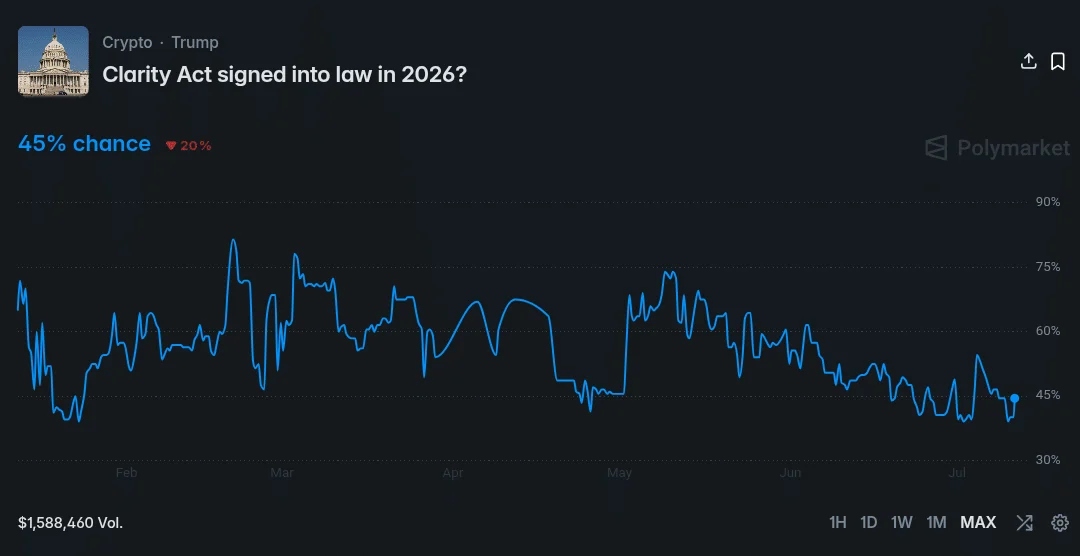
This occurs as the approval odds on Polymarket have dropped to 45%, a 20% decrease from 74% two months ago.
Source: Polymarket
Others supporting the passage of the CLARITY Act
However, regarding the approval, the community still appears to be in favor.
For instance, Rep. French Hill is arguing that the best way to force lawmakers to reach a compromise is to give them a clear deadline to vote on the CLARITY Act before Congress starts its August recess.
Rather than leaving these activities in a regulatory gray area, Hill believes the CLARITY Act would subject them to defined standards and said,
I’ve encouraged Senate leadership to put it on the floor. I think if you schedule a floor date here in the month of July, that will cause these final meetings, these final discussions to take place. You’ve got to have a deadline in Congress to get people to move and find consensus.
Supporters net increases
Not only this, the bill is also supported by Michael S. Selig, the 16th Chairman of CFTC, who said,
The Clarity Act, talking to this future proof notion of making sure that crypto is here to stay.
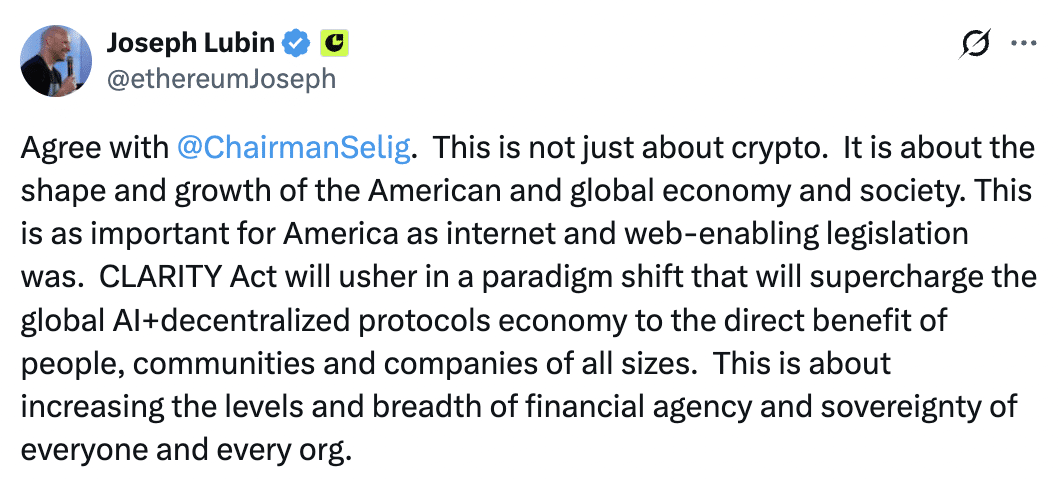
Echoing similar sentiments, Joseph Lubin, Ethereum’s co-founder, added,
Source: Joseph Lubin/X
In fact, Democratic Senator Elizabeth Warren, who has been a stern supporter of the bill, recently put it best when she said,
As currently drafted, the CLARITY Act is a ticket to sanctions evasion.
However, Trump has stated that he will “not sign other bills” until Republicans in Congress have passed the SAVE America Act. As a result, the CLARITY Act is now awaiting a new deadline of the 7th of August to advance.
Final Summary
JP Morgan, supporting the bill, has ignited fresh optimism for the approval of the CLARITY Act.
Though the Polymarket odds have fallen to the 45% Senators, CFTC chairman, Ethereum co-founder, and many others are demanding the bill’s approval.
Early today, traders received Japan’s producer price index for June, which came in at 7.1%, the fastest annual increase since March 2023. The spike in wholesale inflation reinforced expectations for further Bank of Japan rate hikes. A former central bank official said Thursday that the BOJ may hike rates faster, potentially pushing them above 2%.
Note that the Japanese yen and Bitcoin have developed an unusually strong positive correlation, often moving in lockstep against the U.S. dollar. If that correlation holds, yen upswings may ultimately prove positive for bitcoin in general, even as BTC/JPY (and other crypto/JPY) pairs continue to lag in relative terms.
The GPIF Risk
The Government Pension Investment Fund (GPIF) of Japan manages roughly ¥277 trillion ($1.87 trillion) in assets, making it the world’s largest retirement fund. It invests heavily in global stocks and bonds.
Now the Japanese government wants the GPIF and other pension funds to invest more in local assets. Such a rotation could trigger volatility in global financial markets.
“The fund, one of the largest pension pools in the world, held 293.4 trillion yen, or roughly 1.81 trillion dollars, in assets at the end of December, maintaining roughly equal allocations across domestic equities, foreign equities, domestic bonds and foreign bonds,” analysts at InvestingLive said in a market update.
According to average rates from the Zillow lender marketplace, the current 30-year fixed rate fell by 3 basis points to 6.44%, the 15-year fixed rate fell by 9 basis points to 5.82%, and the 5/1 ARM fell by 3 basis points to 6.43%.
These are today’s mortgage refinance rates, Saturday, July 11, 2026, according to the latest Zillow data:
30-year fixed: 6.52%
20-year fixed: 6.11%
15-year fixed: 5.89%
5/1 ARM: 6.55%
7/1 ARM: 6.58%
30-year VA: 5.88%
15-year VA: 5.42%
5/1 VA: 5.44%
Again, the numbers provided are national averages rounded to the nearest hundredth. Mortgage refinance rates are often higher than rates when you buy a house, although that’s not always the case.
Use the mortgage calculator below to see how today’s interest rates would affect your monthly mortgage payments.
Mortgage payment calculator
You can bookmark the Yahoo Finance mortgage payment calculator and keep it handy for future use, as you shop for homes and the best mortgage lenders. You also have the option to enter costs for private mortgage insurance (PMI) and homeowners’ association dues, if applicable. These details result in a more accurate monthly payment estimate than if you simply calculated your mortgage principal and interest.
30-year fixed mortgage rates: Pros and cons
There are two main advantages to a 30-year fixed mortgage: Your payments are lower, and your monthly payments are predictable.
A 30-year fixed-rate mortgage has relatively low monthly payments because you’re spreading your repayment out over a longer period of time than with, say, a 15-year mortgage. Your payments are predictable because, unlike with an adjustable-rate mortgage (ARM), your rate isn’t going to change from year to year. Most years, the only things that might affect your monthly payment are any changes to your homeowners insurance or property taxes.
The main disadvantage of 30-year fixed mortgage rates is the mortgage interest, both in the short and long term.
A 30-year fixed term comes with a higher rate than a shorter fixed term, and it’s higher than the intro rate to a 30-year ARM. The higher your rate, the higher your monthly payment. You’ll also pay much more in interest over the life of your loan due to both the higher rate and the longer term.
15-year fixed mortgage rates: Pros and cons
The pros and cons of 15-year fixed mortgage rates are basically swapped with those of the 30-year rates. Yes, your monthly payments will still be predictable, but another advantage is that shorter terms come with lower interest rates. Not to mention, you’ll pay off your mortgage 15 years sooner. So you could save hundreds of thousands of dollars in interest over the life of your loan.
However, because you’re paying off the same amount in half the time, your monthly payments will be higher than if you choose a 30-year term.
Adjustable-rate mortgages lock in your rate for a predetermined period, then adjust it periodically. For example, with a 5/1 ARM, your rate stays the same for the first five years and then goes up or down once per year for the remaining 25 years.
The main advantage is that the introductory rate is usually lower than what you’ll get with a 30-year fixed rate, so your monthly payments will be lower. (Current average rates might not necessarily reflect this, though — in some cases, fixed rates are actually lower. Talk to your lender before deciding between a fixed or adjustable rate.)
With an ARM, you have no idea what mortgage rates will be like once the intro-rate period ends, so you risk your rate increasing later. This could ultimately end up costing more, and your monthly payments are unpredictable from year to year.
But if you plan to move before the intro-rate period is over, you could reap the benefits of a low rate without risking a rate increase down the road.
First of all, now is a good time to buy a house compared to a couple of years ago. Home prices aren’t spiking like they were during the height of the COVID-19 pandemic. So, if you want or need to buy a house soon, you should feel pretty good about the current housing market.
Plus, despite the recent uptick, mortgage rates are lower than they were this time last year.
The best time to buy is typically whenever it makes sense for your stage of life. Trying to time the real estate market can be as futile as timing the stock market — buy when it’s the right time for you.
Why do 30-year mortgage rates vary by the source reporting them?
According to Zillow, the national average 30-year mortgage rate is 6.44% right now. Why are Zillow’s rates usually different than those reported by Freddie Mac (which reported 6.49% this week) and elsewhere? Each source compiles rates by different methods, and rates are reported for different time frames. Zillow obtains rates from its lender marketplace and reports them daily, while Freddie Mac pulls information from loan applications submitted to its underwriting system and averages them for the week. However, mortgage rates vary by state and even ZIP code, by lender, loan type, and many other factors. That’s why it’s so important to shop with multiple mortgage lenders.
Are interest rates expected to go down?
According to the latest available forecasts, the MBA expects the 30-year mortgage rate to be between 6.4% and 6.5% through 2026. Fannie Mae predicts a 30-year rate of 6.4% through the end of the year.
Are mortgage rates dropping?
Yes, they are, compared to yesterday. According to average rates from the Zillow lender marketplace, the current 30-year fixed rate fell by 3 basis points to 6.44%, the 15-year fixed rate fell by 9 basis points to 5.82%, and the 5/1 ARM fell by 3 basis points to 6.43%.
How do I get the lowest refinance rate?
In many ways, securing a low mortgage refinance rate is similar to the process you used when you bought your home. Try to improve your credit score and lower your debt-to-income ratio (DTI). Refinancing into a shorter term will also land you a lower rate, though your monthly mortgage payments will be higher.
South Korean automaker Hyundai is doubling down on stablecoins for internal transfers between its subsidiaries.
During its testing stage, the automaker saw faster transfers between U.S and Mexico subsidiaries. Instead of the typical 4 hours or more for traditional interbank transfer methods, the firm said it took about 7 minutes to transfer Tether’s USDT between its two offices.
Commenting on the test, Hyundai hailed stablecoin transfers as offering “overwhelming speed and superior stability” to conventional methods. The pilot involved Hyundai Motors Group-owned credit card firm Hyundai Card, Avalanche, Tether and payment integrator Axiym.
Source: Hyundai
For his part, Paolo Ardoino, Tether CEO, billed the move as an impressive “real world adoption of USDT.” Bo Hines, CEO of Tether U.S., scored the Hyundai move as “what the future of finance looks like.”
At the end of July, the automaker will conduct a similar test with Circle’s USDC and Visa for EU transfers.
For Hyundai, this was a foundation for utilizing and scaling stablecoins for remittances between overseas subsidiaries. But its credit card division plans to go beyond internal transfers. The firm noted,
Going forward, we will explore and continuously expand various businesses utilizing stablecoins, including international remittance and payment infrastructure.
This signals growing enterprise stablecoin adoption.
Stablecoin adoption wars: USDT vs. USDC
Stablecoins have graduated from a crypto experiment to a tool that addresses real global pain points: US dollar accessibility and cheaper, faster cross-border transfers.
Although Euro-based stablecoins have also seen significant growth, they still have a smaller market share compared to US Dollar-based alternatives.
But the USD-based segment has become increasingly competitive. The recent activation of the MiCA regime saw USDC gain significant ground over Tether’s USDT.
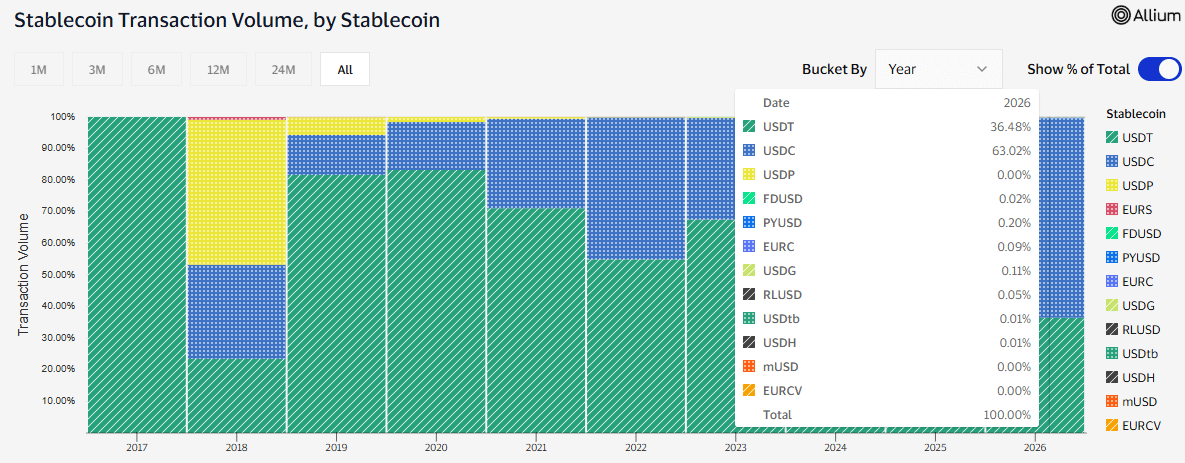
In fact, USDC currently accounts for 63% of annual stablecoin transaction volume (about $6T out of the total $9T). That was more than double Tether’s USDT volume of $3.3T (36%).
Source: Visa
Worth pointing out that this was the first time USDC has led in annual stablecoin transfer volume. Whether the MiCA will allow USDC to maintain its dominance by the end of the year remains to be seen.
Final Summary
Hyundai plans to scale internal stablecoin transfers using USDC and USDT
USDC dominates 2026 stablecoin transfer volume at 63%, underscoring significant usage
Opinions expressed by Entrepreneur contributors are their own.
The four moves any non-coder can use to launch a one-person business this week.
Key Takeaways:
Discover what “vibe coding” really means — and why 63% of the people using it to build real businesses have never written a line of code.
Watch how one solo founder built a $401 million business in year one with $20K and his brother as his only employee.
Screenshot the exact Perplexity Computer prompts that reverse-engineer what four solo founders did to build their businesses — without figuring it out from scratch.
You have the idea. You have the laptop. You have every AI tool on the market open in a tab. And you are still not launching anything.
That is the quiet frustration behind the biggest shift in one-person business formation of the last decade. The tools are here. Most solopreneurs are still waiting to feel technical enough to start. The founders in the video above stopped waiting — and the moves they made are not what most solopreneurs expect.
The four moves I break down in the video above are designed to fix that — starting with the one most non-coders skip.
“Vibe coding” is the term Andrej Karpathy, one of the co-founders of OpenAI, coined in early 2025 to describe a new way of building software. You describe what you want in plain English, an AI writes the code, and you refine it by conversation instead of syntax. It sounded like a joke a year ago. According to Startup Fortune, it is now a $4.7 billion market growing at 38% a year, with 63% of active users identifying as non-developers.
This is not a fringe movement. Axios reported in June that Americans are starting one-person businesses 20% faster than they were a year ago, while startups planning to hire employees have stayed flat — a shift Nasdaq’s economists tie to autonomous coding tools. Intuit’s 2026 AI Impact Report, built on more than 34,000 SMB owners, found that 43% of AI-using businesses say AI has increased their revenue, versus just 2% who say it has gone the other way.
That compression is what Rule 5 of my book, The Wolf Is at the Door, is really about. In a world where the software builds itself, adaptability is no longer about learning faster than the market — it is about shortening the loop between what you see and what you launch. The reason a solo founder can now sell a company for $401 million with almost no employees is not that AI made him smart. It is that AI has collapsed the reaction time that used to give bigger competitors the advantage. That opportunity is now in your hands, no seven-figure marketing budget required.
This weeks video breaks down how Matthew Gallagher launched Medvi in two months with $20K and his brother as his only employee, how Billy Howell charges $750 to $2,500 per app with no coding background, how the creator behind BridgeMind made $42,630 in 142 days building live on YouTube, and how KEV hit $100,000+ in revenue and 67,000 users across four apps — plus the four Perplexity Computer prompts to reverse-engineer their moves in your own business this week.
Every founder, every move and every prompt is walked through in the video above — including the four Perplexity Computer prompts that turn what took these founders months of trial and error into a single afternoon of work.
The four moves any non-coder can use to launch a one-person business this week.
Key Takeaways:
Discover what “vibe coding” really means — and why 63% of the people using it to build real businesses have never written a line of code.
Watch how one solo founder built a $401 million business in year one with $20K and his brother as his only employee.
Screenshot the exact Perplexity Computer prompts that reverse-engineer what four solo founders did to build their businesses — without figuring it out from scratch.
You have the idea. You have the laptop. You have every AI tool on the market open in a tab. And you are still not launching anything.