There’s a divergence happening within the world of streaming entertainment. Netflix(NASDAQ: NFLX), the pioneer in the industry, has seen its share price fall 12% in 2026 (as of June 10). Roku(NASDAQ: ROKU), on the other hand, is up 11% this year.
These companies have different operations. But investors might look at them as a way to allocate capital to a growing and tech-forward industry. The performance of their shares might provide an indication as to the direction their businesses are going in.
Missed Nvidia in 2009? This Rare Signal Is Flashing Again.In 2009, a “Double Down” signal flashed for a little-known chipmaker called Nvidia. For the first time in years, that same “Total Conviction” signal is flashing for a company 1/100th the size of Nvidia. Continue »
Which of these well-known streaming stocks is the better one to buy in June?
Image source: The Motley Fool.
The behemoth is slowing down
Netflix continues to dominate video entertainment. It has more than 325 million subscribers. Its massive scale supports huge profits. The company’s operating margin in Q1 was a reported 32.3%.
But it’s becoming clear that its next phase will be defined by slower growth. Management expects sales to rise 13.3% (at the midpoint) year over year in 2026, which would be the slowest pace since 2012 (besides 2022 and 2023).
During the earnings call, co-CEO Greg Peters mentioned that Netflix hasn’t yet captured 45% of its addressable market based on about 800 million total smart-TV-capable households in the countries it operates in. This means that there is still a sizable untapped opportunity to continue pushing growth. In theory, this is the correct view.
However, bringing these consumers on as Netflix subscribers will be much more difficult than it has been. Competition is incredibly fierce. Key markets like the U.S. and Canada are essentially saturated. And growth in emerging countries, like India, Brazil, and Mexico, will come from cheaper membership tiers that will have less impact on revenue.
Based on the stock’s 12% decline this year and the 39% fall from its peak in June 2025, the market might be accepting this new reality. Shares trade at a price-to-earnings ratio of 26.5, representing a 36% discount to the five-year trailing average.
It’s all about free cash flow
During the first quarter (ended March 31), Roku reported a year-over-year revenue gain of 22.4%, with the top line totaling $1.2 billion. This was the fastest growth rate since Q1 2022.
The company’s platform segment is operating at a high level. Its sales were up 28% in Q1, driven by a 27% increase in advertising and a 30% jump in subscriptions. This is a very high-margin revenue stream, with the gross margin coming in at 51.6%.
Roku’s position as an agnostic streaming ecosystem works to its benefit. While content companies spend copious amounts of money to develop shows and movies, this business provides a meaningful value proposition as the aggregator of all those offerings. More than 100 million households are Roku customers, giving the company’s smart-TV operating system the leading market share in North America.
Although revenue trends get the attention, it’s time investors start to focus on the profit story. The leadership team forecasts $360 million in net income this year. And in 2028, they expect Roku to generate $1 billion in free cash flow (FCF), up 107% from 2025. Cost controls and rising high-margin platform revenue are tailwinds.
Shares trade at 17.3 times the 2028 $1 billion FCF estimate. That’s a compelling valuation to pay, given Roku’s outstanding growth trajectory.
What’s your objective?
Both Netflix and Roku are in strong positions within the broader media and entertainment landscape. Investors looking to bet on streaming’s ongoing success are wise to consider these two businesses.
Netflix is the safer opportunity. It has established a leadership position, supported by a tech-enabled platform and strong content creation. And its impressive profitability is hard to overlook.
Roku’s advertising-heavy model is taking off, even though it can be more cyclical. But the company’s rising FCF is an encouraging trend that can boost shareholder value.
Investors deciding between these two streaming stocks must determine their ultimate objective. If you’re after a proven and stable company, Netflix is the better choice. But if you want the chance to achieve better returns, Roku has more upside over the next five years.
Should you buy stock in Roku right now?
Before you buy stock inRoku, consider this:
The Motley FoolStock Advisoranalyst team just identified what they believe are the10 best stocksfor investors to buy now… andRokuwasn’t one of them. The 10 stocks that made the cut are built for long-term growth and could produce monster returns in the coming years.
Consider whenNetflixmade this list on December 17, 2004… if you invested $1,000 at the time of our recommendation,you’d have $442,220!* Or when Nvidiamade this list on April 15, 2005… if you invested $1,000 at the time of our recommendation,you’d have $1,230,114!*
That performance is why people listen. With a track record ofbeating the S&P 500 by nearly 5x,Stock Advisoroffers a distinct advantage. Don’t miss the latest top 10 list, available withStock Advisor, and join an investing community built for the long haul.
Neil Patel has no position in any of the stocks mentioned. The Motley Fool has positions in and recommends Netflix and Roku. The Motley Fool has a disclosure policy.
SpaceX (SPCX) shares will begin trading on Solana the same day the company is expected to list on Nasdaq, according to Sunrise, a tokenization infrastructure provider, and Backpack Securities, a regulated brokerage and crypto trading platform, which are launching a tokenized version of the stock called SPCX.
The token, issued by Backpack, represents ownership of underlying SpaceX shares and can be redeemed for those shares through Backpack’s brokerage platform. The firms say eligible shares can also be converted back into tokens, creating a bridge between traditional brokerage accounts and blockchain-based markets.
The launch attempts to bring newly listed U.S. equities onchain from day one. Backpack says SPCX holders will have a direct redemption path to the underlying security.
SPCX will trade on Solana around the clock, including outside traditional market hours. The token can be held in self-custody wallets and traded across supported Solana-based venues.
The announcement comes as interest in tokenized real-world assets continues to grow across the crypto industry. Stablecoins have become one of blockchain’s most successful use cases, and several firms are now betting that equities could follow a similar path if tokenized shares can be made accessible to a global investor base.
Advocates argue that tokenized stocks could eventually expand access to U.S. capital markets and enable continuous trading. Whether demand develops at a scale comparable to stablecoins remains an open question.
“The future of tokenized equities is not just putting price exposure onchain,” Backpack CEO Armani Ferrante said in a press release shared with CoinDesk. “It is making underlying securities portable across financial systems.”
Yacht life is often seen as a decadent pursuit of the ultra-rich. And, with a growing number of billionaires — driven by a boom in AI and tech wealth — superyachts are the new status symbol of the elite, including Jeff Bezos, Larry Ellison and Mark Zuckerberg (1). Entrepreneurs can even run their business from a superyacht.
Yacht ‘season’ (2) typically runs from May to October in the Mediterranean, and November to April in the Caribbean and other tropical destinations such as Southeast Asia.
Must Read
And along with the six-figure parties (3) complete with champagne and caviar, there may be a practical reason for yacht life, too: tax breaks — especially for European ultra-high-net-worth individuals (UHNWI).
“European UHNWI have a structural incentive to stay mobile. Not being in one place too long is itself a tax strategy,” writes author and financial communications strategist Richard Amador on X (4).
Yachts are “a remarkably efficient asset class for people whose wealth depends on being nowhere in particular,” he writes. “This is why European UHNWI do a yearly circuit — Wimbledon one week, Cannes another, the WEF, the Biennale.”
Amador argues that the social calendar of the ultra-rich isn’t separate from tax strategy: “They are the same thing.”
But this isn’t as straightforward as it might sound.
“Most countries have regulations determining tax residency, which involves more than just physical location. Factors like income, assets, and connections to a country can affect your tax status,” writes Iven De Hoon, a lawyer and tax expert from Belgium, for No More Tax. “Attempting to avoid taxes by living on a yacht and avoiding tax residency could be considered tax evasion or fraud (5).”
As De Hoon points out, Americans in particular can’t escape taxes — even if they happen to live on a yacht — since they’re taxed on their worldwide income. “Additionally, Americans living on a yacht may need to pay state and local taxes, based on the yacht’s registration and where it stays for extended periods,” he writes.
So whether you’re moving abroad for a job, planning to retire in another country or choosing to live the yacht life, you’ll likely still be paying taxes to the IRS.
Why Americans living abroad can face complicated taxes
The U.S. taxation system requires Americans to pay taxes on their worldwide income based on citizenship — regardless of where they happen to live. The only other country that uses citizen-based taxation is Eritrea (6), although its model is a bit different.
The rest of the world uses residency-based taxation, which means you pay taxes based on where you reside, rather than your citizenship.
While the U.S. has tax treaties with 68 foreign countries (7) that can help Americans living abroad as residents avoid double taxation, it also means doing your taxes is a whole lot more complicated.
Typically, with residency-based taxation, if you stay longer than a certain number of days in a calendar year, you have to pay local taxes. A popular claim is that if you stay less than 183 days, you can avoid this. But that’s not entirely accurate.
Every country is different — even when it comes to their definition of a calendar year. And residency is often based on more than just the number of days you’ve spent in a country.
“A country may care far less about your travel spreadsheet than about whether you kept a family home, ran your business there, or kept the centre of your life there,” writes Adrian Blackwell, an international tax policy researcher, in the Tax Haven Directory (8).
For example, he writes, “Portugal can treat you as resident if you maintain a home there as a habitual residence, France can look at home, main professional activity, or economic interests, Australia can use the resides or domicile test, and Cyprus has a 60-day statutory route.”
That’s not to say the ultra-rich in the U.S. don’t have other options to shield their wealth. As Amador writes in his tweet, they “optimise differently” with such tactics as dynasty trusts or state domicile arbitrage (4), which refers to the practice of establishing permanent residency somewhere with favorable tax laws while still maintaining ties to other locations.
If you’re planning to move from the U.S. to another country, you’ll need a tax strategy. And it doesn’t matter how long you’ll be gone, whether it’s a short stint for work or a permanent move for retirement (or just hanging out on a yacht).
Thanks to regulatory and compliance constraints, not all U.S.-based financial institutions can serve clients abroad. Nor do their advisors necessarily have international expertise. Ahead of your move, find out if your financial provider, brokerage firm or advisor is qualified to serve you abroad. If not, you’ll need to switch providers.
You may even need to adjust your investment strategy if you’re making a permanent move (such as retiring abroad) — which is where a financial advisor or wealth manager with international expertise can help.
Every country has its own tax rules and, even if you’re moving to one that has a tax treaty (7) with the U.S., you’ll still need to file the right forms and claim U.S. tax credits or exclusions to avoid double taxation when filing your federal tax return. You may also have to file state taxes, too (depending on which state you previously lived in).
Local tax rules in your new home country could also impact your U.S.-based investments.
“For instance, although Roth IRAs are tax-free in the US, this benefit may not be recognized abroad,” writes Tom Zachystal, president of International Asset Management, in a blog (9). The same goes for estate planning. “Estate planning tools such as revocable trusts, which are effective in the US, might not be recognized or could create complications abroad (9).”
So, if you’re planning to move abroad, it’s a good idea to consult with a U.S.-based international tax advisor and possibly a local tax advisor in your new country of residence to make sure nothing falls through the cracks — whether or not you’re living the yacht life.
You May Also Like
Join 250,000+ readers and get Moneywise’s best stories and exclusive interviews first — clear insights curated and delivered weekly. Subscribe now.
Article Sources
We rely only on vetted sources and credible third-party reporting. For details, see ourethics and guidelines.
Boat International (1); AK Yachts (2); Business Insider (3); X (4); No More Tax (5); Taxes For Expats (6); Internal Revenue Service (7); Tax Haven Directory (8); I Am Advisors (9)
After falling to a low of $0.054, World Liberty Financial [WLFI] bounced and reached a local high of $0.062 before retracing.
At press time, WLFI traded at $0.059, up 8.3% over the past 24 hours. During the same period, trading volume surged 207% to $88 million, reflecting renewed market participation.
Why is WLFI rising today?
World Liberty Financial’s rebound appeared to stem from two key developments.
First, AI Financial Corp, a major corporate investor in WLFI, said its outlook on the investment had improved.
The company stated that most of the challenges it previously warned investors about had been substantially mitigated. In May, AI Financial Corp warned that it might not continue operating over the following 12 months.
Even so, the firm disclosed a $348 million loss on its crypto assets during Q1 2026. It also reported operational losses alongside unrealized losses on its balance sheet. That shift aligned with growing speculation around the USD1 ecosystem.
Speculation hit the market, driven by the USDI campaign extension.
World Liberty Financial also transferred 170 million World Liberty Financial [WLFI], worth roughly $9.3 million, to Binance.
The move fueled speculation that Binance could extend its USD1 yield campaign. Traders also speculated that Phase 6 of the USD1 event could continue.
On top of that, Gate announced a USD1 campaign offering up to 20% APR without lockups. That added to bullish expectations across the market.
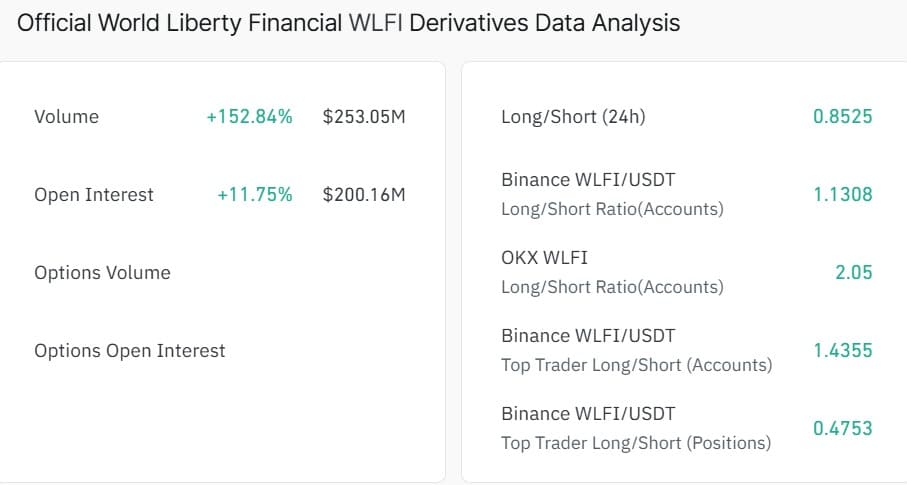
Source: CoinGlass
As speculation intensified, traders rushed to establish positions. Derivative Volume jumped 152.8% to $253 million, while Open Interest rose 11% to $200 million.
The rise in both metrics suggested new money entered the market as traders opened fresh positions. Historically, such activity has supported short-term price rallies.
Can WLFI hold its recovery?
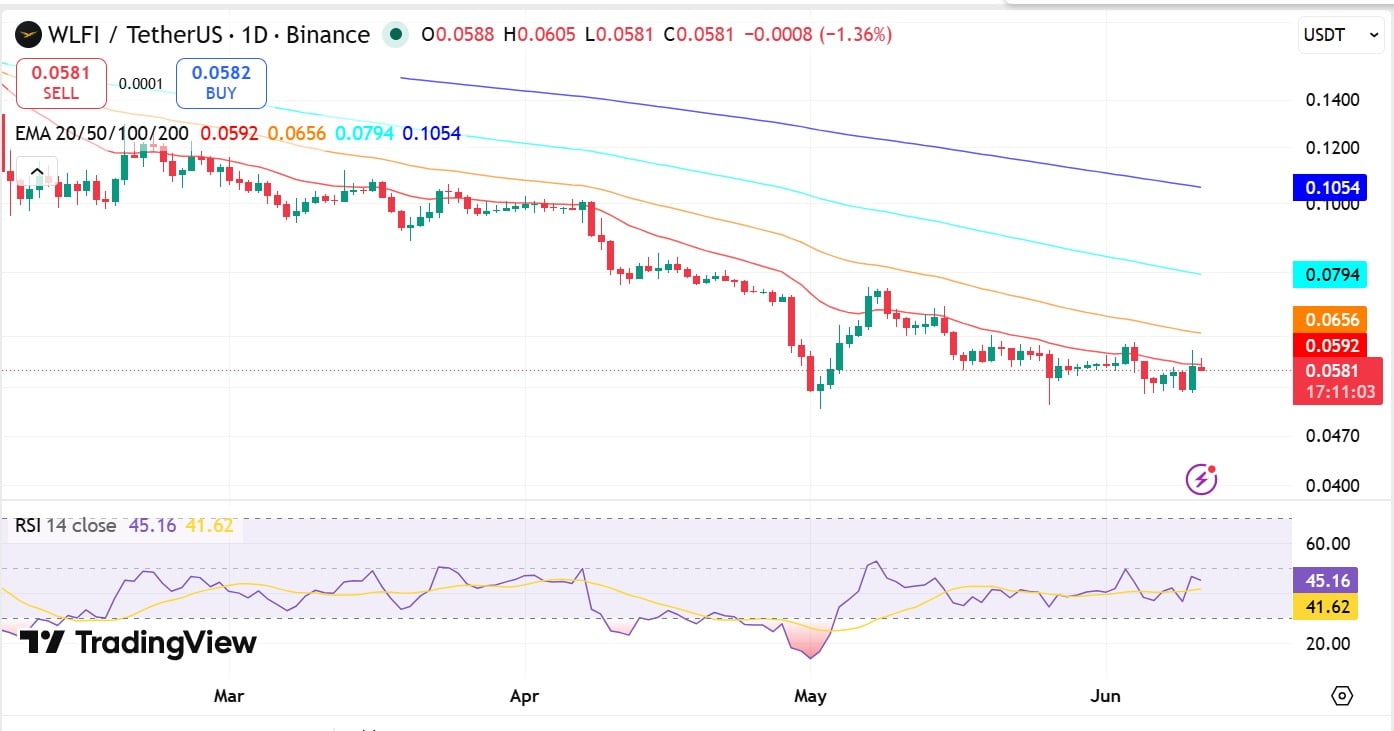
Despite the rebound, WLFI’s broader market structure remained weak. For starters, the Relative Strength Index (RSI) stayed below the neutral level at 45.
The RSI has remained in this range for more than 30 days, suggesting bearish momentum continued to dominate. That left sellers with the upper hand.
Source: TradingView
At the same time, WLFI traded below both short and long-term Moving Averages, reinforcing the prevailing downtrend.
Taken together, these indicators suggested bears still controlled the market. If weakness persists, WLFI could revisit $0.052.
However, if speculation continues to drive demand, WLFI may hold above $0.06. A sustained move higher could open the door to $0.065, with $0.07 acting as the next major resistance level.
Final Summary
Binance campaign speculation appeared to be the main catalyst behind WLFI’s latest rebound.
Fresh derivatives activity suggested traders expected further upside despite the broader downtrend.
The debate over Strategy’s (MSTR) recent dilutive transaction resurfaced, this time featuring Strategy Executive Chairman Michael Saylor and Strike and Twenty One Capital (XXI) CEO Jack Mallers, on Wednesday at BTC Prague, as the two weighed in on how investors should assess the company’s increasingly complex capital structure.
Mallers asked Saylor how he defines multiple-to-net asset value (mNAV), noting that some investors include out-of-the-money securities in their calculations and asking whether he agrees with that approach. (Strategy currently has $6.7 billion of convertible debt that is out of the money, meaning the securities are not expected to convert into equity at the current $115 share price).
Mallers also challenged Saylor’s view on dilution, asking for an example of a dilutive transaction if issuing equity for cash is not considered dilutive.
Saylor responded that mNAV can be calculated by including the notional value of convertible debt, common equity and preferred equity. However, he argued that mNAV is only one valuation framework. Investors can also evaluate gross assets per share and net assets per share, which may exclude preferred equity or convertible debt from the calculation. According to Saylor, the distinction matters less when debt and preferred equity represent only a small portion of the company’s overall asset base.
On dilution, Saylor argued that issuing equity for cash is not inherently dilutive because shareholders receive a tangible asset in return, whether cash or bitcoin. He said raising capital strengthens the balance sheet, expands the capital base and improves creditworthiness. As an example, Saylor pointed to Strategy’s recent addition of approximately $100 million to its U.S. dollar reserves, bringing the total to roughly $1 billion.
Baxter International (BAX) Faces Tough Road Ahead, Says Citi in Downgrade
On May 28, Citi analyst Joanne Wuensch downgraded Baxter International Inc. (NYSE:BAX) to Sell from Neutral. She lowered the price target on the stock to $17 from $19. In a research note, the analyst said the company faces a year that is weighted toward the second half and is still searching for a CFO. Citi also noted that valuations across the broader medical technology sector are “dipping into value territory,” which it believes offers investors more attractive opportunities than Baxter.
On May 4, Barclays raised its price recommendation on Baxter to $27 from $25. It reiterated an Overweight rating on the shares. The analyst said the company exceeded expectations at a time when many investors had anticipated a guidance cut. In a research note, Barclays described the results as a “respectable beat and reiterated outlook.”
Baxter International Inc. (NYSE:BAX) is a global medical technology company. Its operations are organized into three segments: Medical Products and Therapies, Healthcare Systems and Technologies, and Pharmaceuticals.
While we acknowledge the potential of BAX as an investment, we believe certain AI stocks offer greater upside potential and carry less downside risk. If you’re looking for an extremely undervalued AI stock that also stands to benefit significantly from Trump-era tariffs and the onshoring trend, see our free report on thebest short-term AI stock.
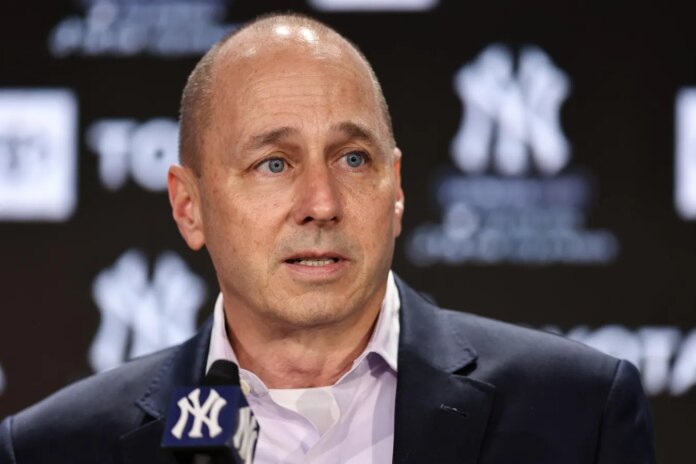
BRONX, NEW YORK – DECEMBER 21: New York Yankee general manager Brian Cashman speaks to the media during a press conference at Yankee Stadium on December 21, 2022 in Bronx, New York. (Photo by Dustin Satloff/Getty Images)
Getty Images
The New York Yankees remain firmly in the American League playoff picture despite losing superstar Aaron Judge to the injured list.
The team recently took a series from the American League Central leading Cleveland Guardians, immediately after a brutal setback in Judge’s injury status indicated the franchise slugger would be sidelined with a fractured rib for a significant stretch.
“I’m very disappointed,” Judge said of the diagnosis, per MLB.com’s Bryan Hoch. “That’s why we went through every measure we could, to get every expert to take a look and see what was going on in there. It’s definitely not what you want to hear, a fracture or anything like that.”
New York Yankees Urged To Consider Aaron Judge Replacement Trade After Injury
Following that development, the Yankees indicated that Judge will be out for a month at the least, but it seems he could be recovering for even longer than that. And, as a result, the team has been urged to evaluate potential replacement options before the upcoming trade deadline.
“There’s really no good time to lose Aaron Judge, but for the Yankees, this is probably the time it hurts the least to endure an extended absence from the game’s most devastating offensive force,” ESPN’s Bradford Doolittle wrote. “If they do (make a trade), then it’s still about October, and for that part of the calendar, they might look at adding another righty bat, perhaps a third baseman and, certainly, some bullpen help.”
But even though it seems like a replacement on offense might be top-of-mind for the Yankees’ front office after losing Judge, the general manager has shared a different outlook.
New York Yankees’ Brian Cashman Offers Trade Deadline Response After Aaron Judge Injury
Though Judge’s absence is significant, given both his production and his importance in the clubhouse, the team appears optimistic that he will return in the earlier part of his recovery timeline and that seems to have shaped a trade deadline decision.
“I don’t think (Judge’s injury will impact the trade deadline),” Yankees general manager Brian Cashman said, according to CBS Sports’ Julian McWilliams. “If we expect him back, which we do, then I don’t see why that would impact something for the deadline. So, we just have to be able to hold the fort and hold that spot nice and warm until he returns.”
Those comments suggest the Yankees still view Judge’s injury as a temporary obstacle rather than a truly season-altering event. The organization appears confident enough in both Judge’s eventual return and the current roster to continue operating under the same deadline blueprint that existed before the injury diagnosis.
For now, that confidence is well placed. But if the team endures a significant slide between now and the August trade deadline, Cashman could decide to pivot on his decision to stand pat in the slugger replacement market.