Home Blog Page 354

BlackRock’s income-paying bitcoin ETF nears launch at a fee that undercuts rivals

0
BlackRock's income-paying bitcoin ETF nears launch at a fee that undercuts rivals

BlackRock is close to launching a bitcoin fund that pays an income.

The world’s largest asset manager filed its fourth amendment for the iShares Bitcoin Premium Income ETF on Tuesday, according to its SEC filing. The fund will trade on Nasdaq under the ticker BITA.

The income comes from options. The fund holds bitcoin and shares of IBIT, BlackRock’s $47 billion spot bitcoin ETF. Each month it sells call options on those IBIT shares.

A call option gives the buyer the right to purchase the shares at a set price. The fund collects a fee, called a premium, for selling that right. That premium is the income it hands to investors.

As such, selling calls caps how much the fund gains if bitcoin rallies hard. Investors take steady income in exchange for giving up part of a big move. The fund plans to write calls on 25% to 35% of its value at a time.

The fee is the edge, however. BlackRock set the sponsor’s fee at 0.65%, which sits below the two largest covered-call bitcoin funds, YBTC and BTCI, which charge 0.95% and 0.99%, Bloomberg analyst Eric Balchunas said in a post on X.

Balchunas added he expects the fund to launch very soon, noting BlackRock is under pressure to beat Goldman Sachs to market, with Goldman’s own bitcoin fund due to go live around July 1.

BlackRock already has the strongest distribution base in the spot bitcoin ETF market. Its iShares Bitcoin Trust, IBIT, has become the flagship product of the sector, regularly drawing the largest inflows and often absorbing capital even when rival funds see redemptions.

IBIT and Fidelity’s FBTC have increasingly turned the U.S. spot bitcoin ETF market into a two-firm race, with smaller issuers often contributing little to daily flows.

The launch would be another step in turning bitcoin into an income product for mainstream investors. The filing shows the fund is already seeded and has started buying bitcoin and IBIT shares – a sign it is close to being ready.




Source link

IAMGOLD (IAG) Increases Côté Gold Mine Mineral Resource Estimate by 12%

0
IAMGOLD (IAG) Increases Côté Gold Mine Mineral Resource Estimate by 12%


IAMGOLD Corporation (NYSE:IAG) is one of the most profitable growth stocks to buy. On June 1, IAMGOLD announced an updated consolidated Mineral Resource estimate for the Côté Gold Mine in Ontario, Canada, reporting 20.3 million ounces of Measured and Indicated gold, a 12% increase from the end of 2025. This update integrates the Côté and Gosselin zones into a single geological framework, bolstered by recent drilling that successfully expanded resources in the connecting “saddle” area. The estimate utilizes updated economic assumptions, including a $2,500 per ounce gold price and a lower cut-off grade of 0.25 g/t Au, to better reflect current market conditions. Consequently, Inferred Mineral Resources also saw significant growth, rising 61% to 3.5 million ounces, further strengthening the project’s long-term geological profile.

IAMGOLD (IAG) Increases Côté Gold Mine Mineral Resource Estimate by 12%

Pixabay/Public Domain This consolidated model serves as a key milestone for the joint venture, which is currently preparing for a plant expansion and larger-scale mining scenario. The updated data will be foundational to the upcoming Côté Gold Technical Report and comprehensive mine plan, both of which remain on track for release in Q4 2026. IAMGOLD Corporation (NYSE:IAG) is a mining company engaged in the exploration, development, and production of gold. Its operations include producing assets such as the Essakane mine in Burkina Faso and the Westwood mine in Canada, alongside development projects like the Côté Gold project in Ontario. While we acknowledge the potential of IAG as an investment, we believe certain AI stocks offer greater upside potential and carry less downside risk. If you’re looking for an extremely undervalued AI stock that also stands to benefit significantly from Trump-era tariffs and the onshoring trend, see our free report on the best short-term AI stock. READ NEXT: 33 Stocks That Should Double in 3 Years and Cathie Wood 2026 Portfolio: 10 Best Stocks to Buy.  Disclosure: None. Follow Insider Monkey on Google News.


Source link

Singapore bank DBS to offer tokenized gold to retail customers

0
Singapore bank DBS to offer tokenized gold to retail customers

Crypto-friendly DBS Bank said it will start offering tokenized gold trading to its retail customers in the second half of 2026.

DBS said it will list the product, called DBS Physical Gold Tokens, on its digibank platform and is also considering making it available on the DBS Digital Exchange (DDEx), which is tailored for accredited investors and institutions.

The bank will tokenize, issue, distribute and manage the physical gold tokens entirely in-house, backed by trusted bank-grade infrastructure. Each token is backed by 1 gram of physical gold held by DBS in a dedicated vault in Singapore, the bank said in a statement.

The move builds on a growing trend towards blockchain-based versions of real world assets (RWAs). The size of physical gold holdings in the portfolios of wealthy clients of DBS has more than doubled over the past three years.

In 2025, DBS tokenized structured notes on Ethereum and listed sgBENJI, the token of Franklin Templeton’s tokenized money market fund, alongside the Ripple’s RLUSD dollar-pegged stablecoin.

“While our retail investors have been able to buy gold funds, access to physical gold has been largely available to only institutional and accredited investors,” said James Tan, the head of DBS’ investment product and advisory unit. “DBS has offered physical gold investments to wealth clients since 2013, and we are now leveraging tokenisation to broaden access, enabling more retail customers to invest in gold in a safe and meaningful way.”


Source link

Nuvalent Stock Hits All-Time High Following GSK’s Buyout Offer

0
Nuvalent Stock Hits All-Time High Following GSK's Buyout Offer


Medical research and development by Gorodenkoff via Shutterstock

Nuvalent (NUVL) stock ripped higher on June 9 after GSK (GSK) announced a $10.6 billion all-cash deal to acquire the Nasdaq-listed precision oncology company. 

The British pharmaceutical behemoth will commence a tender offer at $124 per share, representing a massive 40% premium on NUVL’s previous close. 

More News from Barchart

NUVL is the second-largest acquisition in GSK’s history, marking a departure from its focus on smaller transactions in recent years. 

Including today’s explosive gains, Nuvalent shares are up more than 20% versus the start of this year.

www.barchart.com

Why Did GSK Price Nuvalent Stock at a Premium?

Buying Nuvalent adds two near-approval therapies (zidesamtinib and neladalkib) to GSK’s portfolio — positioning it strongly to challenge lung cancer treatments from the likes of Roche (RHHBY) and Pfizer (PFE). 

FDA is set to announce its decision on those next-gen investigational cancer drugs in September and November, respectively, with BofA analysts calling for combined peak annual sales of up to $4 billion. 

In its press release, GSK said the NUVL transaction will be profitable from 2027 and incremental to its goal of achieving £40 billion in yearly sales within the next five years. 

The pharma titan is paying a hefty premium for NUVL stock because the acquisition may also help offset an expected decline in revenue when its best-selling HIV medicine loses exclusivity in 2028.

Is There Any Further Upside Left in NUVL Shares?

Investors should note that Nuvalent shares are already trading just below the $124 buyout price, which means the upside from here is essentially gone.

Since GSK is taking the biotech firm private, its stock price is unlikely to push higher in the absence of a superior proposal. 

But a rival bid appears improbable given the substantial premium GSK has already agreed to pay — and just how strategically a fit NUVL is for its portfolio.  

Simply put, a better way to bet on a potential breakthrough in lung cancer treatment is GSK, not Nuvalent. 

Wall Street’s View on Nuvalent

Investors should note, however, that heading into June 9, Wall Street firms had a consensus “Strong Buy” rating on NUVL shares, with a mean price target of nearly $144. 


Source link

30% drop in 30 days, yet Sharplink’s staking rewards cross 21K ETH – What’s happening? 

0
30% drop in 30 days, yet Sharplink's staking rewards cross 21K ETH - What's happening? 


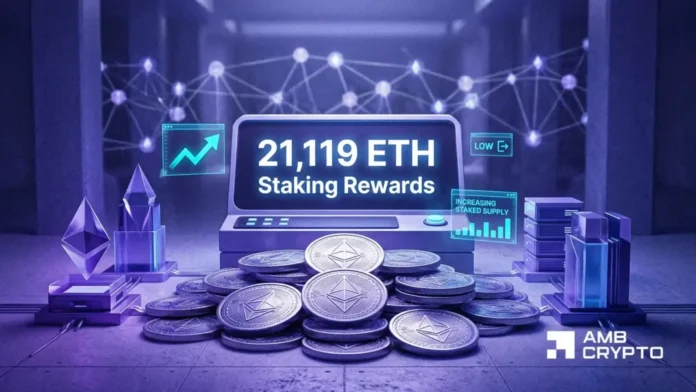
Sharplink, the second-largest Ethereum [ETH] digital assets treasury (DATs) company, has hit 21,119 ETH in total staking rewards.

This milestone was achieved as Sharplink added another 529 ETH in staking rewards this week. 

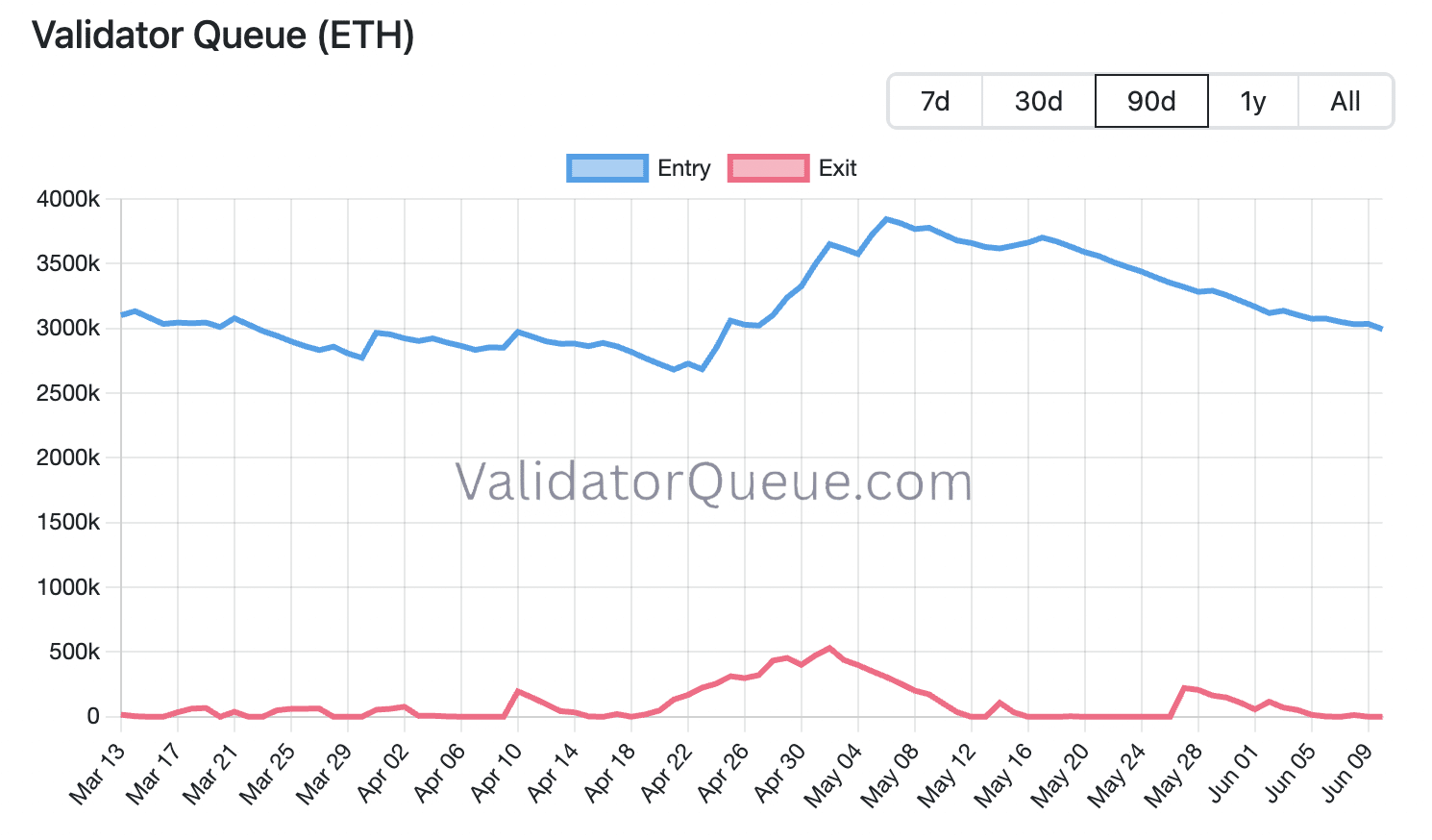
Entry outpaced exit despite the drop 

Meanwhile, Ethereum‘s validator queues in June highlighted a staking environment that was still strong, despite cooling down.

Entry and Exit of ETH staking
Source: Validator Queue

The “Entry” queue gradually shrank from about 3.2 million ETH towards the beginning of the month to about 3 million ETH by 09 June. This indicated that although demand for new staking was still high, the spike that occurred in late April and early May had started to subside.

The “Exit” line, however, remained close to zero for the majority of the month, with only a brief hike in late May that lasted into early June before rapidly diminishing.

All in all, this indicated that validators have continued to prefer staking over withdrawing.

What are Ethereum’s staking dynamics showing? 

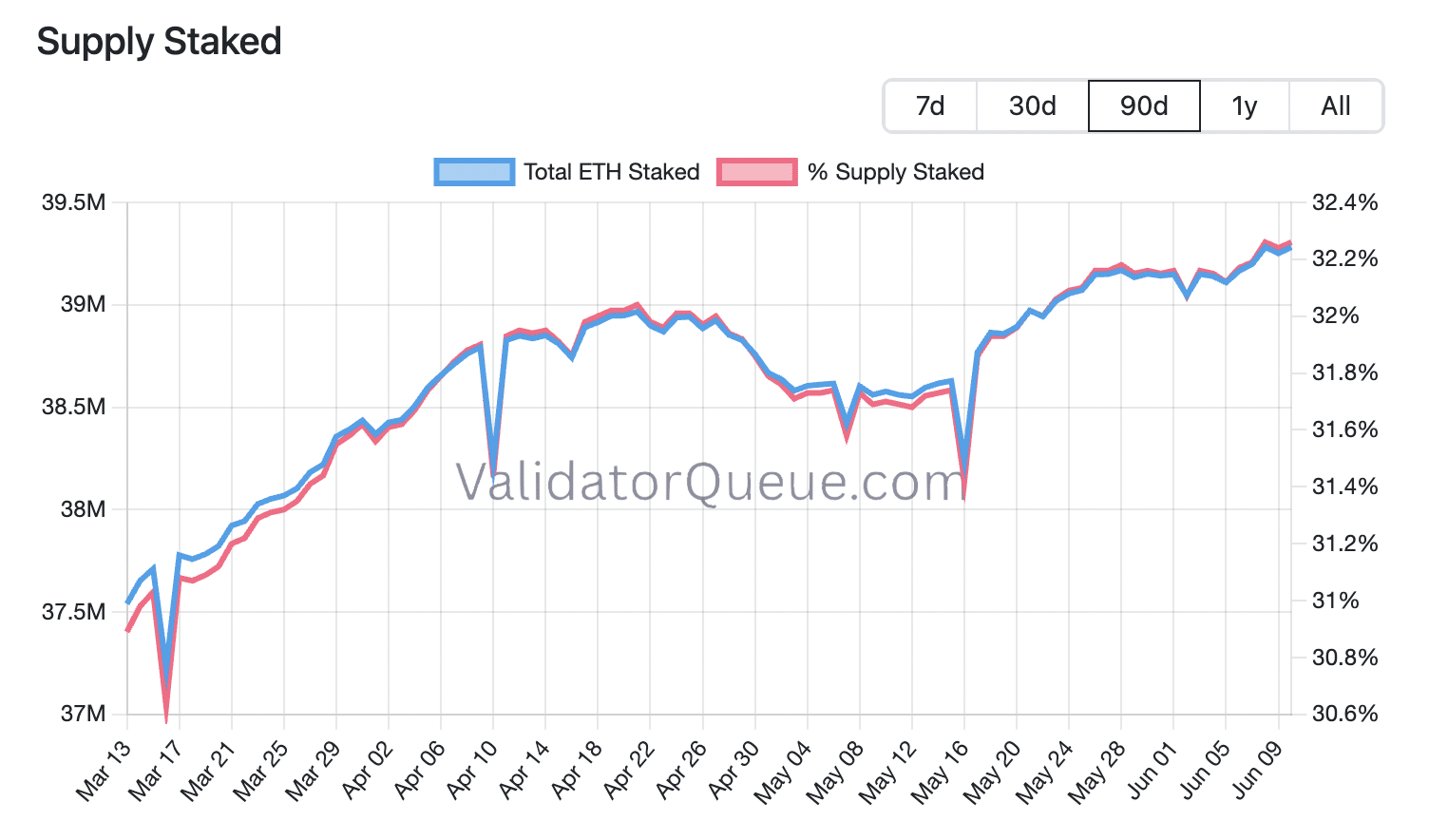
Well, over the last ninety days, the percentage of Ethereum’s supply that is staked as well as the total amount of ETH staked seemed to tell us a different story. 

Supply stakedSupply staked
Source: Validator Queue

Despite a slight slowdown in the growth of the validator queue, Ethereum staking has remained strong in June. The total amount of Ethereum staked increased gradually from about 39.1 million at the start of June to over 39.25 million by 09 June – A new high for the timeframe.

At the same time, the percentage of Ethereum’s circulating supply that was locked in staking increased from about 32.1% to more than 32.2%. The steady uptick indicated that more Ethereum owners kept their holdings in staking, rather than selling or keeping them liquid.

This trend can generally be seen as a positive for Ethereum since it lowers the quantity of ETH that may be easily accessible on the market. 

Sharplink vs. Bitmine

According to AMBCrypto, Sharplink added 422 ETH to its staking rewards over the previous week. 

On the other hand, Bitmine Immersion Technologies, Inc. has so far staked 4,718,677 ETH – Equivalent to $7.7 billion at $1,630 per ETH.

All of this occurred as ETH’s value fell by nearly 30% over the previous month, with the altcoin trading at $1,634.58 at press time. This suggested that Sharplink is still far behind Bitmine.

This can be further supported by Bitmine’s own ETH holdings, with the same climbing to 5,543,872 ETH worth $9.06 billion.


Final Summary

  • Ethereum staking has kept growing in June.
  • By taking advantage of Ethereum’s continuously expanding staking ecosystem, Sharplink added 529 ETH in rewards this week.


Source link

BTC updates: Soft core inflation gave crypto a bounce, but only bitcoin held up on the week

0
BTC, ETH prices drop even as futures show growing taste for risk. XLM, HYPE gain: Crypto Markets Today

Crypto caught a modest bid on Thursday after Wednesday’s inflation report showed underlying price pressures staying contained. Bitcoin rose about 1.9% over 24 hours to roughly $62,600, leading the majors, per CoinDesk data.

Headline inflation rose 0.5% on the month and 4.2% over the year, the fastest annual pace since April 2023, but energy did most of the work, climbing 3.9% on the month and accounting for more than 60% of the increase as oil rose on the Iran conflict.

Core inflation, which strips out food and energy and is the gauge the Federal Reserve leans on, rose just 0.2% on the month, below the 0.3% forecast, and 2.9% over the year.

The bounce is shallow and concentrated in bitcoin. BTC is down less than 1% over the past seven days, holding its 200-week average, while the rest of the top tokens remain deep in the red on the week. Ether is off about 6.5% at roughly $1,651, XRP down 7.5% near $1.12, Solana down 7.4% around $65, and dogecoin off 7%. BNB held up better at a 2.1% weekly loss.

Traders now await Fed’s June 17 meeting, where markets expect no change to rates. The hot headline gives hawks cover to stay restrictive, while the soft core gives doves room to argue the pressure is narrow and energy-driven.

Another widely-cited catalyst is the public offering of Elon Musk-owned satellite, rockets and AI company SpaceX, which prices later Thursday and is expected to start trading on Friday at a $1.8 trillion valuation.

Shares for the company are already four times oversubscribed, with some singular entities bidding as much as $10 billion for the stock, per Bloomberg.


Source link

The space economy’s next frontier is in ground infrastructure, Northwood Space CEO says

0
The space economy's next frontier is in ground infrastructure, Northwood Space CEO says

In the last six years, a surge of satellites in orbit has triggered what Northwood Space Chief Executive Bridgit Mendler called the “infrastructure building era” of space.

Speaking at the Fortune Brainstorm Tech conference in Aspen, Colorado on Tuesday, Mendler emphasized how massive leaps in launch capacity and spacecraft manufacturing are supercharging the space economy. Satellites have evolved from isolated scientific missions into large constellations of thousands. And they all require the type of network routing Northwood builds, she said.

Northwood is focused on the ground segment, which Mendler described as the networking system linking Earth and space. Without this infrastructure, she argued, a satellites would be a “really expensive hump of metal up in space.”

“For a long time, the space economy has existed, but it’s been pretty niche,” Mendler said. “The economics are switching. You can see that that is leading to adoption and market share from major parts of the economy like telecom.”

SpaceX’s Starlink, which beams internet access to customers on Earth, currently has more than 10,000 operational satellites in low-Earth orbit, while Amazon’s Project Kuiper is racing to launch its own constellation of satellites. SpaceX and other companies also hope to eventually launch so-called orbital compute data centers. Companies are striking massive multi-billion-dollar deals to deliver AI compute services via space infrastructure.

The burgeoning space industry will get a big boost this week when SpaceX is expected to make its public market debut under the ticker SPCX at a $1.75 trillion valuation. The IPO is expected to raise $75 billion, making it the largest IPO in history, surpassing Saudi Aramco’s 2019 debut.

Northwood recently closed a $100 million Series B funding round led by Washington Harbour Partners and Andreessen Horowitz. The company is betting heavily on Earth-based data infrastructure. Its flagship product, named Portal, uses a network of smaller, individual antennas that work together as a single, powerful system designed to replace traditional parabolic dishes.

Mendler’s philosophy is that space networking should be a shared resource, akin to how cloud infrastructure supports tech startups. By providing this shared layer, Northwood aims to drastically shorten the timeline for new space ventures. What took industry leaders like SpaceX 20 years to build could soon be achieved in five, she said.

A Hollywood story

Mendler is a former Disney Channel actress, appearing in popular TV shows such as Good Luck Charlie and Wizards of Waverly Place. She said she views her Hollywood background as “traditional” for a space CEO because both industries require a high risk tolerance and the ability to beat significant odds.

She also views space-based energy as an exciting use case, noting that there is an “abundance of energy in space” which could help solve terrestrial energy supply concerns.

“Data is the way that you gather value from the space economy,” she said. “So, the more throughput you can get through space, the space economy directly grows.”

More from the 25th annual Fortune Brainstorm Tech conference:

Anthropic’s Boris Cherny, creator of Claude Code, says there are days he manages tens of thousands of AI agents at once

The AI industry spent years chasing bigger models. Now it’s chasing efficiency

‘Not an Allbirds Moment’: Xbox’s new CEO says she is grounding the console in gaming roots not AI


Source link