Home Blog Page 372

Ethereum (ETH) News: Foundation cuts and departures aren’t a crisis, Joe Lubin says

0
Ethereum (ETH) News: Foundation cuts and departures aren't a crisis, Joe Lubin says

Ethereum Foundation budget cuts, staff departures and leadership changes have fueled weeks of criticism from parts of the blockchain’s community, but Joe Lubin, who was involved in its creation and is now CEO of software developer Consensys, said the moves are a necessary evolution, not a crisis.

Lubin, who has no role at the foundation, told CoinDesk that the organization’s role should be narrower, more focused on stewarding the network’s core technology and values, while other organizations take responsibility for adoption, institutional engagement and ecosystem growth.

“It is important that the Ethereum Foundation be credibly neutral above reproach,” Lubin said in an interview. “The opportunity for conflicts of interest between the business side and the builders is just not a credibly neutral way to run your decentralized protocol ecosystem.”

The comments come after weeks of debate over the foundation’s direction. Critics have questioned whether the organization, often known by its initials, has moved quickly enough to address competitive threats and improve Ethereum’s market position, while others have raised concerns about staff departures and restructuring.

Lubin said many of those concerns stem from a misunderstanding of what the foundation is supposed to do for the blockchain, which handles about 2 million transactions a day, according to Etherscan data.

“What’s happening at the EF is cleaning that up,” he said, referring to efforts to separate protocol stewardship from commercialization and business development.

According to Lubin, Ethereum’s future will be shaped by multiple organizations rather than a single dominant institution.

“I think it’ll be clear that there’ll be a handful of major nodes that are stewards of the Ethereum ecosystem and leading in different niches or different specialties in the Ethereum ecosystem,” he said.

That model differs from other blockchains, where protocol development and commercial strategy are often housed under the same umbrella. Lubin said Ethereum’s decentralized nature requires a more distributed institutional structure.

The Ethereum co-founder also pushed back on a broader narrative that Ethereum itself has entered a period of decline. “Ethereum is not on the decline, not at all,” he said.

Still, Ethereum and the rest of the crypto industry are facing a new rival competing for funding and investment. Artificial intelligence has displaced crypto as the dominant technology narrative in recent years, said.

“We were the cool kids, the edgy bringers of the new excitement in the economy and society. We are not front and center right now in terms of capital inflows, investments,” he said.

But he argued that Ethereum’s years-long focus on scaling infrastructure is beginning to position the network for a new wave of adoption.

Among the trends he highlighted were autonomous AI agents conducting transactions onchain and growing institutional use of Ethereum-based infrastructure.

“A next major wave is agentic commerce, where the hybrid human-machine economy starts to make use of our rails,” Lubin said.

For Lubin, those emerging use cases are precisely why the Ethereum Foundation is narrowing its focus. As new organizations take responsibility for adoption and commercialization, he argued, the foundation’s job is to remain focused on the protocol itself, and ensure it can support the next generation of activity built on top

Read more: Why the Ethereum Foundation is suddenly again at the center of crypto’s culture war



Source link

HELOC and home equity loan rates Sunday, June 7, 2026: Truist stays Yahoo’s top HELOC lender in June

0
HELOC and home equity loan rates Sunday, June 7, 2026: Truist stays Yahoo's top HELOC lender in June


It takes more than low rates to be considered one of the best lenders in the market. Truist was named the best HELOC lender in June by Yahoo Finance. But why? According to our research, Truist offers home equity credit lines up to $1 million, allows borrowers to select interest-only or revolving payments during the draw period, offers a fixed-rate HELOC option with five terms to choose from, and much more.

Learn more: The best HELOC lenders, according to Yahoo Finance

Learn the differences between a HELOC and a home equity loan

HELOC and home equity loan rates: Sunday, June 7, 2026

According to real estate analytics firm Curinos, the average HELOC rate is 7.25%. We first saw the 2026-HELOC low of 7.19% in mid-January and then again in March. The national average rate on a home equity loan is 7.86%, well above its 2026 low of 7.36% observed in mid-March and at the end of April.

Rates are based on applicants with a minimum credit score of 780 and a maximum combined loan-to-value ratio (CLTV) of less than 70%.

As primary home mortgage rates hold near 6%, homeowners with equity and a low primary mortgage rate may not be able to access the increasing value of their home with a refinance. For those who are unwilling to give up their low home loan rate, a home equity line of credit or home equity loan can be an excellent solution.

Learn how to choose between a HELOC vs. a cash-out refinance

HELOC and home equity loan interest rates: how they work

Home equity interest rates are different from primary mortgage rates. Second mortgage rates are based on an index rate plus a margin. That index is often the prime rate, which is currently 6.75%. If a lender added 0.75% as a margin, the HELOC would have a rate of 7.50%.

Lenders have flexibility with pricing on a second mortgage product, such as a HELOC or home equity loan, so it pays to shop around. Your rate will depend on your credit score, the amount of debt you carry, and the amount of your credit line compared to the value of your home.

Average national HELOC rates can include “introductory” rates that may only last for six months or one year. After that, your interest rate will become adjustable, likely beginning at a substantially higher rate.

HELs don’t usually have introductory rates, so that’s one less variable to deal with. The fixed rate you earn on a home equity loan won’t change over the life of the agreement.

Dig into how HELOC and home equity loan rates work

What the best HELOC or home equity loan lenders offer

You don’t have to give up your low-rate mortgage to access the equity in your home. Keep your primary mortgage and consider a second mortgage, such as a home equity line of credit.

The best HELOC lenders offer low fees, a fixed-rate option, and generous credit lines. A HELOC allows you to easily use your home equity in any way and in any amount you choose, up to your credit line limit. Pull some out; pay it back. Repeat.

Meanwhile, you’re paying down your low-interest-rate primary mortgage and earning even more wealth-building equity.

Remember that HELOCs typically come with variable interest rates, meaning your rate will fluctuate periodically. Make sure you can afford monthly payments if your rate rises.

The best home equity loan lenders may be easier to find, because the fixed rate you earn will last the length of the repayment period. That means just one rate to focus on. And you’re getting a lump sum, so no draw minimums to consider.

And as always, compare fees and the fine print of repayment terms.

HELOC rates today: FAQs

What is a good interest rate on a HELOC right now?

The national average for a HELOC is 7.25%, and 7.86% for a home equity loan. However, rates vary from one lender to the next. You may see rates from just below 6% to as much as 18%. It really depends on your creditworthiness and how diligent a shopper you are.

Is it a good idea to get a HELOC right now?

For homeowners with low primary mortgage rates and a chunk of equity in their house, it’s probably one of the best times to get a HELOC or a home equity loan. You don’t give up that great mortgage rate, and you can use the cash drawn from your equity for things like home improvements, repairs, and upgrades.

What is the monthly payment on a $50,000 home equity line of credit?

If you withdraw the full $50,000 from a line of credit on your home and pay a 7.25% interest rate, your monthly payment during the 10-year draw period would be about $302. That sounds good, but remember that the rate is usually variable, so it changes periodically, and your payments may increase during the 20-year repayment period. A HELOC essentially becomes a 30-year loan. HELOCs are best if you borrow and repay the balance within a much shorter period.


Source link

Assessing whether whale demand can absorb Ethereum’s $168mln ETF exodus

0
Assessing whether whale demand can absorb Ethereum's $168mln ETF exodus


Ethereum’s ETF outflow streak continues weighing on demand. Spot ETH ETFs recorded another $168.2 million in weekly outflows, extending four consecutive weeks of withdrawals. As institutional demand weakened, Ethereum lost a source of liquidity that had previously absorbed supply during market pullbacks.

Whales accumulate while liquidation risk builds

Ethereum’s decline has started attracting aggressive dip-buying from large holders. One whale spent $55.8 million acquiring 35,723 ETH near $1,563 after previously selling 60,000 ETH and 9,442 wstETH around $2,040.

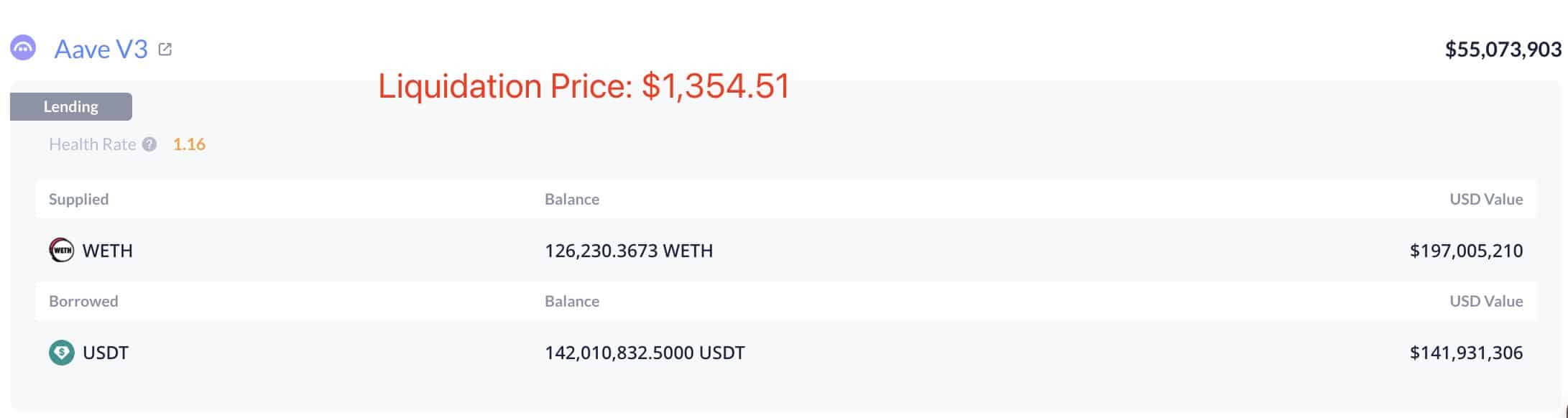
Meanwhile, another investor borrowed $142 million in Tether [USDT] from Aave [AAVE] and accumulated 87,680 ETH at an average price of $1,620. The activity suggests some large holders view current prices as attractive despite persistent market weakness.

Source: X

However, the leveraged position carries a health factor of 1.16 and faces liquidation near $1,354, making Ethereum’s next move increasingly important for determining whether this conviction proves correct.

What’s next for Ethereum?

Ethereum’s selloff has not unfolded in a vacuum.

While ETF investors have continued pulling capital from the market, on-chain data shows other participants stepping in. Exchange Reserves remain near multi-year lows around 15 million ETH, while large holders continue withdrawing coins and adding to positions during the decline.

Yet not all of that demand looks the same. Some buyers are using borrowed capital to accumulate ETH through lending protocols such as Aave. That explains why buying interest has persisted despite weeks of institutional outflows.

The market now faces a different question. Whales appear willing to absorb supply, but leveraged demand is far less stable than spot accumulation. Whether that buying can offset ETF selling remains one of the key forces shaping Ethereum’s next move.


Final Summary

  • Ethereum [ETH] remains caught between persistent ETF outflows and growing whale accumulation, leaving demand absorption as the key market test.
  • Ethereum whale buying continues supporting the market, but leveraged positions keep liquidation risks elevated near critical levels.


Source link

Phillies Prospect Who Ditched Yankees Turns Heads In Debut

0
Phillies Prospect Who Ditched Yankees Turns Heads In Debut


The Philadelphia Phillies continue to invest heavily in international talent as they attempt to sustain long-term success around a veteran major-league core.

And while much of the attention remains focused on the club’s pursuit of another postseason run, led by international successes like Cristopher Sanchez, the organization is also closely monitoring a new wave of prospects beginning their professional careers.

Sanchez was relatively undervalued before he emerged as a frontline starter for the Phillies and propelled a record-setting scoreless streak this season. But some international baseball players instantly arrive with intriguing scouting reports and considerable expectations. And others bring unique stories that make their first professional appearances particularly noteworthy.

One of the Phillies’ newest international signings delivered both this week, turning heads during his professional debut in the Dominican Summer League.

ForbesYankees Raise Season-Ending Surgery Concern In Aaron Judge Injury Update

Philadelphia Phillies’ Standout Pitcher Enjoys Strong Debut After Leaving New York Yankees

Before taking the mound, Yilmar Samudio had already generated attention as an intriguing young pitcher in Philadelphia’s 2026 international class. The 17-year-old right-hander from Panama entered professional baseball with an impressive reputation.

“Baseball America says this ‘a fastball that touches 96 mph,” Steve Potter noted for his scouting website. “‘It’s a strong fastball for his age with good feel to pitch. His ability to spin a breaking ball gives him another standout trait.'”

Samudio quickly lived up to that billing during his first Dominican Summer League appearance.

“Yilmar Samudio shines in his debut in the Dominican Summer League,” Sanchez wrote on X, formerly Twitter. “He was the best pitcher of the opening day.”

ForbesDodgers’ Dave Roberts Offers 4-Word Response On Trading For Tigers’ Tarik Skubal

Former New York Yankees Pitcher Finds Bigger Bonus With Philadelphia Phillies

Sanchez added that Samudio went three innings with no hits, no earned runs and six strikeouts. And he added that the teenager recently left a pre-agreement with the New York Yankees to land a bigger deal with the Phillies.

“He had a pre-agreement with the Yankees for $100,000,” Sanchez added. “However, after the dismissal of his international director, the deal fell through and he ended up signing with the Phillies for $150,000.”

The Yankees replaced longtime director Donny Rowland with Mario Garza earlier this year.

As a result, the Yankees’ loss could ultimately become Philadelphia’s gain. While it is far too early to draw long-term conclusions from a single outing, the Phillies were clearly willing to invest more aggressively after the Yankees’ original agreement fell apart.

For now, the young right-hander’s professional career with the Phillies couldn’t have gotten off to a much better start. After a signing process that unexpectedly redirected him away from the Yankees, Samudio rewarded the Phillies with a promising start.


Source link

Arthur Hayes dumps zcash holdings after Orchard Pool vulnerability revealed

0
Hyperliquid's HYPE drops 10% as Arthur Hayes exits position despite $150 price target

Arthur Hayes, chief investment officer of Maelstromfund, said he liquidated his entire zcash (ZEC) position after a developer disclosed a potential critical vulnerability in the network’s Orchard Pool.

Hayes, who previously championed the privacy token, said on X that while he believed it was extremely unlikely that any minting would take place, it could not be cryptographically proven impossible.

The now-plugged vulnerability was disclosed by Shielded Labs, which said a major issue went undetected for four years and could have allowed a hacker to print unlimited counterfeit tokens, damaging trust in the crypto’s supply and its value. The token slumped following the announcement and was recently down 42% over 24 hours.

“I read about the exploit yesterday, and didn’t appreciate how it violated my narrative mental map,” said Hayes. “The 30% dump made me rethink, and I had to take profit on the entire position.”

The vulnerability, present since 2022, was discovered on May 29 and fixed June 1, Shielded Labs said.

Hayes, who also co-founded the BitMex exchange, said he would reevaluate his stance moving forward and that, if his assumptions were proven incorrect, he would buy ZEC again “hopefully at lower prices.”

Blockchain analytics and intelligence firm Arkham wrote on X that one large investor lost over half the value of his $174 million ZEC stash.

“He hasn’t sold ZEC for 6 months. Ouch,” said Arkham.


Source link

Best CD rates today, Sunday, June 7, 2026: Lock in up to 4% APY

0
Best CD rates today, Sunday, June 7, 2026: Lock in up to 4% APY


Find out how much you could earn by locking in a high CD rate today. A certificate of deposit (CD) allows you to lock in a competitive rate on your savings and helps your balance grow. However, rates vary widely across financial institutions, so it’s important to ensure you’re getting the best rate possible when shopping around for a CD. The following is a breakdown of CD rates today and where to find the best offers.

Overview of CD rates today

Historically, longer-term CDs offered higher interest rates than shorter-term CDs. Generally, this is because banks would pay better rates to encourage savers to keep their money on deposit longer. However, in today’s economic climate, the opposite is true.

Today, Sunday, June 7, 2026, the highest CD rate is 4% APY. This rate is offered by Marcus by Goldman Sachs on its 14-month CD.

How much interest can I earn with a CD?

The amount of interest you can earn from a CD depends on the annual percentage rate (APY). This is a measure of your total earnings after one year, taking into account the base interest rate and how often interest compounds (CD interest typically compounds daily or monthly).

Say you invest $1,000 in a one-year CD with 1.52% APY, and interest compounds monthly. At the end of that year, your balance would grow to $1,015.20 — your initial $1,000 deposit, plus $15.20 in interest.

Now let’s say you choose a one-year CD that offers 4% APY instead. In this case, your balance would grow to $1,040.74 over the same period, which includes $40.74 in interest.

The more you deposit in a CD, the more you stand to earn. If we used the same example of a one-year CD at 4% APY but deposited $10,000, your total balance when the CD matures would be $10,407.42, meaning you’d earn $407.42 in interest. ​​

Read more: What is a good CD rate?

Types of CDs

When choosing a CD, the interest rate is usually top of mind. However, the rate isn’t the only factor you should consider. There are several types of CDs that offer different benefits, though you may need to accept a slightly lower interest rate in exchange for more flexibility. Here’s a look at some of the common types of CDs you can consider beyond traditional CDs:

  • Bump-up CD: This type of CD allows you to request a higher interest rate if your bank’s rates go up during the account’s term. However, you’re usually allowed to “bump up” your rate just once.

  • No-penalty CD: Also known as a liquid CD, this type of CD allows you to withdraw funds before maturity without penalty.

  • Jumbo CD: These CDs require a higher minimum deposit (usually $100,000 or more), and often offer a higher interest rate in return. In today’s CD rate environment, however, the difference between traditional and jumbo CD rates may not be much.

  • Brokered CD: As the name suggests, these CDs are purchased through a brokerage rather than directly from a bank. Brokered CDs can sometimes offer higher rates or more flexible terms, but they also carry more risk and might not be FDIC-insured.


Source link

Tether overtakes Ethereum: Is crypto entering a ‘stablecoin season’?

0
Tether overtakes Ethereum: Is crypto entering a 'stablecoin season'?


One of the clearest signals of a bearish market phase comes from a key correlation.

From a technical perspective, the simultaneous decline in stablecoin market cap and risk-asset valuations suggests that investors are not simply rotating into defensive positions. Instead, they are exiting the ecosystem altogether.

In other words, rather than seeking refuge in stablecoins, capital appears to be flowing out of the market, reflecting a clear reduction in risk exposure.

To put this into perspective, the stablecoin market has contracted by more than $7 billion in less than 21 days, while investors have pulled $400 billion from the crypto market. Of course, that easily highlights this liquidity exodus in real time.

What makes this cycle particularly notable, however, is the strength of this relationship.

USDT
Source: CoinMarketCap

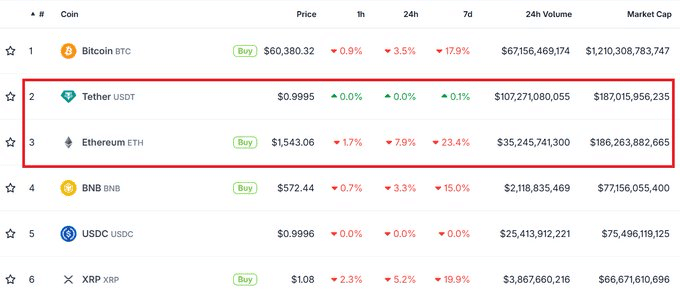
As the chart above shows, Tether’s (USDT) market cap recently surpassed Ethereum’s [ETH] after ETH’s market cap fell to around $185 billion while USDT remained relatively stable at approximately $187 billion. Notably, this was the first time in nearly eight years that USDT overtook Ethereum in market value.

Unsurprisingly, the move quickly became a major talking point across the market.

As noted earlier, this divergence reinforces the broader risk-off trend, with investors selling Ethereum while moving toward stablecoins. As a DeFi player, the impact is also visible in ETH’s TVL, which has fallen to just $36 billion.

In essence, the decline in both Ethereum’s market cap and TVL suggests that capital is not only leaving risk assets but also becoming less active on-chain, reflecting weaker investor conviction.

As a result, this trend has become increasingly visible throughout the current cycle, with some investors already referring to 2026 as a “stablecoin season.” And looking at the recent capital flows, that idea may not be as far-fetched as it sounds. 

From altcoin season to stablecoin season 

Is the market becoming too utility-driven?

Usually, capital rotates into altcoins when Bitcoin [BTC] hits resistance, as investors look for higher risk-reward opportunities across the market. This time, however, the rotation appears absent. Despite Bitcoin dominance (BTC.D) stalling around the 60% level, ETH/BTC has remained in a steady downtrend for nearly eight weeks, showing little sign of risk capital flowing into altcoins.

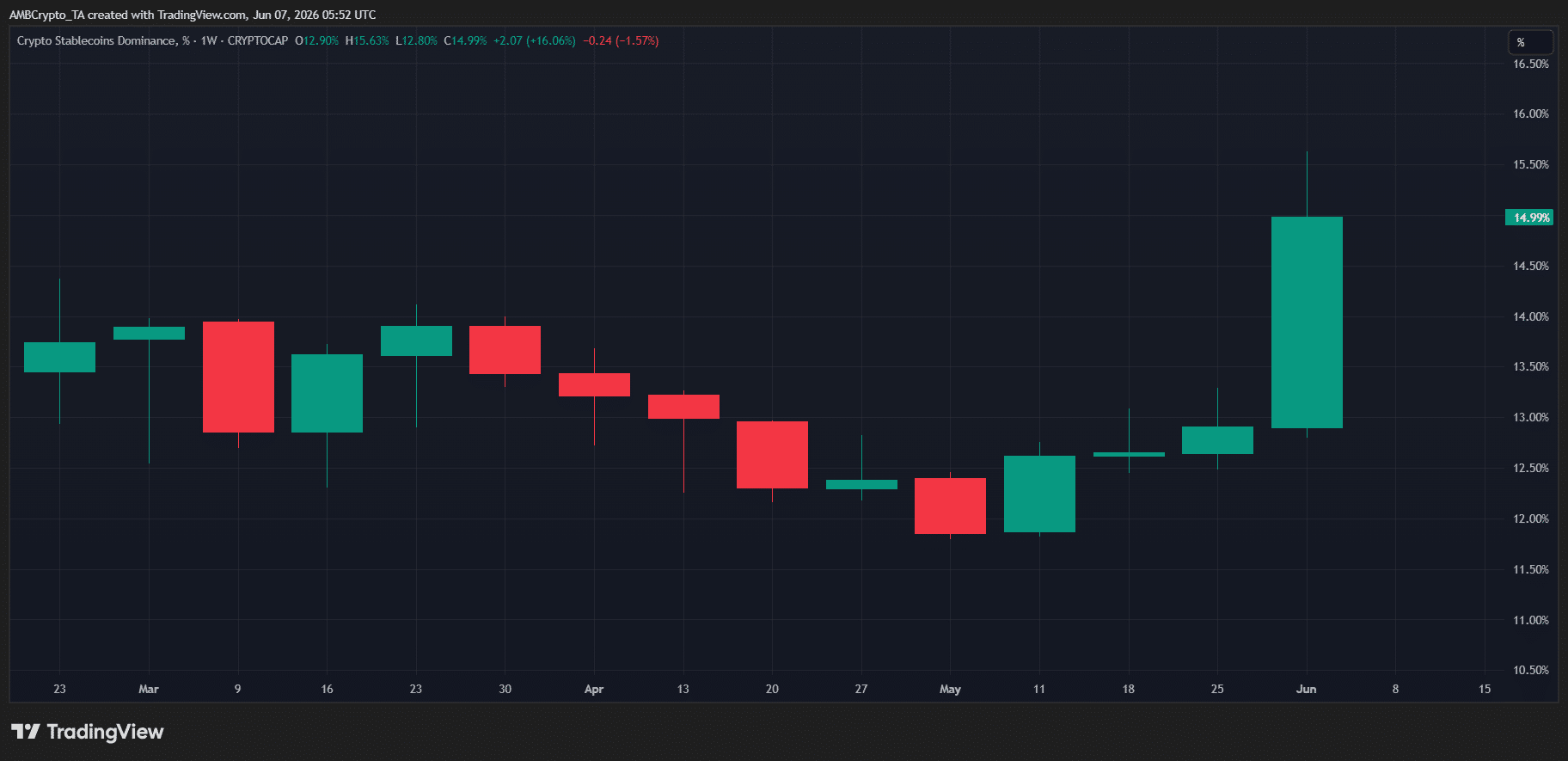
Meanwhile, the stablecoin market cap has continued to trend higher, extending its recent upside. This suggests that investors are choosing liquidity and utility over speculation.

Unlike most crypto assets, stablecoins offer an immediate use case as a store of value, trading pair, and settlement asset, making them attractive during periods of uncertainty.

USDT stablecoinsUSDT stablecoins
Source: TradingView (STABLE)

In other words, capital is flowing toward assets that serve a clear functional purpose.

As a result, investors appear more focused on preserving capital than chasing the next altcoin rally, helping fuel the narrative that 2026 may be shaping up as a “stablecoin season.” 

Tether’s recent flip above Ethereum offers a clear example.

For the first time in nearly eight years, USDT overtook ETH in market cap, highlighting the market’s growing preference for liquidity over risk. While Ethereum continues to function as the backbone of DeFi, current capital flows suggest that investors are placing a higher premium on stability and utility than on speculative upside.


Final Summary

  • Investors are reducing risk exposure, pulling capital from both crypto assets and on-chain ecosystems.
  • Stablecoins are attracting more demand than altcoins, signaling a growing preference for liquidity, utility, and capital preservation.


Source link