Home Blog Page 380

Security experts warn advanced AI is about to spark a hacking crisis for both crypto and banks

0
Security experts warn advanced AI is about to spark a hacking crisis for both crypto and banks

A major bug found in the top privacy network Zcash, using artificial intelligence, may be a warning sign that similar undiscovered flaws exist across crypto and banking software.

What’s worrying the crypto community is that the bug, which had existed in the network for 4 years, was only found recently by Shielded Labs, a nonprofit developer on the privacy token system, using Anthropic’s newly released Opus 4.8 AI model. The vulnerability, which Zcash said “has been remediated,” if left undetected, could have allowed an attacker to print unlimited counterfeit tokens.

The disclosure had already caused panic among the crypto community and took the Zcash token down nearly 38% in the last 24 hours. Some even said on social media that “Crypto is dead. We should have pivoted to AI.”

Now, the question everyone is asking is: with AI getting better and the world bracing for the release of Anthropic’s newest Mythos model, which is supposed to be much more capable of identifying and chaining together weaknesses across systems, is the crypto industry’s security in jeopardy?

However, the prominent crypto venture capital firm Dragonfly (an early investor in Zcash) and its Managing Partner, Haseeb Qureshi, have a slightly different take on AI and crypto’s security. In his view, AI finding vulnerabilities is a good thing as it will only make the code better.

“While AI found this bug, AI will also deliver the fix for the whole category: formal verification. I’m very bullish on this as the path to harden all software across the industry,” he said on a X post.

While Haseeb’s firm continues to hold Zcash and is bullish on AI’s role in crypto security, Ben Goertzel, the CEO of AI firm SingularityNET, told CoinDesk that similar vulnerabilities aren’t just limited to crypto security, but are likely hiding in the traditional banking system as well.

“Other cryptocurrencies are not vulnerable to this specific bug, which was a simple logic error in the Zcash implementation,” Goertzel said, explaining that other cryptocurrencies are “certainly very much likely to possess similar vulnerabilities, which are likely to be found by AI tools in the coming weeks and months.”

Moreover, Goertzel said that “software infrastructures of banks and other centralized institutions are also very likely to embody serious bugs to be found by AI tools in the near future as well.”

‘Formal verification’

So what is an actual solution for this AI threat?

Both Qureshi and Goertzel said that cryptographical code and global software infrastructure must transition to “formal verification.”

The process is essentially “writing proofs of mathematical theorems in such a way that these theorems can be checked automatically,” as Ethereum’s co-founder Vitalik Buterin explained. He noted that AI-assisted formal verification could become one of the most important tools for cybersecurity, as increasingly advanced AI systems make it easier to discover software vulnerabilities.

And Qureshi echoed that sentiment.

“Formally verified cryptography can’t have implementation bugs by construction,” he said. “Right now AI is surfacing vulnerabilities across all our software–browsers, OSes, and blockchains are no exception,” he added, noting that formally verified software would be the “only path forward for mission-critical software,” which Zcash has made its focus on its roadmap.

Goertzel, meanwhile, explained why developers aren’t already using this formal verification process to make their software ironclad.

He argued that while the “Rust” programming language used by Zcash can be formally verified, developers rarely do it because it requires extra work. Furthermore, Goertzel noted that core Rust libraries often use “unsafe” constructs that are difficult to verify.

However, rewriting them to be safe would make the software slower: A problem, he stated, that could be fixed by using advanced techniques such as “supercompilation” to boost performance.

An asymmetric security war

But implementing those protections is easier said than done, CEO and co-founder of security firm CertiK, Ronghui Gu, told CoinDesk.

Defending against these threats has become an unequal battle, Gu said.

“We’re currently seeing an AI token consumption war in which hackers are highly motivated by profit, he said. “To find an exploit, they can burn a massive number of AI tokens on a single target, such as a project or smart contract.”

Gu explained that profit-driven hackers are currently engaged in a token consumption war, burning massive amounts of computing power to target individual smart contracts. Because security firms must protect hundreds of clients simultaneously, they cannot allocate the same concentrated resources to a single target without incurring significant capital costs.

To shield from this asymmetric risk, Gu said security firms must integrate automated scanners directly into daily development workflows through smaller, on-demand sessions, while relying on mathematical proofs to guarantee that contracts satisfy key security properties.

For Gu, the challenge is no longer simply finding bugs before attackers do; rather, it’s about scaling defenses against these vulnerabilities quickly enough to keep pace with increasingly powerful AI systems.

While the debate over how to stay ahead of such vulnerabilities will likely continue, as AI gets better, faster and smarter, the question for all developers is how to ensure such incidents never happen again.

Perhaps ZODL CEO Josh Swihart (former CEO of Electric Coin Company, a key developer of Zcash) put it aptly:

“The more interesting question is how we ensure that vulnerabilities never happen again. The best answer is formal verification,” Swihart said in his X article, titled “Never Again.


Source link

Decoding Thursday’s SIREN bull trap and what’s next for traders

0
Decoding Thursday's SIREN bull trap and what's next for traders


Bitcoin has shed 1.5% of its value in the last 24 hours, with the crypto down by over 15% over the past week. As expected, this has affected the altcoin market’s sentiment negatively, with its capitalization falling by 9.7% in a week.

According to Glassnode, the memecoin sector fell by 10% too. Altcoins, especially weak ones with a lack of demand or narrative, can continue to bleed against Bitcoin even if the latter turns its own trend around.

Siren [SIREN], for its part, lost 12% in 24 hours. Its daily trading volume declined by 40%, with Open Interest falling by 17% in a day too – Both hinted at sidelined market participants and low appetite for risk-taking.

In a previous report, AMBCrypto had contemplated if the temporary price spike on Thursday, 04 June, could become a bullish reversal. At the time, a flip of the $1.13 resistance was needed to confirm a long-term trend reversal.

As Bitcoin inched closer to the $60K-mark though, sentiment increasingly turned fearful. This has since already influenced SIREN’s price action.

SIREN bulls turned away from a fair value gap

SIREN 1-day Chart
Source: SIREN/USDT on TradingView

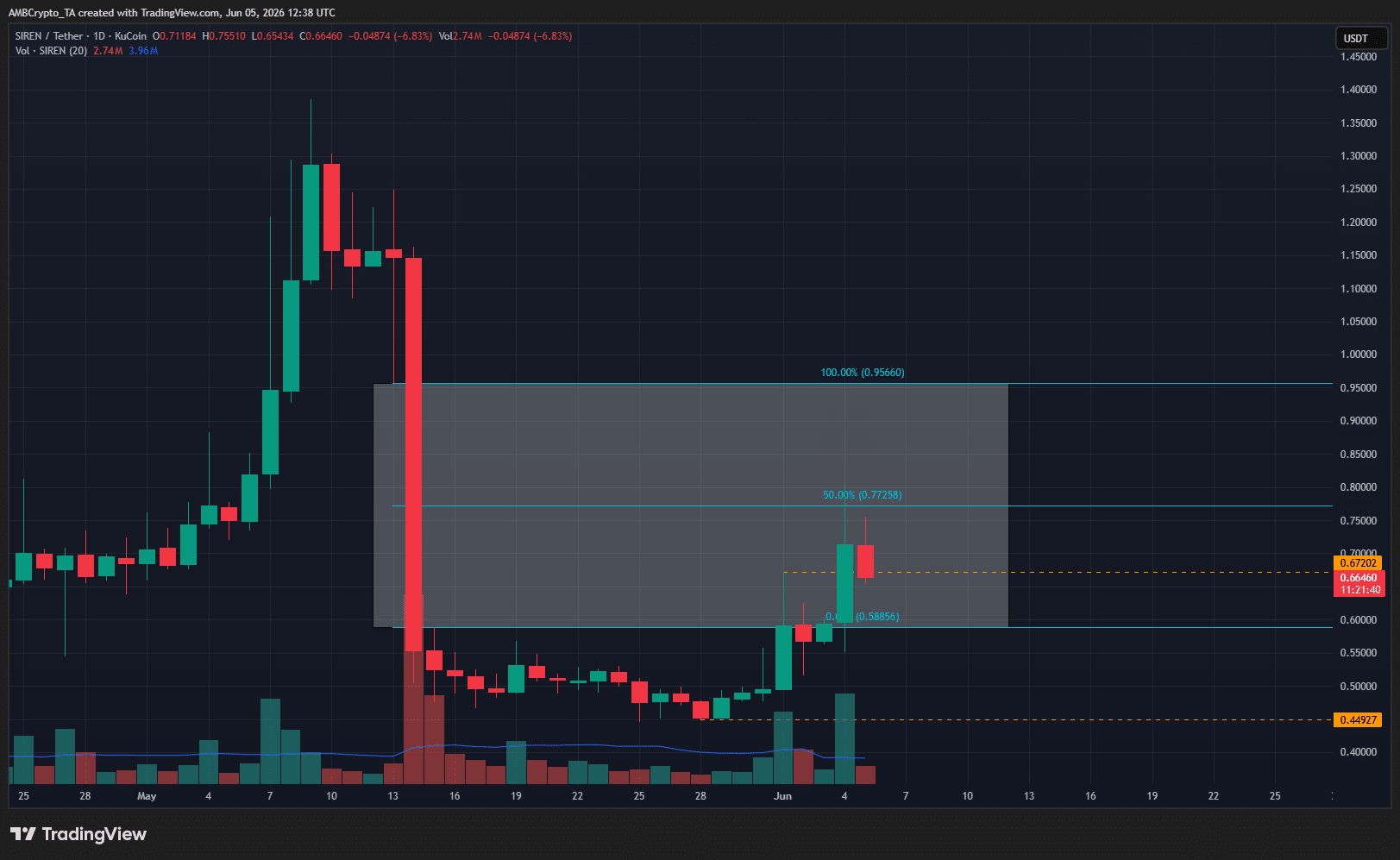
The drop to $0.131 in April shifted the 1-day SIREN structure bearishly. A sizeable relief rally peaked in May and reversed quickly. A large fair value gap (white) was left on this timeframe.

It stretched from $0.956 to $0.588. Some technical analysts like to use the mid-point of such a gap as S/R. In this instance, SIREN reacted bearishly from the mid-point of the FVG.

Traders’ call to action – Sell

SIREN 1-hour ChartSIREN 1-hour Chart
Source: SIREN/USDT on TradingView

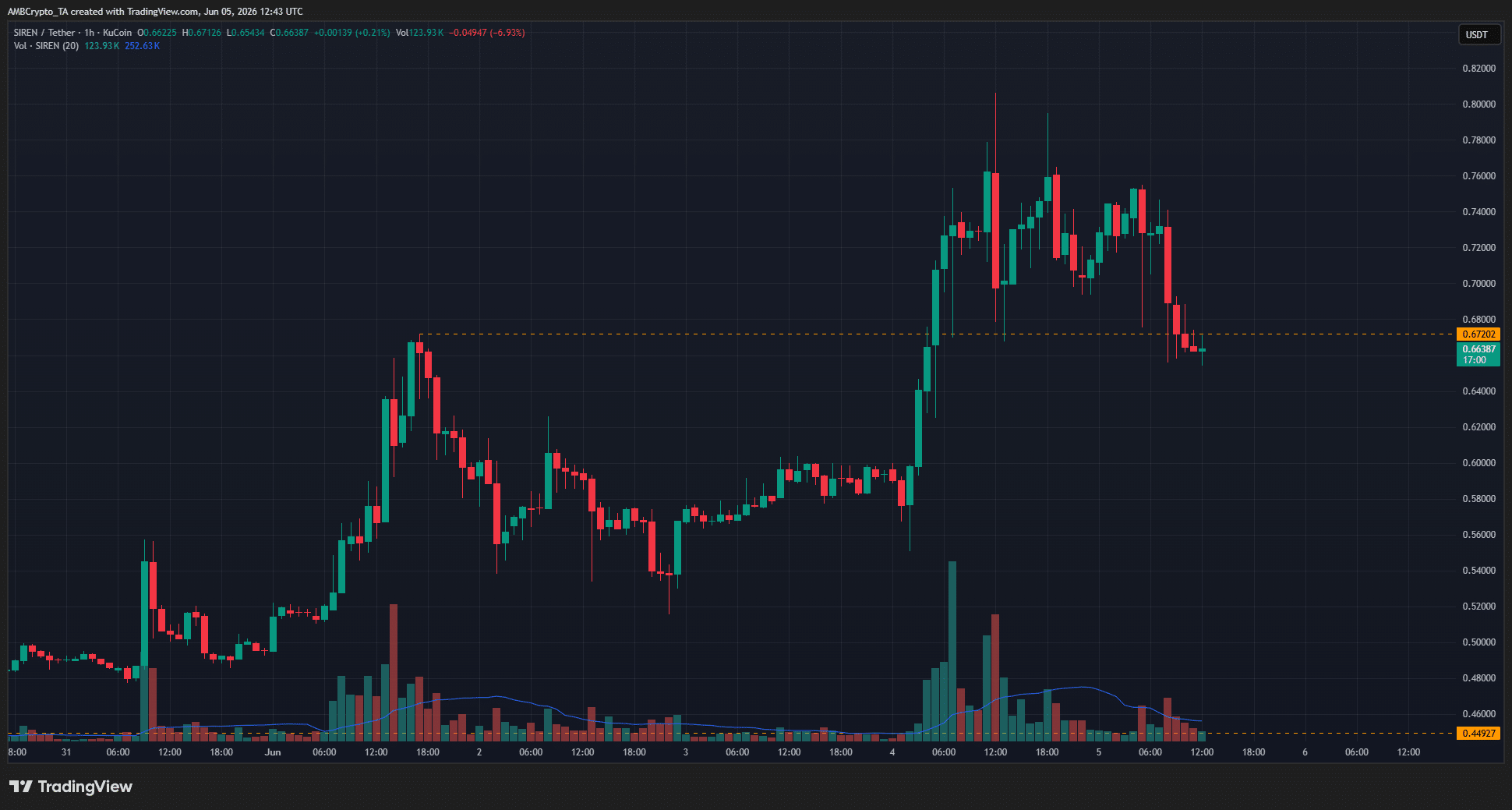
The former local high at $0.672 (orange) was flipped to support in the last 36 hours, but the bulls were not able to defend it for long. In fact, the altcoin’s price action at press time showcased SIREN’s slump back below this level.

Combined with the higher timeframe structure, the rejection from the FVG’s midpoint, as well as the bearish pressure piling on Bitcoin, it would seem that SIREN will fall towards the $0.575 and $0.48 local support levels next.


Final Summary

  • Relentless selling pressure on Bitcoin has negatively affected altcoins.
  • SIREN rallied briefly on Thursday, 04 June, but the bulls were immediately rebuffed.


Source link

Tokenization specialist Securitize clears key hurdle to go public on NYSE

0
Tokenization specialist Securitize clears key hurdle to go public on NYSE

Securitize, the tokenization specialist backed by BlackRock, moved a step closer to becoming a publicly traded company after the U.S. Securities and Exchange Commission approved a key filing tied to its planned merger with a special purpose acquisition company (SPAC).

The agency declared Securitize’s registration statement for its proposed combination with Cantor Equity Partners II (CEPT) effective. The merger is with a blank-check company sponsored by an affiliate of Cantor Fitzgerald, the companies said Friday.

The deal now heads to a shareholder vote scheduled for June 29. If approved, the transaction is expected to close shortly thereafter, with the combined company trading on the New York Stock Exchange under the ticker “SECZ.”

The milestone comes as tokenization has emerged as one of the fastest-growing trends in finance. The process involves creating blockchain-based representations of traditional assets such as funds, bonds, private credit and equities. Proponents argue the technology can reduce settlement times, lower costs and enable assets to trade around the clock.

The market has attracted growing interest from global banks and asset managers including BlackRock, Franklin Templeton, JPMorgan and Fidelity. The tokenized asset market nearly tripled in a year surpassing $30 billion, RWA.xyz data shows. Citi has projected tokenized assets could reach $5.5 trillion by 2030, while a joint report from Boston Consulting Group and Ripple estimated the market could grow to $18.9 trillion by 2033.

Securitize has become one of the sector’s most prominent infrastructure providers, supplying the tokenization, transfer-agent and trading technology behind products from firms including BlackRock, Apollo, KKR, Hamilton Lane and VanEck.

The company’s highest-profile partnership is with BlackRock’s BUIDL fund, a tokenized money market fund launched in 2024 that has grown into one of the largest tokenized Treasury products in the market.

The firm is also helping the New York Stock Exchange build its tokenized securities platform earlier this year.

Securitize going forward with its plan to go public is notable as several crypto companies such as Kraken and Consensys have halted efforts amid turbulent crypto markets.


Source link

How much life insurance do I need? A guide for every life stage.

0
How much life insurance do I need? A guide for every life stage.


Close to 100 million American adults report that they need more life insurance. Determining how much life insurance you need isn’t one-size-fits-all and depends on your financial goals, what you owe, who depends on you, and your life stage.

Let’s take a look at the factors that determine how much life insurance you need, how your life stage affects coverage, and the most common methods for calculating the right amount for your family.

Do you even need life insurance?

Life insurance is normally a benefit offered by an employer. While employees see the policies in their benefits portal at some point in their careers, they might not understand exactly what they’re seeing and may sign up for a policy just to check a box.

So, do you actually need life insurance? If you don’t have any children or dependents and can pay for end-of-life costs on your own, you might not. But if you’re taking your financial plan seriously, life insurance can offer protection for the future.​

Factors that determine how much life insurance you need

Calculating how much life insurance an individual needs is similar to planning for retirement. In retirement planning, we ask ourselves: How much income will we need to live on when we no longer have active income? A financial planner would usually take what you live on today, according to your fixed and variable expenses, and then adjust it by an estimated rate of inflation.

​In the case of life insurance, you take into account the missing income of the insured and the ongoing budget of the family. The DIME method lays out the factors to consider in four categories. (Later, we’ll talk more about this method as a way to calculate how much life insurance you need.)

  • Debt: Add up your outstanding debts, including credit cards, car loans, or personal loans, etc.

  • Income: Multiply your annual income by the number of years your family might need your support after you’re gone. One rule of thumb is to account for five to 10 years’ worth of income replacement, factoring in ongoing fixed expenses and debt payments. You can also choose to get enough life insurance to pay off debts completely.

  • Mortgage: Determine the balance on your mortgage so your family can afford to stay in the home.

  • Education: Estimate any future educational costs for your children, such as private school or college tuition.

Term vs. permanent life insurance: Which one do you need?

Here are the key differences between term life insurance and permanent life insurance:

Term life insurance

  • Covers you for a specific period, typically 10, 20, or 30 years

  • Pays out a death benefit if you die during the term

  • Cheaper premiums

  • Has no cash value; this is just insurance

  • Perfect for covering specific financial obligations (mortgage, kids’ college, income replacement during working years)

  • Expires if you outlive the term

Permanent life insurance

  • Covers you for your entire life (permanently, as the name implies) as long as premiums are paid

  • Over time, builds cash value you can borrow against or withdraw

  • Higher premiums: often five to 15 times more expensive than term for the same death benefit

  • Has several types: whole life (fixed premiums, guaranteed growth), universal life (flexible premiums), and variable life (cash value tied to investments)

  • Can serve as an estate planning or wealth transfer tool

How to calculate how much life insurance coverage you need

Here are a few ways to calculate how much life insurance you need.

DIME method

We talked about this method earlier, but here’s how to use it to calculate how much coverage you’ll need to protect your family.

Debt: Add up all outstanding debts your family would be responsible for if you died, excluding your mortgage (that’s covered separately):

  • Car loans

  • Credit card balances

  • Student loans

  • Personal loans

  • Medical bills

  • Funeral expenses

Income: Multiply your current income by the number of years your family would need income replacement. A common benchmark is 10 years, but you can adjust based on the age of your children or your partner’s ability to work.

Mortgage: What’s the full remaining balance on your home mortgage? You’ll want an amount that lets your family pay off the mortgage in full and keep the house.

Education: What’s the estimated cost of college for each child? A common estimate today is $100,000–$200,000 per child, depending on whether the university is public or private.

Here’s an example of how the DIME method works for calculating coverage:

DIME method

Amount

Total debt

$30,000

Income ($60,000 x 10 years)

$600,000

Mortgage

$250,000

Education ($150,000 x 2 kids)

$300,000

Total coverage needed

$1,180,000

Multiple of salary method

The multiple of salary method is probably the simplest way to calculate your coverage. The common rule of thumb is to simply multiply your salary by seven to 12. The number you choose depends on things like your age and life stage.

So, if you make $100,000 a year, you’d want roughly $1-1.2 million in coverage. This payout will allow the survivors to carry on for a given period and is typically invested at a modest rate to generate ongoing income for your dependents.

Keep in mind that this is just a starting point and doesn’t account for things like debt, number of children/dependents, existing assets or savings, and future expenses (like college).

Capital needs analysis method

The capital needs analysis method is a more precise way to calculate life insurance coverage. Instead of multiplying your salary by a set number, this method works backward from a lump sum. That lump sum amount is set by figuring out how much money, earning a reasonable return, would support your family’s ongoing needs.

This method has two variations:

  • Capital retention: Your beneficiaries live off investment returns only, with the principal intact. This approach preserves wealth for your heirs.

  • Capital liquidation approach: Your beneficiaries draw both principal and returns over a set time frame. This approach typically requires less coverage.

Here’s an example:

  • Your family needs $80,000 a year

  • You assume a 5% annual return on the invested payout

  • $80,000 / 0.05 = $1.6 million in coverage

Special circumstances that affect how much life insurance you need

In certain cases, life insurance coverage should be approached more thoughtfully, depending on your finances and current situation. Here are a few common examples.

High-net-worth individuals

When your net worth is high, your concerns might be different, and you may think of life insurance as a wealth preservation and transfer tool.

Large estates face high federal taxes, and without proper planning, heirs may be forced to liquidate assets just to pay them. Life insurance is one of the most tax-efficient ways to transfer wealth to heirs. These individuals often place life insurance inside an Irrevocable Life Insurance Trust (ILIT) so the death benefit is income tax-free.

Read more: Is life insurance taxable? Here’s when you might have to pay.

Business owners

Business owners have to think beyond just personal income replacement, because their death will affect the business itself. This means having multiple layers of coverage: key person insurance protects the business from the financial loss of a key player, and a funded buy-sell agreement ensures a smooth transition of ownership between partners. Business debts come into play here too.

Long story short: A business owner needs to think about both personal and business-specific life insurance policies.

Stay-at-home spouses

Stay-at-home spouses are often underinsured because there’s no paycheck involved, but their economic impact on the family is enormous.

If a stay-at-home spouse dies, the surviving spouse would face out-of-pocket costs for childcare, housekeeping services, transportation, and other hidden work. Life insurance coverage for a stay-at-home spouse should be calculated by estimating the annual cost of replacing all these services and multiplying that by the number of years the services would still be necessary.

On the flip side, a larger policy is necessary for the working spouse. That way, the stay-at-home spouse could continue to stay home (not work) and still have financial support to take care of the household.

Those with special needs dependents

Families with special needs dependents will need to provide financial care for their dependents long after standard life insurance runs out. That means coverage amounts need to be significantly larger than the norm. Permanent life insurance is usually better than term in this scenario since coverage doesn’t expire.

Keep in mind that the benefit should be put in a trust rather than paid directly to the dependent, since an inheritance may disqualify the dependent from important government benefits. If you’re financially planning for a special needs dependent, consulting with a life insurance professional, financial planner, or estate planning attorney is a good idea.

What is the right amount of life insurance at every life stage?

Life stage matters when deciding how much life insurance coverage you need. Typically, those in early and late life need less coverage. Here’s how it breaks down:

Life stage

Age (estimate)

Primary goal

Policy type

Coverage level

Young, single

18-25

Lock in low rates; cover co-signed debts or dependents (parents, siblings)

Term (10-20 years)

Low

Young, married, no kids

25-35

Protect shared debts, mortgage, and income

Term (20-30 years)

Moderate

Married with young kids

30-45

Full income replacement, mortgage payoff, childcare, education

Term (20-30 years)

Highest

Established family, older kids

45-55

Income replacement, mortgage payoff, education

Term and consider permanent

High

Empty nester

55-65

Spouse protection, estate planning, and end-of-life expenses

Permanent or shorter term

Moderate

Retirement

65 and up

End-of-life expenses, charitable donations, and estate tax liquidity

Permanent (whole/universal)

Low to moderate

Do I need life insurance? FAQs

Is $500,000 enough life insurance?

This will depend highly on income, debt, and other ongoing obligations. Existing assets are also an essential line item to evaluate to determine if someone needs more or less coverage.​

Do I need a medical exam to get life insurance?

Not always. No-exam policies are becoming more common. Medical exams, in some cases, can help to reduce premiums. Overall, age is probably the biggest factor in underwriting policy premiums and insurability.

Do I need life insurance if I’m single?

Possibly. Even if you’re not married, the family could bear the burden of final expenses and any outstanding debt (if they co-signed for any loans) — just because you’re not married doesn’t mean there aren’t any others who depend on you financially.

Can I have more than one life insurance policy?

Yes. Employer-provided policies are common. In addition, people often combine these with their own term or whole-life policies to increase coverage and avoid the lack of portability that many employer plans have. Estate-planning policies, like ILITs, are another common layer of protection.

When should I update my life insurance coverage?

Update your coverage when major life events happen: having a child, purchasing a home, or starting a business with partners. Your policy type and coverage amount will depend on the financial obligations you hold and the time frame you expect those obligations to last.


Source link

Zcash says Orchard bug could have enabled undetectable counterfeit ZEC

0
Zcash says Orchard bug could have enabled undetectable counterfeit ZEC


Zcash developers have revealed that a critical vulnerability in the network’s Orchard shielded pool could have allowed attackers to create unlimited counterfeit ZEC without detection.

In a detailed post published June 5, Shielded Labs said the flaw existed from Orchard’s activation in May 2022 until an emergency fix was deployed earlier this week.

The disclosure significantly escalates the severity of what was initially described as a coordinated network upgrade affecting Orchard transactions.

According to the report, the vulnerability could generate “unlimited, undetectable counterfeit ZEC” within the Orchard pool.

Developers stressed that there is currently no evidence that the flaw was exploited before remediation. However, they also acknowledged there is “no definitive way to determine using only cryptography whether such exploitation occurred.”

Exploit reportedly worked in testing environment

The vulnerability was discovered on May 29 by security researcher Taylor Hornby during an ongoing security review commissioned by Shielded Labs.

According to the disclosure, Hornby successfully created a working exploit in a local testing environment that generated unlimited counterfeit ZEC.

The flaw reportedly stemmed from an “under-constrained element” in the Orchard circuit that allowed arbitrary false inputs to pass elliptic-curve multiplication checks.

Developers said the issue persisted for roughly four years before the emergency remediation was completed on June 2. The remediation was done through a coordinated ecosystem-wide response involving Zcash developers, infrastructure operators, and validators.

Privacy protections created a verification problem

One of the most serious implications of the vulnerability is that Zcash cannot cryptographically prove whether counterfeit coins entered circulation before the flaw was fixed.

Because Orchard transactions are shielded by privacy-preserving cryptography, developers said there is no reliable way to independently verify whether the exploit was ever used on the live network.

Shielded Labs said it believes prior exploitation was unlikely, partly because the vulnerability had eluded scrutiny by experienced cryptographers for years. It was only uncovered through a targeted security effort using advanced AI-assisted auditing tools.

The company also said the exploit window narrowed significantly once the flaw was identified and disclosed internally.

Still, the uncertainty surrounding supply integrity is likely to reignite long-running debates around hidden inflation risks in privacy-preserving cryptocurrency systems.

AI-assisted auditing helped uncover the flaw

The disclosure also highlights the growing role of artificial intelligence in advanced security research.

Shielded Labs said Hornby used Anthropic’s Opus 4.8 model alongside custom AI-assisted auditing techniques during the Orchard review.

According to the report, the vulnerability was discovered shortly after the updated AI model was released on May 28.

Zcash may pursue another network upgrade

Shielded Labs said it is now exploring a follow-up network upgrade to verify the integrity of the Zcash supply and eliminate uncertainty about counterfeit ZEC.

The proposal would involve deploying a new shielded pool and implementing “turnstile accounting” to verify coins moving out of Orchard.

The organization said additional details on the proposal and its tradeoffs will be released next week.

Concerns around hidden inflation risks in shielded systems have circulated in crypto communities for years. 

In a 2025 post, Crypto Bitlord warned that compromising Zcash’s shielded infrastructure could, in theory, enable unlimited undetected ZEC creation. Although the newly disclosed Orchard flaw involved a different technical mechanism.


Final Summary

  • Zcash developers revealed an Orchard vulnerability could have enabled unlimited undetectable counterfeit ZEC before an emergency fix was deployed.
  • Developers said there is no cryptographic way to determine whether the flaw was exploited before remediation conclusively.


Source link

XRP price news: What next as Ripple-linked token falls 5% to $1.10

0
XRP price news: What next as Ripple-linked token falls 5% to $1.10

XRP is no longer fighting over $1.20. It’s fighting over whether $1.10 holds. The latest selloff came with the kind of volume usually associated with forced liquidations rather than orderly selling, pushing the token to its weakest levels in months before dip buyers finally showed up near $1.09.

News Background

• XRP ETFs recorded roughly $4 million in inflows after seeing their first daily outflow in three weeks, bringing cumulative inflows to around $1.5 billion.

• Market sentiment deteriorated sharply across crypto, with the Fear & Greed Index falling into extreme fear territory as traders reacted to broader macro uncertainty.

• XRP also slipped behind USDC in market capitalization rankings after the selloff pushed its value below $75 billion.

Price Action Summary

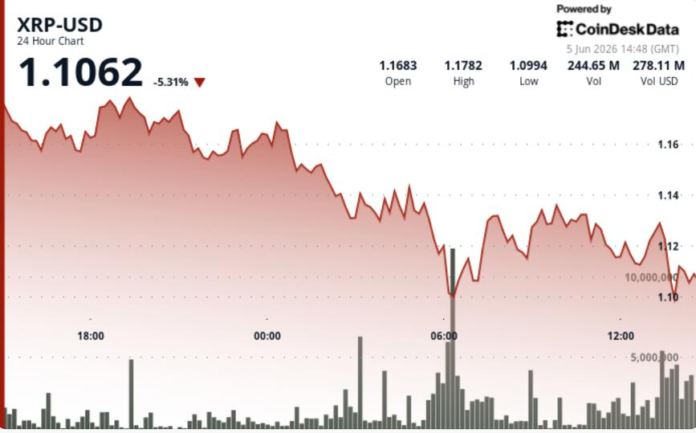
• XRP fell from $1.17 to $1.11 during the 24-hour session, touching lows near $1.09 before recovering slightly.

• The biggest move came during the June 5 06:00 UTC session, when volume surged to 268.2 million XRP and accelerated the breakdown.

• A failed rally toward $1.133 later reversed sharply, sending price to fresh lows before buyers stepped in near $1.10.

Technical Analysis

• The key takeaway is that support levels keep becoming resistance. What was a buying zone around $1.20-$1.25 just days ago is now where sellers are reappearing.

• The move below $1.10 briefly pushed XRP into one of the most oversold conditions seen in years, with weekly RSI readings reaching levels that historically appeared near major cycle lows.

• Even so, oversold does not automatically mean bullish. Markets can stay oversold for longer than traders expect, especially during liquidation-driven declines.

• The bounce from $1.09 showed signs of seller exhaustion, but recovery volume remained weaker than the selling that preceded it.

What traders should watch

• $1.09-$1.10 is now the most important support zone on the chart. Losing it would shift focus toward the $0.92 area highlighted by several analysts.

• $1.12-$1.13 becomes the first recovery zone XRP needs to reclaim before any stabilization narrative gains credibility.

• The broader trend remains bearish until XRP starts reclaiming former support levels rather than simply bouncing from oversold conditions.

• Traders looking for evidence of a durable bottom will likely want to see stronger volume on rebounds than on selloffs, something the market has not yet delivered.


Source link