Home Blog Page 381

Aren Graphic Solutions deploys Cartes label printing equipment

0
Aren Graphic Solutions deploys Cartes label printing equipment


UAE-based Aren Graphic Solutions, which is linked to Quadriga USA, has installed Cartes label printing, embellishment and converting equipment.

The project was supported by Wassim Khatib of Packmind, Cartes’ representative in Dubai.

Khatib commented: “The Middle East market is showing increasing interest in advanced label technologies, and Cartes solutions represent a strong opportunity for converters who want to combine quality, flexibility and innovation.”

The new setup is intended to help Aren Graphic Solutions expand its work in premium label applications, widen production options and increase the value of output for clients in the Middle East and overseas.

The Cartes system is expected to support the company in producing more complex label printing, embellishment and converting work, while improving flexibility and efficiency in manufacturing.

Aren Graphic Solutions is part of an international network centred on label production, serving brands and printing professionals with technical solutions.

The installation adds to Cartes’ presence in international markets and marks a further development of its activity with label converters focused on premium and high-output production.

Cartes production manager Carlo Stefano Lodi said: “Dubai is an important and dynamic market, and we are proud that our technology has been chosen to support the growth of a company connected to an international group such as Quadriga USA.”

“Aren Graphic Solutions deploys Cartes label printing equipment” was originally created and published by Packaging Gateway, a GlobalData owned brand.


The information on this site has been included in good faith for general informational purposes only. It is not intended to amount to advice on which you should rely, and we give no representation, warranty or guarantee, whether express or implied as to its accuracy or completeness. You must obtain professional or specialist advice before taking, or refraining from, any action on the basis of the content on our site.



Source link

The May jobs report just blew past expectations—and maybe too far for markets

0
The May jobs report just blew past expectations—and maybe too far for markets

The labor market delivered another whopping win on Friday: 172,000 jobs in May, when economists had expected 88,000.

The even stronger surprise was in the rearview mirror: March was revised up by 29,000 to 214,000, April by 64,000 to 179,000. Combined, the two months were 93,000 stronger than previously reported.

Though such a strong labor market is good news for those fearing the economy was stalling—or that AI was eating jobs—it could make investors wince. The strong print could kill what has been left of rate-cut hopes for this year, especially as inflation persists and the conflict in Iran drags on. The 10-year bond yield jumped about 6 basis points to above 4.5%.

Unemployment held at 4.3%, however, where it’s been parked since last July, so the report’s other wildcard is defused.

The job market is rebounding in 2026 after a limpish 2025. After all the revisions were said and done, the economy added roughly 10,000 jobs a month in 2025. So far in 2026, it’s averaging 114,000.

Under the hood, however, the hiring is still relatively concentrated. Leisure and hospitality added 70,000 jobs  in May—five times its 12-month average—with restaurants and bars alone hiring 48,000. Local government added 55,000, and health care 35,000. That’s the whole party. Meanwhile, financial activities cut 22,000 jobs and is down 107,000 from its peak a year ago, and transportation and warehousing has shed 92,000 since early 2025.

Paychecks also don’t seem to be keeping up. Average hourly earnings rose 3.4% over the year—the slowest pace in four years, and below inflation running near 4%. Americans are getting hired faster and paid less, in real terms, simultaneously.

Which brings us back to the economy’s trap. For the Fed, which meets June 16–17, a labor market this resilient is yet one more reason to sit on its hands. Rates parked at 3.50%–3.75% mean borrowing costs—particularly mortgage rates—stay elevated too.

“Robust hiring drives household formation, keeps homebuyer demand resilient, and helps existing homeowners stay current on their mortgages,” said Selma Hepp, chief economist at Cotality. “On the other hand, a hot labor market signals to the Federal Reserve that rate cuts may be delayed… higher-for-longer mortgage rates will continue to strain affordability and keep a tight lid on inventory for the rest of the year.”


Source link

U.S. job growth blows past forecasts, setting stage for Fed rate hikes

0
U.S. job growth blows past forecasts, setting stage for Fed rate hikes

The U.S. economy added 172,000 jobs in May, nearly double economists’ expectations, strengthening the case for Federal Reserve rate hikes this year.

The unemployment rate held steady at 4.3%, according to data released Friday by the Bureau of Labor Statistics.

Bitcoin remained under pressure following the report, trading below $62,000 as the broader crypto market nursed steep overnight declines.

The 10-year Treasury yield jumped to 4.52% following the report. U.S. equity index futures were also lower, the Nasdaq 100 index down 1.2%. Oil prices edged modestly lower at $94 per barrel, while gold slid 1.1% to around $4,400 per ounce.

Recent economic data continue to point to a resilient U.S. economy this week. Both the ISM Manufacturing PMI and ISM Services PMI came in above expectations and remained in expansionary territory.

U.S. equities have had an incredibly strong run, with the S&P 500 about to post gains for 10 consecutive weeks and rising roughly 10% year-to-date. However, some exuberance has faded from the semiconductor sector following Broadcom’s earnings report, which disappointed investors with a weaker-than-expected outlook for AI-related chip demand.


Source link

Wellington’s $1.9B Deal to Buy Hartford Funds

0
Wellington’s $1.9B Deal to Buy Hartford Funds


Concerned about an AI bubble? Sign up for The Daily Upside for smart and actionable market news, built for investors.

It’s not just sailors and punk-rockers shipping up to Boston.

Wellington Management has agreed to acquire Hartford Funds, the asset arm of The Hartford insurance group, in a deal valued at $1.9 billion. While the firms have partnered for decades, Wellington will gain direct access to Hartford Funds’ extensive advisor relationships through the deal. Hartford Funds, which offers mutual funds, ETFs and 529 college savings plans, manages more than $160 billion in client assets and will be integrated into Wellington’s US wealth business. With the deal, Wellington said it can offer financial advisors broader access to investments, better support and a deeper distribution platform. “The US wealth market has evolved dramatically in recent years and continues to do so at a rapid pace,” Jean Hynes, Wellington CEO, told Advisor Upside. “Advisors increasingly want access to broader capabilities, more vehicles and stronger support.

Sign up for The Daily Upside at no cost for premium analysis on all your favorite stocks.

READ ALSO: Robinhood’s New AI Trader Is Raising Red Flags for Advisors and How Advisors Can Give Lackluster Annuities New Life

Buy ‘Em All

Boston-based Wellington, which is famous for its work on many Vanguard funds, oversees more than $1.3 trillion in assets, but hasn’t focused on M&A in the past. This is actually its first acquisition since the company went private over 50 years ago. As asset managers look to scale, acquisitions are quickly becoming a priority.

Over the next five years, some 1,500 mergers and acquisitions are expected in the wealth and asset management spaces, reducing the number of firms by 20%, according to a report from consultant Oliver Wyman and Morgan Stanley.

Major deals last year included:

  • BlackRock purchased HPS Investment partners in July, bringing with it more than $150 billion in private credit assets.

  • Japan-based Nomura Holdings bought Macquarie’s US and European public asset management business in December, acquiring $166 billion in retail and institutional client assets.

  • Also in December, Janus Henderson agreed to sell itself to Trian Fund Management and General Catalyst Group Management, in a transaction now valuing the business at about $8 billion.

A Thin Line. The bar to profitability used to be lower and there was enough organic growth to go around, but now mid-sized players are operating on much thinner margins, as leaders take an increasingly disproportionate share of net new money, according to the report. “We expect the combination of these factors to drive consolidation as mid-sized players become attractive targets for leaders seeking further scale and diversification,” the report said.

This post first appeared on The Daily Upside. To receive financial advisor news, market insights, and practice management essentials, subscribe to our free Advisor Upside newsletter.


Source link

Artificial Superintelligence Alliance [FET] plunges 18% in a day: What’s next?

0
Artificial Superintelligence Alliance [FET] plunges 18% in a day: What's next?


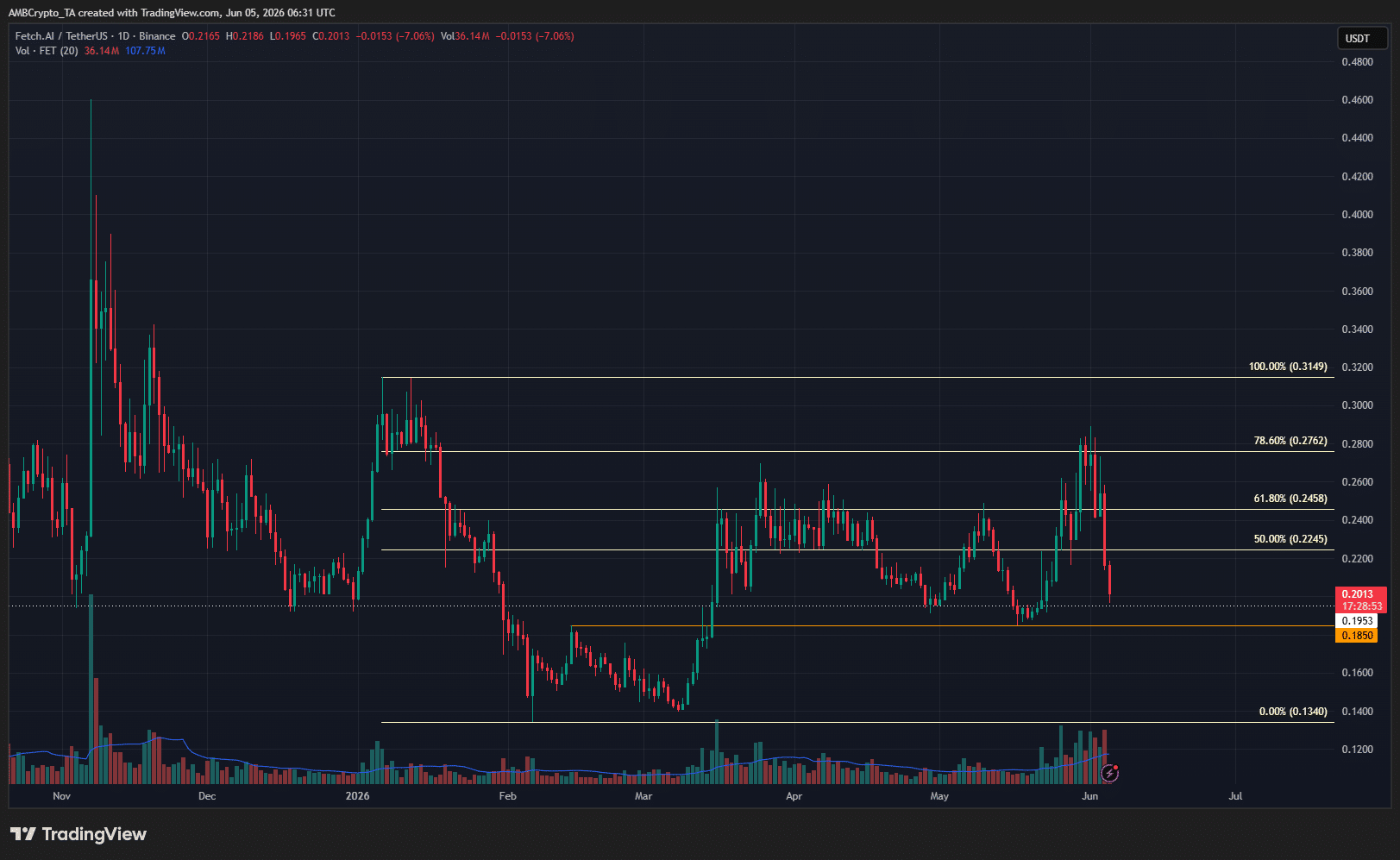
The Artificial Superintelligence Alliance [FET] token price rallied 50.94% from the 23rd of May to the 1st of June. This move spanned from $0.1914 to $0.2889, just below the $0.30 psychological round-number resistance.

AMBCrypto reported that this resistance level could be challenging to overcome. The recent rejection showed that sellers remained in control of this supply zone.

Though Binance traders had been bullish going into this supply zone, they have been headed. The question remains—was this a temporary reset, or should you anticipate a deeper bearish trend?

FET remains locked in a higher timeframe downtrend

FET 1-day Chart
Source: FET/USDT on TradingView

The higher timeframe price chart quite cleanly answered the question about FET’s ongoing trend. Despite the rally in recent months, the swing structure remained bearish.

The selloff in early 2026 saw Artificial Superintelligence Alliance token prices post a new swing low at $0.134. Like Bitcoin’s [BTC] relief rally to $82k, FET also witnessed a relief rally to the 78.6% retracement level.

The subsequent rejection has forced the price back to the $0.195-$0.20 support zone that has been respected since April.

FET is down by nearly 18% in 24 hours. Yet, though the momentum appeared firmly bearish in the short term, swing traders should watch out for a relief bounce.

Traders’ call to action: Sell the bounce

FET 4-hour ChartFET 4-hour Chart
Source: FET/USDT on TradingView

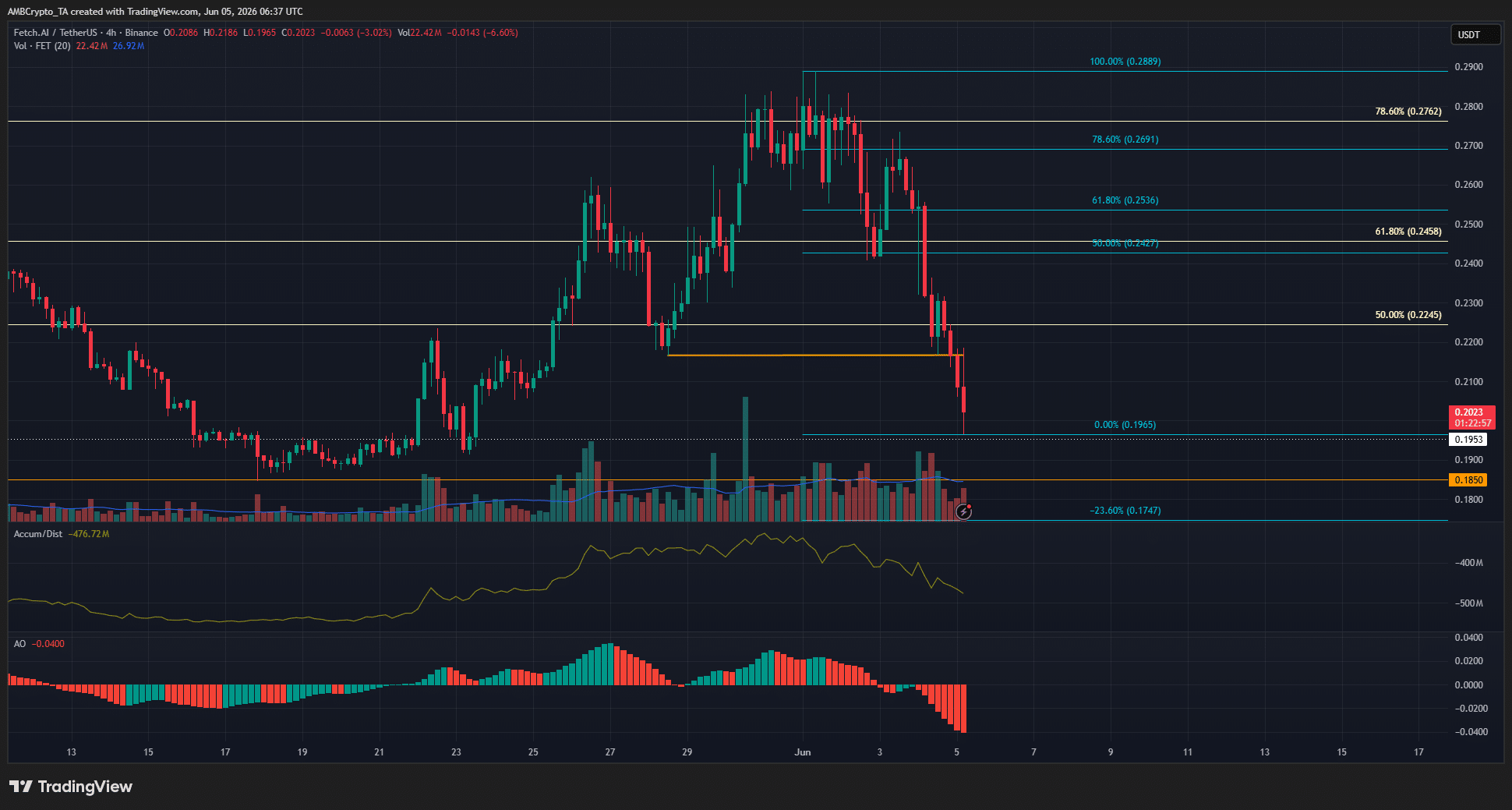
The internal structure has shifted bearishly on the 4-hour chart when the altcoin crashed below the higher low at $0.2166 (orange). The technical indicators also agreed with overwhelming bearish strength in the short term.

On this timeframe, the A/D was rapidly declining, and the Awesome Oscillator fell to depths not seen since the October 2025 crash. And the impulse leg was not yet over.

Eventually, the sell-off would be oversold and necessitate a relief rally. This bounce is likely to reach the $0.25-$0.26 area, though the exact levels are not clear yet.

Traders can wait for a bounce toward $0.25 before looking to sell FET. Trying to buy during the bounce could be risky since a Bitcoin drop below $60k can set off another immense wave of panic across the altcoin markets.


Final Summary

  • FET bulls drove a rally nearly as high as $0.3 but were rebuffed from this technical and psychological resistance.
  • A short-term bounce toward $0.25-$0.26 could offer a selling opportunity.


Source link

Crypto’s worst week since July 2024 deepens as BTC, ETH prices near critical support levels

0
Crypto's worst week since July 2024 deepens as BTC, ETH prices near critical support levels

The crypto market is teetering on the brink of a major breakdown in price after suffering one of its worst weeks since July 2024.

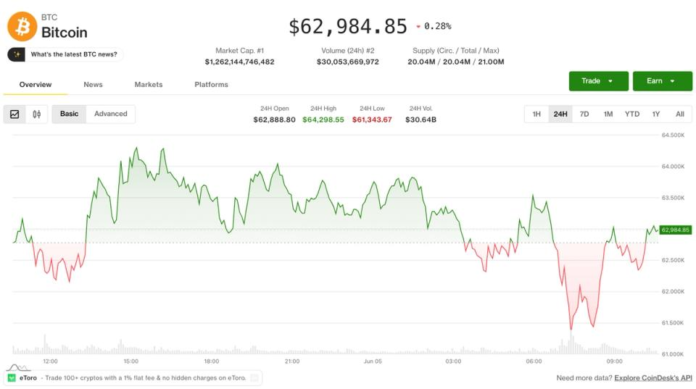
Bitcoin , currently trading around $62,500 has lost more 14.5% since midnight UTC on Monday morning, while ether (ETH) has plunged by more than 17%, dropping 5.5% on Friday alone.

Ether, the second-largest cryptocurrency, is now at its lowest level since April 2025, when it bounced at $1,420 before rallying to record highs over the subsequent four months. A break below that level would bring it toward 2022 bear-market levels, when it dipped below $900.

The broader altcoin market also suffered deep losses this week. One of the worst performers on Friday was zcash (ZEC), which tumbled by more than 30% after a security researcher found an exploit that would have minted “unlimited” tokens in its shielded pool.

There are multiple catalysts causing this week’s slide. Strategy (MSTR) Executive Chairman Michael Saylor attributed it to capital rotation in light of a series of artificial intelligence IPOs in the U.S., while onchain analysts are pointing towards a lack of spot crypto volume.

CryptoQuant notes that spot trading volume fell to $679 billion in April, the lowest monthly level since October 2023, indicating a lack of demand.

Derivatives positioning

  • BTC derivatives positioning has flipped from mild improvement to clear deleveraging this week. Open interest dropped 15% to $17 billion, with funding rates flipping negative to flat across multiple venues
  • At Deribit, the rate dropped to -15% annualized, a notable reversal from the prior positive regime. The three-month annualized basis fell to 2.7% from 2.9% last week, confirming a pullback in institutional risk appetite.
  • Options positioning has turned clearly defensive: Put/call volume has flipped to a 50/50 split over the past 24 hours, losing the prior call tilt, while the one-week 25-delta skew more than doubled to 27% from 13% a week ago. That signals a sharp escalation in demand for downside protection.
  • Front-end implied volatility (DVOL) has climbed further to 47, confirming a sustained bid that aligns with the broader deleveraging in derivatives.
  • Coinglass data shows $1.2 billion in 24-hour liquidations, with a 76-24 split between longs and shorts. Bitcoin ($364 million), ether ($291 million) and zcash ($107 million) were the leaders in terms of notional liquidations.
  • The Binance liquidation heatmap indicates $60,900 as a core BTC liquidation level to monitor, in case of a price drop.

Token talk

  • Zcash’s (ZEC) plight on Friday sowed seeds of doubt across privacy coins, with monero (XMR) losing 12% since midnight UTC and dash (DASH) dropping 9%.
  • ZEC’s losses were compounded by BitMEX founder Arthur Hayes, who said on X that his firm had sold its entire allocation of the token.
  • There were also heavy losses for , which tumbled by more than 10% after the project’s founder, Charles Hoskinson, said that he was “taking a break” after warning of ecosystem failures.
  • AI tokens lost their early week momentum as FET, NEAR and TAO fell 4%-6% despite outperforming the rest of the market on Monday.
  • One reason for altcoin holders to be hopeful is the fact that the average relative strength index (RSI) across all crypto pairs is in “oversold” territory, suggesting that a relief bounce could be on the cards this weekend.


Source link

Delfin Approves $5 Billion FID for First U.S. Floating LNG Export Vessel

0
Delfin Approves $5 Billion FID for First U.S. Floating LNG Export Vessel


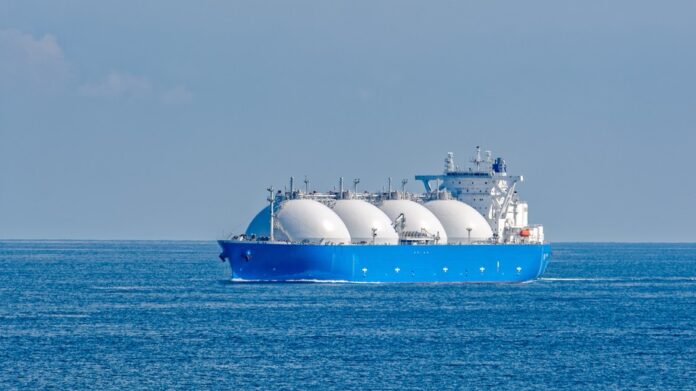
Delfin Midstream has sanctioned the first phase of its Louisiana-based LNG export project, taking a final investment decision (FID) on a $5 billion floating liquefied natural gas (FLNG) vessel that the company says will be both the first floating LNG export facility in the United States and the largest FLNG project globally by liquefaction capacity.

The first vessel, Delfin FLNG 1, is expected to export up to 4.4 million metric tons of LNG annually and is scheduled to begin production in 2030. The project represents a major milestone for the Houston-based developer, which has spent years advancing an offshore LNG export concept designed to leverage existing pipeline infrastructure and floating liquefaction technology.

The FID was accompanied by a new round of investment led by Global Infrastructure Partners, part of BlackRock, alongside existing investors Mitsui O.S.K. Lines, Vitol, and Diameter Capital Partners. Financial terms of the equity commitments were not disclosed.

Delfin CEO Dudley Poston described the decision as a significant step for both the company and global energy markets, emphasizing the project’s role in expanding U.S. LNG export capacity and strengthening energy security.

The project enters construction with long-term LNG sales agreements already in place with several major buyers, including Vitol, Expand Energy, Centrica, and Gunvor. Delfin said it has secured all permits and licenses required to begin construction.

Samsung Heavy Industries and engineering firm Black & Veatch have been selected as key construction partners for the first FLNG vessel.

The investment comes as global LNG demand continues to grow, particularly across Asia and Europe, where buyers are seeking long-term supplies from politically stable producers. Floating LNG facilities have gained traction as a potentially lower-cost and faster-to-develop alternative to traditional onshore export terminals, although large-scale FLNG developments remain relatively rare globally.

Delfin’s broader project has already received authorization from the U.S. Department of Energy to export up to 13.2 million tonnes of LNG annually and holds a deepwater port license from the U.S. Maritime Administration. The company ultimately plans to deploy multiple FLNG vessels offshore Louisiana, with FIDs for vessels two and three targeted over the next year.

If completed as planned, Delfin LNG would establish a new model for U.S. LNG exports by moving liquefaction offshore while further expanding the country’s position as the world’s leading LNG supplier.


Source link