Home Blog Page 382

Dogecoin slides 5%, hits a 4-month low: Can dip buyers help DOGE recover?

0
Dogecoin slides 5%, hits a 4-month low: Can dip buyers help DOGE recover?


The broader crypto market extended its bearish streak. As a result, Dogecoin weakened further, breached the $0.09 support, and fell to $0.081. 

The memecoin last reached such low levels during the February market dip. At press time, Dogecoin traded at $0.085, down 5.3% on the daily charts, adding to its 12% weekly slip. 

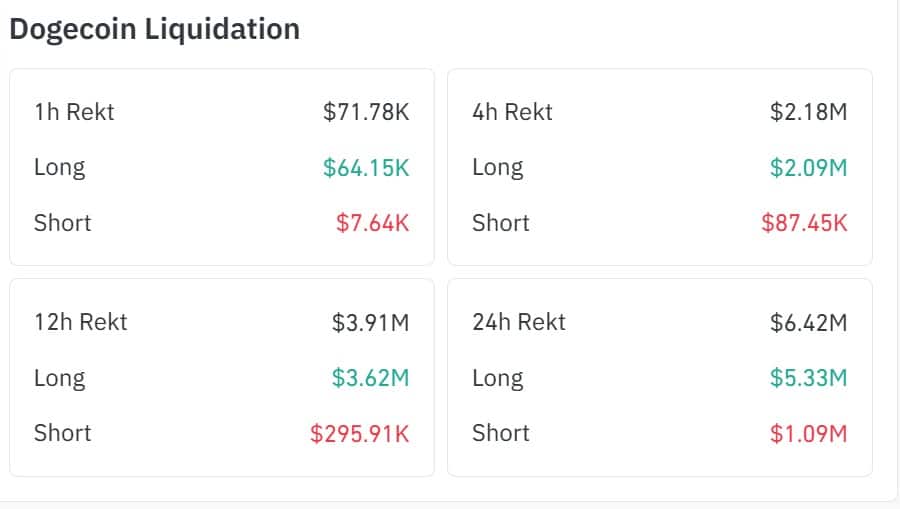
The price slip triggered the massive liquidation of leveraged positions. Dogecoin [DOGE] saw a total of $6.4 million in positions liquidated, with $5.3 million in longs liquidated.
Dogecoin liquidation
Source: CoinGlass

The liquidation of leveraged longs to such levels causes exchanges to close positions and cut losses. As a result, the market sees additional selling pressure, causing further market slip. 

Dogecoin Futures panic close amid liquidation risk

Driven by a surge in liquidations, traders in the Futures market panicked and hurriedly closed their positions. 

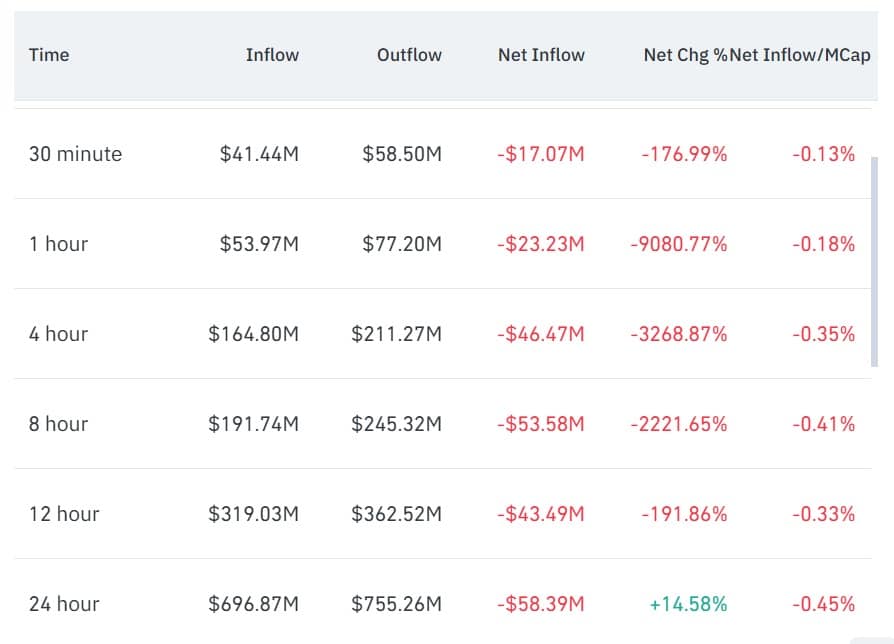
According to CoinGlass data, Dogecoin saw $755 million in Futures Outflows while only $696 million in inflows. As a result, Futures Netflow dropped to -$58.9 million. 
Dogecoin futures inflowDogecoin futures inflow
Source: CoinGlass

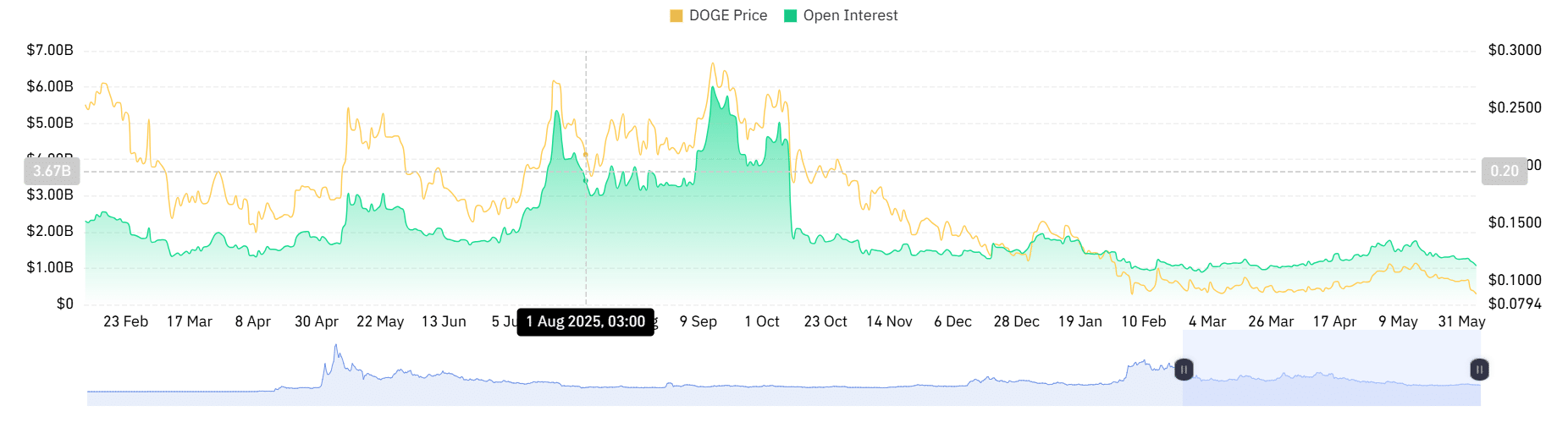
A negative Futures Netflow suggests that sellers dominated the market, as they closed positions. The memecoin’s Open Interest fell to $1.02 billion, the lowest level since March, further confirming this shift in bearish sentiment.
Dogecoin open interestDogecoin open interest
Source: CoinGlass

Dip buyers jump on the Spot

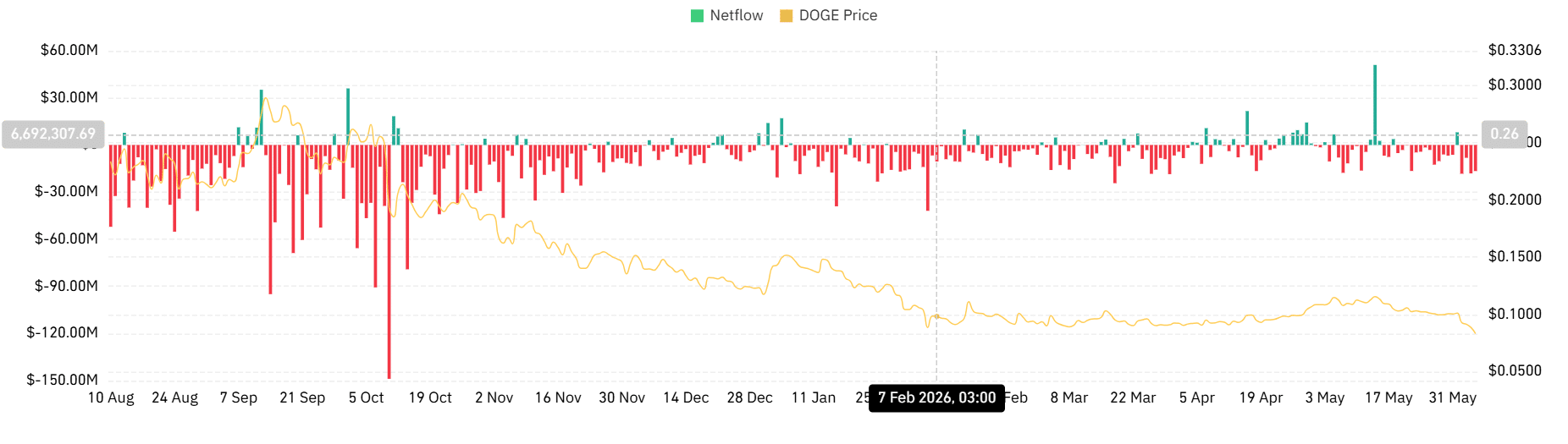
Interestingly, while leverage got flushed and Futures panic exited, the market dip created a buying opportunity. As such, on the Spot market, buyers returned to accumulate at a discount. 

As a result, Spot Netflow extended its bullish outlook, holding negative for four consecutive days. At press time, Netflow was -$16.59 million, a slight drop from -$18.1 million the previous day. 
Dogecoin spot netflowDogecoin spot netflow
Source: CoinGlass

A Negative Netflow indicated that buyers dominated exchanges and continued to accumulate at lower price levels. Often, when Spot buyers jump in, they present the market with a fighting chance by absorbing pressure from Futures.

What’s next for the memecoin?

Dogecoin’s downward momentum intensified after leveraged longs were liquidated. Succeeding selling pressure caused further market weakness.

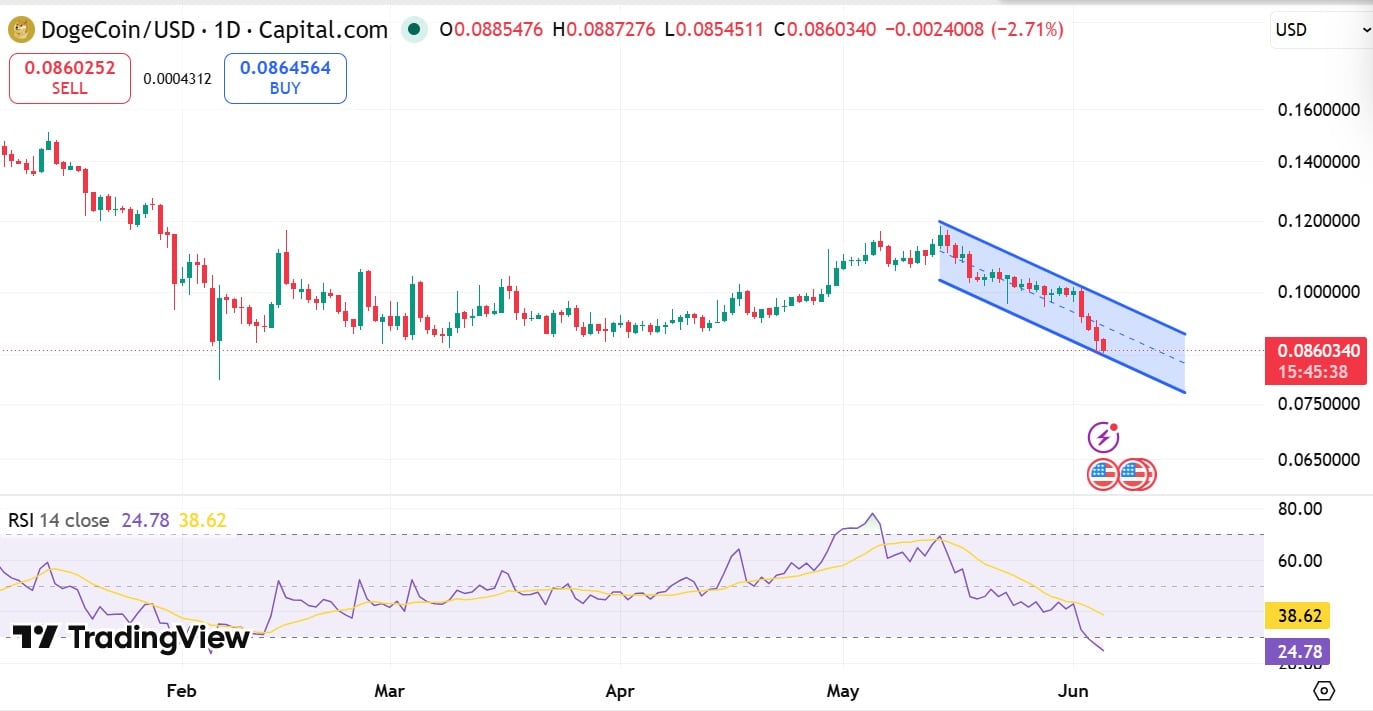
As a result, the memecoin’s Relative Strength Index (RSI) dropped into the oversold zone, touching a low of 24. RSI at these levels suggested that sellers have total control of the market.
Dogecoin RSIDogecoin RSI
Source: TradingView

As such, even dip buyers in the Spot market remain insufficient to absorb the prevailing market pressure. Under such conditions, DOGE is at risk of more losses.

If the prevailing sentiment persists, Dogecoin is likely to make more losses on its price charts and breach the $0.08 support level.

However, if Futures panic cools off amid the dip-buying witnessed, the market will cool down and revisit $0.094, then eye $0.1.


Final Summary

  • Dogecoin dropped 5%, hitting a four-month low of $0.081, amid intense bearish pressure. 
  • The Spot market saw renewed demand as dip buyers returned to accumulate at lower price levels, but the market remains overly bearish. 


Source link

Here’s what could happen if bitcoin breaks below $60,000

0
Bitcoin (BTC) underperforms risk assets as record 9th day of ETF outflows signal waning demand: Crypto Daily

Bitcoin continues to lose ground and the price is fast closing on $60,000 amid record ETF outflows.

The $60,000 level has been widely cited by analysts as a major support, below which the selloff could get even uglier.

Jean-David Péquignot, the chief commercial officer at leading crypto options exchange Deribit said that price is critical not just because it’s a round-number psychological level. More importantly, it’s a structural threshold with real consequences for institutions and derivatives market participants.

The cost basis problem

According to Péquignot, a significant chunk of institutional money — comprising ETF buyers, large holders and short-term speculators — bought bitcoin at prices between $60,000 and $67,000 over the past year.

With the largest cryptocurrency now trading within that range, these buyers are sitting at or near their cost basis, essentially at break-even. If prices drop further, unrealized or paper losses will mount and holding becomes expensive, especially when AI stocks and other parts of the traditional market are rallying like there is no tomorrow.

“As price undercuts their cost basis, the resulting unrealized losses may incentivize rushed selling, especially as the opportunity cost of holding BTC rises against a surging AI equity sector,” he said.

Michael Saylor, the high-profile executive chairman of Strategy (MSTR), the largest publicly traded bitcoin holder, also blamed capital rotation for recent BTC losses.

The derivatives problem

Things become mechanical after that.

On Deribit, there is over $1.2 billion in notional open interest sitting at the $60,000 strike put options, which pay out if prices fall below that level. Investors have bought these as a hedge against a protracted selloff.

The problem, however, is that market makers, who are on the opposite side of the investors, are now short puts, or more precisely, “short gamma.”

So, as BTC nears $60,000, market makers and dealers will be forced to sell spot BTC or futures to balance their books. Other things being equal, this hedging can accelerate the selloff, turning an orderly decline into a chaotic one, Péquignot said.

He also pointed out that there are too many leveraged longs in the system, and a break below $60,000 could lead to more liquidations, adding to downside momentum.

“With leverage still not fully flushed from the system, a break of $60K could rapidly worsen collateral metrics, triggering a cascading wave of automated long liquidations,” he said.

Note that billions of dollars of leveraged longs, or bullish plays tied to BTC and other tokens, have already been liquidated this week.


Source link

PE stocks tumble on Partners Group redemption news

0
PE stocks tumble on Partners Group redemption news


News that Partners Group is limiting redemptions on an $8.6 billion evergreen private equity fund sent share prices tumbling Wednesday amid fears that the problems plaguing private credit could be spreading to other asset classes.

The Swiss investment manager said it was limiting the amount investors could redeem from Partners Group Global Value SICAV to 5% of the fund’s net asset value, after receiving requests exceeding that limit during Q2. The fund is one of the oldest PE vehicles targeted at wealthy individual investors.

The firm said in a statement that it sees redemption limits as “indispensable” to meeting the needs of those seeking liquidity while “preserving investment capital for long-term investors who want to capitalize on market opportunities.”

Investors who have submitted a redemption request will receive approximately 62% of what they requested. The unpaid portion will be canceled and not carried forward into the next liquidity window.

Partners Group’s share price dropped 16.3% by the end of trading on Wednesday. Other large European PE firms, such as EQT, CVC Capital Partners and Bridgepoint Group, also experienced appreciable declines.

The firm has also been facing growing competition from newer evergreen offerings managed by US rivals such as Blackstone and KRR, the Financial Times reported in January. The firm’s flagship US offering lost more in redemptions than it received in new money for the first time in 2025.

Evergreen PE funds could be set to experience the same mass outflows experienced by credit vehicles aimed at the same constituency of wealthy individual investors.

Though much smaller and newer than business development companies, which have borne the brunt of the trouble facing the private credit market, evergreen PE vehicles posted record inflows last year and are forecast to top $1 trillion of total NAV by the end of the decade.

PE vehicles are, in some ways, more exposed to corporate distress than BDCs, which mainly make senior-secured loans to private businesses. Equity holders are last in line to recover their money in the event of bankruptcies, which have been ticking up since interest rates rose in 2022. This has been compounded by recent shocks, such as investor panic over the potential impact of AI on the business models of SaaS companies.

Sign up for The Daily Pitch newsletter Subscribe

In Q1, investors requested to pull roughly $13.2 billion from US nontraded BDCs, which extend loans to privately owned businesses, according to investment bank Robert A. Stanger & Co.

Sponsors agreed to meet about half of this demand.

Partners Group cited “significant macroeconomic shifts and geopolitical challenges” as key reasons for the outflows that hit private credit vehicles and are now spreading to PE.

The firm said the fund has around 15% of its NAV in liquid assets, roughly in line with the distributions it paid out last year and what it expects to pay out this year. It also has access to an undrawn credit facility of roughly the same size, an estimated $1.3 billion.

Partners Group Global Value SICAV primarily invests directly in private companies, makes primary fund commitments in PE funds and buys positions on the secondary market. The vehicle also holds some credit and liquid assets to meet redemptions.

This article originally appeared on PitchBook News


Source link

BTC price updates: Bitcoin could fall to $60,000, Zcash plunges 37%

0
BTC price updates: Bitcoin could fall to $60,000, Zcash plunges 37%

Forward Industries deposited 455,784 SOL worth roughly $31.87 million to Coinbase Prime on Friday after a month of dormancy, according to onchain tracker Lookonchain.

The transfer is the first sizeable movement from the company’s treasury wallets in more than four weeks and lands in the middle of a sharp Solana drawdown that has pushed the token down 18.5% on the week.

The company launched its Solana treasury strategy in September 2025, spending roughly $1.59 billion to accumulate 6.83 million SOL at an average price of $232.08 per token. Solana is now trading at $66.51, which puts those same holdings at $458.6 million.

The position is currently around $1.13 billion underwater, a more than 70% paper loss per token.

A deposit to Coinbase Prime does not necessarily mean tokens will be sold, but it puts them within reach of a sale and reverses a month of inactivity that had kept the SOL position immobile.

Forward Industries is one of the most aggressive Solana-treasury imitators of the Strategy bitcoin playbook, and its cost basis above $230 leaves it among the most exposed corporate holders if the current drawdown continues.


Source link

Broadcom’s sales and AI chip forecast comes in below expectations, shares tumble

0
Broadcom's sales and AI chip forecast comes in below expectations, shares tumble


(Corrects typo in headline)

By Anhata Rooprai, Zaheer Kachwala and Stephen Nellis

June 3 (Reuters) – Chipmaker Broadcom missed Wall Street expectations for second-quarter revenue on Wednesday and its top executive left a previous 2027 sales forecast unchanged, ‌sending its shares down more than 13% in extended trading.

Second-quarter revenue of $22.19 billion missed estimates of $22.27 billion, as ‌Broadcom races with Nvidia whose dominant graphics processing units remain the industry standard for AI workloads.

Broadcom also said it expects AI chip revenue of $16 billion ​in its current third quarter, slightly below estimates of $16.36 billion, according to analysts polled by Visible Alpha.

Chief Executive Officer Hock Tan said Broadcom now expects to ship more than 10 gigawatts’ worth of AI chips in 2027 – a slight increase from previous estimates – but stuck to the company’s long-range forecast of $100 billion in sales from those chips.

“Nothing slows down what was estimated prior – they ‌just didn’t raise it,” Ben Bajarin, chief ⁠executive of technology consultancy Creative Strategies, said of the long-range forecast.

Rivals such as Marvell Technology are also making inroads with key hyperscale customers. At the end of May, Marvell said its custom ⁠chip business would surpass $10 billion in revenue in 2029, and forecast second-quarter revenue above estimates.

The boom in inference – the process by which models respond to user queries – has made custom chips crucial to the industry, driving more orders for advanced processors and intensifying competition.

Broadcom’s ​ability ​to meet AI demand has also been tested by a strained ​supply chain. But company executives on the post-earnings call ‌assuaged such concerns, saying Broadcom is “very comfortable” that it has secured supply for 2026 and 2027.

“Today’s miss on revenue and subsequent post-market pull back (in shares) shows the market demands perfection for this chip rally to keep running,” said Ryan Lee, senior vice president of product and strategy at Direxion.

Broadcom forecast third-quarter revenue of about $29.4 billion, compared with analysts’ average estimate of $28.54 billion, according to data compiled by LSEG.

CORE BUSINESS REMAINS STRONG

Still, Broadcom has been one of the biggest beneficiaries of the ‌AI race. Analysts view its core business as robust due to its ​lead position in the custom chip market with Meta and Alphabet’s Google ​as its hyperscale customers.

Big Tech firms are expected to ​spend more than $700 billion on AI infrastructure this year, up from around $400 billion in 2025.

As ‌the AI industry evolves rapidly, machine learning capabilities and ​requirements vary greatly from company ​to company, resulting in large cloud companies building their own processors to slash costs and personalize workloads.

Broadcom plans to ship 10 gigawatts worth of compute capacity next year and plans “a lot more” in 2028, Tan said during ​the earnings call.

“Q2 semiconductor revenue from AI ‌of $10.8 billion grew 143% year-over-year, above our forecast, driven by increasing demand for custom AI accelerators and AI ​networking,” he said in a statement.

(Reporting by Zaheer Kachwala and Anhata Rooprai in Bengaluru and Stephen Nellis ​in San Francisco; Editing by Arun Koyyur and Cynthia Osterman)


Source link

Bitcoin drops, MSTR crashes – Is the market being pushed lower?

0
Bitcoin drops, MSTR crashes - Is the market being pushed lower?


Bitcoin’s [BTC] recent fall has brought fear back into the market.

However, does this mean the market is in real trouble, or is it just a bad phase? Here’s what you need to know.

Strategy’s Bitcoin bet in its toughest phase yet

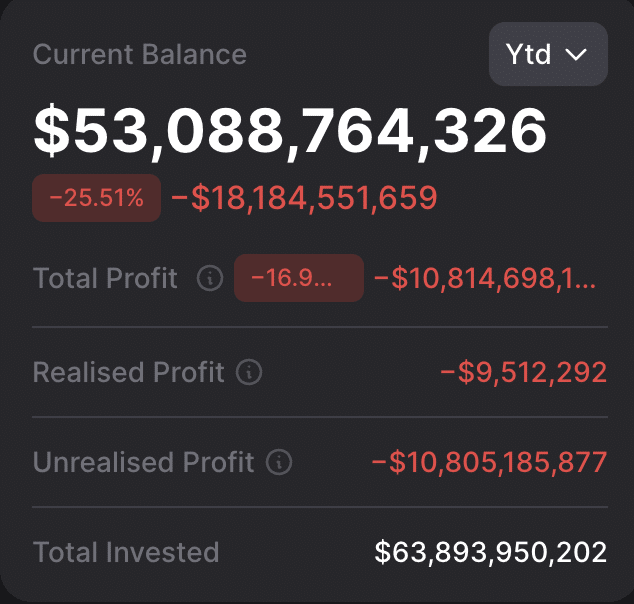
Strategy is reportedly sitting on its largest-ever unrealized loss, worth around $10.8 billion. After nearly six years of steadily buying Bitcoin, its overall position is now down about 17%.

Bitcoin
Source: X

For reference, over the same period, the S&P 500 has gained by more than 100%.

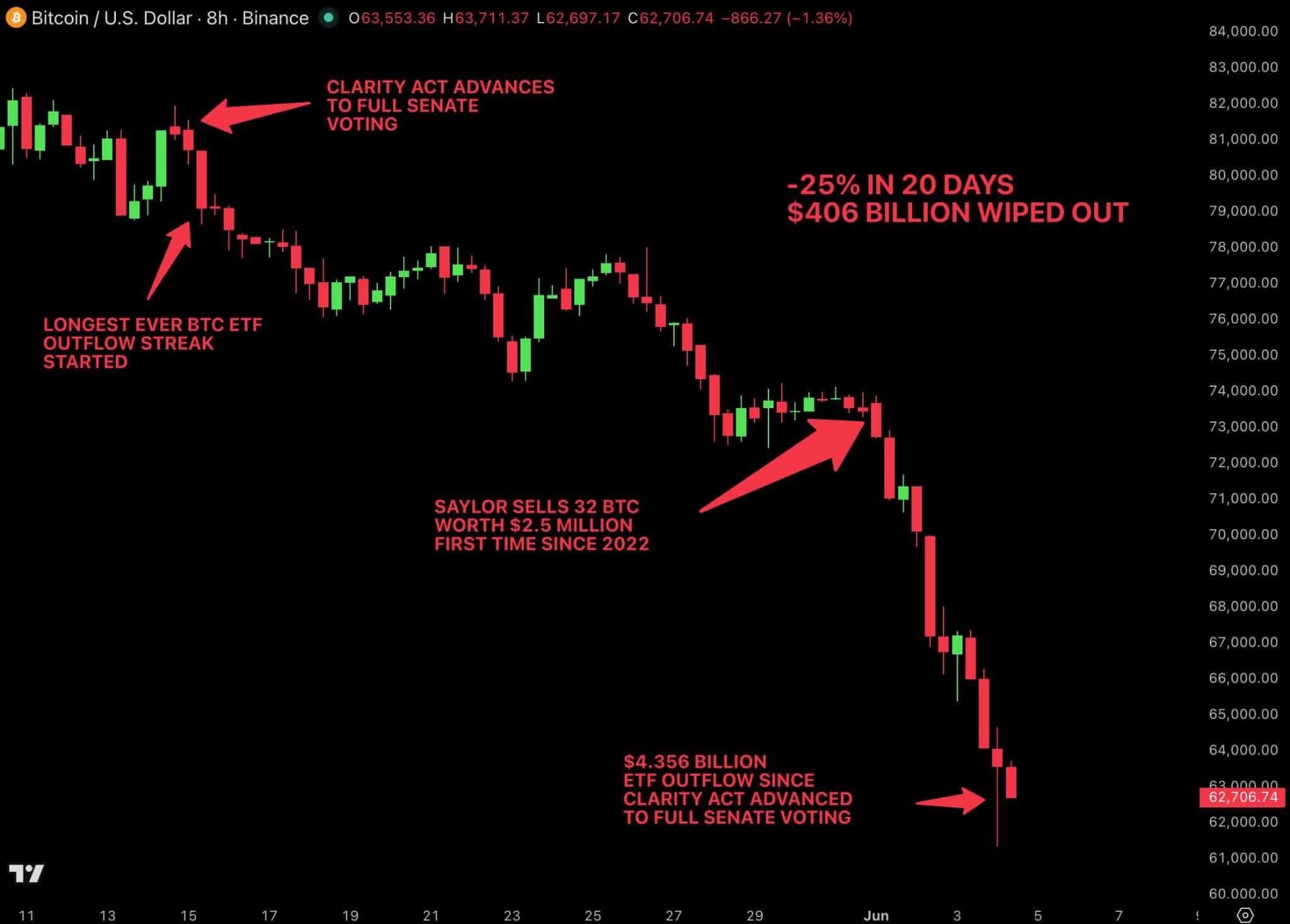
Since the company sold 32 BTC at around $77,135 per coin, the value of its remaining Bitcoin holdings has fallen. MSTR’s stock itself is now down nearly 77% from its all-time high. This is one of the company’s most difficult crypto-market phases.

Short-term holders sell at a loss

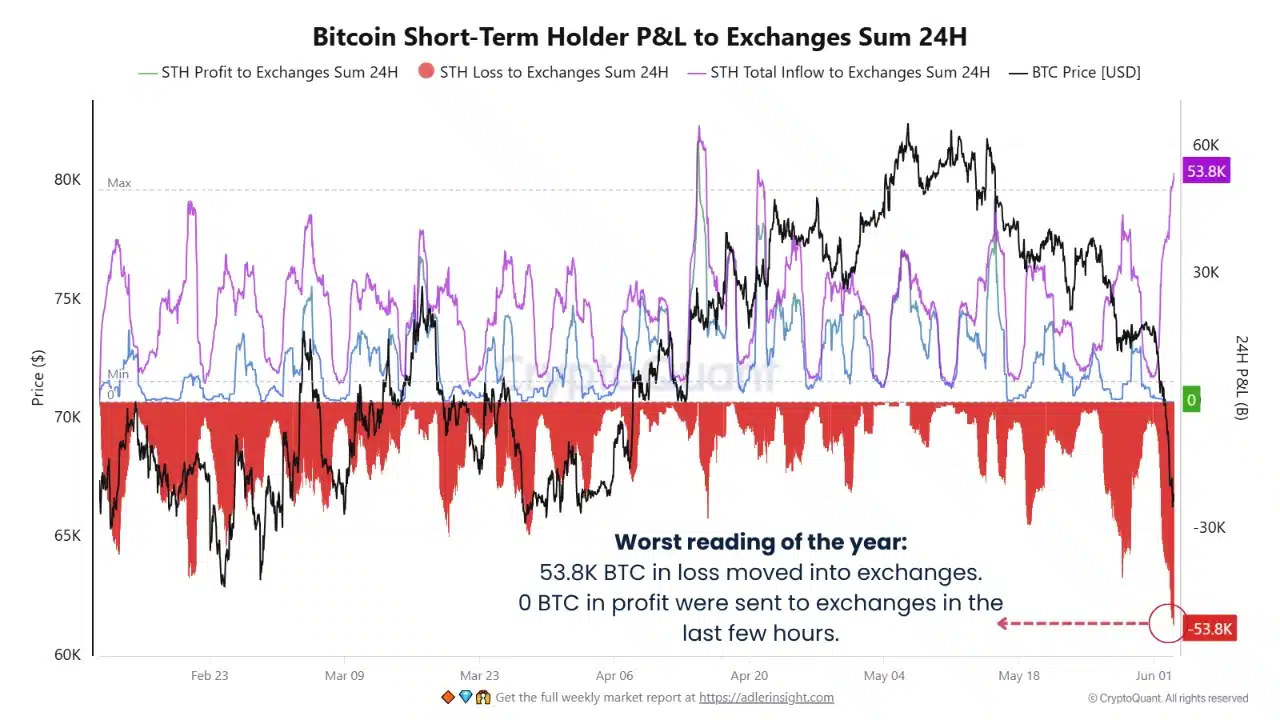
In the last 24 hours, a large amount of BTC held at a loss moved to exchanges too. Profit-led inflows were almost absent.

It looks like recent buyers, especially those who entered near higher levels, may be choosing to exit as prices tumble.

bitcoinbitcoin
Source: Cryptoquant

This usually happens during capitulation, when weaker hands sell and stronger holders absorb.

If loss-driven inflows slow down and Bitcoin stabilizes, the market may find support.

Interestingly, Bitcoin’s price started falling soon after the crypto market structure bill moved ahead in the Senate Banking Committee. This is peculiar because regulatory progress is usually seen as a positive.

Source: X

This could simply be liquidity rotation. However, one also wonders if prices are being pushed lower before clearer crypto rules arrive. This would let larger players buy BTC at cheaper levels.

Sellers in control?

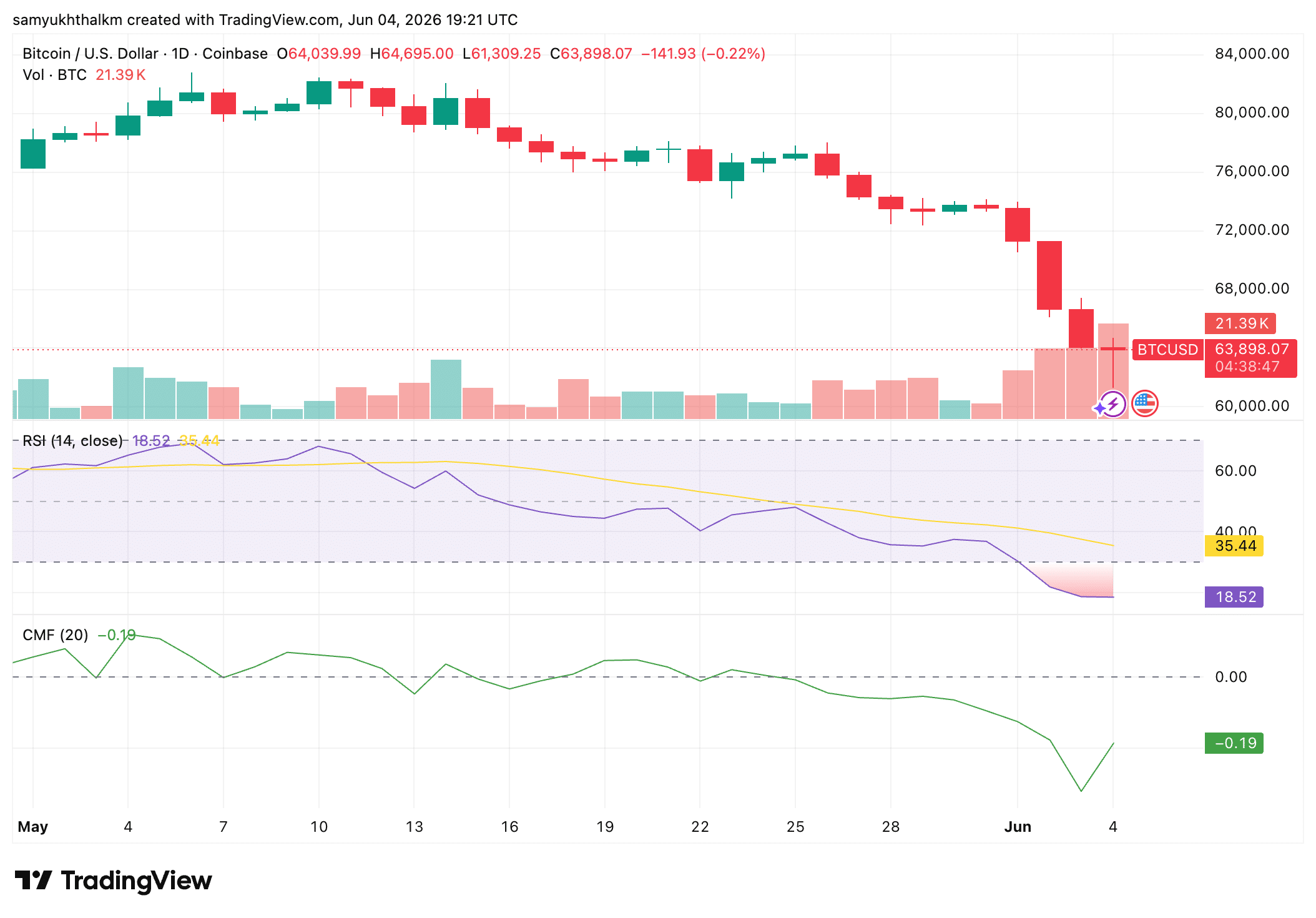
At the time of writing, BTC had slipped and was trading near the lower end of its recent move.

The overheated RSI proved that the selling did become stretched. However, such a finding doesn’t automatically mean a rebound. The CMF was also negative, implying that capital was still going out of the market rather than flowing in.

Source: TradingView

So, is this a state of emergency? Not yet. It is a stress phase. A recovery needs stabilization first, not just panic selling.


Final Summary

  • Bitcoin’s fall has pushed Strategy into a $10.8 billion unrealized loss.
  • Short-term BTC holders are now selling at a loss.


Source link

Tom Lee’s $250,000 ether (ETH) target would imply $2 million per bitcoin (BTC)

0
Tom Lee's $250,000 ether (ETH) target would imply $2 million per bitcoin (BTC)


Ether at $250,000 would make Ethereum a $30 trillion network, larger than the U.S. Treasury market and comparable to all the gold ever mined.

But that’s the target Bitmine chairman Tom Lee laid out at Proof of Talk in Paris this week, with the move pitched as a 50x from current levels on the back of AI-driven payments and a corporate validator takeover of the network.

Let’s dive into the math of how that target may be reached, starting with supply. Ethereum’s circulating supply sits at 121.75 million ETH and is growing at 0.82% a year, because since the Dencun upgrade pushed most fee activity to cheaper layer-2 chains in 2024, the burn mechanism has collapsed to roughly 29,000 ETH a year against issuance of 1.03 million ETH.

At $250,000 a coin, that 0.82% drift turns into $250 billion of fresh ether issued every year.

The supply growth is not huge by itself. Gold supply expands at a similar pace, and the U.S. Treasury market grows much faster. Big assets can absorb new issuance if demand is strong enough.

However it puts to rest the old “ultrasound money” trade that was built on the idea that Ethereum could become a shrinking monetary asset while usage kept rising. That setup is not here right now. ETH supply is growing, slowly but steadily, so a 50x move has to come from demand doing almost all the work.

To get a sense of how far-out Lee’s target is, look at the ether-bitcoin ratio, which tracks how ether trades relative to bitcoin. The ratio has never crossed 0.15, a level it touched briefly at the 2017 peak. At today’s bitcoin price of $63,872, $250,000 ether would push that ratio to 3.91, more than 25 times that all-time high.

For the ratio to stay anywhere in its historical range while ether hits $250,000, bitcoin would have to rally to somewhere between $1.67 million and $2.94 million at the same time. So Lee’s call needs either bitcoin running alongside ether at similar multiples, or the pair breaking historical bounds wildly. Neither is in motion right now.

(CoinDesk)

Lee further argued the Ethereum Foundation has dropped to roughly 0.1% of supply while corporate entities like Bitmine and SharpLink now control 7% of circulating ether collectively.

Public companies and governments hold 7.43 million ETH across 32 entities, or 6.16% of supply, with Bitmine alone at 5.42 million ETH and SharpLink at 869,000.

But holding ether and validating the network are different jobs. Validators are the operators that actually run the software securing Ethereum and earn the staking yield.

Of the 39.25 million ether currently staked, Lido, a decentralized staking protocol governed by a DAO of token holders, controls 19.4%, followed by Binance, ether.fi, Coinbase and Figment.

The top corporate treasuries are not running validators at anywhere near the scale Lee’s takeover thesis implies. Lido alone validates more ether than every public-company holder combined.

(CoinDesk)

All in all, ether has to capture a chunk of global financial throughput that no asset has captured before, the burn has to outrun issuance again, the ETH-to-bitcoin pair has to recover more steeply than at any point in its history, and the corporate validator thesis has to actually translate into validating power.

The ETH-to-bitcoin pair turning on a real trend, not a one-week bounce, would be the first sign anything’s actually changing. Right now, however, the data tells a different one.


Source link