A whale removed 130 million TRON [TRX] worth $43.13 million from Poloniex, reducing exchange-held supply as market sentiment weakened.
The transfer arrived shortly after TRX suffered a sharp rejection from local highs, creating a notable divergence between large-holder activity and broader trader expectations.
Exchange withdrawals often reduce immediate selling availability because tokens leave trading venues and move into private wallets.
In this case, the size of the transaction stood out because it represented one of the largest recent TRX movements.
However, the transfer occurred during a period of declining price action rather than strength.
The contrast suggested some large investors still preferred holding despite growing uncertainty, while the wider market continued questioning TRX’s near-term direction.
Why are traders leaning so bearish?
Derivatives traders showed little confidence despite the whale withdrawal.
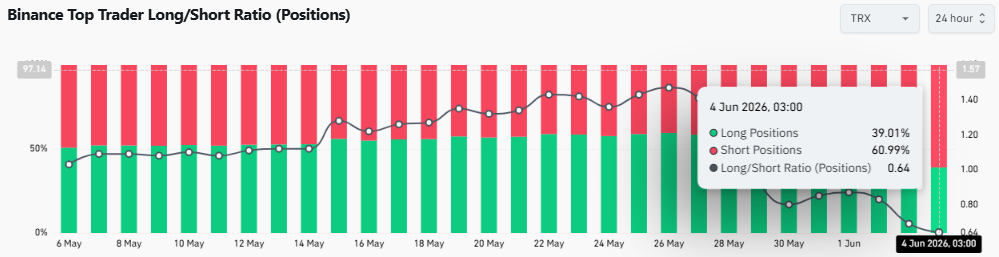
Binance top traders held 60.99% short positions, while long positions accounted for only 39.01% of total exposure. As a result, the Long/Short Ratio dropped to 0.64, reflecting a strong bearish bias among professional participants.
Such positioning often reveals expectations of further downside, especially when it develops after a failed breakout attempt.
However, crowded short positioning can also create vulnerability if the price stabilizes unexpectedly.
Traders appeared focused on TRX’s recent technical deterioration rather than the reduction in exchange supply.
The disconnect between whale accumulation signals and derivatives sentiment highlighted a market struggling to establish a clear directional consensus.
Source: CoinGlass
Has TRX reached a critical support zone?
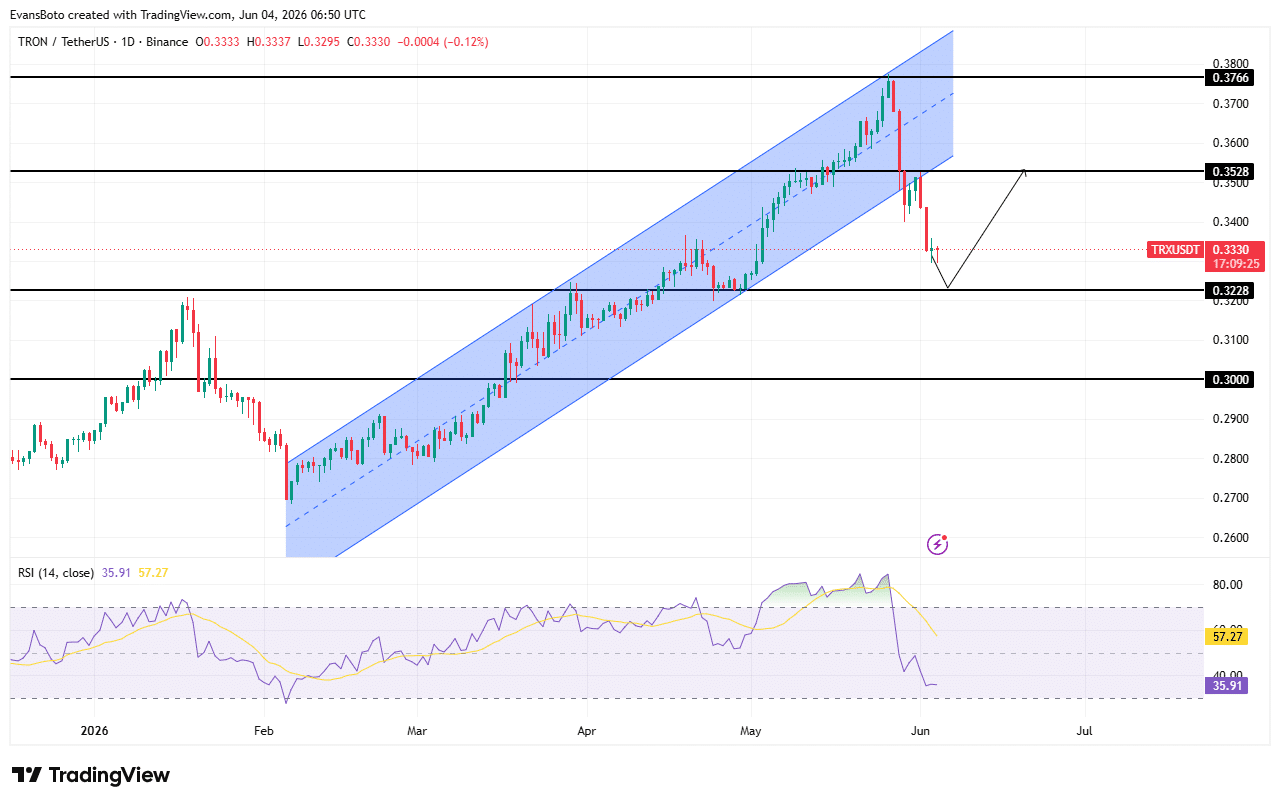
TRON [TRX] lost its multi-month ascending channel after failing to hold gains near the upper boundary.
The asset previously climbed toward $0.3766 before aggressive selling pressure pushed the price sharply lower.
Following that rejection, TRX fell beneath channel support and approached the key $0.3228 level, which now represented the most important support zone on the chart.
TRX price traded around $0.3330 at the time of writing, placing it between major support and resistance levels.
RSI also weakened significantly during the decline. The indicator dropped to 35.91 after spending several weeks near overbought territory above 70.
However, RSI had not yet entered extreme oversold conditions. If buyers defended $0.3228 successfully, TRX could attempt a rebound toward $0.3528.
Otherwise, sustained weakness would likely increase downside pressure and invalidate the recent bullish structure.
Source: TradingView
Where could liquidations pull price next?
Liquidation data revealed concentrated leverage zones both above and below current price levels.
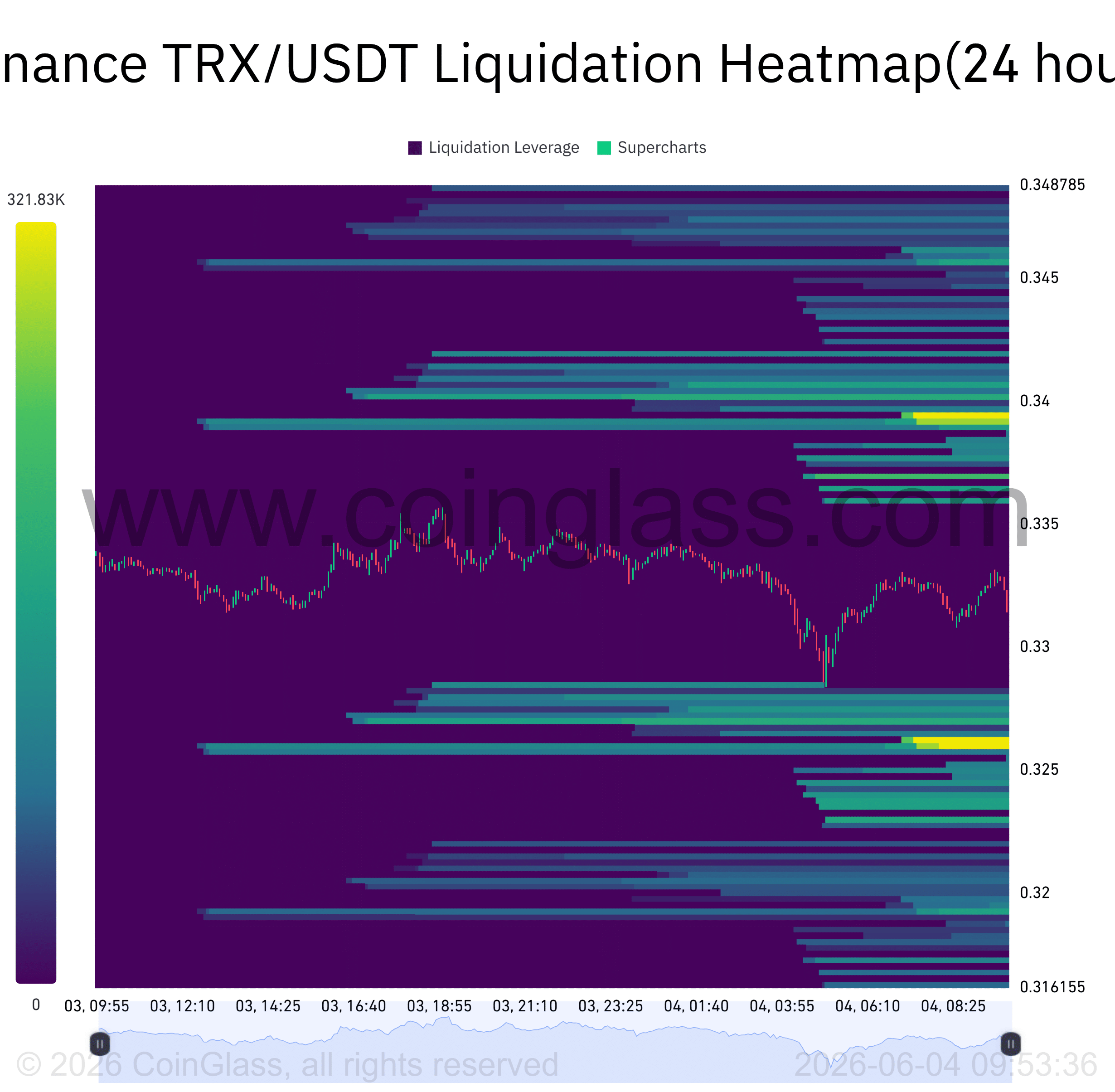
The largest upside cluster emerged around $0.340 to $0.345, while another significant liquidity pocket developed near $0.325 to $0.326.
Markets frequently gravitate toward these areas because leveraged positions accumulate there over time.
During the recent decline, TRX briefly swept lower liquidity before recovering modestly. Nevertheless, several high-density liquidation levels remained active across the chart.
If the price moved higher, short liquidations around $0.340 could accelerate volatility and strengthen recovery attempts.
On the other hand, renewed selling pressure would likely target liquidity concentrated near the lower support region.
Source: CoinGlass
Is TRX preparing for a rebound or a deeper breakdown?
Despite the bearish positioning among Binance traders, the broader evidence continued favoring a rebound scenario rather than an immediate extension lower.
The $43.13 million whale withdrawal reduced exchange supply, while RSI fell near oversold territory after the recent selloff.
In addition, TRX approached the key $0.3228 support, where buyers could re-enter the market.
Liquidation clusters also remained concentrated above current prices near $0.340, making that area a likely target if recovery continued.
As long as support held, TRX would likely rebound toward $0.3528 rather than extend its decline.
Final Summary
Whale withdrawal reduced exchange supply while TRON [TRX] approached major support.
Bearish trader positioning remained elevated despite improving rebound conditions.
To many observers, the developments have revived a familiar question: Has Ethereum’s sprawling layer-2 ecosystem become too crowded?
Industry participants, however, argue the opposite.
“The thing to recognize is that anywhere where somebody would be running a smart contract on an existing blockchain, someone could equally run a layer two,” said Ben Fisch, co-founder and CEO of Espresso Systems. “We’re in a consolidation phase for general-purpose layer twos, not layer twos broadly.”
Ethereum layer-2s exploded over the past several years as improvements in rollup technology dramatically reduced the cost and complexity of launching new chains. Rollups work by processing transactions off Ethereum’s main blockchain, bundling hundreds of them together, and then periodically posting compressed transaction data back to Ethereum for settlement and security. The model allows applications to offer faster transactions and lower fees while still relying on Ethereum as the ultimate source of trust.
The result was a flood of networks built using infrastructure stacks such as Optimism’s OP Stack, Arbitrum Orbit and zkSync. But while launching a chain became easier, attracting users proved much harder.
“There were way too many general-purpose layer twos, which frankly don’t make sense as a product, because there’s no reason to have many, many versions of the same thing,” Fisch said.
The numbers support that view. Today, activity across Ethereum’s layer-2 ecosystem remains heavily concentrated among a handful of networks. Base and Arbitrum alone account for more than 80% of layer-2 DeFi total value locked (TVL), according to DefiLlama data.
(DefiLlama)
That concentration has only become more apparent as smaller chains struggle to maintain liquidity. Over the past six months, networks including Linea, World Chain, Starknet and Mantle have all seen declining bridge deposits. Linea’s deposits, for example, fell from $976 million in November 2025 to $367 million in May 2026, a decline of more than 60%.
Token Terminal
“I think only a few L2s with clear financial demand will be able to sustain themselves over time,” said Alice Hou, a former research analyst at Messari, to CoinDesk.
For Hou, the key issue isn’t whether layer-2 technology works, it’s whether a network can generate enough activity to justify its existence.
“Without enough blockspace demand, user activity or developer traction, there is little reason to continue maintaining an L2,” she said.
Ironically, the economics of launching a rollup have never looked better. Ethereum’s Dencun upgrade, introduced in 2024, dramatically reduced the cost of posting rollup data to Ethereum through blobs. According to Messari research, data availability costs now represent only a small fraction of operator expenses for many OP Stack chains.
“From an operator perspective, it is definitely cheaper to run an L2 today,” Hou said. “The economics of launching an L2 have become easier, but the real challenge is still generating enough sustained demand to make the network worth operating.”
That dynamic has created a paradox. The barriers to creating a blockchain continue to fall, but the barriers to attracting users continue to rise. As a result, many teams are discovering that simply offering another Ethereum-compatible chain is no longer enough.
“People have realized that all the different general-purpose blockchains compete with each other,” Fisch said. “If you want to succeed, you need to build out a differentiated application.”
From infrastructure to applications
The shift is already visible across the industry. Several blockchain projects that once emphasized infrastructure are increasingly focusing on payments, stablecoins, tokenized assets and other application-specific markets. Traditional financial institutions may become some of the biggest beneficiaries.
Fisch pointed to asset managers launching tokenized money-market funds, stablecoin issuers and tokenized deposit platforms as examples of businesses that have clear reasons to operate on-chain. For those firms, a dedicated layer-2 can offer lower costs, greater control and more predictable performance than deploying directly as a smart contract.
“The technology decision to run as a layer two is simply an option of running an application onchain,” Fisch said.
Hou said she agreed that distribution matters more than technology.
“Only L2s with a solid existing user base and a clear reason to benefit from blockchain infrastructure should launch their own networks,” she said.
That helps explain why exchanges remain among the strongest candidates. Coinbase’s Base has become the dominant example, leveraging the exchange’s existing customer base while integrating users into Ethereum’s broader DeFi ecosystem.
“The question should not be, ‘Can this company launch an L2?'” Hou said. “It should be: ‘Does this business already have enough distribution, financial activity and ecosystem synergies to make an L2 meaningfully useful?'”
“I don’t view layer twos as scaling Ethereum,” he said. “I view layer twos as leveraging the existing security properties of layer one.”
In that framework, Ethereum functions less as a destination and more as a settlement layer that applications can use when it makes sense.
“Ethereum is sort of a commodity that layer twos can choose to use,” Fisch said.
That vision aligns with a broader trend unfolding across crypto infrastructure. Rather than competing to become the next dominant blockchain, more projects are increasingly treating blockchains as modular components that can be assembled into larger products.
If that trend continues, the future Ethereum ecosystem may look very different from the one imagined during the rollup boom. Instead of hundreds of competing general-purpose chains fighting for liquidity, the winners could be a smaller number of networks tied to specific businesses, financial products and user communities.
Jim Cramer is bullish on the newly public FedEx Freight Holding Company (FDXF) because he believes the business was undervalued and underappreciated while buried inside parent FedEx. As FedEx Freight officially began trading independently on June 1 under the ticker FDXF, Cramer said the company “could be a true winner” after suffering from “not-so-benign neglect” inside the larger organization.
The bullish sentiment stems from the idea that FedEx Freight operates in the highly profitable less-than-truckload (LTL) trucking market, where competitors such as Old Dominion Freight Line (ODFL) command far richer valuation multiples than FedEx historically received. Analysts and investors believe the spinoff allows the freight business to finally be valued on its own merits instead of being bundled into FedEx’s broader express and parcel operations.
More News from Barchart
Another reason Cramer and Wall Street are paying attention is the unusually strong market debut. FedEx Freight immediately joined the S&P 500 Index ($SPX) and the Dow Jones Transportation Average ($DOWT) after the separation, which forces many index funds and institutional investors to buy shares.
Nevertheless, short-term volatility, separation costs, and execution risk remain as the business transitions into a standalone company.
About FedEx Freight Stock
FedEx Freight officially began trading as an independent company on June 1 after being spun off from FedEx Corporation (FDX), with shares now listed on the New York Stock Exchange under the ticker symbol FDXF while simultaneously joining the S&P 500 Index. The company is North America’s largest less-than-truckload carrier, serving industrial, manufacturing, retail, and healthcare customers through a broad transportation network focused on speed, reliability, and premium freight services. Its market cap currently stands at $28 billion.
Leading the newly independent company is longtime FedEx executive John A. Smith, who officially became CEO upon completion of the spinoff after previously serving as chief operating officer for FedEx’s U.S. and Canada operations. Meanwhile, R. Brad Martin, vice chairman of the FedEx board, has taken over as chairman of FedEx Freight’s board.
Under the terms of the separation, FedEx shareholders received one share of FedEx Freight common stock for every two shares of FedEx owned as of the May 15, 2026, record date. FedEx distributed roughly 80.1% of the new company to shareholders while retaining a 19.9% stake that it plans to monetize over time.
The market debut generated substantial investor attention as Wall Street increasingly views standalone LTL trucking companies as deserving higher valuation multiples than diversified transportation conglomerates. However, the first trading session was volatile. FedEx Freight shares surged as high as $166.90 on June 1, before reversing sharply and ultimately closing at $150.01. The stock surged by 2.55% on June 2.
www.barchart.com
In addition, FedEx Freight enters the public markets with ambitious medium-term financial targets. Management expects fiscal 2026 revenue of $8.7 billion and adjusted operating income of $1.1 billion while targeting annual revenue growth of 4% to 6% and core profit growth of 10% to 12% over the medium term. The company is also aiming for operating margins near 12%, supported by improving freight pricing conditions, automation investments, and network optimization initiatives.
Also, industry conditions may provide a favorable backdrop for the newly independent trucking giant. Freight markets have recently begun tightening as weaker carriers exit the industry and capacity becomes more constrained, trends that could support stronger pricing and profitability across the LTL sector.
What Do Analysts Expect for FedEx Freight Stock?
Analysts across Wall Street are largely viewing FedEx Freight’s launch as one of the transportation industry’s most significant spinoffs in years, as the separation from FedEx allows the business to be evaluated more like a dedicated less-than-truckload carrier rather than part of a diversified logistics giant.
Ahead of the spinoff, JPMorgan (JPM) highlighted that FedEx Freight may initially trade at a modest discount to established LTL rivals because of near-term transition uncertainty, but could see its valuation improve as the company delivers on technology investments and commercial growth strategies.
Meanwhile, BMO Capital Markets emphasized that strong execution and the ability to preserve premium service standards will be essential for FedEx Freight to command valuation multiples in line with top players in the sector.
Additionally, Truist Securities initiated coverage on FedEx Freight Holding Company with a “Hold” rating and a $155 price target, saying it wants clearer evidence that the newly independent trucking company can improve profitability and move closer to historical peak margin levels before turning more bullish.
On the other hand, BofA Securities initiated coverage on FedEx Freight Holding Company with a “Buy” rating and a $185 price target, highlighting the company’s dominant position as the largest less-than-truckload carrier. Overall, FDXF has a consensus “Moderate Buy” rating as of now, with both the average and Street-high price targets pointing to a potential 22.88% upside from here.
www.barchart.com
www.barchart.com
On the date of publication, Subhasree Kar did not have (either directly or indirectly) positions in any of the securities mentioned in this article. All information and data in this article is solely for informational purposes. This article was originally published on Barchart.com
In today’s newsletter, Beth Haddock reviews the three due diligence questions advisors should be asking in 2026: how client cash is managed, how regulatory assumptions should be disclosed and how to manage liability when AI executes crypto trades.
Then, in “Ask an Expert,” Aaron Brogan reviews the GENIUS Act implementation timeline, how things will change once it’s here and what to do in the meantime.
Crypto due diligence has changed: three questions advisors should revisit
As digital money, shifting regulatory requirements and AI-enabled infrastructure mature, advisors need to revisit what legal and regulatory diligence covers. The objective is practical: meet fiduciary duties, protect client trust and adapt as the market changes. Three questions deserve more attention: how client cash is managed, how regulatory assumptions are disclosed and how AI-driven crypto infrastructure is validated.
3 legal and regulatory questions advisors should ask
Prepared with Claude (Anthropic) as a drafting tool; content, direction, and review by author
Diligence Question
Which clients would benefit most from evaluating digital cash management alternatives?
Institutional and cross-border payment clients are a natural place to start.
1. Cash Management Innovation
How should client cash management be reviewed? The GENIUS Act and the growth of stablecoins have opened a new chapter for cash management. Stablecoin lending markets, made accessible via platforms like Axal, offer yields with increased transparency. Tokenized money market funds and other short-term assets from issuers including BlackRock, Fidelity and J.P. Morgan now hold billions in assets, with on-chain settlement and daily liquidity.
For advisors, the question is not whether digital alternatives should replace traditional cash sweeps or money market funds. It is also whether the documented analysis reflects that the advisor considered the client’s best interests, including fees, conflicts and suitability. The SEC’s recent cash sweep enforcement actions against Wells Fargo Advisors and Merrill Lynch make the point: cash management is not a neutral decision. Stablecoins and tokenized short-term assets are not generic cash products, but that is the point: their structure may offer meaningful advantages for the right client, particularly where settlement speed, transparency, yield or cross-border movement matter. Advisors should understand the product terms, provider controls and client use case before making a recommendation.
Diligence Question
What would change a recommendation of legislation, agency leadership or enforcement posture shifts?
2. Connecting Political Risk and Client Trust
How should regulatory dependency be explained? Political support for and opposition to crypto growth remains contentious. The GENIUS Act and proposed CLARITY Act represent progress from regulation by enforcement toward more predictable frameworks. But implementation regulations, market conduct, consumer protection and global coordination remain unsettled. Stablecoin yield and ethics debates, including bank opposition and CLARITY legislative hurdles, show the sector still faces scrutiny from incumbents, private litigants and state attorneys general.
The enforcement shift under SEC Chairman Atkins illustrates why client communication matters. A platform under active enforcement one year can be cleared the next, and the reverse is possible under a future administration. Advisors should not overpromise certainty. Advisors should disclose regulatory assumptions and risks behind portfolio recommendations and update those assumptions as legislation and enforcement posture evolve.
Diligence question
Who is accountable when an agentic workflow touches client data or transaction execution?
3. The Convergence of AI and Crypto
Who is accountable when AI touches crypto execution? AI agents are beginning to settle transactions on crypto rails, while the IMF and others have flagged gaps in operational resilience and governance. Research on agentic commerce suggests validation, liability and programmable compliance remain unsettled.
This convergence should push advisors to cover four priorities. Security: do product sponsors have a credible view on quantum readiness? Substance over hype: the SEC’s AI-washing cases remind us that claims about AI capabilities must be verifiable. Validation and controls: how are AI outputs tested, supervised and authenticated before they are used in advice, trading or client communications? Are platforms that prepare transactions for users transparent user interfaces or opaque in their operations? Privacy: amended Reg S-P and the recent Fidelity data breach settlement show why client data governance matters when AI tools touch client and confidential information, including prompts, outputs and data used for training.
These trends will keep evolving. Advisors who deliver trustworthy crypto recommendations will be the ones whose diligence accounts for AI innovation, political risk and the best cash management options for their clients. Where is your practice least prepared?
When interacting with stablecoins, is it important to evaluate whether they are the GENIUS-compliant type, or the old MTL-only type?
The GENIUS Act was signed into law on July 18, 2025. Despite this, to date, stablecoins remain regulated under the old regime. While GENIUS will introduce cross-agency federal oversight, as well as many requirements including limiting reserve composition, current stablecoins are still issued using state money transmitter licenses (MTLs) without dedicated federal oversight.
The GENIUS Act will change the risk profile of legal stablecoins in the United States, but when will it take effect?
This will all change when GENIUS takes effect. The statute becomes effective on the earlier of January 18, 2027, or 120 days after the primary federal payment stablecoin regulators issue final implementing regulations. It separately directs the federal payment stablecoin regulators, state payment stablecoin regulators and the Secretary of the Treasury to coordinate to promulgate rulemaking by July 18, 2026. Those rulemakings are currently in progress. The rules governing foreign payment stablecoin issuers will become operative on the same effective-date timeline.
Brown Advisory, an investment management company, released its “Brown Advisory Global Leaders Strategy” for the first quarter of 2026 investor letter. A copy of the letter can be downloaded here. The strategy focused on delivering strong long-term performance by investing in a focused portfolio of companies that solve customer problems and provide good returns for shareholders. The first quarter of 2026 saw intensified challenges in capital markets, marked by a general weakness in risk assets and negative perceptions around the “AI loser” narrative, significantly impacting the portfolio’s concentrated holdings. Additionally, not being invested in the Energy sector contributed to the underperformance, accounting for about 20% of the Strategy’s relative decline year-to-date. Overall, the Strategy experienced an absolute correction of about 8.3% in the quarter, underperforming relative to the MSCI ACWI Net Return Index’s -3.2% return. In addition, please check the fund’s top five holdings to know its best picks in 2026.
In its first-quarter 2026 investor letter, Brown Advisory Global Leaders Strategy highlighted Taiwan Semiconductor Manufacturing Company Limited (NYSE:TSM) as a notable contributor. Taiwan Semiconductor Manufacturing Company Limited (NYSE:TSM) is the world’s leading contract chip manufacturer, producing advanced semiconductors for major global technology companies. On June 2, 2026, Taiwan Semiconductor Manufacturing Company Limited (NYSE:TSM) closed at $446.69 per share. One-month return of Taiwan Semiconductor Manufacturing Company Limited (NYSE:TSM) was 6.48%, and its shares gained 120.70% over the past 52 weeks. Taiwan Semiconductor Manufacturing Company Limited (NYSE:TSM) has a market capitalization of $2.317 trillion.
Brown Advisory Global Leaders Strategy stated the following regarding Taiwan Semiconductor Manufacturing Company Limited (NYSE:TSM) in its Q1 2026 investor letter:
“Taiwan Semiconductor Manufacturing Company Limited (NYSE:TSM): Manufactures, distributes and tests integrated circuits, silicon wafers, diodes and related semiconductor components. Taiwan Semiconductor Manufacturing benefits from its leadership in leading node manufacturing which allows it to take market share and benefit from the strong demand environment for high-performance computing and AI infrastructure.”
Is TSM a good stock to buy?
Taiwan Semiconductor Manufacturing Company Limited (NYSE:TSM) is in 6th position on our list of 40 Most Popular Stocks Among Hedge Funds Heading Into 2026. According to our database, 234 hedge fund portfolios held Taiwan Semiconductor Manufacturing Company Limited (NYSE:TSM) at the end of the first quarter, up from 224 in the previous quarter. In Q1 2026, Taiwan Semiconductor Manufacturing Company Limited’s (NYSE:TSM) revenue increased 6.4% (in U.S. dollar terms) sequentially to $35.9 billion, modestly exceeding the first quarter guidance. While we acknowledge the potential of Taiwan Semiconductor Manufacturing Company Limited (NYSE:TSM) as an investment, we believe certain AI stocks offer greater upside potential and carry less downside risk. If you’re looking for an extremely undervalued AI stock that also stands to benefit significantly from Trump-era tariffs and the onshoring trend, see our free report on thebest short-term AI stock.
SIREN delivered one of the strongest performances in the market after its price climbed 26.72% over the past 24 hours. The rally pushed the token to around $0.73 while its market capitalization expanded to $529.94 million.
Trading volume soared 258.53% to approximately $50.9 million, showing that fresh activity accompanied the price advance. This combination suggested that buyers returned aggressively after an extended consolidation period.
Earlier rallies had struggled to attract sustained participation. However, the latest move attracted significantly higher turnover, indicating stronger conviction among traders.
As a result, SIREN established itself among the session’s standout performers and shifted attention back toward its broader recovery structure.
SIREN traders pile in as leverage grows
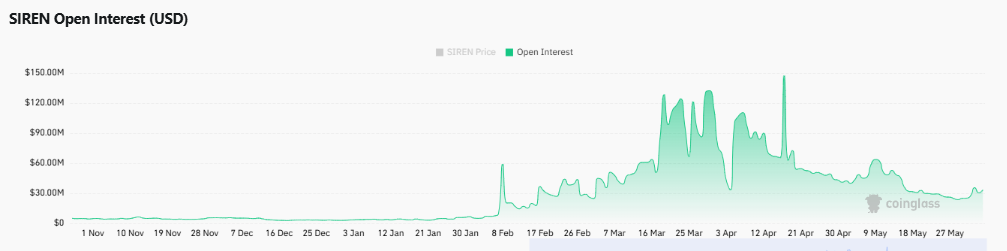
Speculative activity also accelerated across derivatives markets. Open Interest increased 53.19% to $48.76 million, reflecting a substantial rise in active positions.
Such growth indicated that traders had increased exposure instead of merely rotating existing capital. The expansion occurred alongside the price rally, which suggested that market participants anticipated additional upside.
Historically, rapid Open Interest growth amplified volatility because leveraged positions created larger liquidation risks. Nevertheless, the increase also highlighted growing confidence in the ongoing recovery.
Rather than showing hesitation, derivatives traders continued adding exposure as SIREN advanced. This behavior strengthened the bullish narrative, although it also raised the probability of sharp price swings should sentiment shift unexpectedly.
Source: CoinGlass
Can bulls turn recovery into reversal?
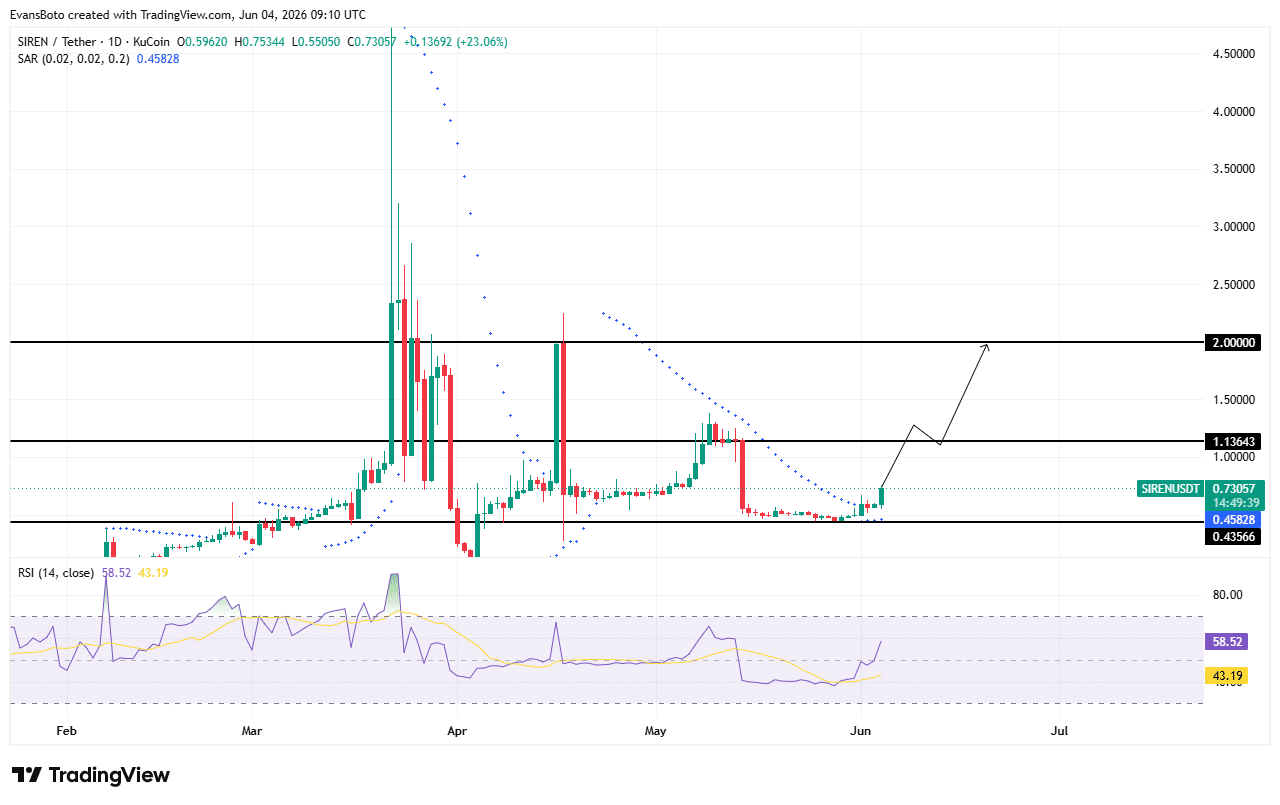
Price action painted a much broader recovery story than a simple daily rally. SIREN had defended the major support zone between $0.435 and $0.458 after months of weakness.
Following that defense, buyers pushed the token toward $0.73 and established a higher low structure.
The Parabolic SAR had already flipped beneath price, indicating that trend conditions had improved considerably compared to previous weeks. RSI also climbed to 58.52 after spending much of May near depressed levels.
The recovery showed strengthening buying pressure without entering overbought territory. Meanwhile, the first major resistance remained at $1.136. A successful move beyond that barrier would strengthen the case for an extended recovery.
Under that scenario, attention would likely shift toward the larger resistance zone near $2.00.
Source: TradingView
Where is liquidity waiting next?
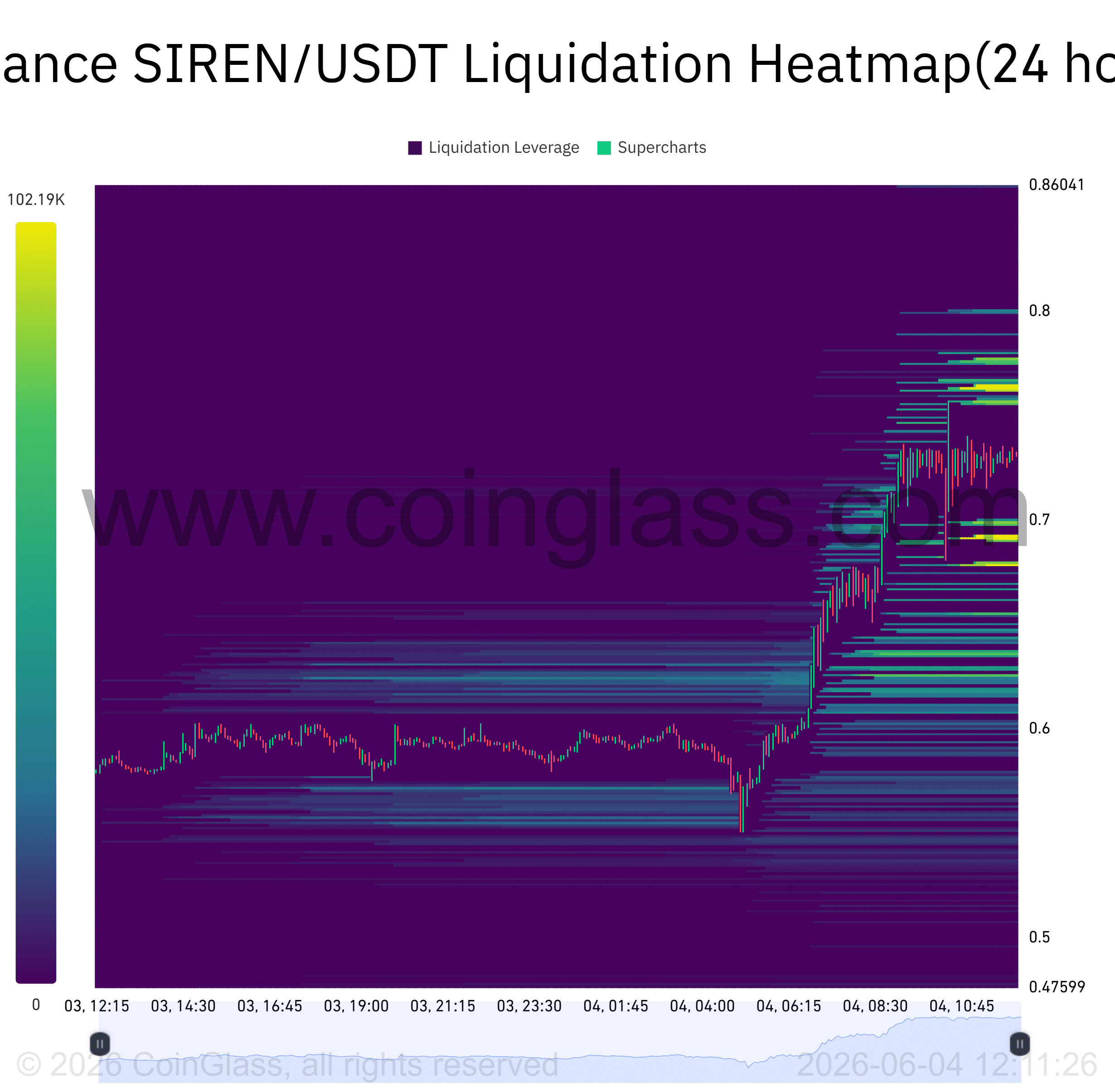
The liquidation heatmap highlighted several areas where volatility could intensify. Dense liquidity clusters emerged around the $0.77 to $0.80 region, directly above the current market price.
These zones often attract price action because large concentrations of leveraged positions accumulate there. Therefore, SIREN appeared positioned to challenge nearby liquidity if buying pressure remained intact.
Additional clusters also formed around the $0.69 to $0.70 region, creating a short-term support area beneath current levels. Market participants frequently targeted these pockets during periods of heightened activity.
Consequently, traders would likely monitor these zones closely for potential squeezes. The concentration of liquidity above price slightly favored further upside exploration in the near term.
Source: CoinGlass
Final Summary
SIREN attracted fresh buying interest as volume and participation expanded sharply.
Rising Open Interest and stronger structure supported a potential recovery continuation.
When Joe Ngai, McKinsey’s Greater China chair, first began to test-drive his point that “the next China is still China” on social media, the world’s second-largest economy was in a post-COVID slump. Sluggish consumption and a property market crash were still dragging down the country’s economy, while foreign companies were rethinking their investment in China as both a consumer market and a manufacturing hub—and asking where the “next China” might be.
“You heard all these things. We’re trying to diversify away from China. We’re trying to de-risk from China,” Ngai tells Fortune in McKinsey’s Hong Kong office. “You can’t find another China. There’s no other China out there now.”
Ngai’s observation is now a book, The Next China is Still China: An Insider’s Playbook for Winning in the New Era, coauthored with Nick Leung, director of the McKinsey Global Institute and Ngai’s predecessor as Greater China chair.
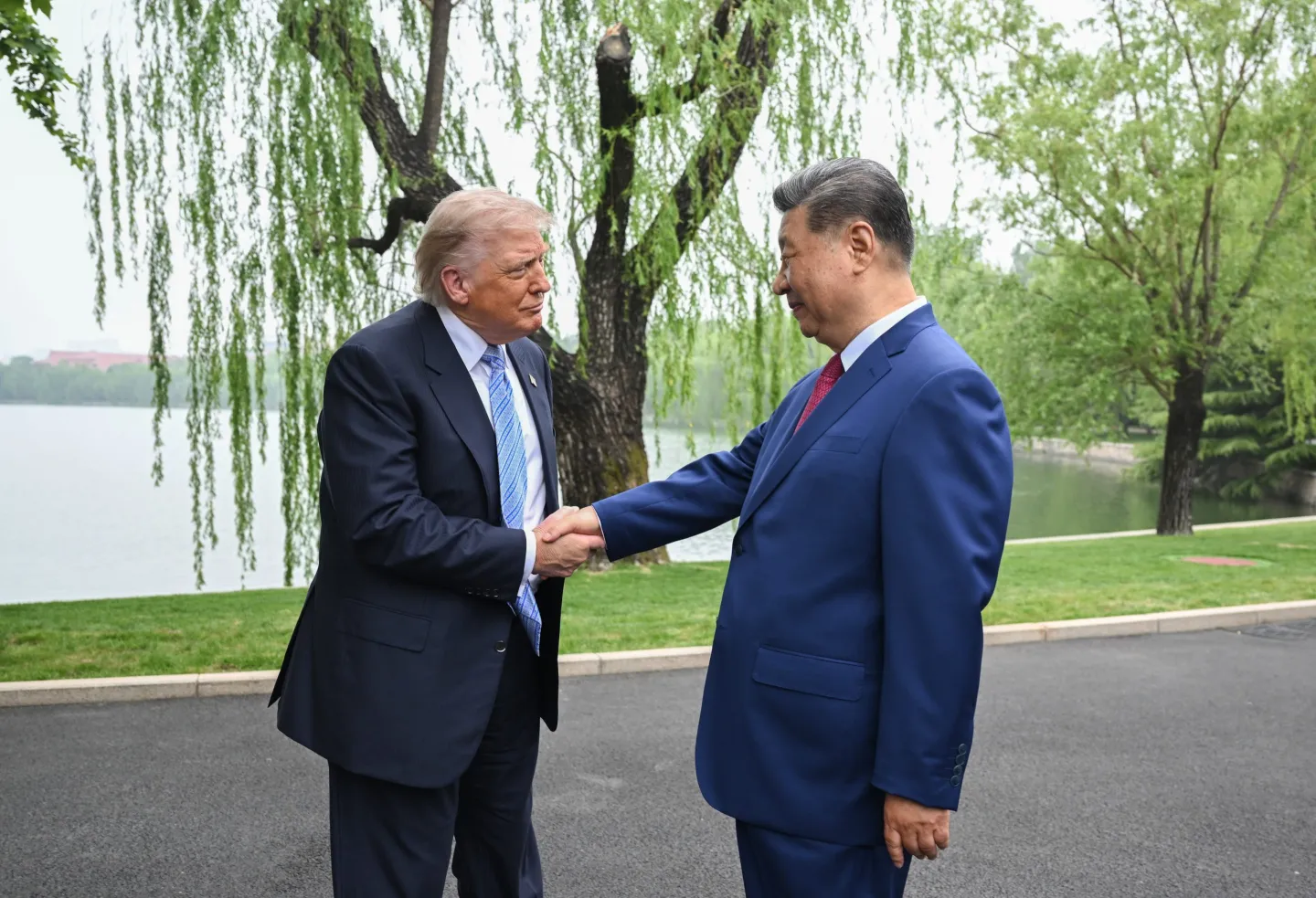
The narrative on China’s economy is shifting. New advances in AI have reset the conversation about China’s capacity to innovate, and Chinese products are now winning converts in overseas markets. The U.S.-China relationship is no longer in free fall following U.S. President Donald Trump’s state visit to Beijing in May, the first by a U.S. leader since Trump’s last trip in 2017.
But for global multinationals, Ngai and Leung argue that China remains a “hard, competitive, and oversupplied” market that requires a shift in corporate strategy. Once-dominant brands like Nike, Starbucks, and Volkswagen are now struggling amid fierce competition from hungry Chinese companies. Yet China possesses both a massive consumer market and a deep manufacturing sector, which economies like Vietnam or India still can’t wholly replace.
“As a board, as a CEO, you can’t just ignore China or find something else,” Ngai says. “You need a Chinese strategy.”
The world’s ‘toughest gym’
In their attempts to describe the success of Chinese companies like BYD, Western governments and commentators often blame government subsidies. The argument is that China deliberately manufactures more than it can absorb and dumps the surplus overseas, either to demolish local competition or just because it needs to offload the goods somewhere. That “overcapacity” argument has motivated trade protectionism in the U.S., Europe, and even some developing markets like Vietnam and Indonesia.
Ngai and Leung push back against that framing. First, they point to the initial period of reform starting in the 1980s and how it incubated dynamic entrepreneurs like Alibaba founder Jack Ma and Xiaomi founder Lei Jun. Second, they note that China’s financial system and competition between provincial governments offered cheap credit to local businesses, allowing the growth of (perhaps too many) local champions.
More recently, Chinese consumers have proved quick to switch to whatever delivers the best product at the lowest price. “In China, they always give you a shot,” Ngai says. “If you have a better thing, the market will respond.”
Ngai ultimately describes China as “the world’s toughest gym,” training hyper-competitive companies.
“This is exactly the argument Europeans used to deploy when they were looking at America,” Leung says. “They would call it cowboy capitalism. China is just an even more intense version of that extreme entrepreneurism.”
Courtesy of McKinsey
One symptom of that intensity is a near-endless series of price wars. BYD, the world’s largest EV manufacturer, has repeatedly slashed prices to capture more market share from its rivals, leading to a 55% drop in net profit in the first quarter of the year. Another example is food delivery, where JD.com’s decision to break into a market dominated by Meituan and Alibaba led to all three devoting over 100 billion yuan ($14 billion) to subsidies and discounts over just two quarters. Meituan, the market leader, has now posted three straight quarters of net losses.
Beijing has complained about what has been termed neijuan, or “involution,” where relentless competition erodes profits for an entire industry. “The entire industry has fallen into a vicious cycle of losing money in an attempt to grab market share, ultimately dragging down the broader trend of consumption recovery,” state media outlet Economic Daily wrote in March, referring to the food delivery price war.
“The competition is at 11 right now,” Ngai says. “If you can get it to an eight, or a seven, there’ll be less wastage and less capital being destroyed.” Still, China’s capital controls mean that investors are forced to bear lower returns, because money has nowhere else to go. “It can be at ten-and-a-half for a very long time,” he admits.
Multinationals in China
For two decades, foreign brands enjoyed a structural advantage in China: Consumers were willing to pay a premium for global products that were better than what domestic producers could make.
That’s not the case now. Apple contends with Huawei and Xiaomi. Nike is losing share to Li Ning and Anta Sports. General Motors, Honda, and Volkswagen are scrambling against BYD and Geely.
“The German car companies made more money in China than they made anywhere else in the world, put together, for years,” he adds. “When you have an entitlement and you take it away? People get very upset.”
“Multinational companies felt they had a right to print money in China forever,” he adds. “And what happened? Competition happened.”
Ngai points out that Chinese entrepreneurs can make market decisions immediately while global multinationals must work through approval chains stretching back to Tokyo, Stuttgart, or New York. “When you have corporate executives fighting against local entrepreneurs who have nothing to lose,” he says, “it’s a very tough battle.”
A few Western brands, like Coach and Logitech, are managing to turn things around by giving autonomy to local executives and designers in a “China for China” strategy. Other multinationals, like Volkswagen and Stellantis, are choosing to partner with Chinese companies to adopt their manufacturing and design practices. Others still, like Starbucks and General Mills, are instead selling their China businesses to local investors.
“Those companies that manage to reimagine their China business as a business in itself—all the way from capital, ownership, management structure, and be as responsive to Chinese consumers as Chinese companies are —maintain their competitiveness,” Leung says. “Those that remain global multinationals find it hard to keep up.”
Going global, and getting stuck
China’s “gym” might have better prepared its companies to win overseas. Chinese firms are already taking market share in Europe, Southeast Asia, and Latin America, competing on both quality and price. BYD, for example, sold more than one million cars overseas in 2025.
However, Chinese companies still struggle to figure out how to appeal to foreign consumers. In China, companies sell their goods by focusing on features, but a global approach requires building an emotionally compelling brand. “Chinese companies produce fantastic products, but don’t position them correctly,” Leung says. He invokes Coca-Cola, whose value is almost entirely its brand. “Drinking Coke makes you cool,” he says. “It’s the emotional connection between the person drinking Coca-Cola and the drink itself.”
Christian Monterrosa—Bloomberg via Getty Images
Some Chinese companies are starting to tentatively explore how to build a brand premium. MiHoYo, the Shanghai-based game developer behind Genshin Impact and Zenless Zone Zero, has broken into the notoriously difficult Japanese and U.S. gaming markets. More recently, Luckin Coffee has opened outlets in New York City and used viral social media campaigns and localized products to muscle into the city’s coffee scene. Li Ning, the Chinese sportswear brand, recently signed an endorsement deal with basketball star Steph Curry.
The next frontier may be AI. Chinese AI companies like DeepSeek, Moonshot AI, and MiniMax have released open-source models whose flexibility and top-tier performance are winning converts across the world, including in Silicon Valley.
“The next export from China that the U.S. hasn’t figured out how to tariff is actually tokens,” Ngai says, referring to the units of data processed by AI models. Chinese AI tokens have already overtaken U.S. tokens on some global marketplaces.
McKinsey’s own China test
McKinsey’s history in China starts in 1993, when the U.S. consulting company put four partners in Beijing and Shanghai, years before its competitors did. It had to explain to Chinese clients what consulting actually was and its slide decks were sometimes photographed and sold outside the building for as little as 10 renminbi.
Leung, who has Swiss and Chinese heritage, joined McKinsey’s Zurich office in 1993 before transferring to Hong Kong in 1997. He served as McKinsey’s Greater China chair for more than a decade before turning to lead the McKinsey Global Institute, the firm’s economic research arm, in 2011. Ngai, who took over as Greater China chair that same year, has run the region since then.
McKinsey has had its own problems in China. In October 2024, the Wall Street Journal reported that McKinsey had cut approximately 500 jobs in Greater China, roughly a third of its regional workforce, after scaling back its client base. Partners reportedly debated whether the firm should continue to do business in China at all, given the deteriorating state of U.S.-China relations.
The firm has pulled back from serving state-owned enterprises, a sector that had become both politically fraught for a U.S. company and simply harder to serve well. “Is that growth the same as what we were thinking about in the early 2010s?” Ngai asks. “It’s probably more mature.”
“Our addressable market has become narrower,” Leung adds, “but we’re addressing a fast-growing market even within that narrow band.”
A ‘cold peace’
China’s economy, while improving, still hasn’t returned to the heady days of the 2000s and 2010s. Retail sales grew just 0.2% in April, the slowest rate since December 2022, the depths of the COVID pandemic. Industrial output rose 4.1%, below expectations.
“We’re in a longer-term 4% or 5% growth scenario, and we’re trending lower,” Ngai says. Yet he sees the shift as “healthy,” setting more realistic expectations about the country’s economy.
“We’re still mid-reset,” Leung adds. “It’s not a structural slowdown or structural demise. It’s not the next Japan.”
Trump’s May visit to Beijing, the first such visit in nearly a decade, ended without major trade breakthroughs. The biggest success was a deal for China to buy 200 Boeing planes, fewer than an expected 500-jet order.
Yan Yan—Xinhua via Getty Images
“Business conditions aren’t contingent on the two presidents meeting,” Ngai admits. “Geopolitical calm is good, but if I’m a multinational, the China market remains freaking hard. That’s not going away anytime soon.”
Still, even just setting a floor under the U.S.-China relationship is better than nothing, even if corporate and trade developments will take longer to arrive.
“A cold peace is better than no peace,” Leung says.
In Fortune’s “Asia Agenda” column, released twice a month, we speak with Asia’s top business leaders about how they are building for the future and the lessons they’ve drawn from leading companies in one of the world’s fastest growing and most dynamic regions. Explore all of our profiles here.
Fortune is hosting the Fortune Leaders Forum on September 8 in Macau, China, on the theme “Leadership in the Age of Convergence and Complexity.” Join business leaders as they discuss how today’s world demands decisive leadership and a balance of strategic imagination with operational agility. Register here!