
error code: 520
Online Casinos Unmasked: How to Play Safely and Cash Out Big
Things You Should Never Talk About at Work, From Etiquette Experts

Coworkers often engage in small talk, which is usually a well-meaning attempt at forming connections.
However, some subjects or remarks can be misunderstood or come across as inappropriate in a professional setting, potentially straining relationships between coworkers.
That’s why Business Insider asked four etiquette experts about the topics people should avoid discussing at work. Here’s what they said.
How others spend their time and money
Dayfaphoto/Shutterstock
The lines between work and personal life can sometimes feel blurry, but how a coworker spends their paid time off or paychecks is none of your business.
That’s why etiquette expert and author, Jamila Musayeva, said it’s important to avoid making scrutinizing remarks.
“Saying things like, ‘How can you afford a designer item?’ or ‘Another vacation already?’ may seem like casual banter, but these comments carry an undertone of judgment and jealousy,” Musayeva told BI.
Coworkers’ meal choices and preferences

AnikonaAnn/Shutterstock
Meal choices, including workday snacks, are often moments of personal expression and comfort. Musayeva said unwanted commentary about one’s food choices can create an environment that’s not inclusive.
“Comments such as ‘That’s all you’re eating?’ or ‘You’re eating that?’ may be intended as lighthearted, but can come across as shaming or intrusive,” Musayeva told BI.
Plans to leave the company or look for a new job
It can be tempting to share career updates with your colleagues, but business etiquette expert Jacqueline Whitmore recommends keeping them to yourself until you formally resign.
“Sharing that you are job hunting or plan to leave can undermine trust, damage relationships, or even put your current position at risk if management hears about it,” Whitmore said.
Frequent mentions of stress and burnout
Although mentioning busyness and stress may seem like a way to connect with colleagues, it can sometimes have the opposite effect.
“Constantly framing yourself as the busiest or most overwhelmed can create unhealthy competition and guilt among coworkers,” Musayeva said. “It subtly implies that those who prioritize boundaries or balance are less committed.”
Salary details

Pormezz/Shutterstock
Suzy Lins, a certified etiquette trainer known as The Manners Maven, said people should never discuss their pay with others.
“Even though people want pay transparency and equity, you run the risk of making coworkers jealous or alienating them,” Lins said.
Recaps from your scandalous weekend

Media_Photos/Shutterstock
According to Whitmore, it’s best to avoid sharing stories about your weekend, especially if your behavior may be perceived as unprofessional.
“Bragging about your heavy partying, hangovers, or illicit behavior outside work can make you appear irresponsible,” Whitmore said. “This may also cause colleagues or supervisors to question your judgment or reliability.”
Details about your love life
Jo Hayes, an etiquette expert and founder of EtiquetteExpert.Org, said it’s best to avoid discussing your love life with your coworkers, as this can quickly blur personal and professional boundaries.
“Your love life is a personal topic and reveals far too much vulnerable information about your private life,” Hayes told BI.
Deep dives into medical and health troubles

Volha_R/Shutterstock
In addition to oversharing personal relationship details, Hayes recommends keeping medical and health information private for similar reasons.
“Even when needing to take time off work for medical or health reasons, there is often no need to disclose what that health reason is,” Hayes said.
Keeping your update short and sweet is sufficient.
This story was originally published on July 7, 2025, and most recently updated on August 21, 2026.
Hyundai considers Georgia Metaplant expansion to 800,000 units

Hyundai Motor is considering expanding production capacity at its Georgia assembly plant from 500,000 vehicles annually to between 700,000 and 800,000 units by 2028, CEO José Muñoz told CNBC on Thursday. The South Korean automaker said following publication of the interview that the plans are under consideration but not yet confirmed.
At the upper end of that range, the Georgia Metaplant would leapfrog rivals — among them Tesla and Toyota Motor — to claim the top spot among U.S. vehicle assembly plants measured by capacity.
Muñoz said President Donald Trump’s tariffs, including a 15% levy on imports from South Korea, have accelerated the company’s localization plans. “Tariffs are helping accelerate our localization plan. That’s very, very simple,” he said. “The good thing is that we had already started before tariffs were announced. So in a way it’s helping us to accelerate.”
Any such expansion would be funded through Hyundai’s already-announced $26 billion U.S. investment commitment running to 2028. Hyundai has targeted a domestic production share of at least 80% of the vehicles it moves in the U.S. market by 2030, compared with roughly 40% in 2024. “For that purpose, we need to add more capacity,” Muñoz said.
The $7.6 billion Metaplant, which Hyundai first announced in 2022, is currently turning out the all-electric Ioniq 5 and Ioniq 9 models alongside the Kia Sportage hybrid. The facility is designed to build hybrid and all-electric vehicles for the Hyundai, Genesis, and Kia brands. Under the existing 500,000-unit framework, the Georgia campus would employ upward of 8,500 people directly, with a further 6,900 positions supported at supplier facilities nearby.
Hyundai is also evaluating additional investment for body-on-frame vehicles such as trucks and SUVs at a location separate from the Georgia plant, though Muñoz declined to provide further details.
Muñoz, who became the first non-Korean CEO of Hyundai Motor when he took the role last year, framed the U.S. as central to the company’s global strategy. “For us, the USA is the most important market in the world besides Korea, which is our headquarters,” he said. Hyundai’s U.S. market share has grown from 8.4% in 2020 to 11.2% last year, according to CNBC, citing data from Mobility Global.
Ethereum whales sell 14,000 ETH at $2346 – Can buyers absorb it?

Ethereum whales intensified profit-taking after a two-day rally exceeding 20%, placing fresh selling pressure against still-strong market demand.
According to Lookonchain, 7 Siblings sold 14,000 ETH worth $32.85 million at an average price of $2,346. Another whale sold 11,252 stETH worth $26.5 million and 1,824 ETH worth another $4.26 million.
The transactions coincided with ETH’s sharp rise and profit-taking was a probable reason for the selling by large holders.
However, the distribution came as ETH was still trading close to the whales’ average selling points. The positioning raised the significance of demand at $2,346, with sellers converting massive amounts of their inventory into stablecoins.
Buyers counter whales as Ethereum leaves exchanges
Aggressive spot demand provided the clearest counterweight to the whale selling observed during Ethereum’s price rally.
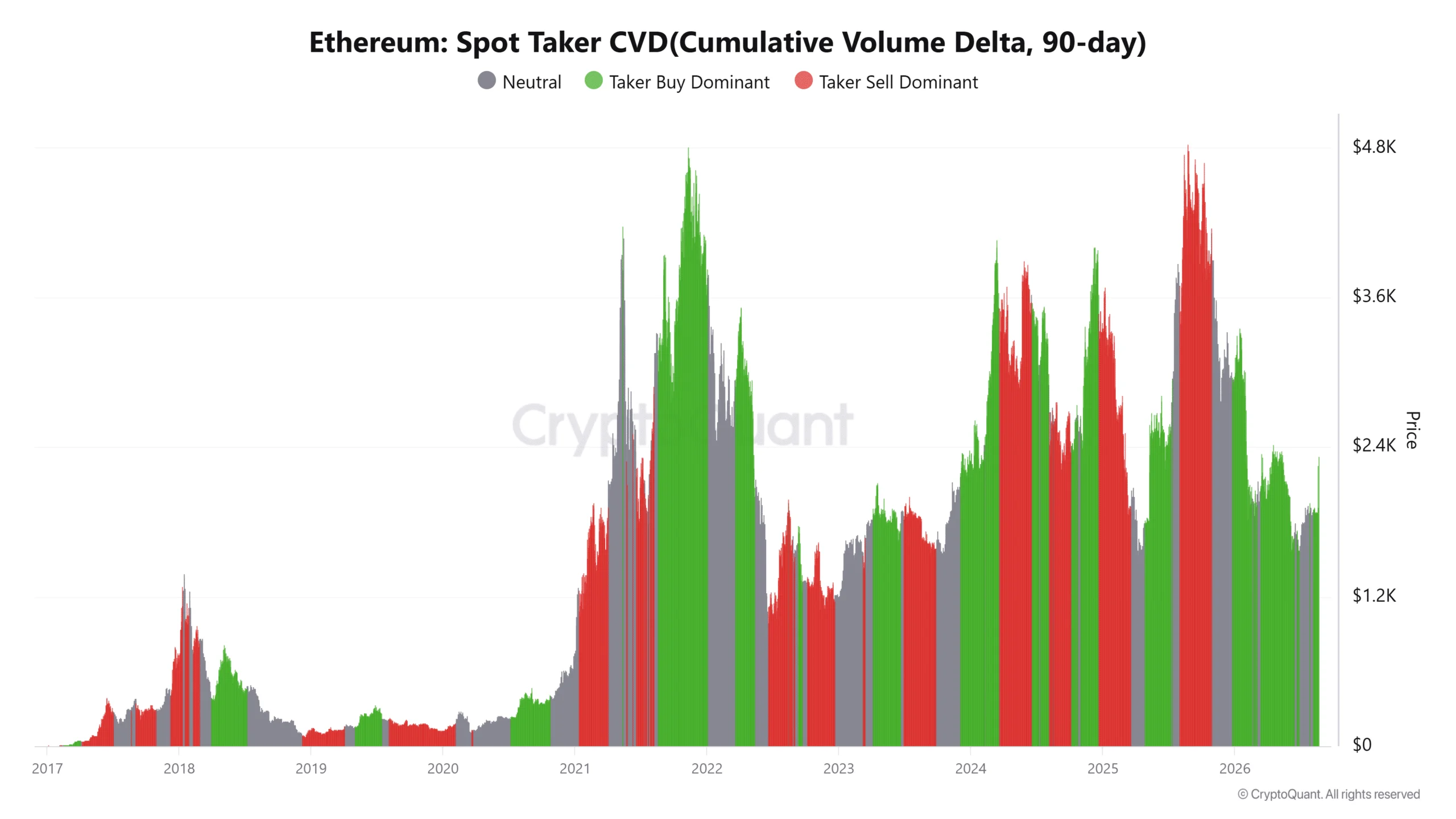
The 90-day Spot Taker CVD remained taker-buy dominant, indicating that there was more buying activity than selling activity in the market.
Therefore, buyers continued taking available offers despite whales offloading large amounts of Ethereum.
Exchange Spot Netflows strengthened that demand picture further, rather than confirming broader distribution across the market.
According to CoinGlass, ETH recorded approximately $40.43 million in negative Spot Netflows as of the time of writing.
This led to a decline in exchange side availability, while aggressive taker demand competed with the circulating supply.
Whale profit taking had brought some resistance near term especially with the rapid rise in price.
However, the taker buy dominance and exchange outflows provided the buyers with two buffers against such big holder supply.
Can buyers crack the $2,378 ceiling?
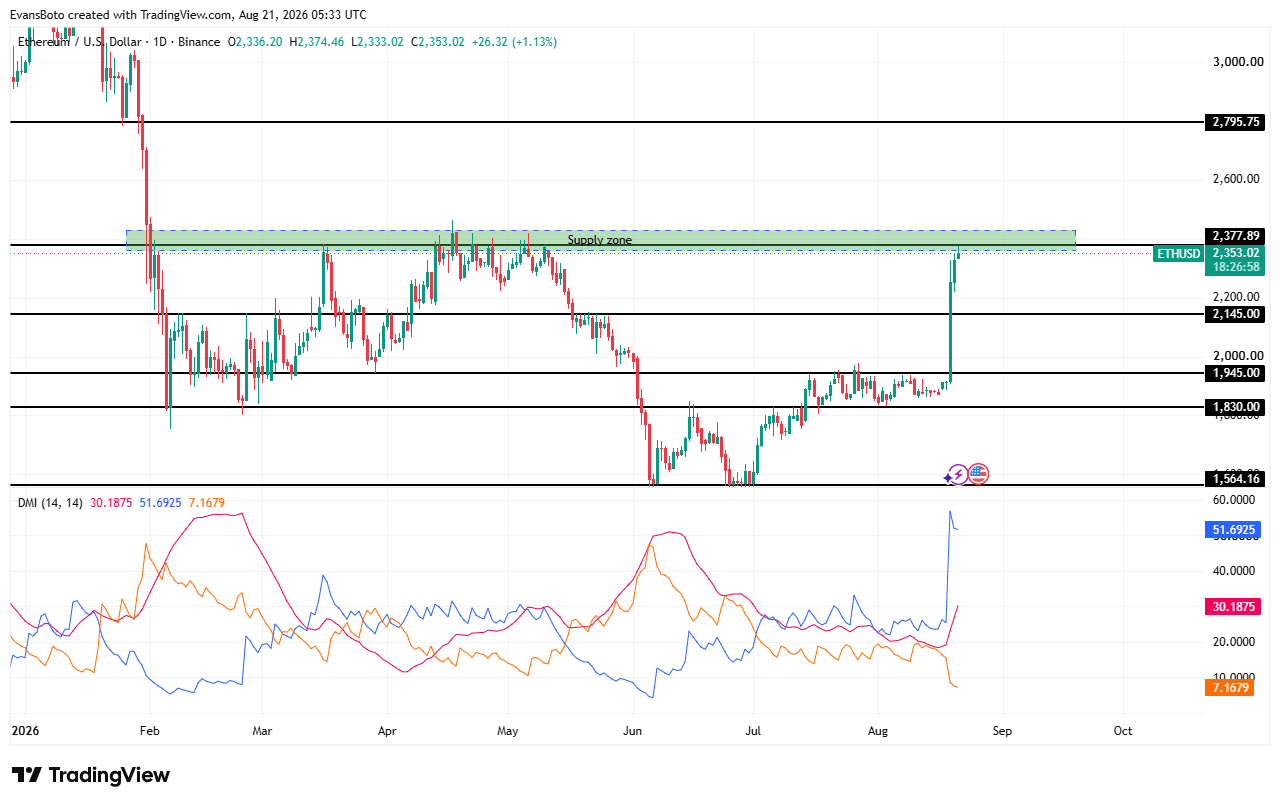
The battle between demand and supply was brought directly to $2,378, the significant resistance zone for Ethereum.
Ethereum [ETH] had rallied from $1,945 prior to hitting around $2,353 and testing the broken supply level.
Importantly, buyers entered that zone with strong directional conditions rather than approaching it through weak participation.
The +DI has rallied to 51.69 while the -DI has fallen drastically to just 7.17.
The ADX is currently at 30.19, indicating strong momentum in the direction of the trend. Those readings favor buyers as ETH tests an area that previously capped advances during the April and May sessions.
Still, $2,377.89 represented the immediate threshold separating the rally from a cleaner technical expansion.
A continuation break may create a larger opportunity to the major $2,795.75 resistance level.
Rejection could also swing momentum back to $2,145 before other supports came into play.
Liquidity could amplify the supply-zone battle
Leveraged positioning added another layer to Ethereum’s attempt to clear its nearby supply pressure.
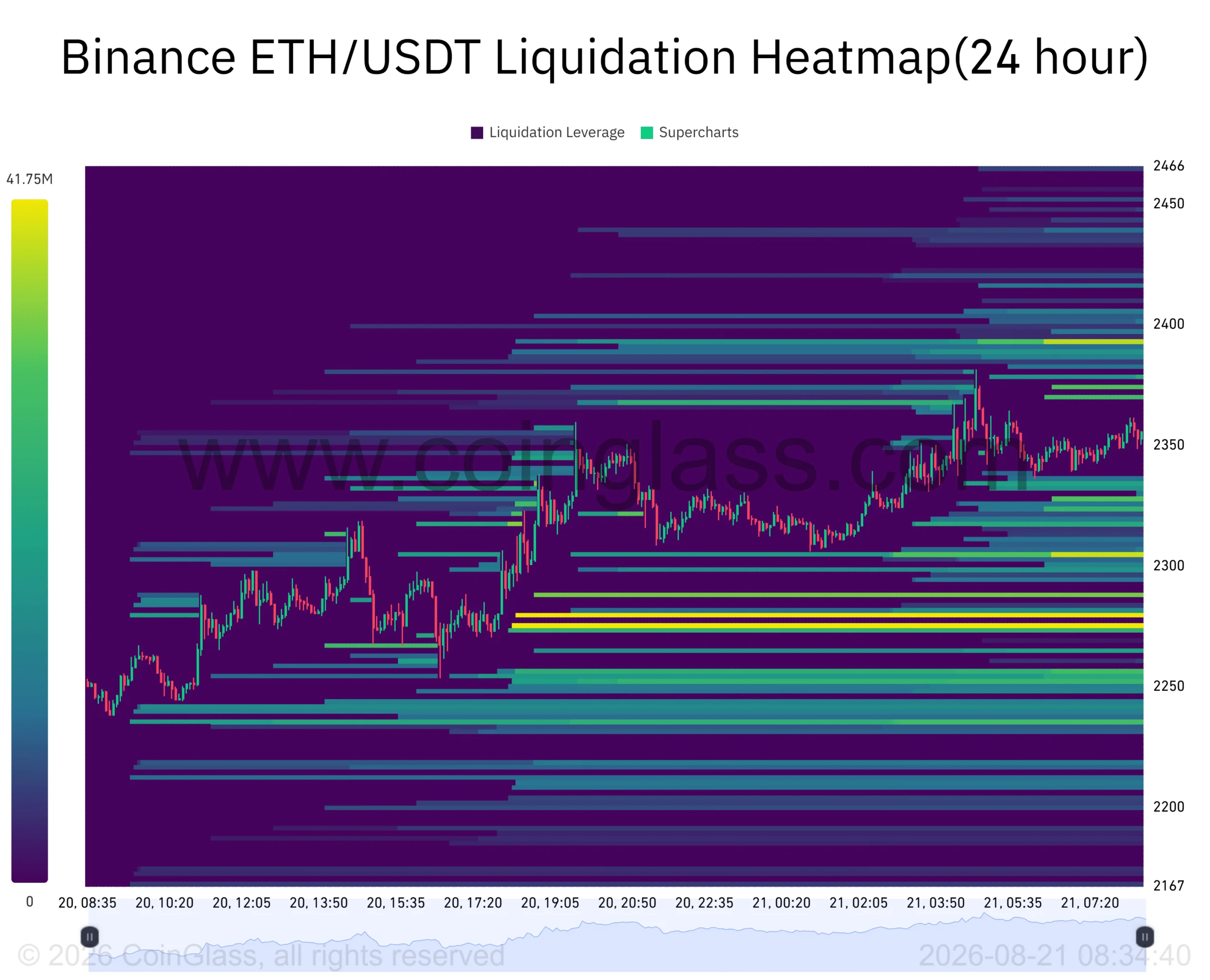
The 24-hour Liquidation Heatmap showed significant liquidation liquidity below price in the $2275 – $2290.price range
Specifically, the brightest concentration formed around $2,280, which makes for a major downside liquidity pocket.
However, liquidity also accumulated above ETH as price approached the upper boundary of its supply zone.
Clusters in the $2,380 to $2,400 range sat just past the resistance that buyers are facing.
Therefore, a move through $2,378 could expose nearby liquidation levels and strengthen the upside extension.
A rejection could otherwise drive ETH back down before any buyers would try and resume the upward run.
Importantly, spot demand remained supportive while those competing liquidity pools surrounded the current price structure.
The next direction would then be driven by whether buyers could absorb supply around the $2,378 region.
Final Summary
- Whale profit-taking has increased, but taker buyers continue absorbing available ETH supply.
- A $2,378 breakout could expose upside liquidity and strengthen Ethereum’s ongoing recovery.
Silver prices today, Friday, August 21, 2026: Silver pushes higher on weaker dollar

Silver (SI=F) September futures opened at $68.20 per ounce on Friday, August 21, 2026, up 0.1% from Thursday’s closing price. The silver price moved higher this morning, reaching $69.49 as of 9 a.m. ET.
The opening silver price was up nearly 5% since last week as traders reacted to a record high in U.S. debt and the Treasury’s unexpected announcement to increase long-term bond repurchases. The news contributed to a decline in the U.S. dollar. A weaker dollar supports higher silver prices by lowering the cost for foreign buyers.
Silver, like gold, can function as a safe-haven asset for investors, but its supply and demand dynamics differ. Most silver is mined as a byproduct of other metals, so producers don’t necessarily change their output to fit demand. And silver demand has investment and industrial components. Those complexities can make silver more volatile and difficult to predict than gold.
Current price of silver
The opening price of silver futures on Friday, August 21, 2026, was 0.1% higher compared to Thursday’s closing price. Here’s how today’s opening silver price has changed versus last week, month, and year:
-
One week ago: +4.9%
-
One month ago: +21.1%
-
One year ago: +79.3%
For context, silver’s year-over-year growth was 173.3% on May 14.
24/7 silver price tracking: Don’t forget you can monitor the current price of silver on Yahoo Finance 24 hours a day, seven days a week.
Want to learn more about the current top-performing companies in the silver industry? Explore a list of the top-performing companies using the Yahoo Finance Screener. You can create your own screeners with over 150 different screening criteria.
Investing in silver? Here’s how to avoid taxes.
Do you have to pay taxes on silver? Yes. Silver is a capital asset, so when you sell it for more than you paid, the gain is taxable and reported on Schedule D of your federal return.
Many investors assume holding silver for more than a year qualifies them for the same long-term capital gains rates as stocks (0%, 15% or 20%).
Spoiler: It doesn’t.
The 28% collectible tax trap
The IRS classifies physical precious metals — including bars, rounds, and coins — as collectibles. That classification changes the tax math in a big way.
Short-term gains
If you hold silver for one year or less, your profit is taxed as ordinary income. Depending on your tax bracket, that could go as high as 37%.
Long-term gains
If you hold silver for more than one year, your gain is taxed at your ordinary income rate — but no more than 28%.
Here’s what that looks like in real life:
-
If you’re in the 10%, 12%, 22% or 24% bracket, your silver gain is taxed at that same rate.
-
If you’re in the 32%, 35% or 37% bracket, you’re capped at 28%.
So if you’re a middle-income earner accustomed to paying 15% on stock gains, silver can cost you more, maybe 22% or 24%, depending on your adjusted gross income.
If you’re in the top brackets, the 28% cap is technically a discount versus 35% or 37% — but it’s still higher than the 20% max long-term capital gains rate on stocks.
That difference adds up quickly when you’re talking five- or six-figure gains.
Learn more: How to avoid taxes when investing in silver
Price of silver chart
Whether you’re tracking the price of silver since last month or last year, the price-of-silver chart below shows the precious metal’s value journey so far this year.
More silver coverage from the Yahoo Finance team:
Zurich Australia finalises $275m ClearView Wealth takeover

Zurich Financial Services Australia has finalised its purchase of ClearView Wealth through a members’ scheme of arrangement (SoA).
Under the deal terms, ClearView shareholders will receive A$0.60 per share in cash, taking the total cash consideration to roughly A$385m.
Zurich Financial Services Australia first announced the agreement to acquire ClearView Wealth in February this year.
The transaction proceeded after clearance was obtained from the Australian Competition and Consumer Commission (ACCC) and the Australian Prudential Regulation Authority (APAR), alongside sign-off from ClearView shareholders and the Supreme Court of New South Wales.
Zurich retail head Tim Kane said: “Zurich will retain ClearView’s ClearChoice product, which will remain open to new customers alongside our existing Zurich and OnePath Life offerings.
“Across all three propositions, we will continue our significant investment in leading technology and people to ensure we are meeting the evolving needs of customers and advisers and delivering the outstanding service we are known for.”
ClearView, listed on the Australian Securities Exchange, is the parent company of ClearView Life Assurance, a life insurer in Australia that works alongside financial advisers to support Australians and their families in planning ahead.
The company recorded A$436m in in-force premiums as of 31 December 2025.
A members’ SoA refers to a formal, statutory process requiring court approval, through which a company and its shareholders agree to reshape the corporate structure, amend shareholder rights, or carry out a friendly takeover.
Zurich CEO Justin Delaney said: “This transaction marks the creation of one of Australia’s largest and fastest-growing life insurers at a time when advice-led protection, prevention and financial security has never been more important.”
Elsewhere within the group, Zurich established a branch in Warsaw, Poland, in April, enabling it to begin underwriting commercial insurance in the country via Zurich Austria.
In another development, Zurich Commercial Insurance extended its Data Center Project Guard product internationally in June, launching in Brazil, Germany, Italy, the Nordics and Spain following its initial US rollout in January 2026.
The product, originally created by Zurich North America’s construction division, secured business within weeks of debuting in the US before being extended to the five additional markets.
“Zurich Australia finalises $275m ClearView Wealth takeover” was originally created and published by Life Insurance International, a GlobalData owned brand.
Crypto deposit vs Card deposit in online casinos. Which is the best?

A New Zealand casino player choosing between a card and crypto deposit is really choosing between simplicity and control. It is worth taking a look at the speed, fees, security, and practical risks of both methods to see which one makes more sense in varying contexts.
A casino deposit can look straightforward until the cashier asks you to choose a payment method. Cards use money already held in New Zealand dollars, while crypto requires a supported asset and a wallet transfer. The important differences sit behind the payment button: fees, settlement, price movement, and what happens when a transaction goes wrong.
The cashier makes the difference concrete
The choice starts inside the casino account, before any game begins. A card deposit uses money already sitting in a bank account, usually in New Zealand dollars. A crypto deposit starts in a wallet and sends a supported digital asset across a blockchain. Both can reach the casino balance quickly, but they take very different routes.
Players returning through the SpinBit login enter a New Zealand-facing account where Visa, Mastercard and Maestro sit alongside Bitcoin, Ethereum, Litecoin and Tether as deposit options. The minimum deposit for a New Zealand account is NZ$30, while crypto minimums are set in the selected asset rather than local currency.
That difference affects the whole transaction. A card player chooses an amount in NZD and approves the payment through a bank. A crypto holder selects an asset, checks the wallet address, and sends the transfer through the correct network. Buying crypto solely for the deposit adds another stage because the player must first use an exchange, pay any trading spread and move the coins into a wallet.
SpinBit presents its supported crypto deposits as free and instant on the casino side. Blockchain fees and confirmation times still sit outside that promise, so the total cost depends on the asset, network traffic, and the service used to acquire the crypto.
Cards win the familiarity test
Cards have one large advantage in New Zealand: people already use them every day. Stripe’s April 2024 guide to New Zealand payments reported that 67% of Kiwis preferred debit or credit cards for daily spending, while 88% used contactless payments at least occasionally.
That existing habit reduces the amount a player needs to learn at the cashier. The deposit is entered in NZD, the bank handles authentication, and the casino receives an approval or rejection. There is no wallet address to copy and no blockchain network to choose.
| Factor | Card deposit | Crypto deposit |
|---|---|---|
| Starting asset | NZD in a bank account | Supported cryptocurrency |
| Deposit process | Card checkout and bank approval | Wallet transfer through a blockchain |
| Price exposure | None once the NZD amount is chosen | Possible with BTC, ETH or LTC |
| Reversibility | A dispute process may exist | Transfer is usually final after confirmation |
| Main user risk | Rejection or stolen card credentials | Wrong address or incorrect network |
Security concerns still affect the decision. Stripe reported in the same April 2024 guide that 86% of New Zealanders considered hacking, data safety, or stolen banking credentials when assessing a new payment method. Cards remain easy to understand because the player knows the bank sits behind the transaction, even when the technical process is hidden.
Crypto gives the player direct control, but direct control also means direct responsibility.
Crypto moves the risk rather than removing it
Blockchain payments are often described as faster or safer, but both words need context. The important technical point is settlement finality, which means the payment has become unconditional and cannot be reversed through the network.
Coinbase Institute’s February 2026 analysis defined settlement finality as the point at which a transfer becomes irrevocable, distinguishing confirmed blockchain payments from card transactions that can later face chargebacks.
That finality benefits the recipient because the payment cannot be pulled back through a card dispute. The sender carries the heavier burden. A transfer sent to the wrong wallet address, through an unsupported network or in the wrong asset may be impossible to recover.
Inside SpinBit’s cashier, players can choose BTC, ETH, LTC or USDT. Each option has its own minimum deposit and network conditions. A BTC transfer may face a different fee and confirmation period from an Ethereum transaction, while Litecoin follows another process again. The casino may credit the account as soon as its required confirmations arrive, but the blockchain decides when those confirmations occur.
Stablecoins narrow the gap
USDT gives crypto users a middle route because its value is designed to track the US dollar. A player holding Bitcoin or Ethereum may see the asset price move between buying the coins and making the deposit. Tether reduces that problem, although a New Zealand player still has to consider the exchange rate between NZD and USD.
Raj Dhamodharan, Mastercard’s Executive Vice President for Blockchain and Digital Assets, said in April 2025: “For stablecoins to go mainstream, consumers and businesses need the same level of trust and confidence they experience with traditional payment methods”.
His point reaches beyond price stability. A payment method also needs clear fees, understandable transaction status, and a process users trust when something goes wrong.
USDT solves part of the crypto problem:
- It reduces exposure to Bitcoin, Ethereum or Litecoin price movement.
- It keeps the payment on blockchain rails.
- It does not remove wallet-address errors.
- It does not remove network-selection risk.
- It does not eliminate conversion costs between NZD and USD.
The USDT option at SpinBit suits a player who already holds the stablecoin and understands wallet transfers. It offers less value to somebody starting with NZD, since buying USDT first creates an extra exchange transaction before the casino deposit begins.
Cards and crypto are already converging
The line between card payments and crypto payments is getting harder to draw. A person can hold stablecoins in a wallet and spend them through a card network, while another can use a bank card to buy crypto before sending it on-chain.
Adewale Olarinde reported on 15 January 2026 that crypto-linked card payments had reached a monthly run rate above $15 billion, compared with about $11 billion for peer-to-peer stablecoin transfers. Visa accounted for more than 80% of the stablecoin card volume tracked in the underlying Artemis data.
Those figures show that users do not always choose between two separate camps. Card networks are becoming a front end for digital assets, while exchanges continue to use cards as a route into crypto. The best choice becomes clearer once the full funding path is counted, rather than judging only the final click.
The best method depends on the starting point
Cards are the practical default for most New Zealand players. They use NZD, require no wallet knowledge, and come with a payment process that people already understand. A failed card deposit normally produces an error or rejection rather than sending money into the wrong network.
Crypto makes more sense for an experienced wallet user who already holds a supported asset. Direct settlement avoids the card chain, operates around the clock, and gives the player control over the transfer. That control comes with responsibility because confirmed payments cannot usually be undone.
A SpinBit account keeps the choice inside one cashier, but the payment method does not bypass the casino’s account rules. Identity checks are required before withdrawal, and players can set deposit limits, loss limits or wager limits through their account controls. Time-outs and self-exclusion are also available.
Neither method improves the odds of a casino game. The deposit route only changes how money enters the account, what it costs to move and who carries the risk when something goes wrong.
Gambling is intended for adults and should be treated as entertainment, never as a way to earn money. Only gamble with money you can afford to lose.
Disclaimer: This is a paid post and should not be treated as news/advice.