On August 11, Venture Global (NYSE:VG) reported its Q2 2026 earnings. While the text implies an established corporate history, Venture Global completed its IPO in January 2025, making this only its second Q2 report as a publicly traded company. The company posted its largest quarterly EBITDA ever, raised its full-year guidance for the second time this year, and lifted its dividend by triple digits. But the stock still carries one of the most lopsided sentiment profiles on the market, and that gap between the fundamentals and the trading floor is the real story here.
Venture Global (VG): Record Earnings and Raised Outlook Signal Strong Growth
Bull Case: Profits Surge Across Every Metric
The headline number was $2.5 billion in consolidated adjusted EBITDA for the second quarter of 2026, a 79% jump from the $1.4 billion posted in the same quarter of 2025. Revenue followed the same trajectory, climbing 48% year over year to $4.6 billion, with $1.3 billion of that increase coming from higher sales volumes and the rest from better pricing. Venture Global shipped 466 TBtu of LNG in the quarter, up from 329 TBtu a year earlier, and net income attributable to common stockholders came in at $1.3 billion, up 266% from $368 million.
That kind of operating leverage let management raise 2026 EBITDA guidance to a range of $8.7 billion to $9.1 billion, up from the $8.2 billion to $8.5 billion range given back in May. The company also exported its 1,000th cargo, just four years after its first shipment in March 2022, while keeping 91% of its 2026 volumes contracted, up from 84% at the start of the year. On the balance sheet side, Venture Global refinanced $5.3 billion of debt and preferred equity during the quarter, part of more than $103 billion raised or refinanced since the company’s founding, a move management says will cut annual interest and coupon costs by more than $100 million. The board followed that up by raising the quarterly dividend 122% to $0.04 per share.
Bear Case: Growth That Still Needs Proving
Not everything in the release points in one direction. Management kept its EBITDA guidance range wider than usual, citing LNG price volatility tied to events in the Middle East, and said it would only narrow that range after the third quarter. The current guidance assumes a liquefaction fee of $12.50 to $13.50 per MMBtu for uncontracted 2026 cargoes, and every $1 swing in that fee moves EBITDA by $180 million to $210 million, a reminder of how exposed results still are to global gas prices.
Much of the company’s future growth also sits years out. A final investment decision on the 10 MTPA CP2 expansion isn’t expected until early 2027, with first production not until late 2028, while the Plaquemines expansion is targeting an FID in the first half of 2027 and Phase 1 output only starting in 2029. Of the roughly 85 MTPA of run-rate production expected once all three projects and their bolt-ons are online, only about 53 MTPA is currently committed under long- and medium-term contracts, leaving 32 MTPA still to be marketed. And despite the dividend increase, the payout remains modest at $0.04 per share, even as the company keeps tapping debt and equity markets to fund expansion.
A Cheap Stock, Heavily Shorted
Hedge fund ownership of Venture Global climbed from 22 funds to 50 quarter over quarter, which points to institutions building positions rather than trimming them. That accumulation is happening even as short interest sits at 80.57% of the float, a level that signals heavy organized skepticism and a stock crowded with bearish bets. Meanwhile, shares trade at a forward P/E of just 9.41, as of August 19, a multiple that assumes little of the growth management just described.
The Question Investors Are Weighing
Venture Global just delivered a quarter that most companies would call a best-case scenario, with record EBITDA, a raised outlook and a much larger dividend. Yet the stock’s setup, a cheap multiple, growing institutional interest and an enormous short position, suggests the market hasn’t fully settled on what to make of it. For the bulls, the next test is whether contracted volumes and cargo output keep climbing while CP2 and Plaquemines expansions stay on schedule.
While we acknowledge the potential of VG as an investment, we believe certain AI stocks offer greater upside potential and carry less downside risk. If you’re looking for an extremely undervalued AI stock that also stands to benefit significantly from Trump-era tariffs and the onshoring trend, see our free report on thebest short-term AI stock.
The next Miss USA won’t be coming to your television screens after all.
A spokesperson for The CW confirmed to Business Insider on Thursday that the network will not air the Miss Teen USA and Miss USA finals next week as originally planned.
“After careful consideration and conversations with the Miss USA Organization, The CW Network has decided to forego next week’s broadcasts of the Miss USA and Miss Teen USA pageants,” the spokesperson said in a statement. “We wish the organization and all of this year’s contestants well in the competition.”
A spokesperson for Miss USA told Business Insider that the pageant will be available to watch on the Queen Beauty Network — a streaming platform focused on the pageant, fashion, and beauty industries — as it was in 2025.
Audrey Eckert was crowned Miss USA in 2025.
Reza Venegas
The Miss USA Organization also addressed the change in an Instagram story. “Two weeks ago, we identified a contractual issue with our production arrangements that could not be resolved within the necessary timeframe,” it said. “Since then, our team has worked diligently to explore options that would allow us to continue with a live broadcast on The CW. Unfortunately, we were unable to reach mutually agreeable terms for this year’s event.”
The organization added that it was “grateful” for its relationship with The CW and “open to opportunities to work together in the future.”
It was meant to be a return to cable for the troubled pageant, which has seen its leadership change hands three times since 2020 and weathered several highly publicized scandals.
The CW network previously agreed to a three-year deal with then-CEO Laylah Rose in April 2024. A month later, Miss USA 2023 Noelia Voigt and Miss Teen USA UmaSofia Srivastava relinquished their titles, a first in the pageant’s 70-plus-year history. The pageant queens said they had been bullied by Rose, who denied the allegations.
Every time Anneta publishes a story, you’ll get an alert straight to your inbox!
Stay connected to Anneta and get more of their work as it publishes.
Miss USA has not been on television since the 2024 pageant.
Gilbert Flores/Variety via Getty Images
Miss USA 2024 took place in August 2024 and aired on The CW as scheduled. But, in 2025, the network confirmed to Business Insider that it had no plans to air that year’s pageant. It was the first time Miss USA had not been televised since 1965.
“Bringing Miss USA and Miss Teen USA back to The CW for both competitions is a defining moment as we celebrate 75 years of Miss USA,” he said in a press release announcing the new deal in June.
“The CW reaches audiences in every corner of the country, and there is no better stage on which to showcase these 102 extraordinary women as they compete for two of the most iconic titles in the world,” he added.
The Miss Teen USA and Miss USA finals will take place at the Adrienne Arsht Center in Miami on August 26 and 27.
The U.S. government’s debt has surpassed $40 trillion, according to the latest data from the Treasury. It’s a staggering, hard-to-process number, totaling over $359,000 in federal debt for every American taxpayer.
Bank of America’s chief equity strategist, Michael Hartnett, projects the number will swell to $50 trillion in less than three years.
“The problem with $40 trillion is not the number,” Stephen Innes, financial markets analyst and former investment bank trader, wrote in an analysis. “Markets have been watching the US debt clock spin higher for years and, for most of that time, the response has been little more than a shrug. Washington spends, Treasury issues, investors absorb it, and the machine keeps moving.”
The largest federal budget items are Medicare/Medicaid combined (nearly $2 trillion), Social Security (over $1.6 trillion), national defense ($946 billion) — and interest on the debt (over $1 trillion).
Innes believes interest costs will soon begin “eating the budget alive,” with the steep trajectory of the government debt making the interest expense “one of Washington’s largest single outlays.”
What does that mean for the stock and bond markets — and the cost of living?
For fiscal year 2026, the federal government is projected to collect $5.6 trillion in revenue while spending about $7.4 trillion. That results in a deficit of roughly $1.9 trillion, according to the Congressional Budget Office.
“In other words, the government is spending roughly $1.33 for every $1 collected,” Colin Slabach, clinical assistant professor at New York University’s School of Professional Studies, told Yahoo Finance in an email.
“The good news is that there is still plenty of demand for US government debt,” he added. “The problem is that if that changes in the future — and nations like Japan need to sell our debt to stabilize their own currency — it could lead to an overabundance of supply.”
That’s when the Treasury would have to pay increasingly higher interest rates to attract investments in the U.S. government, Slabach said.
As swelling government debt pushes bond yields higher, borrowing costs for consumers also rise.
“As the federal government runs a deficit, it must borrow the difference by issuing Treasury securities. Increased supply of U.S. Treasuries pushes yields higher to attract investors. Those yields then serve as a benchmark for interest rates across the economy,” the Peter G. Peterson Foundation, a nonpartisan economic think tank, wrote in an economic outlook.
As rising rates filter through the economy, the cost of living squeezes household budgets even tighter.
“Rising borrowing costs mean larger payments on mortgages, car loans, student loans, business loans, and credit card debt,” the report noted.
However, it’s not only about a higher monthly housing payment, Ethan White, co-founder of White Sands Tax Services in Long Beach, Calif., told Yahoo Finance.
When borrowing costs remain high, the “freedom to buy, move, downsize, or respond to a new job or caregiving need” is reduced.
“The debt becomes tangible not when Washington crosses another trillion-dollar milestone, but when an otherwise reasonable life decision no longer fits within the family budget,” White said.
The federal debt could ‘lower the standard of living for all Americans’
In June, the Government Accountability Office (GAO) came to a startling conclusion: At $31.3 trillion, the U.S. debt was roughly equal in size to the country’s economy. Within weeks, the debt quickly surpassed the U.S. Gross Domestic Product.
“When the federal government spends more than it collects in revenue, it borrows money to make up that deficit,” the GAO report said, adding that while the federal debt would often spike during an economic setback, over the past two decades, the deficit had grown even as the economy thrived.
One result: Businesses face higher borrowing costs. With less capital for operational costs, wages suffer, “leading to slower wage growth,” the GAO reported.
“If nothing is done to reduce deficits each year, we project that debt will grow about twice as fast as the economy over the next 10 years. In 30 years, that debt will likely be 2.5 times the size of the economy,” the GAO said. “What that means for you, and future generations, is that today’s deficits — if not addressed — could have lasting financial consequences. The federal government’s debt could ultimately lower the standard of living for all Americans.”
What to know about taxes, investments, and debt
A growing deficit could bring another headache to taxpayers: “It could mean higher taxes with no additional services because the taxes will pay the interest on the debt,” Slabach said.
And investors are likely to see continued volatility in the markets.
“Higher rates can weigh on stocks because it makes borrowing more expensive for companies,” Robert Brokamp, CFP, a financial advisor with The Motley Fool, told Yahoo Finance. “When rates rise, the prices of current bonds drop since they are now less attractive than new bonds offering higher yields. Because rates have risen in 2026, the overall bond market has dropped approximately 2.5% so far this year. It’s not a devastating loss, but also not what many investors expect from ‘safe’ bonds.”
Brokamp recommends keeping any money you may need in the next three to five years in higher-yielding cash, money market funds, CDs, or short-term bonds, which are less sensitive to interest-rate moves.
Borrowers should watch debt levels as well.
“If rates remain elevated, carrying $25,000 on a variable-rate credit card or financing a car every few years becomes much more consequential,” Zachary Sahar, CPA, managing director at Capital Tax in Walnut Creek, Calif., said in an email. “I’d focus less on predicting Washington and more on reducing expensive variable-rate debt, maintaining liquidity, and avoiding new fixed expenses that only work if rates or economic conditions improve.”
Pendle’s [PENDLE] supply pressure was renewed when a whale transferred all of its tokens, valued at $1.28 million, to Binance without staking them.
The whale’s Binance deposit immediately sparked distribution concerns since transfers to exchanges usually create more available selling pressure.
Before depositing, the whale had withdrawn roughly $1.338 million worth of PENDLE from Bybit across six months. The whale also had over $80,000 in profits while still holding a 5x leveraged short position at an open price of $1.52.
However, PENDLE rallied 12.47% at press time, and trading volume grew 121.41% to some $53.13 million. Therefore, demand had absorbed the initial supply threat without derailing the recovery.
Three-day outflow streak tightens available supply
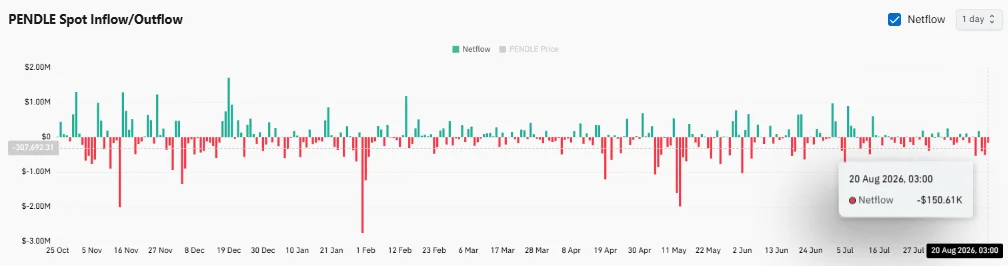
Broader exchange flows offered buyers another advantage despite the whale’s isolated Binance transfer. PENDLE had recorded three days of negative Spot Netflows, keeping its streak of consistent withdrawals going.
The most recent reading stood at -$150.61K, indicating that withdrawals were larger than deposits on all tracked spot exchanges. Importantly, the three-day pattern suggested broader holders had not followed the whale toward exchanges during PENDLE’s recovery.
Rather, aggregate flows kept moving tokens away from trading venues, and buyers controlled the spot market as supported by the Spot Taker CVD indicator. Therefore, the whale’s potential supply faced a market environment with declining exchange balances from recent flows.
Continued outflows would likely strengthen that narrative, particularly as aggressive spot buying remained dominant. However, a reversal toward sustained inflows could weaken the current demand advantage.
Source: CoinGlass
Rising Open Interest adds fuel and risk
PENDLE also saw derivative traders build up their positions, further adding to the emerging demand situation.
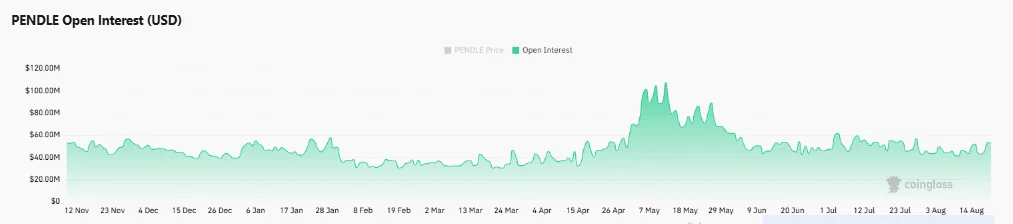
At the time of writing, the Open Interest (OI) rose 8.46% to $57.11 million, reflecting new leveraged interest in the price rise.
The rise was significant because traders were buying rather than selling during the PENDLE. But that didn’t determine whether the new positions were preference longs or shorts.
The whale’s existing 5x short highlighted the bearish side of that leveraged expansion. However, PENDLE’s price advance suggested that the sellers did not have enough control to derail the recovery. Meanwhile, the rising OI may lead to more volatility as the price nears an important technical resistance area.
Strong spot demand could pressure bearish positions should PENDLE continue advancing. However, if buyers are weakened, then the market may see more severe declines as the leveraged exposure unwinds.
Source: CoinGlass
PENDLE’s price keeps KEY resistance within reach
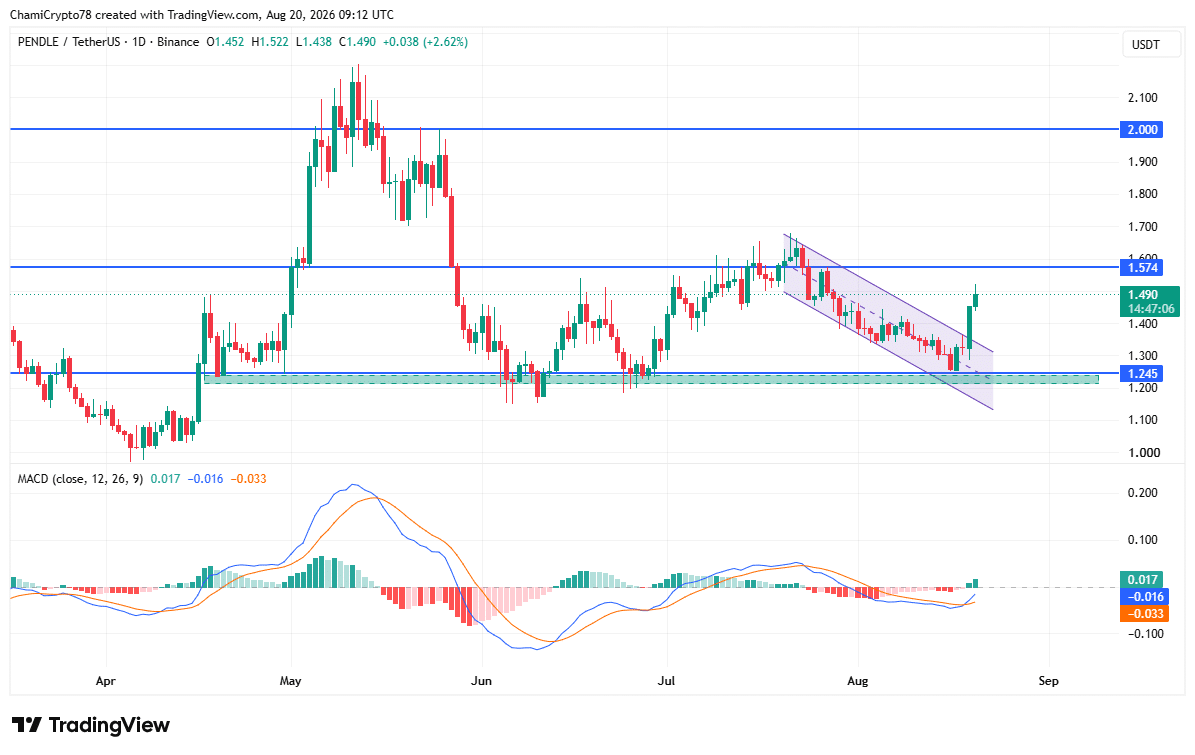
PENDLE’s technical structure shows an improvement since the price broke out from the descending channel and bounced from the $1.245 support zone. The breakout halted the downtrend that held price action since July’s local top.
The price then rallied to about $1.49, bringing the $1.574 resistance right into the recovery. Instead of getting stuck in a downtrend resistance zone, buyers have decisively moved PENDLE out of the channel’s upper boundary.
The MACD indicator also improved following the breakout, as the histogram shifted from negative to positive at 0.017 as of writing. The MACD line was at about -0.016 and above the signal line at -0.033.
Therefore, the suggested bullish momentum is still intact. Breaking above $1.574 could provide a chance to move towards major resistance at the $2.00 level.
However, a failure at $1.574 may lead to consolidation, while $1.245 would be the key structural support level.
Bitcoin (BTC-USD) opened at $64,681.22 on Wednesday, August 19, 2026, 0.3% higher than Tuesday’s opening price. As of 9:25 a.m. ET this morning, the price of bitcoin moved up to $64,877.66.
Ethereum (ETH-USD) opened at $1,916.47 on Wednesday, August 19, 2026, up 0.2% from Tuesday’s opening price. The price of ethereum moved higher this morning to $1,936.31 as of 9:24 a.m. ET.
Bitcoin and ethereum prices opened higher and rose in early trading after the SEC announced new regulation for crypto assets.
The proposed rules provide a framework for crypto companies to raise capital. They define two registration requirement exemptions for crypto-related investment contracts. Issuers would still be required to make certain disclosures. Larger offerings would have to provide financial statements and meet ongoing reporting requirements. The rules also allow certain crypto assets to exit securities classification, and the related reporting requirements, after a project fulfills core managerial commitments. This would benefit mature crypto networks like bitcoin and ethereum.
Current price of bitcoin and ethereum
Bitcoin
The price of bitcoin this morning was 0.3% higher than Tuesday’s opening price. Here’s a look at how the opening bitcoin price has changed versus last week, month, and year:
One week ago: +1.8%
One month ago: -0.2%
One year ago: -44.4%
The all-time high for bitcoin was $126,198.07 on Oct. 6, 2025. The all-time low value for bitcoin was $0.04865 on July 14, 2010.
Ethereum
The price of ethereum this morning was 0.2% higher than Tuesday’s open. Here’s a look at how the opening ethereum price has changed versus last week, month, and year:
One week ago: +1.9%
One month ago: +3%
One year ago: -55.6%
The all-time high for ethereum was $4,953.73 on Aug. 24, 2025. The all-time low value for ethereum was $0.4209 on Oct. 21, 2015.
You generally owe taxes when you sell cryptocurrency for more than you paid for it. This also applies when you exchange one digital asset for another. Converting bitcoin into ethereum, for example, isn’t “just a trade” in the eyes of the IRS. It’s a taxable event if the value changes.
Crypto taxes aren’t paid at the time of the transaction, but instead, they’re reported on your tax return for the year in which the transaction took place. So, if you sold crypto for a profit at any point during 2025, that activity is reported when you file your 2025 return in early 2026.
How much tax you pay depends on two main factors:
How long you held the asset before selling
Your overall taxable income and filing status
Hold it for less than a year, and you’ll usually face higher rates. Hold it longer, and the rates tend to be lower.
This holding-period distinction matters more than most people realize. A few days can make a difference of as much as 17% or more — so timing matters.
Whether you’re brand new to tracking the value of bitcoin and ethereum or a more seasoned crypto investor, Yahoo Finance’s price-of-bitcoin and price-of-ethereum charts below show a visual history of how the currencies’ value continues to move and evolve.
Ethereum [ETH] led the broader altcoin market after surging by more than 18% in the past hours, at press time. Ethereum surges back above the $2,000 level as bullish momentum continues to push it to higher zones.
Leverage, new investors, supply dynamics, and a breakout from an accumulation pattern influenced this sudden uptick. Can bulls sustain this uptrend and stay above $2K?
ETH exchange supply falls 15%
For leverage, a whale created a fresh wallet and loaded $20 million in USDC on the Hyperliquid exchange. The amount was deposited in three transactions of $10 million, $9.41 million, and $589K. Then, the whale opened a 4x leveraged long position of 20K ETH, worth $45.38 million.
The position coincided with the sudden surge, suggesting the whale could be privy to the move. Technically, Ethereum was about to breakout from a sideways range. As a result, the whale is sitting at an unrealized profit of $6.66 million.
Ethereum Spot ETFs added to the buying pressure, as per data from SoSoValue. Participants bought $189.15 million prior to the 18% move, the largest single-day buying volume in 10 months.
ETH Spot ETFs by BlackRock, Fidelity, and Grayscale led the pack with $122 million, $36.54 million, and $16 million, respectively. Even from a broader perspective, investors still bought Ethereum aggressively.
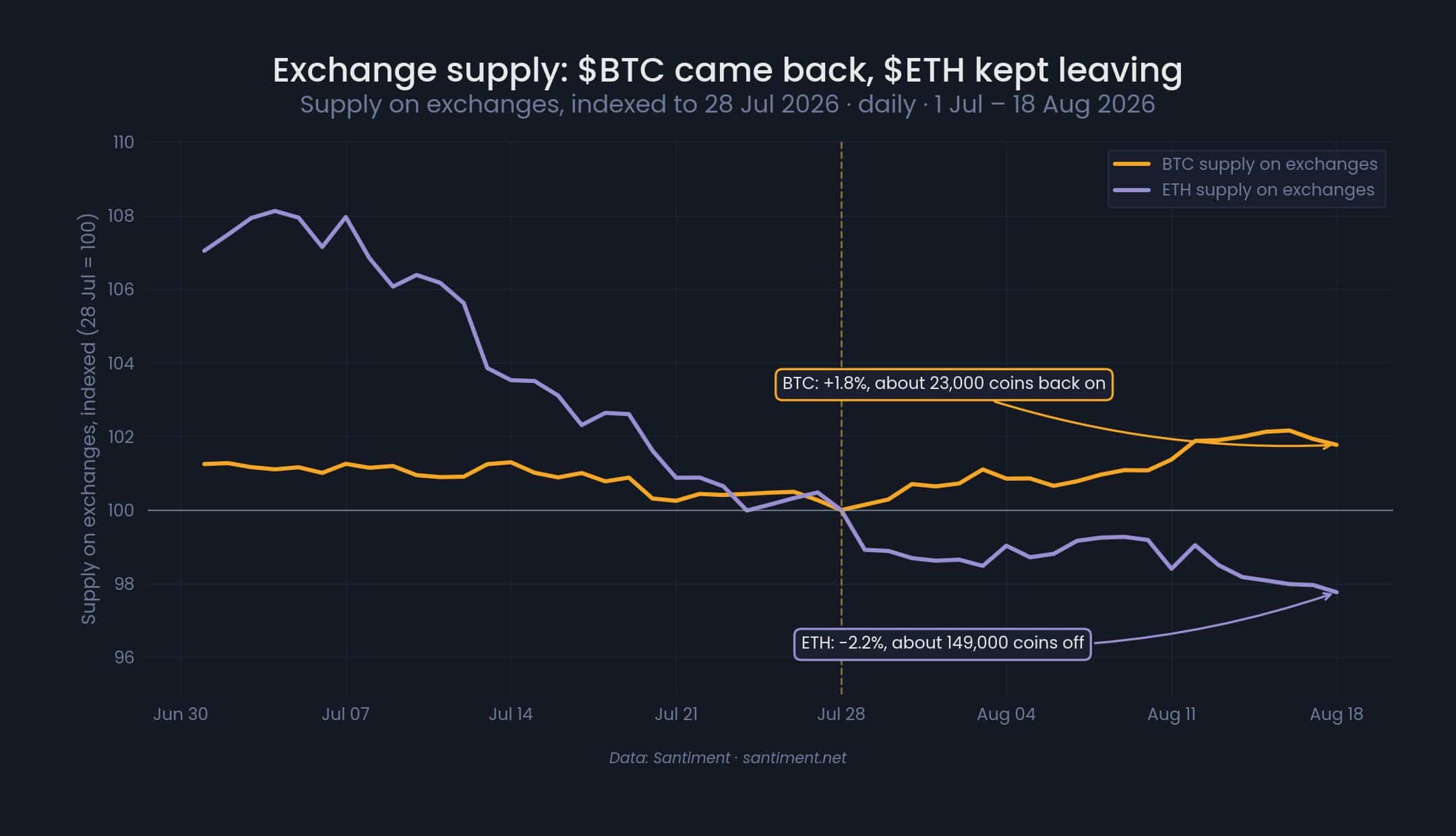
According to Santiment data, the exchange supply of ETH declined by 15% in eleven weeks. The supply plunged from 7.70 million on the 2nd of June to 6.54 million on the 18th of August, with roughly 1.15 million ETH coins withdrawn.
Source: Santiment
Can ETH’s price reach $2,500?
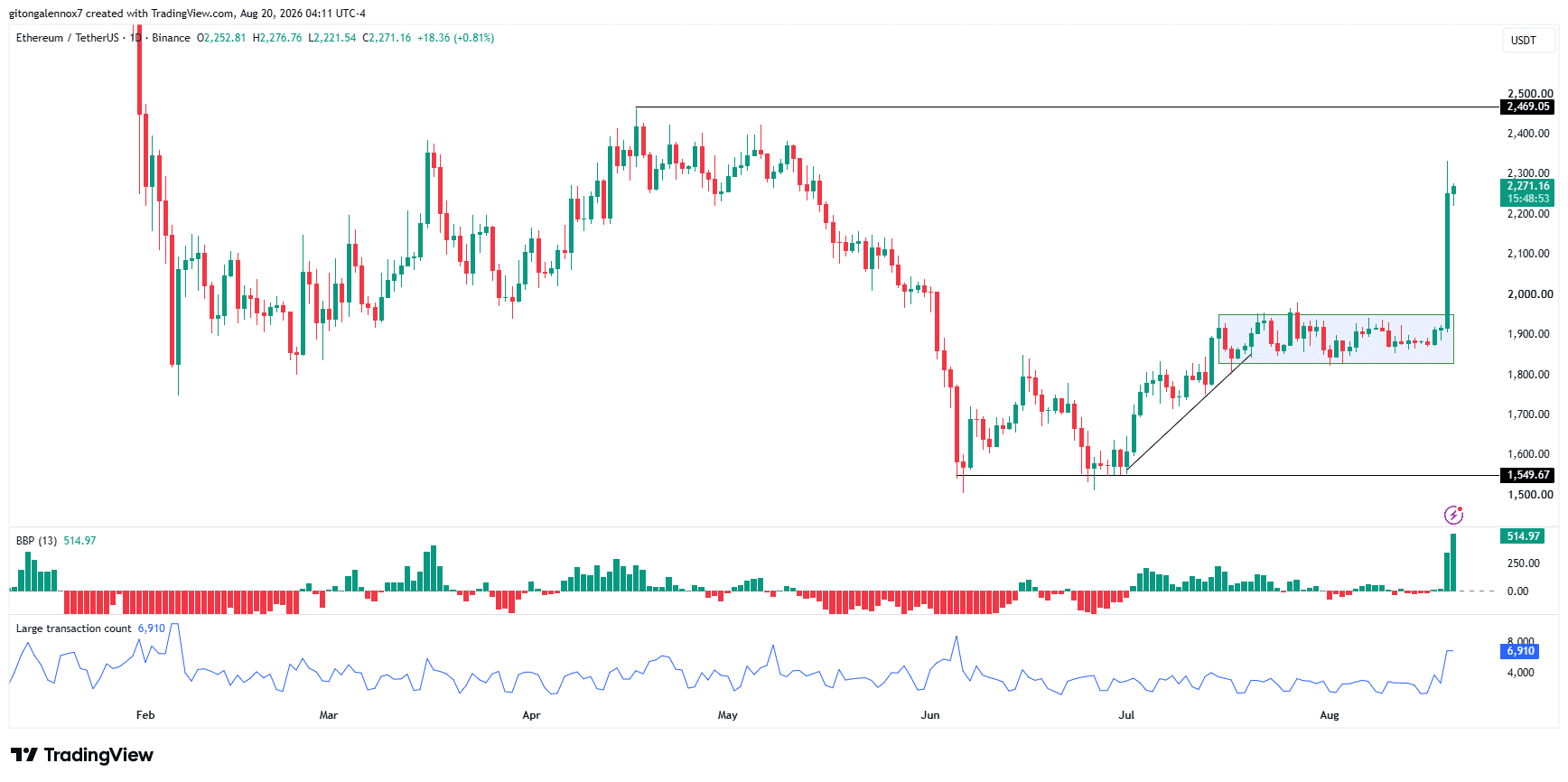
The charts showed the altcoin first hinted at a bottom on the 6th of June, after rebounding at $1,549. The potential bullish reversal was reinforced by the double bottom whose neckline at $1,800 was broken through.
The retest of the breakout lasted for a month before the eventual breakout. Now, Ethereum appears to be headed toward $2,500. The Bull/Bear Power (BBP) has hit its highest level this year, at about 528 as of writing. Additionally, large transaction count has increased from 2,690 to 6,910, almost a 3x increase in a day.
Source: ETH/USDT on TradingView
While this move is a signal of shifting market structure, bulls need to push ETH past $2,500 for a confirmation. The zone acts as the most recent lower high of the existing bearish market structure.
If the zone were turned into support, Ethereum would turn bullish in the midterm. Otherwise, the supply zone of $2,500 could reverse the current aggressive buying pressure, though it looks unlikely.
Final Summary
Ethereum rallied over 18% as ETH Spot ETFs saw their largest single-day inflows in 10 months.
ETH price action is bullish in the short term but needs to flip $2,500 to shift the market structure to bullish in the mid-term.
Roger Penske has accomplished a lot of great things in his career as a business leader and as a racer. This weekend’s Freedom 250 Grand Prix of Washington, DC may be one of his most impressive achievements. It is already the most complex events Penske, and his team at the Penske Corporation have ever undertaken.
Roger Penske called me on Tuesday night to explain why this is by far the most complex race in IndyCar history because of the various jurisdictions involved, from Federal to the District of Columbia to the Department of the Interior and the Department of Transportation to the Executive Branch in the White House.
“The complexity is No. 1 we don’t have a fixed facility to handle the amount of fans we expect over the weekend, so it all has to be built from scratch,” Penske told me. “That includes building the barriers, the fencing, the track, plus three major suite facilities that had to be built from scratch,” Penske told me. “Also, the permitting and licensing took several months to negotiate what the city wants from us to meet their code regulations. It just took time for us to explain and negotiate options they could look at in order to have the event.
“All of that is already in place at the Indianapolis Motor Speedway so it is fixed with permits and the facility and it’s about giving a great experience on Race Day. We don’t have to build the facility than tear it down and have it removed like we do for a street race.
“The complexity in having this in the Nation’s Capital and then closing down certain streets is a partnership with the city that we had to develop. Those all add to the complexity of this event.”
Roger Penske’s Team That Made The Freedom 250 Grand Prix A Reality
Penske’s team on the ground in Washington, D.C. includes Penske Corporation President Bud Denker and Vice President of Penske Entertainment at the Penske Corporation Michael Montri. These are also the two that oversee the construction, set up and teardown of the Chevrolet Detroit Grand Prix every year and play a major role in the Java House Grand Prix of Arlington in March, the Acura Grand Prix of Long Beach in April and the Borchetta Bourbon Music City Grand Prix in July.
Denker and Montri have spent more time in Washington, DC than many members on Capitol Hill.
“Bud Denker led that whole office and probably had almost 100 meetings over the last five months to have the right approvals to build the track and execute on Sunday,” Penske said. “The team that we are using are our Detroit team, our Arlington team, people from Long Beach and also from the Indianapolis Motor Speedway. It’s a team effort and we have all of our best people executing in order to make a super event for the weekend.
“It’s absolutely more complicated than building the Indy 500 every year.”
Penske Corporation President and Freedom 250 Grand Prix of Washington DC Chairman Bud Denker
Bruce Martin Photo
At the Penske Corporation, there is a saying that there is “No ‘I’ in Team” and this is a classic example. When asked if putting IndyCar on the streets of Washington, DC for a race in the celebration of the 250th birthday of the United States is Penske’s greatest accomplishment, he focused the accolades on his lieutenants.
“I say the team led by Bud Denker and Michael Montri have done an outstanding job,” Penske said. “And with our partners at FOX Sports working on this, our expectations are to have an event we will never forget. To run an IndyCar race in the capital of the United States. It’s an amazing vision and even more amazing to see it come together in execution.”
It’s going to be both an exhilarating and exhausting weekend for everyone involved as over 150,000 spectators already have tickets for the “free” event. The demand was so high for this race, a lottery had to be used to determine who got the tickets to attend the race in either the “Stars” sector of the National Mall, or the “Stripes” sector. Once the spectators clear Secret Service security including magnetometers and enter their “sector” they aren’t allowed to enter into the other sector.
According to Denker, who is the Chairman of the Freedom 250 Grand Prix of Washington DC, 288,000 people signed up for the 150,000 tickets. The tickets were determined through a lottery system. There are 70,000 fans in the “Stars” second and 70,000 in the “Stripes” sector of the National Mall. The rest will be in high-quality luxury suites.
The Indy Car race track is visible down Pennsylvania Avenue for the Freedom 250 Grand Prix on August 19, 2026 in Washington, DC. Final preparations continue for this weekend’s inaugural Freedom 250 Grand Prix, a historic two-day NTT IndyCar Series street race past iconic National Mall landmarks to celebrate America’s 250th anniversary. (Photo by Anna Moneymaker/Getty Images)
Getty Images
Large video screens will line both the Stars and Strips sectors so that fans can get a view of what is happening on other parts of the track.
Construction on the Gulfsteam Suite and Delta 250 Suites ahead of the Freedom 250 Grand Prix race, near the US Capitol on the National Mall, on August 5, 2026 in Washington, DC. (Photo by Al Drago/Getty Images)
Getty Images
The suite area will include some of the most impressive temporary suites in IndyCar history, similar to what is constructed at the Chevrolet Detroit Grand Prix. The cost to be in those suites are staggering, but the demand to be a part of this historic event have never been higher for any NTT IndyCar Series race, including the Indianapolis 500.
Guests will enjoy a world-class hospitality experience in the more than 70 luxury suites that surround the 1.7-mile street circuit around the National Mall, and the historic streets of Washington D.C. Premier partners will help elevate the experience for Grand Prix guests across the three stunning suite structures during the Aug. 22-23 race weekend.
New Partners Join IndyCar For Historic Race
Verizon, Delta Air Lines and Gulfstream will all help power what promises to be a memorable weekend for suite guests, complete with premium viewing and exclusive access and amenities at the Freedom 250 Grand Prix.
Each of the Freedom 250 Grand Prix climate-controlled suites will feature full walls, with executive restrooms located on all three floors and an enclosed elevator in each suite structure. Each suite will include premium food and beverage options and first-class concierge service for all suite guests.
The Monument Suites powered by Verizon, located just outside the Air National Guard Fan Zone on 7th Street NW and between Turns 4 and 5 on the seven-turn street circuit, features 30-person hospitality suites. The impressive three-level structure, positioned in the shadows of the Washington Monument, also houses the Freedom 250 Grand Prix Champions Club on its first level. Fans can still purchase passes to the climate-controlled Champions Club that features all-inclusive food and beverages all weekend long. Saturday, Sunday and two-day Champions Club passes can be purchased online through Ticketmaster.
Whether it’s Champions Club pass holders or attendees in the structure’s other luxury suites, guests will enjoy the exclusive experience and being close to the racing action in the Monument Suites powered by Verizon, the longtime technology and connectivity partner of IndyCar and Team Penske that helps support enhanced fan engagement and communications across the sport.
The U.S. Capitol Building is visible at the finish line of the Indy Car race track for the Freedom 250 Grand Prix on August 18, 2026 in Washington, DC. Final preparations continue for this weekend’s inaugural Freedom 250 Grand Prix, a historic two-day NTT IndyCar Series street race past iconic National Mall landmarks to celebrate America’s 250th anniversary. (Photo by Andrew Harnik/Getty Images)
Getty Images
The Delta 250 Suites, positioned on 3rd Street NW and overlooking the U.S. Capitol and the Start/Finish line on track, offer 40-person suites with direct sightlines to what are expected to be some of the most pivotal moments of racing action during the historic weekend. With a birds-eye view of the Freedom 250 Grand Prix pre-race pageantry, the green flag start and the checkered flag finish of each race, guests will feel the excitement all weekend long in the three-level suite structure sponsored by Delta Air Lines, the leading global airline that recently marked a century of flight with its 100-year anniversary in 2025.
Freedom 250 Grand Prix suite partner Arrow McLaren will call the second floor of the Delta 250 Suites home during race weekend in Washington D.C. Arrow McLaren brings a championship-caliber legacy and a relentless drive to win to the Freedom 250 Grand Prix, featuring one of the most consistent and productive teams in the NTT IndyCar Series led by drivers Pato O’Ward, Nolan Siegel and Christian Lundgaard.
The Gulfstream Suite structure is located on the east side of the Air National Guard Fan Zone near Turn 1 on 3rd Street NW and adjacent to the Delta 250 Suites. Also featuring stunning views of the pre-race festivities and the on-track action at the start/finish line in front of the U.S. Capitol, guests will enjoy one of the most unique backdrops in motorsports inside the suite hosted by Gulfstream, the longtime American aircraft manufacturer and a visionary leader in the aerospace industry.
“Verizon, Delta Air Lines, Gulfstream and Arrow McLaren are all helping raise the bar on the overall hospitality experience at the Freedom 250 Grand Prix,” said Denker, Chairman of the Freedom 250 Grand Prix. “With first-class service from the key vantage points along the Start/Finish line to Turn 1 and all around the National Mall circuit, the support and the drive of these partners will help us deliver an amazing experience and an unforgettable weekend for all of our suite guests on the streets of Washington D.C.”
IROC Joins IndyCar at Freedom Grand Prix of Washington DC
With a unique mix of IndyCar competition and IROC exhibition racing, the Freedom 250 Grand Prix will deliver a rare combination of past and present for fans, highlighting the sport’s legends alongside today’s star drivers in a once-in-a-lifetime celebration in the nation’s capital.
It also helps create engagement with partners and sponsors who want to be involved in this race that aren’t already associated with IndyCar.
Anchored by premium locations across the scenic street circuit, Freedom 250 Grand Prix partners will include branding along key viewing zones and fan touchpoints. These placements will position each partner at high-visibility areas of the circuit, connecting fans and brands to the high-speed excitement of IndyCar racing in the heart of the nation’s capital.
NTT will feature its distinct branding on the pedestrian bridge located just past Turn 1 of the racing circuit and trackside signage leading onto the fast .4-mile Pennsylvania Avenue frontstretch. The integrated fan-facing presence on track will build on NTT’s long-standing IndyCar partnership and the leading global technology company’s position as the title sponsor of the NTT IndyCar Series.
Boeing branding will be displayed on the pedestrian bridge located just before Turn 6 of the Grand Prix circuit. The global aerospace company, whose corporate offices are located near Washington D.C., will also feature trackside signage on Independence Avenue with prominent placement at a key vantage point on the racing circuit.
The dome of the US Capitol is seen behind a stand as setup continues ahead of the IndyCar series Freedom 250 Grand Prix on the National Mall in Washington, DC, on August 17, 2026. The race will be held on August 23, 2026, on a temporary street circuit in Washington, DC. (Photo by Kent Nishimura / AFP via Getty Images)
AFP via Getty Images
Bitdeer, a world-leading technology company for digital infrastructure and Bitcoin mining, will be represented with track signage and the Bitdeer Bridge over the Freedom 250 Grand Prix track. Located at the exit of Turn 5, the Bitdeer Bridge will be one of the pedestrian bridges over the track that includes lift service for mobility-challenged guests during race weekend.
“All these new companies have come in to gauge the interest in IndyCar,” Denker said. “This is also an opportunity for us to grow our sport by showcasing it tothese companies that were never part of our sport before. Our job is to grow the sport.”
On Thursday, METRO trains in Washington DC had an IndyCar show car attached to one of the trains that was traveling through the District of Columbia.
“We loaded our race car on a rail car,” Denker said. “It’s going all around the city right now, under the subway, with our show car. They are going to say, ‘What the hell is that?’ It’s just another way that we are engaging. the fans here in ways we’ve never, ever done it before.”
The U.S. Capitol Building is visible at the finish line of the Indy Car race track for the Freedom 250 Grand Prix on August 18, 2026 in Washington, DC. Final preparations continue for this weekend’s inaugural Freedom 250 Grand Prix, a historic two-day NTT IndyCar Series street race past iconic National Mall landmarks to celebrate America’s 250th anniversary. (Photo by Andrew Harnik/Getty Images)
Getty Images
The Freedom 250 Grand Prix Pit Lane Powered by Shell will include branding and signage highlighting Shell, the longtime partner of Team Penske and IndyCar, which also serves as the official fuel supplier of the NTT IndyCar Series. Located adjacent to Pennsylvania Avenue, between Turns 1 and 2 on the track, the Freedom 250 Grand Prix Pit Lane Powered by Shell is where all NTT IndyCar Series teams will service their race cars during on-track activity over the course of the weekend.
The Paddock Presented by WillScot is an exclusive area of the Freedom 250 Grand Prix venue that features the high-tech haulers that transport team race cars and equipment, along with the temporary garages for all competing IndyCar teams. Known as the “locker room of motorsports,” the race paddock is where race teams and drivers will work throughout the Freedom 250 Grand Prix weekend and it will include branding for WillScot, a leading provider of turnkey space solutions in North America and an IndyCar series partner.
In addition to the trackside partner activations, the Air National Guard Fan Zone will bring high-energy fan experiences to the Freedom 250 Grand Prix. The Air National Guard Fan Zone will deliver engaging and dynamic destinations for fans of all ages in both the Stars and Stripes ticketed areas of the venue during race weekend, including free driver autograph sessions, interactive displays and more.
“NTT, Boeing, Shell, WillScot, Bitdeer and the Air National Guard will help define what fans, partners and competitors experience at the Freedom 250 Grand Prix circuit,” Denker said. “From pedestrian bridges and signature turns on track to the pit lane, the paddock and the fan zone, these partner activations will help bring this special event to life and help fuel IndyCar’s debut in Washington, D.C.”
The Freedom 250 Grand Prix will feature comprehensive multi-platform coverage across FOX, FS1, FS2, FOX One and the FOX Sports app, highlighted by live broadcast coverage of Sunday’s 250-mile NTT IndyCar Series race on FOX. The race weekend will also showcase the return of the iconic International Race of Champions (IROC) series, bringing together some of the most accomplished drivers in both IndyCar and NASCAR history for two exhibition races on Saturday, Aug. 22.
Whether the race is a showstopper on the track such as last Sunday’s Ontario Honda Dealers Indy At Markham, or not, it doesn’t really matter to drivers in IndyCar.
The venue alone makes this one of the most important races they have ever competed.
US First Lady Melania Trump holds a helmet presented to her by US Indy Car driver Alexander Rossi (R), New Zealand driver Scott Dixon (2nd R), US driver Graham Rahal (2nd L) and New Zealand-American driver Scott McLaughlin (L) at an event with IndyCar and FOX Sports to expand academic opportunities for individuals transitioning from foster care, in the Rose Garden of the White House, in Washington, DC, on August 20, 2026. (Photo by Jim WATSON / AFP via Getty Images)
AFP via Getty Images
“It’s the fact that, this is a race that’s a showcase for our series and our nation, and that’s really cool,” driver Alexander Rossi of ECR said. “It’s an event that as soon as it was announced, it was like you were counting the days until you get to do it.
“And as we all know, it’s probably going to be a one-and-done thing. So, I’m just super looking forward to getting there and experiencing it and doing something that very few people will get to do.”
The President of Mexico, Claudia Sheinbaum, will be in attendance as a guest. One of the star drivers of IndyCar is Pato O’Ward, a 10-time race winner at Arrow McLaren, who is from Monterrey, Mexico.
O’Ward has spent most of his life attending school in the United States and proudly said he has spent more than half his life in the USA. Although his is proud of his Mexican heritage, he stressed how much he loves the United States.
Freedom 250 Grand Prix Of Washington DC Is A ‘One In A Lifetime’ Event
Both Penske and Denker stress that the Freedom 250 Grand Prix of Washington DC is a one-time only event. IndyCar may return in the future, but it likely would be in a different part of town and not on the National Mall because of the heavy lift it took to get the federal government, the District of Columbia and other governmental agencies to approve of this effort.
That is why Sunday’s race will be historic and to the driver that wins the race, it may mean as much to them as winning the famed Indianapolis 500.
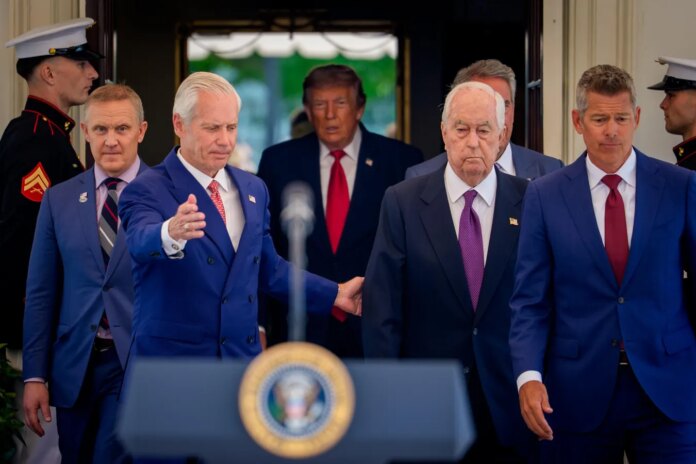
“In just a few short days, with the unyielding support of our President, IndyCar will blaze an unprecedented path on the streets of our Nation’s Capital,” IndyCar President Doug Boles said at the Rose Garden at the White House on August 20. “The stars of the ‘Fastest Racing On Earth’ will reach speeds in excess of 180 miles an hour as they make their way past the US Capitol Building, the Washington Monument, and around the National Mall. They will put on a massive and very fast spectacle to celebrate our country’s 250th birthday.”
The Freedom 250 Grand Prix of Washington DC will be a grand spectacle as IndyCar gets a chance to give its own unique present to the United States as it celebrates its 250th birthday.
Fireworks explode over the Lincoln Memorial to celebrate the 250th anniversary of the founding of the United States in Washington, D.C., the United States, in the wee hours of July 5, 2026. (Photo by Li Rui/Xinhua via Getty Images)