It’s not a priority, said Executive Chairman Michael Saylor, but Strategy (MSTR) could buy back its own shares if they become cheap enough.
The comments during a Monday Q&A follow a rough stretch for Strategy’s common shareholders. MSTR is down about 38% this year and 73% year-over-year, driven in large part by bitcoin’s BTC$64,343.13 decline, as well as by the consistent issuance of common stock to fund more bitcoin purchases, build cash reserves, pay dividends, and repurchase preferred stock.
“If MSTR is trading at a very, very deep discount to NAV, then probably you would see us do something like that,” Saylor said.
For now, though, Strategy is focused on its preferred stock business, especially STRC.
CEO Phong Le also defended Strategy’s practice of selling new MSTR shares. While some investors worry that issuing more stock dilutes existing shareholders, Le argued that selling shares can help when MSTR trades above the value of the assets backing each share, and Strategy uses the proceeds to buy bitcoin. In that situation, he said, the amount of bitcoin backing each MSTR share can increase.
The recent drop in STRC has also changed how Strategy manages its money.
The US Treasury announced a proposal for new guidance that could reshape which stablecoins crypto exchanges may offer to American customers
The proposal implements parts of the GENIUS Act and extends beyond US stablecoin companies. Now, issuers from outside the US that desire entry into America can also be bound to new rules, and crypto exchanges are to check whether the stablecoins they want to list are from authorized issuers.
Foreign stablecoins face new conditions
One major requirement concerns how issuers from outside the US respond to US legal orders.
For it to be able to serve the American market, an issuer may need to show that it can freeze, seize or burn stablecoins, or stop them from moving when they are legally required to do so.
Instead of just relying on the words of the issuers about their capabilities, exchanges will also be required to carry out their own checks.
Foreign companies may also enter if the Treasury deems their regulatory regimes comparable to US standards and they register with the Office of the Comptroller of the Currency.
Treasury is taking a broad approach to what counts as issuing stablecoins in the US, as a transaction could fall within the rules simply when either the issuer or the recipient is in the US
Foreign issuers trying to stay outside the US market may therefore need controls that will block their stablecoins from reaching American users.
Exchanges could have to reconsider their listings
From July 18, 2028, service providers would not be allowed to offer US customers stablecoins not issued by an authorized company.
Simply listing a stablecoin would not automatically make an exchange its issuer, but exchanges and market makers could face problems if they help newly created, unauthorized stablecoins reach buyers.
The proposal also looks at advertising a stablecoin to Americans, responding to purchase requests or helping customers bypass location restrictions as offering it in the US.
Airdrops will count towards issuance too, even if the recipients do not purchase them!
However, direct transfers between individuals receive limited exemptions, as do some transactions made through self-custody software and hardware wallets, but none of these requirements are final.
The GENIUS Act is expected to enter into force on January 18, 2027, while the restrictions affecting service providers would follow 18 months later, and Treasury is giving the public 60 days to comment after the proposal is published in the Federal Register.
Final Summary
Foreign stablecoin issuers could face new requirements for legal-order compliance and access to US customers.
From 2028, exchanges may need to reconsider stablecoins whose issuers do not meet GENIUS Act requirements.
SHANGHAI, CHINA – NOVEMBER 3, 2021 – Children’s princess dresses, Mickey Mouse, Duffy and Friends, Linabelle’s animated characters and plush toys are seen at the official store of Disneyland in Shanghai, China, on November 3, 2021. On December 12, 2021, Shanghai Disney officially announced the postponement of the 2021 Duffy & Friends Christmas collection. (Photo credit should read Xing Yun / Costfoto/Future Publishing via Getty Images)
Future Publishing via Getty Images
Walk down any toy aisle, and you’ll likely see a plethora of merchandise and products branded to Disney Princess. From classic dolls and play dresses to huggable plush toys and more, Disney Consumer Products’ line of Princess items has captivated minds and emptied wallets for decades. But gone are the days of Disney Princess being exclusive to little girls who wish to star in their own fairytale. Today, Disney Princess has global reach with a merchandise pipeline for children all the way to adults.
When the Disney Princess brand was formed in 2000, it featured eight princesses (Ariel, Belle, Cinderella, Jasmine, Mulan, Pocahontas, Sleeping Beauty and Snow White), and today it has grown to showcase 13 princesses (the original eight, plus Moana, Rapunzel, Tiana, Merida, and Raya). During theinitial formation of the brand, $300 million of individual Princess merchandise was sold. Then just five years after the larger brand umbrella was formed, Disney Princess passed $3 billion in worldwide product retail sales.
“Disney Princess has grown into a global lifestyle brand that connects with consumers across generations. Through products and experiences that extend Disney storytelling beyond our films and parks, we’re creating new, meaningful ways for fans and families to connect with beloved Princess characters in their everyday lives,” says Paul Gitter, Executive Vice President of Brand Commercialization, Disney Consumer Products.
Disney Princess products range in style from play, fashion and beauty to home, accessories and collectibles, making the brand accessible for nearly anyone at any stage of life. And since the brand is an evergreen franchise, the Princess-themed products are relevant year-round, whether they are for children or adults.
In recent years, the brand has morphed into a massive money maker for Disney Consumer Products, which is also the world’s top licensor. In fact, in 2025, Disney Princess generated more than $1 billion in retail sales globally, Gitter shares. While this is a small portion of Disney Consumer Products’ $63 billion in 2025 retail sales, it still shows the enduring power of a princess. Sales have peaked around 100 million in recent years. “Put another way, recent sales could place a Disney doll in the hands of nearly every child in the U.S.,” says Gitter.
Creating Lifetime Consumers
Intelligent and adventurous, Belle writes the ending to her own story. Celebrate this beloved Disney Princess with this beautiful American Girl® 18-inch doll with brown hair and hazel eyes, designed in collaboration with Disney.
The Walt Disney Company
Over the past few years, Disney has continued to expand its Disney Princess products for adults through branded collaborations with companies like Pandora, Little Words Project and Bath & Body Works, along with collector items like dolls made in partnership with American Girl and fashion house Viktor&Rolf.
“Our strategy is to continue serving the core audience of young kids, while building more relevant product expressions for older fans and adults through fashion, beauty and more,” says Gitter.
These strategic collaborations not only bring thoughtful products to the marketplace, but may also bring adults who drifted away from the brand back to Disney Princess thanks to a sense of nostalgia for a favorite movie or character. The collaborations also bring meaningful Disney-branded touch points for those who may already be fully interacting with the company. Disney is essentially meeting fans where they already spend a majority of their time, at work or at home.
The adult-centric products are often limited-edition or available for a short time, making the urge to purchase strong for those who already have an affinity for Disney. For instance, when Disney Princess released its first collaboration with Bath & Body Works in 2025, the products instantly went viral. The initial line of 85 products, inspired by six princesses, included candles, soaps, decor and more. This caused plenty of online buzz, translating to lines out the door at brick-and-mortar stores and a sold-out online store within hours.
Outside of sales, the longevity of Disney Princess for a single consumer can be pointed back to the brand’s ability to grow naturally with its audience. Parents may buy dolls and play sets themed around Disney Princess for their children. Those same children may then go on to buy royal-themed accessories as tweens and teens, and continue to purchase home goods and luxury products as adults, making them lifetime consumers of the brand.
WOLF surged 6% and ON jumped 3% after Mizuho flagged a faster NVIDIA Vera Rubin ramp anchored by xAI and Meta starting Q4 2026.
El-Khoury says power content per rack rises from $15,000 to $115,000 under 800V DC, with AI data center revenue doubling in 2026.
ON Semiconductor’s September 16 Analyst Day and NVIDIA’s next quarterly update are the two checkpoints that could confirm or crack Monday’s rally.
It sounds nuts, but SoFi1 is giving new Active Invest users up to $3,000 in stock for a limited time, and all it takes is a $50 deposit to get started.2 See for yourself (Sponsor)
Power semiconductor stocks are pushing higher in Monday trading, with Wolfspeed (NYSE:WOLF) up 5.74% to $33.61, STMicroelectronics (NYSE:STM) up 4.17% to $56.56, and ON Semiconductor (NASDAQ:ON) up 2.96% to $85.11. The move follows a weekend Mizuho research note flagging a stronger and faster NVIDIA Vera Rubin ramp than the market had been positioned for.
Shutterstock
Vera Rubin Ramp Signals Reset the Power Semi Setup
Mizuho, in a note published Sunday, August 16, 2026, told clients to expect strong VR200 NVL72 ramps in 2027, ramping in Q4 2026 led by xAI and Meta, with NVIDIA potentially pushing the four-die transition out to Feynman and running VR-Ultra on a two-die configuration. The firm also flagged 2027 CoWoS growing more than 75% with NVIDIA and Broadcom and cloud service provider RPO/backlog now at $2.3 trillion, up 3.5x year over year.
Mizuho’s named upside list covers Dell, Credo, NVIDIA, Broadcom and Lumentum, while the three power names moving here benefit indirectly. The connection is a read-through: Vera Rubin materially raises power management content per rack, so a bigger, on-schedule VR200 ramp means more power semiconductor content shipped across the rack, alongside more GPUs. Just as important, weeks of chatter about a Vera Rubin delay had weighed on the group. A supply chain check pointing to xAI and Meta anchoring a Q4 2026 ramp removes that overhang, and the removal is itself the catalyst.
ON Semiconductor has been the loudest voice on this. Management said content per rack goes from $15,000 per rack today toward $115,000 per rack under 800V DC architecture, with AI data center revenue expected to more than double in 2026 and silicon carbide in data center applications projected to grow nearly 60% year-over-year. CEO Hassane El-Khoury framed the company as “the only broad-based U.S. power semiconductor supplier with technologies spanning the full AI power tree.”
ON Price Target — 24/7 Wall St.
STMicroelectronics raised its data center ambition to above $1 billion in 2026 and well above $2 billion in 2027, with CEO Jean-Marc Chery citing accelerating adoption of 800 gigabit and 1.6 terabit per second pluggable optics. Wolfspeed reported ~30% sequential growth in AI applications in fiscal Q3 and launched its first commercially available 10 kilovolt silicon carbide power MOSFET for high-voltage data center power delivery.
Longer-period context supports the setup. STM is up 110.14% year to date, ON is up 52.65%, and Wolfspeed is up 82.6%, though all three had drifted lower over the past month before Monday’s rally.
13F Backdrop Filed Friday
Position disclosures as of June 30, 2026 and filed August 14, 2026 add background color rather than a direct catalyst.
In Wolfspeed, Two Sigma added to 2,272,968 shares valued $109,670,706, Millennium added to 1,012,371 shares valued $48,846,901, and Renaissance Technologies opened a new position of 498,900 shares valued $24,071,925.
In ON, Point72 opened a new position of 1,606,182 shares valued $151,848,446 and Balyasny added to 1,517,790 shares valued $143,491,867.
In STM, Situational Awareness disclosed 7,802,700 shares valued $584,344,203. These are point-in-time snapshots as of the reporting date and may differ from current positions. For example, Situational Awareness had to sell their book as a block trade to Citadel since the latest quarter ended.
What to Watch
The next hard checkpoint is ON Semiconductor’s Analyst Day on September 16, 2026 in New York, where management is expected to detail the AI power tree strategy. Investors will also parse NVIDIA’s next quarterly update for confirmation of the Q4 2026 VR200 ramp trajectory Mizuho described. Any wobble in that schedule would test today’s rerating in the group.
Want Up To $3,000 In Stock? SoFi Is Giving New Active Invest Users Complimentary Stock
Looking to grow your money but unsure where to begin? SoFi Active Invest is offering a limited-time promotion—open a new Active Invest account, fund it with $50 or more, and you could receive up to $3,000 in complimentary stock.
From $0 commission trading3 to fractional shares4 and automated investing, this app is designed to simplify investing for everyone, whether you’re just starting or already experienced. Its easy to sign up and secure your bonus.(Sponsor)
“We have collected full evidence of the content on X, all of which is fabricated rumors,” Lee said. “During daytime US time, we will file a police report and send a lawyer’s letter to X, demanding technical and data forensics.”
Regarding unpaid staff, the founder of the Cayman Islands-based crypto exchange said, employee assets “are not prioritized over client assets, everyone is a client, and there are no privileges.”
An X user known as BeardStaff said their assets had been inaccessible since the July 26 announcement, and that a dedicated VIP manager removed them from Telegram the day withdrawals stalled. “Where is my $10 million?” they posted.
Another user cut straight to Lee’s hacked account claim.
“No one asked you if the account was hacked or not,” wrote @chicha_liam. “Answer what people have been asking you since July 26. When will users be able to withdraw their funds?”
Onchain investigator ZachXBT also pushed back. “If you actually have the liquidity, then simply return the funds to everyone instead of posting vague statements.”
Roshan Dharia, CEO of distressed investment firm Echo Base, told CoinDesk via Telegram that his firm has offered BitMart a funded restructuring package including debtor-in-possession financing and equity at emergence, underwritten by Echo Base as a claimholder. He said BitMart has not responded.
Cash Cat [CASHCAT] has declined in the past day. The asset has dropped 16% as of writing, which, by depth, remains one of the biggest losses for a crypto asset within the top 200 assets by market capitalization.
While this may signal the start of a bearish move, it could also be a potential retracement, especially as CASHCAT remains up by over 13,000% in the past three weeks.
CASHCAT pulls back
The major concern over the recent CASHCAT pullback has been the volume performance of the asset. At the time of writing, the volume is up 42%, reaching $21.35 million.
Rising volume alongside declining prices has always been connected to a growing bearish trend as more traders sell their positions. Volume analysis specific to the perpetual market of CASHCAT, alongside Open Interest (OI), corroborates this as well.
The Long/Short Ratio, which tracks buyers against sellers, has plummeted to 0.823, implying there has been more selling volume as the ratio fell below 1. OI has also declined by a little over 10% in the past day to $22.52 million.
Source: CoinGlass
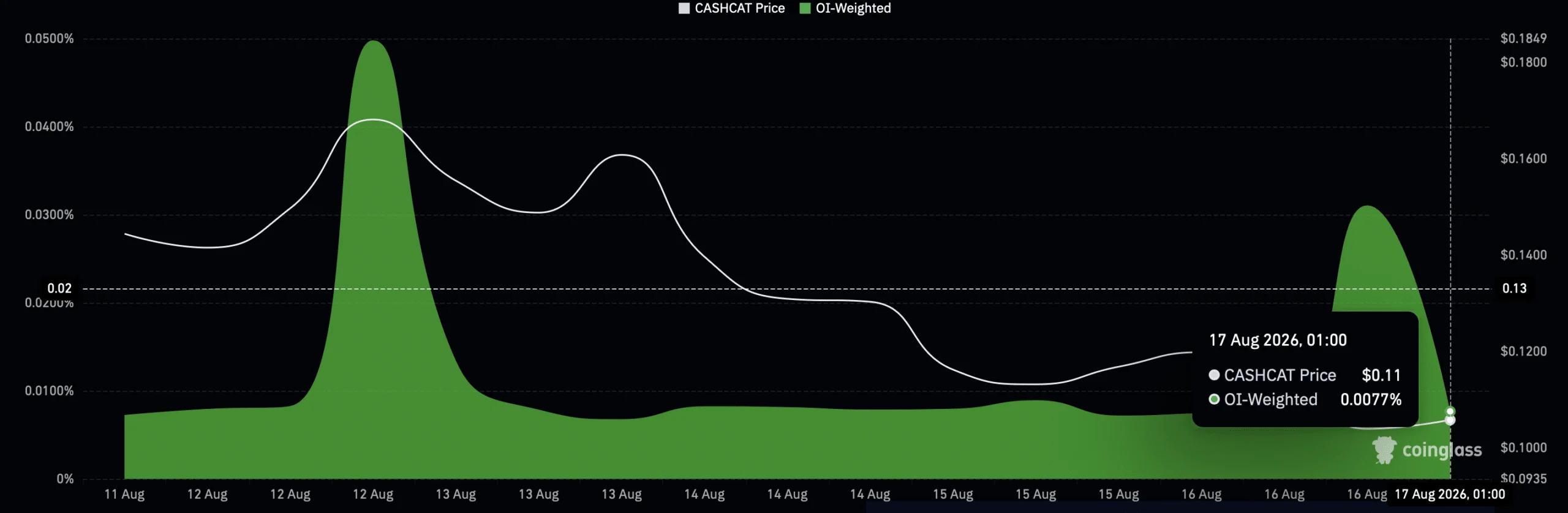
While this bearish outflow takes place, the funding rate, which contextualizes positions in the perpetual contract of an asset as being dominated by longs or shorts, shows that the former is still the case.
Press-time data shows that there are still more long contracts than shorts, as the funding rate hit 0.0077%, according to the chart reading.
CASHCAT has found a bottom?
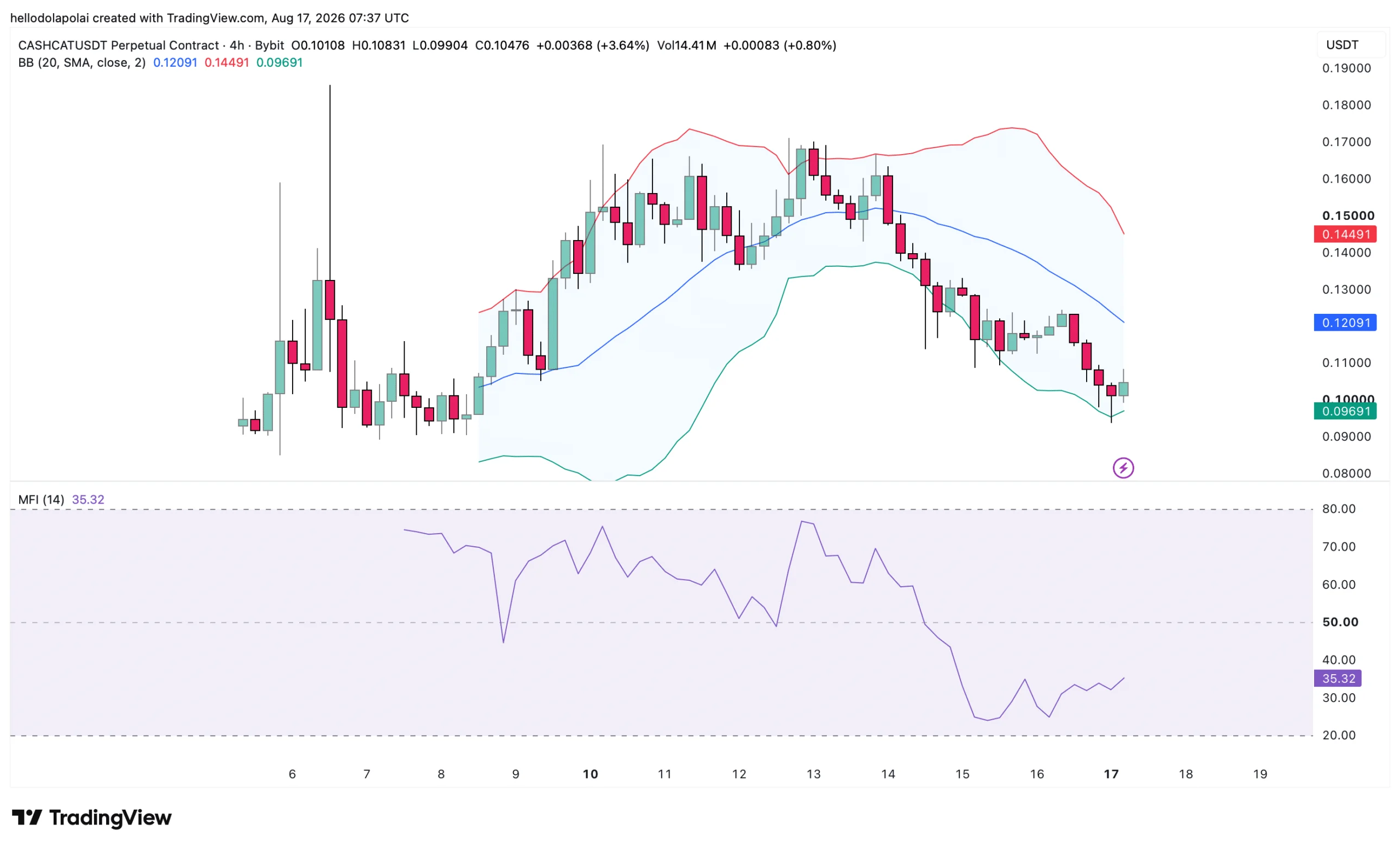
The 4-hour Bollinger Band analysis of CASHCAT shows that the decline has forced the asset into an undervalued territory, and right now, it’s likely to surge higher.
The undervalued territory stems from the asset’s last red candle, which moved into the green lower band. Currently, the rebound is taking shape, with CASHCAT already trending higher.
There are two notable levels worth watching from this point onward. First is the mid-band in blue ($0.120), which could act as potential resistance. If the buying pressure is high enough, the asset could surge toward $0.144, the red upper-band level.
Source: TradingView
Capital inflow into the market has already been helping the narrative as it continues to surge. The Money Flow Index (MFI) has been gradually rising, with a reading of 35.52, while pointing upwards and implying that there is ongoing buying pressure.
If the MFI continues to build up, then there’s a high chance that CASHCAT continues to see a rebound, adding to the outlook that the asset is likely to extend its gains even further from its present level.
Liquidation flow is massive
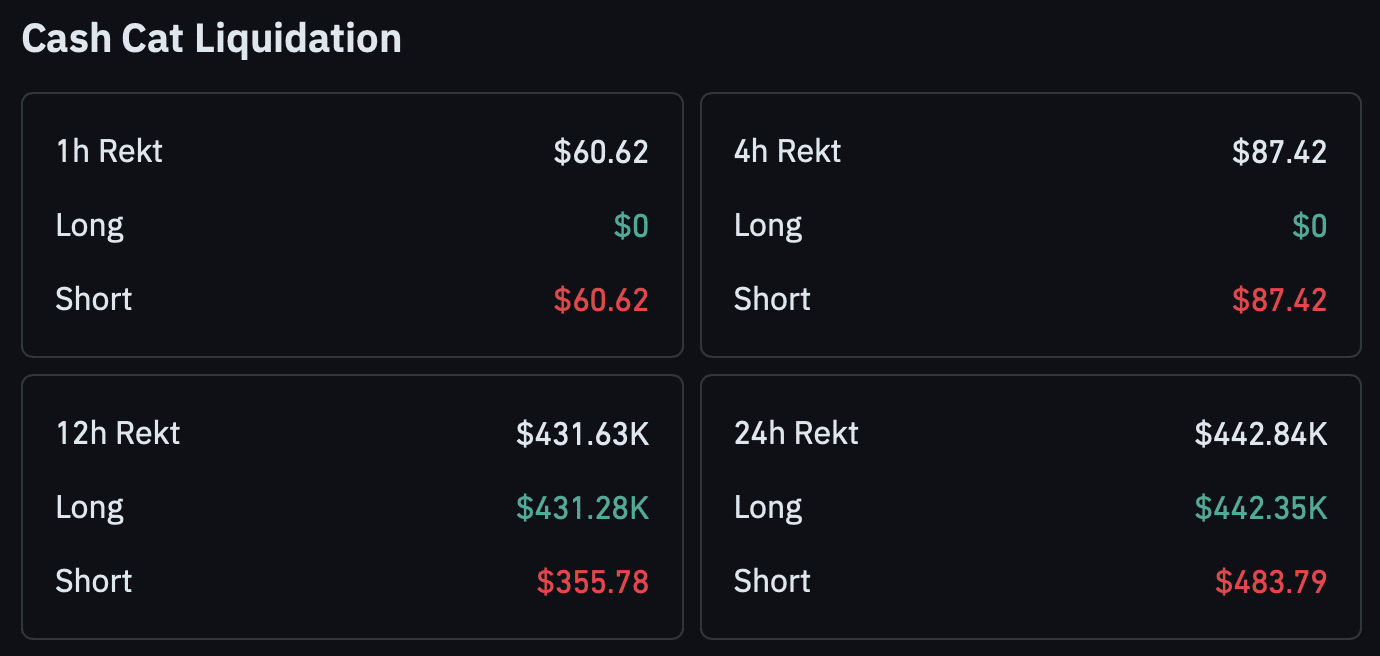
The liquidation data shows that there’s a massive gap between long and short positions on the chart.
There was a total long liquidation of $442,350 in CASHCAT positions, with a meager $483.79 in short-position losses at the same time.
Source: CoinGlass
The disparity shows there’s a massive risk in betting long, as there are 914 times more long losses than short losses in the market.
Despite the chart suggesting a bottom, it’s important that traders approach the market with caution and avoid becoming overly bullish on their positions.
Final Summary
CASHCAT has dropped 16% in 24 hours, while rising volume and falling open interest point to growing selling pressure.
Bollinger Bands and rising MFI suggest CASHCAT could rebound, but heavy long liquidations keep downside risks elevated.
Greenhaven Road Capital, an investment management company, released its second-quarter 2026 investor letter. A copy of the letter can be downloaded here. The fund achieved an approximate 11% net return in the second quarter, indicating progress from the first quarter. Key changes to the portfolio will include lower concentration and increased investments with near-term catalysts, alongside a proactive stance on profit-taking. The focus will remain on owning strong businesses and conducting research that challenges consensus views, as several major investments are poised for significant events within the year. Despite declines in market multiples, underlying businesses continue to grow, suggesting a favorable positioning for returns. Additionally, reviewing the Fund’s top five holdings could help identify its best picks for 2026.
In its Q2 2026 investor letter, Greenhaven Road Capital highlighted PAR Technology Corporation (NYSE:PAR). PAR Technology Corporation (NYSE:PAR) is a leading technology company that offers cloud-based hardware and software solutions to the restaurant and retail industries. On August 14, 2026, PAR Technology Corporation (NYSE:PAR) closed at $19.05 per share. One-month return of PAR Technology Corporation (NYSE:PAR) was 13.25%, and its shares lost 64.50% over the past 52 weeks. PAR Technology Corporation (NYSE:PAR) has a market capitalization of $787.96 million.
Greenhaven Road Capital stated the following regarding PAR Technology Corporation (NYSE:PAR) in its Q2 2026 investor letter:
“We still own PAR Technology Corporation (NYSE:PAR) and KKR, but they are not currently top-five holdings, so we will devote more space to the new investments. My view on PAR remains that there is a long runway for growth and that the company has inflected to EBITDA profitability. If our view is variant, it is in two places: analysts are significantly underestimating 2027 EBITDA and underestimating PAR’s chances of winning McDonald’s. KKR remains a great business. I believe the private credit scare will pass and AUM will march higher, driven by the maturation of existing strategies and the development of the high-net-worth channel.”
Is PAR Technology Corp. (PAR) the Hot Tech Stock to Buy Right Now?
PAR Technology Corporation (NYSE:PAR) is not on our list of 40 Most Popular Stocks Among Hedge Funds Heading Into 2026. According to our database, 31 hedge fund portfolios held PAR Technology Corporation (NYSE:PAR) at the end of the first quarter, up from 27 in the previous quarter. While we acknowledge the potential of PAR Technology Corporation (NYSE:PAR) as an investment, we believe certain AI stocks offer greater upside potential and carry less downside risk. If you’re looking for an extremely undervalued AI stock that also stands to benefit significantly from Trump-era tariffs and the onshoring trend, see our free report on thebest short-term AI stock.