The scale of the positioning is easier to see measured in tokens. About 2.77 billion XRP now sits in futures positions, up from closer to 2 billion earlier this summer and nearing the levels last seen when the token was worth several times more.
The ledger is getting busier too. Nearly 50,000 addresses were active over one 24-hour stretch, the most in more than two months, per Santiment, after activity slid close to its 2026 lows in July.
An active address is a wallet that sent or received anything during the period. It shows more wallets are using the ledger, but not whether the people behind them are buying, selling or shuffling tokens between their own accounts.
CoinGlass data shows the long-to-short ratio across all venues at about 0.93 over 24 hours, meaning positioning market-wide is close to balanced. The heavy long bias sits on Binance, OKX and among their bigger accounts.
Watch what happens if XRP breaks below $1, as leveraged longs that run out of collateral get closed by the exchange, which could mean selling into the market.
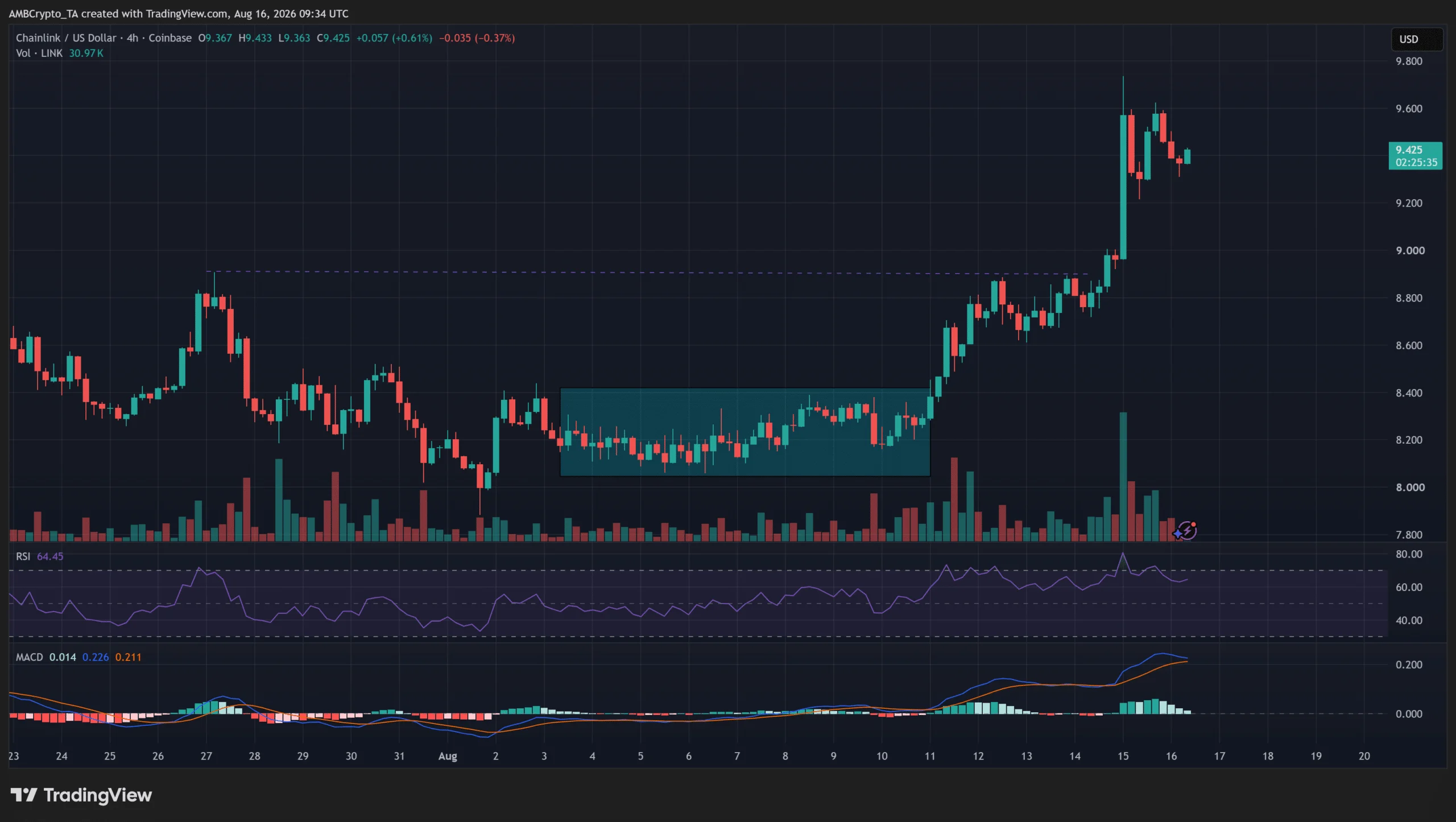
Chainlink’s [LINK] recovery gained structure as bulls relentlessly defended higher lows before pushing the altcoin beyond its early-August range. The price initially rose from approximately $8.20 and then broke the $8.90 resistance zone as volume expanded sharply.
That breakout accelerated the weekly gain to 14.7%, pushing LINK above $9.60 before profit-taking pulled it toward $9.43 as of writing. Notably, price remains above the former $8.90 resistance, keeping the breakout structure intact despite the pullback.
Source: LINK/USD on TradingView
RSI has eased to 64.45, suggesting momentum has cooled without losing its bullish bias. However, Open Interest (OI) also climbed toward the $690 million mark. This implies that leverage helped amplify the advance alongside spot demand.
Still, mild positive funding reduces immediate crowding concerns, although further leverage growth could make the move less stable.
Ultimately, reclaiming $9.60 could re-establish the upside momentum. Consequently, losing $8.90–$9.00 would weaken the breakout and increase the risk of a deeper retracement.
Whale deposit tests LINK’s breakout strength
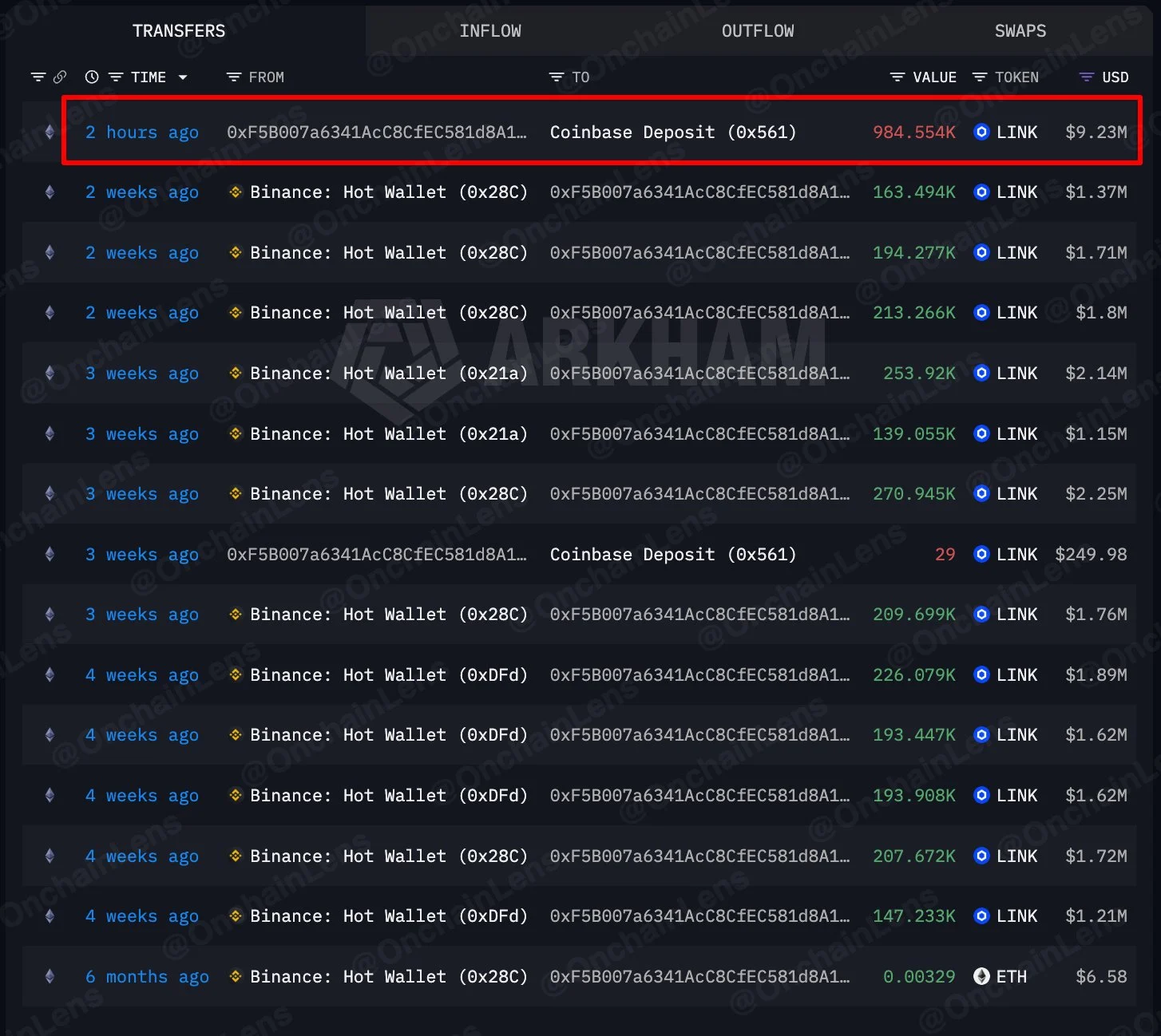
LINK’s stronger price structure now faces a supply test after a large holder moved 984,550 LINK, worth roughly $9.23 million, to Coinbase. The transfer follows the whale’s accumulation of roughly 2.41 million LINK from Binance over the past month.
With the altcoin trading around $9.40 after its 14.7% weekly rally as of writing, the deposit creates potential selling pressure above its current price. Still, an exchange transfer alone doesn’t necessarily mean the tokens were sold.
Source: OnChain Lens
Furthermore, the whale currently holds 1.43 million LINK worth approximately $13.43 million. This means there will potentially be a larger supply amount than the Coinbase deposit.
Continued exchange transfers could pressure LINK’s breakout, while unchanged holdings would limit the immediate supply risk.
The White House catalyst
Part of that growing market interest may also reflect the timing of Chainlink’s upcoming White House appearance. The meeting scheduled for Wednesday, the 19th of August, comes just days after LINK’s rally.
Meanwhile, with OI at approximately $690 million, Futures activity is increasing faster than spot trading. This seems to confirm trader behavior. Yet, it doesn’t imply that the White House meeting influenced the rally.
However, it may encourage traders to continue to hold exposures rather than take immidiate profits.
Source: Semafor
Funding remains relatively neutral, suggesting that the positions are less crowded. More importantly, Chainlink’s inclusion places it alongside Coinbase, Ripple, and other industry participants in direct policy discussions.
Nonetheless, that type of visibility, if it leads to meaningful developments, will likely positively influence investor sentiment. Otherwise, without a substantial outcome, event-driven leverage could fade quickly, shifting attention back to whether spot demand can sustain LINK’s breakout.
Final Summary
Chainlink held its breakout after a 14.7% weekly rally, with $9.60 remaining the key upside level.
Whale supply and White House-driven positioning now test whether LINK’s momentum can extend beyond the recent rally.
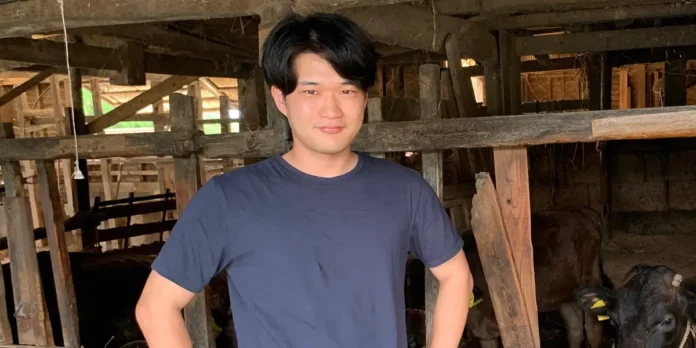
This as-told-to essay is based on a conversation with Masashi Nakamura, 29, who is running Nakamura Farm, a small Wagyu farm in Kagoshima Prefecture, Japan. His words have been edited for length and clarity.
I was working at a meat processing facility in Tasmania when my interest in Wagyu began. It was 2024, and I had just moved from Vancouver after my plans to study web development fell through.
One day, I noticed the word “Wagyu” written on the hanging beef carcasses. Having grown up in Japan, I’d always taken this kind of beef for granted. But seeing how highly people overseas regarded it changed my perspective. I began to understand that Wagyu was more than just beef — it had deep roots in Japan and was valued around the world.
I was 27 and living in a rural area surrounded by cattle. The experience made me realize how strongly I was drawn to the quiet lifestyle. I began reflecting on my future.
Before returning to Japan, Nakamura spent time in Canada and Australia.
Provided by Masashi Nakamura
Last year, I decided to pursue a career in the Wagyu industry. I moved back to Japan to help restore my grandfather’s aging Wagyu farm in Satsuma, a town in Kagoshima Prefecture.
From IT to the countryside
I grew up in a town near Kansai International Airport in Osaka Prefecture. Unlike the image of Osaka as a crowded city, my hometown has many fields and rice paddies.
I graduated from a Japanese university with a degree in English language and communication, hoping English would help me work internationally and experience different cultures.
By graduation, though, I realized English alone wasn’t enough. I got a job as an IT engineer in Osaka, monitoring and maintaining servers. After two years, I decided I wanted to build digital products and systems myself.
I moved to Vancouver to study web development, but after a year, I realized it wasn’t the right path and dropped out. Next, I headed to Australia on a working holiday visa.
Around the same time, I found out that my grandfather was planning to close the Wagyu farm after selling all of his cattle. My grandparents were getting older and could no longer run it.
I used to visit the farm as a kid. During the summer, I’d ride in the back of my grandfather’s truck as he drove around the rice fields. When I told him I wanted to take over the farm, he was surprised. He worried I wouldn’t be able to make a living from farming, but he supported my decision.
For years, I’d been so focused on life overseas that I constantly looked outside Japan for my future. Now, I hope my IT and language skills will give me an edge in farming and help me do things differently while still respecting tradition.
An old photo of his grandfather with a cow on the farm in Japan.
Provided by Masashi Nakamura
Embracing a simple life
I moved back to Japan in late 2025 and took over the farm’s daily operations as my grandfather began stepping back. These days, I wake up at 6 in the morning to feed the cattle and clean the farm.
I’m still rebuilding the business, and it doesn’t generate enough income to hire workers. My grandmother continues to care for the cattle, and I’ve used savings from my IT career and overseas jobs to pay for renovations, maintenance, feed, and the farm license.
To support myself, I work part-time at an artificial insemination center, where I help with calf management and public relations. I also work at a neighboring Wagyu farm, which gives me a chance to learn more about cattle care.
I also earn income online through Buy Me a Coffee donations and Instagram subscriptions, where I share behind-the-scenes videos of Wagyu farming. I also manage social media for the Wagyu farm where I work part-time.
I earn less than half of what I made when I was starting out as an IT engineer. But I’m happier living in the countryside. I feel like I have a greater sense of purpose.
Nakamura has been supplementing his income by sharing videos of Wagyu farming on social media.
Provided by Masashi Nakamura
Rebuilding with a purpose
Working in the IT industry came with mental stress, but in farming, it’s physical and financial stress and constant pressure. When you’re responsible for living animals, there’s no such thing as a day off.
Despite that, restoring my grandfather’s farm motivates me. It has a history of over 60 years and is something he has devoted his life to. This experience isn’t something I could gain by working in front of a screen.
My goal isn’t to follow the traditional model of increasing the herd size to grow revenue. I’ve seen how that can turn into a cycle of constant survival, from balancing cattle with rice farming to pushing people to their limits.
Instead, I want to build a sustainable business by diversifying my income streams. Right now, I’m creating a management application to help with the farm and hoping to develop a farmstay. My focus isn’t on raising more money, but creating a structure that can last and grow over time.
For now, my focus is on keeping the farm alive, at least while my grandfather is alive
Cramer’s remarks about Diageo PLC (NYSE:DEO) and Constellation Brands, Inc. (NYSE:STZ) marked somewhat of a shift in opinion compared to his statements in 2025. Last year, he was mostly bearish about the alcoholic beverage sector in particularly primarily due to shifting trends in the younger generation. However, in this appearance, while he maintained that Diageo PLC (NYSE:DEO) might find it difficult to grow, his shift on STZ was clear:
“They have fired so many people. The liquor business is a really interesting business. Because it turns out you just don’t do that, if you have good brands, you really don’t need as many people as you’d thought. But remember that company’s been hurt by the decline in both the clears and the browns. As we call them. That’s whisky, scotch, and also vodka and gin.
“I like growth, they don’t have it, Diageo doesn’t have, remember these are not growth vehicles. The one that I think is eventually going to have growth, will be Constellation. And that’s because, you have a very, very good new CEO there. Ned Fink. . .he comes from Jim Beam, and he did a great job at Jim Beam. And he’s back. And I think that he’s going to lead that company back out of the wilderness to good things.”
Jim Cramer Tells Caller Down 15% on Netflix to Average Down
The weakness in Diageo PLC (NYSE:DEO)’s performance is, as Cramer has been saying for more than a year, partly attributed to generational drinking shifts. Data from IWSR shows that the total value of alcoholic and non-alocholic beverages market was $13 billion across 2024, out of which non-alcoholic products accounted for 72%. Additionally, some of the troubles are the firm’s own doing with volumes in Latin America and Carribean suffering from supply and inventory mismanagement. Yet, with the stock down by 52% over the past five years, all weakness might be priced in. However, Diageo PLC (NYSE:DEO)’s troubles in China, with sales falling 34.9% in fiscal 2026, $20.5 billion of net debt and North America net sales down 8.4%, the firm has to fire on multiple fronts to regain confidence.
On the other hand, Constellation Brands, Inc. (NYSE:STZ) grew beer sales by 2% to $2.28 billion in fiscal Q1 and beat analyst earnings expectations. Yet, at the same time, the firm’s beer depletion dropped by 0.3% in the same quarter, which could spell trouble in terms of demand. Additionally, the pressure on the beer business is high as it has to account for a 10% dip in wine and spirit sales, as well as an operating income plunge of 33%. Constellation Brands, Inc. (NYSE:STZ)’s wine and spirit shipments also dropped by 11% in the quarter. As a result, the new CEO has his work cut out for him.
Like Cramer, the hedge funds also appear to have more faith in Constellation Brands, Inc. (NYSE:STZ). During Q1 2026, 56 funds covered by Insider Monkey had held a stake in the firm, which was higher than the 35 for DEO. Yet, at the same time, 6.13% of Constellation Brands, Inc. (NYSE:STZ)’s float was short, while the figure was 0.71% for DEO. DEO is also valued slightly better through its forward P/E ratio of 14.41 (11.36 for STZ).
While Insider Monkey acknowledges the risk and potential of STZ as an investment, our conviction lies in the belief that some AI stocks hold greater promise for delivering higher returns and have limited downside risk. If you are looking for an AI stock that is more promising than STZ that has 100x upside potential, check out our report about the cheapest AI stock.
Billionaire investor Bill Ackman has been busy putting billions of dollars to work after completing one of the biggest milestones in the history of Pershing Square.
In its second-quarter update, Pershing Square highlighted the $5 billion initial public offering of PSUS, the New York Stock Exchange listing of Pershing Square USA, Ltd. (PSUS), and the deployment of the new fund’s capital.
“In summary, it was a highly productive few months since our IPO,” Ackman said in a shareholder letter.
Pershing Square has deployed more than 95% of PSUS’s capital across 14 investments. That includes six new positions: Visa (V), Mastercard (MA), Intercontinental Exchange (ICE), Netflix (NFLX), Alcon (ALC), and S&P Global (SPGI).
“They are simple, predictable, and free cash flow-generative, with strong competitive positions, minimal financial leverage and capital markets dependency, and are run by excellent management teams,” Ackman said about the companies he invested in.
Bill Ackman’s 14 holdings as of Q2 2026
Uber Technologies (UBER) | 12.72% | $2,476.98 million
Brookfield Corporation (BN) | 12.58% | $2,448.12 million
Pershing Square USA (PSUS) | 0.77% | $149.52 million
Seaport Entertainment Group (SEG) | 0.69% | $133.63 million
Hertz Global Holdings (HTZ) | 0.17% | $33.96 million
Ackman sees opportunity beyond the AI trade
Ackman also pointed to an increasingly concentrated stock market as a source of investment opportunities.
The S&P 500 gained roughly 10% during the first six months of the year, but Ackman noted that nearly 85% of those gains came from just two sectors: semiconductors and technology hardware and equipment.
Those two sectors represent about 22% of the S&P 500’s market capitalization but only 8% of its companies.
Meanwhile, Ackman noted more than 90% of S&P 500 companies collectively accounted for less than 2% of the index’s overall return, according to Pershing Square. Nearly 40% of the companies in the index posted negative share-price performance.
For Ackman, that gap created an opportunity. He said the market backdrop allowed Pershing Square to deploy nearly $5 billion of PSUS capital since the IPO at what it considers attractive valuations.
Ackman has a broader goal of generating strong returns over long periods rather than chasing short-term market moves.
“Since our inception, we have achieved a gross return of 20% per annum,” Ackman said, adding that his long-term goal is to generate gross annual returns above 20% across the funds and companies it manages and invests in.
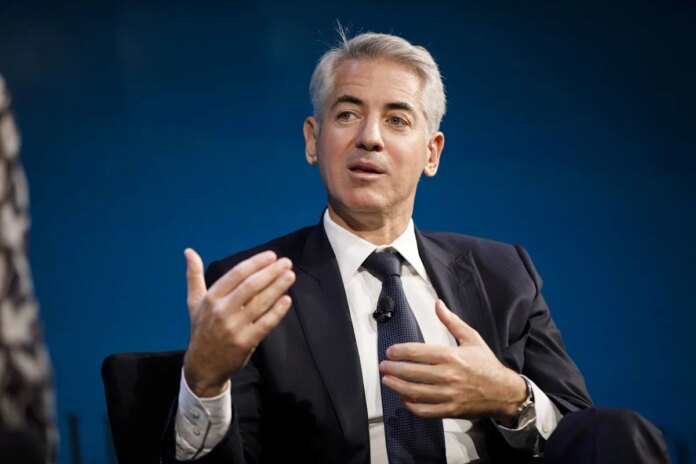
Ackman has a broader goal of generating annual returns of 20% over long periods rather than chasing short-term market moves.Getty Images
What’s Bill Ackman’s strategy?
Ackman said in a 2025 post on X (the former Twitter) that he first learned about Warren Buffett when he was 20 years old. Shortly after, he was inspired to become an investor.
Years ago, Ackman was known as an activist investor, taking large stakes in companies and publicly pushing management to make changes. His most famous moves included a successful $2.6 billion gain from Canadian Pacific Railway and a disastrous $1 billion short bet against Herbalife.
But starting in 2022, Ackman pivoted, saying that he had permanently retired from activist short-selling. Now he wants to build a “modern-day version of Berkshire,” saying in the X post that he plans to “adopt similar, long-term, shareholder-oriented principles to Berkshire” and hold the stock for the long haul.
“Fortunately, our starting base of assets won’t be a dying textile company, but a very good business,” Ackman added.
On Aug. 12, Pershing Square reported an earnings beat for its first full quarter after going public.
The firm recently made several private investments using its balance sheet, and these will form a portion of the initial Pershing Square Ventures portfolio.
“We want to give that opportunity to the average person on the street, so to speak, and that’s what we intend to do with Pershing Square Ventures,” Ackman said on the Q2 2026 earnings call. “And we’re going to seed it with investments so people will know what they’re investing in.”
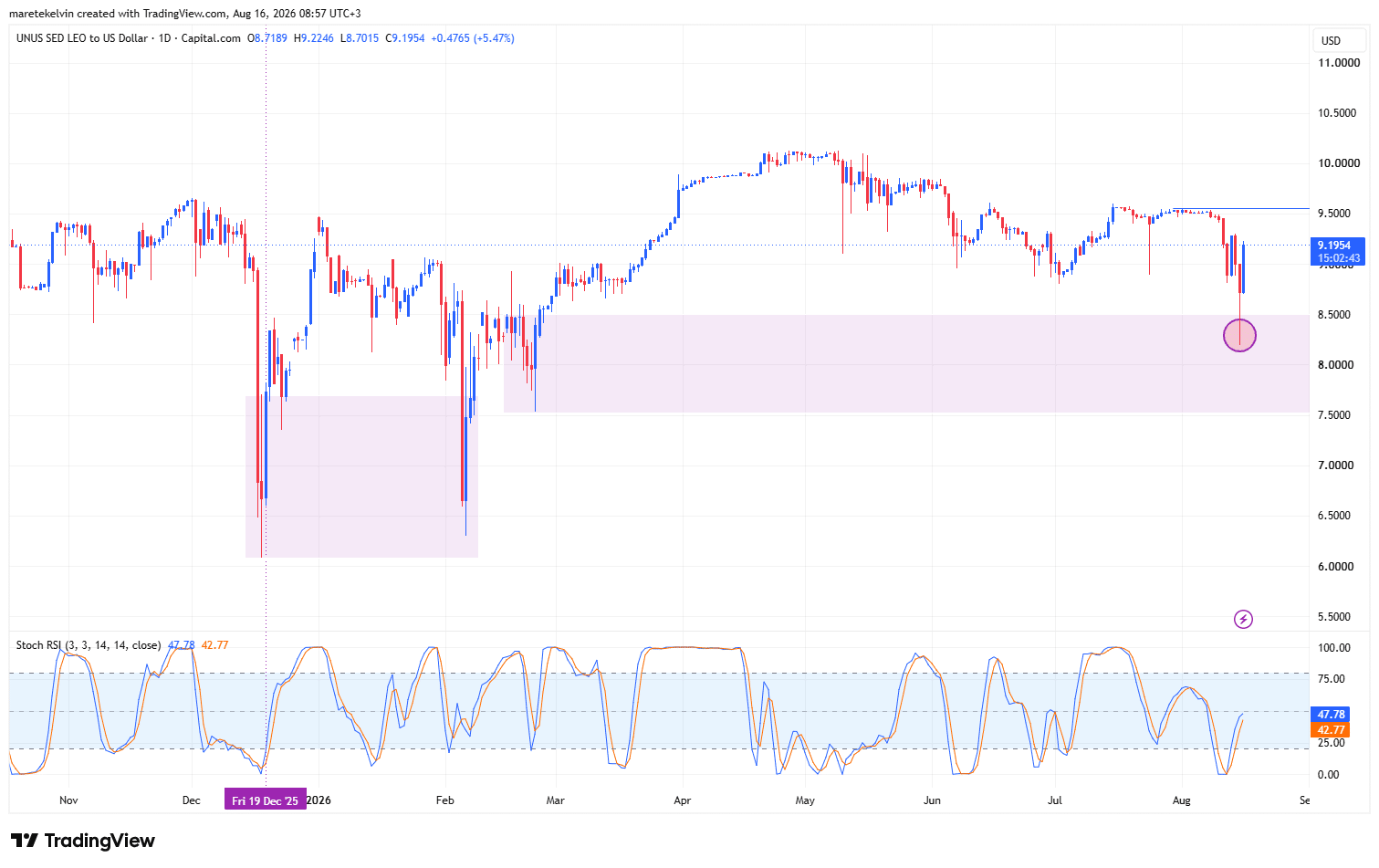
UNUS SED LEO [LEO] has surged 8% in the past day, at press time, but faced sharp rejections at key demand zones.
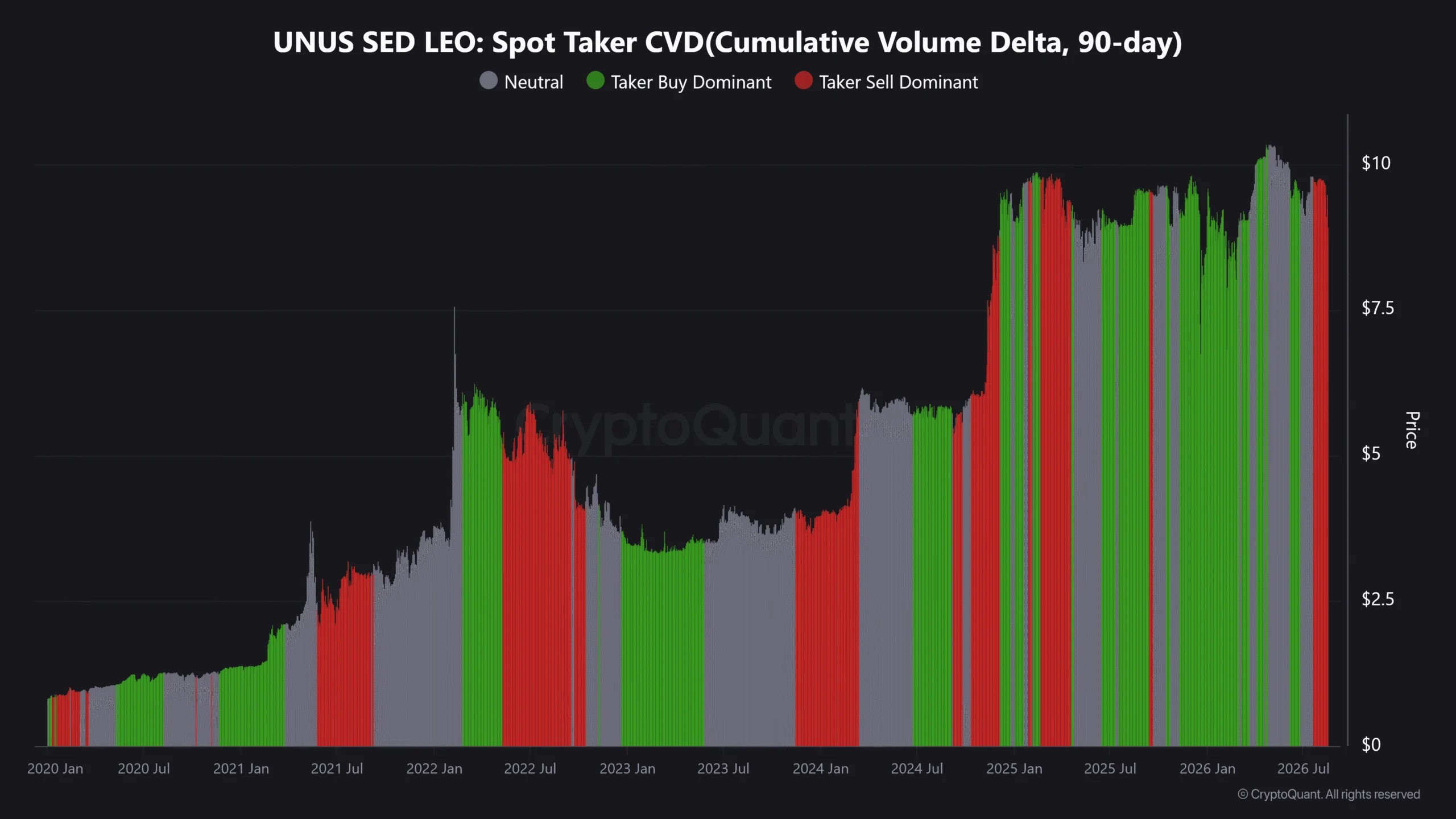
Despite the bullish advances, the token’s Stochastic RSI remained below overbought territory, while social activity and whale participation were also increasing. However, Spot CVD data shows sellers still dominate, creating a key test for buyers as LEO approaches its next resistance at $9.55.
Will the positive sentiment overpower the network bears for an ultimate surge to $9.55?
LEO rebounds from a key demand zone
On the daily chart, LEO has recorded a sharp recovery after finding support within the $7.50-$8.50 demand zone. The rebound has pushed the token up more than 8%, suggesting buyers are actively defending the zone.
A sustained move above the recent highs could strengthen the recovery and put $9.55 in focus. However, at press time, LEO’s RSI has yet to reach the overbought region despite the recent price surge.
This indicates that the current rally has not yet produced extreme bullish momentum. If buying pressure continues without the RSI entering overbought territory, LEO could have additional room to extend its recovery.
Source: TradingView
Social activity hits multi-month high
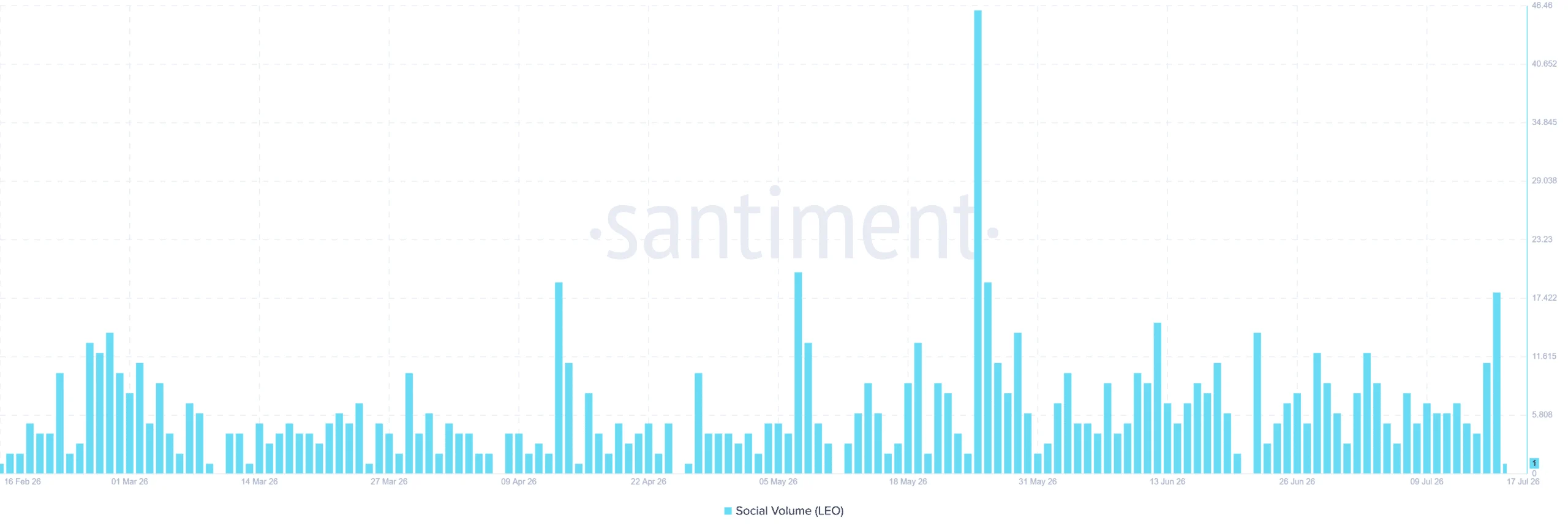
At the same time, LEO’s social mentions are also increasing across social channels.
The token’s Social Volume has reached its highest level since late May at 17,422, highlighting a sharp increase in market attention. Rising social activity alongside price gains could signal a growing interest and potentially attract additional market participation.
Source: Santiment
Whales increase LEO orders
A positive signal from whales is evident in the market right now.
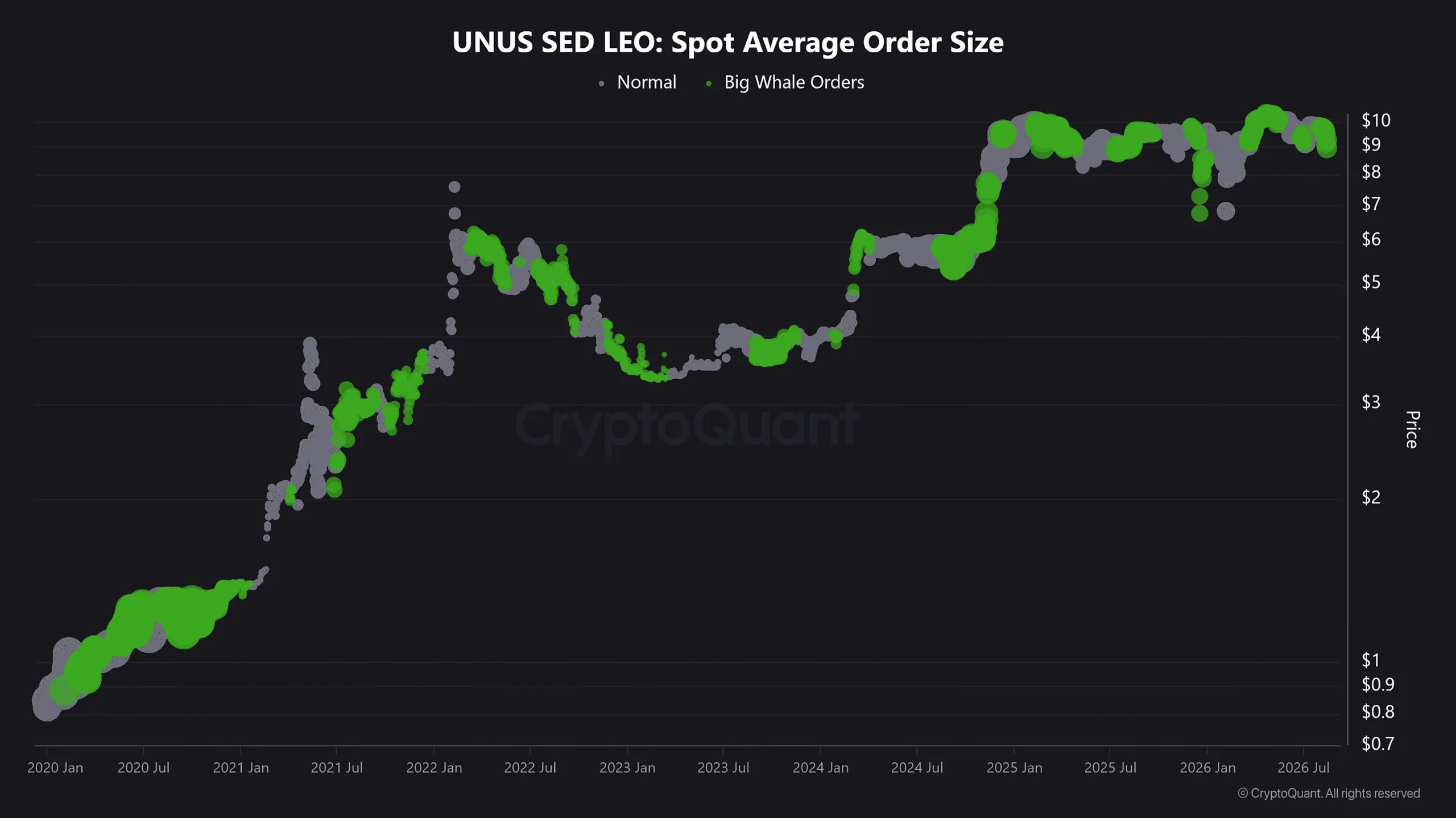
According to the recent Spot Average Order Size data, the LEO whales are making moves by placing more orders at the token’s current trading price. This implies that there are greater market forces at play, and it could be a matter of time before the bears are outperformed.
Source: CryptoQuant
Spot CVD raises a warning
Despite the bullish signals, LEO’s Spot CVD data remains a concern for the bulls.
According to the recent Spot Take Cumulative Volume Delta data, sellers continue to dominate the spot market, indicating that aggressive selling pressure has not completely disappeared despite the recent price recovery.
This divergence means buyers need to absorb the existing sell-side pressure to sustain the rally.
Source: CryptoQuant
Can LEO Reach $9.55?
Overall, LEO’s rebound, rising social activity, whale participation, and rising RSI provide a constructive setup for a further bullish push.
However, the bearish Spot CVD remains a key obstacle. If buyers overcome the selling pressure and maintain control, $9.55 becomes the next major resistance to watch.
Failure to sustain the current momentum could instead send LEO back toward the $7.50-$8.50 demand zone for another test.
Final Summary
LEO gained 8% as social volume hit its highest level since late May.
Whale activity rose, but bearish Spot CVD kept the $9.55 breakout uncertain.
NVIDIA (NVDA) now holds $21B in SPCX equity as SpaceX commits exclusively to NVIDIA GPUs, cementing the AI era’s defining partnership.
Jensen Huang projects AI infrastructure spending to surge from $800 billion today to between $3 trillion and $4 trillion annually by decade’s end.
The most widely read finance newsletter on Substack isn’t published by a bank, it’s Doomberg, where 383,000+ readers get the energy and macro analysis the mainstream press misses. 24/7 Wall St. readers save 17% on their first year here.
Over the past two weeks, four separate headlines may look unrelated, but my bet is they’re adding up to something much larger.
Shutterstock
First, Elon Musk committed SpaceX exclusively to NVIDIA GPUs during the company’s first conference call on August 4th. Second, Musk set a target of 10 gigawatts of AI compute by the end of 2027. Third, on August 10, NVIDIA announced financing partnerships with Apollo, BlackRock, Blackstone, Brookfield, Goldman Sachs and KKR to mobilize over $500 billion of third-party capital. And fourth, NVIDIA disclosed roughly 122.8 million SpaceX shares worth about $21 billion in its Q2 13F filed August 14, 2026.
Together, they tell one story: the buildout Jensen Huang calls “the largest infrastructure expansion in human history” now has a defining partnership.
Putting Together the Partnership That Could Define the AI Factory Buildout
NVIDIA (NASDAQ:NVDA) sells the GPUs, networking, and full-stack software behind essentially every frontier AI model. Data Center revenue reached $75 billion last quarter, up 92% year over year.
SpaceX (NASDAQ:SPCX) is the newest hyperscale AI buyer. Beyond rockets and Starlink, its AI segment (Grok, Colossus II, cloud services) delivered $2.56 billion in Q2 revenue, up 247% year over year, with $15.83 billion of a $18.37 billion single-quarter capex bill directed to AI infrastructure. Here’s why those numbers will soon look tiny.
On August 4th, Musk spoke of driving SpaceX to 10 gigawatts of computing capacity by the end of 2027, which is up from 1.4 gigawatts today. The cost of getting SpaceX to 10 gigawatts by the end of 2027? Somewhere around $500 billion.
From Our Partners
Written by Insiders. Answering to No One.
Before Doomberg published a word, its team spent long careers in heavy industry, private equity, and the hard sciences. They take no advertisers and serve no institution — which is why their lateral-thinking coverage of energy, finance, and geopolitics reads nothing like consensus financial media. Doomberg has set aside a discounted rate exclusively for 24/7 Wall St. readers — it isn’t available on their main page.
The day after earnings, the market didn’t ‘buy’ Musk’s vision. SpaceX shares fell. Several Wall Street firms questioned how Musk could possibly receive the financing to build out the scale of compute he was discussing. However, a couple of days later (August 7th), SpaceX shares began a massive rally that soon brought the company back above its IPO price.
The catalyst for the rally? Research from SemiAnalysis stated that SpaceX was actually in position to achieve its goals and reach up to 10 gigawatts by the end of 2027. If SpaceX hit that target, SemiAnalysis predicted they would exit 2027 with an ARR of around $305 billion.
Wall Street is currently modeling $98 billion in 2027 revenue and $157 billion in 2028 revenue.
NVIDIA Announces $500 Billion in Funding
Then, on August 10th, NVIDIA announced a brand new ‘Compute Infrastructure Financing Platform’ alongside Wall Street’s largest banks. The platform would mobilize over $500 billion in third-party capital, with NVIDIA agreeing to backstop up to 25% of the project’s cost.
And finally, NVIDIA’s 13F released on August 14th revealed the company had established a $21 billion position in SpaceX.
First, we had SpaceX announcing its intention to build a massive amount of data centers (exclusively using NVIDIA’s chips), and then NVIDIA announcing a $500 billion financing initiative and large investment into SpaceX’s stock.
I trust you’re following along with the sequence of events. NVIDIA’s CEO Jensen Huang has repeatedly expressed his admiration for Elon Musk’s drive and ability to stand up data centers in record time. Musk is now targeting a data center buildout that is extremely ambitious, but one which faces challenges in financing Musk’s ambitions.
It’s a partnership that makes sense. NVIDIA has been looking for more ways to use its balance sheet to develop the AI ecosystem, and Musk gives them a ‘backdoor’ to the creation of a new hyperscaler. The company’s $500 billion platform becomes a way for not just SpaceX, but other neoclouds, to receive more capital and compete with the largest companies like Amazon, Alphabet, Microsoft, and Meta Platforms.
And by creating a new funding source for this group, NVIDIA continues to diversify its customer list. The fact that NVIDIA’s revenue remains so concentrated amongst a small group of customers remains one of the largest reasons the company trades near a market-average forward P/E despite its incredible growth rates.
The Future of AI Hinges on Elon Musk and Jensen Huang’s Partnership
Jensen Huang has said he expected AI infrastructure spending to reach $3 trillion to $4 trillion annually by the end of the decade. When he started using that number on conference calls, many analysts mistakenly believed it was an amount of total spending across the next five years.
AI infrastructure estimates vary, but they’re generally around $800 billion in 2026. Consensus continues to grow for 2027, but many estimates place spending next year at closer to $1.2 trillion. That number is eye-watering for those who have been following AI, but it’s still just 1/3 of where Huang sees the market going by the end of the decade.
So, it’s clear that Huang envisions a future for AI that’s much largerand happens much sooner than just about anyone else imagines. Well, anyone else aside from Elon Musk.
My bet: the budding partnership between NVIDIA and SpaceX will become a key driver across the next generation of the AI race. What we’ve seen the past two weeks is just the beginning.
What $28 a Month Buys a Serious Investor
Through this reader link, 24/7 Wall St. readers get their first year of Doomberg for $332 — 17% off the standard $400, which works out to about $28 a month. That buys six to eight deeply researched articles a month on energy, finance, and geopolitics, the full archive, and one of the most resource-rich comment sections anywhere, where engineers, executives, and fund managers add context under every piece. After the first year it renews at the standard rate, and you can cancel anytime. If today’s article touched energy or the macro picture, odds are the green chicken has already gone three layers deeper — see for yourself at the discounted rate.