Home Blog Page 73

A quick review of the Ways and Means tax bills: State of Crypto

0
A quick review of the Ways and Means tax bills: State of Crypto

The House Ways and Means Committee circulated seven draft bills ahead of this week’s hearing on crypto tax policy, signaling what the industry can expect.

You’re reading State of Crypto, a CoinDesk newsletter looking at the intersection of cryptocurrency and government. Click here to sign up for future editions.

The narrative

The House Ways and Means Committee is the group of lawmakers tasked with writing laws governing taxes. While we’ve seen draft bills addressing taxes already, it’s this committee that’s really going to handle a hefty part of the work of drafting crypto tax legislation and shepherding it through the legislative process.

Why it matters

The fact that the committee is at the point of discussing draft legislation in a hearing shows progress on this front, and it’s likely the provisions will eventually become law in the coming years, whether as part of a tax-specific legislative package or as part of some other, broader bill.

Breaking it down

Staking and mining, de minimis and stablecoin transactions are all covered in the draft bills circulated late Thursday by the House Ways and Means Committee, among various other issues.

It’s unclear how much progress will be made in terms of actually turning these bills into law in the 2026 calendar year. The House — and Senate, for that matter — has a number of other priorities that are more advanced and require floor time, as CoinDesk has covered before. Still, the existence of the draft bills and a hearing are important steps.

Alison Mangiero, the head of industry affairs and U.S. policy at the Crypto Council for Innovation, an industry trade group, said in a statement that the group of bills was an “important first step.”

“The Ways & Means Committee’s decision to release seven bills and follow with a full committee legislative hearing on June 9 is significant on procedural grounds alone,” she said. “This format, where members work through specific legislation with expert witnesses before any markup, is one the Committee has not used in years. That kind of deliberate, structured engagement represents the unique focus from the Committee on this important work.”

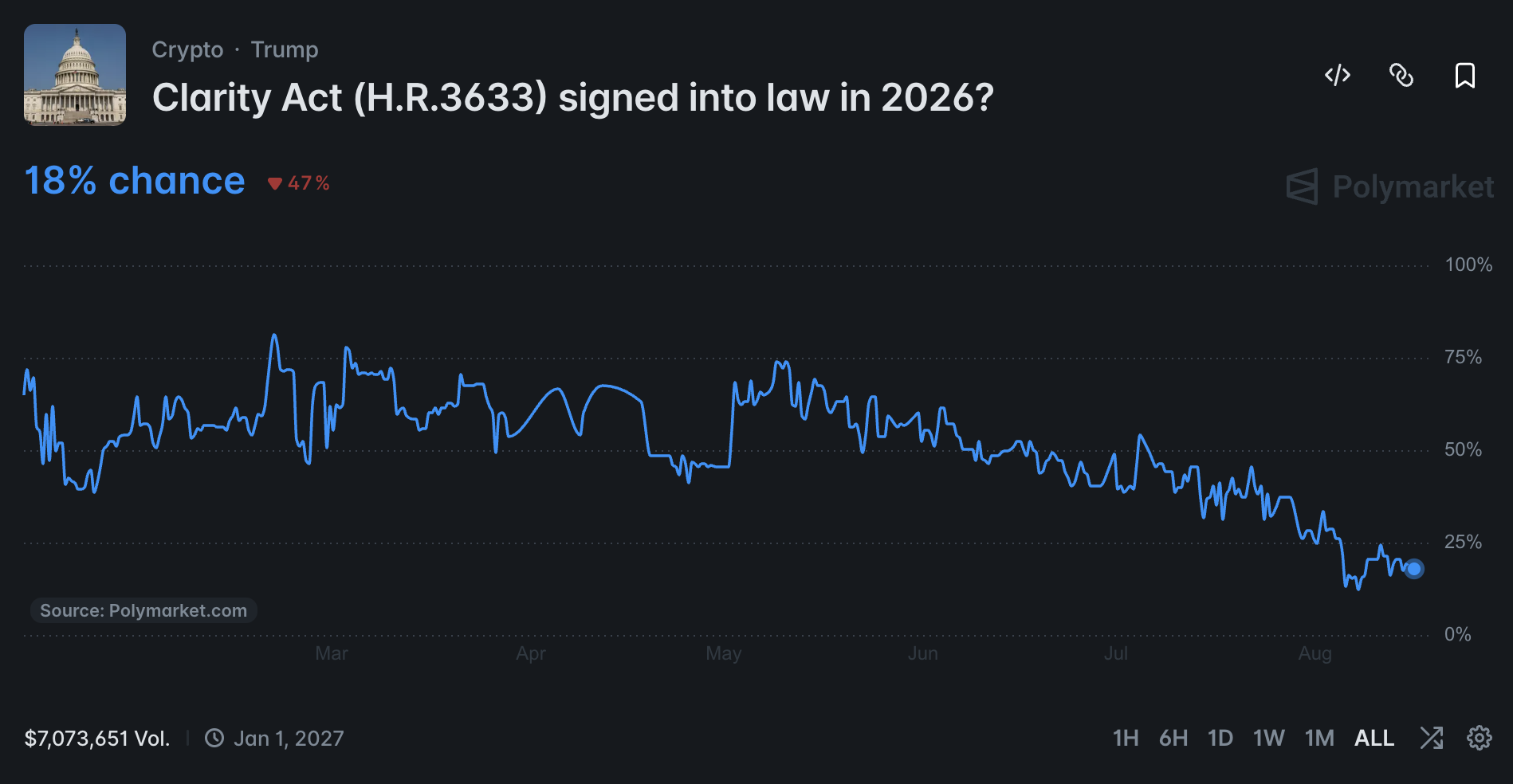
Mangiero called the bills the third leg in the metaphorical three-legged stool of crypto legislation, with the other legs including the stablecoin-focused GENIUS Act and the market structure-focused Clarity Act (the latter of which, as we all know, is still elbow-deep in the legislative process).

“Several provisions in this package reflect priorities we have long advanced: sensible tax treatment for GENIUS-compliant stablecoins that allows them to function as the payments instruments they are; a de minimis exception for routine network transaction fees, a relief we have long advocated for, and believe should be further broadened as the process continues; parity provisions extending securities lending, mark-to-market, and charitable deduction treatment to widely traded digital assets; and clear rules for the taxation of mining and staking rewards,” she said.

In semi-related news, the Financial Accounting Standards Board’s Investor Advisory Committee also met late last month to discuss, among other issues, whether stablecoins qualify to be treated as cash equivalents.

The committee believes there needs to be a “high threshold” to establish something as a cash equivalent, according to a summary of the meeting shared with CoinDesk. The members of the committee did not come to a consensus about what kind of information would be useful for investors.

Possible disclosure information includes how reserves are structured, the type of stablecoin, who the issuer is, where funds are held, disaggregated information about cash equivalents and currency risk and even whether disclosed information was made on an interim basis.

The committee will meet again in November.

Tuesday

  • 18:00 UTC (2:00 p.m. ET): The House Ways and Means Committee will hold a hearing to discuss crypto tax policy.

If you’ve got thoughts or questions on what I should discuss next week or any other feedback you’d like to share, feel free to email me at nik@coindesk.com or find me on Bluesky @nikhileshde.bsky.social.

You can also join the group conversation on Telegram.

See ya’ll next week!


Source link

Micron’s Stock Is Up Over 270% This Year. Here’s How It Can Still Double in 2026.

0
Micron's Stock Is Up Over 270% This Year. Here's How It Can Still Double in 2026.


Micron (NASDAQ: MU) investors have had a banner year, with the stock rising over 270% so far. If you invested in a broad market index fund, a return like that can take well over a decade to achieve. This skyrocketing surge speaks to the results investors can obtain by picking individual stocks, but what’s in the past is in the past. What really matters is what’s coming.

Despite Micron’s strong rise already in 2026, there is a scenario where the stock doubles by the end of the year. That would clearly make it a buy now, but how is a return like that possible to achieve?

Missed Nvidia in 2009? This Rare Signal Is Flashing Again. In 2009, a “Double Down” signal flashed for a little-known chipmaker called Nvidia. For the first time in years, that same “Total Conviction” signal is flashing for a company 1/100th the size of Nvidia. Continue »

Image source: Getty Images.

A memory shortage is driving Micron’s stock higher

Data centers need a large amount of memory to function. There are two primary types of memory, and each gets used differently. DRAM memory is mostly deployed in computing chips, which are seeing a spike in demand as more and more computing power is deployed for artificial intelligence (AI) use. Micron also makes NAND memory, which primarily gets used in data storage like solid-state drives (SSDs). Both of these products are in short supply, which is causing prices to soar. Micron is cashing in on this shortage, but also working to alleviate it at the same time.

By mid-2027, Micron’s new Idaho facility will be up and running, and several other production sites are under construction now. At the same time, investors are getting estimates for 2027 capital expenditures even greater than 2026’s levels. In fact, Nvidia believes its global data center capital expenditures could reach $3 trillion to $4 trillion annually by 2030.

Compared to the estimated $650 billion that AI hyperscalers are expected to spend this year, that growth presents some major supply challenges and could extend the memory chip shortage for several years, allowing Micron’s stock to be an excellent long-term investment.

How Micron could double from here

But in 2026, Micron’s stock isn’t all that expensive at 18 times forward earnings. Its peer, Sandisk (NASDAQ: SNDK), has already risen to about 28 times forward earnings. That could easily unlock another 50% growth just based on valuation alone. However, if investors start to get excited about 2027 data center demand and Micron’s revenue growth exceeds expectations (right now, the analyst consensus projects 263% growth for its next quarter and 250% after that), Micron’s stock could easily rise the other 50% based on beating estimates.

Wall Street only forecasts 60% growth for fiscal year 2027 (ending August 2027), and if that number moves to over 100% (which is entirely possible based on major 2027 demand), I wouldn’t be surprised to see the market bid up the stock as a result.

While Micron could still double this year, I think there’s a compelling case for the stock even if it falls short of that goal.

Should you buy stock in Micron Technology right now?

Before you buy stock in Micron Technology, consider this:

The Motley Fool Stock Advisor analyst team just identified what they believe are the 10 best stocks for investors to buy now… and Micron Technology wasn’t one of them. The 10 stocks that made the cut are built for long-term growth and could produce monster returns in the coming years.

Consider when Netflix made this list on December 17, 2004… if you invested $1,000 at the time of our recommendation, you’d have $443,191!* Or when Nvidia made this list on April 15, 2005… if you invested $1,000 at the time of our recommendation, you’d have $1,258,838!*

That performance is why people listen. With a track record of beating the S&P 500 by nearly 5x, Stock Advisor offers a distinct advantage. Don’t miss the latest top 10 list, available with Stock Advisor, and join an investing community built for the long haul.

See the 10 stocks »

*Stock Advisor returns as of June 7, 2026.

Keithen Drury has no position in any of the stocks mentioned. The Motley Fool has positions in and recommends Micron Technology. The Motley Fool has a disclosure policy.

Micron’s Stock Is Up Over 270% This Year. Here’s How It Can Still Double in 2026. was originally published by The Motley Fool


Source link

Strategy (MSTR) news: Michael Saylor revives bitcoin-buy speculation as scrutiny grows

0
Strategy (MSTR) news: Michael Saylor revives bitcoin-buy speculation as scrutiny grows

Michael Saylor may have offered a clue about Strategy’s (MSTR) next move after last week’s surprise bitcoin sale.

On Sunday, the company’s executive chairman posted the chart traditionally used to track Strategy’s bitcoin purchases on X, writing: “A good time to add more dots.”

Market observers have viewed such posts as a precursor to a new acquisition, although the company has yet to officially announce any transaction and will likely broadcast any action on Monday.

Strategy CEO Phong Le appeared to reinforce that message in a reply to Saylor’s post. “Our corporate @Strategy is to increase net Bitcoin and Bitcoin per share over time,” Le wrote. “Rumors otherwise are just rumors.”

The messages came after Strategy found itself under renewed scrutiny last week. The company disclosed last Monday that it had sold 32 bitcoin, worth roughly $2.5 million, its first sale since 2022. While immaterial relative to its more than 843,000-BTC treasury, the transaction sparked debate because investors have long viewed Strategy as one of bitcoin’s most consistent sources of demand.

Some market participants interpreted the BTC sale as a potential sign that Strategy could sell more of its bitcoin holdings to support dividend payments or shore up liquidity if market conditions deteriorate further. Those concerns have only grown as bitcoin slumped below $60,000 on Friday, its weakest level since October 2024.

Adding to the spotlight, SEC filings on Friday showed two senior executives’ plans to sell a combined $15 million worth of MSTR shares.

CEO Phong Le disclosed plans to sell roughly $11.1 million of stock, while CFO Andrew Kang filed to sell about $3.9 million. The transactions were tied to recently vested stock awards.


Source link

Mark Cuban says small businesses are desperate for AI talent — and it’s where job seekers should look first

0
Mark Cuban says small businesses are desperate for AI talent — and it's where job seekers should look first


Mark Cuban took to his X account to bang the AI-equals-job-opportunities drum again earlier this week.

In a June 2 post (1), the business mogul and TV personality said that small businesses create roughly 60% of new jobs every year and that the percentage of jobs created by the sector will only increase.

Must Read

Because of this, Cuban says that job seekers should start their search by applying to small businesses. Having AI skills additionally presents a way in for Americans because it makes it “easier and faster” for mom-and-pop operations to compete with larger corporations, he wrote.

The post drew hundreds of comments and a few replies from Cuban himself. One X user rebutted Cuban’s stance arguing that smaller companies use AI to reduce headcount needed (2).

“Not true,” Cubain replied. “They use it to do things they didn’t have enough time to do before.”

He told another user (3): “The smallest businesses don’t have the depth of expertise in AI. They need the help. Kids coming out of college have that expertise.”

Working at a small business will likely expedite your career skills, too. One user jokingly pointed out that joining a small business gives employees five years of experience in 14 months. To which Cuban simply replied (4) “Facts.”

The AI job opportunity

Cuban’s is a big believer in the job opportunities AI can create at the small business level, even as major tech companies trim workforces to invest more in the technology. In the past year, he hasn’t been shy about sharing this advice with financial media outlets and on podcasts.

He has said that just 14% of businesses have embedded AI across their organizations and that millions of companies do not have dedicated AI budgets due to sheer size. This translates into much of the economy underusing AI’s potential, which presents a ripe opportunity for job seekers, including college graduates, to find well-paying jobs.

“Learn all you can about AI, but learn more about how to implement [it] in companies,” he said on the TBPN podcast last year. “Companies don’t understand how to implement all of that right now to get a competitive advantage.”

It’s advice he’s even giving his own kids.

“I tell [my children], like I tell every young kid, there’s going to be two types of companies in this country: There’s going to be those who are great at AI and those who used to be in business,” he said on a September 30 podcast episode of The Dumbest Guy in the Room, cited by CNBC (5). “And if you’re looking for a job, it’s going to be easier to work for a small company than a large company.”

Read More: BlackRock warns buying and holding the S&P 500 isn’t enough for retirement anymore — here’s why

Where the job market stands today

Millions of college students have already graduated from school this spring, or will walk across the stage later this month. The job market they’re entering is a bit of a mixed bag.

The U.S. economy added 172,000 new jobs in May, far outpacing analyst predictions for the month, according to U.S. Bureau of Labor Statistics data. And yet, the average job seeker is waiting six months (6) to land one. The median length of time to find a job is nearly three months. Both figures are up compared to April.

Meanwhile, a new Challenger, Gray & Christmas report (7) released on June 4 found that employers cut 97,000 jobs in May. Of those announced job cuts, AI was cited as the primary reason in 40% of them.

You May Also Like

Join 250,000+ readers and get Moneywise’s best stories and exclusive interviews first — clear insights curated and delivered weekly. Subscribe now.

Article Sources

We rely only on vetted sources and credible third-party reporting. For details, see our ethics and guidelines.

X (1), (2), (3), (4); CNBC (5); MarketWatch (6); Challenger, Gray & Christmas (7)

This article originally appeared on Moneywise.com under the title: Mark Cuban says small businesses are desperate for AI talent — and it’s where job seekers should look first

This article provides information only and should not be construed as advice. It is provided without warranty of any kind.


Source link

Bitcoin underwater supply crosses 10mln – Is BTC near cycle bottom?

0
Bitcoin underwater supply crosses 10mln – Is BTC near cycle bottom?


Bitcoin’s recent decline has pushed a growing share of holders underwater, increasing stress across the network. Supply in Loss has now climbed to 10.46 million BTC, marking the first time this cycle that underwater coins have exceeded Supply in Profit.

Source: Glassnode

As Bitcoin [BTC] fell toward the $60,000-$62,000 range, market profitability compressed sharply and unrealized losses expanded across multiple holder cohorts. Yet this is also where the signal becomes interesting.

Previous cycle bottoms formed when more than 10 million BTC sat at a loss. The reason is simple. Investors become less willing to sell after absorbing large drawdowns, causing sell-side pressure to gradually thin out.

If buyers begin absorbing that supply, Bitcoin could move closer to a bottoming phase. If not, deeper capitulation may still lie ahead.

Bitcoin’s MVRV signals a deep valuation reset

Bitcoin’s selloff has pushed the Market Value to Realized Value [MVRV] Ratio down to 1.1, leaving the market only slightly above its aggregate cost basis. In practical terms, most of the speculative premium that built up during the rally has already been erased.

As prices slipped toward the $60,000-$62,000 range, profitability across the network tightened and the market moved closer to levels that historically tested investor conviction. What’s notable is where this level sits in Bitcoin’s history.

Source: CryptoQuant

A further decline toward the low $50,000s would likely push MVRV toward 1.0, a level that has rarely appeared outside major cycle lows. In other words, Bitcoin is no longer expensive. The question remains whether buyers are ready to step in before full capitulation takes hold.

Long-Term Holders return to net accumulation

Long-Term Holder Net Position Change has recently turned positive, signaling a shift in Bitcoin’s ownership structure. Recent data shows this cohort absorbing roughly 30,000-35,000 BTC over a 30-day period after months of mixed positioning.

Source: Glassnode

The change suggests some investors are beginning to increase exposure despite continued market uncertainty.

Historically, sustained accumulation by long-term holders has often coincided with periods when supply gradually moved away from speculative participants.

However, the current pace remains measured rather than aggressive. For now, the data points to improving conviction beneath the surface, though broader market participation remains subdued.


Final Summary

  • Bitcoin [BTC] now has 10.46 million coins underwater, pushing valuation metrics toward levels historically associated with major cycle bottoms.
  • Bitcoin long-term holders are accumulating again, though stronger demand remains necessary to confirm a durable recovery.


Source link

Bitcoin near $60,000 today vs February: ETF flows tell a different story

0
Bitcoin near $60,000 today vs February: ETF flows tell a different story

Bitcoin is back to trading at levels seen in early February: near $60,000. But this time, the response from institutions is totally different.

Today, they are aggressively selling into the dip, ETF flows indicate, unlike in February, when selling slowed as prices dropped to near $60,000. That marks a fundamental shift in how institutions view bitcoin at this level.

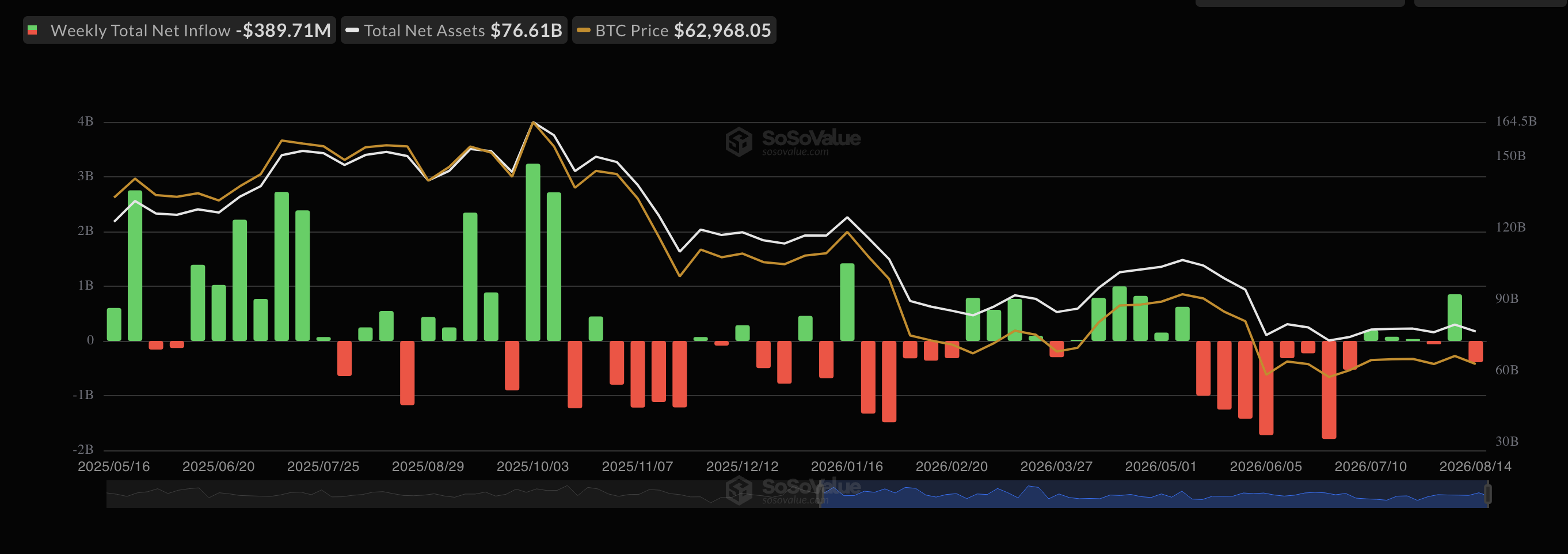
The 11 U.S.-listed spot bitcoin ETFs saw net outflows of $1.72 billion last week. That’s the largest single-week redemption in over a year, according to data source SoSoValue. Back in the first week of February, when BTC crashed to nearly $60,000, the ETFs bled just $318 million.

The bearish contrast doesn’t end there.

Outflows have accelerated for four consecutive weeks, rising from $1 billion in the week ended May 15 to $1.26 billion, then $1.26 billion and $1.42 billion in the following two weeks, and most recently $1.72 billion.

In February it was different. The week BTC hit $60,000 saw $318 million leave. But the two weeks before that had seen $1.33 billion and $1.49 billion leave. In essence, as the price crashed, outflows slowed. Buyers showed up.

This time, the trend has reversed: As price fell, outflows accelerated. Week after week, faster redemptions and no institutional bid beneath them.

The pattern tells a bearish story and suggests the bulls may have tough time holding on to the $60,000 support. As of writing, bitcoin changed hands near $62,000.


Source link

Is AXT, Inc. (AXTI) A Good Stock To Buy Now?

0
Is AXT, Inc. (AXTI) A Good Stock To Buy Now?


Is AXTI a good stock to buy? We came across a bullish thesis on AXT, Inc. on Studio Innovation’s Substack by Studio. In this article, we will summarize the bulls’ thesis on AXTI. AXT, Inc.’s share was trading at $103.16 as of May 29th. AXTI’s forward P/E was 333.33 according to Yahoo Finance.

Deutsche Bank Raises its Price Target on Marvell (MRVL)

Photo by JESHOOTS.COM on Unsplash

AXT, Inc. designs, develops, manufactures, and distributes compound and single element semiconductor substrates. AXTI is emerging as one of the strongest beneficiaries of the accelerating demand for optical connectivity infrastructure supporting AI and hyperscale data centers. The company delivered an exceptionally strong first quarter of 2026, with revenue increasing 39% year-over-year and 17% sequentially to $26.9 million, driven primarily by surging demand for indium phosphide substrates used in high-speed optical transceivers.

Read More: 15 AI Stocks That Are Quietly Making Investors Rich

Read More: Undervalued AI Stock Poised For Massive Gains: 10000% Upside Potential

Indium phosphide revenue reached $13.6 million during the quarter, while non-GAAP gross margin improved dramatically to 29.9% from negative levels a year earlier, highlighting the operating leverage inherent in the business as volumes scale. The investment thesis is increasingly centered on AXT’s unique position within a rapidly expanding supply chain, where demand continues to outpace available capacity. Management reported that indium phosphide backlog exceeded $100 million for the first time in company history and expects the second quarter to set a new record for indium phosphide revenue.

To capitalize on this opportunity, AXT recently raised $632.5 million to aggressively expand production capacity, targeting a doubling of output by the end of 2026, another doubling by the end of 2027, and further meaningful expansion thereafter. Demand from China more than doubled in the first quarter and is expected to double again in the second quarter, while the company is pursuing long-term supply agreements with major customers, hyperscalers, and end users.

Management expects at least $34 million in second-quarter revenue with confidence and forecasts a return to both GAAP and non-GAAP profitability. With capacity expansion underway, growing customer commitments, six-inch product development progressing, and potential upside from export permit approvals, AXT appears positioned for sustained growth and continued rerating as one of the market’s standout AI infrastructure enablers.

Previously, we covered a bullish thesis on Lam Research Corporation (LRCX) by The Antifragile Investor in May 2025, which highlighted the company’s indispensable role in semiconductor manufacturing, its recurring high-margin services business, and durable competitive advantages stemming from deep customer integration and high switching costs. LRCX’s stock price has appreciated by approximately 284.32% since our coverage. Studio shares a similar view but emphasizes AXT, Inc.’s exposure to AI-driven optical networking demand, accelerating indium phosphide growth, and substantial capacity expansion opportunities.


Source link