Tech-oriented lender Erebor Bank is in advanced talks to raise about $1.5 billion in a deal that would value the year-old firm at about $9.5 billion, the Financial Times reported.
Lux Capital, Human Capital, Valor Equity Partners, Andreessen Horowitz and SV Angel are expected to make large commitments in the fundraising round. Existing investors including 8VC and Haun Ventures are also set to take part, according to the report, which cited people familiar with the matter.
The fundraising comes as Erebor expands its deposit base and starts lending activity. Deposits reached $4.6 billion by the end of July, up from $1.1 billion at the end of March, the FT said.
Erebor targets companies working in crypto, artificial intelligence, defense and manufacturing. It also serves payment companies, investment funds and trading firms and its planned services include deposits, credit, stablecoin products, treasury management and payments.
The bank received final U.S. approval to operate in February. Regulators require it to maintain a leverage ratio of at least 12% during its first three years, making the fresh capital important as its balance sheet grows.
MoneyGram has launched its crypto on- and off-ramp service on Solana, letting people on the network move between digital assets and physical cash through the payments company’s global network.
MoneyGram is a payments firm with more than 85 years of experience, serving over 60 million customers through nearly half a million retail locations worldwide.
Its product, MoneyGram Ramps, is a tool that lets apps connect users to cash-to-crypto and crypto-to-cash services, a “ramp” being the bridge between traditional money and digital assets.
Solana is a blockchain network built for fast, low-cost transactions, which has made it one of the most active networks for payments, trading, and stablecoins.
“By connecting our ecosystem to MoneyGram’s global payments network through MoneyGram Ramps, developers are able to more easily build financial applications with real-world utility at global scale,” said Lily Liu, president of the Solana Foundation, the nonprofit that supports the network.
Ramps is built as an API that lets other apps plug into MoneyGram’s network without building their own banking systems or handling complex regulation.
According to MoneyGram, it supports cash deposits in more than 25 countries and cash withdrawals across more than 170 countries and territories.
For Solana developers, the company said the tool is also built into the Solana Developer Platform’s payments module, meaning builders can add cash-to-crypto features directly into their apps.
Trending on TheStreet Roundtable:
Rift becomes the first wallet on board
Rift, an AI-powered trading platform offering access to equities, commodities, crypto, and foreign exchange, is the first Solana wallet to integrate Ramps. MoneyGram framed it as the start of wider adoption across the network.
The launch extends MoneyGram’s push beyond traditional remittances as more financial activity shifts onchain.
“The future of payments is built on access,” said Anthony Soohoo, chairman and CEO of MoneyGram, adding that each new platform the company connects expands its network’s reach.
BlackRock has taken the decision to reduce the $25 million minimum for in-kind Bitcoin-to-IBIT conversions to $1 million.
By making this change, BlackRock is making it much easier for investors who already own Bitcoin [BTC] to increase their exposure through the BlackRock iShares Bitcoin Trust (IBIT).
Before now, this mechanism was essentially restricted to large institutional or high-net-worth investors due to the $25 million minimum. However, the new $1 million threshold now opens it up to a much wider range of large Bitcoin holders, funds, and professional investors.
Robbie Mitchnick weighs in
That said, the in-kind creations can eliminate the need for middlemen to carry out significant Bitcoin sales and purchases on the open market. It may also increase IBIT’s efficiency and appeal while reducing trading frictions and enhancing liquidity.
Remarking on the same, BlackRock’s digital-assets head Robbie Mitchnick said,
We’ve seen the amount of in-kind activity be a growing number over the three quarters now that that’s been allowed.
Further explaining the reason behind the price limit he added,
So there’s some manualness to the transaction that needs to be undertaken. And so it’s about what providers are willing to support just to make the math and the administrative process work.
For its part, the action was taken in the wake of the recent Coldcard exploit, which raised concerns about self-custody.
Swedish Bitcoin treasury company holdings reach 3,506.4 BTC
At the same time, H100 Group, a Bitcoin treasury and health-tech company listed in Sweden, recently completed a significant acquisition that nearly tripled its Bitcoin treasury without having to pay cash.
The deal increased H100’s total holdings to 3,506.4 BTC by 2,455.37 BTC. This happened after H100 Group completed its acquisition of Norway’s Moonshot and PDI.
The deal is unique because it was set up in a 1:1 Bitcoin-for-Bitcoin fashion, meaning that instead of H100 paying cash to purchase the shares, the sellers essentially received H100 shares in return for the Bitcoin and assets they were contributing.
Given the price of Bitcoin as of the 31st of July, the transaction was estimated to be worth SEK 1.47 billion. Following the purchase of two Norwegian companies, the company’s position in the global public corporate Bitcoin holdings rose from 42nd to 26th.
Bitcoin’s market dynamics
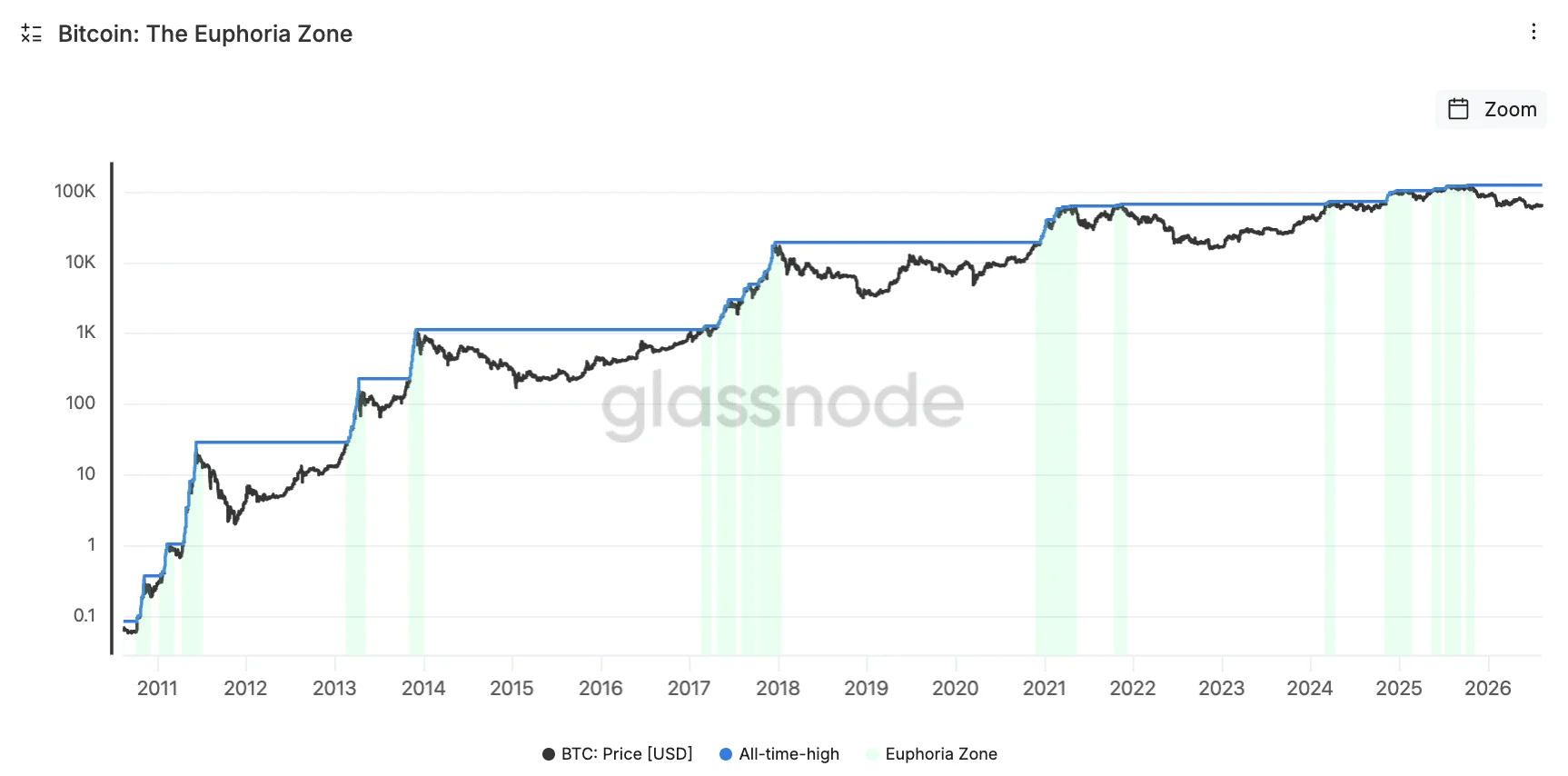
Bitcoin declined by 1.55% in the past 24 hours, trading at $64,081.90 at press time. Meanwhile, after repeatedly entering the Euphoria Zone during the 2025 rally, Bitcoin has now left it in 2026.
Instead of the intense bullishness that was observed last year, the market seems to have moved toward a post-euphoria correction and possible accumulation phase. Hence, a significant push above the $100k price level can change the course of things.
Source: Glassnode
Final Summary
BlackRock has reduced the $25 million minimum for in-kind Bitcoin-to-IBIT conversions to $1 million.
H100 Group, a Bitcoin treasury company, nearly tripled its Bitcoin treasury without having to pay cash.
“I voted against the GENIUS and Clarity acts because they fail to adequately address abuse and instead open the door to corruption,” she said last year. “At a time when the current occupant of the Oval Office is personally benefiting from crypto and memecoin ventures, these bills do nothing to close conflict-of-interest loopholes.”
But if Waters and Brown are running the crypto show in the House, the White House will still have its same occupant. Even if the Democrats win a stronger majority than the narrow GOP advantage of the past two years, the next session could become a mess of go-nowhere, message-sending bills. If the party won the Senate majority, too, that wouldn’t help assure Democrats an ability to get legislation converted to law.
On the Senate side, Senator Warren has been among the crypto industry’s most prominent Capitol Hill detractors, trying to keep a steady spotlight on what she’s portrayed as the president’s crypto corruption. However, under her time as the ranking Democrat on the Senate Banking Committee, she watched her fellow Democrats go against her on crypto matters, gathering for negotiations on the legislation she opposed.
She may have more sway were she to lead the committee and control the advancement of her members’ bills. If she were to follow in the footsteps of the most recent Democrat who ran the banking panel, former Senator Sherrod Brown, she could go for years without allowing a crypto measure through the gate. (Brown, who was defeated by Republican crypto advocate Senator Bernie Moreno two years ago with the help of a massive $40 million crypto PAC boost, is also running again for the other Ohio Senate seat.)
Many consumer tech companies are spending billions, tens of billions, and — in a handful of cases — hundreds of billions on artificial intelligence (AI) this year. Disney (NYSE: DIS) isn’t afraid of cutting big checks to bankroll its future, but AI isn’t the top priority.
It’s been two years since Disney stunned the market by committing to $60 billion in capital expenditures for its experiences business, led by its theme parks and cruise line. Sure, this will be spread out over 10 years. It’s still a substantial wager on a very important segment for the House of Mouse. It’s a lot of money, and with Josh D’Amaro stepping up as CEO earlier this year, this should be a very exciting week on that front.
Missed Nvidia in 2009? This Rare Signal Is Flashing Again. In 2009, a “Double Down” signal flashed for a little-known chipmaker called Nvidia. For the first time in years, that same “Total Conviction” signal is flashing for a company 1/100th the size of Nvidia. Continue »
Image source: Disney.
A wish is a dream your heart makes
Former CEO Bob Iger — who led Disney from 2005 to 2020 before returning to the helm two years later — handed the gig to D’Amaro in March. Iger never neglected the theme parks. International expansion and updated guest experiences served Disney’s empire of gated attractions well.
However, Iger came from ABC. He served all of Disney well when he made it to the corner office, but there is no denying that the studio segment was his priority. The three biggest deals he orchestrated in his tenure — Pixar, Lucasfilm, and 21st Century Fox — were all media businesses. For a business built on princesses, content always seemed to be king in the eyes of Iger.
Iger was CEO when Disney announced the $60 billion shopping spree. Half of it would go to improving its theme parks. Less than a third of it would go to improving the infrastructure of its experiences. The rest would go to building out its fleet of cruise ships. However, when it came time to announce details of the new experiences coming to Disney’s theme parks — two summers ago at the D23 fan expo in California — it was D’Amaro taking center stage.
Disney stock is up just 4% since D’Amaro became CEO less than five months ago. It may not seem like much, but Disney shares rose a mere 8% in the 40 months that Iger was the Big Cheese in his second run at the top. In Iger’s defense, Disney was a five-bagger in his first go-round as CEO.
Carousel of progress
D’Amaro had a strong first full quarter as CEO, as Disney announced last week. Revenue rose just 7%, but that was its strongest top-line jump in more than three years. Adjusted earnings more than doubled that clip, rising a better-than-expected 15%.
There are always plenty of moving parts when Disney is successful, but nothing is moving as well as its experiences segment these days. It accounted for 54% of Disney’s segment operating profit in its latest quarter. New cruise ships are naturally helping, but even its theme park business delivered another pleasant surprise. Its global theme parks posted a 4% increase in guests, while its two domestic resorts delivered a 3% gain. Even more impressively, per capita revenue is up 4%. Unlike rival attractions operators that saw weak guest trends and relied on heavy promotional activity, Disney saw its traffic pick up and guest wallets open wider.
Outside of the well-received financial update, D’Amaro’s first few months have been uneventful, aside from layoffs to streamline operations and last week’s announcement to ramp up its share buyback initiatives to $9 billion in repurchases this fiscal year. If you’re waiting for D’Amaro’s first true signature move, you won’t have to wait long.
D23 is back this weekend, and the experiences segment that D’Amaro is championing will again find him joined by Neil Patrick Harris on Saturday night to announce future plans for its theme parks and cruise ships. Between firming up the timeline of new attractions revealed two years ago and likely announcing some new projects, D’Amaro will be back in his element.
Disney stock has been cut nearly in half since peaking five years ago. It would have to double from here to establish new all-time highs. When that ultimately happens, you can be sure that D’Amaro’s presentation this weekend will play a starring role.
Should you buy stock in Walt Disney right now?
Before you buy stock in Walt Disney, consider this:
The Motley Fool Stock Advisor analyst team just identified what they believe are the 10 best stocks for investors to buy now… and Walt Disney wasn’t one of them. The 10 stocks that made the cut are built for long-term growth and could produce monster returns in the coming years.
Consider when Netflix made this list on December 17, 2004… if you invested $1,000 at the time of our recommendation, you’d have $411,427!* Or when Nvidia made this list on April 15, 2005… if you invested $1,000 at the time of our recommendation, you’d have $1,335,252!*
That performance is why people listen. With a track record of beating the S&P 500 by 4x, Stock Advisor offers a distinct advantage. Don’t miss the latest top 10 list, available with Stock Advisor, and join an investing community built for the long haul.
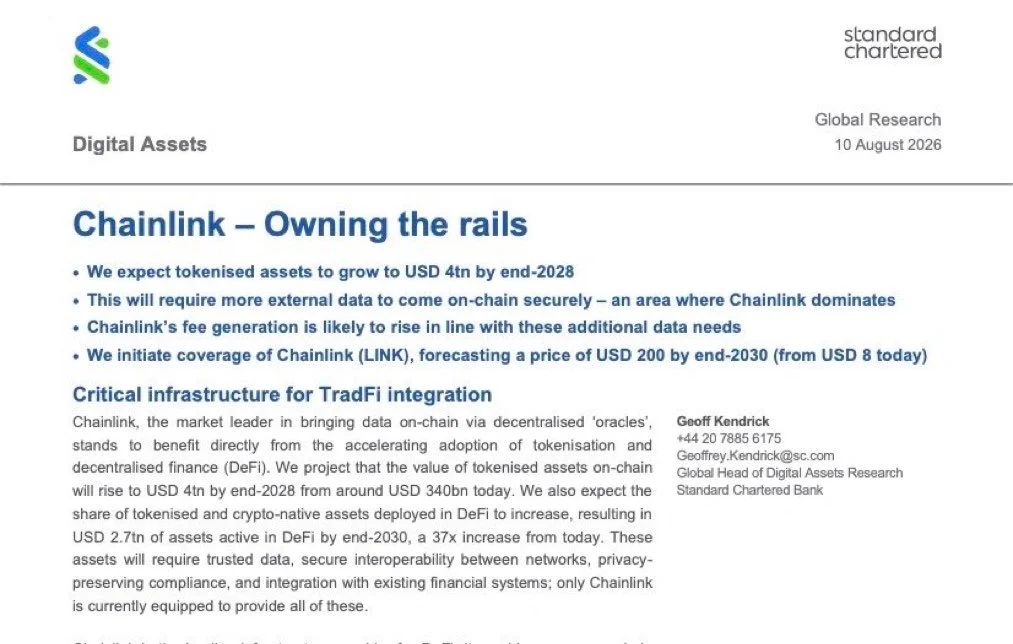
Tokenized finance is growing beyond crypto-native assets while simultaneously drawing attention to blockchain infrastructure. Against that backdrop, Standard Chartered Bank expects tokenized assets to grow from roughly $340 billion to $4 trillion by 2028.
As that market expands, more assets will require reliable data and cross-chain connectivity, creating a larger addressable market for Chainlink [LINK]. Standard Chartered argues this rising demand could significantly boost LINK’s valuation, with some projections suggesting a path toward $200.
Source: X
However, the implied 25-fold increase requires more than rising tokenization volumes. Chainlink must convert greater infrastructure use into higher fees and sustained LINK demand.
Therefore, the $200 target ultimately depends on whether ecosystem growth translates into measurable value for the token itself.
Chainlink’s CCIP activity grows along tokenization demand
Standard Chartered’s $200 target ultimately rests on Chainlink securing enough activity as tokenized finance expands. Notably, the current ecosystem activity provides an early measure of that position.
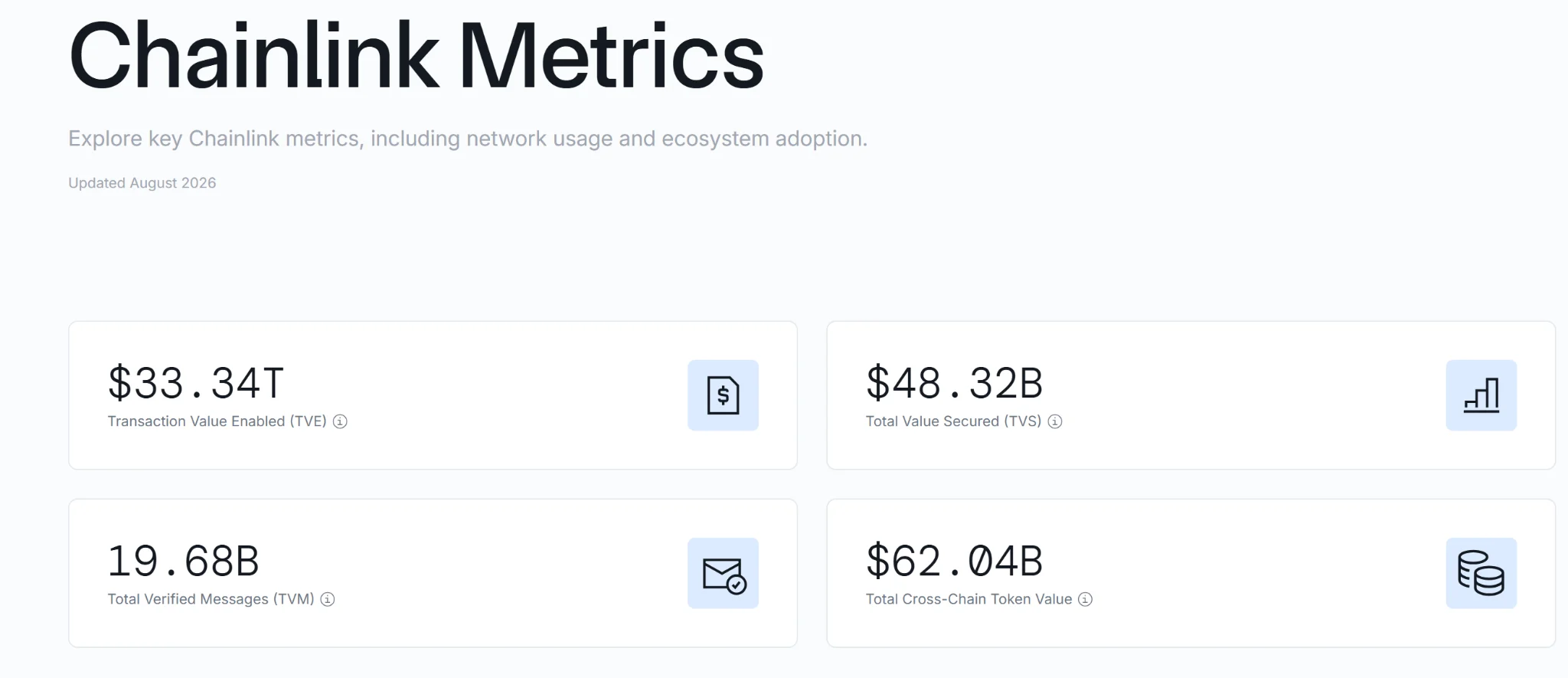
At press time, Chainlink secured $48.32 billion, while cumulative transaction value enabled exceeds $33 trillion.
Source: metrics.chainlink
Moreover, within that activity, CCIP has processed over $4.9 billion in transactions during Q2, an increase of 353% from last year’s second quarter. Supporting that milestone, Chainlink reported over $7 billion in migration activity in its Q2 report.
That growth is significant as it provides the required infrastructure for increasing amounts of tokenized assets to access additional markets. However, with growth comes competition.
Therefore, the altcoin needs CCIP volumes and secured value to keep rising, while stronger fee generation would confirm that infrastructure adoption is translating into economic value.
ETF inflows support institutional demand
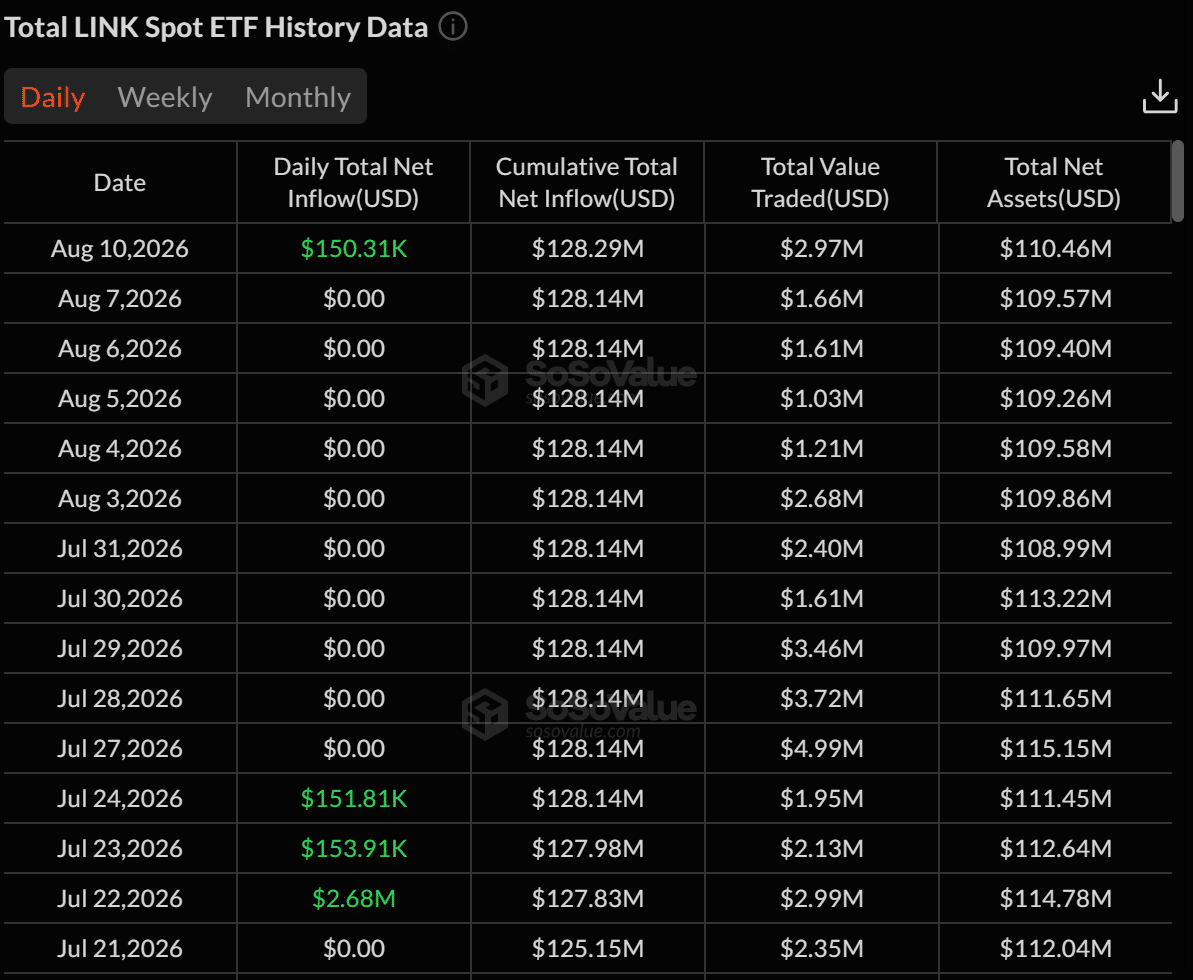
Beyond infrastructure growth, LINK’s market outlook also depends on whether fresh capital is absorbing tokens already available for trading. Spot ETFs added $150,310 on the 10th of August, ending several sessions without net inflows.
Source: SoSoValue
This lifted cumulative inflows to $128.29 million, showing institutional exposure remains intact despite slower recent allocations. Meanwhile, net assets increased to $110.46 million, which adds another layer of demand but remains modest relative to LINK’s market size.
The main implication arises through the interaction between these types of inflows and exchange supply. While ETF inflows persist, if reserves continue to decline, fewer tokens may be readily available to support current demand.
As a result, that could potentially lead to tighter liquidity. Yet, stronger and sustained inflows are still needed to materially influence LINK’s broader valuation.
Final Summary
Chainlink gets a $200 target as Standard Chartered ties its outlook to tokenization growth and rising CCIP activity.
LINK ETF inflows add institutional demand, though current flows remain modest relative to its valuation needs.
MoneyGram, which serves roughly 60 million active customers, views blockchain rails as a way to make cross-border transfers faster, cheaper and easier to track, without requiring customers to think about the technology powering them. Ramps fits into the vision as it connects digital assets into MoneyGram’s extensive brick-and-mortar network to help everyday customers turn tokens into local cash.
“The future of payments is built on access,” MoneyGram CEO Anthony Soohoo said in a statement. “Bringing MoneyGram Ramps to Solana is another step toward building a truly open, global payments network.”
MoneyGram has spent several years building connections between its traditional payments network and crypto. In 2022, it rolled out a service with the Stellar Development Foundation that allowed users to move between cash and Circle’s USDC stablecoin through its retail network, giving crypto wallets a physical entry and exit point for digital dollars.
The firm took that strategy further in June, announcing MGUSD, its own dollar-backed stablecoin issued by Bridge, the stablecoin infrastructure company owned by Stripe, on the Stellar XLM$0.1602 network.
The company has also been deepening its ties with Solana, becoming a validator in June, helping process and secure transactions on the network.
MoneyGram was also listed as a one of the partners in Open USD, the Stripe-led stablecoin initiative that aims to share revenue with a consortium of backers.