Two Prime’s loan to MARA carries a fixed interest rate of 7.65% and matures in August 2028. Blume said borrowing demand has increased in recent months, with institutions tapping bitcoin holdings to finance capital expenditure while retaining exposure to the asset.
The structures are also becoming more sophisticated. Recent regulatory filings show agreements with detailed provisions covering margin calls, collateral custody and liquidation, alongside a wider range of loan sizes and maturities.
Lenders including Ledn and Kraken have also expanded the market through asset-backed securities and warehouse facilities linked to bitcoin collateral, according to Blume.
The development could have implications beyond bitcoin lending as more financial assets move onto blockchain-based infrastructure.
“This core competency will grow increasingly relevant as the broader financial system comes on-chain,” Blume said, pointing to tokenized equities as one potential area of growth.
As more publicly traded companies add bitcoin to their balance sheets, the ability to borrow against those holdings is emerging as an increasingly important part of digital-asset corporate finance.
Hong Kong is considering extending planned tax reforms for the investment industry to proprietary trading firms such as Jane Street and Citadel Securities, the Financial Times has reported.
The move is part of the city’s broader effort to strengthen its standing as a global financial centre after several years of subdued activity.
It also comes as Hong Kong competes with Singapore, New York and Miami for high-end financial talent.
According to two people familiar with the process, cited by the FT, officials are weighing changes to proposed legislation so that employees at proprietary trading firms would not be taxed on performance-related pay.
Another option would be to issue guidance clarifying that traders qualify for the tax break, rather than make late amendments to the bill now before the legislative council.
The people added that any relief may not extend to all proprietary trading firms.
The bill was introduced in June with the aim of “attracting more funds and family offices to establish a presence in Hong Kong”.
The proposed changes have already drawn attention in Singapore, where policymakers are considering their own tax reductions amid concerns that some portfolio managers could shift to Hong Kong.
Proprietary trading firms differ from traditional asset managers because they trade using their own capital, or money from employees, rather than investing on behalf of pension funds, governments or wealthy individuals.
More broadly, Hong Kong is proposing to allow gains from a wider range of investments to be treated as carried interest for tax purposes, instead of limiting that treatment to private equity transactions.
If approved, the changes would apply across hedge funds, private equity, venture capital, private credit and family offices, giving firms more scope to structure themselves in ways that reduce their Hong Kong tax liabilities.
One person familiar with the proposals had previously described them to the FT as a “big bang of tax reforms”.
The plans are being discussed as Hong Kong recovers from a lengthy slowdown in dealmaking linked to the democracy protests and the Covid-19 pandemic.
Its IPO market has recently regained momentum, helped by a rise in listings by Chinese companies including CATL and Zhongji Innolight, as well as the return of many expatriates.
According to a Boston Consulting Group (BCG) report in May, Hong Kong became the world’s largest cross-border wealth hub in 2025, surpassing Switzerland for the first time.
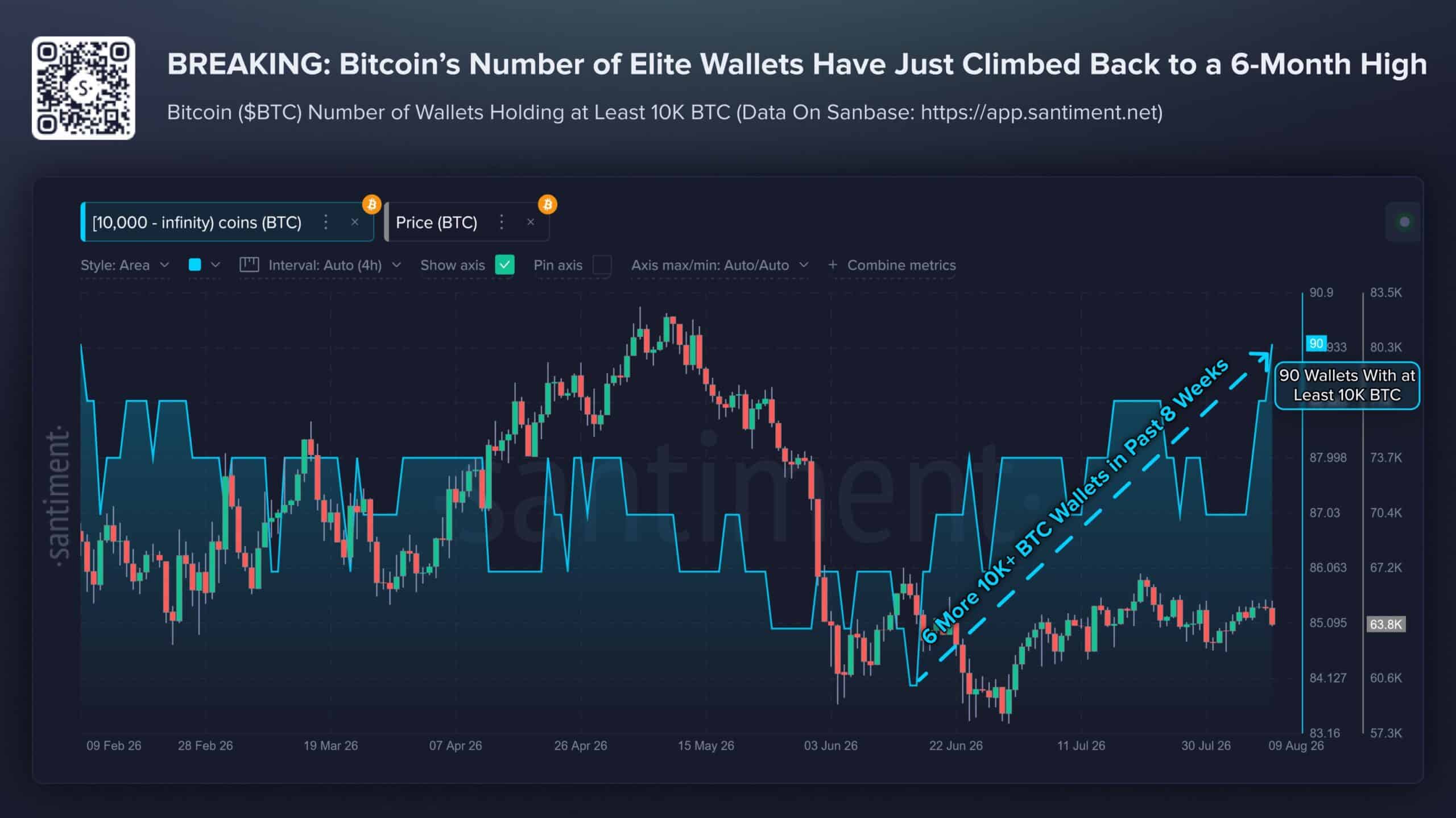
Bitcoin’s elite wallet count reached a six-month high as larger holders expanded their share of the circulating supply.
Santiment analytics recorded 90 wallets holding at least 10,000 BTC, highlighting renewed concentration among Bitcoin’s largest addresses.
Source: Santiment
Notably, the cohort gained six wallets during the previous eight weeks, representing a 7.1% increase.
Meanwhile, micro-wallet holdings declined during August, creating a widening divergence between larger and smaller participants.
Therefore, Bitcoin’s supply distribution increasingly favored stronger hands ahead of the next major price fluctuation.
Rising whale representation supported an accumulation interpretation because fewer coins remained distributed across smaller holders.
However, concentration alone could not guarantee higher prices. BTC still needed stronger technical confirmation before the supply shift could support a sustained bullish advance.
Falling NVT added another bullish layer
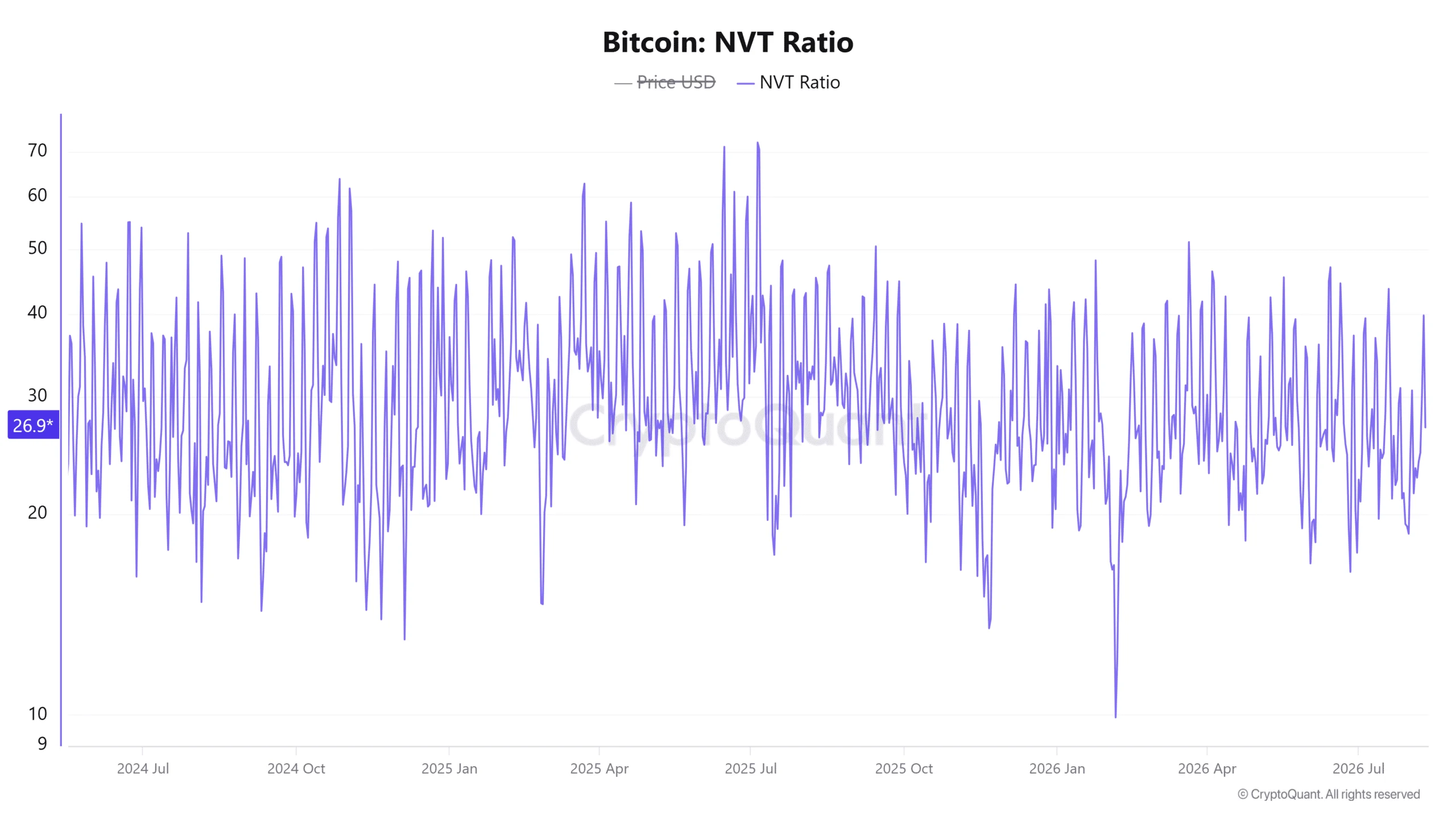
Beyond wallet distribution, Bitcoin’s network valuation picture improved as the NVT ratio fell 32.11% to 26.9998.
The decline reduced the gap between Bitcoin’s valuation and the transaction activity supporting that valuation.
A falling NVT generally indicated transaction value had strengthened relative to the network’s overall valuation.
Therefore, the latest decline complemented the growing presence of elite wallets rather than contradicting the accumulation narrative.
Importantly, this metric added a network-based dimension to the supply concentration trend.
Whale growth alone reflected ownership changes, while NVT captured Bitcoin’s valuation relative to transferred value.
Together, both readings strengthened the bullish case from separate angles.
Nevertheless, price still needed to escape its existing range before these underlying improvements could influence the broader market structure decisively.
Source: CryptoQuant
Can Bitcoin reclaim $65,551 next?
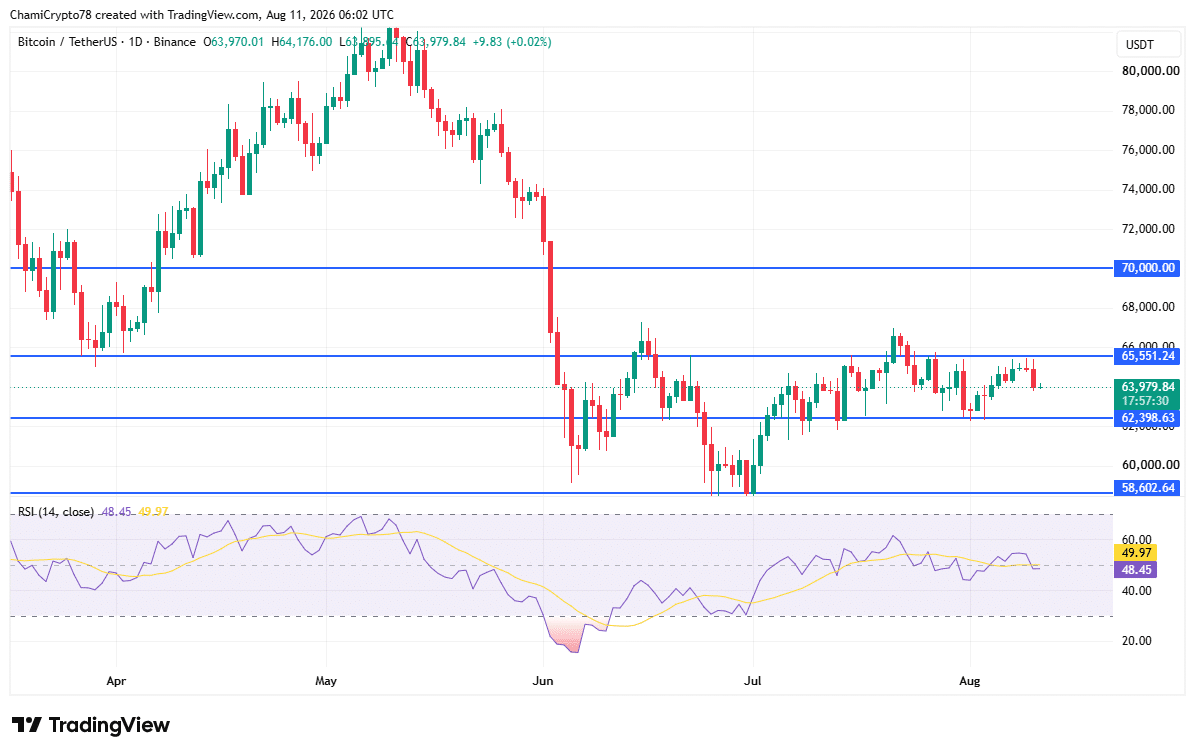
Bitcoin [BTC] price action remained compressed between $62,398.63 support and $65,551.24 resistance, keeping Bitcoin’s immediate direction unresolved.
Buyers repeatedly defended the lower boundary after BTC recovered from the deeper $58,602.64 support region.
However, repeated rejection around $65,551 prevented buyers from converting that recovery into a confirmed breakout.
The RSI reached 48.45, while its average stood slightly higher at 49.97.
Those readings placed BTC near neutral territory, matching the sideways structure rather than establishing strong directional control.
A decisive $65,551 recovery would strengthen the route toward the major $70,000 resistance area.
Alternatively, renewed weakness beneath $62,398 would expose the recovery structure to another test.
Such a breakdown could redirect BTC toward $58,602 despite improving whale concentration and network valuation conditions.
Source: TradingView
Liquidity puts Bitcoin’s range under pressure
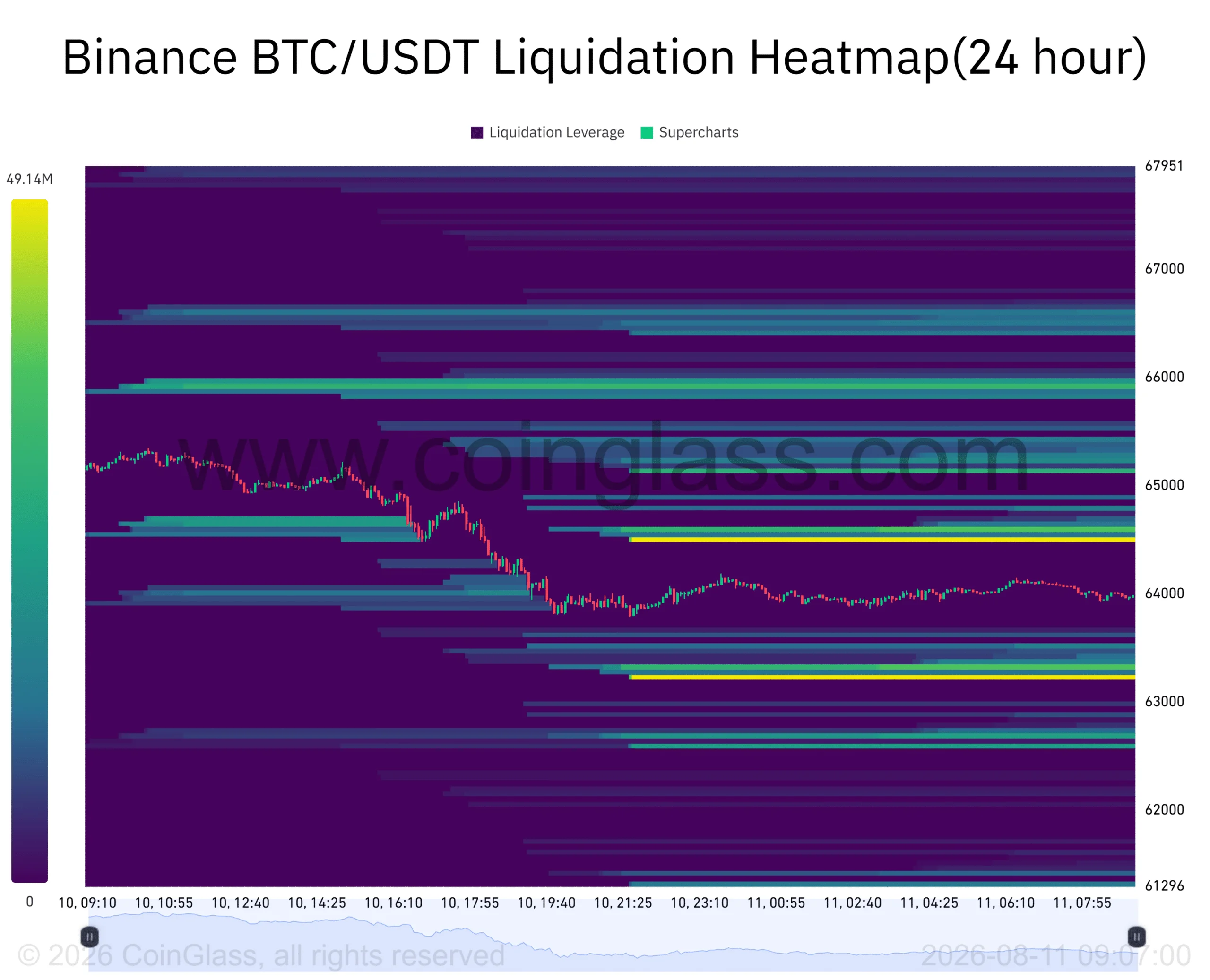
Liquidation liquidity added another pressure point around Bitcoin’s narrowing range, with substantial concentrations sitting above and below the price.
The strongest nearby upside bands developed around $64,500 to $66,000, placing considerable liquidity near the technical resistance zone.
Meanwhile, another prominent concentration emerged around $63,200 to $63,400, immediately below the prevailing market area.
Particularly dense liquidity appeared near $64,500 and $63,300, creating competing zones around BTC’s consolidation.
Yet the upside concentration overlapped more closely with Bitcoin’s $65,551 resistance, making that region especially important for buyers.
A push through nearby liquidity could intensify price movement toward $65,551 and potentially open the $70,000 region.
However, losing the lower liquidity zone could instead increase pressure toward the $62,398 support.
Source: CoinGlass
Final Summary
Bitcoin supply increasingly shifted toward elite wallets as smaller holders continued losing share.
Whale concentration favored bulls, but BTC still needed to reclaim $65,551 convincingly.
ADI Chain’s job is to turn those deals into blockchain tokens and handle payments using stablecoins (digital tokens pegged 1-to-1 to real currencies like the UAE dirham or the U.S. dollar), so money moves instantly without a traditional bank wire. For now, this is aimed at “qualified institutional participants,” or large, vetted investors, not everyday retail buyers.
Shipfinex CEO Capt. Vikas Pandey said the partnership would let the company “create a regulated digital route into this market, with every instrument tied to a real vessel, its economics and its legal structure.”
No maritime asset tokens have been issued yet and Shipfinex doesn’t yet have a green light to do so. Its regulatory clearance from Dubai’s Virtual Asseets Regulatory Authority is an “In-Principle Approval” — a preliminary thumbs-up confirming it has passed an initial background check, not a finished license to operate.
Nevertheless, Shipfinex has earmarked around 35 vessels worth about $500 million combined as candidates for tokenization, once the regulatory approval and deal structure are finalized. Each ship will eventually sit in its own separate legal entity, so if one ship runs into financial trouble, it doesn’t drag down investors in the others.
Buying a token, once one becomes available, could mean one of a few different things for the institutional investors, depending on how each deal ends up being structured. It could mean a loan backed by the ship (similar to earning interest on a loan), a share of the money the ship earns from shipping contracts, or a broader economic stake in the vessel’s value.
If you’re looking to supercharge your savings, a high-yield savings account can provide a competitive interest rate to help your balance grow faster.
However, not all banks offer high savings account rates, which is why it’s important to shop around and find the most competitive savings interest rates available.
Read on to learn more about where to find the best savings interest rates today.
Where to find the best savings interest rates today
Today, Monday, August 10, 2026, the highest savings account rate available from our partners is 4.15% APY. This rate is offered by Forbright Bank.
Here is a look at some of the best savings rates available today:
How much interest can I earn with a high-yield savings account?
The amount of interest you can earn from a savings account depends on the annual percentage rate (APY). This is a measure of your total earnings after one year when considering the base interest rate and how often interest compounds (savings account interest typically compounds daily).
Say you put $1,000 in a savings account at the average interest rate of 0.38% with daily compounding. At the end of one year, your balance would grow to $1,003.81 — your initial $1,000 deposit, plus just $3.81 in interest.
Now, let’s say you choose a high-yield savings account that offers 4% APY instead. In this case, your balance would grow to $1,040.81 over the same period, which includes $40.81 in interest.
The more you deposit in an HYSA, the more you stand to earn. If we took our same example of a high-yield savings account at 4% APY, but deposited $10,000, your total balance after one year would be $10,408.08, meaning you’d earn $408.08 in interest.
Deposit account rates — including savings rates — are tied to the federal funds rate. This is the target interest rate set by the Federal Reserve; when it increases its target rate, deposit account rates usually increase. Conversely, when the Fed lowers its rate, deposit rates fall.
Savings account interest rates have fluctuated quite a bit over the past couple of decades. From 2010 to about 2015, rates were rock-bottom, hovering between 0.06% and 0.10%. This was largely due to the 2008 financial crisis and the Federal Reserve‘s decision to lower its target rate to near zero in order to spur economic growth.
From 2015 to 2018, interest rates gradually increased. However, they remained low by historical standards. Then, the onset of the COVID-19 pandemic in 2020 led to another sharp decrease in rates as the Fed cut rates again to stimulate the economy. This brought average savings interest rates down to new lows, around 0.05% to 0.06%, by mid-2021.
Since then, savings account rates have recovered considerably, largely driven by the Fed’s interest rate hikes in response to skyrocketing inflation. However, the Fed finally lowered the federal funds rate toward the end of 2024 and continued to do so throughout 2025. As a result, deposit rates have steadily declined. So far in 2026, the Fed has kept rates unchanged
Is now a good time to put your money in a high-yield savings account?
Choosing where to put your money is an important decision, and there are a few factors you should consider when evaluating your options. A high-yield savings account could make sense if you’re looking for a secure place to hold shorter-term savings while earning a solid return.
Here are a few key considerations:
Interest rates: One of the most important features of a savings account is the interest rate. It’s important to shop around and compare the best offers to ensure your money will grow over time. Considering that savings rates will likely drop in the near future, opening a high-yield savings account now will allow you to take advantage of historically high rates.
Goals: Today’s high-yield savings accounts offer rates we haven’t seen in more than a decade. That said, savings rates still don’t match average returns for the stock market. If you’re saving for a long-term goal like retirement, a savings account probably isn’t the best place to put your money, since your balance won’t grow at a pace that will allow you to reach your target. However, if you’re saving for a financial emergency, a down payment on a home or car, holiday gifts, or another short-term goal, a savings account is a great place to hold those funds.
Accessibility: Certain types of accounts and investments may provide higher returns than a savings account, but may make it difficult to access your funds in a pinch. For example, if you put your savings in a certificate of deposit (CD) and need to access the money before the maturity date, you could be subject to an early withdrawal penalty. So, if you want to be able to dip into your savings as needed, a high-yield savings account is likely the better choice.
Security: In most cases, savings accounts are insured by the FDIC up to the federal limit. They also can’t lose money due to fluctuations in the market, making them a low-risk option.
Do online banks have the best savings account rates?
Online banks operate exclusively via the web. This significantly reduces their overhead costs, so they’re able to pass those savings onto customers in the form of high deposit rates and low fees. In fact, many of the best high-yield savings accounts also come with zero monthly fees or minimum opening deposit requirements. If you’re searching for the best savings interest rates, online banks are a great place to start.
That said, online banks aren’t the only place you can find savings accounts with rates that range between 3% and 4% APY. Credit unions are not-for-profit financial cooperatives known for offering competitive rates and fewer fees. Many credit unions have requirements that must be met to become a member, though some allow just about anyone to join.
How to open a high-yield savings account
The requirements involved in opening a savings account vary by financial institution. However, if you’re ready to open an account, you can follow these general steps:
Research savings account rates: Of course, when choosing a savings account, one of the most important factors to evaluate is the interest rate. Be sure that you select a savings account with a competitive rate to help your money grow.
Figure out your must-haves: Although savings account interest rates should be top of mind, that’s not the only factor to consider. You’ll also want to think about what else you need from your account, whether it’s no minimum-balance requirement, low fees, or other perks. Finding a savings account with a solid rate that also helps you achieve your goals is key.
Prepare documentation: Opening a bank account requires you to provide a few important personal details and documents. Before you start your application, be sure you have your Social Security number, driver’s license or passport number, and proof of address.
Fill out the application: In many cases, you can apply for a savings account online. However, some financial institutions may require you to visit the branch in person to apply. Either way, the application for a new savings account should only take a few minutes to complete. In many cases, you’ll get your approval decision instantly.
Fund your account: Once your savings account application is approved, you’ll need to add funds to the account. Be sure you’re aware of any minimum opening deposit requirements and the timeline for funding.
A high-yield savings account is a good fit if you want to earn a competitive return on money you’ll need in the near future while keeping it safe and accessible. It’s important to not only consider whether the interest rate is attractive, but whether the account matches the purpose of your savings.
An HYSA may be right for you if…
You want to maximize your emergency fund.
You’re saving for a goal within the next one to five years.
You have extra cash sitting in a low-interest checking or traditional savings account.
You prioritize safety over higher potential investment returns.
You don’t need to write checks or use the money for everyday spending.
An HYSA may not be the best choice if…
You’re investing for retirement or another goal that’s 10+ years away. Investing in a diversified portfolio has historically produced higher long-term returns, though with greater risk.
You won’t need the money for a fixed period. If you can leave your savings untouched for several months or years, a certificate of deposit (CD) may offer a higher guaranteed yield.
You need frequent access to your money. A checking account is more convenient for paying bills and making everyday purchases.
After trading within a thin margin, ASTER finally found an upside footing and flipped the $0.6 resistance into support. In fact, the altcoin rose to a two-week high of $0.169 before retracing.
At the time of writing, ASTER was trading at around $0.607, marking a 1.05% hike on the daily charts. Over the same window, the altcoin’s trading volume climbed by 49% to $56 million, hinting at renewed market interest.
Aster team burns $1.74 million worth of ASTER
With Aster-DEX [ASTER] regaining some upside pressure and defending key levels, the team offered more incentives to the market.
The Aster team has continued to deploy its main deflationary mechanism. According to Onchain Lens, it burned 2.85 million tokens worth $1.74 million.
Source: Onchain Lens
After the same, the cumulative burns rose to 188.87 million tokens, worth approximately $114.6 million or 3.78% of the token supply. Often, token burns reduce token supply. These boost scarcity, a prelude to better price performance.
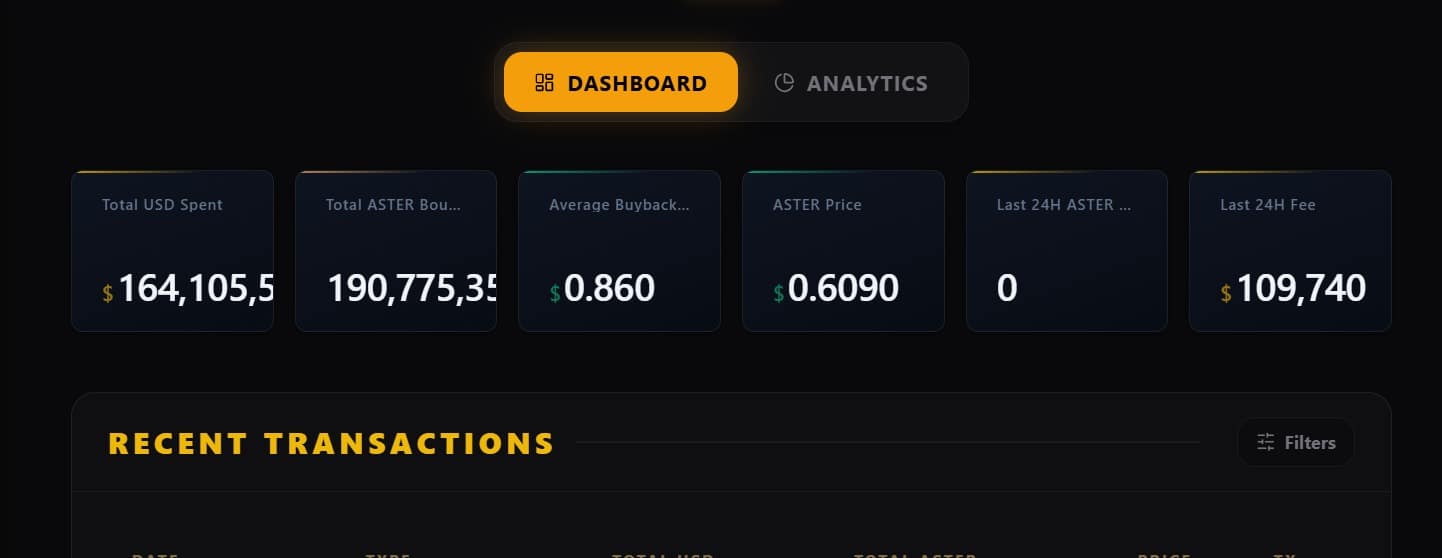
However, although the team resumed the token burns, they have slowed down significantly on buybacks. For example, Asterlify did not record any major token buybacks over the past month or any buyback over the last 24 hours.
Source: Asterlify
According to Asterlify, the team did not purchase any tokens over the said period and only recorded $106K in fees.
It seems the Aster team has scaled back on token buybacks because the ecosystem is not generating significant revenue. Low revenue means no money to deploy on this front.
With the altcoin having previously relied on buybacks and burns for stability, the slowdown has left it exposed to market pressure.
Why is the market rising though? Can it hold?
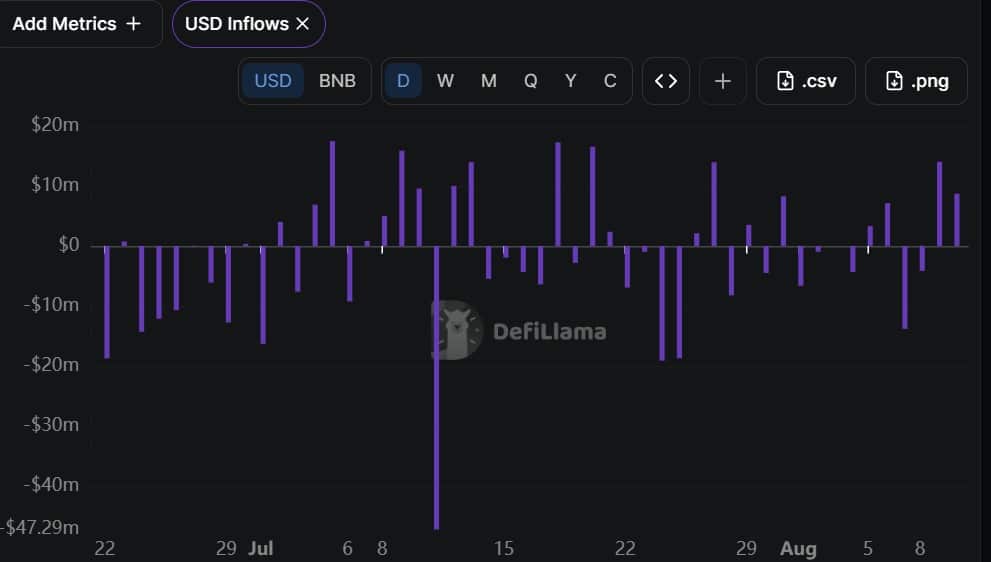
Although Aster has slowed down on buybacks, the market and ecosystem demand have recovered significantly. On the ecosystem’s side, Aster recorded positive USD inflows for two consecutive days, after seeing net USD outflows earlier.
Source: Defillama
Over this period, the network saw $22.7 million in USD Inflows. Positive USD inflows are evidence of more capital flowing into the protocol as more users engage.
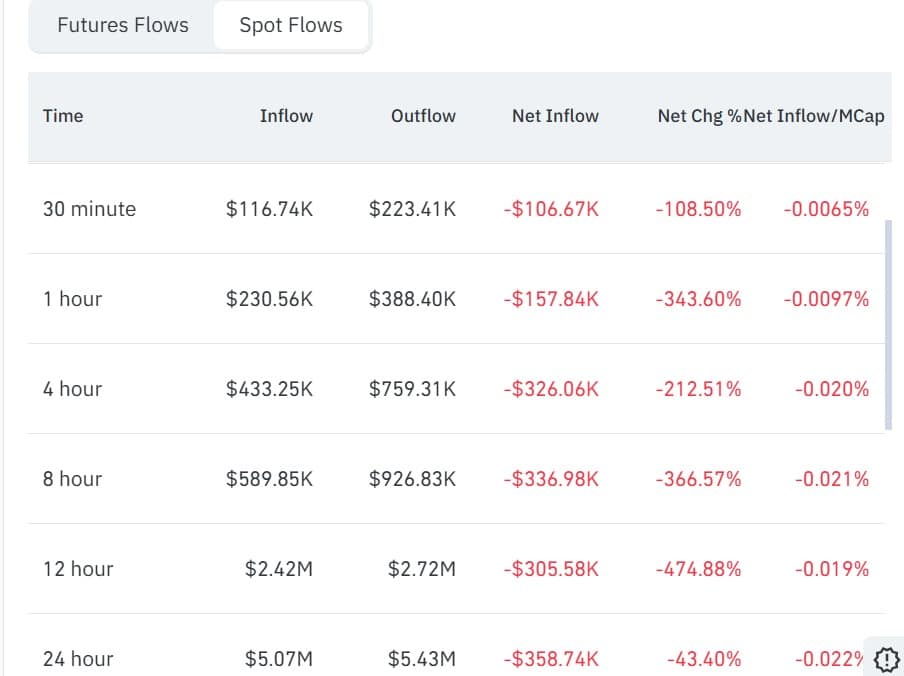
That’s not all though as on the spot front, buyers also stepped in. Over the last 24 hours, the altcoin saw $5.43 million in Spot outflows compared to $5.07 million in Inflows.
Source: Coinglass
As a result, the Spot Netflow fell 43% to -$358K, extending a week-long trend. This alluded to an uptick in market demand and potentially seller exhaustion.
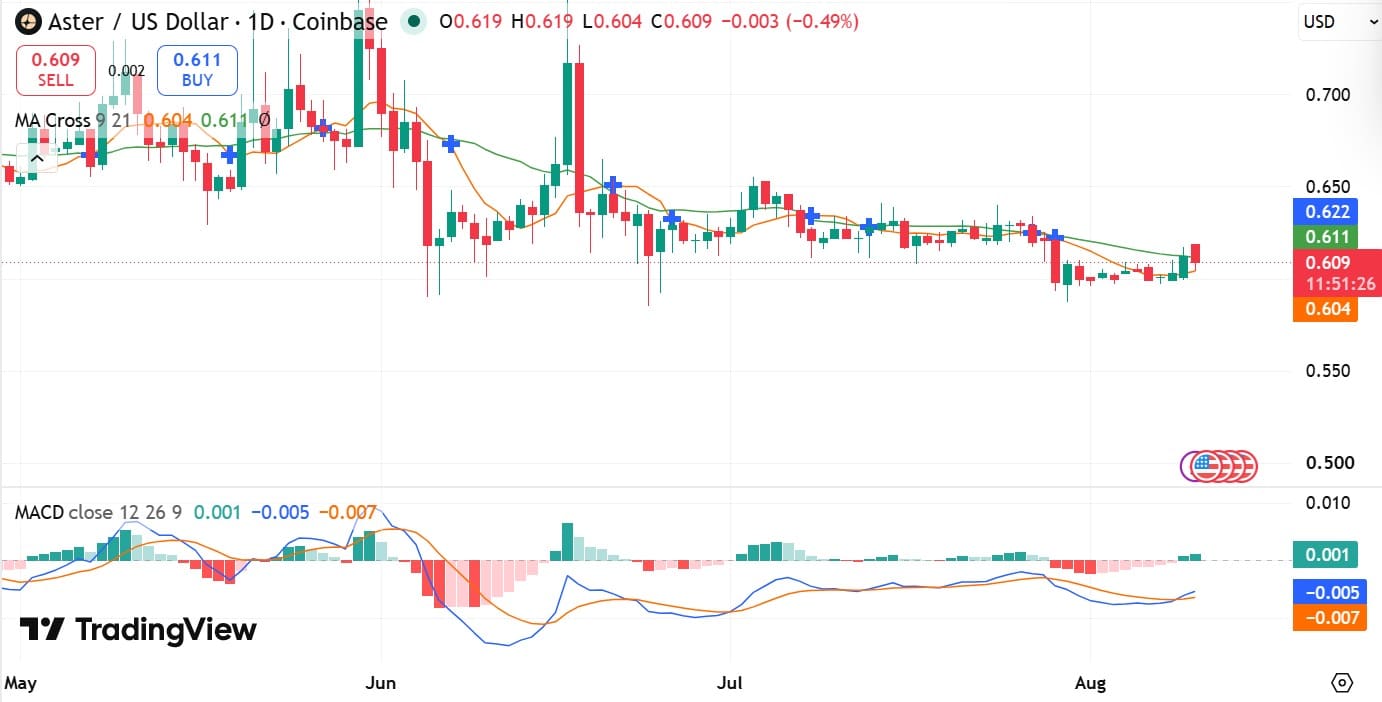
As a result of this recovering demand, the upside momentum has been gradually strengthening. A look at the MACD indicator seemed to confirm this view too.
Source: TradingView
For instance, the MACD made a bullish crossover and rose to -0.006. Despite the crossover, it still held within the negative zone and pointed to a weak trend.
Likewise, the altcoin also flipped both the 9 and 21-day MAs, indicating strong short-term momentum. These market conditions hinted at the likelihood of ASTER making some gains.
If demand holds and is boosted by recent token burns, ASTER will likely hold $0.6 and target a move above $0.64.
Final Summary
Aster burnt 2.85 million ASTER worth $1.74 million, extending total burns to 188.87 million ASTER.
Aster-dex [ASTER] hiked to a two-week high, flipping $0.6 resistance to support amid recovering market demand.